


One of the most effective television ads to air during the 2016 campaign season was a spot created for Bernie Sanders’ unsuccessful primary run. The ad, titled “America,” is striking for its minimalistic style. It is 60 seconds long, but aside from a legally required statement in the final three seconds (“I’m Bernie Sanders, and I approve this message”), it includes no narration whatsoever. No list of accomplishments, no policy statements, and no criticism of his opponents. Instead, there are fleeting shots of regular-looking people cheering and high-fiving during Sanders campaign events, interspersed with a mélange of Americana: farmers milking cows, boats in a harbor, and so forth—all set to an uplifting Simon and Garfunkel melody. Although the ad offers no explicit reasons whatsoever for why the viewer should support Sanders, a professional analysis of viewer reactions dubbed “America” to be “the ad that moved people the most” (Vavreck Reference Vavreck2016).
“America” is an extreme example, but few people would dispute that campaign ads are routinely thin on substance—and the academic literature agrees (e.g., Kaid and Johnston Reference Kaid and Johnston2001). Still, the scholarly understanding of how messaging elements beyond substance work remains minimal. For many years, research focused primarily on framing effects—the capacity of political messages to make some substantive considerations more salient than others are (e.g., Chong and Druckman Reference Chong and Druckman2007a). This focus certainly captures one important facet of campaign messaging, but as Brader (Reference Brader2006) discusses, it puts aside an array of other psychological mechanisms via which campaign advertisements might be influential. As researchers have begun to systematically study the emotional components of political messaging, they have discovered that music, imagery, metaphors, and other nonsubstantive components of political advertising indeed influence voters in a host of ways (see Brader and Marcus Reference Brader, Marcus, Huddy, Sears and Levy2013 for a review).
Our purpose herein is to increase understanding of how the emotional components of political advertising work. So far, the study of nonsubstantive facets of campaign messaging has relied almost entirely on self-reports—about the emotions citizens experience and their liking for particular candidates relative to others. While critical, this work puts aside an extensive body of research in psychology finding that many aspects of human behavior are influenced by visceral positive and negative reactions that are not conducive to being measured with self-reports—so-called implicit attitudes (e.g., Banaji and Heiphetz Reference Banaji, Heiphetz, Fiske, Gilbert and Lindzey2010). Implicit attitudes appear to have an independent influence on political judgments (e.g., Ryan Reference Ryan2017), and as we discuss below, they might be especially ripe for manipulation via political advertising. As such, the current literature might be missing an entire domain of important campaign effects.
The largest contribution of the studies below is to demonstrate the critical relevance of implicit/explicit attitude dissociation to the enterprise of political persuasion. Each of our tests serves to illustrate that implicit and explicit attitudes can change independently, and in response to different stimuli. As such, this work provides an impetus to revisit a wide array of findings related to political messaging, asking what effects the field might have missed, given its almost exclusive focus on explicit attitudes. Second, we begin to characterize the kinds of campaign messages that move implicit versus explicit attitudes. We find that, while implicit and explicit attitudes are interrelated and many stimuli affect both domains, interventions that increase familiarity with a candidate work primarily by influencing implicit attitudes. Psychologists have observed such “mere exposure” effects going back at least to Zajonc (Reference Zajonc1968). The contributions of this manuscript are (1) to show that mere exposure effects act primarily on implicit rather than explicit attitudes and (2) to elucidate the important role that familiarity effects and implicit attitudes play in the context of political campaigning. For instance, as we discuss in our conclusion, the patterns we uncover may point to a key psychological mechanism that makes common low-information campaign tools (such as lawn signs) effective.
This slate of studies is also distinctive in that it reflects a gradual change in our thinking. At the outset, we subscribed to a framework that is prominent in psychology: the associative-propositional evaluation (APE) model (Gawronski and Bodenhausen Reference Gawronski and Bodenhausen2006; Reference Gawronski and Bodenhausen2014). However, our initial tests did not support this model. Instead, they seemed consistent with the “mere familiarity” effects we allude to above. Thus, we put the APE model aside, and developed new experiments focused on testing mere familiarity relationships, finding support. We documented this evolution in our thinking in five distinct preregistration documents. Because these documents clarify the theoretical focus of each test and what we learned from it, this series of studies illustrates how commitment to routine preregistration helps researchers understand and communicate research findings—including for studies where predictions are not borne out.Footnote 1
Implicit and Explicit Attitudes
The distinction between implicit and explicit attitudes relates to the two-part process that psychologists believe characterizes human mental evaluations (Sherman, Gawronski, and Trope Reference Sherman, Gawronski and Trope2014).Footnote 2 First, when a person encounters an attitude object (another person, a kind of food, or almost anything else), one set of mental processes rapidly draws on associations in memory and generates positive or negative affect. These processes are termed “automatic” because they are distraction-proof: they occur irrespective of motivation and any concurrent mental processes (Bargh and Chartland Reference Bargh and Chartrand1999). Second, a separate set of mental processes forms an evaluation. These processes are termed “controlled” because they engage higher-order cognition and have the potential to revise the automatic response (Olson and Fazio Reference Olson, Fazio, Petty, Fazio and Briñol2008).
Answering a survey question requires higher-order cognition.Footnote 3 For this reason, self-reports by definition capture evaluations that have been influenced by the controlled processes (Gawronski and Bodenhausen Reference Gawronski and Bodenhausen2007, 691). To capture more visceral responses before they are influenced by higher-order mental processes, psychologists devised several measures of implicit attitudes (see Petty, Fazio, and Briñol Reference Petty, Fazio and Briñol2008 for an overview). The most popular of these is the Implicit Association Test (IAT; Greenwald, McGhee, and Schwartz Reference Greenwald, McGhee and Jordan1998). The IAT is a latency-based measure in which subjects are asked to associate objects from categories of interest to a researcher (e.g., cans of Coke vs. cans of Pepsi) with positive and negative words. By examining the speed with which subjects make these classifications across several trials, it is possible to determine whether they have stronger visceral positive associations with one category (Coke) than the other (Pepsi).Footnote 4
When measured within the same individual, implicit and explicit attitudes are routinely correlated with each other—but not to the extent to be considered different manifestations of one mental construct. The correlations vary by attitude domain, but they typically range from r = 0.10 to r = 0.54 (Greenwald et al. Reference Greenwald, Poehlman, Uhlmann and Banaji2009, Table 3; see also Greenwald and Nosek Reference Greenwald, Nosek, Petty, Fazio and Briñol2008). This divergence is significant, as it opens up the possibility that each class of attitude might predict behaviors that the other does not.
And so it seems they do. Across dozens of studies, in almost every instance in which implicit and explicit measures are used to predict the same behavior simultaneously, each has incremental predictive validity relative to the other (Greenwald et al. Reference Greenwald, Poehlman, Uhlmann and Banaji2009). Put another way, this research suggests that implicit and explicit attitudes may have separable effects on behavior. Characterizing which behaviors are governed by implicit versus explicit attitudes remains a vibrant area of research. There is some evidence that implicit attitudes predict “uncontrolled” behaviors better—spontaneous, nondeliberative, nonverbal actions such as physical posture (Dovidio, Kawakami, and Gaertner Reference Dovidio, Kawakami and Gaertner2002; Quillian Reference Quillian2008), though this pattern might be limited to socially sensitive topics, such as race and discrimination (Greenwald et al. Reference Greenwald, Poehlman, Uhlmann and Banaji2009, 30). In the political domain, there is evidence that implicit attitudes about candidates and parties predict voting decisions, policy support, and biases in the processing of political information—though the significance of implicit attitudes might depend on the intensity of explicit attitudes (Lundberg and Payne Reference Lundberg and Payne2014; Pérez Reference Pérez2016; Ryan Reference Ryan2017).
Research on the political consequences of implicit attitudes should continue, but our objective herein is to make progress in a separate research area: the ways in which elites can use political messages to manipulate implicit attitudes. Research on the antecedents of implicit attitudes is far less extensive than research on consequences—both in the study of political behavior and in psychology more generally.Footnote 5 Yet, if we are to comprehend what role implicit attitudes play in the broader political system, a crucial part of the account will be to characterize what tools political actors can use to influence implicit attitudes. We next turn to what the research in social and cognitive psychology has to say on this matter.
Associative and Propositional Routes to Attitude Change
Implicit attitude change, as well as its relationship to explicit attitude change is an active area of research in psychology. There are several competing theoretical models, though also some points of consensus (Cone, Mann, and Ferguson Reference Cone, Mann, Ferguson and Olson2017, for a review). We theoretically ground our investigations by focusing on one model in particular: the APE model proposed by Gawronski and Bodenhausen (Reference Gawronski and Bodenhausen2014). We focused on the APE for two reasons. First, it reflects one important point of consensus: that implicit attitude change is best understood in the dual-process framework, wherein implicit attitudes represent fast, automatic, uncontrolled responses, while explicit attitudes reflect the output of slower, controlled processing. Alternatives to the APE, such as the meta-cognitive model (Petty, Briñol, and DeMarree Reference Petty, Briñol and DeMarree2007), still work from the premise that implicit and explicit attitudes arise from two distinct (though potentially interrelated) mental systems.Footnote 6 Second, it is arguably the most prominent model in the literature, and draws on more than a decade of empirical work (Gawronski and Bodenhausen Reference Gawronski and Bodenhausen2006; Reference Gawronski and Bodenhausen2018). This extensive body of research helped us to understand testable implications for political messaging.
The key distinction in the APE model is between propositional and associative mental processes. Propositional processes are a form of higher-order cognition and focus on assessing whether propositions are true or false. To form an evaluation, the brain assesses the truth value and logical interrelationship of propositions relevant to the judgment at hand. For instance, a person would be engaged in propositional thinking if she reasoned, “Higher taxes on corporations are desirable. Bernie Sanders favors higher taxes on corporations. Therefore, I should support (or be more likely to support) Bernie Sanders.” The end result of reasoning like this, the APE posits, is what explicit attitude measures capture.
Where propositional processes focus on truth and falsity, associative processes focus on positivity and negativity. As people interact with the world, the stimuli they encounter bring to mind the feelings, positive and negative, that previously co-occurred with similar stimuli—the principle that neurons that “fire together, wire together.”Footnote 7 For instance, a person who has previously had favorable interactions with dogs will, upon seeing a new dog, experience positive affect, as for this person “dog” is associated with positive experiences such as cuddling on a couch. But a person who has been bitten by a dog in the past might have a contrary response, as the stimulus would evoke memories of pain and fear. Importantly, these two people might still agree on the truth or falsity of a specific proposition, such as “this particular dog is friendly.” Associative processing helps explain why they might have very different gut reactions nonetheless.
Where propositional processing is costly (in terms of cognitive resources) and is posited to occur only when a person has sufficient motivation, associative processing occurs quickly and automatically, irrespective of motivations. Following this reasoning, Gawronski and Bodenhausen argue that implicit attitude measures capture the outputs of associative processes—gut responses that have not yet been refined by higher-order cognition.
The APE Model also provides guidance for how implicit and explicit attitudes change. Because explicit attitudes are based on propositional reasoning, they should change in response to seemingly valid information and arguments—things that cause a person to accept new premises that are relevant to a judgment. Moreover, explicit attitudes can potentially change rapidly, such as if new information sharply undermines the previous basis for a judgment. For example, suppose that a Democrat saw a political activist with a red baseball cap and white lettering that appeared to be Donald Trump’s “Make America Great Again!” slogan. The person would likely reason that the activist is a Trump supporter and dislike him. But suppose that upon closer inspection, the lettering turned out to be a parody, saying, “Make Obama President Again!” The construal of the activists’ political loyalties would change drastically, and explicit attitudes about him likely would as well.
Where the APE Model sees explicit attitude change as grounded in the assignment of truth values, it sees implicit attitude change as grounded in associations built up via conditioning—the pairing of a stimulus and a positive or negative response. Appraisals about truth are beside the point here; what are relevant are patterns. Researchers commonly use “evaluative conditioning” to induce implicit attitude change—pairing attitude objects like “youth” and “elderly” with positive and negative words on a computer screen, for example, can affect the valence associated with these characteristics (Karpinski and Hilton Reference Karpinski and Hilton2001). There are no claims here about what old and young people are like—just the pairing with either positive or negative experiences.
The APE Model suggests that a single stimulus might have very different effects on implicit versus explicit attitudes, depending on the inferences and associations a person draws from the stimulus. For instance, in one test, participants underwent a procedure in which a neutral stimulus (a fictional creature) appeared on a computer screen two seconds before the end of an unpleasant sound (horrified screaming). This procedure caused explicit attitudes toward the creature to improve—presumably because the participants reasoned that the appearance of the creature caused an end to the sound. But it simultaneously caused implicit attitudes toward the creature to worsen—presumably because the creature appeared while a sound was causing an unpleasant feeling (Moran and Bar-Anan Reference Moran and Bar-Anan2013).
In sum, the APE is a promising theoretical perspective with a substantial evidence base in pure psychology. It posits implicit and explicit attitudes to change via independent routes, one focused on positive and negative associations and other focused on assessments of truth and falsity. These premises might clarify how political practitioners use different communication tools to influence separate (but both important) attitudes that guide citizen behavior. However, APE’s implications for political messaging strategy have not been directly tested. We begin our investigations with a study focused on one provocative implication of the APE Model as it might manifest in a political context.
Study 1: How Does Emotional Content Affect Implicit and Explicit Attitudes?
As we discuss above, the APE model posits that explicit attitudes change in response to information that can be assessed as true or false, whereas implicit attitudes change when a stimulus is paired with positive or negative experiences. Applied to political communication, a reasonable interpretation of these propositions is that the informational content in a campaign message acts primarily on explicit attitudes, while the affective content in the message acts primarily on implicit attitudes. Study 1 tests these ideas. We exposed participants to advertisements where the information provided by the ad was held constant but the affective content varied. As we document in our preregistration (available in the Supporting Information), our expectation was that high-quality affective content would improve implicit attitudes. Because the advertisements used provided almost nothing by way of substantive political information that could be used to gauge a candidate’s political positions or likely behavior, we also predicted null effects on explicit attitudes.
Procedures. Testing the expectation above required exposing participants to ads that varied in terms of the emotions they induce but not the information they provide. To create such ads, we follow the basic strategy used by Brader (Reference Brader2006) as well as Albertson and Gadarian (Reference Albertson and Gadarian2015): we created political advertisements that had an identical script but varied in terms of other audiovisual elements (music and imagery). The audiovisual component is what we use to manipulate the affective content of the advertisement.
Creating advertisements suitable for measuring implicit attitudes toward a political candidate presented several additional challenges. One choice we faced was whether to present ads focused on a real or fictional candidate. We opted for a fictional candidate—Mike Harper—because we expected that implicit attitudes about a familiar figure would be more difficult to move (see Gregg, Seibt, and Banaji Reference Gregg, Seibt and Banaji2006) and also because focusing on a fictional candidate allowed us to more tightly control aspects of the advertisements to make for a clean test.
Our objective in writing a script for our advertisement was to fill time with a realistic narration but provide as little actual substantive information relevant to a vote choice as possible, thus making experimental participants who saw an ad and control group participants who saw no ad as comparable as possible in terms of the information they received about Mike Harper. Reviewing real advertisements provided plenty of examples of pap and pablum to fill this role. We wrote a script—included as SI Section 2—in which Mike Harper offers some bland biographical details—he worked at a hot dog stand in the town where he grew up and believes in hard work—but takes no explicit policy positions. He bemoans dysfunction in Washington but does not blame one political side over the other and does not mention his own partisanship. We found it impossible to scrub script elements that might convey, via stereotypes, some inkling of Harper’s political leanings, but we were careful to balance elements that might be construed as liberalizing with ones that might be construed as conservatizing. For instance, Harper talks about being a teacher (possibly a liberal stereotype), but he also discusses growing up in a small town and being the son of a war veteran (possibly conservative elements). As we discuss in more detail below, the results of an external manipulation check confirm that Harper’s political affinities were ambiguous.
To film the ad, we hired a professional videographer and a local actor to play the role of Mike Harper, as well as local university students to serve as “extras.” We spent two days filming scenes around the local community—outside a local school (ostensibly where Harper works); in a classroom and faculty lounge (also ostensibly at Harper’s high school); and in an author’s living room, kitchen, and car (all ostensibly Harper’s). We required two acceptable takes of each scene. One take, which was destined for the high-quality ad condition, was shot with professional-grade staging, lighting, and delivery. In the other take, destined for the low-quality ad condition, the actor delivered the identical script, but he was positioned against a neutral background in the same environs (usually a nondescript wall), the lighting was more neutral, and his delivery was drier. Although we use the term “quality” for ease of discussion, we underscore that this refers to the visual components within the video, rather than the video itself (i.e., both were equally clear when viewed). Because, as we note above, implicit attitudes are thought to change through the accumulation of positive associations, we filmed ads that were between four and five minutes long.Footnote 8
As we discuss below, the tool we use to measure implicit attitudes toward Mike Harper—an Implicit Association Test (IAT)—relies on words and symbols that can be associated with the candidate. For this reason, we were careful to incorporate four suitable IAT stimuli into the ads—and to make them equally prominent in the low-quality and high-quality ad. The four ad elements designed for incorporation into an IAT were (1) Mike Harper’s face, (2) Mike Harper’s name, (3) Mike Harper’s campaign slogan (“Start small, go far”), and (4) Mike Harper’s campaign logo, which prominently features a compass. (In the ad script, Harper says he uses his father’s compass as a campaign logo as a reminder to “stay on course.”) Figure 1 presents still images taken from parallel sections of the low-quality and high-quality ad.
Screen Captures from Campaign Videos

We conducted several instrumentation checks on external samples to verify important properties of the ads we filmed. First, because we hoped to isolate the effect of affective content from partisan and ideological considerations, we ensured that Harper’s political leanings were ambiguous. Second (and more critical), we ensured that Harper’s political leanings were indistinguishable, comparing the low-quality ad with the high-quality ad. (Otherwise, treatment effects would be confounded with something about music and imagery that conveyed political leanings.) Third, we ensured that low- and high-quality ads were comparable in other important respects: equally memorable, equally realistic, and the features we intended to use in the IAT (the slogan and logo) were remembered equally well. Fourth, we confirmed via a post hoc check that viewers actually experienced differing degrees of positive affect while watching the ads, in accordance with our expectations. The ads passed these checks, and we report the relevant results in the SI (Section 3).
For the main study, we incorporated the advertisements described above into a survey instrument. Participants—undergraduates who participated for course creditFootnote 9—began the study by viewing either the low-quality ad, the high-quality ad, or, if randomly assigned to the control condition, no ad at all. Next, participants completed an IAT focused on Mike Harper. The IAT is a common procedure in which implicit attitudes are measured via participants’ response latencies in using keyboard taps to pair target stimuli (items associated with an attitude object of interest, discussed above) with positive and negative words. Across seven blocks, respondents had to pair items related to Mike Harper with either positive words (e.g., joy, love, smile) or negative words (agony, terrible, horrible), with response latencies measured in milliseconds. The order of the pairing (Harper associated first with positive words, or negative) was counterbalanced by a random assignment. The IAT procedure standardly generates a D-score, which is the average response latency (excluding practice rounds) when Harper stimuli are paired with positive words minus the latency when paired with negative words, divided by the pooled standard deviation across all trials.Footnote 10 The IAT standardly measures implicit preference for one target relative to another target, as in Coke versus Pepsi, Democrat versus Republican, or flowers versus insects. Because we did not provide participants with any information about Harper’s political competition, we measured implicit attitudes relative to a neutral target—images of gray shapes. Figure 2 shows the IAT instructions presented to participants.Footnote 11 Measured this way, D-scores about Mike Harper range from -0.985 to 1.280, are roughly normally distributed, have a mean of 0.263, and a standard deviation of 0.452.
Instructions for Implicit Association Test

Immediately after the IAT, participants reported their explicit attitudes toward Mike Harper by answering the question, “How much did you like Mike Harper, the candidate depicted in the ad?”Footnote 12 There were seven response options ranging from “Dislike him a great deal” to “Like him a great deal.” We scale responses such that the most negative feelings toward Harper take a value of 0, the most positive feelings take a value of 1, and other responses take intermediary values. After reporting feelings toward Harper, participants reported perceptions of his political leanings (ideology and partisanship)Footnote 13 and they answered questions measuring respondent demographics.Footnote 14
Participants had one week in which they were allowed to complete the survey instrument, after which this part of the study closed. Two weeks after the initial survey instrument, all participants were invited to complete a follow-up questionnaire—also for course credit. This follow-up questionnaire was much shorter: it simply administered the IAT and explicit liking measures a second time, testing the durability of any effects. Both waves were required for course credit, and attrition from Wave 1 to Wave 2 was low: 94% of participants who completed Wave 1 also completed Wave 2.
We implemented this full paradigm in two separate semesters, in the Fall of 2017 (N = 312) and the Spring of 2018 (N = 158). Because the procedure was the same, and because splitting the data by semester uncovers the same patterns, we pool the administrations in the analyses below, resulting in an N of 470.
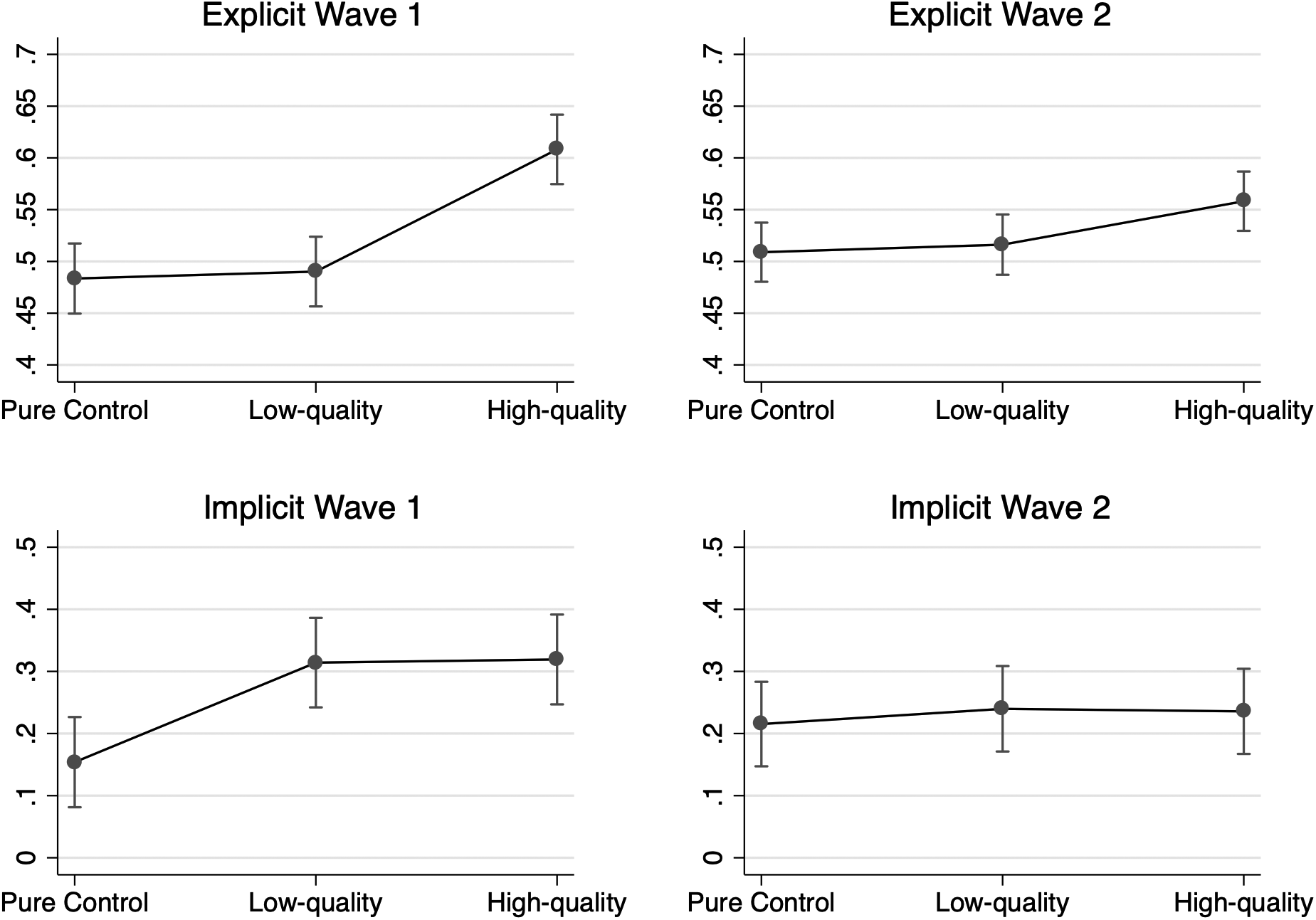
Results. Our primary interest is in how the random assignment influenced implicit and explicit liking of Mike Harper. Figure 3 presents the main results, which are broken down by implicit and explicit measures, as well as survey wave. In Wave 1, the high-quality ad improved explicit attitudes relative to the control (p < 0.001), but the low-quality ad was indistinguishable from the control (p = 0.78). Both ads improved implicit attitudes relative to the control (p < 0.01 for both contrasts). But the low-quality ad was not distinguishable from the high-quality ad (p = 0.92). By Wave 2, the effects for explicit attitudes had become more muted, though the high-quality advertisement was still distinguishable from control (p < 0.02). In Wave 2, no implicit attitude contrasts were statistically significant.
Treatment Effects on Explicit and Implicit Attitudes, Study 1
Note: Explicit attitudes are scaled from 0 = disliking Mike Harper to 1 = liking Harper. Implicit attitudes range from -0.985 to 1.280 in Wave 1 and -0.886 to 1.288 in Wave 2. For implicit attitudes, negative scores reflect implicit dislike of Harper, and positive scores reflect implicit liking. Whiskers represent 95% confidence intervals.

Discussion. This pattern of results does not conform to the preregistered expectations we derived from the APE Model. We predicted no strong effects on explicit attitudes, as the ad provided little substantive information (and identical substantive information in comparing the low- to the high-quality ad). But the high-quality ad substantially improved explicit attitudes. Moreover, although our prediction that the low-quality ad would improve implicit attitudes relative to the control was supported, we also predicted that the high-quality ad would improve implicit attitudes relative to the low-quality ad—a result that did not occur.
Although the APE model was not supported, this test has an important result that underlines the promise in studying implicit attitudes: the treatment conditions moved implicit and explicit attitudes separately. We see this in contrasting the low-quality ad with the control, where implicit attitudes are improved while explicit attitudes remain unchanged. We see the result again in contrasting the high-quality ad to the low-quality ad, as explicit attitudes are improved while implicit attitudes remain essentially unchanged. Thus, we find two clear examples of implicit/explicit attitude dissociation and evidence that the two types of psychological orientations change in response to different influences. A third sign of implicit/explicit attitude dissociation is the greater durability of treatment effects on explicit attitudes that can be seen via the right-hand column. This result is a possible hint that political appeals targeting implicit attitudes require repetition to stick—a point to which we return in our concluding section.
An Alternative to the APE Model: Mere Exposure Effects
After Study 1, we conducted a second test of the APE Model. The advertisement conditions above were crossed with a text-based manipulation providing facts about Mike Harper—an effort to separately manipulate propositional and associational processing about him. We drew participants from Amazon Mechanical Turk (MTurk), providing some ability to extrapolate beyond the university students.Footnote 15 Once again, preregistered expectations derived from the APE Model were not supported. We report this study (Study 2) fully in the SI.
Looking across these two studies, we noticed a pattern: exposure to any advertisement about Mike Harper improved implicit attitudes toward him, relative to a pure control condition (as seen in the bottom-left panel of Figure 3). The same is not true of explicit attitudes. For instance, mere exposure to the low-quality advertisement did not move explicit attitudes in Study 1.
The pattern for implicit attitudes, we realized, is aptly described by a framework with a long history in social/cognitive psychology. In a seminal paper, Robert Zajonc (Reference Zajonc1968) used the term “mere exposure” effects to refer to the tendency for attitudes toward a stimulus to be enhanced whenever the stimulus becomes “accessible to the individual’s perception” (1). Zajonc had in mind patterns such as the tendency to rate fictional words, jagged polygons, and unknown Japanese ideographs more favorably the more times a person has seen them. In the ensuing years, more than 400 studies would document mere exposure effects in a wide range of contexts (Bornstein and Craver-Lemley Reference Bornstein, Craver-Lemley and Pohl2016), and the principle would become a cornerstone approach in product marketing (e.g., Fang, Singh, and Ahluwalia Reference Fang, Singh and Ahluwalia2007).
Mere exposure effects are more than just a recurrent empirical pattern. There are reasons to expect them to emerge more reliably for implicit than explicit attitudes. Years after noting the phenomenon, Zajonc explicitly connected it to the two-systems framework that was beginning to take hold in psychology. He argued that raw positive or negative affect emerges from a set of mental processes that is both uncontrollable and independent of those associated with effortful thinking. Such attitudes can be enhanced, he thought—even in the absence of information—because certain neurophysiological systems are designed to identify stimuli that, in the past, have not proven to be threatening (Zajonc Reference Zajonc1980). The two-systems framework also would acquire the status of conventional wisdom in psychology (e.g., Kahneman Reference Kahneman2011). For instance, it undergirds Petty and Cacioppo’s elaboration likelihood model of persuasion, which describes a peripheral route to persuasion in which attitudes change “without necessitating scrutiny of the true merits of the information presented” (Reference Petty, Cacioppo and Berkowitz1986, 125).
These insights gave us license to posit that the implicit attitude patterns we have presented so far are not quirks but instances of a simple familiarity induction having an effect right where Zajonc might have predicted: in the raw positive and negative associations measured by the IAT. We designed Study 3 as a more focused test of this idea.
Studies 3a and 3b: Does Mere Exposure Improve Implicit Attitudes?
Although the results in Studies 1 and 2 are consistent with an effect of mere exposure on implicit attitudes, they are not an especially demanding test of this idea. Their chief limitation is that, although the advertisements we created were thin on substantive information, it was all but impossible to create realistic advertisements that provided no information whatsoever. So, what looks like a mere exposure effect could instead be attributable (for instance) to participants learning that Mike Harper is a teacher. Thus, Studies 3a and 3b introduce a pure manipulation of candidate familiarity, with the objective of comparing how familiarity affects implicit and explicit attitudes.
Procedure. Study 3a assesses how attitudes toward Mike Harper differ, depending on whether participants have been induced to become familiar with him. Respondents were randomly assigned to one of several induction conditions, described next. Then, the survey measured their implicit and explicit attitudes toward Mike Harper. Because we measure attitudes about Mike Harper irrespective of the random assignment, we refer to Harper as the target candidate.
Study 3a had three conditions: a target induction, a nontarget induction, and a control condition. In the control condition, the protocol measured attitudes toward Mike Harper immediately after the study’s consent screen. In the target induction condition, participants underwent a procedure to induce familiarity with Mike Harper before attitude measurement. In the nontarget induction condition, participants were induced to become familiar with “Paul Coleman,” a fictional candidate similar to Harper in terms of race, gender, and age. The purpose of the nontarget induction is to provide a more conservative comparison point than the pure control. For instance, this condition allows us to assess whether it is familiarity with Harper in particular (as opposed to, e.g., “politicians” or “white men”) that affects attitudes toward him.
Study 3b was identical to Study 3a, but added a fourth condition: we induced some participants to become familiar with a woman nontarget candidate (“Paula Coleman”). The purpose of this condition was to better understand the extent to which familiarity effects “spill over” onto similar attitude objects. For instance, familiarity with Paul Coleman might improve attitudes toward Mike Harper, as both are white men of a similar age.Footnote 16 Adding a comparison point that is more dissimilar to Mike Harper than Paul Coleman helps to assess this possibility. We chose to create a more dissimilar candidate by modifying candidate gender because, as a matter of social cognition, another person’s gender is encoded automatically (Stangor et al. Reference Stangor, Lynch, Duan and Glas1992). If implicit attitudes toward Mike Harper benefit from induced familiarity with Paul Coleman because the two individuals are similar, this pattern should be attenuated by changing Coleman to be a woman.
The familiarity induction sought to increase familiarity with the candidate without providing any substantive information about him or her. We asked participants to rate still photographs of the induction candidate, to guess the candidate’s age, and to report whether a variety of adjectives (intelligent, hard-working, wealthy, competent) describe the candidate well. (Responses to these questions, of course, could only be hunches based on the still photographs.) Familiarity was further induced through a “typing test” that asked participants to type the candidate’s name five times. We also presented the candidate’s slogan (“Start Small, Go Far” for Harper or “Let’s Get Things Done” for Coleman) and asked whether the slogan is difficult to say out loud. Of course, the real purpose of this question was to induce the participants to say the slogan out loud. The images used in the induction are presented in Figure 4.
Images from the Familiarity Induction

After the induction, the study measured implicit and explicit attitudes in the same way as for the previous two studies. Again, all conditions measured attitudes toward our target candidate, Mike Harper, thereby positioning us to understand how attitudes toward Harper depend on whether participants became familiar with him, someone else, or nobody at all.
Our participants in Study 3a were undergraduates, though this time we were able to conduct the experiment at two institutions in different regions. Given that the students underwent identical procedures, we pool the two sets of students together, giving us N = 457.Footnote 17 In Study 3b, we used a sample that would help us assess the extent to which our conclusions might depend on a participant population—undergraduates—that are homogeneous with respect to age and education. We recruited participants (N = 1,275) via Amazon Mechanical Turk.Footnote 18 As we report in the SI, this sample is diverse with respect to age. Additionally, we used an education quota to ensure that at least half our sample would be at a low level of education (lacking a college degree). Thus, Study 3b provides additional leverage via which to consider possible treatment effect heterogeneity. We preregistered our expectations for both studies (See SI Section 9 and 10).
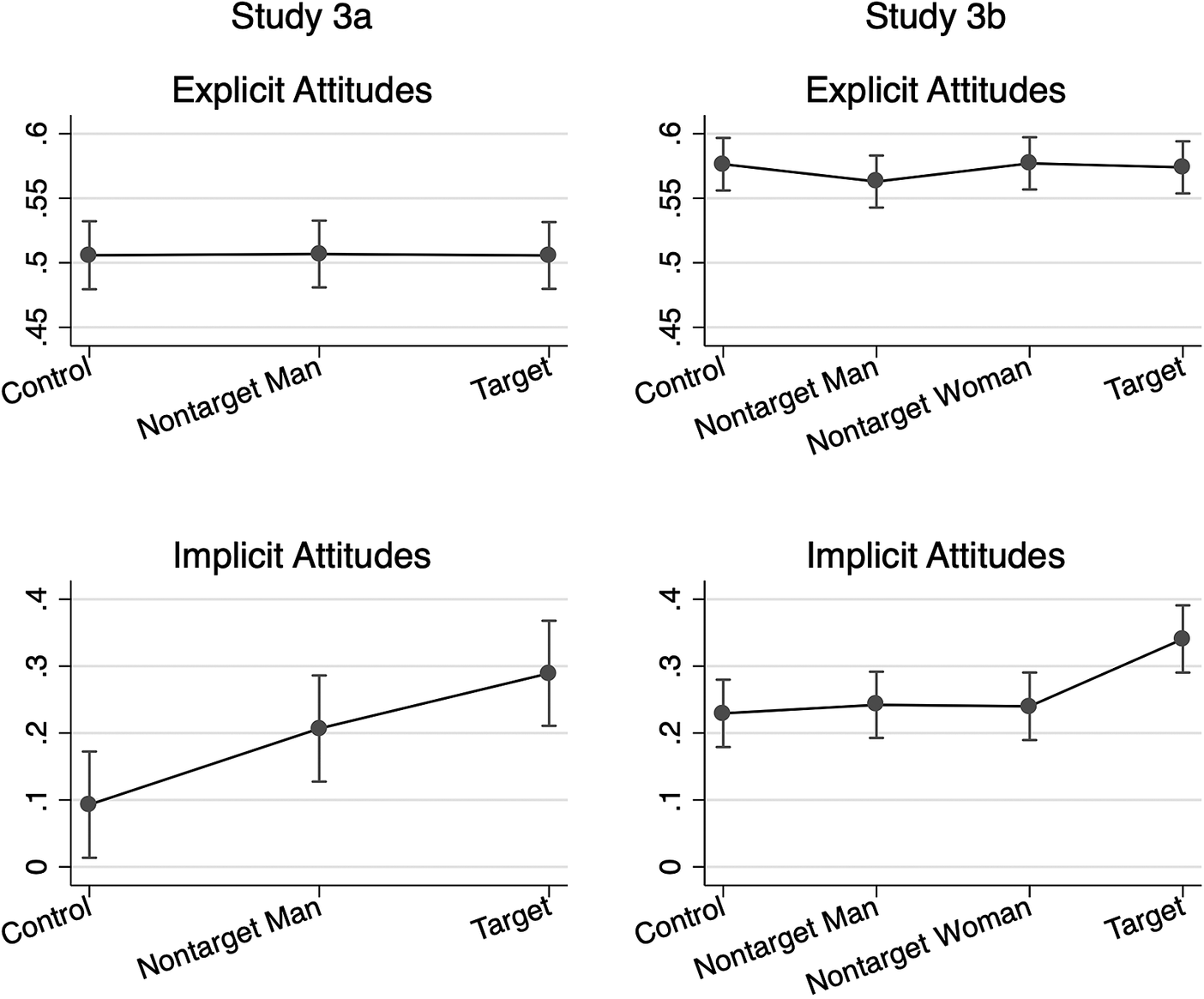
Results. Figure 5 reports the expected implicit and explicit attitudes toward Mike Harper, coded as in Study 1, as a function of the random assignment. There is no evidence that the inductions affected explicit attitudes in either study. (In Study 3a, the F statistic for the underlying model rounds to zero: F(3, 435) < 0.01, p ≈ 1.0. In Study 3b, F(3, 1163) = 0.41, p = 0.75. No pairwise comparisons between conditions are statistically distinguishable.) This is a predicted null result.Footnote 19
Treatment Effects on Explicit and Implicit Attitudes
Note: Whiskers represent 95% confidence intervals. In Study 3a, the analysis sample is 439 for explicit attitudes and 417 for implicit attitudes. In Study 3b, the sample size is 1,167 for explicit attitudes and 1,114 for implicit attitudes.

However, familiarity with Mike Harper improves implicit attitudes toward him. In Study 3a, implicit attitudes in the target condition are statistically distinguishable from the control condition (t = 3.46, p < 0.01), though the contrast against the nontarget condition is only suggestive (t = 1.50, p = 0.14). In Study 3b, the target condition is statistically distinguishable from all others (vs. control, t = 3.07; vs. nontarget male, t = 2.74; vs. nontarget female, t = 2.77; all p < 0.01). Thus, induced familiarity with Harper improves implicit attitudes toward him, but induced familiarity with other politicians (including a demographically similar one) does not.
Discussion. Studies 3a and 3b make three substantive contributions. First, they provide additional evidence that implicit and explicit attitudes are dissociated. They change via different processes, and one can change without the other: the familiarity induction moves implicit attitudes toward Mike Harper, but effects on explicit attitudes are convincingly null. Second, these studies show that merely increasing familiarity with a political candidate improves implicit attitudes about him—even in the absence of any substantive information. Third, they suggest that the channel via which familiarity improves implicit attitudes is reasonably encapsulated. Aside from a suggestive result in Study 3a that did not reemerge in 3b, implicit attitudes toward Harper improve in response to familiarity with Harper only. Footnote 20
In the Supporting Information (Section 5), we report analyses stratified by age and education. We find that some evidence that age and education have direct effects on attitudes (with young and uneducated people having generally less favorable attitudes toward Harper) but no evidence that these factors moderate treatment effects. Such results constitute evidence that the effects we identify are reasonably homogeneous and likely apply well across demographic groups (see Coppock, Leeper, and Mullinix Reference Coppock, Leeper and Mullinix2018).
While we think that this demonstration of mere exposure effects is instructive for the study of political messaging—we return to this below—we recognize that Studies 3a and 3b necessitated some trade-offs. To isolate the effects of familiarity, we manipulated the concept in an unnaturalistic way. Furthermore, because we excised substantive information from the study entirely, we lost the ability to examine how familiarity effects might depend on the provision of substantive information. Thus, Study 4 seeks to reintroduce a substantive messaging. This inclusion allows us to test some limits of mere exposure effects as well as to offer a fuller assessment of the APE Model in the context of political communication.
Study 4: How Do Substantive and Nonsubstantive Messaging Elements Interact?
Study 4 returns to, and builds on, the general approach used in Study 1. Participants are exposed to the same three advertisement conditions (high-quality ad, low-quality ad, or no ad). However, this assignment is fully crossed with a separate assignment that manipulates the substantive information participants have about Mike Harper: they are told he was implicated in a political scandal or they are given neutral information. This procedure is similar to Study 2 (in the SI), though we made some operational improvements and filed a separate preregistration to reflect our developing theoretical understanding.
Procedure. After viewing one of the ads used in Study 1, we asked all participants to report, in open-ended format, what they typically eat for breakfast—a small distractor task to serve as a buffer between survey sections. Next, respondents were randomly assigned to read one of the two news stories presented in Figure 6. As the figure shows, one clipping was a nonpolitical control story about cheese pastry making. The other story, the scandal story, reveals that Mike Harper was implicated in serious misconduct.
News Stories Used in Study 4

Three aspects of the scandal story bear some emphasis. First, the story is plain text—a medium far less rich in affective content than our audio/visual advertisements. Second, the story is parsimonious—just 153 words. Third, the allegations levied against Harper are conclusive. We wanted to leave little doubt that positive characteristics one might have ascribed to Harper based on his ad are, in fact, false. Fourth, we chose an allegation (embezzling funds) that, although conclusively bad, we expected to be less affect-laden than plausible alternatives. (For instance, we decided against revealing evidence of sexual assault.) Thus, while the video advertisements are tailored to target associational mental processes, the news story is suited to target propositional mental processes. From the standpoint of the APE Model, the advertisement manipulation should lead to changes in implicit attitudes, whereas the scandal story should lead to changes in explicit attitudes.Footnote 21
However, given the results we describe above, our preregistered predictions explicitly departed from the APE. Most importantly, for participants assigned to the control story, we predicted a mere exposure effect: ad exposure should improve implicit attitudes toward Mike Harper. At the same time, because Studies 1 and 2 revealed several instances where stimuli intended to target explicit attitudes nonetheless affected implicit attitudes, we predicted that the scandal manipulation would harm implicit (not just explicit) attitudes about Harper—and indeed might neutralize mere familiarity effects.
Once again, experiment participants were undergraduates at two institutions. One of the two institutions expanded the research participation requirement applied to undergraduates, resulting in a considerably larger sample size. As in Study 3, we follow a preregistered plan to exclude international students from one of the participating institutions, resulting in a useable N of 1,104.Footnote 22
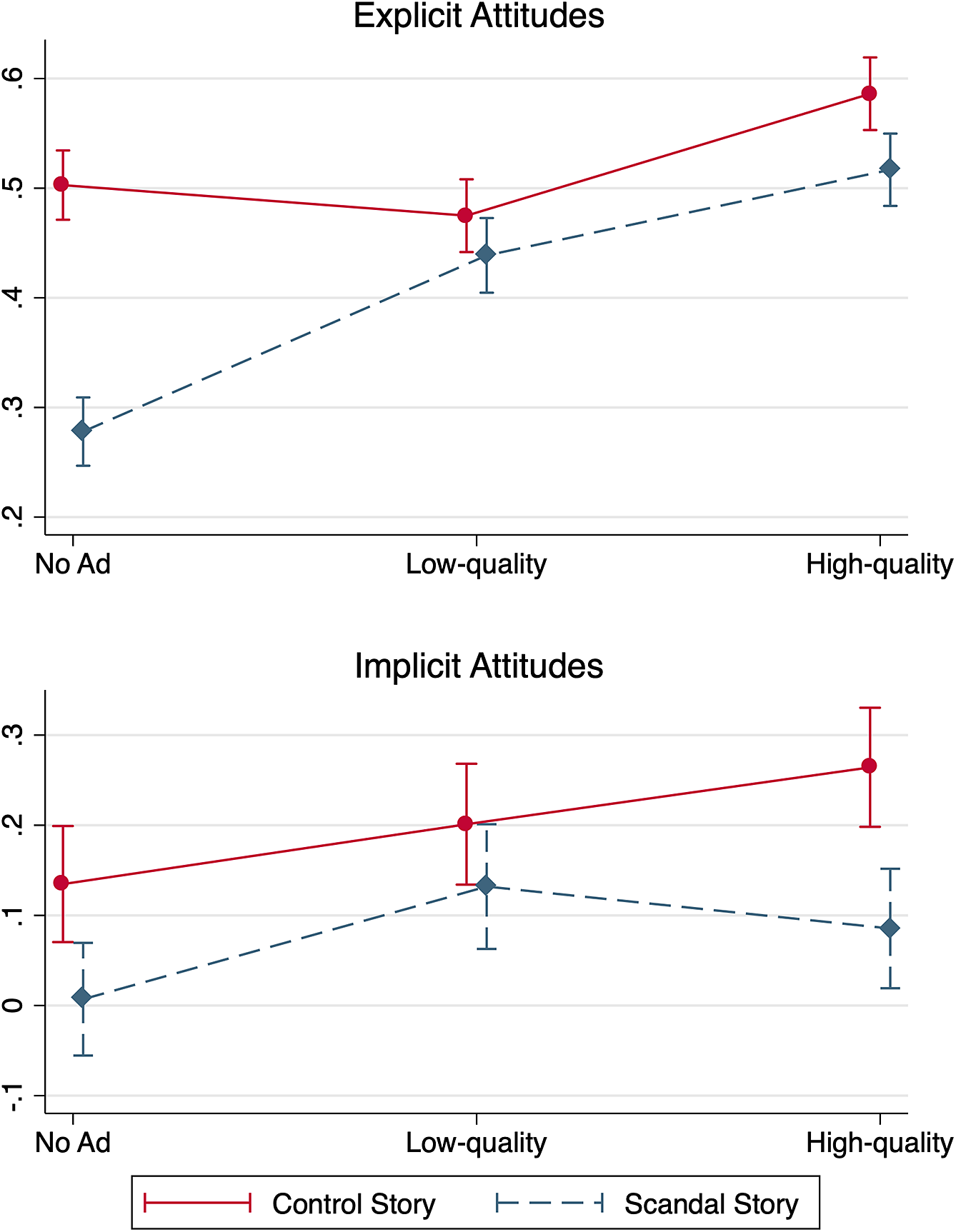
Results. A between-subjects ANOVA reveals significant effects for both manipulations.Footnote 23 Of course, our main interest is in the interdependence between the two random assignments. Thus, Figure 7 shows expected implicit and explicit attitudes for the six possible assignments.Footnote 24 Clearly, a tidy framework in which each kind of attitude (implicit and explicit) is affected via a different route is not supported. For instance, the ad quality manipulation is, according to the APE, better suited to influence implicit attitudes. But the high-quality ad significantly improved explicit attitudes—compared with control and low-quality conditions, and irrespective of the scandal condition (all p < 0.01). Moreover, the scandal manipulation is, again according to the APE, better suited to influence explicit attitudes. But the scandal story had a significant negative effect on implicit attitudes in two of the three ad conditions (p < 0.01, p = 0.17, p < 0.01). Thus, both manipulations affected attitudes in both domains.
Treatment Effects in Study 4
Note: Whiskers represent 95% confidence intervals.

On the other hand, the results are generally consistent with a mere exposure effect for implicit attitudes. In the control condition, exposure to any advertisement (low- and high-quality assignments pooled) improved implicit attitudes (p < 0.02), though as the figure shows this effect was driven more by the high-quality assignment (p < 0.01 compared with control) than the low-quality assignment (p = 0.15). In the scandal condition, exposure to any advertisement improved implicit attitudes (p < 0.02), though here the effect was driven more by the low-quality ad (p < 0.02 compared with control) than the high-quality ad (p = 0.10). No high-quality versus low-quality contrasts were significant for implicit attitudes.
Discussion. Study 4 does not support the APE Model. However, it does accumulate further evidence that mere exposure to an attitude object improves implicit attitudes. Interestingly, mere exposure effects emerge irrespective of the scandal condition. (As our preregistration reflects, we thought the scandal condition might neutralize mere exposure effects.) More generally, Study 4 provides additional examples of implicit/explicit attitude dissociation. For instance, among respondents assigned to the scandal condition, a shift from a low-quality to a high-quality ad significantly improves explicit attitudes (p < 0.01) but has a (nonsignificant) negative effect on implicit attitudes (p = 0.36).
Although our primary focus lies in comparing implicit and explicit attitudes, the explicit attitude results in Study 4 bear some discussion in their own right. The scandal story had a large negative effect on respondents who saw no ad (difference = −0.22, SE = 0.018, p < 0.0001). But the scandal/control contrast is comparatively muted among respondents who saw either the low- or high-quality ads.Footnote 25 In this sense, both ads served to inoculate Mike Harper from the negative effects of a scandal. Although we are cautious about post hoc speculation for why this result occurred, positive ads (such as those in this case) do help candidates build trust with voters (Ridout and Holland Reference Ridout and Holland2010), which may have led to the muted effect. Moreover, the combination of the positive ad with the negative story of the scandal may have led the participants to weigh both more carefully, affecting explicit evaluations (Chong and Druckman Reference Chong and Druckman2007b).
Discussion and Conclusion
Zajonc’s landmark essay laying out the case for distinct mental systems governing cognition and affect contains a passage worth quoting at length:
The dismal failure in achieving substantial attitude change through various forms of communication or persuasion is another indication that affect is fairly independent and often impervious to cognition… . If a person believes that Candidate A is honest, we can simply give the person information proving that A is not honest… . Yet this approach has been the least successful in attitude change. Even the most convincing arguments on the merits of spinach won’t reduce a child’s aversion to this vegetable. (Zajonc Reference Zajonc1980, 158–59)
Quite. Zajonc’s words represent an insight the broad strokes of which political psychologists have partly embraced, such as in studies that emphasize the paramount influence of social identities (e.g., Huddy, Mason, and Aarøe Reference Huddy, Mason and Aarøe2015) or citizens’ motivations to bring political judgments in line with gut reactions (e.g., Lodge and Taber Reference Lodge and Taber2013). But as concerns attitude change, the field still has some ways to go. As we note at the outset, there are precious few studies of factors that cause implicit attitudes—arguably the most direct measure of raw affect—to change. And the preeminent concept in the study of persuasion—framing effects (e.g., Druckman Reference Druckman and Keren2010)—is, at least to the extent it refers to an actor emphasizing different pieces of information relevant to some judgment, entirely cognitive in nature.
Here, by directly comparing paths for implicit versus explicit attitude change, we have attempted to open a new front in the study of political persuasion. Our studies lead us to three main conclusions.
The first conclusion is simple, but bears emphasis. We find that implicit and explicit attitudes are distinct. Over and over again, they respond differently to the treatments we administered, in some cases even seeming to move in opposite directions. This result implies that political actors might—knowingly or not—employ different tools to engage in different kinds of persuasion. Alongside the finding that implicit and explicit attitudes have distinct consequences for behavior (e.g., Albertson Reference Albertson2011; Quillian Reference Quillian2006; Ryan Reference Ryan2017), this conclusion underlines that the tactics used to influence voters are even more complex and multifaceted than has heretofore been appreciated.
Second, we find little evidence that the APE model works as a framework for understanding implicit and explicit attitude change in the context of political communication. We word this conclusion narrowly, and we do so because we wish not to be construed as launching a frontal assault on the APE. We regard the evidence that psychology journals have accumulated in the model’s favor as sound, which is why we made it the starting point for our inquiries. We conjecture that the main reason APE falls short in our research pertains to the different priorities that emerge in traditional cognitive psychology (APE’s provenance) compared with psychologically informed political science (our focus). Where studies in pure psychology often sacrifice realism, the better to isolate and validly manipulate the constructs of interest, political scientists strive to understand how psychological principles apply in real communicative contexts.
As an example of how these different priorities can lead to different conclusions, compare our work with one of the studies that informed our understanding of the APE Model. Moran and Bar-Anan (Reference Moran and Bar-Anan2013) created negative associations with an alien creature by having participants listen to horrified screaming while viewing pictures of the creature on a computer screen. In contrast, our studies attempted to create associations with a candidate via plausible advertisements that varied in their production quality. Our manipulation, more than the screams, is susceptible to spilling over to areas not intended. For instance, although our ads intended to provide equivalent information (by having identical narration), perhaps respondents made different substantive inferences about Mike Harper’s competence depending on whether or not they saw a low- or high-quality ad. We acknowledge this possibility. However, we see it not as a mistake, but rather as a data point that illustrates a limitation of the APE: the model does not transition away from a lab and into the field so seamlessly.Footnote 26
Although we do not corroborate the APE, our studies accumulate evidence for an alternative. Our third conclusion is that political messages can improve implicit attitudes simply by increasing familiarity with a target object. This pattern arises in all four studies we conducted, including two (Study 3a and 3b) with a pure familiarity manipulation. To be sure, there is more to learn about this pattern: does it arise when familiarity is induced in a negative way (such as an attack ad)? How does the magnitude and perseverance of the effect relate to the treatment dosage? And what interventions beyond familiarity successfully move implicit attitudes? (Because we have found one route does not preclude the existence of others.)
Although we must leave these questions to future studies, the familiarity patterns we discuss above already help elucidate real political phenomena. We close with two examples.
Low-information campaign tools. Scholars have long noticed that politicians seek to influence voters with messages that convey little or no substantive information. Long-standing examples include lawn signs, billboards, placards, and vacuous television spots. Many ads on modern advertising platforms—Facebook, YouTube, and Instagram, for instance—undoubtedly fit the bill, too (e.g., Fowler et al. Reference Fowler, Franz, Martin, Peskowitz and Ridout2021). The most common explanations for such efforts are almost entirely cognitive in nature:Footnote 27 These ads can build name recognition, which is electorally beneficial (e.g., Abramowitz Reference Abramowitz1975; Levy and Squire Reference Levy and Squire2000; Makse, Minkoff, and Sohkey Reference Makse, Minkoff and Sokhey2019). Or, they might influence thoughts about a candidate’s viability, incumbency, or experience (e.g., Green et al. Reference Green, Krasno, Coppock, Farrer, Lenoir and Zingher2016; Krasno Reference Krasno1997). Our results suggest that something as simple as a lawn sign may have effects that are more powerful than a purely cognitive model would predict: familiarity with a candidate can affect implicit (but not necessarily explicit) attitudes without necessarily changing cognitions about him or her. Note that a result we saw in Study 1—the greater decay of treatment effects on implicit attitudes after a delay of two weeks—fits in well with this literature. Because implicit attitude change stems from changing positive and negative associations with an attitude object, it unfolds in a more cumulative and incremental way than explicit attitude change does (Gregg, Seibt, and Banaji Reference Gregg, Seibt and Banaji2006). Consistent with this, research in communication finds that the success of low-information political messages hinges in no small part on massive repetition (Fernandes Reference Fernandes2013).
The content of positive versus negative messages. There is considerable evidence that negative political ads are more informative than positive ads. In particular, negative ads tend to contain more information about political issues (Fowler and Ridout Reference Fowler and Ridout2010; Koch Reference Koch2008). Why would this be so? The results we present point to one possibility. If negative ads focused primarily on positive/negative associations, there are two reasons they might backfire: they might accidentally increase familiarity with the opponent politician or the negative associations might, against intentions, become associated with the sponsoring politician (especially given the legal requirement that the sponsor verbally approve each ad). For these reasons, negative ads might need to primarily target propositional thinking. Positive ads, in contrast focus solely on the sponsoring candidate (often without any mention of the opponent), so it is more propitious for them to target associations and, as a result, implicit attitudes.
To close, we note that this series of investigations illustrates one underappreciated benefit of the disciplinary trend toward experimental preregistration (Franco, Malhotra, and Simonovits Reference Franco, Malhotra and Simonovits2014). One common concern about expecting researchers to preregister theoretical expectations is that the requirement might hinder exploratory research or suppress publication of studies with unexpected results (Laitin Reference Laitin2013). Privately, we have even heard some concern that if researchers’ expectations are on-record, they might have even bigger incentives to torture results into alignment.
We think these concerns reveal a limited view of preregistration. As Platt (Reference Platt1964) argues, scientific inference is like climbing a many-branched tree. At each fork, empirical tests exclude some paths forward while leaving others open. In this framework, preregistrations serve a role similar to a chemist’s lab book. They do not handcuff researchers to any particular theoretical view. They simply create a clear record of what ideas a particular test was designed to evaluate. Rather than leading to incentives to hide unexpected results, this record makes it more appealing to lay them bare, as doing so makes it easier for readers to share in the same learning process. It is an approach we found refreshing and hope will continue.
SUPPLEMENTARY MATERIALS
To view supplementary material for this article, please visit http://dx.doi.org/10.1017/S0003055421000538.
DATA AVAILABILITY STATEMENT
Research documentation and data that support the findings of this study are openly available at the APSR Dataverse: https://doi.org/10.7910/DVN/IK4NUZ.
ACKNOWLEDGMENTS
We thank Elijah Cole Stanley, Caitlin Young, Marianna Abdalla, and Derek Robinson for indispensable help producing video advertisements. We thank J Ehlinger, Josh Gubler, Eric Groenendyk, Chris Johnston, Lily Mason, Rahsaan Maxwell, Keith Payne, Kathleen Searles, our peer reviewers, and seminar participants at Duke University and the University of Michigan for feedback at earlier stages of this project. We thank Erika Franklin Fowler and the staff at the Wesleyan Media Project—Laura Baum, Markus Neumann, and Pavel Oleinikov—for sharing data.
FUNDING STATEMENT
This research was funded by the Junior Faculty Development Award at the University of North Carolina Chapel Hill as well as by Stony Brook University’s Political Science Department.
CONFLICT OF INTEREST
The authors declare no ethical issues or conflicts of interest in this research.
ETHICAL STANDARDS
The authors declare the human subjects research in this article was deemed exempt from review by the University of North Carolina at Chapel Hill and Stony Brook University.








Comments
No Comments have been published for this article.