Introduction
Winter cereal rye (WCR) has been identified as an effective in-field practice to reduce nitrate-N and P losses to Upper Mississippi River Basin, USA (Lacey et al., Reference Lacey, Nevins, Camberato, Kladivco, Sadeghpour and Armstrong2020). Winter cereal cover crops offer multiple benefits including improving soil C (Duval et al., Reference Duval, Galantini, Capurro and Martinez2016), suppressing weeds (Sadeghpour et al., Reference Sadeghpour, Hashemi, DaCosta, Gorlitsky, Jahanzad and Herbert2014), reducing runoff (Kaspar et al., Reference Kaspar, Radke and Laflen2001), recycling nutrients (Jahanzad et al., Reference Jahanzad, Barker, Hashemi, Eaton, Sadeghpour and Weis2016) and enhancing soil quality (Blanco-Canqui et al., Reference Blanco-Canqui, Shaver, Lindquist, Shapiro, Elmore, Francis and Herget2015). However, WCR adoption has been slow in the Midwestern USA and <5% of cultivated lands use winter cereals as cover crop especially prior to corn due to N immobilization (Adeyemi et al., Reference Adeyemi, Keshavarz-Afshar, Jahanzad, Battaglia, Luo and Sadeghpour2020; Singh et al., Reference Singh, Dhakal, Yang, Kaur, Williard, Schoonover and Sadeghpour2020), establishment, disease and pest issues (SARE Program, 2014).
Generally, growers who use WCR as cover crop drill a full seeding rate at 19 cm row spacing (7.5 inches) (normal planting; NP). Consequently, a row of WCR will coincide with a row of corn planted in a 76 cm row spacing (30 inches). Previous research has shown potential corn stand failure with rainfall between cover crop termination and cash crop planting due to excessive moisture (Reed et al., Reference Reed, Karsten, Curran, Tooker and Duiker2019) or root and shoot N immobilization (Williams et al., Reference Williams, Wells, Dickey, Hu, Maul, Raskin, Reberg-Horton and Mirsky2018; Weidhuner et al., Reference Weidhuner, Afshar, Luo, Battaglia and Sadeghpour2019). Also, intersecting corn roots with WCR often results in pest and disease transfer from WCR to corn and further contributing to corn yield reduction (Bakker et al., Reference Bakker, Acharya, Moorman, Robertson and Kaspar2016). To facilitate corn planting following a WCR stand, we will investigate the ability of skipping the corn row (STCR) to generate non-intersecting zones of WCR and corn growth. In this practice, the WCR will only be planted between the corn rows and at each corn row, every 76 cm, there will be a gap to allow for (i) warmer soil temperature and earlier planting of corn; (ii) later termination of WCR which can minimize corn stand failure due to excessive moisture issue between early cover crop termination and planting time; and (iii) reduce N immobilization and thus, maintain/increase corn yield. However, it is important to evaluate whether STCR of WCR can perform similar to NP in terms of producing biomass, taking up nutrients and its chemical composition.
To the best of our knowledge, there has been no study evaluating STCR performance compared to NP. Therefore, our objectives were to compare the effect of STCR vs NP on (i) WCR plant height, normalized difference vegetative index (NDVI) and leaf area index (LAI) at termination; (ii) WCR biomass production, nutrient concentration and accumulation; (iii) C, lignin and C:N and lignin:N ratio; (iv) soil temperature on corn row at WCR termination; (v) economic benefits.
Materials and methods
Experimental site
This experiment was initiated in 2018–2019 at one location and conducted in 2019–2020 at two locations. From this point forward, to simplify presenting our results, 2018–2019 is referred to 2019 and 2019–2020 is referred to 2020. The experimental sites included Agronomy Research Center (ARC), in Carbondale IL (37.75°N, 89.06°W) (2019 and 2020), and Belleville Research Center (BRC), in Belleville, IL (38.52°N, 89.84°W) in 2020. Soil type at ARC in 2019 and 2020 was a Stoy silt loam (Fine-silty, mixed, superactive, mesic Fragiaquic Hapludalfs). At BRC, the soil type was a mixture of Bethalto silt loam (fine-silty, mixed, superactive, mesic Udollic Endoaqualf) and Winfield silt loam (Fine-silty, mixed, superactive, mesic Oxyaquic Hapludalfs) (Soil Survey Staff, 1999). Initial soil chemical properties are reported in Table S1. Daily weather data, including average air temperatures and daily precipitation amounts were collected at ARC and BRC facility sites. Weather data are presented in Fig. S1 showing significantly higher precipitation in 2018–2019 (wet growing season) than 2019–2020 leading to results differences for site-yrs.
Experimental design, treatments and cultural management practices
Treatments (STCR vs NP) were laid out in a randomized complete block design with four replicates. Plots were 9.1 m long and 3 m wide to allow for planting four rows of corn at 76 cm apart. Each WCR was fertilized with 56 kg urease inhibitor-treated UAN (32-0-0) ha−1 at the ARC sites at planting. The N source at BRC was urea (46-0-0). WCR (Gaurdian, Crosse Seeds, WI, USA) was planted with a John Deere 450 series grain drill (John Deere, Moline, IL), and a Great Plains 1006NT, respectively. Planting dates were 12 November 2018, 23 October 2019 at ARC and 27 October 2019 at BRC and the seeding rate for NP treatment was 100 kg ha−1 (2,076,000 seeds ha−1). The seeding rate for the STCR was ~75% of the NP. Illinois Nutrient Loss Reduction Strategy (IL NLRS, 2015) encourages growers to use higher than 67 kg ha−1 seeding rates to ensure cover crop establishment and effective residual nutrient uptake. WCR seeding rate in recent published studies in Illinois ranges from 87 to 144 kg ha−1 (Sievers and Cook, Reference Sievers and Cook2018; Lacey et al., Reference Lacey, Nevins, Camberato, Kladivco, Sadeghpour and Armstrong2020; Singh et al., Reference Singh, Dhakal, Yang, Kaur, Williard, Schoonover and Sadeghpour2020). WCR was chemically terminated at 12 May 2019 and 5 May in 2020 at the ARC site and 14 April at BRC site using glyphosate (1.05 a.i. ha−1). WCR stage was different in 2020 than in 2019. The WCR stage was 51 at ARC2020 and BRC2020 but 59 at ARC2019 (Zadoks et al., Reference Zadoks, Chang and Konzak1974).
Data collection and calculations
WCR plant height, NDVI, LAI and aboveground biomass
Prior to termination, 0.675 m2 (3 frames of 0.225 m2) per plot were harvested with grass shears (GS model 700; Black and Decker Inc., Towson, MD) at 5 cm above the ground surface to eliminate soil contamination (Weidhuner et al., Reference Weidhuner, Afshar, Luo, Battaglia and Sadeghpour2019). Prior to aboveground biomass sampling, height of nine plants (from ground to the top of the canopy) were measured with a yard stick. At each site-yr, a GreenSeeker Handheld Crop Sensor HCS 100 (Trimble Ltd., Sunnyvale, CA) was used to measure the canopy reflectance and NDVI from the WCR by passing it over the two center rows for the full length of each plot. The specific sensor was low cost (no connection or data logging capabilities). The meter uses an active light source optical sensor (660 nm red, 780 nm near infrared, ~25 nm full-width half-maximum), and displays the NDVI of the scanned area every ~0.5 s while the trigger is depressed. Upon release of the trigger, the average of measurements over the last 60 s is displayed (White et al., Reference White, Bradley, Finney and Kaye2019). An AccuPAR (LP–80; METER Group, Pullman, USA) ceptometer was used to calculate the LAI from above and below canopy photosynthetically active radiation (PAR) measurements. All measurements were taken between 1100 and 1400 h when sun angles were near the zenith and with cloud-free sky conditions. AccuPAR calculates fractional beam radiation and solar zenith angle, based on the global position and the time of day from the setup menu adjusted by the operator, and uses the typical leaf angle distribution (LAD, χ) parameter for determining the LAI through a radiative transfer model (Rahman et al., Reference Rahman, Lamb and Samborski2019). The extinction coefficient K for the canopy was calculated using the equation reported in Campbell (Reference Campbell1986):

where x is a leaf angle distribution parameter and θ is the solar zenith angle.
WCR nutrient concentrations, accumulation and chemical composition
Harvested cover crop samples were dried at 60°C for at least 48 h until constant dry weight. The oven-dried samples were ground to pass a 1-mm screen using a Wiley Mill first, and then passed through a 0.6-mm screen Wiley Mill (Arthur H. Thomas, Co., Philadelphia, PA). The ground samples were placed into coin envelopes. Prior to tissue analysis, plant tissue samples were once again placed into a forced-air oven (60°C) for 72 h to ensure plant tissue moisture was not a confounding factor. The oven-dried samples were then analyzed for N and C content using dry combustion (Flash 2000 Elemental Analyzer, Thermo Scientific, Cambridge, UK). Nutrient concentrations were estimated with near-infrared spectroscopy (NIRS) analysis at Ward Laboratory (Kearney, NE, USA) using equations developed by the NIRS Forage and Feed Testing Consortium and included N, P, K, Ca and Mg, along with lignin.
Lignin:N and C:N ratio then calculated as indicators of mobilization/immobilization potential for each treatment. To calculate nutrient uptake, cover crop aboveground biomass was multiplied by percent nutrient measured for each treatment. Carbon addition was also calculated by multiplying cover crop aboveground biomass with percent C measured for each treatment.
Soil temperature
Soil temperature (0–10 cm depth) was measured (two readings at BRC; three readings at ARC per plot) with a soil thermometer at each site (ARC2020 and BRC2020) at WCR termination date to evaluate if STCR resulted in a higher soil temperature which allows for earlier planting in no-till systems.
Statistical and economic analysis
Data for WCR plant height, NDVI, LAI, aboveground dry matter (DM) biomass, N, P, K, Ca, Mg concentrations and accumulation (uptake), lignin, C concentration, C:N, lignin:N ratios and soil temperature were analyzed with PROC Mixed (SAS version 9.4, SAS Institute, Cary, NC, USA). To evaluate the differences between the two tillage treatments, data were analyzed with site-yr (ARC2019, ARC2020 and BRC2020) and WCR planting methods (STCR vs NP) as fixed effects, and block as a random effect. Where treatment results were found significant (P ≤ 0.05), least-square means and standard error were withdrawn using the LSMEANS option in SAS PROC Mixed adjusted for Tukey.
To evaluate seed costs for STCR vs NP, range of WCR cover crop seed prices (from $0.34 to $1.68 kg−1 at $0.34 kg−1 increments) were used and multiplied by seeding rates for STCR (75 kg ha−1) and NP (100 kg ha−1) to calculate $ saved by implementing STCR.
Results
WCR plant height, NDVI, LAI and aboveground biomass
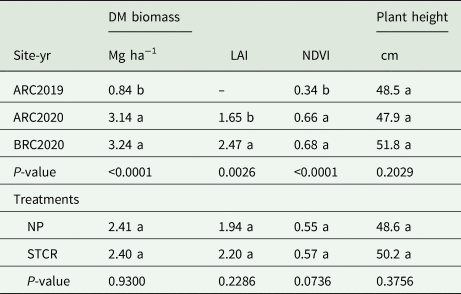
WCR aboveground DM biomass was influenced by site-yr and not by planting methods or the interaction of site-yr by planting methods. WCR biomass was 0.84 Mg ha−1 at ARC2019, 3.14 Mg ha−1 at ARC2020 and 3.24 Mg ha−1 at BRC2020. These data were supported by NDVI values presented in Table 1. At ARC2019, NDVI was 0.35 almost two-fold lower than those recorded at ARC2020 (0.66) and at BRC2020 (0.68). LAI was higher at BRC2020 (2.47) than ARC2020 (1.65) indicating higher LAI at BRC2020 did not necessarily resulted in higher biomass accumulation (Table 1). Both NDVI and LAI were similar between the two planting methods. Plant height was not affected by site-yr, planting methods and their interaction (Table 1) indicating planting height could not be a reliable estimator of biomass for WCR.
Treatment influence on winter cereal rye dry matter (DM) biomass, leaf area index (LAI), normalized difference vegetative index (NDVI) and plant height at termination time

Values (lsmeans) with different letters within each site-yr or treatments indicate a significant difference at P < 0.05.
WCR nutrient concentrations, accumulation and chemical composition
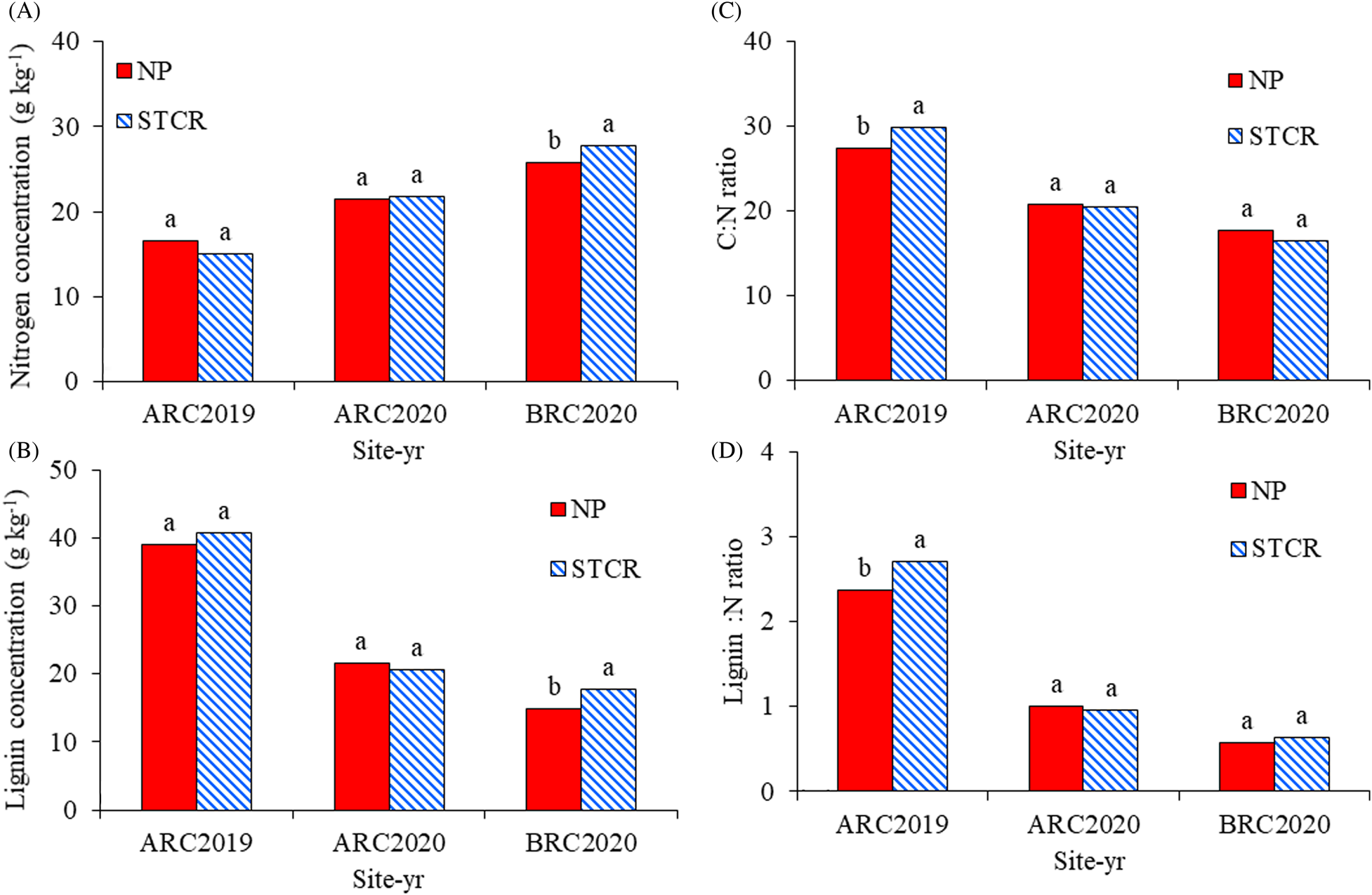
Site-yr, planting methods and their interaction had no significant effect on P, K, Ca and Mg concentration of WCR (data not shown). Among nutrient concentrations, only N was influenced by site-yr and interaction of site-yr by planting methods (Fig. 1A). Nitrogen concentration was similar between STCR and NP at ARC2019 and ARC2020 (Fig. 1A). At BRC2020, STCR had higher N concentration (27.7 g kg−1) and N accumulation (91.10 kg N ha−1) than NP (25.7 g kg−1) and (81.62 kg N ha−1) (data for N accumulation not shown).
Nitrogen concentration (A), lignin concentration (B), C:N (C) and Lignin:N ratio (D) as influenced by site-yr and planting methods interactions. Values (lsmeans) with different letters within each site-yr indicate a significant difference between STCR vs NP.

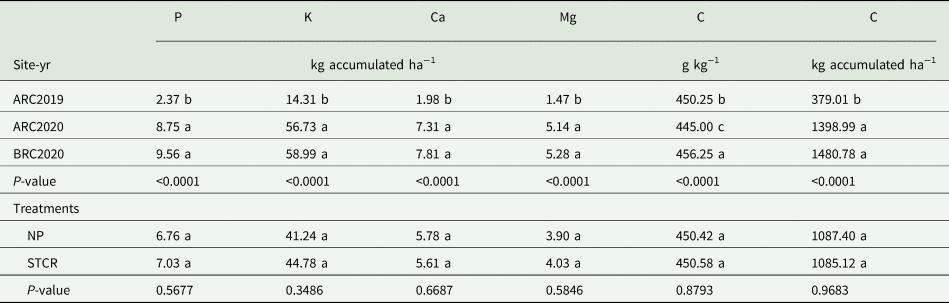
WCR nutrient accumulation (P, K, Ca and Mg) were only influenced by site-yr reflecting higher aboveground DM biomass at ARC2020 and BRC2020 indicating nutrient accumulation is highly related to aboveground biomass. Nutrient accumulation was similar between ARC2020 and BRC2020 and on average, WCR accumulated 9.15, 57.86, 7.59 and 5.21 mg kg−1 P, K, Ca and Mg, respectively. Averaged accumulated P, K, Ca and Mg in WCR for ARC2020 and BRC2020 were approximately four-fold higher than that of ARC2019 (Table 2).
Treatment influence on phosphorus (P), potassium (K), calcium (Ca) and magnesium (Mg) accumulation along with carbon (C) concentration and accumulation

Values (lsmeans) with different letters within each site-yr or treatments indicate a significant difference at P < 0.05.
Carbon concentration and accumulation were not affected by planting methods and was 450.50 g kg−1 (averaged over STCR and NP) (Table 2). Carbon concentration, however, was influenced by site-yr. Carbon concentration was higher at BRC2020 (456.25 g kg−1) than ARC2019 (450.25 g kg−1) which also had higher C concentrations than ARC2020 (445.00 g kg−1) (Table 2). Carbon accumulation was also influenced by site-yr and was lower at ARC2019 (379.01 kg ha−1) than ARC2020 (1398.99 kg ha−1) and BRC2020 (1480.78 kg ha−1) reflecting lower WCR DM biomass at ARC2019.
Lignin concentration was affected by site-yr, and the interaction of site-yr by planting methods. Lignin concentrations were higher for STCR (17.77 g kg−1) than NP (14.95 g kg−1) at BRC2020. Lignin concentrations did not differ between STCR and NP at ARC2019 (39.93 g kg−1) and ARC2020 (21.16 g kg−1) reflecting later termination date in 2019 (Fig. 1B).
Carbon:N and lignin:N ratios were also influenced by interaction of site-yr with planting methods (Fig. 1C and D). Carbon:N ratio was higher for STCR (29.85) than NP (27.42) at ARC2019 with no differences observed between the two treatments at ARC2020 and BRC2020 (Fig. 1C). Lignin:N ratio followed a similar pattern to C:N ratio. Within each site, there were no differences between STCR and NP except for ARC2019. The STCR treatment had greater (2.71) lignin:N ratio at ARC2019 compared with NP (2.38) at ARC2019 (Fig. 1D).
Soil temperature
At each site, soil temperature on corn row at termination timing was at least 1°C higher for STCR than NP. At ARC2020 soil temperature was 15.3°C for STCR vs 14.2°C for NP and at BRC2020 soil temperature was 13.6°C for STCR vs 12.6°C for NP indicating potential for earlier planting with STCR (data not shown).
Economic analysis
Considering the lack of differences in WCR biomass and nutrient accumulation, STCR was more economical to implement than NP. Assuming only $0.34 kg−1 for WCR seed, growers could save $8.4 ha−1 by implementing STCR than NP. By increasing the WCR seed price on $0.34 kg−1 increments up to $1.68 kg−1, growers save $16.8, $25.2, $33.6 and $42 ha−1 when implementing STCR than NP. Average farm size in Illinois is 152 ha. If growers only use WCR as cover crop in half of their fields, they can save from $638.4 to $3192.0 ha−1 with STCR compared to NP (Table S2).
Discussions
WCR plant height, NDVI, LAI and aboveground biomass
WCR aboveground biomass was affected by site-yr mainly due to later planting date at ARC2019 as well as extremely wet year in 2019 (Fig. S1A-B). This supports previous research showing WCR biomass decreases with delay of fall planting (Hashemi et al., Reference Hashemi, Farsad, Sadeghpour, Weis and Herbert2013). Regardless of site-yr, WCR produced similar biomass between STCR and NP indicating opportunities for reducing seed costs of WCR by evaluating economical seeding rate for capturing agronomic and environmental benefits. Similar NDVI and LAI data as well as plant height also support this hypothesis, which is in line with results of Haramoto (Reference Haramoto2019) who reported similar WCR biomass accumulation at low and high seeding rates in Kentucky, USA. Therefore, we propose seeding rates should be tested at multiple years and locations to improve economy of WCR use as cover crops and to test if STCR performs similar to NP at lower seeding rates.
WCR nutrient concentrations, accumulation and chemical composition
Except for N, nutrient concentrations for WCR were similar at all site-yrs indicating nutrient accumulation is driven by aboveground biomass (R 2 > 0.93 for all nutrients) and suggesting delaying the termination date is critical for increasing nutrient uptake (Otte et al., Reference Otte, Mirsky, Schomberg, Davis and Tully2019). Our data indicate the potential of WCR for accumulating 2.3 kg P ha−1 at ARC2019, 8.8 kg P ha−1 at ARC2020, and 9.6 kg P ha−1 at BRC2020. In Illinois, nutrient loss reduction strategy is pushing for P loss reduction by 25% by 2025. In animal operations soil test P (STP) levels are often very high (>30 mg kg−1 Bray-1 P) and corn-alfalfa (Medicago sativa L.) rotations are typical crop rotations (Sadeghpour et al., Reference Sadeghpour, Ketterings, Godwin and Czymmek2017). In these soils if silage corn is double cropped with WCR, it presents an opportunity to reduce some excess P by harvesting WCR as forage, decrease P balances and reduce STP which are beyond agronomic response levels. However, the P removal numbers here are not high indicating to reduce STP and minimize the potential for P losses in very high P soils in Illinois, several decades of double cropping WCR with silage corn is needed to bring STP to near agronomic response values (~30–35 mg kg−1 Bray-1 P) depending on soil supply P power (Fernández and Hoeft, Reference Fernández and Hoeft2009).
Soil temperature
Compared to tilled soils, no-till soils are cooler which delays corn planting and results in slower corn growth. In a recent long-term tillage study comparison, Weidhuner et al. (Reference Weidhuner, Hanauer, Keausz, Crittenden, Gage and Sadeghpour2020) reported 1°C warmer soil temperature (from emergence to V6 for corn) and faster corn growth in tilled vs no-till system. This issue often exacerbates with the presence of cover crops (Unger and Vigil, Reference Unger and Vigil1998). Also, planting through decaying cover crop residue, and rainfall between cover crop termination and corn planting may result in poor crop establishment by either reduced seed-to-soil contact, or by poor seed slot closure (Reed et al., Reference Reed, Karsten, Curran, Tooker and Duiker2019). Compared to NP, STCR had higher soil temperature and left a bare soil in corn planting row which could allow for earlier planting of corn and minimizing the issues discussed above and therefore, encouraging WCR cover crop adoption. It also could help with early corn establishment, which facilitates nutrient uptake and could translate into higher corn yields.
Economic analysis
According to SARE Program (2014), reducing the seed costs and increasing government cost shares incentivizes growers to further adopt cover crop use. Here, we assumed when WCR seed costs only $0.34 kg−1, growers could save $8.4 ha−1 by implementing STCR than NP. This can translate into $638.4 for an average sized farm in Illinois (152 ha) that uses WCR cover crop in half of their fields and implements STCR rather than NP.
Conclusions
Compared to NP, STCR: (i) maintained cover crop biomass, nutrient concentration and accumulation indicating similar nutrient reduction loss benefit to NP; (ii) added similar C content to the soil; (iii) had slightly higher C:N and lignin:N ratio in one out of three site-yrs; (iv) provided higher soil temperature for earlier planting of corn or for quicker corn germination; and (v) saved at least $8.4 ha−1 for growers. Therefore, we conclude that STCR has potential to be implemented for encouraging growers to further adopt WCR as cover crop. Future research should compare STCR and NP for forage quality of WCR in rotation with silage corn. Research should also focus on corn N requirement following STCR vs NP and assess whether economic benefits are beyond WCR planting costs with STCR.
Supplementary material
The supplementary material for this article can be found at https://doi.org/10.1017/S1742170520000411.
Acknowledgements
The authors thank Illinois Nutrient Research and Education Council, USDA-North Central SARE (Project LNC20-432 and ONC20-078) and SIU Vice Chancellor for Research for funding this project. They thank SIU Environmental Resource Policy (ERP) program for funding Oladapo Adeyemi's PhD studies. They also thank Randy Lange and Chris Vick for planting and maintaining the plots.