Introduction
In undergraduate medical education, there has been a move away from teaching factual knowledge to placing an emphasis on lifelong learning skills.Reference Riley1 This assumes that more specific knowledge will be acquired at a later stage, as the learner enters their chosen area of practice. There remains a need, however, for students to be exposed to a wide range of specialties at an undergraduate level. An important reason for this is that the majority of medical graduates will go on to become general practitioners.2 General practitioners require their knowledge and skills to be wide-ranging, and yet their training remains the shortest of any post-graduate specialty.3 Additionally, the current political climate calls for increasingly versatile doctors who are able to care for the wide range of conditions seen in an ageing population.4,Reference Harries, Rashid, Smitham, Vesey, McGregor and Scheeres5 European working time regulations have also led to increasing ‘cross-cover’ between specialties.Reference Wild, Lambert, Hornby and Fitzgerald6 This necessitates junior doctors being able to provide cover for a variety of specialties, sometimes without any induction.Reference Bird, Biggs, Bennett, Reddy and Counter7
A number of recent papers have highlighted the mismatch between the relatively small amount of time in the curriculum dedicated to undergraduate otolaryngology and the large volume of otolaryngology cases encountered in general practice.Reference Khan and Saeed8–Reference Lightbody and Wilkie10 Studies report that 10–25 per cent of adult and up to 50 per cent of paediatric consultations in general practice relate to otolaryngology topics.Reference Mace and Narula9,Reference Neil11–Reference Griffiths13 Given the Department of Health's target for 50 per cent of medical graduates to enter general practice,2 otolaryngology forms an important part of the education of general practitioners. In addition, for the 50 per cent of graduates not entering general practice, medical school may be a doctor's only exposure to otolaryngology; this has implications from both a careers and recruitment perspective and also in view of the emergency ‘cross-cover’ required of many newly qualified doctors.Reference Wild, Lambert, Hornby and Fitzgerald6,Reference Davis and McDonald14
Developing curricula that are comprehensive but not overwhelming is a challenge. The key is selecting what should be included in a curriculum and what should be left out. Outcomes frameworks such as CanMedsReference Frank, Snell and Sherbino15 and the Scottish Doctor16 are rarely specific enough to be able to define competencies or outcomes at a specialty level. There are many methods described for developing curricula and for establishing curriculum content. Although there has been a move away from the subject ‘expert’ approach to curriculum development,Reference Dent and Harden17 individual specialty curricula are often still developed primarily by specialists overseeing that particular element of the course.Reference Grant and Swanwick18 A number of specialties have published standardised curricula developed using a variety of techniques.Reference Rohan, Ahern and Walsh19–Reference Von Fragstein, Silverman, Cushing, Quilligan, Salisbury and Wiskin21
For 20 years, outcomes-based education has been widely discussed in the medical education literature. More recently, competency-based medical education, entrustable professional activities and milestones have come to the fore.Reference Carraccio, Wolfsthal, Englander, Ferentz and Martin22–Reference Carraccio, Englander, Gilhooly, Mink, Hofkosh and Barone24 Competency-based education has been defined as an ‘outcomes-based approach to the design, implementation, assessment, and evaluation of medical education programs’.Reference Frank, Snell, Cate, Holmboe, Carraccio and Swing25 Competencies are often defined on a continuum, from novice through to expert or mastery.Reference Dreyfus and Dreyfus26,Reference Dreyfus27
Carraccio et al. describe a step-wise approach for developing competencies.Reference Carraccio, Wolfsthal, Englander, Ferentz and Martin22 This starts with identifying a competency, before moving onto defining the components of the competency and the performance level for this. This links to the features of a valid assessment. First, it must be possible to define a topic for which the student should be competent, and then identify what a student should be able to do with regard to that topic.Reference Newble, Jolly and Wakeford28 Carraccio et al. note that, despite this, many studies to date have focused on the first step of the curriculum design process: identifying a competency.Reference Carraccio, Wolfsthal, Englander, Ferentz and Martin22
This study sought the opinions of qualified doctors on what they feel medical students should learn about otolaryngology. It aimed to identify both the content deemed relevant and the expected performance levels, for medical students in otolaryngology.
Materials and methods
A survey method was chosen to measure the perceived level of performance for medical students in relation to otolaryngology. Questionnaire content was defined utilising three inputs, to ensure a robust approach. These consisted of: a content analysis of undergraduate otolaryngology curricula from the UK;Reference Steven, Mires, Lloyd and McAleer29 a review of the literature for published otolaryngology ‘intended achievements’; and input from an expert group comprising four otolaryngologists, a senior lecturer in medical education and a medical school dean. Topics were then refined for the final questionnaire. Utilising work by BloomReference Bloom30 and Millar,Reference Miller31 performance levels were defined for use in the questionnaire.
The majority of the survey utilised Likert-type scales for data collection purposes.Reference Likert32 As such, ordinal data were collected and therefore the mode was used to represent the average response. Data collection was undertaken using Bristol Online Survey software.33
The questionnaire was piloted prior to a full national survey. A convenience sampling technique was used for the pilot study, as the aims of this were along a qualitative line of enquiry.Reference Mathers, Fox and Hunn34 A national survey was then undertaken and was considered essential to improve the generalisability of the results. The aim was to collect data from a wide range of doctors from a variety of backgrounds within the medical community. The full survey utilised a cluster sampling technique based on the geographical area; namely, London, North West England and East of Scotland.
Four groups of doctors were targeted: foundation year doctors, specialty trainee doctors (including core trainee doctors), general practitioners and consultants. Because of variations in local administrative processes, there were minor differences in exact distribution methods; however, e-mail was the main route employed. The timing of distribution was chosen to coincide with foundation year doctors’ and specialty trainees’ end of year. This was undertaken prior to August rotations.
A medical statistician was consulted for determining statistical analyses. Basic analysis was undertaken using Microsoft™ Excel® spreadsheet software.
Ethical approval for this study was obtained from the University of Dundee Research Ethics Committee.
Results
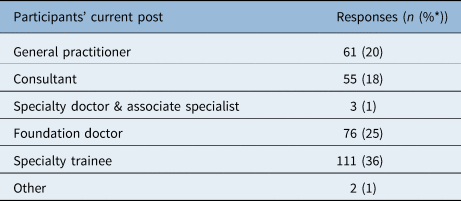
An estimated 6496 doctors were contacted and 308 responses were received. An exact figure for the number of doctors contacted cannot be given, as there may have been some duplication due to cross-over between mailing lists. Based on this estimate, the overall response rate was 4.74 per cent. Doctors from a range of specialties and geographical locations, in various posts, participated (Table 1).
Number of responses by a participant’s current post

*Rounded to nearest 1 per cent
Fifteen specialties were represented within the consultant group and 26 within the specialty trainee group. Forty-two per cent of participants from the consultant group were from specialties other than otolaryngology.
Only 21 per cent of participants felt that current undergraduate otolaryngology teaching was adequate. When subgroups were analysed by the participants’ current post, results showed that 64 per cent of foundation year doctors and 53 per cent of specialty trainees disagreed or strongly disagreed that current undergraduate otolaryngology teaching was adequate.
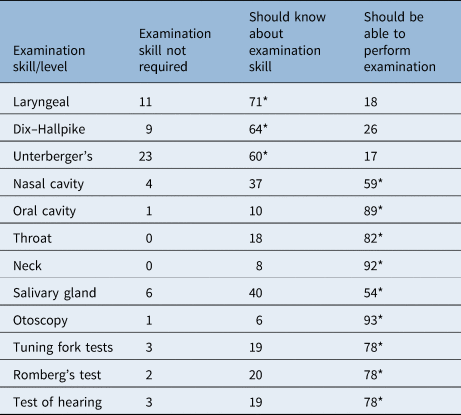
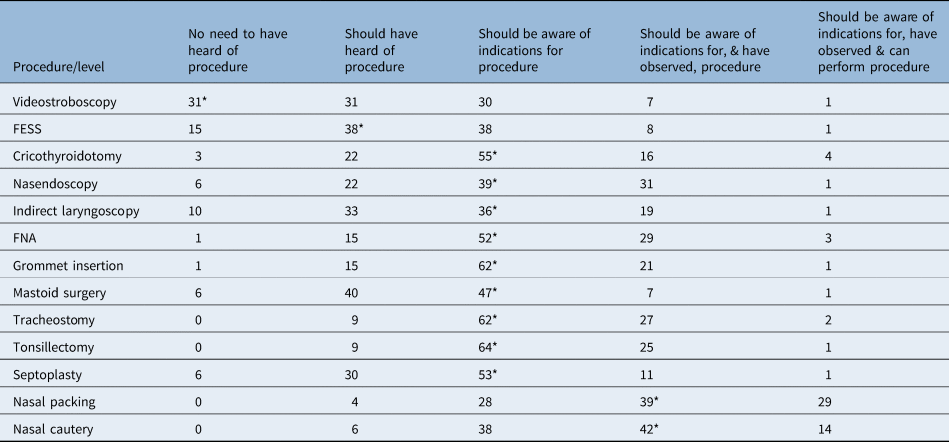
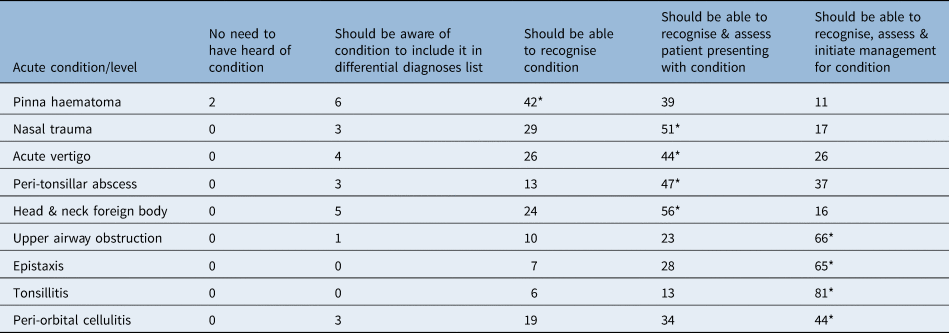
In Tables 2–6, the mode responses are indicated by asterisks. Numerical data have been presented so that where clear consensus (taken as greater than 50 per cent) has not been achieved, the frequency of responses (as a percentage) is available.
Mode response for all respondents for examination skills, indicated by asterisks

Data represent percentages
Mode response for all respondents for procedures, indicated by asterisks

Data represent percentages. FESS = functional endoscopic sinus surgery; FNA = fine needle aspiration
Mode response for all respondents for acute conditions, indicated by asterisks

Data represent percentages
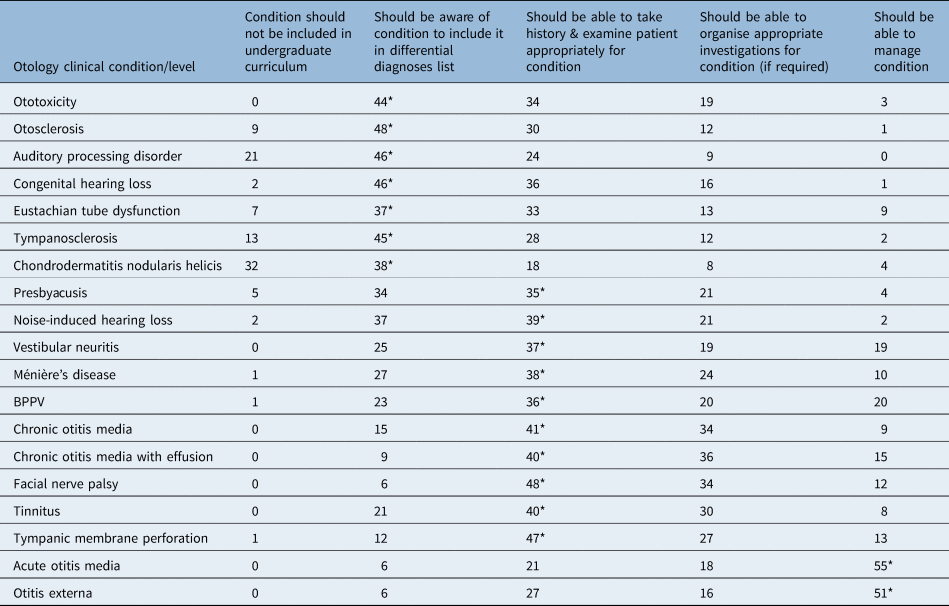
Mode response for all respondents for some otology clinical conditions, indicated by asterisks

Data represent percentages. BPPV = benign paroxysmal positional vertigo
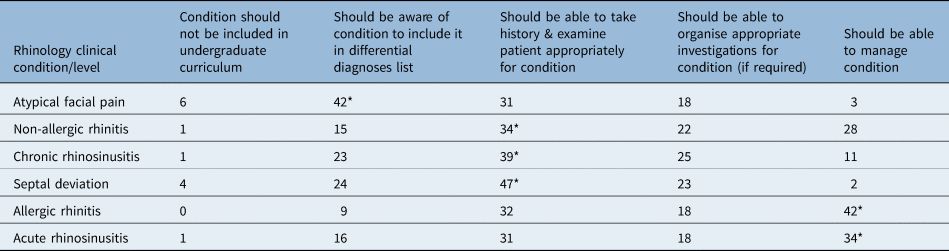
Mode response for all respondents for rhinology clinical conditions, indicated by asterisks

Data represent percentages
Participants felt that graduating medical students should be able to perform the majority of the examination skills listed (Table 2). The exceptions were tests requiring specialist equipment or those which are more specialist in nature.
The mode response of participants indicated that a graduating medical student should be aware of the indications for the majority of otolaryngology procedures listed, but not necessarily have observed any procedures except for nasal packing and nasal cautery (Table 3). There were no procedures that respondents felt students should be able to perform.
Doctors felt that graduating medical students should be able to recognise, assess and initiate management for four acute conditions (Table 4). These were: common otolaryngology emergencies, namely epistaxis and tonsillitis; and serious otolaryngology emergencies that may be life- or sight-threatening, namely upper airway obstruction and peri-orbital cellulitis.
In just under half of the otological conditions, the mode response of participants was for students to simply be aware of the condition and to include it on a list of differential diagnoses (Table 5). For 50 per cent of the conditions, the mode response was that students should be able to take a patient history and examine a patient appropriately for the specific condition. For both acute otitis media and otitis externa, the majority of participants indicated that students should be able to manage the conditions.
Allergic rhinitis and acute rhinosinusitis were the only two rhinology conditions for which the mode response was for students to be able to manage the conditions (Table 6). The mode response indicated that doctors also felt that graduates should have the knowledge and skills to allow appropriate history-taking and examination of patients presenting with non-allergic rhinitis, chronic rhinosinusitis and septal deviation.
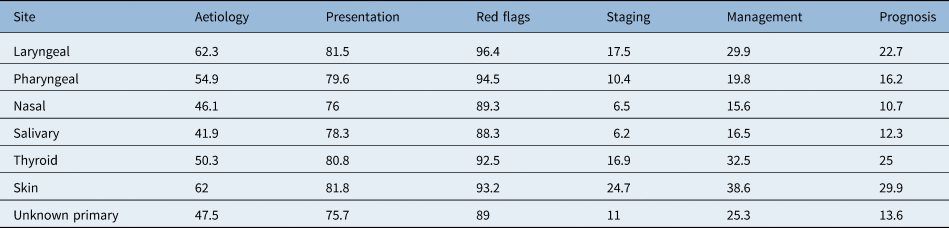
Table 7 shows that doctors felt that the aetiology of a cancer, how it presents and the ‘red flags’ of its presence were important for a student to know. Staging, management and prognosis were deemed less important.
Aspects of head and neck cancer deemed important for graduating medical students to know about

Data represent percentages of participants
Other subcategories, including investigations, psychosocial, non-technical skills, laryngology and other otolaryngology conditions, have been omitted for conciseness. The categories chosen are thought to be representative of the results in general, and give an overview of the main themes identified during analysis.
Discussion
This study goes further than previous studies by eliciting the level of performance expected of medical students by the point of graduation. It shows that doctors feel medical students should be able to perform the majority of otolaryngology examination skills. They should also be able to: recognise, assess and initiate management for both common and life-threatening acute conditions; take an appropriate patient history; and perform an appropriate examination for the majority of otolaryngology clinical conditions but manage only a select few.
Previous studies have investigated the perceived importance rating of otolaryngology topics. Similar areas emerge from each study as being deemed important. These include common topics such as ear infections, rhinosinusitis and throat infections, and life-threatening conditions such as airway compromise.Reference Wong and Fung35–Reference Ganzel and Martinez38 A difficulty with rating the importance of a topic is relating this to clinical and teaching practice. For example, what does an otitis externa importance rating of 5 out of 5 mean compared to an importance rating of 4 out of 5 for neck mass examination? This study moves beyond rating topics in terms of importance and identifies the level of performance expected of medical students by the end of their undergraduate studies.
Studies have shown that many medical schools within the UK have limited exposure to otolaryngology at an undergraduate level.Reference Khan and Saeed8,Reference Mace and Narula9 The findings from this study indicate that current medical school otolaryngology training is perceived as inadequate. What is striking is that it was the more junior participants (i.e. foundation year doctors and specialty trainees) who felt most strongly about this. These are the groups that have not only been through medical school most recently but are also those putting into practice what they have recently learned across a wide range of specialties.
One proposed theory for this perception is that the European Working Time Directive has led to an increased requirement by doctors in training to cross-cover other specialties.39,40 Otolaryngology is one of the specialties that commonly relies on cross-cover.Reference Sharpe, Farboud and Trinidade41 In 2009, Sharpe et al. published a survey showing a lack of confidence amongst surgical trainees who cross-cover otolaryngology.Reference Sharpe, Farboud and Trinidade41 Cross-cover has also been highlighted as an issue by the Association of Surgeons in Training, who have produced recommendations for doctors providing emergency cross-cover.Reference Wild, Lambert, Hornby and Fitzgerald6
Studies have highlighted a lack of confidence amongst junior doctors when managing otolaryngology conditions that require the use of procedural skills, for example, epistaxis.Reference Fox, Nash, Liu and Singh42 Despite this, the general response in this survey indicated that most doctors did not feel it was necessary to be able to perform any otolaryngology procedure, including nasal cautery and packing. With increasing requirements of junior doctors to cross-cover other specialties, this is an educational need that may have to be met at the post-graduate level.Reference Wild, Lambert, Hornby and Fitzgerald6 To date, the evidence suggests that this is not happening, with only 35 per cent of core surgical trainees having received any teaching on otolaryngology emergencies before starting a post requiring otolaryngology cross-cover.Reference Sharpe, Farboud and Trinidade41 Participants also did not feel that students should have observed any specific otolaryngology operations, including tonsillectomy. This is despite tonsillectomy being one of the most commonly performed operations in the UK.43 It is acknowledged that the questionnaire asked about specific operations and not about experience in an operating theatre in general.
The results of this study show that the majority of participants felt medical students should be competent in performing most otolaryngology examinations. Participants also indicated that students should be able to manage a number of acute conditions, but only a select few other otolaryngological conditions, by the time of graduation. These conditions included acute otitis media, otitis externa, acute rhinosinusitis, allergic rhinitis, laryngitis, epiglottis and croup; that is, the more commonly encountered or potentially serious conditions.Reference Hannaford, Simpson, Bisset, Davis, McKerrow and Mills44,45 For the majority of other otolaryngological clinical conditions, responses indicated that graduating students should be aware of a condition, or be able to take a patient history and examine a patient appropriately for the condition.
These findings are in keeping with the General Medical Council's Outcomes for Graduates, which emphasises the ability to ‘carry out a consultation with a patient’ (outcomes 2, The doctor as a practitioner).46 This includes the ability to perform an examination and obtain a patient history. The document also states that graduates should be able to ‘provide immediate care in medical emergencies’, which includes the ability to ‘diagnose and manage acute medical emergencies’.
The Scottish Doctor learning outcomes also correlate with the findings from this present study.16,Reference Simpson, Furnace, Crosby, Cumming, Evans and Friedman Ben David47 For example, ‘undertake physical examination of patients’ was included in the Scottish Doctor learning outcomes. However, these also state that students should be able to interpret the results of history-taking and physical examination, and make a diagnosis of ‘life-threatening conditions requiring immediate treatment’.
The findings of this study emphasise diagnosis rather than management of the majority of otolaryngological conditions. The exceptions to this are conditions that are commonly encountered or potentially serious. Both the General Medical Council and Scottish Doctor documents differentiate ‘routine’ clinical conditions from life-threatening ones, and state that graduates should be able to recognise and manage medical emergencies. The Scottish Doctor document also highlights an ‘important’ conditions element. This is in keeping with the results obtained from this study, in which participants appeared to differentiate between life-threatening, acute, common and other more general clinical conditions.
Two organisations have published curricula specifically relating to otolaryngology: The Royal College of Surgeons of England, and the Student and Foundation Doctors in Otolaryngology subgroup of ENT UK.48,49 The Royal College of Surgeons of England, in 2015, published a surgical curriculum for use in medical schools that included six ‘key surgical conditions’ relating to otolaryngology. The topics were chosen following discussion with stakeholders. Topics were included on the basis of how common or important they were, and the likely influence of ‘early recognition and potential surgical treatment’ on outcomes.49
The Student and Foundation Doctors in Otolaryngology subgroup of ENT UK also published an otolaryngology specific curriculum in 2015.48 Curriculum objectives were extrapolated from Delphi study data.Reference Lloyd, Tan, Taube and Doshi36 The learning objectives produced stipulated a level of performance for each objective; however, these were produced as a guide rather than being derived directly from study evidence. The current study builds on this by providing evidence for the level of performance expected of graduating medical students.
Limitations
The low response rate to this questionnaire is acknowledged. It is known that survey response rates from doctors are generally low.Reference Cunningham, Quan, Hemmelgarn, Noseworthy, Beck and Dixon50 In 2014, a British Medical Association survey of general practitioners returned a 4 per cent response rate, and another on contract imposition returned a 10 per cent response rate.51,52 The 5 per cent response rate in our survey is therefore in keeping with findings from other UK-based physician surveys. The results are felt to be representative of the wider UK doctor population. Responses were received from all main target groups and a range of opinions were elicited.
The three areas chosen for survey distribution were felt to be representative of the UK. It is, however, possible that a different setting (e.g. a more rural setting) would produce alternative results because of varying population needs. Given that, by their very nature, hospitals and doctors’ practices are generally located in more urban areas, the risk of bias is acknowledged but felt to be low.
• Developing curricula that are comprehensive but not overwhelming is a challenge
• Students should be able to recognise, assess and initiate management for common and life-threatening acute conditions
• Students should be able to take an appropriate patient history and perform an appropriate examination
• Students should be able to manage a select few clinical conditions
Conclusion
This study reports expected undergraduate performance levels for otolaryngology topics. Participating doctors feel that a higher level of performance should be expected of students treating life-threatening, acute and common otolaryngology conditions. The students should be able to: recognise, assess and initiate management for both common and life-threatening acute conditions; take an appropriate patient history; and perform an appropriate examination for the majority of otolaryngology clinical conditions but manage only a select few.
Acknowledgement
Simon Lloyd was financially supported by the NIHR Biomedical Research Centre, Manchester Academic Health Science Centre, University of Manchester, UK.
Competing interests
None declared