Loneliness is an emerging public health concern in the 21st century. About 20–30% of adults (age 45–79) report frequent feelings of loneliness; this number increases, reaching 40–50% among those over the age of 80 (Dykstra, Reference Dykstra2009). The adverse consequences of loneliness range from increased depressive symptoms (Bergman and Segel-Karpas, Reference Bergman and Segel-Karpas2018) to greater risk of mortality (Holt-Lunstad et al., Reference Holt-Lunstad, Smith, Baker, Harris and Stephenson2015). Thus, it is of great importance to identify the possible predictors of loneliness.
Loneliness is defined as a discrepancy between one’s desired and achieved levels of social relationships (de Jong Gierveld et al., Reference de Jong Gierveld, van Tilburg, Dykstra, Vangelisti and Perlman2018). It is a subjective state, which includes a person’s perceptions regarding their existing social relations as being deficient. This deficiency may be either quantitative, when the social network is perceived as too small, or qualitative, when social relationships are perceived as not intimate or rewarding enough (Hughes et al., Reference Hughes, Waite, Hawkley and Cacioppo2004). Accordingly, while there is only a moderate association between social isolation and loneliness (de Jong Gierveld et al., Reference de Jong Gierveld, van Tilburg, Dykstra, Vangelisti and Perlman2018), the association between quality of social relationships and loneliness is stronger (Masi et al., Reference Masi, Chen, Hawkley and Cacioppo2011). This study focuses on the association between close social relationships and loneliness, and on the role of subjective age as a potential moderator of this association.
The role of subjective age
According to the socioemotional selectivity theory (SST; Carstensen, Reference Carstensen1992), when people perceive time as limited, they tend to change their priorities and focus their attention on close social relationships. In order to create favorable social environments, older adults go through a process of reducing the size of their social networks by selecting those social partners that bear the greatest emotional meaning for them. These selected relationships serve as a way to increase favorable social feedback and reduce loneliness.
While the SST points to a general process that should help alleviate loneliness, individual differences in the experience of aging could also play a part in one’s ability to benefit from their close social environment. A key variable in this regard was termed subjective age, defined as the age people feel-like in relation to their chronological age. While it seems reasonable to think it is beneficial to accept one’s own chronological age, research shows that individuals who feel younger than their chronological age report better mental health, that is, fewer depressive symptoms and less loneliness. One explanation for this is that a younger age identity might reflect a more positive state of mind and a better “fit” to a society that encourages youthfulness (Kotter-Grühn et al., Reference Kotter-Grühn, Kornadt and Stephan2016; Segel-Karpas et al., Reference Segel-Karpas, Palgi and Shrira2017).
Feeling older than one’s age might imply a perceived mismatch between the self and one’s social environment, suggesting a sense of alienation. It is also possible that those who feel older than their chronological age might be burdened by their aging process, and as such, too preoccupied to enjoy and benefit from social interactions. Thus, older subjective age might impair the ability to enjoy the possible benefits that close social relationship can offer, first and foremost – the alleviation of loneliness.
Hence, the purpose of the current study is to investigate the role of subjective age in the association between close social relationships and loneliness. We draw on the SST (Carstensen, Reference Carstensen1992) and suggest that while, for most, the ability to engage in close social relationships bears advantages and results in a sense of connection that reduces loneliness, those who have an older age identity enjoy these advantages to a lesser extent. Therefore, we hypothesize that:
H1: There will be a negative association between close social relationships and loneliness.
H2: The negative relationship between close social relationships and loneliness will be moderated by subjective age, such that it will be weaker for those with older subjective age.
Method
Participants and procedure
A polling company randomly sampled Jewish and Arab participants residing in Israel. Participants were selected using an in-region random digit dialing methodology. The sample included individuals aged 20 or above from the national telephone directory, which provides regional and community-specific phone number information. The survey was conducted between March 26 and July 22, 2017 and an average interview took 18:41 min.
A total of 13,616 phone calls were conducted for the purpose of the study. In 6890 households, there was no answer, or the number belonged to a company. In another 1644 households, repliers did not meet the inclusion criteria of age. Out of 5082 households that included eligible interviewees, 3077 potential interviewees refused to participate in the survey. A total of 810 additional potential interviewees could not be interviewed because of hearing problems or cognitive incapacity; 342 participants filled out only the initial part of the demographic details and refused to complete the rest of the interview. The final sample consisted of 853 participants who completed at least most of the survey. Out of this sample, for the purpose of the present study, we included only those participants who were married or cohabiting, and were aged 50 or older, as the discrepancy between subjective and chronological age gains prominence in the second half of life. The analytical sample included 360 community-dwelling Israelis. The mean age was 64.65 (SD = 9.92, range = 50–97), more than half (n = 201; 55.8%) were men, and most had no higher education (beyond high school) (n = 209; 58.10%). Participants were interviewed in either Hebrew or Arabic, according to their mother tongue. Informed consent was obtained from all participants prior to completing the interview. The study received ethical approval by an institutional review board at the authors’ university. For further information, see Table 1.
Descriptive statistics for the study’s variables

Note. N = 360. *p < 0.05. **p < 0.01. ***p < 0.001.
Measures
Close Social Relationships were measured by an adjusted shortened version of a questionnaire proposed by Schuster et al. (Reference Schuster, Kessler and Aseltine1990). This three-item scale (i.e. “How close is your relationship with your partner/family members/friends?”) was rated on a scale ranging from 1 (not close at all) to 5 (very close). The final score was based on the cumulative sum of the answers, higher scores indicating a closer relationship. The Cronbach’s α was 0.74.
Subjective Age was measured by adapting Kastenbaum et al. (Reference Kastenbaum, Derbin, Sabatini and Artt1972) measure. While the original questionnaire related to the subjective age dimensions of “feel age”, “look age”, “do age”, and “would like to be age”, the dimensions we included were emotional age, physical age, “look age”, and “do age”. This four-item scale (e.g. “I do most of the things as if I am…”) was rated on a scale ranging from 1 (much younger than my age) to 5 (much older than my age). Items were averaged to create the score, such that higher scores indicated older subjective age. The Cronbach’s α was 0.84.
Loneliness was measured using the short version of the Revised UCLA loneliness Scale (R-UCLA) (Hughes et al., Reference Hughes, Waite, Hawkley and Cacioppo2004). The scale included three items (e.g. “How much of the time do you feel you lack companionship?”), which measure the respondent’s subjective feelings of distress regarding their lack of relationships. The items were rated on a scale ranging from 1 (hardly ever or never) to 3 (often). The final score was based on the average of the answers, higher scores indicating greater loneliness. The Cronbach’s α was 0.86.
Covariates included age, gender, education, and subjective health. Education was coded as 1 = (up to elementary education), 2 = (incomplete high school education), 3 = (complete high-school education), 4 = (BA degree), and 5 = (MA degree or above). Subjective health included a single item (“How would you describe your health?”), rated on a scale of 1 (very bad) to 5 (very good).
Results
We first examined the correlations between the study’s variables. Both the number of close social relationships and young subjective age were negatively correlated with loneliness (r p = −0.179, p < 0.005, r p = −0.179, p < 0.005, respectively). However, the number of close social relationships and subjective age were not significantly correlated (r p = −0.09, p = 0.06). Table 1 presents additional means, standard deviations, and correlations for all study variables.
Next, hierarchical linear regression was conducted to examine the association between close socialrelationships and loneliness, and whether subjective age moderated this relationship.
After controlling for age, gender, education, and subjective health in the first step of the hierarchical linear regression analysis, the results demonstrated that both social relationships (B = −0.130,t = −2.88, p < 0.001) and subjective age (B = 0.375, t = 2.410, p < 0.05) were associated with loneliness. Moreover, the results also indicated that the interaction between social relationships and subjective age on loneliness was significant (B = 0.192, t = 3.426, p < 0.001), accounting for an additional 3% of the variance in loneliness.
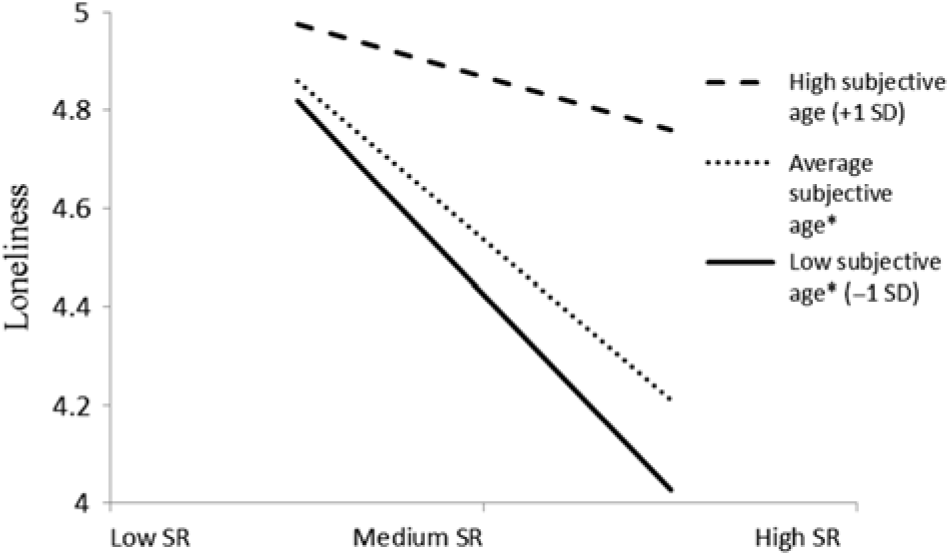
We further probed the interaction using the PROCESS statistical tool (Hayes and Rockwood, Reference Hayes and Rockwood2017), testing the slope between the variables for young subjective age (1 SD below the mean), mean subjective age, and old subjective age (1 SD above the mean). As can be seen in Figure 1, when subjective age was “old” (1 SD above the mean), each additional close social relationships score was associated with a nonsignificant decrease of 0.05 points in loneliness (B = −0.05, t[352] = −1.09, p = 0.27). When subjective age was mean, each additional close social relationships score was associated with a significant decrease of 0.21 points in loneliness (B = −0.21, t[352] = −4.23, p < 0.001). When subjective age was “young” (1 SD below the mean), each additional close social relationships score was associated with a statistically significant decrease of 0.30 points in loneliness B = −0.30, t[352] = −4.50, p < 0.001). Thus, the results suggest that an increase in subjective age weakens the association between close social relationship and loneliness.
The moderating role of subjective age on the association between social relationship and loneliness. Note. SR = social relationships *p < 0.001.

Discussion
The current study is unique in demonstrating that perceptions regarding one’s own aging, that is, subjective age, serve as a moderator in the relationship between close social relationships and loneliness. The findings show that an older subjective age might impair the impact of close social relations on experiencing less loneliness. This means that in the second half of life, those who succeed in adopting a young subjective age are able to enjoy close social relationships, which are related to lower levels of loneliness. However, for those with an “old” subjective age, close social relationships are not enough to prevent high levels of loneliness. The explanation for this finding could be that the majority of older adults tend to feel younger than their chronological age. This suggests that adopting a younger identity is part of the normal aging process, which makes older adults with an old subjective age feel alienated from their peer group. It is also possible that feeling older than one’s actual chronological age is an indicator of impaired physical and mental health, and that individuals who are preoccupied with health issues are less able to enjoy their close social relationships. Our findings broaden Carstnesen’s (Reference Carstensen1992) SST, which postulates that social relationships in old age decrease in number, but increase in intimacy − which in turn may mitigate loneliness. However, our findings suggest that this association is significant only among adults who do not have an older subjective age. Our findings also add to the existing literature regarding subjective age, suggesting that in addition to all other disadvantages related to older subjective age (Segel-Karpas et al., Reference Segel-Karpas, Palgi and Shrira2017), it also harms one’s ability to benefit from close social relationships.
Several limitations of the current study should be mentioned. First, a main limitation of this study is its cross-sectional design, and therefore causality cannot be determined. Further longitudinal studies are needed to determine how subjective age contributes to close social relationships and loneliness. Second, when considering policy implications, it is important to note that the size of the correlation effect between loneliness and close social relationships is relatively small (although statistically significant), and that the actual change in loneliness level is quite moderate regardless of social relationships’ closeness or subjective age levels. Therefore, it is difficult to evaluate the extent to which these differences in loneliness affect the suffering of the individual. Finally, while there are other constructs which are key variables in investigating the effect of subjective age on loneliness − such as feelings of alienation resulting from typical aging processes or having nearby family members − the current study did not measure these constructs.
In the current study, we investigated loneliness, a subject that has received increased research and public attention over the last two decades (Cohen-Mansfield et al., Reference Cohen-Mansfield, Hazan, Lerman and Shalom2016). Theoretically, this study adds to the existing body of knowledge aimed at disentangling the subjective state of loneliness from objective social isolation, which refers to deficits in a person’s social relationships (Palmer, Reference Palmer2019). In addition, it contributes to the literature by stressing the importance of examining one’s age identity as a variable that may negatively influence individuals’ ability to benefit from their social relationships by alleviating loneliness.
Practically, our findings suggest that subjective perceptions of aging should therefore be addressed in interventions aimed at easing one’s sense of loneliness. Promoting more positive attitudes toward aging could help individuals benefit more from the close social relationships they already have.
Conflict of interest
None.
Description of authors’ roles
N. Spitzer was responsible for carrying out the statistical analysis and the writing of the current paper. D. Segel-Karpas supervised the data collection process and assisted in the writing of the article. Y. Palgi designed the study, supervised the data collection, assisted in the writing process and was responsible for the study’s statistical design.
Acknowledgments
The research was supported by funding number 100004714 from the National Insurance Institute of Israel.