Introduction
Supervisor bottom-line mentality (SBLM), defined as a supervisor’s one-dimensional thinking that revolves around securing bottom-line outcomes while ignoring competing priorities (Bonner et al., Reference Bonner, Greenbaum and Quade2017; Greenbaum, Mawritz, & Eissa, Reference Greenbaum, Mawritz and Eissa2012), is ubiquitous in organizations. Research has demonstrated that SBLM has harmful effects on organizations. For example, SBLM may lead to subordinates’ unethical practices (Farasat & Azam, Reference Farasat and Azam2022; Hua, Zheng, Yang, & Yan, Reference Hua, Zheng, Mengxi and Yan2021), reduce employees’ organizational commitment (Quade et al., Reference Quade, Wan, Carlson, Kacmar and Greenbaum2021) and performance (Quade, McLarty, & Bonner, Reference Quade, McLarty and Bonner2020), and cause employee turnover intention (Mesdaghinia, Rawat, & Nadavulakere, Reference Mesdaghinia, Rawat and Nadavulakere2019). The abundant research lays a foundation for follow-up research on SBLM.
However, there is still a problem that the existing research has not resolved: how does SBLM influence employee withdrawal? This particular gap in the literature is important because employees are often considered the most important asset of the company (Vithana, Jayasekera, Choudhry, & Baruch, Reference Vithana, Jayasekera, Choudhry and Baruch2021) and serve as a catalyst to achieve the bottom line and other important priorities. Employees’ covert and retaliatory withdrawal will not only weaken employees’ sense of efficacy and work performance (Viswesvaran, Reference Viswesvaran2002) but can also cause economic losses to the organization and hinder the long-term development of the organization (Sagie, Birati, & Tziner, Reference Sagie, Birati and Tziner2002). Therefore, it is necessary to clarify the generation mechanism of SBLM. As a common scenario in organizations, SBLM often acts as a source of information for employees, affecting the cognition, attitude, and behavior orientation of subordinates. The immediate supervisor plays a central role in shaping employees’ experiences and behavior (Leiter, Gascón, & Martínez‐Jarreta, Reference Leiter, Gascón and Martínez‐Jarreta2010), and research has indicated that the supervisor is a key situational factor that affects employee withdrawal (Barrick, Mount, & Li, Reference Barrick, Mount and Li2013; Jiang & Qu, Reference Jiang and Qu2023). Previous studies seem to implicitly suggest that there is some connection between SBLM and employee withdrawal (e.g., the relationship between SBLM and performance, organizational commitment, and turnover intention), but the specific mechanism that connects the two is not clear. Therefore, we intend to explore the relationship between SBLM and employee withdrawal and to further examine its connection mechanism.
The meaning of work (individual feeling and experience of the meaning of the work that they are engaged in from the perspective of positive psychology; Steger, Dik, & Duffy, Reference Steger, Dik and Duffy2012) is a fundamental human need that all persons require to satisfy their inescapable interests in freedom, autonomy, and dignity (Yeoman, Reference Yeoman2014). The concept of the meaning of work can be influenced by individuals’ interactions and relationships with other persons or groups in the workplace (Pratt & Ashforth, Reference Pratt, Ashforth, Cameron, Dutton and Quinn2003; Wrzesniewski, Dutton, & Debebe, Reference Wrzesniewski, Dutton and Debebe2003). In particular, supervisors and the symbolism of their interpretations of, communications about, and responses to various work events and circumstances have an important influence on the meaning of work that people come to understand (Podolny, Khurana, & Hill-Popper, Reference Podolny, Khurana and Hill-Popper2004). SBLM is a mode of thinking that reflects the work priorities to which supervisors have always attached importance; the bottom line usually refers to quantitative indicators, such as economic profit indicators and performance objectives. Supervisors may only pay attention to the bottom line, ignoring the needs of employees, which may hinder employees’ perception of the meaning of work. The damage to the internal work driving force of employees will reduce their willingness to invest in work, which may be related to employee withdrawal.
Specifically, social information processing (SIP) theory indicates that individuals seek and use cues from social environments to interpret reality and shape their opinions, attitudes, and motives (Salancik & Pfeffer, Reference Salancik and Pfeffer1978). We draw upon this theory to suggest that superiors become the main source of information for employees in the organization because of their influence and official status. Employees’ perceptions of SBLM will not only stimulate employees’ concerns about survival (Greenbaum, Babalola, Quade, Guo, & Kim, Reference Greenbaum, Babalola, Quade, Guo and Kim2021) but also lead employees to consider the meaning of work. When a supervisor’s sole focus is on the bottom line, zero-sum competition and resource scarcity prevail (Sirola & Pitesa, Reference Sirola and Pitesa2017), destroying the relationship between colleagues (Greenbaum, Mawritz, & Eissa, Reference Greenbaum, Mawritz and Eissa2012) and causing cognitive internal friction among employees, which come at the expense of the meaning of work. Research shows that the meaning of work influences important aspects for employees, such as work motivation and performance (Hackman, Reference Hackman1980; Roberson, Reference Roberson, Brief and Nord1990), absenteeism and job satisfaction (Wrzesniewski, McCauley, Rozin, & Schwartz, Reference Wrzesniewski, McCauley, Rozin and Schwartz1997), stress (Elangovan, Pinder, & McLean, Reference Elangovan, Pinder and McLean2010; Locke & Taylor, Reference Locke, Taylor, A. and R. S.1991), career development (Dik & Duffy, Reference Dik and Duffy2009), and personal fulfillment (Kahn, Reference Kahn, Dutton and Ragins2007). Overall, the desire to find the meaning of work is an important motivator because it is indispensable in promoting positive results in the workplace (Rosso, Dekas, & Wrzesniewski, Reference Rosso, Dekas and Wrzesniewski2010; Wrzesniewski, Dutton, & Debebe, Reference Wrzesniewski, Dutton and Debebe2003; Yeoman, Reference Yeoman2014). Our research suggests that employees’ perception of high SBLM reduces employees’ meaning of work, which erodes their work motivation and promotes withdrawal.
In addition, reducing the negative influence of SBLM on employees’ meaning of work and employee withdrawal is another focus of this study. According to SIP theory, employees’ SIP process is not only directly affected by leadership behavior but also by other work situation characteristics (Salancik & Pfeffer, Reference Salancik and Pfeffer1978). High SBLM is sometimes accompanied by moral problems (Farasat & Azam, Reference Farasat and Azam2022; Hua et al., Reference Hua, Zheng, Mengxi and Yan2021; Mesdaghinia, Rawat, & Nadavulakere, Reference Mesdaghinia, Rawat and Nadavulakere2019); therefore, the supervisor’s attitude toward moral issues may affect the subordinate’s interpretation of the attitude and subsequent behavior. Amoral management is defined as a supervisor’s consistent failure to respond to issues that have ethical implications (Greenbaum, Quade, & Bonner, Reference Greenbaum, Quade and Bonner2015). Emerging empirical research has proven that amoral management has detrimental effects on the organization (Quade, Bonner, & Greenbaum, Reference Quade, Bonner and Greenbaum2022), and under the extreme conditions of SBLM, supervisor amoral management will alter their ability to detect information in the workplace (e.g., less information about the bottom line realization and work process of subordinates will be obtained), thus reducing control over the work process and work results of employees. The information transmitted by amoral management may also change employees’ negative cognition and interpretation of SBLM to weaken the negative influence it has on the meaning of work. Different from moral management, amoral management can improve the work efficiency and effect of employees (Bird & Waters, Reference Bird and Waters1989). Decision-making without strict moral standards can save time (Kreps & Monin, Reference Kreps and Monin2011) and provide employees with more operating space and flexibility to achieve the bottom line. From this perspective, we expect supervisors’ amoral management to mitigate the reaction extent of employees to high SBLM and weaken the negative influence on the meaning of work.
Further, according to the overall logic of SIP theory, we consider that the work situation factor-amoral management will not only weaken the influence of SBLM on employees’ meaning of work but also extend to employees’ turnover intention and work withdrawal behavior. Specifically, under the influence of SBLM, amoral management provides employees with additional cues to deal with special events or bottom-line implementations in the workplace where the bottom line is emphasized (Entwistle & Doering, Reference Entwistle and Doering2023) and reduces the influence of supervisors on employees’ cognitive process such as meaning of work. Research has shown that adhering to ethics and rules often comes at the cost of efficiency and effectiveness (Bird & Waters, Reference Bird and Waters1989). Continuously considering ethics and communicating ethical agendas in decision-making requires a significant amount of time (Greenbaum, Quade, & Bonner, Reference Greenbaum, Quade and Bonner2015), and implementing amoral management may be more efficient and effective because it gives employees discretion in achieving the bottom line (Greenbaum, Quade, & Bonner, Reference Greenbaum, Quade and Bonner2015). It also enables employees to independently decide how to allocate resources such as attention and time in the process of achieving the bottom line, without having to focus on other goals that are not directly related to the bottom line outcomes (Entwistle & Doering, Reference Entwistle and Doering2023) such as ethical considerations and strict work processes. This makes employees more likely to reach higher levels of accomplishment and a sense of competence to perceive the positive impacts of their work (meaning of work), which in turn will reduce employees’ willingness to leave the organization and work withdrawal behavior.
Our research makes the following contributions. First, this study contributes to the BLM literature by clarifying the relationship between SBLM and employee withdrawal. Specifically, we have confirmed that SBLM, as a situational factor that transmits negative social information, can not only lead to psychological withdrawal (higher turnover intention) which echoes the research of Mesdaghinia, Rawat, & Nadavulakere (Reference Mesdaghinia, Rawat and Nadavulakere2019) but can also lead to physical withdrawal (work withdrawal behavior).
Second, although many studies have focused on the dysfunctional effect of SBLM in organizations, its causes and mechanisms need to be further explored. Previous studies primarily described the causes of SBLM dysfunction from the perspective of competition (Wolfe, Reference Wolfe and Srivastva1988), social learning and social cognitive theory. We provide a novel explanation based on the SIP theory to introduce a new cognitive mechanism called meaning of work. This is a cognitive product of employees’ information processing of SBLM. Through this mechanism, SBLM can affect employee turnover intention and work withdrawal behavior, reflecting the importance of employees’ meaning of work under the influence of SBLM.
Third, by introducing amoral management to the literature as a moderator, we enrich the boundary conditions of SBLM. SBLM is sometimes accompanied by moral problems (Farasat and Azam, Reference Farasat and Azam2022; Mesdaghinia, Rawat, & Nadavulakere, Reference Mesdaghinia, Rawat and Nadavulakere2019), so the attitude and tendency of supervisors toward moral issues will affect employees’ subsequent behavior. Our research demonstrates that in extreme SBLM situations, amoral management can not only alter employees’ negative cognition toward high SBLM but also improve employees’ adaptability to it and decrease the subsequent negative influence. This reduces the negative influence of SBLM on employees’ meaning of work.
Fourth, this study integrates the moderating effect of management situational factors (amoral management) into the mediating role of meaning of work based on SIP theory, which further enhances our understanding of what management contexts can offset the negative effects of SBLM on employees’ ultimate outcomes, especially on employee withdrawal, thus promoting new insight on the boundary conditions of management situational factors in the relationship between SBLM and employee withdrawal and it also deeply expands the application of SIP theory in the fields of BLM and amoral management.
Fifth, we contribute to amoral management literature by introducing it to conduct empirical research. This is the second study that brings amoral management into empirical tests thus far which verifies the effectiveness of the amoral management scale (Greenbaum, Quade, & Bonner, Reference Greenbaum, Quade and Bonner2015; Quade, Bonner, & Greenbaum, Reference Quade, Bonner and Greenbaum2022). Previously, only one empirical study proved that supervisors’ amoral management will have a negative influence on subordinates’ moral courage and then lead to unethical behavior. The empirical study also calls for exploring the additional effects of amoral management (Quade, Bonner, & Greenbaum, Reference Quade, Bonner and Greenbaum2022). Based on existing research, our research verified that amoral management can complement the negative effects of the SBLM, lower the negative effects of SBLM on the employees’ meaning of work, and then reduce employees’ turnover intention and withdrawal behavior.
Literature review and hypotheses development
Employee withdrawal and its indicators
Employee withdrawal has been described as a family of attitudes and behaviors in which an employee is psychologically and physically away from the workplace in some capacity (David, Avery, Witt, & McKay, Reference David, Avery, Witt and McKay2015; Hanisch, Reference Hanisch and Nicholson1995), affecting both individual and organizational performance (Hanisch, Reference Hanisch and Nicholson1995). We are interested in two types of employee withdrawal: those with psychological tendencies and external behaviors. According to the existing research, employee withdrawal can be measured by several factors. For example, Koslowsky (Reference Koslowsky2009) summarized the decision point model of organizational withdrawal and job adaptation, as well as Hanisch and Hulin’s classification of work withdrawal (e.g., bad work behavior, lateness, absence) and job withdrawal (e.g., turnover intention, retirement intention). Although there are many indicators of employee withdrawal, combined with existing research, we conceptualize turnover intention as an indicator of employee psychological withdrawal and work withdrawal behavior as representative of physical withdrawal because they are the products of employee withdrawal (Koslowsky, Reference Koslowsky2009; Hanisch & Hulin, Reference Hanisch and Hulin1990). Turnover intention is described as an individual’s deliberate and estimated intention to leave an organization or profession within the near future (Cho et al., Reference Cho, Johanson and Guchait2009). Work withdrawal behavior refers to behavior that dissatisfied individuals use to minimize the time spent on their specific work tasks while maintaining their current organizational and work-role memberships. Work withdrawal has various manifestations, such as leaving work early, being absent from work under the pretext of illness, and taking longer breaks (Hanisch & Hulin, Reference Hanisch and Hulin1990).
SBLM and meaning of work
Bottom-line mentality (BLM) has the following five characteristics: a single-dimensional way of thinking (single value judgment standard), believing that everything can be measured by money, focusing more on recent situations, lacking a moral code, and caring too much about winning or losing (Duan, Liu, Deng, & Peng, Reference Duan, Liu, Deng and Peng2022; Wolfe, Reference Wolfe and Srivastva1988). Supervisors have high visibility and an important position and influence in the organization. When supervisors have high BLM, they become an important source of information for employees and convey organizational expectations and goals in the form of social information. After perceiving the clues, the individual will compare the information with his existing knowledge and experience and then make possible explanations for the obtained clues to form corresponding attitudes and behaviors (Salancik & Pfeffer, Reference Salancik and Pfeffer1978).
Many people want their career and work to be more than just a way to earn a paycheck or pass the time; they want their work to be different and mean something (Sverko & Vizek-Vidovic, Reference Sverko, Vizek-Vidovic, Super and Sˇverko1995). The meaning of work is a fundamental human need (Yeoman, Reference Yeoman2014), defined as an individual’s feeling and experience of the meaning of the work they are engaged in from the perspective of positive psychology (Steger, Dik, & Duffy, Reference Steger, Dik and Duffy2012). Previous studies have identified four main sources of meaning of work: the self (values, motivation, beliefs), other persons (coworkers, leaders, groups and communities, family), the work context (design of job tasks, organization mission, financial circumstances, etc.), and spiritual life (spirituality, sacred callings) (Rosso, Dekas, & Wrzesniewski, Reference Rosso, Dekas and Wrzesniewski2010). Although the meaning of work will be affected by environments and social situations, the final perception still depends on the individual (Wrzesniewski et al., Reference Wrzesniewski, McCauley, Rozin and Schwartz1997). Potential studies have shown a significant correlation between SBLM and employee work meaninglessness (Mesdaghinia, Nadavulakere, & Rawat, Reference Mesdaghinia, Nadavulakere and Rawat2020). Drawing on this research, we propose that the SBLM effects employees’ meaning of work from the following aspects.
First, corporate social responsibility and values play a vital role in shaping people’s meaning of work (Akdoğan, Arslan, & Demirtaş, Reference Akdoğan, Arslan and Demirtaş2016; Brief & Nord, Reference Brief, Nord, Brief and Nord1990). Supervisors with high BLM adhere to the bottom line first and may do anything at all costs (Greenbaum, Mawritz, & Eissa, Reference Greenbaum, Mawritz and Eissa2012; Lin, Yang, Quade, & Chen, Reference Lin, Yang, Quade and Chen2022). These attitudes and behaviors may be interpreted by followers in a short-sighted way, leading them to believe that supervisors and organizations are only concerned with ensuring the bottom line and financial results while ignoring other considerations (Chen, Sawyers, & Williams, Reference Chen, Sawyers and Williams1997; Greenbaum, Mawritz, & Eissa, Reference Greenbaum, Mawritz and Eissa2012; Wolfe, Reference Wolfe and Srivastva1988). However, the truth may be that the organization is also willing to focus on other competitive priorities. As representatives of organizations, supervisors with high BLM convey that the supremacy of organization profits has broken employees’ trust in the organization. Coupled with the moral problems caused by SBLM, employees may think that the organization lacks moral responsibility, and a violation of ethics rules will depress employees’ perception of the meaning of work (Akdoğan, Arslan, & Demirtaş, Reference Akdoğan, Arslan and Demirtaş2016).
Second, research shows that a sense of belonging and good interpersonal relationships are important sources of employees’ meaning of work (Rosso, Dekas, & Wrzesniewski, Reference Rosso, Dekas and Wrzesniewski2010; Wrzesniewski, Dutton, & Debebe, Reference Wrzesniewski, Dutton and Debebe2003), but high SBLM destroys this foundation. On the one hand, the focus of supervisors’ work is to achieve the bottom line, which may lead to neglect of employees’ need for work resource support, emotional care, and career development guidance. This can foster an organizational environment in which followers are unable to feel the organization’s attention and concern for them, resulting in a low sense of belonging. On the other hand, supervisors with high BLM will use various means to achieve the bottom line, sacrificing process, cooperation, and morality (Greenbaum, Mawritz, & Eissa, Reference Greenbaum, Mawritz and Eissa2012; Wolfe, Reference Wolfe and Srivastva1988), because this behavior can bring a multitude of benefits to individuals in the short term. Therefore, followers may imitate supervisors’ attitudes and behaviors, participate in excessive competition, and engage in immoral behavior and social undermining to achieve the bottom line (Eissa, Wyland, & Gupta, Reference Eissa, Wyland and Gupta2020), which makes it impossible for subordinates to maintain a sincere and friendly relationship with colleagues. Employees attach great importance to their current and long-term relationships with colleagues. Relationship harmony is the basic principle for employees to navigate interpersonal relationships (Chen, Leung, Li, & Ou, Reference Chen, Leung, Li and Ou2015) and is the basis of the meaning of work, while SBLM destroys the opportunities for subordinates to contact, connect, belong, and associate with others to reduce the meaning of work.
Third, a sense of autonomy and competence is the source of the meaning of work (Rosso, Dekas, & Wrzesniewski, Reference Rosso, Dekas and Wrzesniewski2010). SBLM will produce a highly competitive atmosphere in the organization (Babalola et al., Reference Babalola, Ren, Ogbonnaya, Riisla, Soetan and Gok2022) and increase employees’ job insecurity (Zhang et al., Reference Zhang, Zhang, Xie and Yang2021a) and performance pressure (Mesdaghinia, Rawat, & Nadavulakere, Reference Mesdaghinia, Rawat and Nadavulakere2019). This atmosphere may undermine employees’ sense of competence, leading to anxiety around the possibility of achieving the bottom line. Employees may then feel forced to invest more time and energy in their work to achieve the bottom line. This can lead to a lack of work autonomy, giving employees the sense that they are unable to independently control their work and determine the level of work time, work location, and effort level.
Hypothesis 1: SBLM is negatively related to employees’ meaning of work.
The mediating role of meaning of work between SBLM and turnover intention
According to SIP theory, after explaining the main context clues of bottom-line supremacy, employees will consider possible behavioral responses. They will then evaluate various responses and determine which action to take (whether to work hard or to withdraw) (Lord & Maher, Reference Lord and Maher1993). Existing studies have provided a possible mild result that employees’ meaning of work has a significant relationship with turnover intention (Arnoux-Nicolas, Sovet, Lhotellier, Di Fabio, & Bernaud, Reference Arnoux-Nicolas, Sovet, Lhotellier, Di Fabio and Bernaud2016; Hognestad Haaland, Olsen, & Mikkelsen, Reference Hognestad Haaland, Olsen and Mikkelsen2021; Sun & Sohn, Reference Sun and Sohn2021). We plan to verify whether this conclusion can also be applied in the context of SBLM.
SBLM reduces the subordinate’s sense of work autonomy and ability by transmitting clues to the subordinate about the lack of moral responsibility consciousness of the organization, which destroys the subordinate’s good interpersonal relationship and sense of belonging, leading them to have a lower sense of the meaning of work. Meaning of work is an internal work motivator that will further affect subsequent behavior (Wrzesniewski, Dutton, & Debebe, Reference Wrzesniewski, Dutton and Debebe2003). On the one hand, a potential consequence of solely defining and determining the value of employees in an organization based on economic indicators, such as focusing only on bottom-line implementation (SBLM), is a decrease in the enthusiasm and passion for work among subordinates (Schellenberg, Gaudreau, & Bailis, Reference Schellenberg, Gaudreau and Bailis2022). This is because the standard for defining personal value is too singular, but Maslow indicated that individuals have multiple value pursuits. Chasing a single goal for an extended period will lead to subordinates experiencing job burnout (Wrzesniewski et al., Reference Wrzesniewski, McCauley, Rozin and Schwartz1997) and eventually produce higher turnover intention. On the other hand, when employees have a low sense of the meaning of work, they will not only lack the internal motivation to continue to serve the organization but also lack the resources to manage work pressure since the meaning of work itself is considered a resource that helps employees cope with work pressure and maintain their well-being (Clausen & Borg, Reference Clausen and Borg2011). It is also one of the three psychological conditions for personal investment (Kahn, Reference Kahn1990). When employees fail to perceive the usefulness and value of work, especially if they perceive themselves to be the ‘machine’ that drives the organization’s bottom line, employees will not only lack the physical, cognitive, and emotional energy to work (May, Gilson, & Harter, Reference May, Gilson and Harter2004) but will also develop thoughts of leaving the organization. Research also shows that employees with a lower meaning of work are more likely to lose their identity to their work and organization (Pratt, Rockmann, & Kaufmann, Reference Pratt, Rockmann and Kaufmann2006), thereby increasing the willingness to leave the organization. Previous studies have provided evidence for our suggestion; for example, the meaning of work mediates the negative relationship between social mission and turnover intention (Sun & Sohn, Reference Sun and Sohn2021), and the effects of adverse working conditions on turnover intentions are also partially mediated by the meaning of work (Arnoux-Nicolas et al., Reference Arnoux-Nicolas, Sovet, Lhotellier, Di Fabio and Bernaud2016). In summary, this study believes that SBLM provides employees with objective conditions and information clues that undermine the meaning of work; therefore, employees’ turnover intention may increase accordingly. Combined with the previous content, we believe that high SBLM will enhance employees’ turnover intention by reducing employees’ meaning of work. The assumption is as follows:
Hypothesis 2: SBLM is negatively and indirectly related to turnover intention through employees’ meaning of work.
The mediating role of meaning of work between SBLM and work withdrawal behavior
According to SIP theory, after evaluating various behaviors and predicting the effects of various reactions, individuals may also choose hostile behaviors (Salancik & Pfeffer, Reference Salancik and Pfeffer1978), such as work withdrawal behavior in response to the organizational atmosphere. The information clues transmitted by SBLM reduce employees’ meaning of work, resulting in employee burnout and indifferent attitudes (Hackman & Oldham, Reference Hackman and Oldham1976). This lowers organizational commitment and work motivation, leading employees toward burnout and emotional exhaustion, thus, rationalizing their withdrawal behavior in subsequent work.
First, when employees lack the meaning of work, their organizational commitment is reduced (Fairlie, Reference Fairlie2011; Geldenhuys, Taba, & Venter, Reference Geldenhuys, Taba and Venter2014). Under the influence of SBLM, once employees realize that supervisors and organizations are determined to pursue the bottom line, even at the expense of employee welfare and corporate social responsibility (Eissa, Wyland, & Gupta, Reference Eissa, Wyland and Gupta2020; Greenbaum, Mawritz, & Eissa, Reference Greenbaum, Mawritz and Eissa2012; Quade, Bonner, & Greenbaum, Reference Quade, Bonner and Greenbaum2022), they are more likely to retaliate against the organization and engage in work withdrawal behaviors to express their dissatisfaction. Second, employees’ low meaning of work represents low work motivation (Chadi, Jeworrek, & Mertins, Reference Chadi, Jeworrek and Mertins2017; Hackman & Oldham, Reference Hackman and Oldham1976). SBLM creates a highly competitive atmosphere (Babalola et al., Reference Babalola, Ren, Ogbonnaya, Riisla, Soetan and Gok2022), tense relations, and low exchange relations among colleagues, making it difficult for employees to fluidly obtain work information and cooperate with colleagues. Instead, they can only rely on personal strength to deal with high competition so are involved in lower work motivation avoidance response, generating work withdrawal behavior. Third, when employees perceive the low meaning of work for extended periods, they are prone to burnout and emotional exhaustion (Wrzesniewski et al., Reference Wrzesniewski, McCauley, Rozin and Schwartz1997), resulting in employees not having enough resources to control their emotions and behaviors. Continuous resource shortages and mental laxity will lead to employees’ work withdrawal behaviors, such as poor attendance or tardiness.
Hypothesis 3: SBLM is negatively and indirectly related to work withdrawal behavior through employees’ meaning of work.
The moderating role of amoral management between SBLM and the meaning of work
Consistent with the perspective of SIP, the formation of employees’ perceptions and behavior will be affected by the relevant factors of the information sender and the information receiver (Miller & Monge, Reference Miller and Monge1985). Research shows that high SBLM is sometimes accompanied by moral issues (Babalola, Mawritz, Greenbaum, Ren, & Garba, Reference Babalola, Mawritz, Greenbaum, Ren and Garba2021; Farasat and Azam, Reference Farasat and Azam2022; Mesdaghinia, Rawat, & Nadavulakere, Reference Mesdaghinia, Rawat and Nadavulakere2019); therefore, supervisors’ attitudes toward moral issues may affect subordinates’ interpretation and subsequent behavior. Amoral management refers to supervisors’ consistent failure to respond to issues that have ethical implications (Greenbaum, Quade, & Bonner, Reference Greenbaum, Quade and Bonner2015) and reflects the neutral attitude of supervisors when facing moral issues, which can be divided into two types: intentional and unintentional. The main view is that business activities do not belong to the scope of the application of moral judgment, and individuals who implement amoral management will not judge the rationality of a business decision on whether they comply with morality (Greenbaum, Quade, & Bonner, Reference Greenbaum, Quade and Bonner2015). A few studies empirically test the negative influence of amoral management in organizations and propose testing whether and when amoral management is effective (Quade, Bonner, & Greenbaum, Reference Quade, Bonner and Greenbaum2022) because morally neutral supervisors are common in business environments. With the support of the above theories, our research proposes that amoral management may complement the effect of SBLM. Specifically, it can alleviate the negative influence of SBLM on employees’ meaning of work in the following ways.
First, the long-term implementation of amoral management by supervisors, whether intentional or unintentional, will alter a supervisor’s ability to detect information in the workplace. For example, it may reduce the information retrieval, acquisition, and monitoring of employees’ work processes and results. The message transmitted by these behaviors is released to employees so that they can decide how to achieve the bottom line without too much interference from supervisors, which imperceptibly affects the cognition of employees. Consequently, the neutral attitude of supervisors toward ethical issues may make employees overlook moral considerations in work and decision-making to obtain more working autonomy space and fewer rule constraints. In this case, it is easier for employees to achieve the bottom line or achieve certain achievements to enhance their perception of the significance and value of their work.
Second, the implementation of amoral management can enable subordinates to obtain social capital with ease. Social capital spans multiple social fields, and friendship in one field can be used to provide resources that are lacking in another (Greenbaum, Quade, & Bonner, Reference Greenbaum, Quade and Bonner2015). The amoral management implemented by supervisors provides clues that employees have a certain degree of work autonomy and discretion in special events. Employees can use this implicit support to obtain social capital, such as socializing with prospective clients (Quenqua, Reference Quenqua2012) and providing other benefits to partners, which helps to achieve the bottom line. Although employees know that this may violate morality, the moral neutrality of supervisors allows them to adopt such behavior to achieve the bottom line by default, which can alleviate the pressure on employees to do so, which may in turn enhance employees’ sense of achievement if the bottom line is realized. Research also confirms that immoral managers may be in a leading position to realize the bottom line but fail to do so when they strongly encourage moral compliance (Trevino et al., Reference Treviño, Brown and Hartman2003).
Finally, the business strategy of amoral management advocates that managers should not be constrained by the excessive moral framework but should allow a certain amount of free space within the scope of the enterprise system. Because acting strictly within ethical rules requires employees to spend more time on moral decision-making and management (Brown, Treviño, & Harrison, Reference Brown, Treviño and Harrison2005), it may be at the cost of efficiency and effectiveness (Bird & Waters, Reference Bird and Waters1989). In amoral management, the moral mentality of supervisors is neutral, which reduces the time and energy spent by employees abiding by complex ethics. In other words, supervisors with a high level of amoral management acquiesce in giving employees work autonomy, discretion on special matters and flexibility of rules, which can increase the resources and support for employees to achieve the bottom line. This can reduce the sense of incompetence and competition caused by SBLM and alleviate employees’ low sense of meaning of work.
In summary, we propose that amoral management moderates the extent to which SBLM negatively affects the meaning of work. We hypothesize the following:
Hypothesis 4: Supervisor’s amoral management moderates the relationship between SBLM and meaning of work such that the relationship is weaker when supervisors have higher (rather than lower) amoral management.
Moderated mediation model
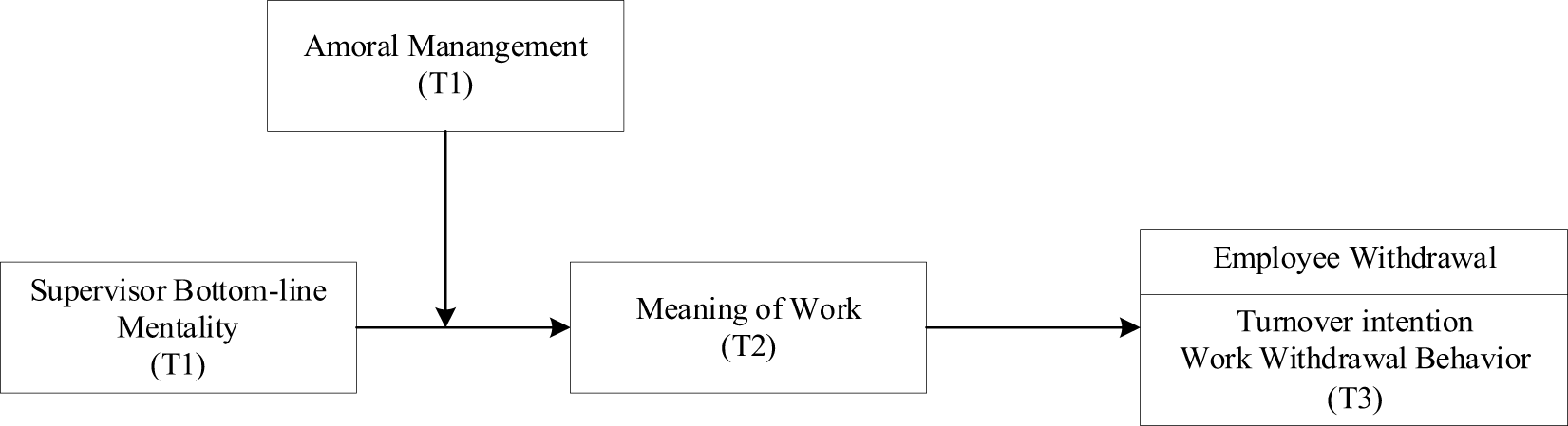
We propose that SBLM leads to a low meaning of work (H1). Furthermore, we suggest that the meaning of work serves as a mediator between SBLM and turnover intention (H2) and between SBLM and work withdrawal behavior (H3). In addition, amoral management moderates the negative relationship between SBLM and the meaning of work. These relationships can form a complete framework with a moderated mediation model (Edwards & Lambert, Reference Edwards and Lambert2007; Jiang, Liang, & Wang, Reference Jiang, Liang and Wang2023; Preacher, Rucker, & Hayes, Reference Preacher, Rucker and Hayes2007) (see Fig. 1). Specifically, SBLM provides employees with prominent clues and behavioral norms to urge members to pursue the bottom line, while subordinates interpret the moral ‘inaction’ of amoral management as valuing organizational profits and personal interests. Also, it conveyed the implicit message to employees that they have a high level of discretion in achieving the bottom line (Entwistle & Doering, Reference Entwistle and Doering2023) and the ability to obtain social capital support in special ways (Greenbaum, Quade, & Bonner, Reference Greenbaum, Quade and Bonner2015). As a result, employees are more likely to achieve the bottom line and thus they feel less challenged and stressed (Entwistle & Doering, Reference Entwistle and Doering2023). This implicit message of flexibility and autonomy in realizing the bottom line can enhance employees’ positive work cognition under the influence of SBLM (meaning of work), so that employees are less motivated to withdraw from the organization – reducing employees’ psychological withdrawal (turnover intention) and physical withdrawal (work withdrawal behavior). On the contrary, when amoral management is low, employees are unable to enjoy the benefits of implicit discretion and may even be subject to more monitoring and control of the bottom-line implementation process by supervisors at work. Close monitoring and control increases employees’ sense of obstruction and pressure at work. In this circumstance, their sense of obstruction and pressure increases, leading to a lower meaning of work and a higher willingness to leave the organization, as reflected in their higher turnover intention and work withdrawal behaviors. Integrating the above viewpoints, we propose:
Hypothesis 5a: Amoral management moderates the mediated relationship between SBLM and employee turnover intention by meaning of work. Specifically, the indirect relationship will be weaker for supervisors with higher (vs. lower) levels of amoral management.
Hypothesis 5b: Amoral management moderates the mediated relationship between SBLM and employee work withdrawal behavior by meaning of work. Specifically, the indirect relationship will be weaker for supervisors with higher (vs. lower) levels of amoral management.
The theoretical model. T1 = Time 1; T2 = Time 2; T3 = Time 3.

Method
Sample and procedure
The research data were collected from a Chinese manufacturing enterprise. Before the investigation, we contacted the key contacts of the company to inform them of the purpose of our investigation and assured them that the investigation would not jeopardize the privacy of the company. The data obtained would only be used for academic research and would not be disclosed elsewhere. With the assistance of the human resources management department, we obtained employee ID information and used it to match surveys at three points in time. More specifically, participants filled out their employee IDs in each of the three-stage questionnaires, and we matched surveys from different time points using employee IDs. Before the formal investigation, we followed the standard back-translation procedure proposed by Brislin (Reference Brislin1970) to process the measurement scale. First, a doctoral student was invited to translate the English scale into Chinese; then, another professional translated Chinese into English to ensure that the expression of the scale conformed to the habits and cultural situations of Chinese people without losing the information in the original scale. Then, we edited the electronic questionnaire on a questionnaire-making website (https://www.wjx.cn), sent the three-stage questionnaire links to the key contacts of the company, and distributed it to the employees three times (3-week interval).
The samples are distributed in multiple departments, including the sales department, project department, information department, and others. First, 676 employees were invited to respond to measures of SBLM and amoral management measurement, as well as some demographic information about themselves at Time 1. We received 568 complete data points (overall response rate = 84.02%). Then, 3 weeks after Time 1 (Time 2), key contacts sent a questionnaire on the meaning of work to employees, and 419 of them responded (response rate from Time 1 = 62.82%, overall response rate = 61.98%). At Time 3 (3 weeks after Time 2), key contact invited employees to complete the questionnaire, which included questions on turnover intention and withdrawal behavior, and 371 of them responded (response rate from Time 2 = 88.54%, overall response rate = 44.53%). After deleting randomly filled questionnaires, incomplete and/or mismatched data, we finally obtained 301 data points that could be used in our research. In the sample, 71.1% are male and 28.9% are female. The average age of employees is 34.80 years (SD = 6.309) because manufacturing enterprises have a higher level of requirements for employees’ experience and skills, and older employees can better meet these requirements. In terms of education level, 69.1% of the participants had an undergraduate degree. Finally, the sample’s average organizational tenure was 10.73 years (SD = 6.105).
Measures
Participants were invited to rate demographic information (including gender, age, education level, and organizational tenure), SBLM, amoral management at Time 1, and meaning of work at Time 2. At time 3, participants rated their turnover intention and withdrawal behavior. Except for demographic information, all scales adopt a Likert 5-point scale ranging from 1 (strongly disagree) to 5 (strongly agree).
SBLM
Participants responded to a 4-item scale on SBLM (Greenbaum, Mawritz, & Eissa, Reference Greenbaum, Mawritz and Eissa2012). A sample item is ‘my supervisor treats the bottom line as more important than anything else’ (α = 0.94).
Amoral management
Participants responded to a 4-item scale on amoral management (Quade, Bonner, & Greenbaum, Reference Quade, Bonner and Greenbaum2022). A sample item is ‘my supervisor does not get involved when ethical issues arise’ (α = 0.95).
Meaning of work
Participants responded to a three-item scale on the meaning of work (Spreitzer, Reference Spreitzer1995). A sample item is ‘the work I do is meaningful’ (α = 0.94).
Turnover intention
Participants responded to a three-item scale on turnover intention (Meyer, Allen, & Smith, Reference Meyer, Allen and Smith1993). A sample item is ‘I will probably look for a new job outside this organization’ (α = 0.94).
Work withdrawal behavior
Participants responded to an eight-item scale on work withdrawal behavior (Hanisch & Hulin, Reference Hanisch and Hulin1990). A sample item is ‘I let others do work for me’ (α = 0.85).
Control variables
Previous studies have shown that employees’ gender, age, education level, and organizational tenure are related to turnover intention (Babalola, Stouten, & Euwema, Reference Babalola, Stouten and Euwema2016; Meyer, Stanley, Herscovitch, & Topolnytsky, Reference Meyer, Stanley, Herscovitch and Topolnytsky2002) and employee withdrawal behavior (Huang, Tian, Wang, & Wang, Reference Huang, Tian, Wang and Wang2022; Tak, Reference Tak2011). Therefore, we controlled for these variables to exclude their potential impacts on turnover intention and employee withdrawal behavior. During our data analyses, only age and organizational tenure had significant correlations with turnover intention among the four control variables. Therefore, following the suggestion of Becker et al. (Reference Becker, Atinc, Breaugh, Carlson, Edwards and Spector2016), we only controlled for these two variables in our data analyses with turnover intention as the dependent variable, while other analyses did not include control variables.
Results
Preliminary analysis
Before testing our hypothesis, we conducted several confirmatory factor analyses using AMOS 24.0 based on the research of Lux, Grover, and Teo (Reference Lux, Grover and Teo2023). We evaluated the rationality of the measurement model by comparing our proposed five-factor model with several nested four-factor measurement models, as shown in Table 1. The proposed five-factor model fit the data best, indicating an acceptable fit (χ2 = 542.173; df = 199; χ2/df = 2.724; Comparative Fit Index (CFI) = 0.938; Tucker-Lewis Index (TLI) = 0.928; Normed Fit Index (NFI) = 0.906; Root-Mean-Square Error of Approximation (RMSEA) = 0.076; Standardized Root Mean Square Residual (SRMR) = 0.051). Furthermore, the five-factor model was significantly better than the four-factor model 1, which combined SBLM and turnover intention; the four-factor model 2 combined SBLM and work withdrawal behavior; the four-factor model 3 combined amoral management and meaning of work; the four-factor model 4 combined amoral management and turnover intention; the four-factor model 5 combined SBLM and meaning of work; the four-factor model 6 combined SBLM and amoral management; the four-factor model 7 combined work withdrawal behavior and turnover intention; and the single-factor model. Equally important is that the difference tests between the four-factor models and the five-factor model are significant. Moreover, the factor load of all items is greater than 0.5 and significant on the proposed latent constructions, which indicates that the model is acceptable and has significant discriminant validity.
Confirmatory factor analysis results

N = 301. Four-factor model 1 = SBLM + turnover intention; Four-factor model 2 = SBLM + work withdrawal behavior; Four-factor model 3 = amoral management + meaning of work; Four-factor model 4 = amoral management + turnover intention; Four-factor model 5 = SBLM + meaning of work; Four-factor model 6 = SBLM + meaning of work; Four-factor model 7 = work withdrawal behavior + turnover intention. ***p < .001.
In addition, the overall response rate of the sample in this study is 44.53%, so we attend to the nonresponse bias problem by comparing whether there is a difference between early and late participant data (Armstrong & Overton, Reference Armstrong and Overton1977). Due to the use of three-stage data in the study, different variables were collected at each stage, and participants in each stage submitted questionnaires at different times. Therefore, we first extracted 301 participants’ submission times at each stage. Then, we tested the SBLM and amoral management scales completed in the first stage, the meaning of work scales completed in the second stage, and the turnover intention and work withdrawal behavior scales completed in the third stage for any significant differences before (50%) and after (50%) each stage. Referring to the independent-sample t-test method adopted by Samreen, Rashid, and Hussain (Reference Samreen, Rashid and Hussain2022), the results showed that the difference test of SBLM (mean difference = 0.074, t = 0.832, p = .406), amoral management (mean difference = −0.022, t = −0.234, p = .816), meaning of work (mean difference = −0.053, t = −0.960, p = .338), turnover intention (mean difference = 0.089, t = 1.274, p = .204), and work withdrawal behavior (mean difference = −0.018, t = −0.462, p = .645) in the early and late stages of each stage was not significant, demonstrating that no nonresponse bias would affect our research results.
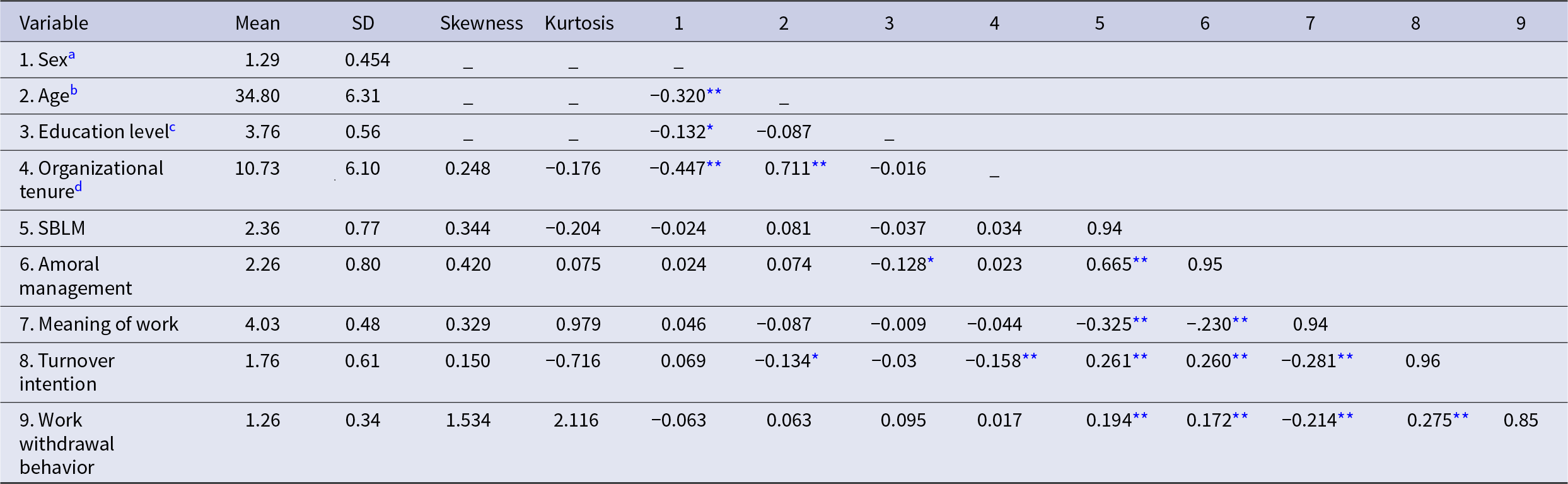
Table 2 shows the descriptive statistical indicators, skewness, kurtosis, and correlations among variables. From the skewness and kurtosis values, the absolute value of the skewness of the continuous variable was less than 3, and the absolute value of the kurtosis was less than 7. These results indicate that our data followed normal distribution (Curran, West, & Finch, Reference Curran, West and Finch1996). Additionally, SBLM was negatively associated with meaning of work (r = −0.325, p < .01) and positively associated with turnover intention (r = 0.261, p < .01) and work withdrawal behavior (r = 0.194, p < .01). Furthermore, meaning of work was negatively associated with turnover intention (r = −0.281, p < .01) and work withdrawal behavior (r = −0.214, p < .01). The diagonal line of the table showed the α reliability of the scale. In addition, because the correlation coefficient between SBLM and amoral management was 0.665, which was higher than 0.5, we made a multicollinearity test. The results showed that there was no serious multicollinearity problem in this study (tolerance ranged from 0.439 to 0.991, and VIF ranged from 1.009 to 2.276) (Menard, Reference Menard1995).
Descriptive statistics and correlations among variables

N = 301. SBLM = supervisor bottom-line mentality.
a 1 = male, 2 = female.
b In years.
c 1 = doctoral degree, 2 = master’s degree, 3 = bachelor’s degree, 4 = college degree, 5 = middle school degree.
d In years.
* p < .05, **p < .01.
Tests of hypotheses
We utilized Mplus 8.3 to construct a structural equation model to test the hypotheses. Bootstrapping analysis (Preacher & Hayes, Reference Preacher and Hayes2008) was used in our models when testing mediating and moderating effects. Bootstrapping can use limited sample data to re-establish a new sample that represents the distribution of the parent sample after repeated sampling to verify the robustness of the hypothesis (Preacher & Hayes, Reference Preacher and Hayes2004). We summarize these results in Tables 3–5. First, we construct a mediation model to verify H1, H2, and H3. As expected (see Table 3), SBLM has a significant negative effect on the meaning of work (b = −0.33, p < .001), supporting H1. Meaning of work also had a significant negative effect on turnover intention (b = −0.23, p < .001) and work withdrawal behavior (b = −0.17, p < .01). The results of our bootstrapping analysis (k = 2000) revealed that the indirect effect between SBLM and turnover intention is significant, as the confidence interval (CI) did not include zero (b = 0.08, SE = 0.02, 95% CI = [0.028, 0.100]), supporting H2; the indirect effect between SBLM and work withdrawal behavior is also significant, as the CI did not include zero (b = 0.06, SE = 0.02, 95% CI = [0.009, 0.043]), supporting H3. In addition, following the suggestions of Becker et al. (Reference Becker, Atinc, Breaugh, Carlson, Edwards and Spector2016), we reported the results with turnover intention as the dependent variable and without control variables. As shown in Table 3, the meaning of work also had a significant negative effect on turnover intention (b = −0.22, p < .001), and the indirect effect between SBLM and turnover intention was also significant (b = 0.07, SE = 0.02, 95% CI = [0.026, 0.097]). This result further demonstrated the robustness of our research findings.
Regression results of mediating effect

N = 301. SBLM = supervisor bottom-line mentality; TI = turnover intention; WB = withdrawal behavior.
Standardized regression coefficients are reported. Bootstrap sample size = 2000; standard error in brackets.
* p < .05, **p < .01, ***p < .001.
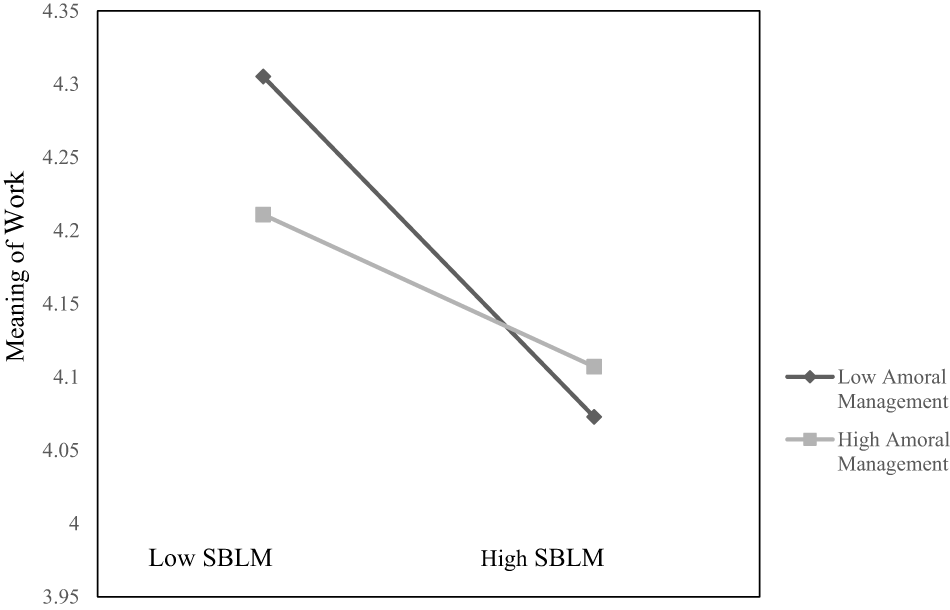
Furthermore, we tested H4, H5a, and H5b with a structural equation model containing moderator and interaction terms; see Table 4. In support of H4, the regression of the interaction term on the meaning of work is significant (b = 0.16, p < .01). To further confirm our conclusion, we also conducted a simple slope analysis and found that they were consistent with our hypothesized pattern. As shown in Fig. 2, the relationship between SBLM and meaning of work was negative when amoral management was low (b = −0.29, SE = 0.06, t = −4.97, p < .001) and was mitigated when amoral management was high (b = −0.12, SE = 0.05, t = −2.39, p < .05).
Regression results of the moderating effect

N = 301. SBLM = supervisor bottom-line mentality; TI = turnover intention; WB = withdrawal behavior.
Standardized regression coefficients are reported. Standard error in brackets.
* p < .05, **p < .01, ***p < .001.
The moderating effect of amoral management on SBLM and meaning of work.

Finally, we tested the conditional indirect effects of SBLM on turnover intention and work withdrawal behavior through the meaning of work at low and high values of amoral management (±1 SD from the mean). As shown in Table 5, the conditional indirect effect between SBLM and turnover intention is significant at low (b = 0.08, 95% CI = [0.037, 0.143]) and high (b = 0.03, 95% CI = [0.006, 0.068]) amoral management, and the difference between the high and low effects is also significant (b = −0.05, 95% CI = [−0.096, −0.015]), as the bootstrap CI did not include zero, thus supporting H5a. Similarly, the conditional indirect effect between SBLM and withdrawal behavior is significant at low (b = 0.03, 95% CI = [0.012, 0.063]) and high (b = 0.01, 95% CI = [0.002, 0.031]) amoral management, the difference between the high and low effects is significant (b = −0.02, 95% CI = [−0.042, −0.005]), and H5b has also been confirmed. In addition, we also reported the results without control variables in Table 5, and our results stayed substantively the same. Taken together, our results show that when supervisors implement amoral management more frequently, employees can change their negative cognition toward SBLM, adapt to SBLM, weaken its negative impact on the meaning of work, and possibly lead to lower levels of turnover intention and work withdrawal behavior.
Conditional indirect effects

TI = turnover intention; WB = withdrawal behavior; AM = amoral management.
N = 301. Standardized regression coefficients are reported. Bootstrap sample size = 2000.
Discussion
BLM is a developing research topic (Babalola et al., Reference Babalola, Ren, Ogbonnaya, Riisla, Soetan and Gok2022; Greenbaum, Mawritz, & Eissa, Reference Greenbaum, Mawritz and Eissa2012; Mesdaghinia, Rawat, & Nadavulakere, Reference Mesdaghinia, Rawat and Nadavulakere2019), and the relationship between SBLM and employee withdrawal needs to be further explored. Through a three-stage field study, we indicated that as a source of negative social information, SBLM will reduce employees’ cognition of the meaning of work and lead to employees’ turnover intention and work withdrawal behavior. In contrast, the amoral management implemented by supervisors can perform a complementary role in the effects of SBLM. In special situations, it can decrease the negative influence of SBLM on employee withdrawal through the meaning of work to adapt to the environment of bottom-line supremacy.
Theoretical contributions
Our research makes the following theoretical contributions. First, this research contributes to the emerging BLM research by clarifying the relationship between SBLM and employee withdrawal. Although many studies have proven that SBLM has more negative effects on subordinates (Farasat et al., Reference Farasat and Azam2022); Greenbaum et al., Reference Greenbaum, Mawritz and Zaman2023; Mesdaghinia, Rawat, & Nadavulakere, Reference Mesdaghinia, Rawat and Nadavulakere2019), existing studies ignore the relationship between SBLM and employee withdrawal. Employee withdrawal has a great negative influence on the normal operation of the organization (Koslowsky, Reference Koslowsky2009; Hanisch & Hulin, Reference Hanisch and Hulin1990). To clarify the relationship between the two, our research provides specific evidence that SBLM has a stimulating effect on employee withdrawal in the form of turnover intention and work withdrawal behavior. Based on this, our understanding of the relationship between SBLM and employee withdrawal has been strengthened.
Second, based on SIP theory, we confirmed the mediating role of employees’ meaning of work between SBLM and employee withdrawal and more clearly illustrated the transmission path between the two, which provides the academic community with a more comprehensive and accurate understanding of the ‘black box’ between SBLM and employee withdrawal. Early theoretical research has highlighted that the surrounding negative environment (such as SBLM) will greatly weaken the internal motivation of subordinates and reduce their interest in work (Babalola et al., Reference Babalola, Greenbaum, Amarnani, Shoss, Deng, Garba and Guo2020), thus increasing the possibility of psychological withdrawal and physical withdrawal. While revealing the mechanism that induces employee withdrawal, we further expand the role boundary of the meaning of work, responding to the call of Rosso, Dekas, & Wrzesniewski (Reference Rosso, Dekas and Wrzesniewski2010) and others to expand the role scope of work meaning.
Third, our research demonstrates that not all employees will perceive that a low meaning of work is due to high SBLM. Amoral management acts as a moderator in this influence process and contributes to the BLM literature. Specifically, the amoral management implemented by supervisors can supplement the influence of SBLM. The neutral attitude of supervisors toward moral events may mean employees automatically ignore moral considerations in work and decision-making. This invisible work autonomy, discretion in special events, and flexibility of rules can be used to obtain social capital and improve employees’ adaptability to the bottom-line first environment. Improvement in employees’ understanding of SBLM can reduce the adverse processing of SBLM information (Entwistle & Doering, Reference Entwistle and Doering2023), thus reducing the negative influence of SBLM on employees’ meaning of work.
Fourth, the moderated mediation perspective explains why and when the effect of SBLM on employee withdrawal is reduced. The results elaborate that the moderating effect of amoral management on the negative relationship between SBLM and the meaning of work has a strong effect so as to spread to employees’ withdrawal. In other words, the higher the level of amoral management, the weaker the influence of SBLM on employees’ turnover intention and work withdrawal behavior through the meaning of work. Although previous BLM literature has used SIP theory to explain its mechanism (Babalola et al., Reference Babalola, Greenbaum, Amarnani, Shoss, Deng, Garba and Guo2020, Reference Babalola, Ren, Ogbonnaya, Riisla, Soetan and Gok2022; Lin et al., Reference Lin, Yang, Quade and Chen2022), our study first introduces amoral management as a management situational factor in influencing SBLM-driven employee withdrawal. In doing so, we answer the call of previous studies to explore the organizational boundary conditions of SBLM (Farasat & Azam, Reference Farasat and Azam2022) and promote new insight into the boundary conditions related to the relationship between SBLM and employee withdrawal. More importantly, our findings echo the overall logic of SIP theory that social information from important individuals in the work context (SBLM) and management situational factors (amoral management) together play a prominent role in shaping the cognitive processing, attitude, and subsequent behavior of individuals (Lin et al., Reference Lin, Yang, Quade and Chen2022; Salancik & Pfeffer, Reference Salancik and Pfeffer1978). In an environment where the bottom line is emphasized, situational cues released by amoral management offer individuals more leeway to achieve the bottom line to improve personal values and meaning (Bhave, Kramer, & Glomb, Reference Bhave, Kramer and Glomb2010; Salancik & Pfeffer, Reference Salancik and Pfeffer1978), resulting in a higher level of meaning of work, which further reduces employee withdrawal. In doing so, we provide an integrative picture regarding the cognitive and behavioral processes following which employees react to their SBLM in a certain management situation.
Fifth, our research has made a unique contribution to amoral management literature. Specifically, this is the second study that brings amoral management into empirical tests thus far, which not only supports the effectiveness of the amoral management scale but also reveals the moderating effect of amoral management on the functioning of SBLM. Until now, only one empirical study has demonstrated that the implementation of amoral management by supervisors will have a negative influence on reducing subordinates’ moral courage and then leading to unethical behavior. Different from previous studies, we discover that amoral management can reduce the negative influence of SBLM on the meaning of work because the neutrality of superiors to morality implies that subordinates have less monitoring in their manners to achieve bottom lines, and thus increase their likelihood to survive in a context where their leaders emphasize bottom line outcomes, and then reduce employee withdrawal.
Managerial implications
Our research provides managers and organizations with the following practical implications. First, organizations should take human resource management measures to curb the negative influence of SBLM. Supervisors with high BLM can do anything at all costs to achieve the bottom line, this will increase employee withdrawal in the form of high turnover intention and work withdrawal behavior. Therefore, it is necessary to take measures from multiple perspectives of human resource management to reduce the emergence rate of SBLM in the organization. From a recruitment point of view, organizations should avoid recruiting managers with certain characteristics. For example, research shows that individuals with Machiavellianism are more likely to have BLM (Eissa, Wyland, Lester, & Gupta, Reference Eissa, Wyland, Lester and Gupta2019); from the perspective of training, organizations need to provide professional managers with goal management and corporate social responsibility training so that professional managers can realize the goal balance and avoid paying massive attention to financial performance indicators and ignoring other momentous goals such as social responsibility and employee welfare; from the perspective of performance appraisal, enterprises need to carry out scientific appraisal methods, such as Objectives and Key Results and Balanced Score Card, to emphasize the importance of other indicators other than only financial indicators (Hua et al., Reference Hua, Zheng, Mengxi and Yan2021).
Second, the organization should take measures to improve the internal workforce of employees and reduce the possibility of employee withdrawal. Supervisors should respect their subordinates and avoid using mandatory goal setting and punishment measures to treat their subordinates and should give subordinates work autonomy and decision-making power and encourage them to participate in goal-making. In practice, amoral management can alleviate the negative influence of the SBLM on the meaning of work, in part because supervisors acquiesce in employees’ work autonomy and operation space with a moral neutral attitude, so organizations should try to help ensure that high-BLM supervisors also practice amoral management when the organization is facing survival crisis and in a special period.
Limitations and directions for future research
Our research still has several limitations that provide a reference direction for future research. First, our research data are self-reported by employees. There may be measurement errors and large common method bias in a single data source (Podsakoff et al., Reference Podsakoff, MacKenzie, Lee and Podsakoff2003), which limits the representativeness of our samples. Consequently, we encourage future research to utilize multisource data to verify our conclusions, such as the paired data of supervisors and subordinates and the paired data of employees and colleagues. Diversified research designs, such as experimental research designs and longitudinal study designs (Greenbaum et al., Reference Greenbaum, Babalola, Quade, Guo and Kim2021), can also be considered to strictly verify the conclusions in our study and to provide more rigorous causality.
Second, existing studies mainly explore the mechanism of SBLM from social cognition, social learning, and SIP mechanisms while ignoring the role of emotion. Leadership factors have a direct impact on employees’ emotional experience (Kaplan, Cortina, Ruark, LaPort, & Nicolaides, Reference Kaplan, Cortina, Ruark, LaPort and Nicolaides2014). For example, supervisors with BLM pay too much attention to the realization of bottom-line results such as financial performance, and the pressure led by SBLM may lead to employees’ anxiety and emotional exhaustion (Guo & Du, Reference Guo and Du2021). Therefore, the influence mechanism of SBLM can be discussed from the perspective of emotion in the future.
Third, employee behavior in the organization is usually the product of the interaction between individuals and situational factors. When considering the boundary conditions, we only take the role of amoral management into account. Combined with previous studies (Babalola et al., Reference Babalola, Mawritz, Greenbaum, Ren and Garba2021, Reference Babalola, Ren, Ogbonnaya, Riisla, Soetan and Gok2022; Zhang et al., Reference Zhang, Zhang, Xie and Yang2021a), there may be other boundary conditions that can alleviate the negative effects of SBLM. Future research can increase the discussion of other situational factors and employee personal factors. For example, when supervisors have high political skills, it may affect the expression of the BLM and the information processing of employees on the BLM and, in turn, change the strong response of subordinates to the BLM. Research shows that individuals with high political skills are good at persuasion and communication (Grosser et al., Reference Grosser, Obstfeld, Choi, Woehler, Lopez-Kidwell, Labianca and Borgatti2018). They can adjust their personal opinions according to the interest preferences of stakeholders, and their explicit sincerity helps them establish a harmonious relationship with stakeholders (Tocher, Oswald, Shook, & Adams, Reference Tocher, Oswald, Shook and Adams2012). Therefore, when supervisors with high BLM also have excellent political skills, they can whitewash their bottom-line tendency and obtain more employee trust and support, thus reducing negative reactions among employees. From the perspective of employees’ characteristics, when employees have proactive personality traits (Babalola et al., Reference Babalola, Greenbaum, Amarnani, Shoss, Deng, Garba and Guo2020), they are more likely to respond energetically to work challenges (Bolino, Reference Bolino1999). When they encounter SBLM at work, they tend to remain calm and pay attention to the opportunities and rewards behind the bottom line. Therefore, they may be more active in exploring solutions to problems and realizing the bottom line. In addition, this study only incorporated age and organizational tenure as control variables while excluding other factors that may lead to alternative explanations, such as marriage and job satisfaction. Therefore, future research can explore whether employees’ marriage, job satisfaction, or other motivational factors such as intrinsic motivation may play a role in altering SBLM’s influence on employees’ turnover intention and withdrawal behaviors.
Fourth, amoral management is also a new research topic (Greenbaum, Quade, & Bonner, Reference Greenbaum, Quade and Bonner2015; Quade, Bonner, & Greenbaum, Reference Quade, Bonner and Greenbaum2022). Recently, scholars have developed a measurement scale (Quade, Bonner, & Greenbaum, Reference Quade, Bonner and Greenbaum2022); we introduce it into the study as a boundary condition, but we think it is insufficient. Future research can use it as an independent and main construct to conduct empirical research to explore its influence on the organization, especially on employees’ moral decision-making and work behavior, as well as under what circumstances and when it will be effective (Quade, Bonner, & Greenbaum, Reference Quade, Bonner and Greenbaum2022).
Fifth, our theoretical foundations and evidence are based on previous studies collecting data from different cultural backgrounds such as the United States and China. Therefore, we expect that our research findings should be generalizable to findings in other cultures, such as the United States. However, we acknowledge that cultural values, such as individualism and power distance, may play a role in moderating our proposed relationships. Therefore, we encourage future research to collect samples from other countries, such as the United States and the United Kingdom, to test whether our findings can be replicated and whether cultural values such as individualism versus collectivism and power distance may act as moderators to alter our proposed relationships.
Sixth, although we hoped for a higher response rate for the final sample, due to the voluntary participation of all employees, we obtained a response rate that was less than 50%. We are aware that time-lagged studies with three-stage or two-stage data collection could have a high attrition rate (Babalola et al., Reference Babalola, Ren, Ogbonnaya, Riisla, Soetan and Gok2022; Kim & Beehr, Reference Kim and Beehr2018). Despite the difficulties in maintaining a high response rate, as reflected in our study as well as these previous studies, we acknowledge that a high attrition rate may signify a potential sample bias issue. Future research needs to strengthen the scientific design of survey questionnaires by using rewards or incentive measures to actively guide participants’ enthusiasm considering the issue of nonresponse bias in the data analysis process.
Conclusion
Based on SIP theory, our research examined how and why SBLM causes employee withdrawal. Specifically, three-stage data from 301 employees in China confirmed that BLM has a negative indirect effect on subordinates’ turnover intention and withdrawal behavior through the meaning of work and that amoral management can alleviate the negative relationship between SBLM and subordinates’ meaning of work and reduce employees’ turnover intention and withdrawal behavior. Since the BLM literature and the amoral management literature are in the initial stage of development, we hope that our research will make contributions to these two fields. In addition, we provide suggestions to organizations and managers, take measures to reduce the incidence of BLM in the organization, and monitor whether employees’ working procedures comply.
Data Availability Statement
The data that support the findings of this study are available from the corresponding author upon reasonable request.
Acknowledgements
We acknowledge the financial support from the National Natural Science Foundation of China (Grant No. 71673082, 72102220 and 72192843), the Hunan Province Graduate Research Innovation Project (Grant No. QL20230110) and the Fundamental Research Funds for the Central Universities and MOE Social Science Laboratory of Digital Economic Forecasts and Policy Simulation at UCAS.
Conflicts of interest
Zhihong Tan, Ling Yuan, Mengxi Yang, and Yuanmei (Elly) Qu declare that they have no conflict of interest.