Introduction
Obstructive sleep apnoea (OSA) syndrome represents a complex clinical entity, with significant medical and quality-of-life implications for patients. Management typically focuses on initial lifestyle modifications in combination with continuous positive airway pressure (CPAP) as the definitive treatment modality.Reference Virk and Kotecha1
Secondary adjunctive measures such as mandibular advancement devices or surgery are considered for patients who are inadequately treated on CPAP, or who are unable or refuse to use it. Initial assessment by the ENT department generally results in a recommendation for drug-induced sleep nasendoscopy to evaluate airway collapse during anaesthesia for the suitability of a mandibular advancement device or surgery. Typically, mandibular advancement devices and other intra-oral devices are absolutely contraindicated where poorly controlled epilepsy or other seizure disorders co-exist with OSA.Reference Sheller2, Reference Pancer, Al-Faifi, Al-Faifi and Hoffstein3
We present the case of a patient with epilepsy exacerbated by OSA and sleep deprivation, who responded to treatment with a mandibular advancement device in combination with CPAP, and ultimately used the mandibular advancement device alone.
Case report
A 48-year-old obese male patient, with longstanding epilepsy and OSA, was referred to the ENT service by his attending physician for consideration of tracheostomy. At the time of referral, CPAP treatment was ongoing, but his symptoms were worsening. The patient's epilepsy had also deteriorated significantly in the period prior to this referral, with daily seizures occurring, despite a medication regime of: Epanutin®, 400 mg every night; Lamictal®, 200 mg in the morning and 250 mg at night; and Tegretol®, 300 mg three times daily. By the time of the review, the patient was no longer able to work. He was wheelchair-bound 24 hours a day, and was unable to sleep for any adequate amount of time, remaining on permanent CPAP with continuous oxygen support. The recorded apnoea-hypopnoea index at the time of referral was severe, at 50 events per hour.
Initial attendance at the ENT department demonstrated a significantly deviated nasal septum. Septoplasty was recommended in an attempt to improve the nasal airway and facilitate CPAP therapy. Following a routine procedure, however, the patient continued to deteriorate, with multiple seizures and an apnoea-hypopnoea index now recorded at over 70 events per hour.
The multidisciplinary team (MDT), which included individuals from the otorhinolaryngology and head and neck surgery, respiratory, neurology, and anaesthesia departments, now considered surgical options, including the original request for tracheostomy, in order to manage this severe and worsening situation.
Drug-induced sleep nasendoscopy was initially undertaken, in an attempt to assess airway turbulence or obstruction during sleep, with the hope of identifying a source of airway collapse for the patient's apnoeic episodes. In view of his co-morbidities and potential loss of airway during the procedure, it was decided to secure his airway initially by inserting a laryngeal mask airway. There was an immediate return to normal limits on his per-operative capnography with the laryngeal mask airway in place, suggesting that the primary obstruction was at the level of the tongue base. This dramatic improvement was maintained with mandibular advancement using jaw thrust following removal of the laryngeal mask airway. Evidence of obstruction at the level of the tongue base was observed.
A lengthy discussion subsequently took place between the patient and the MDT, which also now involved a colleague from the restorative dentistry department, regarding the possibility of introducing a mandibular advancement device as a treatment modality, whilst remaining mindful of the general rule contraindicating oral devices in epilepsy patients. A collective decision was taken to trial a mandibular advancement device in a supervised setting to assess response, and hopefully preclude the need for maxilla-mandibular advancement surgery or a permanent tracheostomy. As generic appliances could potentially occlude the airway during a seizure, it was suggested that an individual custom-made device be fabricated that was large enough to prevent such an occurrence.
Restorative dental assessment revealed a mild, class II (retrognathic), dental base relationship. The lips were competent at rest. There was no history of temporomandibular joint related problems; these joints were asymptomatic and silent. The maximum range of mandibular opening was good (45 mm at the incisal level).
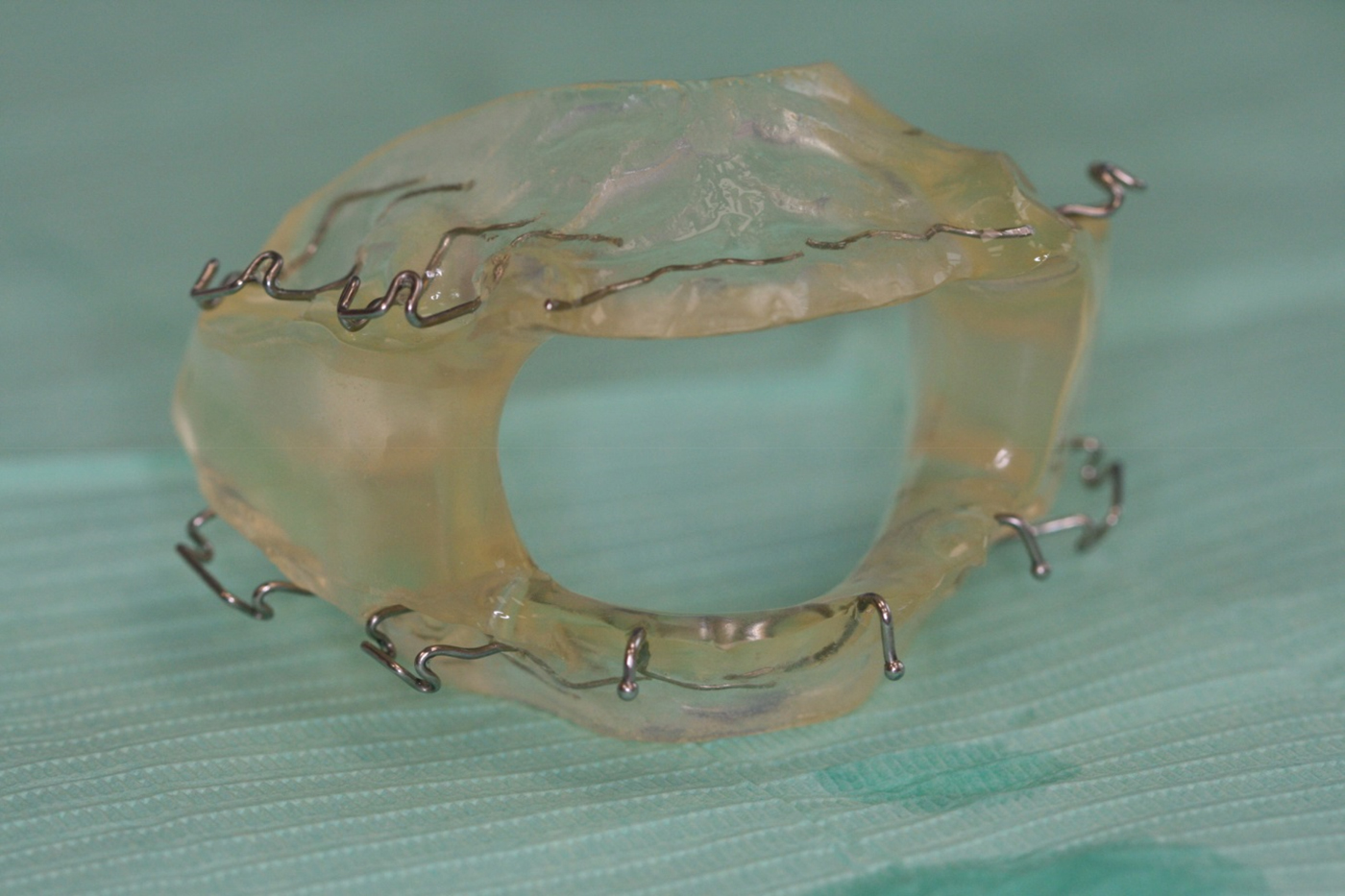
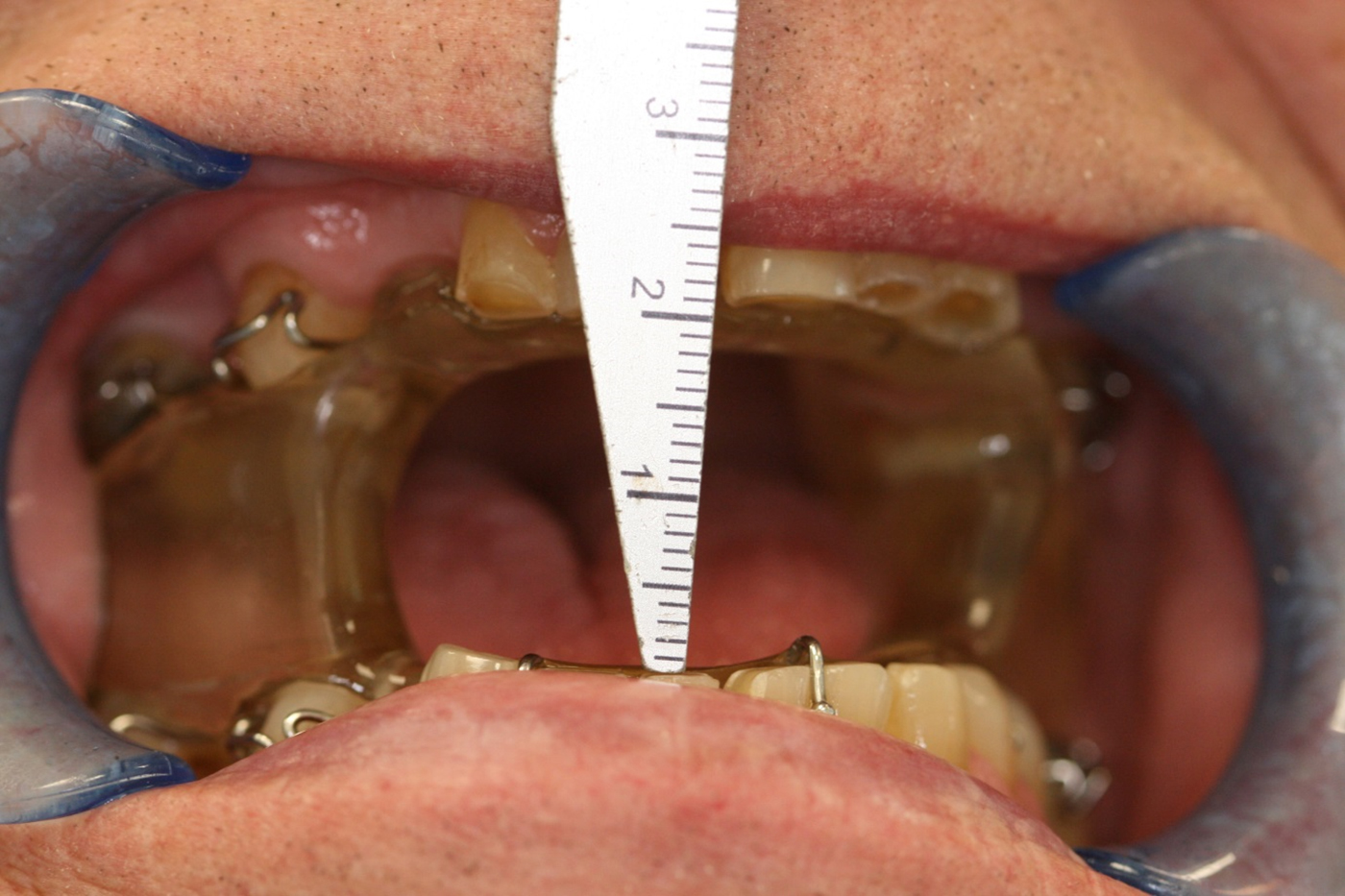
A mandibular advancement device of monobloc design was fabricated in clear acrylic resin with an anterior aperture (Figure 1). A combination of Adams’ cribs and ball clasps were used for retention. With the mandibular advancement device in situ, the mandible was retained in a protrusive position with approximately 20 mm of incisal opening (Figure 2). The postured mandibular position rendered the lips incompetent at rest and facilitated mouth breathing through the aperture.
Custom-made mandibular advancement device.

Mandibular advancement device in place 13 years later.

Application of the mandibular advancement device led to some improvement in the capnogram waveform, but no notable clinical improvement in his sleep-disordered breathing. It was suggested by the ENT department to combine the mandibular advancement device with CPAP, with a suitable aperture on the splint. The patient demonstrated an almost immediate near-complete resolution of apnoeic episodes.
Six months following treatment, his apnoea-hypopnoea index had reduced to 21 events per hour, and the seizures had improved dramatically. The patient's general condition gradually improved, leading to greater mobility and better sleep, with significant subsequent weight loss, allowing him to return to work and normal activities.
It has now been 13 years since management with the mandibular advancement device commenced. The patient wears the device nightly and no longer requires CPAP therapy. His epilepsy remains well controlled on medication; the Epanutin dose has been halved to 200 mg per night, whilst continuing with the same Lamictal dose, but he no longer requires Tegretol. He has not had a full seizure in at least two years. His attending consultant neurologist at the National Centre for Neuroscience has requested that a substitute mandibular advancement device be fabricated in case the one in use breaks.
Discussion
This report illustrates a number of atypical OSA features, in that septoplasty was shown to potentially aggravate the process, albeit in conjunction with an overall deterioration in the patient's condition. It also demonstrates the usefulness of sleep nasendoscopy. Furthermore, it contradicts the traditional conviction that uncontrolled epilepsy is an absolute contraindication for mandibular advancement device application, although some of the poor seizure results may have been due to sleep deprivation. The findings support previous sporadic reports of using combined modality mandibular advancement device and CPAP in recalcitrant cases. They also confirm the importance of weight loss and exercise in the overall successful management of sleep-disordered breathing.
The benefits of a mandibular advancement device in the management of OSA and snoring have been confirmed by a number of studies since the 1980s.Reference Marklund, Franklin, Stenlund and Persson4, Reference Takaesu, Tsuiki, Kobayashi, Komada, Nakayama and Inoue5 It is favoured in the treatment of dentate patients because of its non-invasive nature, cost and ease of use, with some authors advocating its use as a first-line treatment in OSA.Reference Cistulli, Gotsopoulos, Marklund and Lowe6 A mandibular advancement device may reduce airway obstruction in some OSA patients, by stabilising structures that can affect airway patency, namely the mandible, tongue, lateral pharyngeal wall and soft palate.Reference Cistulli, Gotsopoulos, Marklund and Lowe6 The anteriorly postured mandibular position achieved with the mandibular advancement device in situ alters the degree of mandibular opening, and renders the lips incompetent at rest, thereby facilitating mouth breathing.
• Obstructive sleep apnoea (OSA) represents a morbid and challenging condition
• Multidisciplinary assessment is essential in recalcitrant OSA management
• Sleep nasendoscopy should be considered in the diagnostic pathway in difficult-to-treat OSA cases
• A mandibular advancement device in combination with continuous positive airway pressure may be required in select cases
• Sleep deprivation could be an important factor for poor epilepsy control in OSA patients
• Epilepsy is not an absolute contraindication for mandibular advancement device use
Mandibular advancement devices are recommended most commonly for patients with mild OSA, or those who do not tolerate CPAP.Reference Schmidt-Nowara, Lowe, Wiegand, Cartwright, Perez-Guerra and Menn7 Two previous publications have reported the use of a mandibular advancement device in combination with CPAP in select cases.Reference Denbar8, Reference Upadhyay, Dubey, Kant and Singh9 Other authors have highlighted the patient cohort intolerant to CPAP, who may benefit from a mandibular advancement device as an alternative treatment.Reference Cantore, Ballini, Farronato, Malcangi, Dipalma and Assandri10
The addition of sleep nasendoscopy to the diagnostic pathway should be considered in cases of challenging OSA, and may enhance patient selection in those considered for a mandibular advancement device.Reference Johal, Hector, Battagel and Kotecha11 Sleep nasendoscopy can prove a useful diagnostic aid, allowing for dynamic assessment of the airway, and observation of the effect of mandibular advancement with jaw thrust.Reference Hewitt, Dasgupta, Singh, Dutta and Kotecha12 It is usually performed without the laryngeal mask airway in situ; however, in this case, the airway support was used prior to formal assessment as a safety precaution by the anaesthetist for control, given the potentially precarious nature of the patient's upper respiratory tract, which serendipitously revealed one of the main areas of obstruction.
As with most intra-oral devices, seizure syndromes and epilepsy remain relative contraindications for the use of mandibular advancement devices, together with concurrent periodontal and temporomandibular conditions.Reference Petit, Pépin, Bettega, Sadek, Raphaël and Lévy13 However, as in this case, uncontrolled epilepsy is considered an absolute contraindication for mandibular advancement device management: during seizures, injuries such as soft tissue damage, lingual laceration, maxillofacial region fractures, temporomandibular joint subluxations, tooth breakages, and subluxation or avulsion can frequently occur, in addition to the risk of prosthesis fragmentation or airway obstruction.Reference Sheller2
In this case, an individualised device, specific to the patient, was fabricated. This device was large enough to prevent posterior dislocation during a seizure, with an aperture that was wide enough to facilitate CPAP therapy as a combined modality. The spiral of immobility, weight gain, sleep deprivation, and worsening apnoea and seizures was reversed to such an extent that the patient was able to return to normal life, with convulsion control, medication reduction, and no need for ongoing CPAP.
This is the first report in the literature to describe the application of a mandibular advancement device used in combination with CPAP to treat severe OSA that had resulted in worsening epilepsy and sleep-deprived seizures. The contribution of sleep deprivation may explain the increased incidence of medically refractory epilepsy in a cohort of older, heavier, more somnolent males facing epilepsy surgery.Reference Manni, Terzaghi, Arbasino, Sartori, Galimberti and Tartara14 The use of a mandibular advancement device, despite a stated contraindication, precluded the need for an almost certain tracheostomy; it was not only a life changer but probably a lifesaver for this patient.
Patient consent and multidisciplinary support represented key components in managing this clinical dilemma. Sleep nasendoscopy was a crucial diagnostic aid, which highlighted objective evidence of improved capnography with mandibular advancement, prompting the consideration of a mandibular advancement device as a treatment option. It reaffirms the traditional medical aphorism of ‘never say never or never say always’.
Conclusion
A mandibular advancement device used in combination with CPAP presented a novel management option in this case of apnoea-induced epilepsy, which resulted in significant clinical benefits for the patient. The addition of drug-induced sleep nasendoscopy to the diagnostic pathway should be considered in all cases of challenging OSA.
Competing interests
None declared