During the past few decades, research on Europe’s maritime engagement with the Atlantic World has contributed to a better understanding of the historical development of long-distance trade between the several continents bound together by the Atlantic Ocean. Following the affirmation of Jack P. Greene and Philip D. Morgan on the development of Atlantic history as a scholarly field of research, the institutionalisation of Atlantic history as ‘an analytic construct and explicit category of historical analysis’Reference Greene and Morgan 1 has aimed to overcome traditional national colonial and imperial historiography. However, scholars have still continued to focus on a British, French, Portuguese or Spanish Atlantic rather than applying a comparative multinational approach. Only recent studies have put the various Atlantic economic systems and commodity chains in a broader perspective that also includes the analysis of merchant communities located in Atlantic marketplaces and seaports into their research.
This article argues that Central and Northern European merchandise and merchants played a quite important role within the economic systems of the Atlantic World during the Early Modern Period and will analyse this topic from two perspectives: first, a comparison of the Portuguese, Spanish and French Atlantic empires to identify cross-national economic and political patterns in regard to their socio-economic relations with Central Europe. Second, the importance of Central and Northern European merchandise and merchants within the socio-economic systems of these Atlantic worlds will become visible by comparing the bilateral relations between four representative strategic Atlantic port cities, namely Nantes, Bordeaux, Lisbon and Cádiz, and Hamburg as one of Central Europe’s major marketplace and redistribution centres. These case studies include a comparison of the French and Portuguese linen and sugar trade with Hamburg during the eighteenth century. This geographical narrowing excludes the direct trade relations and commodity flows between the Baltic Sea regions and the Atlantic port cities that can be quantitatively researched in the Sound Toll Register Online database.
The umbrella terms German and German-speaking merchants and Central Europe identify individuals and trade associations from the territories of the Holy Roman Empire: today’s Germany, Poland, the Baltic States, Czech Republic, Slovakia, Hungary and the Swiss Confederation.
Trade between European port cities predates the era of overseas maritime discoveries and expansion. From the mid-fourteenth century onwards, commerce was generally characterised by the exchange of agricultural and forest produce along with metal wares and textiles. The range of commodities comprised salt, fruits, vegetables and wine in a west–east direction, whereas they comprised timber, tar, grain, brass and copper wares, woollens and linens in an east–west direction. The product range was soon extended by the onset of the continuous maritime expansion of the Western European sea powers into the Atlantic, regions of the Indian Ocean and the China Sea, and comprised commodities such as sugar, spices and textiles, among others.
For centuries, trade between Central Europe and the Atlantic port cities was mainly channelled through Antwerp, Europe’s most important redistribution centre. In the course of the Eighty Years War (1568–1648), this structure of a single hub for colonial and European wares was supplanted by a multiplicity of trade routes, Central European redistribution centres and Atlantic port cities. Following the affirmation of William R. Thompson, ‘the European entrepôt function and its leading entrepreneurs gravitated toward the Northern Netherlands with Amsterdam as its center’.Reference Thompson 2 But simultaneously with Amsterdam, Hamburg became one of the most important hubs in Central Europe due to its political neutrality, and its location on the lower Elbe River with its transportation channels that connected the sea with the hinterland. Both cities were actually among the main refuge places for the Sephardim diaspora from Iberia and later on for the French Huguenot communities after the revocation of the Edict of Nantes (1685) both groups were formerly vital nuclei of the Iberian and French socio-economic elites respectively.
Atlantic port cities such as Nantes, Bordeaux, Lisbon, Cádiz and Seville benefited from this policy as their former trade with an assortment of national produce was enlarged by the additional redistribution of commodities from and towards the ‘New Worlds’. However, these port cities were not the political centres of their respective kingdoms but instead the economic pillars. Only Lisbon held the status of the kingdom’s major economic, juridical and political centre at the same time.
The Iberian Mare Clausum or the French l’Exclusif were cross-national features of Western and Southwestern European monopolistic overseas policy based on the principle of exclusive direct shipping between the respective motherlands and their overseas markets. From the late sixteenth century onwards, both Iberian crowns withdrew from trading with Central Europe and mainly focused their shipping on their overseas markets. Henceforth, intra-European shipping became the domain of private merchants, the majority of them of Northern and Central European origin. From the second half of the sixteenth century onwards, Dutch shipping became the most important intermediary of Europe’s maritime trade due to its efficiency.Reference Bruijn 3
The Western European Atlantic sea powers demanded large quantities of Northern and Central European products destined for their markets overseas. As Stanley B. Alpern showed in his 1995 article ‘What Africans got for their Slaves: A master list of European trade goods’,Reference Alpern 4 the range of commodities comprised barter goods, namely metal wares and textiles, destined for the Transatlantic slave trade and used as consumer goods in general. Following the affirmation of Herbert S. Klein in his book ‘The Atlantic Slave Trade. New Approaches to the Americas’ (2010),Reference Klein 5 West African market demands shifted away from Indian cottons towards German-made linens as the prime textile import at the turn of the seventeenth century. Although France’s textile industries, especially the linens from Brittany, directly benefited from the growing demand for textiles as barter goods for the Transatlantic slave trade, Central European linens, especially Platillas, ‘a fine white linen originally made in Silesia’ (Ref. Reference Alpern4, p. Reference Weber9), were imported from Hamburg and re-exported to the French Atlantic through Bordeaux, Nantes and La Rochelle.
Quantitative data from eighteenth-century French balance sheets (see database project TOFLIT18 Transformations of the French economy through the lens of international trade, 1716-1821) 6 clearly demonstrate the existence of a direct relation between the re-exports of Central European fabrics and textiles to the French Atlantic. This long-term trade was only interrupted by the Seven Years’ War (1756–1763). In 1753, Platillas imports from the North made up some 50% of exports from Nantes towards Guinea and they came to a complete standstill in 1760. This trade only partially recovered during the following decades.
In contrast to the French case, the Iberian sea powers traditionally depended on foreign textile trans-shipments via Seville, Cádiz and Lisbon as they lacked a national textile industry. During the course of the seventeenth and early eighteen centuries, textile imports into Spain mainly originated from France, a situation that during the course of the eighteenth century changed in favour of Silesian and Westphalian linens due to their high standards of quality and lower production costs. At the same time, Portugal continued its strong trade relations with England, from where it imported the majority of its manufactured goods. However, English linen exports to Portugal need to be put into perspective because, as Margrit Schulte Beerbühl and Klaus Weber have shown,Reference Schulte Beerbühl and Weber 7 the majority of English linens brought to the Atlantic markets had been previously imported from Germany.Reference Butel 8 Recent research into Portuguese trade with Brazil and West Africa during the second half of the eighteenth century shows the quantitative dominance of linen textiles produced in the European hinterland regions of either Silesia or Westphalia, and which were exported from Hamburg.
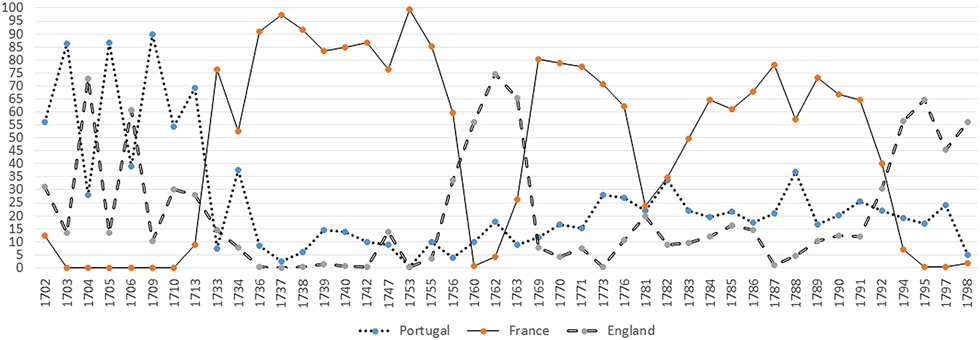
In return, Northern and Central Europe became major consumer markets for overseas commodities such as sugar, dyestuffs, tobacco, hides and cotton.Reference Weber 9 Before the ascent of the French empire, Hamburg imported most of its sugar and tobacco from Portugal.Reference Poettering 10 The statistics of sugar imports into Hamburg registered in the Admiralitätszoll exclude imports from ports in the Netherlands or Denmark, for example. Still, they show that French sugar exports superseded those from Portugal by the 1730s and kept their dominance until the Slave Rebellion in Saint Domingue in 1791.Reference Schneider, Krawehl and Schulenburg 11 As shown in Figure 1, in 1755, French sugar made up 85% of the total registered imports, but this fell to under 1% in 1760 as a result of the Anglo-French warfare during the Seven Years’ War and only recovered its former position of 80% in 1769. In that same period, English imports dominated the Hamburg market due to the occupation of almost all the French Caribbean islands, except for Saint Domingue.
Graph of Hamburg’s sugar imports (Ref. Reference Poettering10, p. 92, Ref. Reference Schneider, Krawehl and Schulenburg11, pp. 581–587).

Figure 1 does not show, however, the general trend of a rising demand for sugar. In 1703, the value of sugar imports declared by commissioners and merchants amounted to some 713,305 Mark Banco. The first peak of sugar imports was reached in 1755 (6,413,870 Mark Banco), followed by a decline due to the Seven Years’ War (3,606,725 Mark Banco in 1760). The second half of the eighteenth century saw an ever-rising increase in the import of sugar (18,529,677 Mark Banco in 1798) that was only interrupted in 1781–1782 and 1788.
The shift of commodity flows away from the Iberian Peninsula towards north-western Europe was a rather general trend that comprised many commodities during the eighteenth century. Spanish exports to Hamburg mainly comprised hides, dyestuffs and medical plants; sugar or even cacao did not play any significant role (Ref. Reference Weber9, pp. 89, 388).
The trans-shipment of merchandise between Central Europe and the Atlantic basin was a stimulating factor for economic growth for both sides. In particular, the proto-industrial sectors of textile production in Brittany, Silesia and Westphalia and the sugar refineries in Bordeaux, La Rochelle, Amsterdam and Hamburg profited from the growing demands on either side. The affirmation of Paul Butel for the French case that ‘the trans-shipping trade that animated France’s commercial empire depended on the Antilles trade […]. French trade could not maintain its growth except by re-exporting to northern Europe’ (Ref. Reference Butel8, p. 168), is certainly correct and can be applied to the Spanish and Portuguese cases too. Yet it still excludes the continuous importance of the ‘traditional’ sectors of the national GDPs, namely agriculture, forestry and crafts among others (Ref. Reference Butel8, pp. 157–166; Ref. Reference Weber9 387–388).
From the late seventeenth century onwards and especially during the second half of the eighteenth century, bilateral trade between Bordeaux, Nantes, Seville, Cádiz, Lisbon and Hamburg was mainly conducted by German and German-speaking merchants. These German Protestant merchants replaced to some extent the hitherto Sephardim and Calvinist traders, who once had been a vital part of the autochthonous socio-economic elites in Iberian and French ports.
Studies by Jorun PoetteringReference Poettering 10 and Klaus WeberReference Weber 9 show that Protestant merchants in Iberia were in some cases under the surveillance of the Inquisition and excluded from holding public offices until the end of the seventeenth century. Therefore, quite a significant number of individuals opted for naturalisation or conversion to Catholicism in order to fit into the local societies, even if only for appearance’s sake, while privately maintaining their former religious practices. The increasing commercial relations between the Atlantic sea powers and Central Europe in the course of the early eighteenth century was accompanied by a rising number of Protestant merchants who established themselves in the Atlantic port cities. The combination of these two factors, the growing commercial relations and the rising number of foreign Protestant merchants, could be seen as one of the reasons for a policy of détente by the French, Spanish and Portuguese towards Protestant communities. From the 1730s onwards, they were allowed to have their own cemeteries in Nantes, Bordeaux and Lisbon.
Kinship and family ties were the key elements to economic success. Many of the new arrivals were sons of established merchant families from Hamburg, Bremen, Frankfurt (Main) and other places in Germany who spent their apprenticeship years abroad. Their access to the local socio-economic communities was often facilitated by a family member who already ran a branch of the family business or by an entrusted agent who represented them abroad (Ref. Reference Weber9, pp. 179–185).
During the course of the second half of the eighteenth century, German (Ref. Reference Schulte Beerbühl and Weber7, pp. 89–90) and SwissReference Schneider, Krawehl and Schulenburg 11 businessmen and entrepreneurs were not only involved in the trans-shipment of commodities, but they were also involved in the expansion of the French slave trade and established proto-industrial textile manufactories in Bordeaux, Nantes and Lisbon. Unsurprisingly, this particular period of economic prosperity saw the strongest presence of foreign merchants in strategic French, Portuguese and Spanish Atlantic port cities.
Bordeaux became France’s major seaport for the re-export of colonial products towards Northern and Central Europe. Until the American War of Independence, Hamburg had become one of the main export destinations for French sugar, coffee and indigo and was competing with Amsterdam. At the same time, Nantes was the most important port for the French transatlantic slave trade. In comparison with Bordeaux, Flanders and Holland represented the major trade partners for Nantes, followed by Hamburg in second place. German merchants and trade firms who operated in BordeauxReference Marzagalli 15 mostly originated from Hanseatic towns, particularly Hamburg (Ref. Reference Weber9, pp. 370–379). In Nantes, the geographic origins of the Germans were rather diverse and comprised Hanseatic seaports but also included, for example, Cologne, Saarbrücken and Stuttgart.Reference Weber 16 The Swiss community included merchants and textile entrepreneurs who originated from Basel, Biel, Neuchâtel and Zurich.Reference Sigerist 12
With the French Revolution and the Napoleonic wars following, German and German-speaking merchants who were involved in the trans-shipment business of colonial products and Central European commodities tried to adapt their business strategies and either migrated to other marketplaces, such as London, or tried to reduce their product range to the trans-shipment of regional and national French commodities, particularly wine, liquor and vinegar. Although Bordeaux had lost its position as France’s most important port of trans-shipment from and to the Atlantic, the German and German-speaking communities seem not to have suffered from a rapid change, as indicated by the number of marriages celebrated within these communities. As Silvia Marzagalli showed in her article ‘Le négoce allemand et le commerce de Bordeaux pendant la Révolution’, the number of marriages celebrated within the German-speaking community remained almost identical: 26 during the peak years between 1782 and 1786 and 24 during the crisis years between 1809 and 1813.Reference Marzagalli 15
Spain accompanied the general trend of growing trans-shipment volumes from and towards Hamburg during the 1780s and particularly profited from the outbreak of the French Revolution and the Slave Rebellion in St. Domingue (1791). As a result, some planters relocated their production from Saint-Domingue to Cuba. However, the general political environment of instability provoked profound changes in the economic relations between the Spanish Americas and Hamburg; Spain was not able to maintain and guarantee its national Transatlantic shipping after 1792 and had to change its hitherto monopolistic policy of Mare Clausum into a liberal policy of omitting the landing of vessels from neutral nations. Soon, Spanish merchants who were already established in Hamburg started to invest in direct shipping to the Spanish Caribbean.Reference Weber 16 This important part of the overall mosaic of socio-economic changes also helps to understand the decline of the German and German-speaking communities in Spanish seaports and marketplaces that continued during the Napoleonic Wars and the Continental Blockade. Cadiz lost its position and function as Spain’s most important trans-shipment port and intermediary between the Atlantic World and Northern and Central Europe (Ref. Reference Butel8, pp. 115–116).
In comparison with Bordeaux, it appears that the German community in Cádiz was more strongly affected by the loss of the transatlantic trade. Apparently, only some individuals and firms were able to maintain their businesses, such as the Bohemian Glass traders, or those in the wine and spirits business (Ref. Reference Schulte Beerbühl and Weber7, pp. 81–83).
Britain had been Portugal’s major European trade partner since the seventeenth century and even more so since the Methuen Treaty signed in 1703. Recent research on economic relations between Portugal and Hamburg suggests that Portugal, like Spain, briefly benefited from the crisis years of the French Ancien Régime. This short-lived period of a few years was followed by the Napoleonic Wars and the Continental Blockade. Portugal needed a strong military ally to deal with the French invasion and the Peninsular Wars (1807–1814). As a consequence of military support from the British, Portugal was forced to open its Brazilian ports to direct British shipping in 1808. From then on, Lisbon slowly but steadily lost its importance as the empire’s most important port for trans-shipment. In 1827, Portugal signed a treaty that granted the same rights of direct shipping from and towards Brazil to the Hanseatic towns of Bremen, Hamburg and Lübeck.
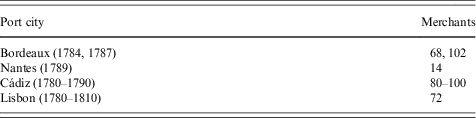
New research on the German and German-speaking merchant communities of Lisbon during the long eighteenth century suggests that there was a significant number of merchants and entrepreneurs who traded in Lisbon (90 between 1730 and 1780, 72 between 1780 and 1810, 27 in 1815 and 21 in 1823 – see Table 1). The majority of these German merchants originated from the Hanseatic towns of Hamburg, Bremen and Lübeck, a fact that shows similarities to the case of Bordeaux. The steady decline in the members of the German and German-speaking communities was not only a result of the crisis years for Portuguese Transatlantic trade during the first two decades of the nineteenth century. Prosopographical analysis of the communities also showed evidence that a relatively high number of merchants died of age-related reasons or because of illness.
German and German-speaking merchants established in Atlantic port cities (1780–1810) (Ref. Reference Schulte Beerbühl and Weber7, pp. 75–76; Ref. Reference Gardey13, p. 361; Ref. Reference Pourchasse14, p. 88; the figures for Lisbon are the result of my private PhD research).

Summing up, it can be stated that at the turn of the eighteenth century, the former major seaports of the French, Spanish and Portuguese Atlantic empires lost their importance as trans-shipment ports between the Atlantic overseas territories and the Northern and Central European markets, as these markets were now directly connected to regions of production in the New World. German and German-speaking merchants either migrated to their lands of origin or to other marketplaces – London in particular. Others tried to shift their business towards national French, Portuguese and Spanish products and Northern and Central European imports.
In summary, the historical development of the Portuguese, Spanish and French Atlantic empires and their socio-economic relations with Northern and Central Europe during the Early Modern period was characterised by some overall cross-national political and socio-economic patterns and their local expressions.
The policies of Mare Clausum and l’Exclusif of the Atlantic sea powers aimed to exclude foreign merchants from direct shipping trade with the overseas colonies. At the same time, these sea powers depended on important barter and consumer goods for the Atlantic economies, particularly Central European textiles that were produced in large quantities, according to high standards of quality and at lower prices. In return, Central Europe became one of the major consumer markets for overseas colonial commodities such as sugar, coffee, dyestuffs and cotton. This reciprocal relationship was particularly reflected in the trade of Central European linens and French and Portuguese sugar. The installation of German and German-speaking merchant communities in the Atlantic port cities of Bordeaux, Nantes, Cádiz and Lisbon was in the mutual interest of both the Atlantic empires and the merchants. As much as foreign merchants were not permitted direct participation in transatlantic trade with the colonies, they were the link between the ‘New Worlds’ on the one hand and the Northern and Central European marketplaces such as Hamburg and Amsterdam on the other. This economic system lasted until the Age of the Revolutionary Wars and the disintegration of the Atlantic empires. With the opening of the Mare Clausum and l’Exclusif policies, the Atlantic seaports lost their importance as transit and redistribution centres in favour of direct shipping between the Americas and Central and Northern Europe.
Acknowledgement
Research for this article was funded by the German Research Foundation (DFG Research Grant WE 3613/2-1, ‘The Globalized Periphery. Atlantic Commerce, Socioeconomic and Cultural Change in Central Europe, 1680–1850’).
Torsten dos Santos Arnold is a Doctoral Researcher within the DFG Project ‘The Globalized Periphery: Atlantic Commerce, Socioeconomic and Cultural Change in Central Europe (1680–1850)’ at the European-University Viadrina in Frankfurt (Oder), Germany. His research and dissertation project analyses the socio-economic relations between Central Europe and the French and Portuguese Atlantic empires during the long eighteenth century. In 2013, his research on the Indo-Portuguese copper trade during the first half of the sixteenth century was awarded the annual research prize of the Portuguese Association of Economic and Social History (APHES).