Introduction
The experience of interpersonal maltreatment in childhood can impact a person for the rest of his or her life. Exposed children are at high risk of developing a variety of psychopathological symptoms (MacMillan et al. Reference MacMillan2001; Molnar et al. Reference Molnar, Buka and Kessler2001; Anda et al. Reference Anda2006; Maniglio, Reference Maniglio2009; Teicher & Samson, Reference Teicher and Samson2013; Danese & Baldwin, Reference Danese and Baldwin2017). Dissociation – defined as a ‘disruption of and/or discontinuity in the normal integration of consciousness, memory, identity, emotion, perception, body representation, motor control, and behavior’ (DSM-5; American Psychiatric Association, 2013) – is increasingly gaining interest in psychological and clinical research because it appears to disrupt emotional learning and mental functions that influence the development of identity and self-control (Rueda et al. Reference Rueda, Posner and Rothbart2005; Medford et al. Reference Medford2006; Ebner-Priemer et al. Reference Ebner-Priemer2009). Likewise, dissociation impedes successful psychotherapy of trauma-associated mental disorders (Michelson et al. Reference Michelson1998; Rufer et al. Reference Rufer2006; Spitzer et al. Reference Spitzer2007; Kleindienst et al. Reference Kleindienst2011; Reference Kleindienst2016; Bae et al. Reference Bae, Kim and Park2016; Wolf et al. Reference Wolf, Lunney and Schnurr2016). A thorough meta-analytic review by Dalenberg et al. (Reference Dalenberg2012) clearly supports a causal link between trauma and dissociation across a variety of traumatic experiences. However, research linking childhood maltreatment and dissociation shows heterogeneous results, depending on the type, duration, and onset of the abuse or neglect, and depending on further trauma characteristics (Eisen & Carlson, Reference Eisen and Carlson1998; Kisiel & Lyons, Reference Kisiel and Lyons2001; Hall, Reference Hall2003). A meta-analytic investigation focusing on childhood abuse and neglect and dissociation, which includes moderators of this relationship, is currently missing.
The most common and best-validated instrument for assessing trait dissociation is the Dissociative Experience Scale (DES; Bernstein & Putnam, Reference Bernstein and Putnam1986). The scale has been translated into several languages (e.g. Yargic et al. Reference Yargic, Tutkun and Sar1995; Spitzer et al. Reference Spitzer1998; Darves-Bornoz et al. Reference Darves-Bornoz, Degiovanni and Gaillard1999; Somer et al. Reference Somer, Dolgin and Saadon2001; Xiao et al. Reference Xiao2006). The DES consists of 28 items, describing mild forms (e.g. ‘getting absorbed by watching a movie’) as well as severe forms of dissociative experiences (e.g. ‘standing next to yourself or watching yourself’) that are associated with various mental disorders (Lyssenko et al. Reference Lyssenko2017). People rate each item from 0% to 100%, i.e. the percentage of the time they have the experience. The DES has good psychometric properties (summarized in van Ijzendoorn & Schuengel, Reference van Ijzendoorn and Schuengel1996).
According to a widely accepted model, acute dissociation is viewed as a neurobiological mechanism that is activated in overwhelming traumatic situations when other avoidance systems (such as fight or flight response) are not adaptive or effective (Putnam et al. Reference Putnam, Helmers and Trickett1993; Freyd, Reference Freyd1994; Kisiel & Lyons, Reference Kisiel and Lyons2001; Schauer & Elbert, Reference Schauer and Elbert2010). There are large interindividual differences in the neural, hormonal, and behavioral response to traumatic stress (e.g. McCrory et al. Reference McCrory, De Brito and Viding2012). Several personality traits are discussed as vulnerability factors for dissociation such as suggestibility (Butler et al. Reference Butler1996), fantasy proneness (Merckelbach et al. Reference Merckelbach, Muris and Rassin1999; Pekala et al. Reference Pekala, Angelini and Kumar2001), or alexithymia (Terock et al. Reference Terock2016). Moreover, twin studies have pointed at the influence of genetic predispositions (Jang et al. Reference Jang1998; Becker-Blease et al. Reference Becker-Blease2004; Pieper et al. Reference Pieper2011).
Children are particularly vulnerable to the development of dissociative symptoms (Putnam, Reference Putnam1997). In case of abuse, they have little chance of fighting or escaping their adult perpetrator – especially if family members whom the child depends on are involved. This helplessness predisposes children to immobility, which is thought to be related to dissociation (Schauer & Elbert, Reference Schauer and Elbert2010). Second, children are in the midst of brain development. Imagination, fantasy play, and daydreaming seem to play a role in the development of executive functioning (Pierucci et al. Reference Pierucci2014) and have been linked to the higher hypnotic capability of children (Oberoi et al. Reference Oberoi, Panda and Garg2016) and proneness to dissociation in children (Putnam, Reference Putnam1997). Third, interpersonal maltreatment in childhood occurs mostly recurrently. The repeated activation of dissociative networks leaves neurodevelopmental traces that seem to remain in the mature brain (Perry et al. Reference Perry1995; Dannlowski et al. Reference Dannlowski2012; Krause-Utz et al. Reference Krause-Utz2017).
According to etiological models, childhood interpersonal maltreatment and dissociation should be moderated by several characteristics of maltreatment. Interpersonal maltreatment experiences during childhood can be distinguished into experiences of threat and deprivation (McLaughlin et al. Reference McLaughlin, Sheridan and Lambert2014). McLaughlin et al. (Reference McLaughlin, Sheridan and Lambert2014, p. 578) define threat as the ‘presence of experiences that represent a threat to one's physical integrity’ and deprivation as ‘absence of expected environmental inputs and complexity’. Within this distinction, Bernstein et al. (Reference Bernstein2003) further differentiate between sexual, physical, and emotional abuse as well as physical and emotional neglect. In addition to the type of abusive experiences, the age of onset and duration of abusive acts may influence dissociative symptoms (Beitchman et al. Reference Beitchman1992). Recent neuroimaging research point to distinct time periods throughout life which are most susceptible to the effects of traumatic stress on brain structure and function (Teicher et al. Reference Teicher2016). Younger age and recurrent traumatic experiences are likely to increase the risk for dissociation: Young children are most helpless and their brains are least developed (Putnam, Reference Putnam1997). Incestuous abuse (abuse by parents or stepparents) has been reported to be experienced as being more traumatic than abuse by other relatives or strangers (Beitchman et al. Reference Beitchman1992) and sexual abuse with acts of penetration lead to the greatest pain and violation of bodily integrity (Schauer & Elbert, Reference Schauer and Elbert2010).
The aim of our review was to combine the results of studies using the DES in samples having suffered from childhood interpersonal maltreatment, considering theoretically- and empirically-derived characteristics of childhood maltreatment and dissociation. We hypothesized that samples with a history of childhood abuse or neglect show higher DES-scores compared with samples without abuse or neglect experiences (hypothesis 1) and that samples with a history of childhood abuse show higher DES-scores compared with samples with childhood neglect (hypothesis 2). Regarding moderators, we hypothesized higher DES-scores in samples with an earlier age of onset and a longer duration of childhood abuse (hypothesis 3), samples with a higher proportion of parental abuse (hypothesis 4) and samples with a greater proportion of victims of severe acts of sexual abuse (i.e. penetration) (hypothesis 5).
Method
Literature search
A systematic literature search was conducted to search for studies investigating dissociation within childhood abuse or neglect samples using the DES (Bernstein & Putnam, Reference Bernstein and Putnam1986) within the following databases up to October 2016: PsychInfo, PubMed, Web of Science and Academic Search Premier. The search strategy [(abuse*) OR neglect*] AND [(dissoc* exper* scale) OR fds] was applied to PubMed and was adapted for the other databases. As differences between DES versions I and II have been shown to be negligible (Ellason et al. Reference Ellason1994), we did not distinguish between versions. Reference lists of included studies, as well as prior meta-analyses investigating effects of childhood abuse, were screened for relevant literature. In addition, we contacted authors for unpublished data.
Eligibility criteria
The eligibility of studies was assessed in abstract and full text screening, using the following inclusion criteria: (1) Population with any form of childhood abuse/neglect (age <18); (2) use of the DES; (3) report of mean (M), standard deviation (s.d.) and sample size (N), or sufficient information to calculate those values; (4) relevant statistics are reported separately for the childhood abuse or neglect samples. A control group with subjects not having experienced maltreatment was only required for the analysis of hypothesis 1. Studies that were eligible for full-text review and could not be electronically accessed were obtained through interlibrary loan or contact to the authors. If both methods did not succeed, then the studies were excluded.
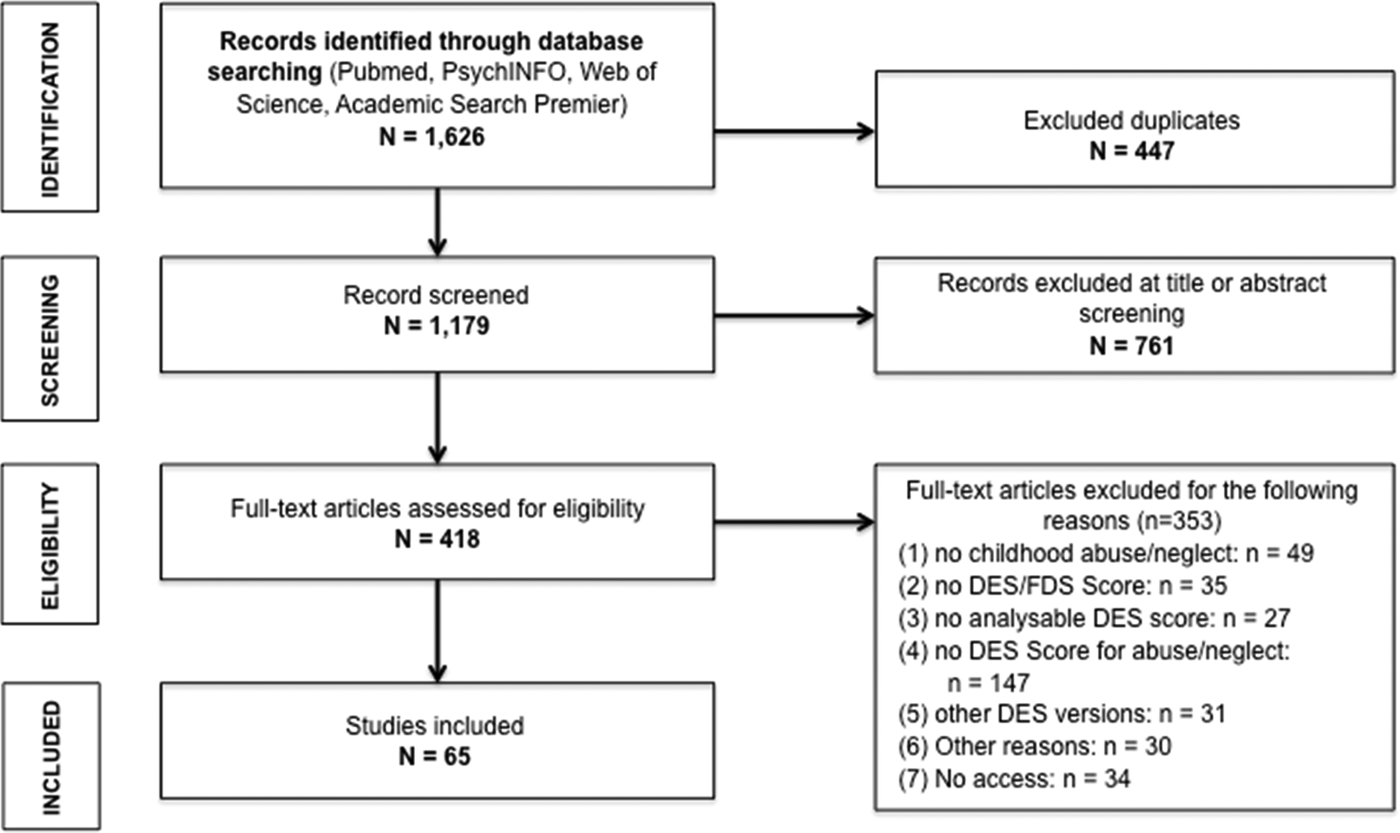
The literature search in the electronic databases yielded N = 1626 articles. As detailed in Fig. 1, after removal of duplicates, and application of exclusion criteria, a total of n = 65 studies were included in this meta-analysis (see online Supplementary Material for the list of included studies and a table of extracted information).
PRISMA flow diagram (Moher et al. Reference Moher2009).

Coding of study characteristics
Data were extracted by two independent reviewers using a standardized coding scheme. We extracted mean DES-scores, standard deviations, and sample sizes for different abuse or neglect subgroups as well as for reported control samples. Further socio-demographic information including a short sample-description, mean age, as well as the proportion of females in the sample (0–100%) were extracted. Regarding the type of maltreatment, we extracted the proportion of the sample that had experienced sexual, physical, and emotional abuse as well as physical and emotional neglect (0–100%) – with further subcategories for severity of acts during sexual abuse, i.e. fondling, oral, or genital contact, and penetration (Kirby et al. Reference Kirby, Chu and Dill1993). As the type of retrospective assessment of childhood maltreatment experiences may influence ratings (Hulme, Reference Hulme2004), we categorized the assessment into (a) one item measure (only one question, e.g. ‘before you were 16 years old, were you threatened or forced by anyone to engage in any unwanted sexual activity, or were you sexually assaulted or raped?’; Boysan et al. Reference Boysan2009); (b) measure developed for the respective study (e.g. ‘subjects were interviewed using a semi-structured interview developed for this study’; Campbell, Reference Campbell1999, p. 37); (c) unstructured interview (e.g. Trauma assessment for adults, Resnick et al. Reference Resnick1993); (d) structured interview (e.g. Structured Trauma Interview, Draijer, Reference Draijer1989); and (e) validated questionnaires (e.g. Childhood Trauma Questionnaire, Bernstein et al. Reference Bernstein2003; Traumatic Events Questionnaire, Kaplan et al. Reference Kaplan1995). As potential moderators, we extracted the mean score for the age of onset and duration in years, as well as the proportion of the sample that had been abused by their parents (father, mother, stepfather, or stepmother; 0–100%). Information that was not explicitly stated was treated as a missing value and was omitted from the analyses. If a subgroup of childhood maltreatment had been examined in a study, but the DES-scores for that subgroup were not reported, we asked the authors to provide the data (10 replies from 50 contacted authors).
Computation of effect sizes
To analyze hypothesis 1, standardized mean difference scores between abused and non-abused subgroups [d = (m abuse/neglect − m non-abuse/neglect)/sd pooled] were computed (Hedges & Olkin, Reference Hedges and Olkin1985), random-effects models were used to synthesize d-scores. For the other hypotheses, raw mean scores (M) of the DES were used as dependent variables. Abuse subtype (sexual v. physical abuse) was treated as a categorical predictor (hypothesis 2); the resulting random-effects models were compared using Cochran's Q statistic (Cochran, Reference Cochran1954). Age of onset, duration, proportion of penetration, and proportion of parental abuse of the sample were treated as continuous predictors of DES-scores (hypotheses 3–5) and meta-regression models with random effects were fitted to the data (Berkey et al. Reference Berkey1995; van Houwelingen et al. Reference van Houwelingen, Arends and Stijnen2002). In addition, we investigated intercorrelations of abuse characteristics to explore dependencies between these variables. Heterogeneity was assessed using the index I 2 (Higgins & Thompson, Reference Higgins and Thompson2002; Cheung, Reference Cheung2014) and tested with Cochran's Q statistic (Cochran, Reference Cochran1954) as recommended by the Cochrane Collaboration (Higgins & Green, Reference Higgins and Green2008).
Multi-level modeling for meta-analyses
To consider as much information as possible for all moderator variables, multiple endpoints within most studies were extracted (159 endpoints within 65 studies) resulting in a nested data structure (Borenstein et al. Reference Borenstein, Borenstein, Hedges, Higgins and Rothstein2009), requiring three-level random effects models for data synthesis (van den Noortgate et al. Reference van den Noortgate2013; Cheung, Reference Cheung2014). The variability in effect-size estimates (τ 2) was estimated using the restricted maximum-likelihood estimator (Viechtbauer, Reference Viechtbauer2005). Analyses were performed using the statistical software R version 3.2.4 (R Development Core Team, 2016) with the metafor package (Viechtbauer, Reference Viechtbauer2010).
Publication bias
To minimize publication bias, we included dissertations and asked authors of included studies for unpublished data. Funnel plot asymmetry was used to indicate publication bias regarding hypothesis 1. To test funnel plot asymmetry, we included the sampling variance as a moderator in a meta-regression model. Because only descriptive data on dissociation scores were included in the analysis, the risk of other biases in the primary studies was assumed to be unlikely and therefore not assessed.
Results
Investigation of sociodemographic information and study characteristics (see Table 1) did not reveal significant effects for female gender, b = −0.01, Q(1) = 0.22, p = 0.638, or sample size on DES-scores, b = −0.01, Q(1) = 1.19, p = 0.275. However, age of the subjects had a significant effect on DES-scores indicating that samples with younger subjects showed higher DES-scores, b = −0.32, Q(1) = 3.98, p = 0.046.
Descriptive statistics of extracted variables

K, number of samples; k, number of studies; M, mean; s.d., standard deviation; DES, Dissociative Experience Scale.
Descriptive Statistics based on data extracted from primary studies. Missing values were omitted from analysis.
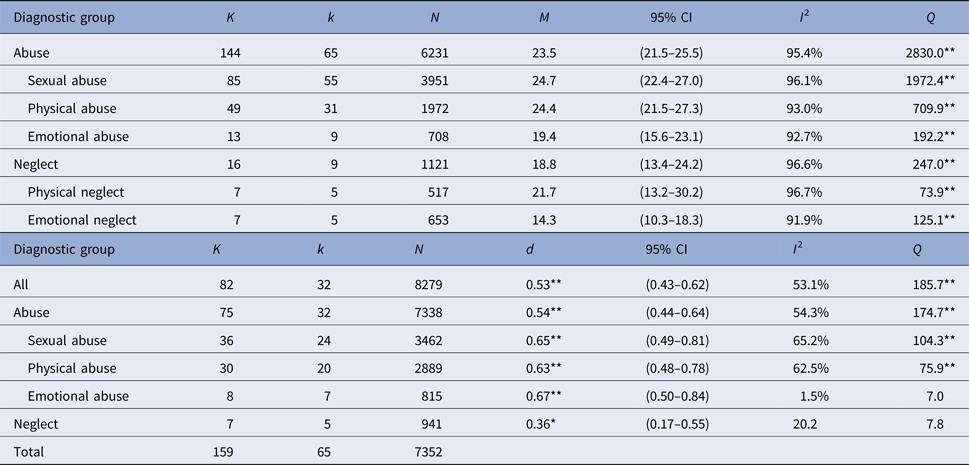
Consistent with hypothesis 1, samples with a history of childhood abuse or neglect showed significantly higher DES-scores compared with samples without childhood abuse or neglect experiences d = 0.53, 95% CI (0.43–0.62), p < 0.001; Table 2. All abuse subtypes show significantly higher dissociation scores with estimated effect sizes d > 0.5 (see Table 2). For the neglect subgroup, the estimated effect size was considerably smaller, but still significant, d = 0.36, 95% CI (0.17–0.55), p < 0.001. No subgroup analyses for the neglect subtypes were conducted because of the small number of studies that compare DES-scores for neglected and non-neglected samples.
Descriptive mean scores (M) of abuse/neglect subgroups and standardized mean difference scores (d) of abuse/neglect compared with non-abuse/non-neglect subgroups

K, number of samples; k, number of studies; N, sample size; d, standardized mean difference; M, mean DES-score; CI, 95% Confidence interval; I 2, heterogeneity statistic; Q, Chochran's Q heterogeneity statistic.
*p < 0.05; ** p < 0.01.
The comparison of DES-scores in patients with abuse and neglect (hypothesis 2) yielded estimated DES-scores of M = 23.50, 95% CI (21.52–25.48) for the abuse subgroup and M = 18.8, 95% CI (13.42–24.18) for the neglect subgroup (see Table 2). The Cochran's Q statistic did not reveal significant heterogeneity between the abuse and neglect groups Q(1) = 2.58, p = 0.108. Differences in dissociation between different subtypes of abuse and neglect were exploratively investigated (see Table 2). Within the abuse group, the Cochran's Q statistic was significant Q(2) = 6.19, p = 0.046, indicating higher DES-scores for sexual abuse z = 2.39, p = 0.017 and physical abuse z = 2.10, p = 0.036 compared with emotional abuse (see Table 2). Sexual abuse did not differ significantly from physical abuse z = 0.15, p = 0.882. Within the neglect subgroup, no significant differences for physical v. emotional neglect were obtained, Q(1) = 2.38, p = 0.123.
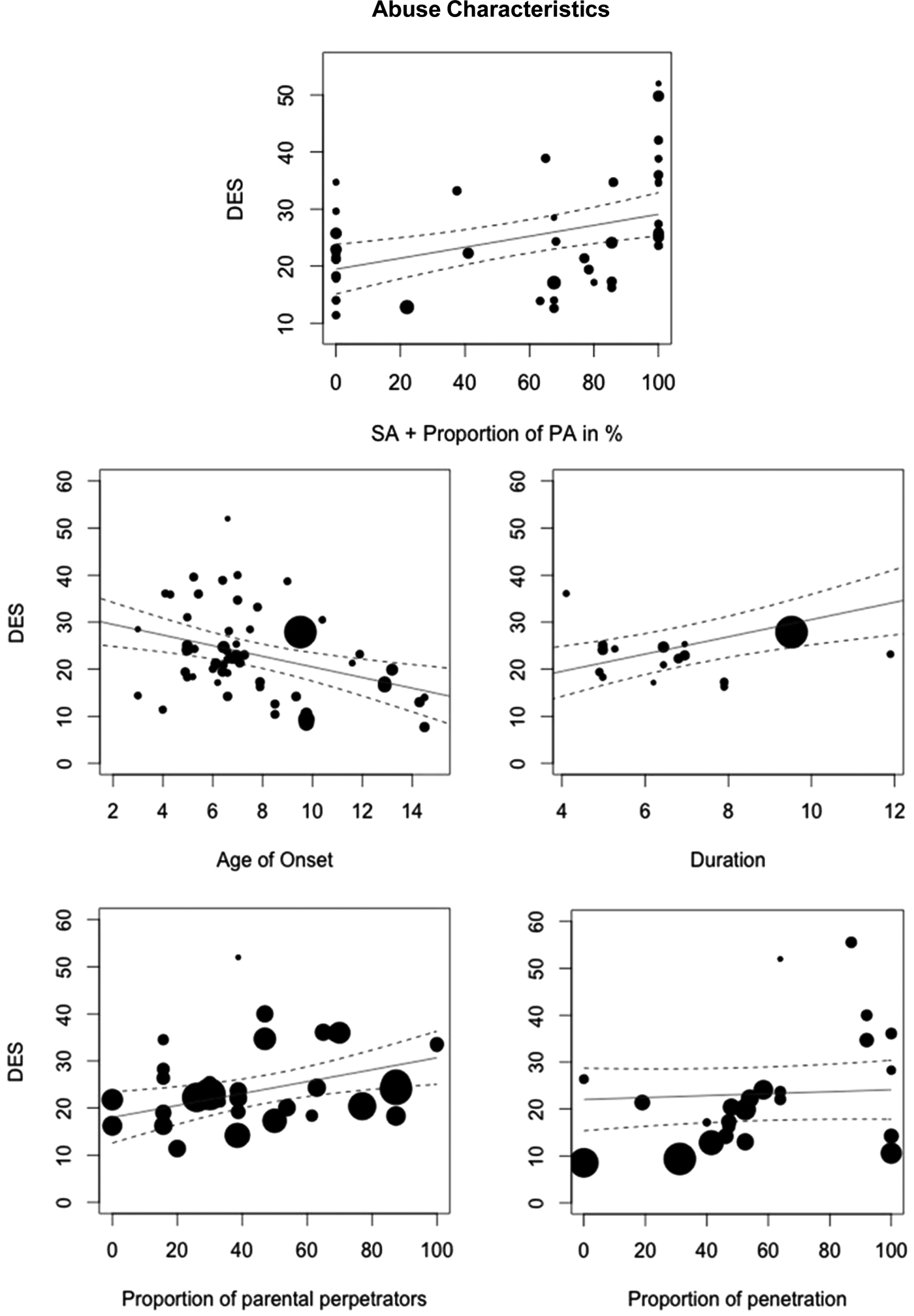
Next, we explored whether the DES-scores differ depending on the combination of abuse or neglect types. Only samples were included, in which the respective combination was reported by 100% of the participants. Particularly high DES-scores were obtained for samples with a combination of physical and sexual abuse (M = 33.4, 95% CI (28.5–38.3); see online Table B2 in the Supplementary Material). In addition, a meta-regression was performed with a subsample of sexual abuse victims, to include samples comprising only a percentage of participants with a combination of sexual or physical abuse. Additional physical abuse was treated as a continuous moderator reaching from 0% to 100% of the sample. Physical abuse in addition to sexual abuse had an additional effect, b = 0.10, Q(1) = 11.26, p < 0.001, indicating higher dissociation scores in samples with a greater proportion of the combination sexual or physical abuse (Fig. 2). Regarding the neglect subgroup, there were insufficient studies reported with explicitly single neglect types.
Meta-regression analyses investigating physical abuse (PA) in addition to sexual abuse (SA) and other moderator variables of Dissociative Experiences. *Each dot represents an extracted DES-score from primary studies. The dot sizes symbolize the inverse of the sampling variance, resulting in larger dots for more precise studies or larger sample sizes, respectively.

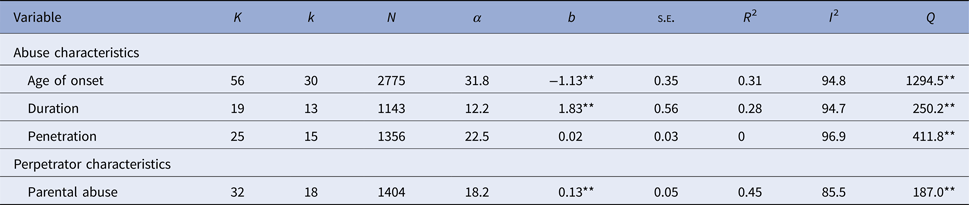
We examined age of onset, duration, proportion of penetration, and proportion of parental abuse of the sample as continuous predictors of DES-scores (hypotheses 3–5). The meta-regression models were significant for age of onset b = −1.13, Q(1) = 10.51, p = 0.001, duration of childhood abuse b = 1.83, Q(1) = 10.79, p = 0.001 and parental perpetrators b = 0.13, Q(1) = 7.66, p = 0.006 (Table 3, Fig. 2) – indicating that samples with an earlier onset, longer duration and parental abuse showed higher DES-scores. The model for severe acts of sexual abuse (i.e. penetration) was not significant b = 0.02, Q(1) = 0.42, p = 0.518 (Table 3, Fig. 2).
Meta-regression analyses investigating moderator variables of dissociative experiences

K, number of samples; k, number of studies; N, sample size; α, intercept; b, unstandardized beta weights in the metric of DES-scores; s.e., standard error; R 2, amount of heterogeneity explained, compared to the same sample, without variable of interest as moderator; I 2, heterogeneity statistic; Q, Cochran's Q heterogeneity statistic.
*p < 0.05; **p < 0.01.
Some of the predictors were highly intercorrelated. Notably, parental abuse was significantly related to both a younger age of onset and to penetration. Furthermore, a younger age of onset was related to a longer duration of maltreatment (a table of intercorrelations is presented in the online Supplementary Material). Unfortunately, the lack of information regarding multiple maltreatment characteristics in the studies did not allow us to study multiple regression and mediation models implying these predictors of DES.
The method of assessment of childhood maltreatment showed no significant influence on the DES-scores Q(4) = 4.81, p = 0.307 (online Fig. B1 in the Supplementary Material). Testing for funnel plot asymmetry to examine a potential publication bias, yielded significant results for overall abuse z = 2.99, p = 0.003 and for sexual abuse z = 3.62, p < 0.001, but not for physical abuse z = 1.06, p = 0.290, emotional abuse z = −0.84, p = 0.402, and neglect z = 0.22, p = 0.827 (see online Supplementary Material for the funnel plots of abuse subtypes and neglect).
Discussion
This meta-analysis investigated the relationship between childhood interpersonal maltreatment (abuse or neglect) and dissociation as measured by the DES (Bernstein & Putnam, Reference Bernstein and Putnam1986). A total of 65 studies were included in the analysis comprising 7352 abused or neglected individuals. The results clearly confirm the hypothesis that abused and neglected individuals show more adult dissociation than individuals without these experiences. Although no overall differences between samples of neglected v. abused subjects emerged, the results revealed that sexual and physical abuse are related to a higher dissociation than emotional abuse and neglect. In addition, victims who experienced a combination of physical and sexual abuse showed particularly higher DES-scores. Maltreatment characteristics significantly related to dissociation were the early age of onset, long duration of abuse, and proportion of parental abuse. Penetration was not related to the level of dissociation. Our findings focusing on childhood abuse extend the findings from the meta-analysis by Dalenberg et al. (Reference Dalenberg2012) which support that traumatic experiences, in general, are involved in the etiology of dissociation.
Relationship of childhood interpersonal maltreatment and dissociation
Theoretical models on the etiology of dissociation emphasize the importance of childhood traumatic experiences (e.g. Putnam, Reference Putnam1989; Draijer & Langeland, Reference Draijer and Langeland1999). The results of the current meta-analysis support this assumption with a medium effect for the sample of abused subjects (d = 0.54) and a small effect of the sample of neglected subjects (d = 0.36; Cohen (Reference Cohen1992). These effects were obtained in comparison to samples that shared relevant population features (e.g. patients, students, etc.) and therefore most likely contain other vulnerability factors for dissociation. Accordingly, the comparison samples in this analysis reports a mean DES-score of M = 13.4, which is higher than mean scores reported for representative samples [M = 8 in a Finnish sample with n = 2001 (Maaranen et al. Reference Maaranen2005); M = 10 in a Portuguese sample with n = 224 (Espírito-Santo & Abreu, Reference Espírito-Santo and Abreu2009)]. Our result concurs with an earlier meta-analytic study reporting a medium effect size of d = 0.52 for the difference in DES-scores between abused and non-abused samples (van Ijzendoorn & Schuengel, Reference van Ijzendoorn and Schuengel1996).
Although experiences of abuse and neglect involve distinct characteristics (McLaughlin et al. Reference McLaughlin, Sheridan and Lambert2014), our analysis did not reveal statistically significant differences in dissociative experiences. However, the mean dissociation scores for abuse and neglect victims differ in numbers (M = 23.5; M = 18.8). The non-significant results might be influenced by the high amount of heterogeneity regarding dissociative symptoms within the groups and the limited number of studies.
Post hoc analyses comparing specific subtypes showed higher dissociation scores for sexual abuse and physical abuse compared to emotional abuse and neglect experiences. One possible interpretation of this result is the violation of bodily integrity during the sexual and physical abuse. From an evolutionary perspective, the violation of bodily integrity – especially when carried out from a superior perpetrator – is extremely threatening to survival (Schauer & Elbert, Reference Schauer and Elbert2010). In our analyses, by far the highest mean dissociation score was calculated for the combination of physical and sexual abuse. This is in line with research reporting more pronounced sequelae for multiple abuse types such as interpersonal difficulties (Mullen et al. Reference Mullen1996; Ducharme et al. Reference Ducharme, Koverola and Battle1997; Davis et al. Reference Davis, Petretic-Jackson and Ting2001) or higher trauma symptomatology (Clemmons et al. Reference Clemmons2007). In addition, the duration of abuse was significantly related to dissociative experiences in this analysis. In conclusion, physical intrusiveness and the frequency of childhood interpersonal violence is indeed linked to the manifestation of dissociative symptoms in adulthood.
In contrast to childhood abuse, neglect has been studied much less frequently in relation to dissociative symptoms (9 v. 65 studies). Neglect has been associated with a higher range of manifestations and different definitions (Glaser, Reference Glaser2002). Especially emotional neglect is a subtle form of interpersonal maltreatment that includes emotional unavailability, unresponsiveness, or developmentally inappropriate interactions with the parents such as experiences of being rejected or emotionally distant relationships (Glaser, Reference Glaser2002; Naughton et al. Reference Naughton2013). The retrospective assessment is, therefore, more dependent on individual perception and retrospective attribution than the assessment of acts of sexual or physical abuse. Consequently, the range of severity during emotional neglect might vary more strongly within samples. However, our analyses revealed significantly higher dissociation scores in neglected samples than in non-neglected samples. This indicates that dissociation does play an important role in the long-term sequelae of neglect.
The comparison of different types of childhood abuse and neglect is impeded by the interrelation of maltreatment types (Dong et al. Reference Dong2004). The experience of any type of maltreatment in childhood increases the likelihood of also experiencing other types: In a representative US sample of 4053 children aged 2–17 years, about 65% of the sample was exposed to more than one type of victimization (Turner et al. Reference Turner, Finkelhor and Ormrod2010). A recent study reported correlation coefficients for sexual, physical, and emotional abuse or neglect between 0.29 and 0.70 (Cecil et al. Reference Cecil2017). In addition, victims of any childhood maltreatment type are often raised in ‘high-risk families’ who are characterized by aggression and conflict as well as unsupportive and neglectful relationships (Repetti et al. Reference Repetti, Taylor and Seeman2002); therefore, they share other vulnerability factors that predispose to dissociation such as poor family mental health (Tyler et al. Reference Tyler, Cauce and Whitbeck2004).
The relationship between dissociation and maltreatment characteristics
The characteristics of abuse or neglect investigated in this meta-analysis were the age of onset, duration of abuse, proportion of parental abuse, and proportion of penetration. A lower age of onset, a longer duration of abuse, and a higher proportion of parental abuse resulted in significantly higher dissociation scores. A particularly strong association was found for duration of abuse and age of onset, which is in line with research on early life stress on later stress responses, neurobiological alterations, and psychopathology (McLaughlin et al. Reference McLaughlin, Sheridan and Lambert2014; Shapero et al. Reference Shapero2014; Teicher et al. Reference Teicher2016). There is evidence for sensitive periods in cognitive and social development before the age of 12–13 years in which a longer duration of adverse experiences leads to higher impairments in adulthood (Kaplow & Widom, Reference Kaplow and Widom2007; McLaughlin et al. Reference McLaughlin, Sheridan and Lambert2014); such as HPA abnormalities after sexual and physical abuse (Heim et al. Reference Heim2000), depression after emotional abuse (Shapero et al. Reference Shapero2014), working memory associated brain activity in the absence of psychiatric illness (Philip et al. Reference Philip2016) and higher levels of urinary free cortisol and PTSD symptoms after sexual abuse (DeBellis et al. Reference DeBellis1999).
Although the neural underpinnings of dissociation remain unclear, recent neuroimaging studies have provided insight into functional and structural alterations possibly being more pronounced in individuals having experienced chronic childhood maltreatment (Krause-Utz et al. Reference Krause-Utz2017). Following the developmental perspective of dissociation (Putnam, Reference Putnam1997), an early age of onset and a long duration of maltreatment likely affects a vulnerable period for dissociative experiences. Younger children might be more prone to dissociation given their higher hypnotic capability (Oberoi et al. Reference Oberoi, Panda and Garg2016), and the decreased feasibility of a fight or flight response to interpersonal stress (Perry et al. Reference Perry1995). Recurrent maltreatment experiences might then enhance the operant learning of dissociation as a stress response to further increase periods of dissociation and thereby influence brain development.
Parental abuse also emerged as a significant predictor of higher dissociation scores in our analyses. This result does not confirm with recent studies, reporting no systematic differences in psychopathology between intra- and extra-familiar abuse victims (Gregory-Bills & Rhodeback, Reference Gregory-Bills and Rhodeback1995; Lucenko et al. Reference Lucenko, Gold and Cott2000; Bal et al. Reference Bal2004). Victims of parental abuse might, therefore, share other characteristics influencing the long-term sequelae: they tend to have a younger age of onset and a longer duration of abuse (Gregory-Bills & Rhodeback, Reference Gregory-Bills and Rhodeback1995) – which is confirmed by the high intercorrelations of these variables in our analysis. Future studies should include more victim, perpetrator, and family characteristics within one sample to investigate the link and mechanism of development between dissociation and parental abuse.
Penetration during sexual abuse had no significant effects on dissociation (M = 22.5 for samples not experiencing penetration; M = 24.5 for samples experiencing penetration). Research on the effect of severe acts of sexual abuse such as forced or coercive penetration on general psychopathology is inconsistent. Two systematic reviews of meta-analyses found no conclusive evidence (Maniglio, Reference Maniglio2009; Hillberg et al. Reference Hillberg, Hamilton-Giachritsis and Dixon2011), while a large longitudinal study from New Zealand (Fergusson et al. Reference Fergusson, McLeod and Horwood2013), as well as a recent study with a nationally representative sample of 6751 Swiss students (Landolt et al. Reference Landolt2016), reported clear evidence for an association between the severity of childhood sexual abuse and psychopathology. The non-significant result in our analysis suggests that other factors might provoke the occurrence of dissociation in sexual abuse. Possible moderators that have recently been highlighted could be the experience of shame, guilt, and fear (Platt & Freyd, Reference Platt and Freyd2015; Dorahy et al. Reference Dorahy2017). These are intense emotions that might trigger dissociation in sexually abusive situations regardless of invasiveness.
Assessment of childhood maltreatment
Maltreatment experiences were assessed because retrospective reporting of childhood abuse might be confounded by cognitive and emotional biases (Maughan & Rutter, Reference Maughan and Rutter1997). The comparison of dissociation scores between different assessment qualities yielded no significant result. Thus, there was no evidence that the results of our analysis are biased by methodological restrictions regarding the assessment of maltreatment experiences.
Risk of bias
We detected a significant funnel plot asymmetry within the overall abuse results and the sexual abuse category. However, Terrin et al. (Reference Terrin2003) showed that measures based on funnel plot asymmetry to detect publication bias have a high risk of type-I error when studies are heterogeneous. This is the case for dissociation scores in our analysis.
Limitations
First, while there was a relationship between abuse or neglect and dissociation, the current data do not prove causation. Second, this meta-analysis focuses on a specific operationalization of dissociation as measured by DES (Bernstein & Putnam, Reference Bernstein and Putnam1986). Although other instruments to assess dissociation may yield different results, the DES is the gold standard to measure dissociation and is the most widely used instrument. Third, only a small number of studies investigating neglect were found. Therefore, not enough data existed to investigate the relation between characteristics of neglect and dissociation. Future research should address this gap in research and should include neglected samples. Fourth, funnel plot asymmetry was detected for two of the groups (for overall abuse and for sexual abuse). Accordingly, the respective results should be interpreted with caution since they might include publication bias.
Finally, in this meta-analysis, different abuse types were treated as distinct categories to investigate differences of dissociation depending on different childhood maltreatment experiences. Although most primary studies focus on distinct categories, epidemiological studies indicate a high rate of co-occurrence of different types of child maltreatment (Green et al. Reference Green2010; Finkelhor et al. Reference Finkelhor2015), and the experience of multiple types of abuse has been linked to more detrimental consequences (Clemmons et al. Reference Clemmons2007; Cecil et al. Reference Cecil2017). Likewise, abuse characteristics are highly interrelated. Our results confirm the results of a recent meta-analysis on associations between abuse characteristics in child sexual abuse (Ventus et al. Reference Ventus, Antfolk and Salo2017) indicating particularly high associations between age of onset, duration, and abuse in the family. Therefore, results on the relation between single characteristics of abuse or neglect and dissociation should be interpreted with caution. Future research should consider the high rate of co-occurrence of different types of child maltreatment and the strong interrelation of abuse characteristics in longitudinal designs to yield an in-depth picture of the mechanisms in the development of dissociative symptoms.
Conclusion
The current meta-analysis systematically investigated the relationship between childhood interpersonal abuse or neglect and dissociation. The results show a significant difference in dissociation scores on the DES with a medium effect size for abused or neglected samples in comparison to samples not reporting abuse or neglect but sharing other relevant population characteristics (e.g. students, inpatients). The age of onset, duration, combination of abuse types, and the relationship between victim and perpetrator were related to the severity of the dissociative experiences. These results are highly relevant for early intervention, risk assessment, and clinical treatment of victims of childhood abuse or neglect.
Supplementary material
The supplementary material for this article can be found at https://doi.org/10.1017/S0033291718000740
Acknowledgements
This research received no specific grant from any funding agency, commercial, or not-for-profit sectors.
Declaration of Interest
None of the authors declare conflicting interests.