


Introduction
The child–parent relationship is one of the most enduring ties in human life, often spanning five to six decades. This unique bond begins with children’s total dependency on their parent(s), which tends to gradually decrease as children grow older. Over time, the roles may reverse, when some of the adult children take responsibility for meeting the long-term care needs of their ageing parents (Fingerman and Birditt Reference Fingerman and Birditt2011). In Europe, about a third of adults aged 25 and older provide informal care, mostly to family members and/or friends (Verbakel et al. Reference Verbakel, Tamlagsrønning, Winstone, Fjær and Eikemo2017). In addition to partners, adult children also contribute to providing care for older parents (de Klerk et al. Reference de Klerk, de Boer and Plaisier2021), offering unpaid support which may include assistance with administrative tasks, instrumental or personal care (Rapp et al. Reference Rapp, Ronchetti and Sicsic2022). While engagement in care-giving may foster spiritual growth, resilience and closer relationships with care recipients, as has been shown in previous studies (Cheng et al. Reference Cheng, Mak, Lau, Ng and Lam2016; Ribeiro and Paúl Reference Ribeiro and Paúl2008), it also poses significant challenges, such as burnout and burden, adversely impacting care-givers’ physical and mental health (Bom et al. Reference Bom, Bakx, Schut and Van Doorslaer2019).
With the growing care needs of the ageing population and an ongoing shift towards a more particularistic and market-based approach in provision of formal care, reliance on informal care-givers is increasing and becoming vital for older people (Verbakel Reference Verbakel2018). At the same time, demographic and family change, such as lower fertility and increasing geographic distance between generations, may reduce the availability of adult children as informal care-givers (Allan Reference Allan2008; Ryan et al. Reference Ryan, Smith, Antonucci and Jackson2012; de Klerk et al. Reference de Klerk, de Boer and Plaisier2021). From an intergenerational ambivalence perspective, later-life child–parent relationships simultaneously contain both solidarity and conflict (Lüscher and Pillemer Reference Lüscher and Pillemer1998), which may complicate adult children’s engagement in care-giving (Ferring et al. Reference Ferring, Michels, Boll and Filipp2009; Fingerman and Birditt Reference Fingerman and Birditt2011). Together, these developments highlight the need to understand what shapes provision of care to ageing parents by their adult children.
The Informal Care Model (ICM; Broese van Groenou and De Boer Reference Broese van Groenou and De Boer2016) conceptualizes informal care provision as a response to the care recipient’s needs and assigns a central role to micro-level factors in shaping engagement in care. In the context of the providing care to older parents, most empirical research has focused on current individual dispositions of adult children, such as intergenerational proximity, socio-demographic resources and the quality of the present relationship with the parent (e.g. Katz et al. Reference Katz, Gur-Yaish and Lowenstein2010; Camden et al. Reference Camden, Livingston and Cooper2011; Lorca and Ponce Reference Lorca and Ponce2015; de Klerk et al. Reference de Klerk, de Boer and Plaisier2021). Lifecourse perspectives, however, suggest that early-life experiences may have lasting implications for intergenerational dynamics in later life (Bengtson and Allen Reference Bengtson, Allen, Boss, Doherty, LaRossa, Schumm and Steinmetz1993; Elder Reference Elder1994; Kesslet et al. Reference Kesslet, Kruse, Wahl, Pachana and Laidlaw2014). In the present study, we therefore consider retrospectively reported child–parent relationship characteristics in childhood and examine whether they are associated with the likelihood of providing care to an older parent.
The ICM further posits that macro-level conditions may influence care-giving both independently and by facilitating or constraining how individual dispositions translate into actual care-giving behaviours (Broese van Groenou and De Boer Reference Broese van Groenou and De Boer2016). Empirical research has primarily examined the direct effects of macro-level contexts, showing that care-giving characteristics vary across European regions. This regional categorization is often used as a proxy for variations in familial norms and expectations, as well as long-term care policy contexts (Billari Reference Billari2004; Brandt Reference Brandt2013; Verbakel Reference Verbakel2014, Reference Verbakel2018; Brenna and Di Novi Reference Brenna and Di Novi2016; Labbas and Stanfors Reference Labbas and Stanfors2023). However, only a limited number of studies have explicitly examined the interplay between child–parent relationships and macro-level contexts (e.g. Katz et al. Reference Katz, Gur-Yaish and Lowenstein2010). Accordingly, we examine whether the association between childhood relationship characteristics and providing care to parents with health limitations varies across broad European regions.
Child–parent relationship characteristics in childhood and care provision to older parents
Taking into account the history of the child–parent relationship, including early-life interactions, is recognized as important for understanding whether adult children provide care to their ageing parents (Bengtson and Allen Reference Bengtson, Allen, Boss, Doherty, LaRossa, Schumm and Steinmetz1993; Cicirelli Reference Cicirelli1993; Carpenter Reference Carpenter2001; Schwarz and Trommsdorff Reference Schwarz and Trommsdorff2005). Yet empirical work that explicitly links childhood relationship characteristics to later-life care-giving remains limited (Kong et al. Reference Kong, Kunze, Goldberg and Schroepfer2021). Following the intergenerational ambivalence perspective (Lüscher and Pillemer Reference Lüscher and Pillemer1998), early child–parent relationships can be viewed as encompassing the coexistence of supportive and adverse experiences. Supportive experiences may include parental warmth and understanding (Silverstein et al. Reference Silverstein, Conroy, Wang, Giarrusso and Bengtson2002; Shaw et al. Reference Shaw, Krause, Chatters, Connell and Ingersoll-Dayton2004; Damri and Litwin Reference Damri, Litwin, Börsch-Supan, Bristle, Andersen-Ranberg, Brugiavini, Justot and Litwin2019), whereas adverse experiences may include physical abuse and neglect (Kong et al. Reference Kong, Kunze, Goldberg and Schroepfer2021). In line with this theory, we focus on specific indicators of supportive and adverse aspects of early child–parent relationships.
Attachment theory offers a useful framework for understanding how supportive aspects of early child–parent relationships may be linked to providing care to parents in later life. According to this perspective, early bonds with a parent as a secure base and a source of emotional support endure into adulthood, so that when the health of a parent deteriorates, adult children may experience a threat to this attachment figure and respond by providing care (Bowlby Reference Bowlby1969; Cicirelli Reference Cicirelli1993). Although empirical evidence is still limited, a prospective study by Silverstein et al. (Reference Silverstein, Conroy, Wang, Giarrusso and Bengtson2002) showed that the affective quality of the parent–child relationship in late adolescence predicted support to parents 27 years later. Another study (Cohen et al. Reference Cohen, Shiovitz-Ezra and Erlich2023), based on the Survey of Health, Ageing and Retirement in Europe (SHARE), showed that higher levels of maternal understanding (i.e. the extent to which respondents felt that their mother understood their problems and worries in childhood) were associated with a greater likelihood of providing care to a mother with health limitations.
As for adverse experiences, some evidence shows that childhood abuse by a parent was linked to reduced support for parents in later life: maternal childhood abuse has been associated with lower levels of emotional support provided to mothers (Kong and Moorman Reference Kong and Moorman2016), and paternal physical abuse has been linked to reduced odds of providing care to fathers (Cohen et al. Reference Cohen, Shiovitz-Ezra and Erlich2023). Building on a lifecourse perspective emphasizing cumulative experiences over time (Elder Reference Elder1998), this may reflect enduring strains in the child–parent relationship, as well as the potentially re-traumatizing nature of providing care for a perpetrating parent (Kong et al. Reference Kong, Kunze, Goldberg and Schroepfer2021).
At the same time, empirical work indicates that some adult children who grew up in adverse childhood family environments still provide care-giving to their parents (see Kong et al. Reference Kong, Kunze, Goldberg and Schroepfer2021 for review). This may arise from several individual-level mechanisms, including constrained choices when financial or social resources are limited (Al-janabi et al. Reference Al-Janabi, Carmichael and Oyebode2018), strong feelings of duty and filial obligation (Silverstein et al. Reference Silverstein, Conroy, Wang, Giarrusso and Bengtson2002; Wuest et al. Reference Wuest, Hodgins, Malcolm, Merritt-Gray and Seaman2007), and personal motivations such as a wish for reconciliation or post-traumatic growth (Kong Reference Kong2018a; Kong et al. Reference Kong, Kunze, Goldberg and Schroepfer2021). Because providing care is not only related to micro-level factors but also shaped by macro-level contexts (Arksey and Glendinning Reference Arksey and Glendinning2007; Broese van Groenou and De Boer Reference Broese van Groenou and De Boer2016), we next examine how providing care for older parents varies across European regions.
Geographic regions in Europe and care for older parents
Empirical evidence shows that patterns, determinants and outcomes of care for older parents vary across European regions (e.g. Brandt Reference Brandt2013; Verbakel Reference Verbakel2014, Reference Verbakel2018; Brenna and Di Novi Reference Brenna and Di Novi2016; Labbas and Stanfors Reference Labbas and Stanfors2023). These differences are often captured by the notion of a North–South gradient, ranging from ‘weak family ties’ in Northern Europe to ‘strong family ties’ in Southern Europe (Reher Reference Reher1998). Two intertwined contextual factors underlie this framework: (a) prevailing norms surrounding intergenerational obligations and (b) the availability and accessibility of formal long-term care services (Billari Reference Billari2004; Brandt Reference Brandt2013).
In Northern Europe, despite ongoing processes of marketization and de-universalization of care services (Chou et al. Reference Chou, Mathew Puthenparambil, Kröger and Pu2024), long-term care for frail older adults is largely delegated to the public sector, whereas familistic norms regarding adult children’s responsibility for ageing parents are comparatively weaker (Vangen and Herlofson Reference Vangen and Herlofson2024). According to the specialization hypothesis (Brandt et al. Reference Brandt, Haberkern and Szydlik2009), more generous public support and formal services may enable informal care-givers to provide more widespread but less intensive forms of support, while regular and demanding tasks are more often taken over by a formal care system. Accordingly, the prevalence of providing informal care in this region is among the highest in Europe, but care tends to be more sporadic, and perceived as voluntary and enjoyable rather than driven by obligation (Brandt Reference Brandt2013; Verbakel Reference Verbakel2018; Vangen and Herlofson Reference Vangen and Herlofson2024).
In Southern Europe, by contrast, long-standing familistic norms and the relatively late development of universalistic long-term care policies have located the main responsibility for supporting frail older parents within the family (Reher Reference Reher1998; Billari Reference Billari2004). According to the specialization hypothesis (Brandt et al. Reference Brandt, Haberkern and Szydlik2009), in these contexts care demands are more likely to become more intensive, often concentrating responsibilities among fewer family members, which may reduce broader participation in providing informal care. Empirical evidence supports this expectation, showing that the prevalence of providing informal care is lower than in Northern Europe, but when care is provided, it is typically more intensive in frequency and in the amount of personal care provided (Brandt et al. Reference Brandt, Haberkern and Szydlik2009, Brandt Reference Brandt2013; Brenna and Di Novi Reference Brenna and Di Novi2016; Verbakel Reference Verbakel2018; Labbas and Stanfors Reference Labbas and Stanfors2023). Empirical evidence also suggests that care-giving is more strongly driven by duty or obligation and is associated with higher levels of burden and poorer mental wellbeing (Verbakel Reference Verbakel2014; Brenna and Di Novi Reference Brenna and Di Novi2016).
Central Europe occupies an intermediate position of family norms and long-term care arrangements (Billari Reference Billari2004). Care intensity tends to fall between Northern and Southern Europe, and motivations often reflect a sense of obligation similar to the South (Brandt Reference Brandt2013). However, the psychological consequences of care-giving appear closer to the North. For example, Brenna and Di Novi (Reference Brenna and Di Novi2016) found that providing care for older mothers was associated with higher depressive symptoms among daughters in Southern Europe, whereas this association was not observed in Central Europe.
Similar to Southern Europe, Eastern Europe combines strong family norms with limited formal long-term care provision (Lestari et al. Reference Lestari, De Luna, Eriksson, Malmberg and Ng2021). However, this pattern reflects distinct historical trajectories, such as traditional multi-generational living, and instability in housing and labour markets following the post-communist transition (Vergauwen and Mortelmans Reference Vergauwen and Mortelmans2020). Existing evidence suggests that family care-givers in this region often assume extensive responsibilities, placing them at risk of poorer mental health (Zarzycki et al. Reference Zarzycki, Morrison, Bei and Seddon2022).
The current study
Following the ICM (Broese van Groenou and De Boer Reference Broese van Groenou and De Boer2016) and other scholars (e.g. Brandt Reference Brandt2013; de Klerk et al. Reference de Klerk, de Boer and Plaisier2021), we view informal care as shaped by the interplay between individual dispositions over the lifespan and macro-level contexts. Previous studies suggest that family norms and welfare-state arrangements may condition the extent to which relationship quality is associated with providing care. In Spain, where familistic expectations are strong and formal long-term care is limited, higher affective quality of the relationship with the parent was not associated with providing care to ageing parents (Katz et al. Reference Katz, Gur-Yaish and Lowenstein2010). By contrast, in Norway, a service-intensive welfare state with weaker familistic norms, higher perceived satisfaction with the relationship with parents was found to predict the provision of care a decade later (Vangen and Herlofson Reference Vangen and Herlofson2024).
To our knowledge, no prior research has attempted to understand whether such macro-level differences moderate the associations between early-life relationship characteristics and later-life provision of care to parents. Accordingly, the present study examines whether supportive and adverse aspects of child–parent relationships in childhood are associated with the likelihood of providing care to a parent, and whether these associations differ across European geographic regions.
Finally, given that relationships with mothers and fathers differ, the identity of the care recipient may shape care-giving in distinct ways (Ferring et al. Reference Ferring, Michels, Boll and Filipp2009). Mothers, who often serve as primary attachment figures, may elicit care-giving responses that differ from those directed towards fathers (Carpenter Reference Carpenter2001). Moreover, much of the existing literature has focused on providing care for mothers, making it difficult to draw firm conclusions about care for fathers (e.g. Schwarz and Trommsdorff Reference Schwarz and Trommsdorff2005; Kong and Moorman Reference Kong and Moorman2016). Therefore, in the current study we analyse care provision for mothers and fathers separately.
Study hypotheses
We propose three hypotheses:
(1a) Supportive aspects of child–parent relationships in childhood (i.e. higher levels of parental understanding) will be positively associated with a higher likelihood of providing care to an older parent.
(1b) Adverse aspects of child–parent relationships in childhood (i.e. higher frequency of physical abuse) will show either no association or a lower likelihood of providing care.
(2) The association between child–parent relationships in childhood and care provision will vary across European regions. In regions with strong familial norms and more limited formal long-term care provision, providing care is expected to be less dependent on childhood relationship characteristics. Conversely, in regions with weaker familial norms and comprehensive welfare systems offering formal care services, childhood relationship characteristics are expected to play a greater role in shaping whether adult children provide care.
Methods
Research design, data and participants
Data were obtained from the Survey of Health, Ageing and Retirement in Europe (SHARE). This is a longitudinal multidisciplinary panel survey that covers 27 European countries and Israel. Community-dwelling adults aged 50 years and older, along with their partners (even if they are younger than 50), are interviewed once in about every two years on various aspects of their individual, family and social lives, including health and health care, socio-economic characteristics and family and social networks (Börsch-Supan et al. Reference Börsch-Supan, Brandt, Hunkler, Kneip, Korbmacher, Malter, Schaan, Stuck and Zuber2013). We used data from the post-pandemic Wave 9, conducted in most of the participating countries between 2021 and 2022 (Bergmann et al. Reference Bergmann, Wagner and Börsch-Supan2024). The majority of variables were taken from Wave 9 except for information on the relationship with the parent during childhood. It was sourced from Wave 7 – a biographical round of the SHARE conducted in 2017 (Börsch-Supan Reference Börsch-Supan2020). Respondents who did not participate in both waves were excluded from the sample (for this reason, respondents from the Netherlands were omitted as they did not participate in Wave 7).
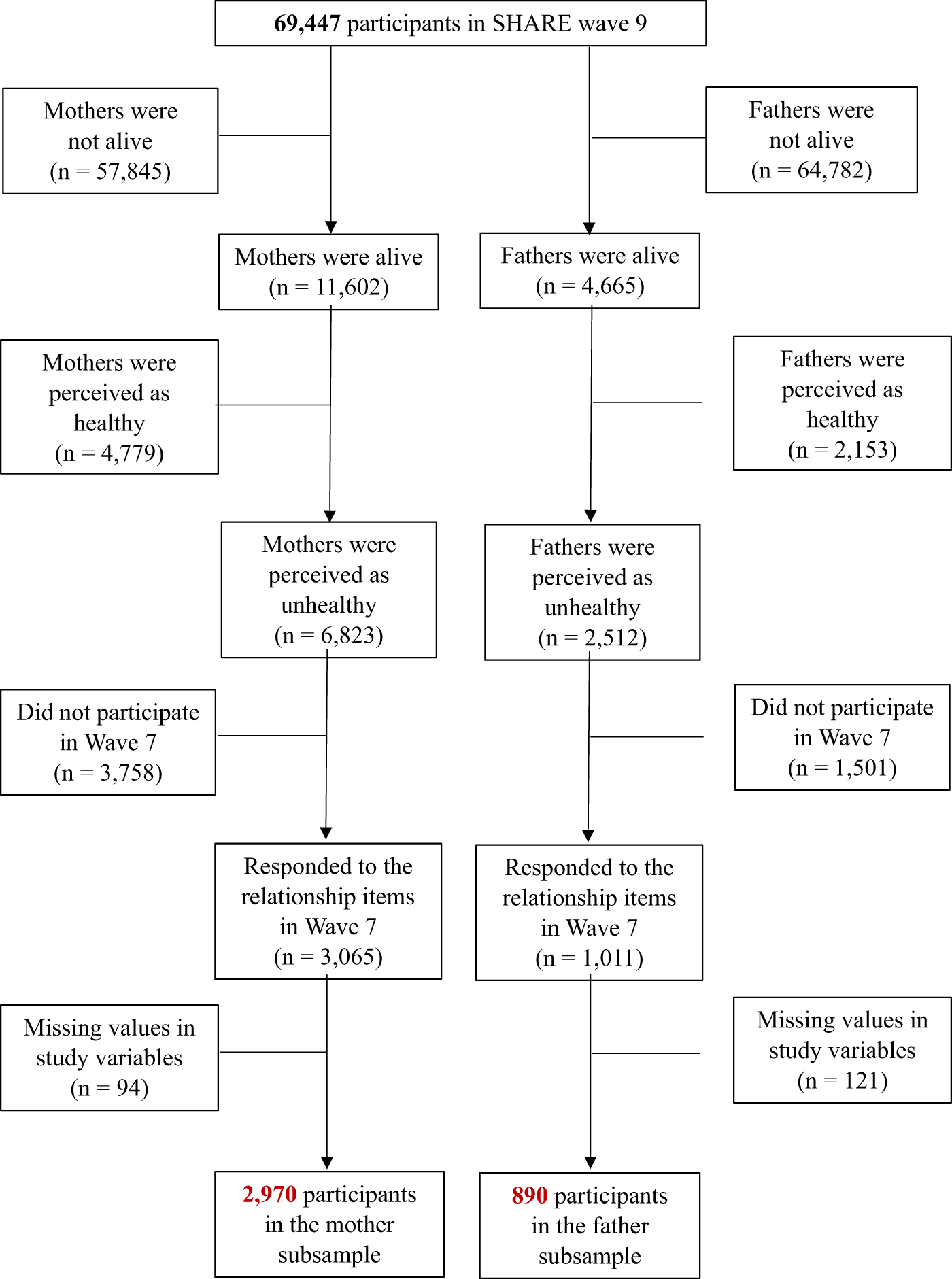
The primary inclusion criterion was having a parent with care needs. This measure was used to define the analytic sample, whereas the outcome variable captures whether respondents provided care. The evaluation was based on the parent’s health as perceived by the respondents. The participants included in the sample were those who reported that their parent’s health was either fair or poor. This subjective health measure aligns with previous studies (e.g. Herrera and Fernández Reference Herrera and Fernández2023) which suggest that a subjective measure of health can be indicative of objectively deteriorated health and a need for care. To address differences based on the identity of the care recipient, the analytic sample comprised two subsamples: 890 respondents with an unhealthy father and 2,970 respondents with an unhealthy mother. See Figure 1 for further details on participant selection.
Flow of the participants.

Figure 1 Long description
The flowchart outlines the selection process of 69,447 participants in SHARE wave 9. It begins with participants whose mothers were not alive (57,845) and those whose mothers were alive (11,602). From the latter, mothers perceived as healthy (4,779) and unhealthy (6,823) are identified. Those with unhealthy mothers are split into non-participants in Wave 7 (3,758) and those who responded to relationship items in Wave 7 (3,065). After accounting for missing values in study variables (94), 2,970 participants are in the mother subsample. Similarly, for fathers, 64,782 were not alive and 4,665 were alive. Among the latter, fathers perceived as healthy (2,153) and unhealthy (2,512) are identified. Those with unhealthy fathers are divided into non-participants in Wave 7 (1,501) and those who responded to relationship items in Wave 7 (1,011). After accounting for missing values (121), 890 participants are in the father subsample.
Study variables
Dependent variable: providing care to a parent with care needs
This variable was assessed using two items that referred to help given to people from each respondent’s personal network in the last 12 months, both inside and outside the household. The help included support in activities of daily living (ADLs), instrumental activities of daily living (IADLs) or assistance with paperwork. We created a binary variable, assigning a value of 0 if a respondent did not provide help to anyone or provided help to anyone except for a parent. A value of 1 was assigned if a respondent provided help to a parent (either solely or in addition to others). Since the help provision items in the SHARE include information on the identity of the care-recipient, we were able to create separate variables for mothers and fathers.
Independent variables
Perceived child–parent relationship characteristics during childhood included both supportive and adverse aspects. The supportive aspect, extent of parental understanding, was assessed through the question ‘How well did your mother/father understand your problems and worries?’, rated on a scale from ‘1’ (not at all) to ‘4’ (very well). The adverse aspect, frequency of physical abuse by parent, was captured through the question ‘How often did your mother/father push, grab, shove, throw something at you, slap, or hit you?’, rated on a scale from ‘1’ (never) to ‘4’ (often).
Geographical regions in Europe were grouped into four country clusters, used as proxies for cross-national variations in long-term care arrangements and reliance on family support (Labbas and Stanfors Reference Labbas and Stanfors2023). The clusters were: Northern Europe/Nordic region (Sweden, Denmark, Finland), Central Europe (Austria, Germany, France, Switzerland, Belgium, Luxembourg), Southern Europe/Mediterranean (Spain, Italy, Greece, Israel, Portugal, Cyprus, Malta) and Eastern Europe (Czech Republic, Poland, Hungary, Slovenia, Estonia, Croatia, Lithuania, Bulgaria, Latvia, Romania, Slovakia). The East European region served as a reference category owing to its having the highest number of observations.
Control variables
We controlled for background characteristics that are well established in the literature as having an impact on informal care provision (Mozhaeva Reference Mozhaeva2019; Seifert and König Reference Seifert and König2019; Quashie et al. Reference Quashie, Wagner, Verbakel and Deindl2022). These included respondents’ age (in years), gender (‘0’ for men, ‘1’ for women) and marital status, which was dichotomized into living without a partner (0) or with a partner (1) in the same household. Financial capacity was assessed based on the perceived ability to make ends meet, ranging from ‘1’ (with great difficulty) to ‘4’ (easily). Self-rated health was assessed on a scale from ‘1’ (excellent) to ‘5’ (poor). Level of education was categorized according to the International Standard Classification of Education (ISCED) 1997, with three categories: low level (ISCED 0, 1 and 2) as a reference category, middle level (ISCED 3 and 4) and high level (ISCED 5 and 6).
We also controlled for variables that represent additional sources of support: number of respondents’ living children, whether the respondent had siblings alive (yes/no), and whether the respondent lived in the same residence as the parent. The latter was assessed separately for fathers and mothers and dichotomized: ‘1’ if the respondent shared the same household or lived in the same building, and ‘0’ if the respondent lived at a greater geographical distance. Finally, we addressed the current relationship with the parent as reflected in the inclusion of the parent within the respondent’s confidant network variable (dichotomized).
Data analysis
We first present descriptive statistics of the study variables. Then, we use adjusted multivariate analyses with binary logistic regression. In the first stage, we entered the independent variables, namely supportive and adverse aspects of the early child–parent relationship and the geographical regions. In the next step, we investigated the moderating effect of geographical regions in Europe on the association between the perception of the parent’s understanding in childhood and the provision of care, as well as on the association between estimated parent’s frequency of physical abuse and the provision of care. All analyses were conducted separately for fathers and mothers using STATA v14. The statistical significance level was set at 0.05.
Results
Table 1 shows the statistics of the sample. As for the study measures, 34.3 per cent of the respondents who had a mother with care needs reported providing care to their mother. Of the respondents who reported having a father with care needs, 28.9 per cent provided care to their father. The mean extent of parental understanding in childhood, as reported by the respondents, was somewhat higher in the mother subsample than in the father subsample. The reported frequency of parental abuse in childhood was similarly low in both subsamples. The mother subsample was more prevalent among residents of Eastern European countries, whereas the shares of respondents residing in other regions were higher in the father subsample.
Descriptive statistics of the study variables

Table 1 Long description
Descriptive statistics compare respondents with a mother versus a father who has care needs, reporting means with standard deviations or counts with percentages, plus ranges for continuous measures. Providing care was reported by 34.3 percent for mothers and 28.9 percent for fathers; most did not provide care in either group. Childhood relationship measures were similar: parental understanding averaged 3.23 for mothers versus 2.91 for fathers on a 1 to 4 scale, while physical abuse frequency averaged 1.61 in both groups on a 1 to 4 scale. Regional distribution differed, with Eastern Europe the largest share for mothers (45.0 percent) and a smaller share for fathers (33.6 percent), while Nordic representation was higher in the father group (16.1 percent) than the mother group (10.3 percent). Gender composition was similar in both groups (about 63 percent women), and mean age was slightly higher in the mother group (61.84) than the father group (60.38), with wide age ranges noted. Living with a partner was common in both groups and higher for the father group (83.6 percent) than the mother group (78.5 percent). Education was mostly middle level in both groups, with a higher share of high education in the father group (33.9 percent) than the mother group (25.5 percent). Respondents averaged about two living children, most had siblings alive (about 94 percent), few lived in the same residence as the parent (12.2 percent for mothers, 7.8 percent for fathers), and fewer included the parent in their confidant network for fathers (14.8 percent) than mothers (22.4 percent).
1 mother sample.
2 father sample.
As for covariates, the gender composition in each of the two subsamples was relatively similar, with female domination in both. Age distribution was also relatively similar, with a somewhat higher mean in the mother subsample. Both subsamples exhibited similarly moderate financial capacity and self-rated health. The share of respondents with a high level of education was notably higher in the father subsample than in the mother subsample. The number of children alive was similar (about two) in both subsamples. So were the shares of respondents with siblings who were still alive on the day the interviews were held. A relatively small share of respondents resided with their parents in the same household/building. Some of the respondents in both subsamples included a parent in their confidant network, but this figure was higher in the mother subsample than in the father subsample.
Multivariable analysis
Tables 2 and 3 show the results of the binary logistic regression models estimating the likelihood of providing care for mothers and fathers, respectively.
Logistic regression models predicting the likelihood of providing care to mothers with care needs: main effects (Model 1) and interactions with European regions (Model 2) (n = 2,970)

Table 2 Long description
Logistic regression results report odds ratios with confidence intervals and p values for providing care to a mother with care needs, comparing a main-effects model with a model that adds region interactions. In both models, living in the same residence is strongly associated with higher odds of care (about 2.4 to 2.5), and having the mother in the respondent’s confidant network also strongly increases odds (about 2.15 to 2.16), both highly significant. Women, older age, greater financial capacity, and better self-rated health are associated with higher odds; high education is also associated with higher odds, while middle education is not clearly different from low education. Having siblings alive is associated with lower odds (about 0.57) in both models. Regional main effects indicate higher odds in Nordic and Central Europe than in Eastern Europe in the main-effects model; in the interaction model, Central and Southern show significant positive region effects, while Nordic is borderline. For child–parent relationship measures, maternal understanding is a small positive predictor in the main-effects model but is not significant once interactions are included; physical abuse is not associated in the main-effects model but becomes positively associated in the interaction model. Interaction terms suggest the abuse association is weaker in Nordic and Central Europe (significant reductions) and possibly weaker in Southern Europe (borderline), while understanding interactions are not clearly significant. Model fit improves slightly with interactions, with a higher pseudo R-squared and a less negative log likelihood.
a Reference categories: Eastern Europe (region), low education (education).
Logistic regression models predicting the likelihood of providing care to fathers with care needs: main effects (Model 1) and interactions with European regions (Model 2) (n = 890)

Table 3 Long description
Odds ratios from two logistic regression models estimate likelihood of providing care to a father with care needs, comparing a main-effects model with a model that adds region interactions (n equals 890). In both models, living in the same residence and having the father in the confidant network show the largest and most consistent positive associations, each with about two to three times higher odds and very small p values. Being a woman is also associated with higher odds in both models, while age is a small positive effect in Model 1 but becomes borderline in Model 2. Higher education (versus low) is linked to higher odds in both models, while middle education is not clearly different from low. Regional main effects in Model 1 suggest higher odds in Nordic and Central Europe compared with Eastern Europe, but in Model 2 these regional main effects are no longer clearly different from the reference once interactions are included. For relationship quality measures, paternal understanding and physical abuse are not clearly associated with care in the main-effects model, but the Nordic-by-understanding interaction is positive and statistically clear, indicating the association of understanding with care is stronger in Nordic countries than in Eastern Europe. Model fit improves slightly in Model 2, with a higher pseudo R squared and a less negative log likelihood.
a Reference categories: Eastern Europe (region), low education (education).
Direct associations
We found that in models without interaction, the extent of parental understanding was positively associated with providing care to mothers (OR = 1.11, p = 0.043) but was unrelated to providing care to fathers (OR = 1.14, p = 0.141). Frequency of parental abuse was unrelated to the outcome variable in both subsamples. Therefore, Hypothesis 1a was partially supported and Hypothesis 1b was fully supported. Geographical region showed strong independent associations with care-giving. Compared with respondents in Eastern Europe, those residing in Nordic countries and Central Europe had significantly higher odds of providing care to both mothers (OR = 3.43, p < 0.001; OR = 1.87, p < 0.001) and fathers (OR = 3.35, p < 0.001; OR = 1.97, p < 0.001). No differences were observed between Southern and Eastern Europe in either subsample.
Patterns for control variables were largely similar across the mother and father subsamples. Women were more likely than men to provide care, and older respondents were also more likely to provide care to their parents. High education (compared to low education) was associated with a greater likelihood of providing care. Co-residence with the parent and including the parent in one’s confidant network were also linked to increased odds of providing care. In the mother subsample, additional factors were relevant: better financial capacity and better self-rated health were associated with a higher likelihood of providing care, whereas having siblings alive was associated with a lower likelihood of providing care.
Geographical region showed strong independent associations with providing care. Compared with respondents in Eastern Europe, those residing in Nordic countries and Central Europe had significantly higher odds of providing care to both mothers (OR = 3.42, p < 0.001; OR = 1.87, p < 0.001) and fathers (OR = 3.35, p < 0.001; OR = 1.97, p < 0.001). No differences were observed between Southern and Eastern Europe in either subsample.
Interaction – parental understanding and region
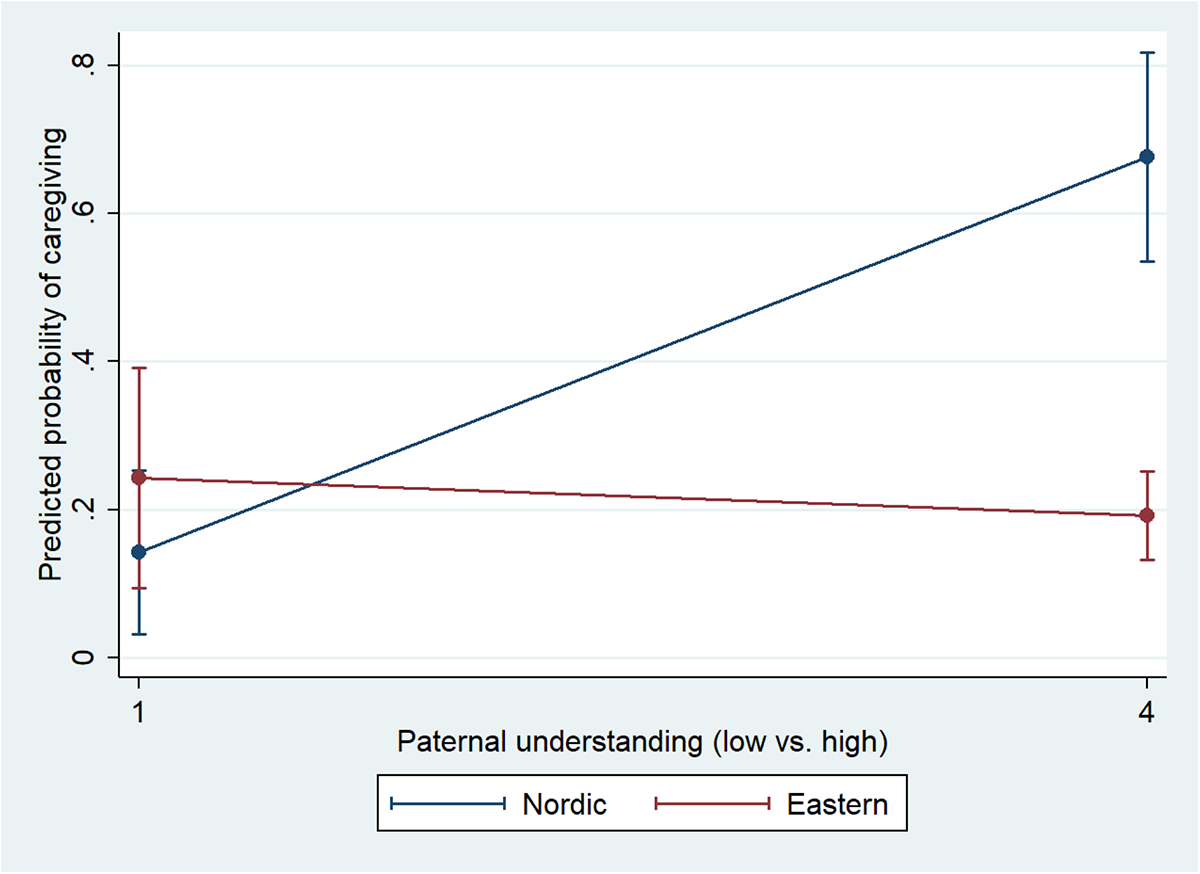
In the mother subsample, no significant interaction was found between maternal understanding in childhood and geographical region, indicating that the positive association observed in the main-effects model did not differ across regions. In the father subsample, a significant interaction was found only for the Nordic region (OR = 2.76, p = 0.001), suggesting that parental understanding in childhood was more strongly related to providing care to fathers among adult children in Nordic countries compared with Eastern Europe (see Figure 2).
Extent of paternal understanding and care-giving to fathers: Nordic vs Eastern Europe.

Interaction – parental abuse and region
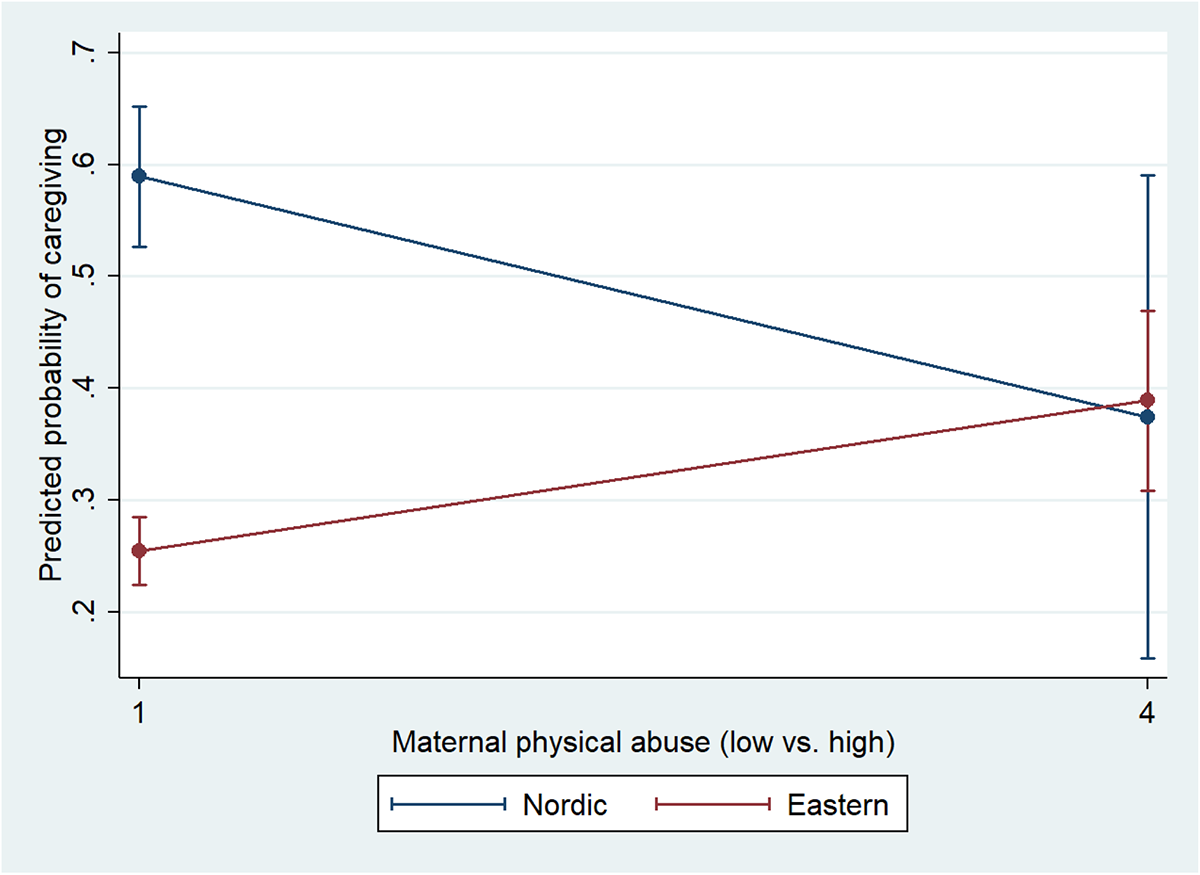
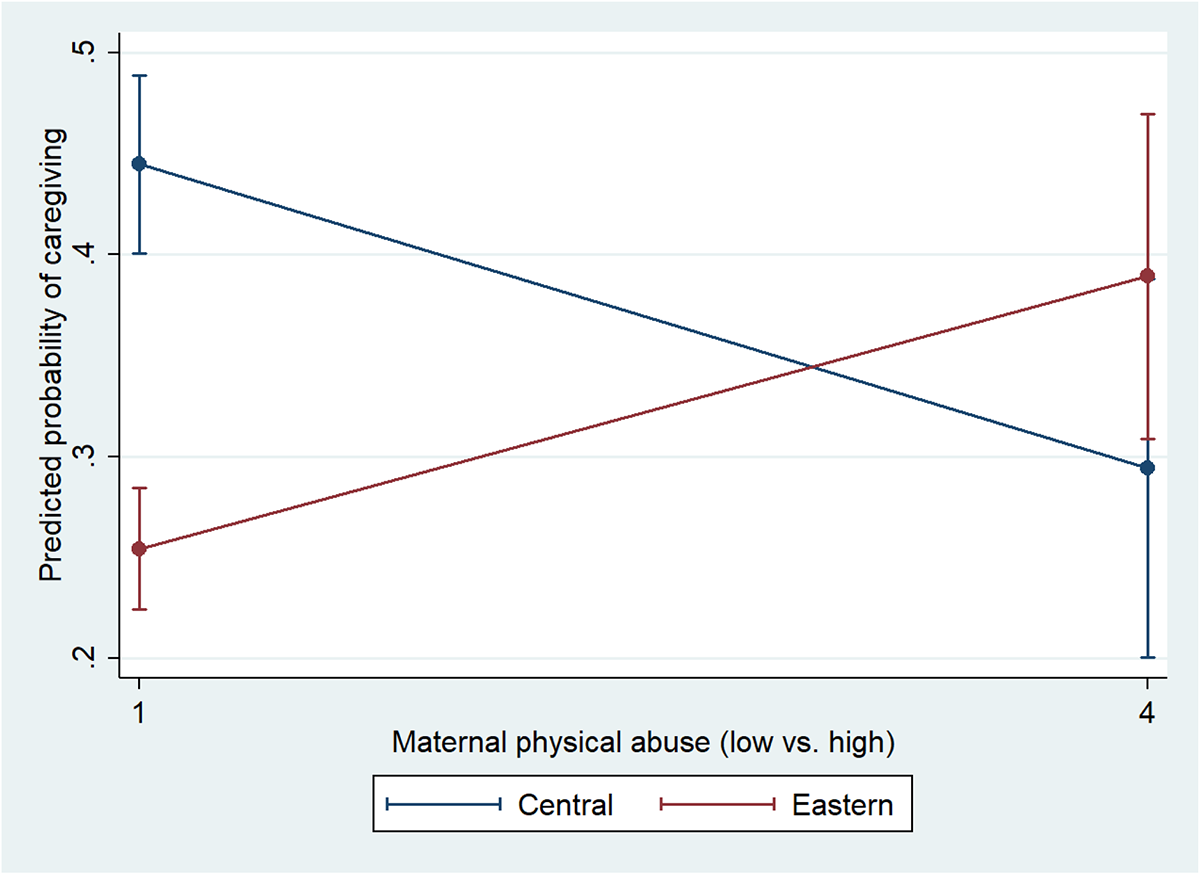
In the mother subsample, significant interactions emerged for the Nordic region (OR = 0.57, p = 0.007) and Central Europe (OR = 0.63, p < 0.001). This indicates that, compared with Eastern Europe, higher frequencies of maternal abuse in childhood were associated with lower odds of providing care to mothers in these regions (see Figures 3 and 4). In the father subsample, no significant interactions were found between paternal physical abuse and geographical region.
Summarizing the interaction results, for the extent of parental understanding, regional variation appeared only for fathers, whereas for the frequency of childhood abuse, regional variation appeared only for mothers. Thus, Hypothesis 2 was partially supported.
Maternal childhood abuse and care-giving to mothers: Nordic vs Eastern Europe.

Maternal childhood abuse and care-giving to mothers: Central vs Eastern Europe.

Discussion
Following the ICM (Broese van Groenou and De Boer Reference Broese van Groenou and De Boer2016), which proposes that both individual dispositions and contextual factors shape the provision of informal care, we first examined whether child–parent relationships in childhood are associated with providing care to an older parent with care needs, while analysing mothers and fathers separately. In line with the ICM’s emphasis on the interplay between micro- and macro-level factors, a second aim was to investigate whether these associations vary across broad European regions, used as proxies for cross-national differences in family norms and long-term care arrangements (Billari Reference Billari2004).
Concerning the direct association between the supportive aspect of childhood relationships and later provision of care, we found that a higher degree of maternal understanding in childhood was associated with a greater likelihood of providing care to mothers with care needs. This pattern is consistent with empirical findings suggesting that emotionally close child–mother ties, including relationship closeness and a strong emotional bond with the mother, are associated with later support and care-giving involvement (Cicirelli Reference Cicirelli1993; Lin and Hammersmith Reference Lin and Hammersmith2024). In contrast, the extent of paternal understanding in childhood was not associated with care-giving to fathers. Previous work has also shown that early relationship quality predicts support for mothers but not for fathers (Silverstein et al. Reference Silverstein, Conroy, Wang, Giarrusso and Bengtson2002; Anonymous 2023). Plausible explanations lie in the role of mothers as primary attachment figures (Cicirelli Reference Cicirelli1993; Klaus Reference Klaus2009) and in their central role in maintaining closer relationships with their children across the lifecourse compared with fathers (Szydlik Reference Szydlik2008).
As to adverse aspects of childhood relationships, we found no direct association between the reported frequency of childhood parental physical abuse and later provision of care, for either mothers or fathers. This pattern is in line with previous work showing that adult children continue to care for parents despite experiences of parental maltreatment in childhood (Kong and Moorman Reference Kong and Moorman2015; Kong Reference Kong2018b). Notably, providing care in such circumstances may be accompanied by feelings of ambivalence and heightened psychological distress (Band-Winterstein Reference Band-Winterstein2014; Kong et al. Reference Kong, Kunze, Goldberg and Schroepfer2021).
The second aim of the study was to examine whether the association between childhood relationship characteristics and later care-giving varies across broad European regions. These regions served as proxies for cross-national differences in familial norms and the availability of formal long-term care (Brandt Reference Brandt2013; Verbakel Reference Verbakel2014, Reference Verbakel2018). In general, a North–South gradient has been widely documented, with Northern European countries characterized by more extensive long-term care provision and weaker familistic norms, and Southern European countries showing the opposite pattern. Eastern European countries tend to resemble Southern Europe in combining stronger family obligations with more limited formal care, whereas Central Europe occupies an intermediate position between North and South (Reher Reference Reher1998; Billari Reference Billari2004; Brandt Reference Brandt2013; Lestari et al. Reference Lestari, De Luna, Eriksson, Malmberg and Ng2021).
Before turning to the moderating role of geographical regions, it is important to note that regional differences were also evident at the level of direct associations. Respondents in Nordic and Central European countries exhibited higher likelihoods of providing care to both mothers and fathers compared with respondents in Eastern Europe. These findings align with the specialization hypothesis (Brandt et al. Reference Brandt, Haberkern and Szydlik2009) and prior research showing that informal care is more prevalent in countries with more developed long-term care systems. In such contexts, formal services tend to absorb the most intensive care needs, allowing informal care to take on a more complementary and less intensive role. By contrast, in regions with more limited long-term care provision, care-giving is less prevalent but more concentrated and intensive (Brandt et al. Reference Brandt, Haberkern and Szydlik2009; Brandt Reference Brandt2013; Verbakel Reference Verbakel2018). Importantly, the present study captures a broad range of care-giving activities, including personal, instrumental and administrative support, which may help explain the higher prevalence of care provision observed in Northern and Central Europe.
Regarding the moderating role of geographical regions, our findings show that the extent of fathers’ understanding in childhood was associated with a higher likelihood of providing care to fathers in Nordic countries compared with Eastern Europe. In addition, maternal physical abuse in childhood was linked to a lower likelihood of providing care to mothers in Northern and Central Europe compared with Eastern Europe. These findings should be interpreted in light of previous research pointing to cross-national variations in informal care characteristics in Europe. In regions with weaker familial obligations and more extensive formal care (e.g. Northern Europe), care-giving is often perceived as more voluntary and less demanding (Brandt Reference Brandt2013; Verbakel Reference Verbakel2018; Vangen and Herlofson Reference Vangen and Herlofson2024); adult children may therefore have greater space to base their decisions on personal considerations, including the quality of past relationship experiences. In contrast, in regions characterized by strong family norms and limited long-term care support (e.g. Southern Europe and Eastern Europe), care-giving is perceived as more obligatory (Verbakel Reference Verbakel2014; Brenna and Di Novi Reference Brenna and Di Novi2016) and the history of the parent–child relationship appears to play a more limited role in shaping whether care is provided.
Furthermore, our findings that childhood relationship characteristics were not associated with providing care in high-familism contexts suggest that familism and the quality of the parent–child relationship are not synonymous. Prior research similarly shows that in strong family ties regions, where familism often involves close living arrangements (Reher Reference Reher1998), older adults report high loneliness (de Jong Gierveld J and Tesch-Römer Reference de Jong Gierveld and Tesch-Römer2012), whereas Nordic countries maintain high social contact despite greater distance (Mönkediek and Bras Reference Mönkediek and Bras2014).
Taken together, our findings provide partial support for the ICM framework (Broese van Groenou and De Boer Reference Broese van Groenou and De Boer2016), suggesting that some childhood relationship characteristics may vary across macro-level contexts. They also point to the importance of examining relational mechanisms separately for care-giving to mothers and fathers. In the mother subsample, the supportive aspect of the relationship (maternal understanding) was associated with providing care consistently across regions, whereas the adverse aspect (maternal physical abuse) was linked to a lower likelihood of providing care in contexts where care-giving is more discretionary. In the father subsample, by contrast, childhood relationship characteristics were overall less predictive of providing care.
Limitations and implications
The study has several limitations. First, the retrospective retrieval of relationship characteristics in childhood may not fully align with objective experiences. In particular, the accuracy of retrospective reports of negative early life events is limited (Ayalon Reference Ayalon2017). Second, the supportive and the adverse aspects of the child–parent relationship were each measured using a single indicator. While this approach allows for broad cross-national comparisons, it may not capture the multi-dimensional and dynamic nature of early parent–child relationships or their long-term implications for care-giving. Third, interpretation of the observed differences between mothers and fathers requires caution. Attachment-based research has historically focused on mothers as primary attachment figures (Bretherton Reference Bretherton, Newland, Freeman and Coyl2014), resulting in greater conceptual and empirical attention to the associations between child–mother relationships and later-life care-giving (Cicirelli Reference Cicirelli1993; Carpenter Reference Carpenter2001; Schwarz and Trommsdorff Reference Schwarz and Trommsdorff2005). Future studies should use richer measures of early relationships and test pathways to providing care for mothers and fathers separately.
The study highlights the importance of addressing the needs of adult child care-givers, as they represent a substantial care-giving force (de Klerk et al. Reference de Klerk, de Boer and Plaisier2021). Clinicians should particularly support those providing care to a parent who was neglectful or abusive, as care-giving under such circumstances is often associated with significant emotional burden and psychological strain. One potential approach is to facilitate pathways of healing or renegotiating the relationship (Kong et al. 2021). At the macro level, special attention should be given to care-givers in regions with strong family norms and restricted long-term care arrangements, ensuring that their past relationships and unique challenges are acknowledged and addressed.
Acknowledgements
This article uses data from SHARE Waves 7 and 9 (10.6103/SHARE.w7.900, 10.6103/SHARE.w9.900,); see Börsch-Supan et al. (Reference Börsch-Supan, Brandt, Hunkler, Kneip, Korbmacher, Malter, Schaan, Stuck and Zuber2013) for methodological details. The SHARE data collection has been funded by the European Commission, DG RTD through FP5 (QLK6-CT-2001-00360), FP6 (SHARE-I3: RII-CT-2006-062193, COMPARE: CIT5-CT-2005-028857, SHARELIFE: CIT4-CT-2006-028812), FP7 (SHARE-PREP: GA N°211909, SHARE-LEAP: GA N°227822, SHARE M4: GA N°261982, DASISH: GA N°283646) and Horizon 2020 (SHARE-DEV3: GA N°676536, SHARE-COHESION: GA N°870628, SERISS: GA N°654221, SSHOC: GA N°823782, SHARE-COVID19: GA N°101015924) and by DG Employment, Social Affairs & Inclusion through VS 2015/0195, VS 2016/0135, VS 2018/0285, VS 2019/0332 and VS 2020/0313. Additional funding from the German Ministry of Education and Research, the Max Planck Society for the Advancement of Science, the US National Institute on Aging (U01_AG09740-13S2, P01_AG005842, P01_AG08291, P30_AG12815, R21_AG025169, Y1-AG-4553-01, IAG_BSR06-11, OGHA_04-064, HHSN271201300071C, RAG052527A) and various national funding sources is gratefully acknowledged (see www.share-eric.eu).
Financial support
None.
Competing interests
None.
Ethical standards
The SHARE project is reviewed and approved by the Ethics Council of the Max Planck Society (www.share-project.org/). The SHARE data are available to the research community upon individual registration: www.share-project.org/data-access/user-registration.html.



 Open access

