IntroductionFootnote 1
The impact of local variables on the initiation and outcome of rebellion has long been the subject of academic inquiry. As Daniel Little has argued in his analysis of rebellion in China, interest in local political influence on collective violence has come about from the failure of class conflict theories to explain regional variations in levels of contention (Little Reference Little1989: 164–70). Scholars have also noted that rebellions challenging central government in different pre-modern East Asian contexts often began as regional attempts to correct local problems (Little Reference Little1989: 171).Footnote 2 Scholars such as Hugh Borton (Reference Borton1968) have argued that in pre-modern Japan and China certain areas were characterized by more contention than others, and these areas remained rebellious despite countrywide political and structural changes. James White (Reference White1995: 285) identifies certain areas that were particularly contentious under the Tokugawa (1600–1868) and observes that these areas often remained so throughout the Meiji Restoration (1868) and up to the First World War. Elizabeth Perry (Reference Perry1980: 246–9) also notes that the mass violence that continued throughout the Qing period (1644–1912) and into the People's Republic of China only ceased when ecological problems were addressed. While Perry believes the interaction of ecological and social variables in rural Huáiběi (淮北, Northern Anhui 安徽 Province) helped instigate rebellion, White argues that both metropolitan areas, and less tightly administered far-flung regions, over time developed a “culture of contention” that was apparently impervious to both socio-political change and government repression (White Reference White1995: 13 and 285). Within White's framework, people from specific areas drew on previous historical memories of local contention as an impetus.Footnote 3
There has been great interest in the outbreaks of collective violence that occurred in areas of the Korean peninsula during the Chosŏn period (1392–1910). The focus has been on two areas in particular: P'yŏngan Province (平安道) in the north west (site of the 1811 Hong Kyŏngnae Rebellion), and Kyŏngsang Province (慶尙道) in the south east (site of the 1862 Chinju Rising [晋州民亂 Chinju millan]).Footnote 4 Among the explanations that have been given for the outbreaks of violence, scholars such as Chŏng Sŏkchong (1972) have interpreted the Hong Kyŏngnae Rebellion (洪景來의 亂) in terms of class struggle, while others like Anders Karlsson (Reference Karlsson2000) have argued that local violence was a response to a power struggle between central government and local elites. Sun Joo Kim (Reference Kim2007) argues that the Hong Kyŏngnae Rebellion should be primarily understood as a response to the cultural and political marginalization of P'yŏngan Province elites and the historical memory of previous violent outbreaks in the region. For Kim, “P'yŏngan residents were socially insulted and politically demeaned” and this helped produce a culture of contention that cut across class differences, as frustration was “transmitted to the general population … who eventually internalized it as their own resentment toward the central government” (Kim Reference Kim2007: 57).Footnote 5 In other words, it was neither class nor shared economic interests that unified a regional community, but rather the vicarious anger non-elites felt about elite disenfranchisement. Thus, Sun Joo Kim's explanations argue against class-based solidarity and instead stress local solidarity.
The 1728 Musin Rebellion broke out in three provinces, and many scholars have used regional as well as class conflict arguments to insist that political marginalization of elites from a single region led to the initiation of the violence.Footnote 6 This paper explores the arguments of regionalist scholars and analyses previously unexamined evidence from official sources about rebel motivation, the regional make-up of the rebel organization, and official views of the causes of the rebellion. Official records provide a wealth of detailed information that can be used to determine whether rebel grievances centred on regional issues. This paper focuses on evidence found in post-rebellion court statements in the Yŏngjo sillok (英祖實錄, “Veritable records of Yŏngjo's reign”, hereafter cited as sillok)Footnote 7 and also assesses rebel motivation for participation based on an analysis of evidence from rebel testimony, actions and propaganda contained in the sillok and Musin Yŏgok ch'uan (戊申逆獄推案, “Trial record of the Musin year rebels” hereafter cited as Yŏgok ch'uan).
The paper also investigates the regional structure and make-up of the rebel organization to determine what this tells us about rebel intention. In her comparative study of rebellion, Diana Russell (Reference Russell1974: 10) writes that: “If it is not the poor who rebel, then the cause cannot be poverty”. Underlying this statement is the assumption that the membership of rebel organizations reflects the interests, demands and grievances of its individual members. If a rebel is motivated by issues relating to his/her locality then that person is likely to be culturally, politically or physically linked to that area. It is important to analyse the membership of the rebel organization to confirm the existence of such regional connections. Based on this analysis of government information, rebel motivations and rebel geographical associations, the paper concludes by challenging assumptions of regionalist scholars which are ultimately misleading about the overall shape of the Musin Rebellion and its place in Korean history.
The Musin Rebellion
The Musin Rebellion broke out in 1728 when armed men led by Yi Injwa (李麟佐, ?–1728) seized control of Ch’ŏngju (淸州) in Ch'ungch’ŏng Province (忠淸道).Footnote 8 The majority of rebels were members of the Southerner faction (Namin 南人) or were extremists of the Disciples faction (Chunso Soron 峻少 少論): this is significant because the Musin Rebellion itself was preceded by several other attempts on power by factional members or disgruntled office holders including the Injo Restoration (仁祖反正, Injo Panjŏng, 1623), the Yi Kwal Rebellion (李适, 1624), the Yi In'gŏ Rebellion (李仁居, 1627) the Kim Ik plot (金釴, 1651), and the Sambok Plot (三復, 1680).Footnote 9 The Musin rebels claimed loyalty to Kyŏngjong, a sickly king who died young, and many Disciple's faction extremists claimed that his half-brother Yŏngjo had deliberately poisoned him to usurp the throne (Haboush Reference Haboush1988: 32). Over a period of three years, these rebels built up an underground organization committed to overthrowing Yŏngjo and destroying the pro-Yŏngjo Patriarch's faction (老論 Noron) and placing a distant relative of Yŏngjo on the throne.Footnote 10
The Musin Rebellion erupted a few months after the 1727 removal of the Patriarch's faction and the restoration of the Disciple's faction to office (Chŏngmi hwanguk 丁未換局), a restoration that represented Yŏngjo's attempt to mollify factionalism (Jackson Reference Jackson2011a). The 1727 Disciple's faction restoration meant that many Musin rebels were, in fact, rebelling to seize power from their own faction. Although many of the restored men were moderates within the Disciple's faction (Wanso Soron 緩少), some rebels were also in office after 1727 and I have argued elsewhere that these rebel fifth-columnists played a central role in both the creation of a military plan and the initiation of the rebellion (Jackson Reference Jackson2013). The rebellion raged for three weeks and the government lost control of four county seats to the rebels in Ch'ungch’ŏng, four in Kyŏnggi and five in southern Kyŏngsang Provinces. Rebels installed their own officials in power and for a brief period there were effectively two competing political authorities on the peninsula – an event that would not occur on such a scale until the Hong Kyŏngnae rebellion, and one that provides evidence of the significance of the Musin Rebellion in eighteenth-century Chosŏn history.
The seizures in southern Kyŏngsang Province were led by Kyŏngsang Province elites and followed an unsuccessful attempt to mobilize and seize Andong (安東, northern Kyŏngsang Province) when local elites turned against rebels (Yi Usŏng 1959: 725). The seizures of provincial towns were meant to be a prelude to the main event – the capture of the capital itself (Jackson Reference Jackson2011b). The rebels seized regional seats to arm themselves before proceeding north to launch a co-ordinated attack on the capital along with fifth-columnist forces. But this did not go to plan. Rebel fifth-columnists led by P'yŏngan military commander Yi Sasŏng (李思晟, ?–1728) were supposed to mobilize government troops under their command and to use the crisis provided by the rebellion to take the capital (YS 04/04/22 (imin)17:26b–28a, pp. 47–48/42).Footnote 11 However, these fifth-columnists were betrayed by captured rebels and their military plan was neutralized by the court, which also raised a force to suppress rebels in the provinces. Rebels in Ch’ŏngju marched towards the capital but were defeated in battles in Kyŏnggi Province (YS 04/03/20 (kyŏngo) 16:19b, p. 23/42). Unaware of the defeat of their comrades, the Kyŏngsang Province rebels made further attempts to head north to link with rebel forces, but were hemmed in by inhospitable terrain and government troops, and were eventually crushed (Yi Wŏngyun 1971: 75).
Regional understandings of the Musin Rebellion
Academics have disagreed over the causes and character of the Musin Rebellion, but Yi Usŏng (1959), Yi Wŏngyun (1971), Yi Chaech’ŏl (1986), the Kŏch'ang kunsa p'yŏnch'an wiwŏnhoe (the history of Kŏch'ang county editorial committee, hereafter cited as Kŏch'ang kunsa, 1997),Footnote 12 Yi Chongbŏm (1997) and Cho Ch'anyong (2003) have stressed that regional dynamics were behind the initiation of violence. The aforementioned scholars argue that discontent resulting from marginalization motivated Kyŏngsang Province elites to dominate the rebel organization. These elites had previously played an important role in Chosŏn elite society, but had been prevented from taking highly sought-after court positions, so by 1728, the “accumulated complaints” exploded into rebellion (Kŏch'ang kunsa 1997: 558; Yi Wŏngyun 1971: 86). There were geographical and political reasons for this change of fortune. Although they occupied other areas, including Kyŏnggi Province, Kyŏngsang Province was the traditional home of the Southerner faction that fell from power in the late Chosŏn period.
Since factional allegiances traditionally ran along family lines, there was a high concentration of single-lineage villages in Kyŏngsang Province with strong Southerners ties (Yi Wŏngyun 1971: 84). The political disenfranchisement of the Southerner faction was engineered by the Westerners (Sŏin 西人).Footnote 13 Subsequently the Westerners, and their offshoot the Patriarch's faction, virtually monopolized power at the centre until Chŏngjo restored some Southerners to power (Setton Reference Setton1992: 60). Scholars argue this “discrimination” (ch'abyŏl, 差別) prevented Kyŏngsang Province elites from holding high office (Cho Ch'anyong 2003: 21),Footnote 14 that they led “unproductive” lives as increasingly impoverished landlords, and were full of “bitterness” (directed primarily towards political opponents in court). Thus Kyŏngsang Province rebels were attempting to overcome their worsening disenfranchisement (Cho Ch'anyong 2003: 7 and 23).
Cho Ch'anyong and the authors of the Kŏch'ang kunsa are local historians interested in highlighting the role of Kyŏngsang Province elites in what they see as a righteous rebellion to overthrow a corrupt dynasty, but some are influenced by class struggle theories and argue that discontent among the Kyŏngsang Province elite coincided with countrywide economic and social disintegration (Cho Ch'anyong 2003: 13, 16). One scholar, Yi Chongbŏm, focuses on the connections of Chŏlla Province (全羅道) to the rebellion, arguing that economic competition between Chŏlla elites and the court manifested itself in growing government interference in the agricultural, lumber and manufacturing sectors, leading to resentment that cut across class boundaries and resulted in great local support for the rebellion (Yi Chongbŏm 1997: 188).
Most regionalist scholars base their arguments on an analysis of political and economic data from the period leading up to the rebellion, and the role of elite Kyŏngsang Province rebels like Chŏng Hŭiryang (鄭希亮) and Cho Sŏngjwa (曺聖佐 both ?–1728) in the violence. Regionalist arguments stress that the rebellion was not a response to local ecological problems (as Elizabeth Perry argues) but was caused by anger about the repressive policy of central government: regionalists imply a local Kyŏngsang Province solidarity because of the disenfranchisement of Kyŏngsang Province elites (Kǒch'ang kunsa 1997: 558). Regionalist scholars have created an influential interpretation of the causes of the Musin Rebellion to the extent that others, such as Anders Karlsson, have followed regionalist analyses of the initiation of the Musin Rebellion to strengthen their own arguments stressing the regional dynamics of the Hong Kyŏngnae Rebellion (Karlsson Reference Karlsson2000: 274). All of the above arguments tend to situate the Musin Rebellion within a trend of late Chosŏn regional rebellion that included the Hong Kyŏngnae Rebellion and Chinju Rising.
Post-suppression court debates over Yŏngnam (嶺南), Andong and the Yŏngnam men
On the twenty-second of the fourth month, some three weeks after the last rebel leaders had been executed, Yŏngjo delivered an edict to his officials. This edict was part of the court's post-Rebellion analysis, in which Yŏngjo and his officials attempted to determine its causes as well as the rebels’ motivations to ensure there would be no repetition. Notable on this list is a short complaint Yŏngjo made about a single region – Yŏngnam or northern and southern Kyŏngsang Province – and its connections to the rebellion:
In the middle of the night when I'm lying down in the palace and I start thinking about Yŏngnam, my heart grows so heavy that I can't get back to sleep (YS 04/04/22 (imin) 17:28a–30b, pp. 48–9 /42).
Considering that the rebels seized territory and mobilized in four different provinces, it is curious that Yŏngjo lost sleep about Kyŏngsang but not Ch'ungch’ŏng, Chŏlla or Kyŏnggi Provinces. Other sections of this edict provide clues to his thinking:
Yŏngnam from time immemorial has been our kingdom's Ungju [雄州];Footnote 15 many men of great virtue and scholarship have been produced there, so the province became the model for the loyalty between subject and ruler. Unfortunately, through their evil utterances, a gang of wild beasts have seduced the southern region [Namdo 南道— Ch'ungch’ŏng, Kyŏngsang and Chŏlla Provinces] and this led to the emergence of the rebel Chŏng Hŭiryang. This is not only unfortunate for morals in general but also for Yŏngnam. The foundation of the kingdom is the Samnam area [same as Namdo], but when compared to Honam [湖南 Chŏlla Province], Yŏngnam is the greater place. How did it reach the point that good and evil cannot be distinguished? How did this loss of loyalty reach such extremes? A person like Chŏng Hŭiryang coming from Yŏngnam happens but once in a generation … (YS 04/04/22 (imin) 17:28a–30b, pp. 48–9/42).Footnote 16
Later in the same edict Yŏngjo discusses the case of the AndongFootnote 17 men and their connections to the rebellion:
… it was my intention to release the Andong men when I did … it is because I already knew of the customs of this area, that with the exception of those facing charges of treason, I couldn't bear to arrest people. Even though this is my intention, many feel ill at ease about this, and if they are suspicious (of me and my intentions) then this is not me rejecting them, for sure this is the Yŏngnam men themselves breaking off relations with me (YS 04/04/22 (imin)17:28a–30b, pp.48–9/42).
Comments in the above edict signalled the start of a lengthy and sometimes heated debate in court, during the fourth to sixth months, concerning the connections between Kyŏngsang Province and the rebellion, and several points are significant. In his discourse, Yŏngjo is precise in his use of terms, and refers to Kyŏngsang Province as Yŏngnam, but also refers to Andong and at other times to the “Yŏngnam men”. In his study of early factionalism, Yim Dongjae argues that “Yŏngnam men” is in fact a euphemism for Southerner faction supporters, since many (but not all) of them resided in Yŏngnam (hereafter, Kyŏngsang Province; Yim Reference Yim1976: 168), for Yŏngjo, Kyŏngsang Province, Yŏngnam men, Andong, as well as the three southern provinces, were distinct entities. Yŏngjo distinguished between Kyŏngsang Province with its historical and cultural legacy, and people like the Yŏngnam men and Andong elites who resided there.
In the above edict and subsequent statements, Yŏngjo reveals a degree of ambivalence towards the Andong men and the Yŏngnam men, and this requires some explanation. It was revealed in the royal court that three influential Andong elites had held meetings with senior rebel leaders just prior to the seizure of Ch’ŏngju, and during one meeting these elites had rejected calls by rebel leaders to mobilize troops for the rebels (YS 04/04/29 (kiyu) 17:34a–b, p. 51/42). Despite the refusal to fight for the rebels, it was also reported to the court that there had been wider Andong support for the rebellion once it had started. On the twenty-seventh day of the third month:
when the Kyŏngsang Province pacificator Pak Sasu [朴師洙, 1686–1739] arrived in Andong, in Kyŏngsang Province popular feelings [insim 人心] had degenerated from the time of the rebel seizure of Ch’ŏngju to the extent that they were out of control. It was only when they saw Pak Sasu come over the ridge that they realized there was still a court [ruling the kingdom], and it was thanks to this that the will of the people [paeksŏng 百姓] was gradually pacified (YS 04/03/27 (chŏngch'uk) 16:36a, p. 31/42).
Having shown disloyalty, the people of Andong were reported to have redeemed themselves because Pak Sasu went on to form a 500-strong loyalist squad to take military action against the Kyŏngsang Province rebels (YS 04/03/27 (chŏngch'uk) 16:36a, p. 31/42). However, Andong was involved in more controversy because Yŏngjo's claims to have forgiven the Andong men were also reportedly met with suspicion from Andong elites. The king's ambivalence should be seen as a response to the behaviour of Yŏngnam men and Andong elites in the context of the cultural history of the province. Yŏngjo's comments about the central place of Kyŏngsang Province in the historical development of pre-modern Korea echoes rebel testimony in official records that Kyŏngsang Province was not traditionally thought of as a particularly rebellious area. On the contrary, it was considered to be a centre of Korean civilization.Footnote 18 With this tradition in mind, Yŏngjo was offended by the fluctuating loyalty and ambiguous actions of a significant number of influential Andong elites who had refused to commit themselves to active participation on the rebel side, but subsequently supported the collapse of court rule in Ch’ŏngju and other areas. Later, when it became clearer that the rebels themselves would be defeated, Andong men fought for the crown yet maintained frosty relations with the king.
The king was advised to make a public declaration that the people of Andong had been officially pardoned. He made the chief state councillor Yi Kwangjwa (李光佐, 1674–1740) compose a document to be announced to the area and the country, and Pak Munsu (朴文秀, 1691–1756) took it to Andong and gathered the local dignitaries in the county Confucian shrine school to proclaim the king had forgiven them. The dignitaries gathered were reportedly moved to tears (YS 04/04/29 (kiyu) 17:34a–b, p. 51/42). After this, Yi Kwangjwa also recommended that because rebel testimony indicated that not “all” the Yŏngnam men had agreed with the rebels, this rebel testimony should be published and proclaimed to the country (YS 04/05/05 (ŭlmyo) 18:5a–6b, pp. 54–5/42). Gradually the clamour for the punishment of the Yŏngnam men abated within court, although occasionally officials urged wider punishment because of those Yŏngnam men who had been mixed up in “murky plotting” (YS 04/06/29 (musin) f30b–31a, p. 67/4).
Further evidence of problems between the government and the Andong men and Southerner faction can be found in discrepancies between government records like the sillok and the Yŏgok ch'uan. Information from one confession included in the Yŏgok ch'uan is subsequently omitted in the sillok, suggesting deliberate manipulation of information. In the Yŏgok ch'uan, one rebel confesses that leader Pak P'irhyŏn (朴弼顯, 1680–1728) had told other rebels that Andong Southerner faction members were mobilizing, and in addition Pak announced that members of the Southerner faction were leading the plot. The sillok version of the confession omits any mention of Andong Southerner faction involvement for unclear reasons (Musin Yŏgok ch'uan 75, pp. 534–5). There are further apparently deliberate omissions about Southerner faction involvement in the mobilization in the same record. In contrast to the king's use of the “Yŏngnam men” in his edict, it is notable that Pak P'ilhyŏn does not refer to the Southerners euphemistically but as “Namin”.Footnote 19
Andong, and the case of the Yŏngnam men and their involvement in the rebellion, was evidently a difficult area for Yŏngjo and his court. The Yŏngnam men case provided evidence of a systematic problem: this was not just a few immoral individuals, but an entire influential provincial community that was potentially hostile to Yŏngjo's government. The rebel organization had also failed to unify the Kyŏngsang Province Southerner faction against the crown, so blanket repression may have unified them, which would have reflected badly on a king committed to not showing favouritism to factions (Haboush Reference Haboush1988: 129). There is no explanation for either the deliberate manipulation of records or the use of euphemism, but it appears to indicate court sensitivity to the involvement of Southerners from Andong and Kyŏngsang Province in the rebellion. It may also indicate a king who did not want relations to degenerate further or at least did not want it recorded in perpetuity that his rule had helped alienate an entire political community. Overall, the post-rebellion debates and manipulation of records provide clear evidence of tensions between the court and the Southerner faction in Kyŏngsang Province.
Rebel motivations
The most public statement of the Musin rebel aims can be seen in their open letters (or manifestos), which were sent to magistrates in Ch'ungch’ŏng, Kyŏnggi and Kyŏngsang Provinces, of which only two Kyŏngsang Province open letters survive.Footnote 20 Kyŏngsang Province rebel leaders Chŏng Hŭiryang and Yi Ungbo (李熊輔?–1728; Yi Injwa's brother) sent one such letter to the Kŏch'ang (居昌)magistrate Shin Chŏngmo (申正模 1691–1742), and it stated that the rebels aimed to save the royal tombs and temples (a euphemism for the kingdom). The text claimed that Chŏng came from a long line of loyal officials and was a descendant of a famous official Tonggye (桐溪, Chŏng On [鄭蘊 1569–1641). The rebels had mobilized an army of “righteous warriors” who would protect the kingdom and its people from chaos. The letter ended by stressing that since this was a matter for the whole country (kukka 國家), magistrates of the region could not remain neutral but should support the rebels and provide horses, troops and supplies. Chŏng Hŭiryang also gave an ominous warning in his letter: if the magistrates refused to help, then “I tremble with fear for what will happen” (YS 04/03/27 (chŏngch'uk) 16:35a–36a, p. 31/42).
The letters clearly show that rebels wanted to intimidate the magistrates either into fleeing or into joining the rebels and surrendering their government arms and supplies.Footnote 21 The rebels couched their threats in Confucian terms, talking about protecting the people and their devotion to the country. They referred to Chŏng Hŭiryang and his famous scholar-official forebear, stressing they were equally worthy and loyal Confucians as the magistrate and his subordinate officials.
Most significantly, the open letters reveal evidence of rebel grievances. Sun Joo Kim, in her analysis of the Hong Kyŏngnae Rebellion, argues that rebel open letters produced in 1812 show clear evidence of resentment about regional discrimination as a catalyst for the rebellion.Footnote 22 However, if the Kyŏngsang Province rebels of 1728 had regional grievances they certainly did not show it in their open letters. We can find no complaints about discrimination against Kyŏngsang Province elites, and neither are there any references to other local problems (the restoration of local rights that had been removed, or complaints about local corruption, mismanagement or high taxes, or for the righting of perceived wrongs by centrally appointed officials). The Musin Rebellion open letters refer to the country on several different occasions as well as the rebel intention to seize the capital. Overall this indicates that the rebels believed they were (or claimed to be) on a mission of national salvation, and the rectification of a Confucian political system from a king they accused of usurpation, regicide and fratricide. They saw themselves as saviours of the Yi Dynasty.
Other evidence of rebel motivation is found in testimony set down in the official records. Several rebels confessed that they had joined the rebel organization because they were prevented from holding office, while others were lured into the rebel organization with promises of office if Yŏngjo were successfully overthrown. An example typical of much testimony comes from the slave of a rebel leader, Min Paekhyo (閔百孝, ?–1728) who confessed:
On the thirteenth day of the third month, Min Paekhyo claimed he was going to the capital to take the civil service examination, and he slept at the house of Yi Chogyŏm. When Yi Chogyŏm [李祖謙] said he wanted to become an official of the third rank, Min Paekhyo said, “If the rebellion succeeds, you won't be a mere third rank official” (YS 04/05/07 (chŏngsa) 18:7b–8a, pp. 55–6/42).
Testimony such as the above is significant because it indicates that political marginalization was more widespread: Min was linked to both Kyŏnggi and Ch'ungch’ŏng Provinces while Yi was linked to Ch'ungch’ŏng Province. Many men who joined the rebel organization descended from lines that had had an ancestor excluded from office – either removed from their posts, exiled, executed or forced to commit suicide – and this resulted in successive generations of the same family strand being marginalized from power at the centre of government. This testimony also indicates that the motivation for participation was not just an angry response to government policy; motivation was also conditioned by rational calculations of self-interest. Through official positions such as that mentioned by Min and Yi above, the elites received social status, wealth and land. To boost its membership, the rebel organization tapped into concerns about the office of marginalized elites. From the rebels who had complaints about being cut off from office, there were no complaints about employment discrimination against individual regions or any evidence to suggest a shared regional experience of discrimination. The majority of these rebels were Southerner faction members connected to various provinces.Footnote 23 If there was anger about marginalization directed towards elites from specific regions, rebels made no reference to it within their testimony or propaganda.
Geographical association
If regional grievances were foremost in rebel minds and regional solidarity was a prime motivational force for the rebellion then this should theoretically be reflected in rebel geographical associations, i.e. where people were born or raised, or where they lived or moved to, but also locations where rebels were particularly active. The collected Yŏgok ch'uan records provide information about individual rebels and their geographical associations.Footnote 24 This information is revealed in several ways. Judicial decision documents (kyŏlan, 結案) produced just prior to execution (Kim Uch’ŏl 2010: 207) identify where each rebel was born, grew up and where the rebel's parents lived. This detail is most likely included for bureaucratic purposes: for officials to demonstrate that they had identified the correct person for execution. The interrogation generally centred around the organization of rebel cells; in other words, it went by families and groups associated with a particular area, where one rebel suspect who was mentioned in an interrogation was subsequently picked up and interrogated, and so on (Yŏgok ch'uan 76 pp. 452–3). Other information about geographical association is found in the testimony of rebels who reveal where their co-conspirators lived, moved to, or areas to which they were linked (see Appendices 1 and 2).
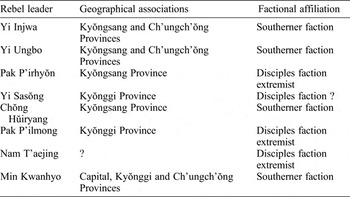
Geographical associations can be divided into leadership groups, regional cells and total rebel numbers. Following the suppression of the rebellion, ten men were identified by the government as rebel leaders.Footnote 25 Although no criteria for the selection of these leaders were ever indicated by sillok historians, it was probably made on the basis of who was considered by the government to have played the most significant roles in military preparation and actions. The leaders identified were: Pak P'ilhyŏn, Yi Yuik (李有翼), Sim Yuhyŏn (沈維賢), Yi Injwa, Chŏng Hŭiryang, Pak P'ilmong (朴弼夢), Yi Ungbo, Nam T'aejing (南泰徵), Yi Sasŏng and Min Kwanhyo (閔觀孝).Footnote 26 Of these ten men, two had clear geographical associations with Kyŏngsang Province, while three were associated with both Kyŏngsang and other provinces; three others had no connections whatsoever and the associations of two men are unknown. Four supported the Southerner faction while four supported the Disciple faction extremists. Far from being disgruntled ex-officials, four were serving officials and acting as fifth-columnist rebels around the time of the rebellion (see Table 1).Footnote 27 Therefore, of the ten men identified as rebel leaders by the government, five had strong links to Kyŏngsang Province but only Chŏng Hŭiryang fits the bill as a marginalized Kyŏngsang Province Southerner.
Geographical associations and factional affiliations of Musin rebel leaders

It is also possible to identify regional cells within the rebel organization laid out according to kinship, marriage, politics and geography. Of eleven identifiable rebel groups, four were active in Kyŏnggi Province, two in Ch'ungch’ŏng Province, three in Chŏlla Province and two in Kyŏngsang Province. Thus, evidence from rebel testimony suggests that the rebels were actively engaged in plotting, recruitment and the mobilization of resources in all four southern provinces, but the most active rebel plotting occurred in Kyŏnggi Province (see Appendix 3).
It is possible to identify the geographical associations of around 335 elite rebels, and this provides an idea about the total regional breakdown of the rebel organization. An analysis of the 335 elite rebels roughly reflects the regional spread of the leadership and regional cells. Around thirty-three of the total number of rebels were associated with Kyŏngsang Province, whereas forty-two and forty-nine were from Ch'ungch’ŏng and Chŏlla Provinces respectively, fourteen had geographical associations with the capital, thirty-four rebels, including Yi Injwa, were associated with more than one geographical area, and the geographical associations of fourteen other rebels are unclear because of partial information or unknown locations; however, the largest number (140) were associated with Kyŏnggi Province (see Appendix 4 for full details). Overall, this evidence suggests widespread regional participation in the rebellion.
The geographical spread based on the analysis of geographical association is confirmed by rebel testimony about the development of the rebel organization. Of the other plotters mentioned in rebel testimony about the early years, the geographical spread is most noticeable. From an early stage, there were links to people connected with four southern provinces: Kyŏnggi, Kyŏngsang, Ch'ungch’ŏng and Chŏlla Provinces. By early 1727, there is evidence that connections with these areas had spread still further.Footnote 28 Overall, the breakdown of the elites within the rebel organization appears to show a mixed picture of geographical association. Half the leadership group had Kyŏngsang Province associations but based on an analysis of rebel groups and total (identifiable) geographical associations of other elite rebels, it is difficult to conclude that rebels with links to a single province dominated the rebel organization. This is significant because it suggests that rebel recruiters were not attempting to build a regional rebellion, nor were they responding to local issues. They were seeking broad-based support from all over the southern part of the country to bring their military ambitions to fruition, and their concerns were countrywide rather than parochial. The evidence about early membership is also significant because it indicates that the rebellion was not an assault on the capital that had begun as a regional rebellion, but that from the very first moment of the plotting, the rebels had recruited from far and wide.
Conclusion
My analysis of the Musin Rebellion brings to light apparently contradictory data about the involvement of regional elites – especially Kyŏngsang Province Southerners – in the Musin Rebellion. Official responses to the rebel challenge from the immediate post-rebellion period signify underlying tensions between the central authorities and provincial elites, especially in Kyŏngsang Province (or a perception of tensions by central authorities), and a desire not to exacerbate these tensions. However, one would expect some reference to such problems if they were so central to the rebels’ concerns. Rebel discourse in the sillok and Yŏgok ch'uan includes no information that could lead us to conclude that discrimination against Kyŏngsang Province Southerners caused the rebellion. A case could be made for official manipulation of records, but as I have shown, court manipulation of records was inconsistent and removed specific references to Andong and the Kyŏngsang Province Southerners’ involvement in the rebellion, yet retained evidence of tensions between Kyŏngsang Province Southerners and the court. The Musin Rebellion was in part responsive: a widespread as opposed to a local response to political exclusion. But in addition to discontent, the rebel testimony above indicates that there were rational and opportunistic components of rebel motivation, based on a desire for greater power. Rebel organization membership also points away from a regionalist explanation for the rebellion. Half of the leadership group had Kyŏngsang Province connections but only Chŏng Hŭiryang fitted the bill of marginalized Kyŏngsang Province Southerner. As for the rest of the organization, elites from the four southern provinces of Kyŏngsang, Chŏlla, Ch'ungch’ŏng and, most of all, Kyŏnggi Provinces took part in the rebellion. From such a widespread membership it is difficult to infer that a regional solidarity unified a region against the court. Southern Kyŏngsang Province Southerners supported the rebellion, while Andong Southerners had refused to commit themselves to active participation on the rebel side, although they had apparently celebrated what they believed to be the collapse of court rule. Such evidence reflects the ambivalence of Kyŏngsang Province elite support for the rebellion.
The concentration of rebel geographical associations around Kyŏnggi Province and the capital, as well as a more or less equal spread of elite rebels across three southern provinces, provides some important insights into what was a centralized rebellion. Charles Tilly (Reference Tilly and Lewis1974: 285–90) argues that an important precondition for rebellion was the emergence of coalitions of contenders, often including members of the polity, which then launched assaults on the government. This is exactly what we see in the Musin Rebellion. The rebel organization calculated that the most efficient method of seizing power was dependent upon the formation of coalitions with elites who were already in power (fifth-columnists) and also disenfranchised elites from all over the southern part of the peninsula. Clues about the causes can also be found in the membership. Kyŏnggi Province is also a location of powerful office-holding elites and those who had until more recently held power. The Musin rebel organization was made up of rebels who had recently lost power in the centre, as well as marginalized elites in three southern provinces. What linked the coalition of groups from the provinces and the centre was political rather than regional allegiance.
At the start of this paper, I stated that scholars have long been interested in regional influences on the initiation and outcomes of rebellion. Regionalist scholars are right to shed light on the regional spread of the Musin Rebellion, but I contend that their conclusions about regional grievances are wrong. The significance of local processes lies in the rebel organization's attempt to build a widespread movement capable of seizing power in the capital. In other words, the expansion of the rebel organization into the provinces occurred for organizational reasons.
Related to this, one important point is revealed in the king's testimony about the central historical role of Kyŏngsang Province in the culture of the kingdom. This is important in the light of James White's “cultures of contention” theory because it suggests that prior to 1728 there was not a culture of contention for rebels to draw on, and this perhaps indicates a more recent change in political behaviour. There is, then, a stronger case for arguing that subsequent rebels in Kyŏngsang Province had a culture of contention to which they could relate, for it was the Musin Rebellion that provided it – at least in southern Kyŏngsang Province. There is more evidence to argue for the existence of regional solidarities behind later rebellions like the Hong Kyŏngnae Rebellion and the Chinju Uprising, but in claiming that Musin rebels were motivated by regional grievances, scholars are arguing for dynamics of rebellion that did not exist for at least seventy years. The Musin Rebellion should be judged on its own terms, and the evidence from the words of the participants themselves in the two most extensive sources on the rebellion point to more complex rebel motivations aimed at seizing power in the capital. In this way, we should think of the Musin Rebellion as the last in a series of elite-led attempts to overthrow the king that started with the rebellions of 1623, 1624, 1627, 1651 and 1680, and involved factional members or incumbent officials. After 1728, bottom-up and regional forces dominated late Chosŏn rebellions. The reason why the face of late Chosŏn rebellion was transformed after 1728 is a subject that requires further analysis.
While not pretending to be a definitive study on the subject of regional catalysts behind rebellion, I hope this article will provoke a debate on a subject which has until now been dominated by assumptions. Other related questions remain: these are beyond the scope of this article but relevant to an understanding of the regional dynamics within Kyŏngsang Province both during and in the aftermath of the Musin Rebellion. As yet no major study has focused on the strong support given to the rebellion in the southern part of Kyŏngsang Province and the total rejection in the Southerner faction-dominated northern part. Related to this, there has been little interest in the reasons for the continued repression of Kyŏngsang Province elites, both in the northern and southern parts, in the light of the Andong elite rejection of military mobilization. A final question concerns the significance of the notion of cultural solidarity in the light of the mixed geographical associations of rebels.
Appendices
Appendix 1. Sample data
Extract from a judgment document (kyŏlan)
Yi Yunhaeng (李允幸) “his mother and father bore him in Yech’ŏn (醴泉, Kyŏngsang Province), following this, his mother and father raised him in Yech’ŏn”. (Yŏgok ch'uan 75, p. 677).
Extract from confession with information about geographical association
The suspect Yun Sangdŏk (尹尙悳) was again pressed to confess, in an earlier confession he stated that he had lived in Yŏngnam for around ten years (Yŏgok ch'uan 77, p. 140).
Example of rebel with multiple geographical associations
Cho Myŏnggyu (趙命奎 kyŏlan) “His mother and father bore him in Yŏju (驪州, Kyŏnggi Province). Following this, his mother and father raised him in the same province” (Yŏgok ch'uan 76, p. 530).
Cho Myŏnggyu moved from Yŏju to Wŏnju (原州, Kangwŏn Province) (Yŏgok ch'uan 76, p. 479). Cho Myŏnggyu went to live together with Han Sehong in Wŏnju (Yŏgok ch'uan 76, p. 434).
Appendix 2. Methodology for determining geographical association
While analysing records of interrogations, the focus was on identifiable fully named individuals rather than those known as Cho ka (趙哥, Cho so and so) from Yŏju. This usage clearly derives from rebel operational security – rebels often kept their given names secret from each other, used pseudonyms (Yŏgok ch'uan 76 p. 307) or used titles like sŏbang (書房, literally “husband”, in this case “Mr”) or saengwŏn (生員, Classics licentiate exam passer).
The focus was also on leading rebels and their associates, those who were interrogated, and those names revealed by rebels during interrogations.
Appendix 3. Example of regional groups

Appendix 4. Identifiable geographical associations of Musin rebels as revealed in interrogations
Kyŏnggi Province 140
Ch'ungch’ŏng Province 42
Chŏlla Province 49
Kyŏngsang Province 33
Capital 20
Kangwŏn Province 3
Associated with more than one area 34
Identifiable but unknown locations 14
Total rebels 335
When rebels associated with one area are added to rebels associated with more than one area:
Associated with Kyŏngsang Province and elsewhere = 13
Total Kyŏngsang Province = 46
Associated with Chŏlla Province and elsewhere = 4
Total Chŏlla Province = 53
Associated with Ch'ungch’ŏng Province and elsewhere = 11
Total Ch'ungch’ŏng Province = 53
Associated with Kyŏnggi Province and elsewhere = 19
Kyŏnggi Province = 159