


1 Introduction
This paper addresses a formal issue in the reduplicative systems of Bugotu (Ivens Reference Ivens1933, Reference Ivens1940, Levy Reference Levy1979) and Cheke Holo (White et al. Reference White, Francis and Hugo1988, White Reference White, Francis and Hugo1995). Both languages fail to reduplicate intervocalic consonants under specific circumstances. For example, in Bugotu, /kalu/ reduplicates as [kau-kalu], in which the root's medial /l/ is not reflected in the reduplicant. However, medial consonants are retained if the root is vowel-initial; for example, /udolu/ reduplicates as [udo-udolu], in which the root's /d/ is reflected in the reduplicant. Blevins (Reference Blevins2003) argues these data are problematic for the hypothesis of the Emergence of the Unmarked (TETU; McCarthy & Prince Reference McCarthy and Alan1994), a corollary of the constraint model of Optimality Theory (Prince & Smolensky Reference Prince and Paul1993, McCarthy & Prince Reference McCarthy and Alan1993b). This paper shows that a TETU account is indeed possible for these languages. In addition, I extend the discussion to Tuvaluan (Besnier Reference Besnier2000) and Hoava (Davis Reference Davis2003), which Blevins (Reference Blevins2005) argues are also problematic for TETU.
The paper is organised as follows. In this section, I review the predictions of the TETU hypothesis. §2 presents the Bugotu and Cheke Holo data and reviews Blevins' (Reference Blevins2003) interpretation of the data's implications. §3 offers an exhaustive analysis of the reduplicative phonology of both languages, focusing on how an Emergence of the Unmarked account is indeed possible. The analysis applies very general constraints to generate the syllable structure of the reduplicant, relying on representations with extrasyllabic segments.
§4 is a parallel discussion of similar claims made by Blevins (Reference Blevins2005) regarding the reduplicative phonology of Tuvaluan and Hoava. In Tuvaluan, reduplication creates an initial geminate consonant, deriving an apparently more marked structure than that seen in the base. In Hoava, reduplication creates coda consonants. I provide a resolution of both languages with the Emergence of the Unmarked hypothesis, and conclude with a summary of the analyses and their implications for the Emergence of the Unmarked approach to reduplicative phonology.
1.1 The Emergence of the Unmarked
The Emergence of the Unmarked (McCarthy & Prince Reference McCarthy and Alan1994) refers both to an empirical observation and to a formal prediction of Optimality Theory. Empirically, TETU is a generalisation that specific substrings, such as reduplicative structures, tend to be less marked than their base counterparts. Formally, a TETU scenario in reduplication is a prediction of the constraint-based model of Optimality Theory, as long as it also incorporates (i) a theory of faithfulness that evaluates similarity between inputs and outputs generally and between bases and reduplicants specifically, and (ii) a theory of markedness that only forbids marked structures. TETU is the product of a constraint hierarchy in which a structural constraint (‘P-constraint’) outranks base–reduplicant (BR) faithfulness, but not input–output (IO) faithfulness, as in (1). Since IO faithfulness outranks the P-constraint, the markedness effect will not be observed in unreduplicated forms, or in the base substring of a reduplicated word. Yet because the P-constraint outranks BR faithfulness, the markedness effect will be observed in the reduplicative substring.
(1)


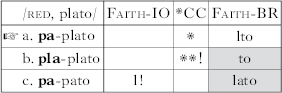
For example, in Tagalog, onset clusters are tolerated generally, but are not copied in reduplicated forms: the root /plato/ reduplicates as [pa-plato]. McCarthy & Prince (Reference McCarthy and Alan1994) show that ranking a markedness constraint *ConsonantCluster below IO faithfulness but above BR faithfulness accounts for this, as illustrated in (2). Because of the high ranking of IO faithfulness, underlying clusters are present in the surface form of the base, but since *ConsonantCluster outranks BR faithfulness, only one of the two consonants is present in the reduplicant.
(2) TETU in Tagalog
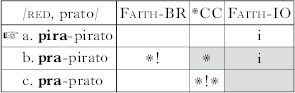
The converse ranking does not predict that a markedness effect will be observed in the base and not the reduplicant. If the effect of a markedness constraint is observed in the base, then that constraint necessarily outranks IO faithfulness, and its effect will be observed in the reduplicative substring as well. Thus the reduplicant can be less marked than or equally marked as the base, but not more marked. For example, suppose in a hypothetical language no consonant clusters are permitted in general, as predicted by the ranking of *ConsonantCluster over IO faithfulness. Regardless of the ranking of BR faithfulness, it is not possible to use these three constraints to describe a system in which the reduplicant must have a consonant cluster, even if that cluster is present underlyingly. Such a situation is illustrated in (3).
(3) Non-TETU
1.2 Summary of formal issues
A primary challenge for any formal account of Bugotu and Cheke Holo is to derive the CVV prefix without overgeneralising in such a way that VV prefixes are derived in the case of VCV stems. However, the implications of the account for the TETU hypothesis are also crucial. The argument provided by Blevins is that Bugotu and Cheke Holo present challenging data for TETU: the reduplicant loses a medial consonant, even though a more faithful form would better satisfy well-known formal constraints such as Onset, which prefers syllables with initial consonants, and *Hiatus, which prefers heterosyllabic vowels not to be adjacent. As such, the reduplicant appears to violate constraints satisfied by the base, a scenario which is not possible under the TETU hypothesis.
Blevins suggests that there are only two recourses available within OT. One option is to appeal to otherwise unmotivated constraints, such as NoOnset or HaveHiatus, so that the emergent constraint directly demands a marked structure. Since such demands do not conform to the ideal of what output constraints should demand, this would weaken the TETU hypothesis. The other option is to admit reduplicant-specific templates, themselves formally undesirable for independent reasons (McCarthy & Prince Reference McCarthy, Alan, Kager, van der Hulst and Zonneveld1999). Both recourses are problematic for the typological strength of a constraint-ranking model.
In §3, I argue that neither recourse is necessary, and that the reduplicants in Bugotu and Cheke Holo are examples of the Emergence of the Unmarked. In both languages, an emergent constraint limits affixes to a single syllable; other constraints apply generally to both stems and reduplicants, and predict the distribution of structures observed in the language.
2 Data and generalisations
Bugotu and Cheke Holo are Austronesian languages of the Solomon Islands, and representative reduplicative forms for each are presented in this section. The degree of productivity of reduplication is not known for either language, but clear phonological generalisations are available under which the form of the reduplicant is regular and predictable, based on the form of the root. Moreover, in general the reduplicated forms in both languages have a fairly transparent semantic attributive relationship with their roots, but the precise interpretation of the reduplicated form is difficult to narrow down to a morphological category such as durative or distributive.Footnote 1
In Bugotu, CVCV and CVV roots receive CVV- prefixes (4a, b), VCV roots receive VCV- prefixes (4c) and VV roots receive VV- prefixes (4d). Note that some reduplicated forms have no unreduplicated bases listed in Ivens (Reference Ivens1940) ; these are marked with an asterisk. Some forms are listed in Ivens (Reference Ivens1940) with no gloss; these are labelled as such in (4). I leave syllable boundaries out of these data, although Ivens (Reference Ivens1933: 142) states that vowel sequences with falling sonority, as in the reduplicant [kau-kalu], are diphthongs, implying tautosyllabicity just in these cases. I address this in §3.5 with a discussion of how the analysis works regardless of whether such vocalic sequences are treated as tautosyllabic.
(4) Bugotu reduplication (Ivens 1933, 1940)

Cheke Holo has a similar set of generalisations, with CVCV roots taking CVV reduplicants (5a). However, onsets may include consonant sequences, so that CCVCV roots receive CCVV- prefixes (5b) and CVCCV roots receive CVV- prefixes (5c). Like Bugotu, VCV forms in Cheke Holo maintain the medial consonant in reduplication, but the reduplicant is separated from the base by a glottal stop (5d). Unreduplicated roots not listed in White et al. (Reference White, Francis and Hugo1988) are marked with an asterisk, and reduplicated forms with no gloss are marked as such.
White et al. note two types of variation in reduplicated forms. First, some C(C)VV reduplicants appear instead with a single vowel, so for example, [dau-dalu] appears as [da-dalu] and [ɣ.uu-ɣ.uru] as [ɣ.u-ɣ.uru]. This also occurs with some VC(C)V roots; for example, [aba-ʔ.aba] also appears as [a-ʔ.aba]. Second, some reduplicants of VC(C)V roots (5e) appear alternately without any medial consonants, as in [ae-ʔ.age] and [oa-ʔ.ogra]. I address this issue in §3.7, following the core analysis of both languages.
(5) Cheke Holo reduplication (White et al. 1988, White 1995)

2.1 Implications for the Emergence of the Unmarked
Bugotu and Cheke Holo both employ reduplicative systems in which the phonological content of the reduplicative string differs from that of the base. The hypothesis of the Emergence of the Unmarked accounts for such systems with a constraint ranking such as that in (1) above, which predicts a particular structural constraint's effect to be observed only in the reduplicated substring and not in the base. For the reduplicants of Bugotu and Cheke Holo to avoid copying the medial consonant, some markedness constraint must outrank BR faithfulness. However, this markedness constraint must also be outranked by IO faithfulness, to ensure that the same effect does not generalise to the base.
Blevins (Reference Blevins2003, Reference Blevins2005) claims that both the presence of a vocalic sequence and the loss of what would be an onset consonant before the second vowel in these language's reduplicants are cross-linguistically marked structures. Thus, her argument is that no Emergence of the Unmarked analysis is possible for the data in either language, because no markedness constraint could force the failure to copy the second consonant in CVCV roots. In a footnote, she acknowledges but ultimately rejects a suggested constraint-based analysis:
Sharon Inkelas (pers. comm., 2003) suggests a possible constraint-based analysis where: i. V is not a good syllable; only CV can be syllabified; ii. the reduplicative prefix must contain one syllable, not zero or two; and iii. the reduplicative prefix is both left- and right-anchored. Given these constraints, if the Base=CVCV, Red=CV.<V>; and if the Base=VCV, Red=<V>.CV., where periods show syllable boundaries, and < > is extrasyllabic. However, this proposal cannot account for reduplicated trisyllabic/trimoraic bases [such as /udolu/ ‘to be gathered together’]. In these forms, constraint iii. above is violated, because there is no right-anchoring of the reduplicative prefix (Blevins Reference Blevins2003: 504, n. 6).
Blevins points out that using right anchoring incorrectly predicts *[poi-ponoti], *[piu-pilau], *[udu-udolu] and so on. She adds that the shape of the reduplicant does not match any known prosodic target, creating additional difficulty for constraint-based prosodic morphology. Still, a constraint-based account is possible: the present analysis follows Inkelas' suggestion that extrasyllabic vowels are tolerated in Bugotu and Cheke Holo. This representational claim, when coupled with the appropriate set of structural constraints, makes an Emergence of the Unmarked analysis available for both languages, as the following section shows.
3 Analysis
3.1 Representational claims
These data are challenging for the TETU hypothesis, because it is difficult to treat the loss of an intervocalic consonant in itself as a markedness effect, especially since intervocalic consonants are retained in the reduplicant in particular conditions – whenever the base is vowel-initial. The analysis thus follows the reasoning laid out informally by Inkelas above: that reduplication generates exactly one consonant-initial syllable, which is adjoined with an unsyllabified vowel that either precedes or follows it, depending on the form of the base.
Specifically, for consonant-initial roots such as /kalu/, the reduplicant is composed of a syllable followed by an unsyllabified vowel (6a).Footnote 3 For vowel-initial roots such as /udolu/, the reduplicant is composed of a syllable preceded by an unsyllabified vowel (6b).
(6)

The notion of unsyllabified segments is explored in previous work by Hyman (Reference Hyman1985), Bagemihl (Reference Bagemihl1991) and Ọla (Reference Ọla and 1995) ; see also Kiparsky (Reference Kiparsky, Féry and Vijver2003) for a thorough review of other examples. Hyman (Reference Hyman1985) analyses extrasyllabic segments in Gokana, arguing that they nonetheless project moras that associate to higher levels of prosodic structure. Bagemihl (Reference Bagemihl1991) provides an analysis of Bella Coola syllable structure in which consonants that cannot fit into a canonical syllable are left extrasyllabic. Ọla (Reference Ọla and 1995) claims that word-initial vowels in Yoruba are not syllabic, since they have a restricted inventory and cannot nasalise, bear high tone or reduplicate. Like the unsyllabified segments in Hyman's analysis, those in Bagemihl's and Ọla's accounts are licensed through projection of moras. There is some parallel here with Downing (Reference Downing1998), who treats initial onsetless syllables as extraprosodic for the purposes of tone assignment in Kikiwere and foot structure in Banawá, Aranda and Alyawarra.
The analysis would be simple if vocalic sequences in Bugotu were tautosyllabic, but Ivens provides little detail about the syllabification of such sequences. I therefore proceed with a representational worst-case scenario, as if the adjacent vowels in the reduplicants of [kau-kalu], [loo-lopo] and [pia-pilau] are never tautosyllabic, and that the second vowel of such sequences is not syllabified. However, this assumption is not crucial to the analysis: I return to the possibility that some or all vocalic sequences are tautosyllabic in §3.5. In fact, the analysis is consistent with scenarios in which (a) only falling-sonority sequences are tautosyllabic, (b) only falling- and level-sonority sequences are tautosyllabic and (c) any vowel sequence is tautosyllabic.
3.2 Preliminary analysis
I first present the analysis by showing how a single syllable can be generated for the reduplicant without any specific templatic process, and then develop the mechanism for predicting the proper additional vowels. Following Spaelti (Reference Spaelti1997), Gafos (Reference Gafos1998), Walker (Reference Walker1998), Ussishkin (Reference Ussishkin2000), Kager (Reference Kager2001), Kennedy (Reference Kennedy2002, Reference Kennedy2005), McCarthy (Reference McCarthy2003) and Yu (Reference Yu2005), the association of the reduplicative substring to a single syllable can be done with two general constraints. First, Align(μ-R, σ-R) (McCarthy & Prince Reference McCarthy and Alan1993a) in (7a) effectively requires at least one syllable for the affix, while *Struc-σ (Zoll Reference Zoll1993) penalises each syllable in the output (7b). We will see that when both constraints are active in the same system, their conflicting demands are best reconciled by a reduplicant that projects exactly one syllable node.
(7)

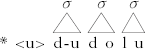
Note that representations like [ka<u>-kalu], in which the reduplicant's [u] is extraprosodic, satisfy Align-R, as the representation in (6a) helps to illustrate. The right edge of the reduplicative melody on the segmental tier is well-aligned with respect to the nodes of the syllable tier. Align-R is only violated if the juncture between morphemes is between segments that explicitly associate to the same syllable, or if it is preceded solely by extrasyllabic segments. This ensures that vowel-initial roots such as /udolu/ receive a separate syllable for their prefix, rather than allow the reduplicant and base melodies to share a syllable node. For example, the representation in (8) violates Align-R, while the one in (6b) satisfies it.
(8)
The next component of the analysis is to generate an extrasyllabic second vowel in the reduplicant. The premise here is that the system prefers the inclusion of a second vowel, but because of the rank of *Struc-σ, this vowel must not be syllabified. Thus, the constraint that motivates the additional vowel, Max-BR (9a), must outrank any constraints violated by the output. These include Parse(V) (9b), which [ka<u>-kalu] violates by having an extrasyllabic vowel, and InputContiguity (9c), which it violates by failing to copy the base /l/, despite copying the vowels that surround it.
(9)

The effect of this hierarchy is illustrated in (10). The ranking of Align-R and *Struc-σ over Max-BR forces the optimal candidate to contain exactly one syllable. Further, the ranking of Max-BR over Parse(V) and InputContig induces the optimum to include an unparsed vowel.
(10)

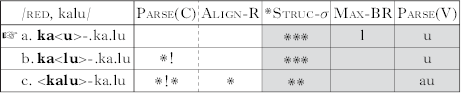
Although the analysis generates unsyllabified segments, it must not allow representations with unsyllabified consonants such as [ka<lu>-.ka.lu]. The constraint Parse(C) forbids extraprosodic consonants.
(11) Parse(C)
Consonants are parsed into syllables.
It is ranked over Max-BR, and thus prevents them from appearing in reduplicative substrings, as shown in (12).
(12)
The analysis also needs to limit the reduplicant to one consonant, motivating additional constraint rankings. Some problematic candidates would have several reduplicative consonants interspersed among extraprosodic vowels. In [k<a>.lu-.ka.lu] (14b) and [k<a>.l<u>-.ka.lu] (14c), the reduplicative [k] and [l] are heterosyllabic, thus the reduplicant is disyllabic and ruled out by *Struc-σ. Similar representations could place the reduplicative consonants in the same syllable, as in [k<a>lu-.ka.lu] (14d) and [k<a>l<u>-.ka.lu] (14e). These are eliminated by a constraint forbidding representations in which unsyllabified vowels intervene between tautosyllabic segments, defined in (13) as SyllableContiguity.Footnote 4
(13) SyllableContiguity (SyllContig)
For any pair of segments x and y dominated by the same syllable node A, if z intervenes between x and y, z is dominated by A.
Last, ranking NoCoda over Max-BR can rule out (14f) [kal<u>-.ka.lu], in which the reduplicative [l] is a coda of the first syllable. These effects are summarised in (14).Footnote 6
(14)

At this point, we may pause and note that the constraint system does not encounter any difficulties with syllabifying unreduplicated forms. Despite the active position of *Struc-σ, it does not improperly force either deletion or extraprosodicity of root segments. Deleted forms violate Max-IO, while extraprosodic structures always violate at least one other constraint. For example, [<ka>lu] (15c) violates Parse(C), and [k<a>lu] (15d) violates SyllContig. A form like [k<a>.lu] (15e), which satisfies SyllContig, is still ruled out by Parse(V), even in its relatively low ranking. This result is summarised in (15). How the system affects unreduplicated words with sequences of multiple vowels, such as [popotoio] ‘fat’, [ŋ.uaŋ.uao] ‘ship’, [faeiei] ‘to annoy’ and [faoioni] ‘to obey’, is taken up in §3.5.
(15)

3.3 Testing against longer roots
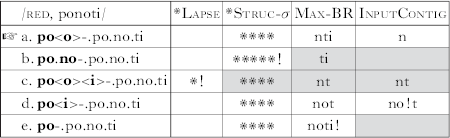
To apply to longer roots such as /ponoti/, the analysis must ensure that the proper vowels are retained in the prefix. It already predicts that the second vowel in /ponoti/ is copied rather than the third; InputContig (9c), which is violated by each skipped segment in the reduplicant, is violated once in [poo-ponoti], but three times by the competitor *[poi-ponoti]. In the latter case, the reduplicant's two vowels reflect segments separated by three segments in the base.
Another candidate copies both the second and third vowels, as in *[pooi-ponoti]. Because InputContig is ranked below Max-BR, it cannot rule this form out, so we must then appeal to a constraint against overzealous extraprosodicity. In particular, a constraint forbidding adjacent extraprosodic segments, formalised in (16) as *Lapse, will rule out such a competitor. Previous research that addresses limitations on the number of extraprosodic elements includes Hayes (Reference Hayes1982), Poser (Reference Poser1985), Inkelas (Reference Inkelas1989) and Bagemihl (Reference Bagemihl1991).
(16) *Lapse
Extraprosodic segments may not be adjacent.
The augmented analysis is summarised in (17). As with /kalu/, the system restricts the reduplicant to a single syllable, so a form with two syllables (17b) is ruled out. The ranking of *Lapse over Max-BR prevents the trivocalic reduplicant (17c). Note also that InputContig, in its low position, rules out [po<i>-ponoti] (17d), in which the third rather than the second vowel is reduplicated.
(17)
3.4 Retention of medial consonants in vowel-initial forms
The next component of the analysis accounts for the perseverance of the intervocalic consonant in the reduplicant of vowel-initial bases, as in [udo-udolu]. In fact, this form is predicted by the constraint system without amendment, and the output representation includes two unsyllabified vowels, as in [<u>do-.<u>do.lu]. The initial vowels of the base and reduplicant are extraprosodic because of the rank of *Struc over Parse(V), whereas the form with a fully syllabified reduplicant [u.do-.<u>do.lu] (18b) is eliminated by *Struc. Align-R rules out forms whose reduplicants do not have their own syllable node (18c, d). Furthermore, the ranking of Max-BR over Parse(V) predicts that the reduplicant will include unparsed segments, thus eliminating [do-.<u>do.lu] (18e) and [u-.<u>do.lu] (18f). These effects are summarised in (18), in which the remaining competitors are ruled out by *Lapse, because of adjacent extraprosodic segments.
(18)

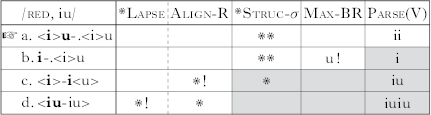
A last subset of data to handle comprises roots with no consonants whatsoever. Because of the lack of consonants in such cases, the rank of Align-R over *Struc-σ forces the reduplicant to project a syllable from a bare vowel. This effect is illustrated in (19); note that the winner of this tableau could instead be [i<u>-.i<u>], segmentally identical to the output shown.
(19)
3.5 Bugotu: discussion
This analysis uses representations in which the second vowel of CVV reduplicants is always extraprosodic, regardless of the relative sonority of the two vowels. In §3.1, I referred to this as the representational worst-case scenario; nevertheless, the analysis does not preclude an alternative in which some or all of these vowel sequences are tautosyllabic. I have avoided tautosyllabic representations, because evidence regarding the true tauto- or hetero-syllabicity of these sequences is missing. Ivens calls only falling-sonority sequences diphthongs, without reference to syllabicity, and without a similar claim for rising-sonority sequences. It may be that sequences of level or falling sonority are tautosyllabic, in which case the appeal to extrasyllabicity is required only for rising-sonority forms such as [pia-pilau]. Indeed, this account has not included any constraints on complex syllable nuclei, but candidates with tautosyllabic representations such as [kau-.ka.lu] and [poo-.po.no.ti] are plausible outputs, due to their satisfaction of Parse(V), as illustrated in (20).
(20)

Alternatively, it may be that all vowel sequences are tautosyllabic, and that the falling-sonority sequences suggested by Ivens to be diphthongs should be considered ‘heavy diphthongs’ in the sense of Kaye & Lowenstamm (Reference Kaye, Lowenstamm, Dell, Hirst and Vergnaud1984), while rising-sonority sequences can instead be called ‘light diphthongs’ in the same framework. If this is the case, then no word-internal extrasyllabicity is required. In short, the analysis predicts that adjacent vowels are associated with the same syllable only if their tautosyllabicity is licit in the language; otherwise, the second of two adjacent vowels is extrasyllabic.
The only forms that require extrasyllabic representations regardless of the syllabification of adjacent vowels are vowel-initial roots; the initial vowel of the reduplicant must be extrasyllabic to minimise violations of *Struc-σ. Moreover, *Struc-σ is the constraint that stands as the emergent P-constraint in the TETU scenario for Bugotu: it is a markedness constraint that outranks BR faithfulness but not IO faithfulness. The markedness of the prefix along other dimensions does not refute the prediction of the hypothesis of the Emergence of the Unmarked.Footnote 7
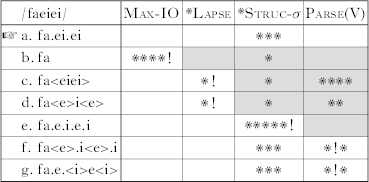
As a last note on Bugotu, I return to unreduplicated words with strings of multiple adjacent vowels, such as [popotoio], [ŋ.uaŋ.uao], [faeiei] and [faoioni], as mentioned in §3.2. The constraint system does not preclude their existence; the high ranking of Max-IO ensures their persistence at the surface. *Lapse and *Struc-σ together then predict that every pair of vowels in sequence is assigned to a syllable. Thus the system does not predict the deletion of any vowels in such sequences, as summarised in (21).
(21) Tolerance of vowel sequences in unreduplicated words
3.6 Cheke Holo
This section extends the analysis to Cheke Holo, focusing on two additional aspects of the data. First, the analysis must predict the appearance of a glottal stop between the reduplicant and base in reduplicated vowel-initial roots, and second, it must ensure that consonant clusters are tolerated in the reduplicant. The separate issue of variation in Cheke Holo is treated in §3.7.
Essentially, the analysis treats the glottal stop as a means of resolving vowel hiatus, as required by *Hiatus, defined in (22).
(22) *Hiatus
Adjacent vowels are forbidden.
Ranked below Align-R, *Hiatus forces a glottal stop to appear between the reduplicant and base, as shown for [o.do-.<ʔ.o>do] in (23).Footnote 8
(23)

Morpheme-internal adjacent vowels, such as those created in CVV reduplicants, violate *Hiatus, but surface through the ranking of ReduplicantContiguity (McCarthy & Prince Reference McCarthy, Alan, Beckman, Dickey and Urbanczyk1995, Kager Reference Kager1999: 250), defined in (24).
(24) ReduplicantContiguity (RedupContig)
The portion of S2 (the reduplicant) standing in correspondence forms a contiguous string.
Violated by each intrusive segment in the reduplicant.
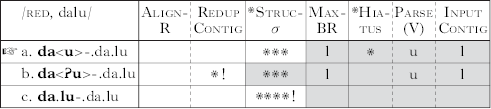
In contrast to InputContig, which is violated by internal deletion of segments within the reduplicant, RedupContig is violated by the internal insertion of segments within the reduplicant. This effect is shown for [da<u>-.da.lu] in (25).
(25)
Another issue for Cheke Holo is its tolerance of consonant clusters in the reduplication of CCVCV forms, as in [blio-bliɣ.o]. The generalisation also applies to VCCV forms such as [egre-ʔ.egre], where the reduplicant retains both medial consonants. These facts suggest a relatively low ranking of *Complex, but this constraint is still active in the system to prevent a CCV- prefix from appearing for CVC roots, as in [ɣ.ru-.ɣ.u.ru] (26b). Meanwhile, [ɣ.<u>ru-.ɣ.u.ru] (26c) is ruled out by SyllContig, the constraint that forbids unsyllabified segments from appearing between two segments of the same syllable.
(26)

3.7 Variation in Cheke Holo
In §2, I acknowledged two dimensions of variation in Cheke Holo: that some C(C)VV and VCV reduplicants appear with a single vowel rather than with two, as in /dalu/→[da-dalu] and /aba/→[a-ʔ.aba], and that some VC(C)V reduplicants copy only their vowels, as in /eklo/→[eo-ʔ.eklo]. This variation is easily addressed in this analysis by allowing alternate constraint rankings. Such an approach to variable data is used by Anttila (Reference Anttila, Hinskens, van Hout and Leo Wetzels1997), Anttila & Cho (Reference Anttila and Yu Cho1998), Auger (Reference Auger2001) and Nagy & Reynolds (Reference Nagy and Reynolds1997). First, if we allow an alternate ranking of Parse(V) over Max-BR, forms like [dalu] reduplicate as [da-dalu] instead of [dau-dalu], as shown in (27a). This alternate ranking also works for vowel-initial roots, as shown for [a-.ʔ.a.ba] in (27b). Alternately ranked constraints are underlined.
(27)

The other alternate pattern, in which medial consonants are not copied in the reduplicants of vowel-initial roots, can be attributed to a variable requirement that words not begin with extraprosodic segments, formalised as Align(PrWd-L, σ-L).
(28) Align(PrWd-L, σ-L) (Align(PrWd))
The left edge of every prosodic word is aligned to the left edge of a syllable.
If Align(PrWd) is ranked below Max-BR, extraprosodic segments may readily occur word-initially, as in [<o>do.-<ʔ.o>do] in (23). With the opposite ranking as an alternative, the first vowel of the reduplicant must be syllabified. The second vowel is then rendered extraprosodic, and likewise no consonant appears in the reduplicant, as summarised in (29).
(29)

Note that the occurrence of both alternate rankings, i.e. Align(PrWd)≫Max-BR and Parse(V)≫Max-BR, does not generate problematic results, since the outputs of (27) already satisfy Align(PrWd). Furthermore, although the analysis variably allows intervocalic consonants in the reduplicants of vowel-initial stems, it still does not variably allow them in the reduplicants of consonant-initial stems, because of the rigid positions of *Struc-σ and Parse(C).
3.8 Summary
This section has provided an analysis of the reduplicative systems of Bugotu and Cheke Holo. The analysis of Bugotu in §§3.1–3.4 uses extrasyllabic representations to derive the observed patterns of reduplication. The loss of intervocalic consonants is motivated by the emergent pressure to limit the reduplicant to a single syllable, coupled with a tolerance for extraprosodic vowels. The analysis therefore shows Bugotu reduplication to be an example of the Emergence of the Unmarked. Furthermore, as §3.5 discusses, the assumptions regarding the extrasyllabicity of certain vowels are not crucial to the analysis.
The same claims hold for Cheke Holo: the loss of intervocalic consonants under reduplication is again an emergent effect of pressure to limit the size of the reduplicant. In addition, the enriched analysis in §3.6 handles the more complex syllable structure and the use of a glottal stop to separate adjacent vowels at morpheme boundaries. Moreover, §3.7 addresses two instances of variation in Cheke Holo, arguing that the means of accounting for such variation does not overgenerate unattested variants.
4 Other apparent problems for TETU
Blevins (Reference Blevins2005) cites several other reduplicative phenomena as evidence against the Emergence of the Unmarked hypothesis. For example, in Tuvaluan the reflex of what was historically CV reduplication is initial gemination (30a), while reduplicants are closed coda-bearing syllables in Hoava (30b). Parallel to the argument regarding the loss of intervocalic consonants in Bugotu and Cheke Holo, Blevins argues that the markedness of these reduplicants relative to the stem refutes the essential prediction of the Emergence of the Unmarked.
(30)

However, in both cases, constraint-based accounts are readily available. In fact, the size-minimising constraint *Struc-σ is implicated in these systems, emerging in the reduplicative context to outrank BR faithfulness. It also outranks other markedness constraints such as *InitialGeminate in Tuvaluan and NoCoda in Hoava.
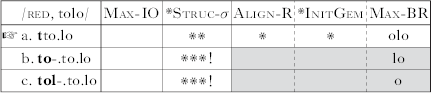
The reflex of reduplication as gemination in Tuvaluan, as in [ttolo], is available from the ranking of *Struc-σ over *InitialGeminate and Align-R. The reduplicant is thus realised through initial consonant gemination, without projecting an additional syllable, in violation of Align-R. This is illustrated in (31). Note that the ranking of *Struc-σ below Max-IO but above Max-BR is a clear case of the Emergence of the Unmarked.
(31)
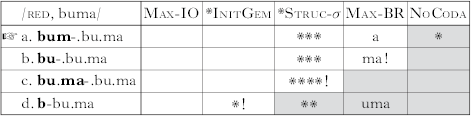
In Hoava, the lack of a second reduplicant vowel, as in [bum-buma], momentarily appears to be another counterexample to TETU, since the coda consonant of the reduplicant gives the affix a marked structure not found in the stem. Blevins (Reference Blevins2005) suggests that the underlying CV structure of Hoava requires an analysis with high ranking NoCoda: ‘in Hoava, No-Coda must be highly ranked, because open syllables are the norm’ (Blevins Reference Blevins2005: 523).
Yet there are contexts outside of reduplication in which coda consonants are tolerated in Hoava, such as polysyllabic words, e.g. /tinávε.tε./→[tinávtε.] ‘work’), and word-finally, e.g. /bɔŋ.i kɔlε.ɔ/→[bɔŋ. kɔlε.ɔ] ‘good night’ (Davis Reference Davis2003: 26–27). The existence of such coda consonants motivates a relatively low rank for NoCoda, in which case the analysis of the reduplicative system is simple: *Struc-σ is needed to limit the reduplicant to a single syllable. With *Struc-σ and Max-BR outranking NoCoda, a monosyllabic reduplicant results, as (32) illustrates. Moreover, the rank of *Struc-σ above Max-BR but below Max-IO is the same TETU scenario seen in Bugotu, Cheke Hola and Tuvaluan.
(32)
5 Discussion
In this paper, I have provided an analysis of reduplication in Bugotu and Cheke Holo, which, despite the loss of medial consonants within reduplicants, does not pose any problem for the predictions of the Emergence of the Unmarked hypothesis for reduplicative phonology. The analysis allows reduplicative substrings to tolerate unsyllabified vowels, so long as there is exactly one syllable node associated to the reduplicative substring. As such, the constraint ranking models the loss of intervocalic consonants, but only for consonant-initial roots.
The apparent problem that the Bugotu and Cheke Holo data pose for TETU stems from a specific interpretation of the claims of McCarthy & Prince (Reference McCarthy and Alan1994), who propose that reduplicated sequences may be subject to phonological constraints which fully specified roots can resist. Because they dubbed this phenomenon the Emergence of the Unmarked, the claim can be undermined because of the interpretation of unmarked to mean ‘cross-linguistically more typical’. Thus, Bugotu and Cheke Holo appear to be counterexamples to the Emergence of the Unmarked, because their reduplicated sequences gravitate towards vocalic sequences and onsetless syllables, both of which are ‘marked’ structures in the cross-linguistic sense.
A crucial point, however, is that ‘marked’ in McCarthy & Prince (Reference McCarthy and Alan1994) must be interpreted as violating a structural constraint: ‘in Optimality Theory, forms are marked with respect to some constraint C if they violate it’ (1994: 333). Since different output constraints can make conflicting demands on the output, it is possible that the satisfaction of one markedness constraint can occur at the expense of another markedness constraint. The present analysis shows that Bugotu and Cheke Holo are systems of this type. The constraint that emerges in the reduplicative system is *Struc-σ, and because of constraints such as SyllContig and Parse(C), medial consonants are not copied in consonant-initial reduplicative substrings, at the expense of other markedness constraints such as *Hiatus, Onset and particularly Parse(V).
Indeed, a similar markedness conflict arises in the case of initial geminates of Tuvaluan and the coda-bearing reduplicants in Hoava. Like the loss of intervocalic consonants in Bugotu and Cheke Holo, these systems appear to contradict the prediction of the Emergence of the Unmarked, using the cross-linguistic sense of markedness, since coda consonants and word-initial geminates are marked in this sense. Nevertheless, the violation of constraints against such structures is compelled by the higher ranking of a conflicting markedness constraint, which again is the size-restricting *Struc-σ.
To summarise, the present analysis has shown that the reduplicative systems of Bugotu, Cheke Holo, Tuvaluan and Hoava are not problematic for Optimality Theory and the predictions of the Emergence of the Unmarked. In each of these languages, a particular markedness constraint is ranked crucially below IO faithfulness and above BR faithfulness, which typifies the basic Emergence of the Unmarked constraint ranking. The observed phenomena are possible simply because of multiple and conflicting dimensions of markedness. As a consequence, Blevins' claims regarding the ability of Optimality Theory and the Emergence of the Unmarked to account for the reduplicative systems of these languages cannot be maintained.


