Introduction
Laryngotracheal trauma is a rare injury, accounting for only 1 in 30 000 emergency room visits in the USA.Reference Schaefer1 In patients with multiple traumas, airway damage occurs in only 0.5 per cent of cases.Reference Lee, Eliashar and Eliachar2 Laryngotracheal trauma is, however, the second most common cause of death in patients with head and neck trauma after intracranial injury. Laryngotracheal trauma in children is rare but can result in significant morbidity and mortality without appropriate diagnostic and therapeutic approaches. Early diagnosis and proper timely treatment of laryngotracheal trauma is critical in these patients.Reference Chatterjee, Agarwal, Bajaj, Teng and Prager3,Reference Schaefer4 Penetrating laryngotracheal trauma is easy to identify because of external wounds, while blunt laryngotracheal trauma is not typically seen in isolation. Laryngotracheal trauma can threaten not only life but also the quality of life, especially in children. However, there are still no universally accepted guidelines for the management of laryngotracheal trauma. At present, management approaches include medical and/or surgical interventions, depending on airway status and the amount of cartilaginous displacement.
As laryngotracheal trauma is so rare, few authors have published a large series of paediatric cases, and most studies have been conducted in the USA.Reference Cheng, Cooper and Tracy5–Reference Wootten, Bromwich and Myer7 Compared with adults, the narrower airways of children increase the risk of airway obstruction from these injuries. Moreover, clinical evaluation and management considerations in children can differ, as children with laryngotracheal trauma can develop respiratory symptoms much more quickly and can be more severely affected, given the smaller dimensions of the paediatric airway.Reference Gold, Gerber, Shott and Myer8 Furthermore, the clinical presentation of blunt laryngotracheal trauma in children can be subtle and may even mimic other common paediatric respiratory conditions. An inaccurate diagnosis in these cases can cause delays in treatment, highlighting the importance of understanding the clinical presentation, diagnostic approaches and airway management strategies in children with laryngotracheal trauma.
This study aimed to summarise and describe our experience of managing paediatric laryngotracheal trauma cases at our hospital in order to provide valuable clinical information and to promote the development of standardised management guidelines. In addition, we report the details of these patients’ radiological and physical examination findings, as well as the surgical reconstructions, for achieving optimal clinical outcomes in paediatric laryngotracheal trauma cases.
Materials and methods
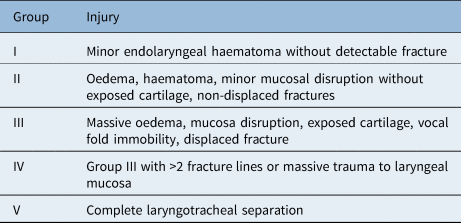
A retrospective analysis was conducted of paediatric laryngotracheal trauma cases at the Beijing Children's Hospital, Capital Medical University, Beijing, from January 2013 to July 2018. Patients diagnosed with laryngotracheal trauma were identified by searching the medical records system. Patients aged over 18 years at the time of injury were excluded. Clinical information for all cases was collected, including the cause of injury, mechanisms of injury, management, surgical approaches and outcomes. The Schaefer–Fuhrman classification system, which has been recommended by the American Society of Otorhinolaryngology – Head and Neck Surgery, was applied to grade the severity of laryngotracheal trauma (Table 1).Reference Schaefer1,Reference Moonsamy, Sachdeva and Morse9
Schaefer–Fuhrman classification of laryngotracheal injury

The outcomes were evaluated by performing functional evaluations of voice, airway and swallowing, as described previously.Reference Lee, Eliashar and Eliachar2,Reference Jalisi and Zoccoli10 Airway and voice outcomes were graded as ‘good’, ‘fair’ or ‘poor’. An airway was considered ‘poor’ if tracheostomy was performed, ‘fair’ if mild aspiration or exercise intolerance occurred, and ‘good’ if functioning normally. The voice was subjectively graded as ‘poor’ (aphonia or whisper), ‘fair’ (functional but hoarse) or ‘good’ (voice quality comparable to baseline). Swallowing was judged to be ‘normal’ or ‘abnormal’ based on patient self-assessment.
Regarding follow-up duration, the wound was sutured and reviewed at three months for patients who did not need a tracheostomy. Patients who needed a tracheostomy were reviewed at one, three and six months after discharge. All patients had their tracheostomy tubes removed within six months.
Results
Baseline clinical characteristics
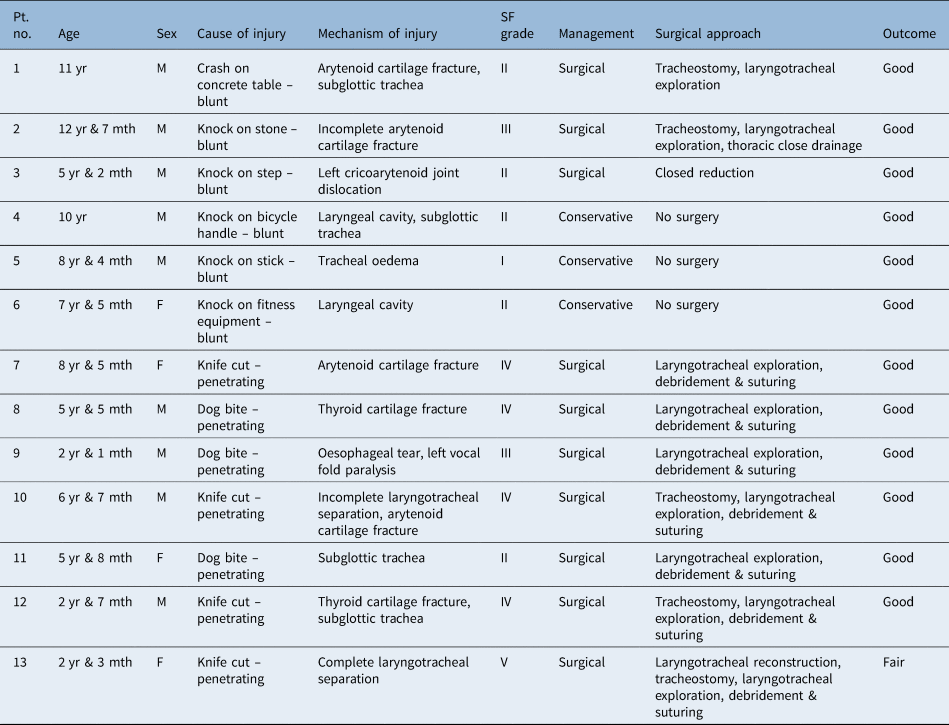
As shown in Table 2, 13 patients with laryngotracheal trauma were identified (9 boys and 4 girls), ranging in age from 2 years and 1 month to 12 years and 7 months. The average age at the time of injury was six years and nine months. Seven patients experienced penetrating laryngotracheal trauma, including four cases of knife trauma and three cases of dog bites. The other six patients experienced blunt laryngotracheal trauma caused by neck injuries after collisions with stones, steps or fitness equipment. Based on the Schaefer–Fuhrman laryngotracheal injury classification system, one case was classified as grade I, five as grade II, two as grade III, four as grade IV and one as grade V. For patients requiring intubation, decannulation was performed three to four months after surgery. Patients’ voices and oral diet recovered within one month and two weeks after surgery, respectively.
Demographics, mechanism of injury, and management

Pt. no. = patient number; SF = Schaefer–Fuhrman; yr = years; M = male; mth = months; F = female
Penetrating laryngotracheal trauma
Among the seven cases of penetrating laryngotracheal trauma, one patient was intubated with an endotracheal tube in the emergency room because of complete laryngotracheal separation. Tracheostomy and reconstruction were then performed in the operating theatre. The remaining six patients underwent debridement, suturing and laryngeal cavity exploration by transoral laryngoscopy. Debridement was performed by washing with soapy water, removing necrotic tissue and washing with saline, followed by wound suturing. Laryngeal cavity exploration was carried out by transoral laryngoscopy. Tracheostomy was performed concurrently in two cases. The seven penetrating laryngotracheal trauma patients were transferred to the paediatric intensive care unit, where they recovered and were discharged after suture removal. Thanks to timely diagnosis and proper treatment, all seven patients ultimately had functional voices and normal deglutition.
The two patients who underwent concurrent tracheostomy were discharged; however, the tracheostomy tubes remained in place for six months to one year after surgery. The examination after tube removal in these two cases showed that the laryngeal mucosa was smooth and free of granulation tissue. For the six patients who underwent surgical intervention, their voices returned to baseline within three weeks after surgery, with voice quality graded as ‘good’ in almost all patients. In the one patient who had complete laryngotracheal separation, the left vocal fold was paralysed and the voice was compensated for by the contralateral side. This patient's voice was graded as ‘fair’ because of hoarseness.
Blunt laryngotracheal trauma
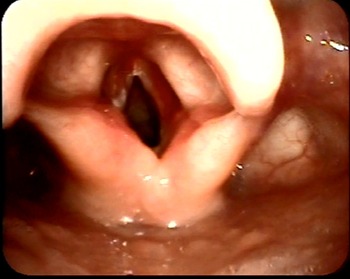
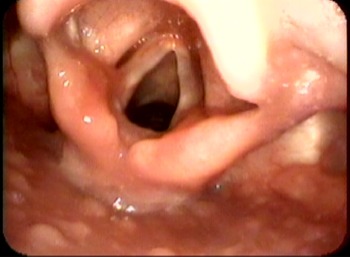
Among the six cases of blunt laryngotracheal trauma, two patients initially underwent a tracheostomy at a local hospital for dyspnoea prior to laryngotracheal trauma exploration. One patient experienced cricoarytenoid joint dislocation, which was treated using the closed reduction technique (Figures 1 and 2). Three patients received conservative treatment with antibiotics and glucocorticoids. Methylprednisolone sodium succinate and budesonide were administered by intravenous injection and nebulisation, respectively. The airway condition was evaluated first in cases with acute airway obstruction, and tracheal intubation was then performed if the airway was found to be unstable.
Left arytenoid cartilage dislocation, bilateral vocal fold congestion and left vocal fold fixation.

Two months after the cricoarytenoid joint closed reduction technique, the vocal folds were symmetrical.

The two patients who underwent laryngotracheal trauma exploration and tracheostomy were discharged with their tracheostomy tubes in place. These tubes were successfully removed two to four months after surgery. Based on flexible fibre-optic laryngoscopy examination, neither scar stenosis nor granulation hyperplasia occurred in these cases. The patient with cricoarytenoid joint dislocation was treated with segmental mobilisation. The vocal folds were symmetrical after closed reduction of the cricoarytenoid joint. The remaining three patients who received conservative treatment were discharged with a prescription for glucocorticoids, antibiotics and a nebuliser. Voice evaluations found that the hoarseness was reduced and breathing had returned to normal.
Discussion
Laryngotracheal trauma is less common in children than in adults; thus, few authors have published related studies with large numbers of paediatric patients. To our knowledge, most reports of laryngotracheal trauma have been published in the USA, and no reports have been published in China.Reference Sidell, Mendelsohn, Shapiro and St John6,Reference Wootten, Bromwich and Myer7 In order to contribute to the development of management guidelines for laryngotracheal trauma, we summarised 13 paediatric laryngotracheal trauma cases in China.
The causes of laryngotracheal trauma in paediatric patients are different from those of the adult population, which may be partially explained by differences in anatomy. In children aged less than three years, the cricoid cartilage is at the C4 level, while it is at the C7 level in adults. The paediatric larynx is also located more cranially and is protected by the mandible. Another potential reason for the aetiological differences is the lack of calcification of, and the elasticity of, paediatric laryngeal cartilage. As a result, fractures of the laryngeal cartilage are less likely to occur after trauma in paediatric versus adult patients.Reference Sidell, Mendelsohn, Shapiro and St John6,Reference Wootten, Bromwich and Myer7,Reference Breysem, Loyen, Boets, Proesmans, De Boeck and Smet11 Furthermore, the causes of laryngotracheal trauma are different in different countries. Injuries in the USA are mainly caused by vehicle accidents, which may be because the USA is a ‘country on wheels’.Reference Wootten, Bromwich and Myer7,Reference Gold, Gerber, Shott and Myer8 In our patients in China, we found that blunt laryngotracheal trauma was mainly caused by collisions with hard objects, such as steps or bicycles, while penetrating laryngotracheal trauma was mainly caused by knife cuts.
Successful management of blunt laryngotracheal trauma depends on an early and accurate diagnosis, because an undetected laryngeal transection can result in death.Reference Ford, Gardner and Lynch12 Common signs of throat injury include, but are not limited to, dyspnoea, stridor, subcutaneous emphysema, haemoptysis, haematoma, ecchymosis, throat tenderness, vocal fold immobility and loss of anatomical landmarks.Reference Kiser, O'Brien and Detterbeck13,Reference Verschueren, Bell, Bagheri, Dierks and Potter14 Trauma to the larynx may not initially be obvious in paediatric patients; however, they should be examined immediately if laryngeal injury is suspected.
Flexible fibre-optic laryngoscopy can be used to achieve timely diagnostic and injury assessments.Reference O'Mara and Hebert15 Flexible fibre-optic laryngoscopy can directly evaluate vocal fold movement and can be used to identify damage to the laryngeal mucosa. For cases with a relatively stable airway, computed tomography (CT) imaging of the larynx can also be useful for evaluating the condition of the laryngeal cartilage and soft tissues in and around the larynx.Reference Mathisen and Grillo16,Reference Parida, Kalaiarasi and Alexander17 However, some clinicians consider CT imaging to be less helpful.Reference Shires, Preston and Thompson18 Computed tomography can determine the location, extent and type of laryngeal and tracheal injury by visualising the neck fascial space, carotid sheath, laryngeal cavity, trachea, oesophagus and other structures; hence, we recommend using CT imaging to aid diagnostic and therapeutic decision-making after laryngotracheal injury. Both flexible fibre-optic laryngoscopy and CT imaging can provide basic evidence for determining the extent of trauma and informing the appropriate treatment plan.Reference O'Mara and Hebert15 In paediatric patients with unstable airways, however, management should be undertaken by any means necessary (e.g. oral endotracheal intubation) according to the Advanced Trauma Life Support protocol. Once the airway has been stabilised in the field or on arrival at the emergency room, most of these patients will subsequently undergo a surgical procedure and tracheostomy.
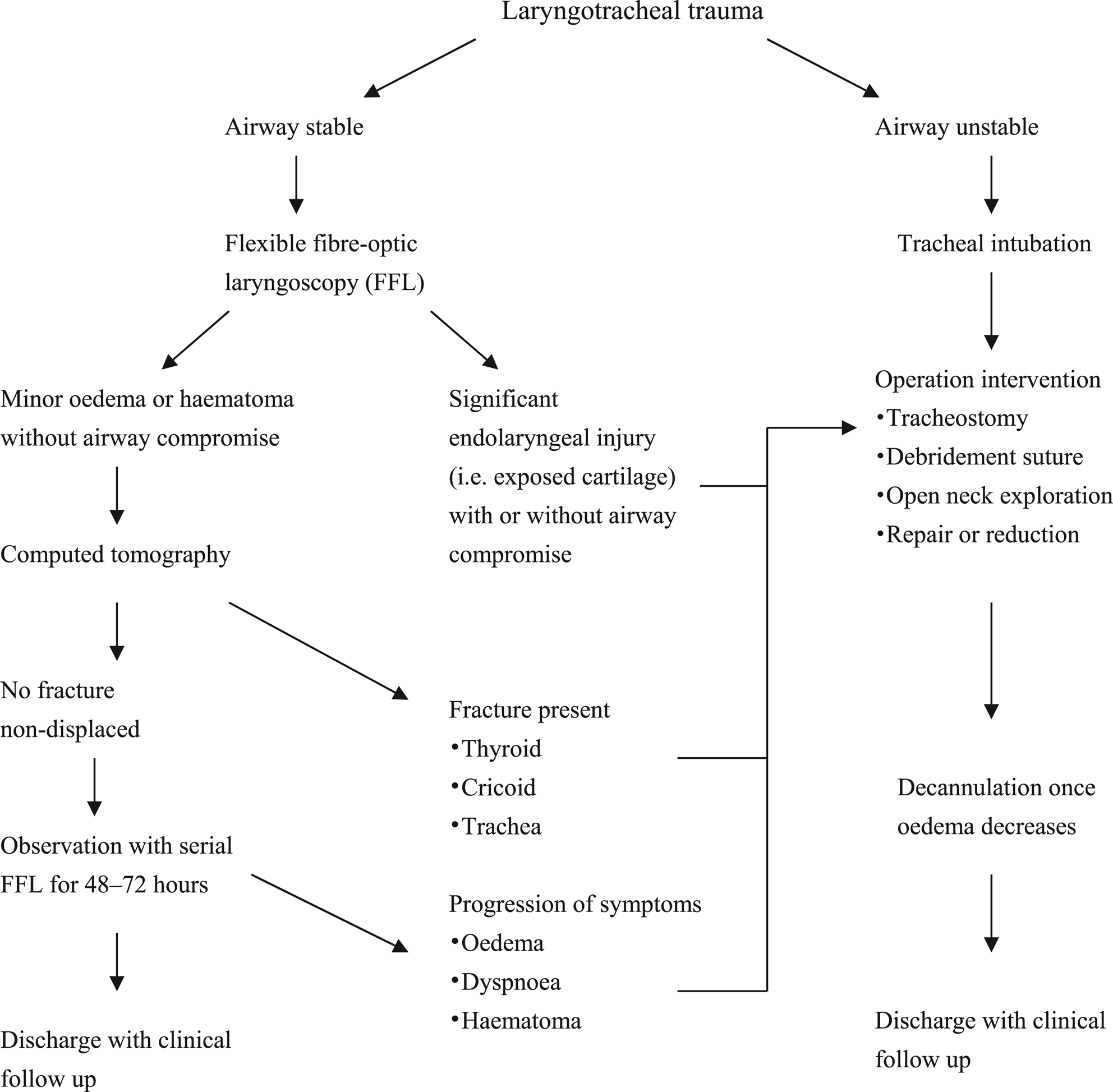
Regarding the treatment of laryngotracheal trauma, the clinician's first priority is to assess whether the patient's airway is stable or whether there is significant dyspnoea. If the airway is stable, the next step is to evaluate the compound injury to determine if there are craniocerebral or cervical spine injuries. Conservative treatment (usually for two or three weeks) should be chosen if there is no fracture or displacement of the laryngeal cartilage, as determined by flexible fibre-optic laryngoscopy and CT imaging of the larynx.Reference Oosthuizen19 Otherwise, laryngotracheal trauma detection and debridement reduction are required. Intubation is not necessary in all cases. Hackett et al.Reference Hackett, Chi and Kitsko20 reported that only 36.3 per cent of blunt trauma cases and 16.6 per cent of penetrating trauma cases required intubation. Emergency tracheal intubation is essential in cases with penetrating trauma to the neck without obvious dyspnoea, but with obvious bleeding or other signs of airway instability. In an emergency situation, such as during complete separation of the larynx and trachea, a tracheal intubation tube can be inserted through the tracheal split to maintain airway patency.Reference Lee, Eliashar and Eliachar2,Reference de Alarcon and Rutter21 If a compound injury has occurred, the first step is to evaluate whether the compound injury requires emergency treatment. Laryngotracheal trauma exploration, debridement and suture reduction can be performed after the airway has been stabilised by tracheal intubation.
• This paper summarises clinical presentations, diagnostic approaches and airway management techniques in children with laryngotracheal trauma
• Incidence rate of laryngotracheal trauma in children is low; without timely rescue there may be serious complications
• Flexible fibre-optic laryngoscopy and computed tomography imaging are important diagnostic approaches for laryngotracheal trauma
• Treatment of laryngotracheal trauma should be based on Schaefer–Fuhrman laryngeal injury classification system
• General management strategies for laryngotracheal trauma in children are proposed
One of the most common challenges in treating paediatric laryngeal injuries is the heterogeneity of patients and techniques used for treatment. Few clinicians have extensive experience in the management of laryngotracheal trauma, and few papers have been published on a large series of patients. Moreover, there is no universally accepted method for the treatment of laryngeal fractures. Management techniques may include medical and/or surgical interventions depending on airway status and the amount of cartilaginous displacement.Reference Schaefer1 Based on the Advanced Trauma Life Support protocol, clinical data and an overview of these 13 cases, we propose several strategies for managing the airway in cases of paediatric laryngeal trauma (Figure 3). Strategies have been reported; however, we present our perspectives and recommendations from China. We recommend using both flexible fibre-optic laryngoscopy and CT imaging to evaluate these patients, depending on airway status and the extent of endolaryngeal injury. Our study provides some recommendations on the appropriate diagnostic approach in patients with laryngeal injury as well as the optimal approach for acute airway management. The top priorities for paediatric patients with laryngotracheal trauma are to maintain airway patency and to restore laryngeal function.
Proposed management strategies for laryngotracheal trauma in children.

Conclusion
We have summarised a large series of paediatric laryngotracheal trauma cases, including their clinical presentations, diagnostic approaches and management strategies. We have further proposed general management strategies for laryngotracheal trauma in children. In our experience, the airway should be kept safe, and should be opened by tracheal intubation or tracheostomy if necessary. Flexible fibre-optic laryngoscopy and CT imaging may play important roles in the diagnosis of laryngotracheal trauma. The diagnosis and treatment of laryngotracheal trauma in paediatric patients should be performed accurately, with evaluations performed on a case-by-case basis until standardised guidelines have been firmly established.
Acknowledgements
The authors would like to acknowledge the patients who participated in the study. We also thank Editage (www.editage.com) for English language editing. This work was financially supported by the Beijing Hospitals Authority Ascent Plan (grant number: DFL20191201).
Competing interests
None declared