Taiwan is conventionally described as a labour absorbing society,Footnote 1 with the accumulated number of unskilled labourers entering from South-East Asia estimated at approximately 365,000 in 2008.Footnote 2 Today it is increasingly recognized as a labour sending society, with at least 3 per cent of its population of 23 million currently working in ChinaFootnote 3 – in other words, the number of workers leaving Taiwan vastly exceeds the number entering. The actual number may be higher, since these statistics do not include all family members involved in the activities of family owned and operated businesses. These migrant workers have also evaded the official statistics both in Taiwan and China.Footnote 4 Whereas the movement of highly skilled workers from Taiwan to industrialized countries in North America and EuropeFootnote 5 follows a well-established migration pattern from less developed to industrialized countries before the 1980s (generally described as “south-north”), the current trend of white-collar workers moving from Taiwan to China represents a special case of movement between two developing societies (or “south-south”).
Taiwan resumed semi-official commercial interactions with China in the late 1980s, when the Republic of China (ROC) government enacted a policy to permit civilians with relatives in China to make “return-home” visits. The then-ruling Nationalist party (Kuomintang or KMT) described its motivation as humanitarian, this during a time when governments on both sides of the Taiwan Strait were openly hostile to each other.Footnote 6 Some of the first visitors and tourists surveyed by Chiu et al. Footnote 7 described China as a less developed country compared to Taiwan, yet the majority of respondents perceived it as a “place of origin” that held meaning in terms of past memories. Ming-Chang Tsai later reported that second-generation Mainlanders living in Taiwan rarely based their identities on the places from which their parents moved in the 1940s and early 1950s.Footnote 8 The majority of both Mainlander and Taiwanese respondents to Tsai's survey considered intensive socio-economic interaction with China to be a necessity, but at the time of the survey they did not consider long-term residency or resettlement a viable option.
Paralleling the increasing flows of people towards mainland China is a deepening engagement of trade and capital movement in the past two decades, once again a one-way process. The volume of trade between Taiwan and China has greatly expanded since 1990. Between 2001 and 2005 alone it increased from 13 per cent to 19.3 per cent of Taiwan's total foreign trade,Footnote 9 and China became Taiwan's primary destination for foreign investment. According to the official statistics, Taiwanese investment in Mainland China escalated from US$1.1 billion in 1995 to $10 billion in 2007. The total accumulated investment between 2001 and 2007 was US$60 billion, surpassing the US$40 billion invested in other areas.Footnote 10 As of 2007, Taiwan ranked number seven after Hong Kong, the British Virgin Islands, Korea, Japan, Singapore and the United States in its amount of investments in China.Footnote 11
The large amount of capital moving across the Taiwan Strait has significantly affected both domestic suppliers and job markets. Motivated by the availability of cheap labour, in the early 1990s a significant number of small and medium-sized Taiwanese enterprises started moving westward across the Taiwan Strait to China rather than southward towards South-East Asian countries.Footnote 12 An increasing number of high-tech corporations followed, taking with them a growing number of managerial and technical personnel to work in their China operations, with many moving in clusters to fill positions for both upstream manufacturers and downstream suppliers. The combined movement of capital and manufacturing activities reflects well-organized transplanting of industrial clusters rather than individual firms' decisions.Footnote 13
In the same manner as most multinational corporations, firms headquartered in Taiwan – numbering between 70,000 and 100,000Footnote 14 – prefer direct ownership and control to contractual transactions, joint-ventures and other management approaches.Footnote 15 Accordingly, their managerial positions are mostly filled with Taiwanese employees enticed by high salaries, bonuses and various allowances. But the Taiwanese firms also contribute to the massive internal labour migration in China,Footnote 16 including the severe exploitation of migrant peasant workers (min-gong).Footnote 17
Such movement of professionals and technicians has been observed elsewhere in Asia. Japan, for example, was a forerunner in sending its highly skilled workers all over Asia, although it involves movement of many fewer people, probably because the location of R and D remains in Japan.Footnote 18 The Taiwan migrants also stand in stark contrast to Chinese returnees from industrial countries (mostly overseas students and scholars). These foreign-trained experts constitute a rich “transnational human capital” from which China's growing enterprises (both state and private) and research institutes has increasingly benefited,Footnote 19 and help integrate China into the global economy.Footnote 20 Yet many returnees target “domestic markets” as the technologies they bring back are not quite new.Footnote 21 The priority for most of them is for immediately profitable projects, but the underdeveloped finance market in China contributes to the failure of a number of these ventures despite the government's taxation benefits.Footnote 22 Another stream worth mentioning is expatriates from multinational corporations in China. Brenda S.A. Yeoh and Katie Willis document several emerging “contact zones” in large Chinese cities in which Singaporean and British transmigrants manage to negotiate differences of personal identity in their cross-cultural encounters.Footnote 23 They observe that while the Britons tended to attribute their presence in China to its cultural attractions, some Singaporeans defined it as a “journey home,” a reconnection to the “motherland.” Such subliminal thinking in terms of a shared heritage might also operate in our case. A variety of economic and cultural attachment elements affect these highly skilled returnees and migrants. What factors influence the Taiwan migrants when they decide to move across the Strait and work in China?
We set out to identify motivations for Taiwanese workers to move to China in a context of increasing economic exchanges and ongoing diplomatic confrontations between the two regimes. Our primary hypothesis is that, besides economic factors, ethnicity, political affiliations and social connections account for a significant amount of variation in the willingness of Taiwanese to work in China. The next section presents our theoretical arguments, followed by a brief description of our research methods and a discussion of results from multivariate analysis. The final section summarizes the research outcomes and evaluates their theoretical and empirical implications.
Human Capital, the Segmented Labour Market and Taiwanese Migrant Workers in China
Taiwanese employers who operate firms and factories in China had found it difficult to hire local highly skilled or professional workers, so such workers from the employers' home country were in an advantageous position in terms of negotiating compensation and extra benefits. It could be hard to persuade upper-level managers to move to other countries, which explains why Tai-zi (台資, Taiwanese-capital) firms offered better pay for many upper-level and middle-level technicians to serve as high-ranking managers and shop floor supervisors, constituting a specific labour market that favours medium and highly skilled migrants.Footnote 24 The lack of a language barrier between Taiwanese and Chinese also reduces the cost of overseas assignments for employers.
Conventional economic explanations indicate that these Taiwanese migrant workers would take the job opportunities in China to maximize their well-being. Indeed, conceived as rational actors, prospective migrants do probably make migration decisions based on cost-benefit calculations. Thus, individuals with higher levels of human capital are more likely to leave their homeland for better returns as expatriates.Footnote 25 Yet professionals and technicians who work in China for extra pay may view their assignments as temporary. To encourage Taiwanese workers to stay longer, most firms made an effort to help their family members settle down, including finding jobs for spouses and schools for children.Footnote 26 Hence there is clearly a segmented yet privileged labour market for Taiwanese migrant workers in China. Extended stays and the permanent settlement of Taiwanese professionals have occurred in China, although reliable statistics for duration of stay are not available.Footnote 27
For migrant workers in China, the returns can increase substantially. We therefore expect to find that individuals equipped with strong human capital – especially management expertise – would have a greater motivation to work in China. Some researchers indicate that Tai-zi firms increasingly mobilized ethnic Chinese skilled labour to replace the Taiwanese cadres, especially at the intermediate level of management, in order to reduce human costs.Footnote 28 This is increasingly likely as the reverse brain drain happens, as discussed above.Footnote 29 Professionals from Taiwan might thus observe their competitiveness decreasing in China, which discourages their interests in migration. We derive a counterargument that human capital factors play a marginal role in explaining the cross-Strait mobility issue.
Social Connections, Ethnicity and Political Affiliations
Some social capital theorists analyse international migration as a system in which migrant networks enhance trans-border labour mobility.Footnote 30 According to this view, migrant networks represent “sets of interpersonal ties that connect migrants, former migrants, and non-migrants to one another through relations of kinship, friendship, and shared community origin.”Footnote 31 These relationships are considered important because they assist in the mobilization of required resources for facilitating migration.Footnote 32 Eliakim Katz and Oded Stark suggest that many migration decisions are based on asymmetric information (such as limited knowledge of destinations) that negatively affects the results of human capital transfers.Footnote 33 Migration networks can provide information that reduces associated costs and risks.Footnote 34
The Taiwan case fits well with social capital theory derived from research on immigrants in industrial countries,Footnote 35 but with the added feature of the large-scale associated movement of family firms. Most managerial positions in these businesses are filled by family members; if necessary, non-family networks consisting of close friends and neighbours are tapped for assistance.Footnote 36 Some earlier studies of migrant entrepreneurs from Taiwan to the United States also documented the favourable effects of social capital among this ethnic group.Footnote 37 As Taiwanese firms increasingly moved to South-East Asia, particularly Vietnam, such networking, trust and reciprocity appeared to be replicated to help Tai-zi firms generate new opportunities.Footnote 38 Another special feature of the Taiwan–China case is that the concentration of Taiwan migrants in boomtowns along the Chinese coast facilitates the exchange of workers among relocated Taiwan firms. Alejandro Portes and Josh DeWind have observed that this and other types of migrant networks sustain worker movement long after the original economic motivations evolve or disappear, such as with Cuban immigrants in the United States.Footnote 39 In the case of Taiwan, the former Democratic Progressive Party (DPP) government attempted to slow down the movement of capital and associated migrants to China, as it considered that the massive outflow of capital and talents towards China not only damages Taiwan's economic growth and employment markets but also risks high economic dependence on China.Footnote 40 Yet network-centred social forces are circumventing regulatory policy. In short, individuals who have personal relationships with workers in China are likely to migrate despite government efforts to keep them at home.
While migrant networks constitute a key element for understanding contemporary migratory processes, such a perspective overlooks contextual factors that go beyond personal characteristics and interpersonal relationships. We believe that ethnic relationships and political identity constitute another set of sociological factors for explaining motivation (or lack of it) for Taiwanese to migrate to China.
Our justification is the unique relationship between the two political entities, which affects how Taiwanese individuals evaluate their attachments to China. The majority of Han Chinese living in Taiwan are part of the Hokkien ethnic group (also referred to as Holo or Minnanese), whose ancestors lived in Fukien (Fujian) province many generations ago.Footnote 41 Another wave of Hakka migrants later moved to Taiwan from what is now known as China's Guangdong province. Combined, Hokkien and Hakka constitute the category now referred to as “Taiwanese,” in contrast to “Mainlanders” who escaped from China in the late 1940s. At the time of the communist victory in 1949, a prominent difference among Han groups living on Taiwan Island was the use of various dialects for informal communication: Hokkien using minnan-hua and Hakka using a unique hakka dialect as their main spoken language. Mainlanders primarily used Mandarin Chinese, and over the ensuing decades this became dominant for political discourse and formal occasions. Younger generations of Hokkien and Hakka are now fluent in Mandarin, and many Taiwanese present this as evidence of the KMT's authoritarian rule and goal of presenting itself as the true government of all China. Confrontations between the two major ethnic groups continue despite social interaction and inter-marriage between them.Footnote 42
In Taiwan, ethnic backgrounds are closely associated with political party affiliation, with “native” Taiwanese constituting a large percentage of DPP supporters.Footnote 43 Independence from China continues to be a key theme in efforts to gain electoral support from Hokkien and Hakka citizens. In contrast, Mainlanders are more inclined to support the KMT and oppose Taiwan independence. The majority of Mainlanders and KMT supporters view strong economic ties with China as necessary in order to maintain the growth momentum of Taiwan's economy. The KMT currently believes that Taiwan can benefit from increased economic exchanges with China, which it views as an emerging global power.Footnote 44 It attributes recent declines in economic growth in Taiwan to what it describes as a conservative China policy adopted by the DPP. DPP supporters counter by describing China as a threat to Taiwan's claims of sovereignty and security, and attribute recent spikes in unemployment to capital flight across the Strait.Footnote 45 The DPP officially opposes the relocation of high-tech firms, arguing that losses of local technologies and human expertise to China represent long-term threats to Taiwan's economic health. This party is therefore spearheading efforts to enact regulations to control Taiwanese business investments in China, expressing a strong distrust of the Chinese Communist Party (CCP). Besides warning local capitalists of the high risks of investing in China, the DPP also describes investing and working in China as unpatriotic indicators of “not loving Taiwan.” Some DPP supporters have even gone so far as to resist strongly the in-migration of Chinese spouses married to Taiwanese citizens.Footnote 46 DPP supporters speculated that marriage migrants are likely to vote for the KMT when they obtain citizenship in Taiwan.Footnote 47
China Bound: Crossing the Strait for Jobs
All data are drawn from the fifth wave (2005) of the Taiwan Social Change Survey (TSCS). Analogous to the British Social Attitudes and the American General Social Survey, the TSCS gathers information on family, consumption, employment activities, cultural values, religious practices and other topics. The fifth edition had a special emphasis on work attitudes and work-related experiences. Using a multistage, area-stratified probability sampling design, the 2005 survey collected face-to-face survey results from 2,171 adult respondents residing in 36 cities and towns of various sizes across Taiwan. Our analysis addresses factors affecting emigration and potential emigration for employment. We excluded students, housewives and the unemployed as unlikely candidates for emigration. Our final sample size was 1,282 employed men and women.
We paid special attention to two TSCS questionnaire items: “Do you think you will go to China to work within the next five years?” and “If the opportunity arises, are you willing to move to China to work?” Responses were given along a four-point ordinal scale (ranging from definitely will to definitely not). The goal of the first question was to assess the perception of overseas job opportunities and employment needs among Taiwanese workers. We assumed that a strongly positive answer (definitely will) indicated that the respondent had a prearranged job in China. The purpose of the second question was to measure the willingness of respondents to work in China under a hypothetical condition, that is, if a job were offered (the scale ranging from definitely willing to definitely not willing). This question represents an exploration of willingness rather than an indication of firm employment plans.
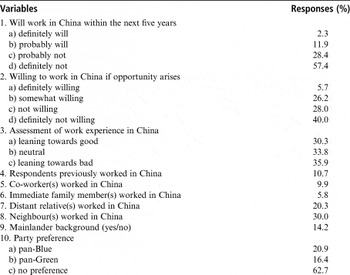
As shown in Table 1, approximately 14 per cent of the respondents stated that they expected to work in China within the next five years, and 32 per cent expressed a willingness to work in China if given the opportunity. Another 28 per cent expressed ambivalence regarding such a move, and the largest groups (57.4 and 40 per cent respectively) expressed no interest in migrating.
Descriptive Statistics of China-Bound Related Variables (N = 1,282)

Social connections in China
Social capital researchers have suggested that transnational movement is more likely to occur among those who possess social networks that serve as bridges.Footnote 48 The 2005 TSCS provides detailed information of the respondents' coworkers, immediate family members (parents, spouses, children, brothers or sisters), more distant relatives, neighbours and friends with work experience in China. Knowing expatriate coworkers in China was viewed as indicating a strong commitment to China on the part of the respondent's employer. In terms of neighbours and friends, Mark Granovetter was among the first to identify them as key providers of insider information for people on the verge of changing jobs.Footnote 49 We view these four kinds of social ties as parts of a continuum running from strong to ambiguous to weak.
According to the TSCS data, 10.7 per cent of the sample had China work experience (Table 1). Results from our cross-tabulation analysis indicate that the large majority of respondents with work experience in China are male, have undergraduate college degrees or higher, and are employers or managers. Ethnically, Mainlanders are more likely to have worked in China (16.8 per cent) than Hokkien (9.4 per cent) or Hakka (11.3 per cent) (chi-square = 8.7, p < .05). Ten per cent of the respondents had co-workers in China. Nearly one-third of the respondents knew neighbours or friends who had worked in China, making this weak tie the most common network type. Approximately 26 per cent reported immediate family members or more distant relatives who had previously worked in China.
Ethnicity and political affiliation
Over two-thirds (71.8 per cent) of the respondents in our sample identified themselves as Hokkien, 14.2 per cent as Mainlanders and 14.0 per cent as Hakka. In terms of party identification, respondents were categorized according to their reported preferences: “pan-Blue” (including the KMT, New Party and People First Party, which favour unification with China) (20.9 per cent), “pan-Green” (including the DPP and Taiwan Solidarity Union, which favour Taiwan independence) (16.4 per cent), and no specific affiliation (62.7 per cent) (Table 1). Our prediction was that Mainlanders and pan-Blue supporters would have the most opportunity and strongest interest in migrating to China.
Multivariate Analysis and Findings
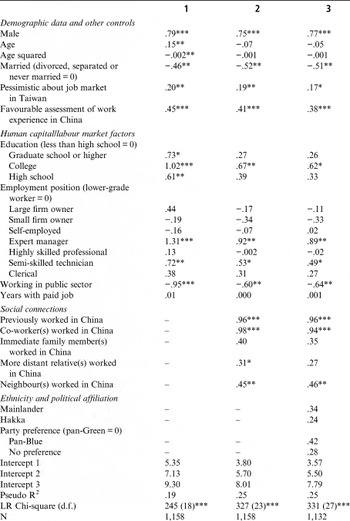
Results from multivariate regression of the likelihood of working in China within the next five years are shown in Table 2.Footnote 50 Column 1 results are associated with the human capital and job-related hypotheses, controlling for several socio-demographic variables as well as two subjective evaluations of job markets in Taiwan and China. We found a statistically significant difference between men and women, with men showing a higher likelihood of working in China. Statistical significance was not found for age after social connection factors were introduced to the equation. As expected, married respondents were less likely than unmarried respondents to move to China for employment purposes.Footnote 51 In addition, our assumptions for the two subjective elements are supported: respondents expressing pessimism about the domestic job market or who held favourable assessments of work experiences in China were more likely to migrate to China.
Expecting to Work in China in Five Years

Note: Ordered Logit Estimates (the scale ranging from definitely will to definitely not).
*p < .05; **p < .01; ***p < .001.
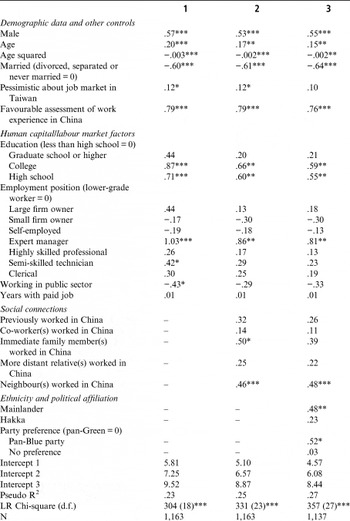
Willingness to Work in China if Opportunities Available

Note: Ordered Logit Estimates (the scale ranging from definitely willing to definitely not willing).
*p < .05; **p < .01; ***p < .001.
Significant differences among respondents were noted in terms of human capital factors,Footnote 52 with those having undergraduate college degrees much more willing than those without to find employment in China, although holders of graduate degrees appeared to be less interested in migrating. However the influences of educational background became statistically insignificant when social connections were considered (Table 2, column 2). In contrast, in assessing the influence of employment status,Footnote 53 managers and semi-skilled technicians demonstrated higher migration likelihood for the near future. Members of the former group are viewed as being responsible for the operation of Tai-zi firms and the creation of industrial clusters along China's south-east coast. Members of the latter group have fewer competitive credentials in Taiwan, and are therefore likely to earn more by working in China. Since the vast majority of Taiwanese firms operating in China are engaged in manufacturing, higher-skilled employees are less likely to find jobs of interest to them there. Finally, as expected, the respondents who identified themselves as working in the public sectorFootnote 54 were much less likely than private-sector workers to migrate to China for employment. Number of years in paid employment had little effect on likelihood of migration.Footnote 55
Results following the addition of social connection variablesFootnote 56 to our analysis are presented in column 2 of Table 2. They indicate a greater likelihood among workers with prior China work experience to emigrate again, suggesting that Tai-zi firms place greater value in employees who have the “China experience.”Footnote 57 Moreover, these workers may have accumulated social networks that positively affect their job prospects in China. The results also indicate that respondents with co-workers, relatives, neighbours or friends working in China or with China work experience were much more likely to migrate across the Taiwan Strait.
The third column in Table 2 lists the results of adding ethnicity and political affiliation factors. They suggest that Mainlanders and Hakka respondents were slightly more likely than Hokkien to migrate to China, but at a statistically insignificant level. The effect of being a pan-Blue supporter is merely significant (p = .06), Thus the ethnicity and political affiliation hypotheses are not strongly supported.Footnote 58 For pan-Blue supporters or Mainlanders the job opportunities in China are no better than for those with different ethnicities or political identities.
Next, we examined the extent to which our respondents would willingly accept positions in China if presented with job offers. Regression results for assessing respondent attitudes towards job offers (ranging from strong willingness to strong absence of willingness) are shown in Table 3. Results in column 1 show a strong willingness among males to migrate to China for work. Note that the age effect is reverse-U-shaped as the impact of age gradually declined at approximately 37 years (computed from the age square coefficient). As reported above, married respondents expressed less interest in migration. Further, pessimistic evaluations of the domestic job market or favourable assessments of China work experience produced expected influences; that is, both factors encouraged China migration.
As to the impact of background factors, the results indicate that respondents with graduate degrees were not as enthusiastic as those with undergraduate degrees, suggesting that China-based jobs do not require high levels of academic knowledge. Similar to the results shown in Table 2, expert managers and semi-skilled workers show a strong willingness to work in China. Public sector workers tend to have lower odds of so doing. Tenure experience is found to have little influence in response to job opportunities.
The results in column 2 of Table 3 reflect the impact of social connection factors. We were surprised to find that the only ties that consistently reached a statistically significant level with positive effects on migration decisions is what Taiwanese generally considered as “weaker ties,” that is, connections among neighbours and friends. The data in column 3 reflect the significant influences of ethnicity and political affiliation. Mainlanders were found to be much more willing than Hokkien or Hakka respondents to work in China.Footnote 59 Statistical significance was also noted in comparing pan-Blue and pan-Green supporters, with pan-Blue supporters being much more likely to migrate to China. In other words, ethnicity and political affiliation were much more likely to affect respondents who were offered jobs than those with prearranged China positions.Footnote 60 While the above findings are based on techniques of variable analysis, some autobiographic reports also reveal close affinity between ethnic backgrounds and willingness to work in China.Footnote 61
Discussion and Conclusion
The relocation of hundreds of Taiwanese firms to China over the past two decades is the basis for significant economic exchanges between the two societies. The massive movement of capital and labour towards China reflects an unusual migratory pattern that differs from the conventional description of immigrants as always moving towards more industrialized countries. Our findings do not refute the importance of human capital; in fact, we identified two specific groups (individuals with undergraduate education and those with management expertise) that comprise the main sources of migrants moving between Taiwan and China. Neoclassical migration theorists might consider these groups as strongly motivated by better financial returns, and strong demand for specific skills on the part of China-based Taiwanese firms also supports their arguments. Further, the responses of Taiwanese job seekers to increasing opportunities in China are considered outcomes of the relocation of Taiwanese manufacturing firms. The steady movement of experienced and skilled managers represents both a privileged labour market and a representative case of ethnic closure.
We assumed that property owners, especially those with large capital holdings, would be more likely to move to China to pursue employment and business opportunities. However, this assumption did not receive support from our data. There are two possible reasons. First, some capitalists may enjoy the benefits of business niches that allow them to be profitable in Taiwan rather than in China. We did not have access to data to evaluate asset liquidity among business owners in order to find support for this conjecture. Second is the problem of sample selection, which may have suppressed the effect of capital in our analysis. In other words, the TSCS respondent population may not have included sufficient examples of this category, since most potential respondents would have already moved to China when the survey was conducted.
Nevertheless, we should not overestimate the impacts of human capital or job-related factors on migration tendencies. According to the results shown in Tables 2 and 3, the coefficients of current employment and human capital factors become smaller (and in some cases statistically insignificant) after adding social network variables. Researchers have long believed that social connections exert notable influences on job seekers. Our findings echo those observations that having friends or neighbours with China work experience exerts a particularly strong influence on decisions to migrate. Surprisingly, influences from immediate family members working in China – considered much more important than extra-family relationships in Taiwan – were much weaker. This finding lends limited support to a prevailing argument that individual migrant behaviour is governed by household strategies that pool benefits and distribute risks among family members.Footnote 62 We did not observe any patterns implying emigration to China as a collective adjustment strategy, since the migratory motivation of additional family members is only slightly (positively) associated with those “first movers” in family.
We found that ethnicity – a factor that is rarely considered in the field of migration studies – played a significant role in the willingness expressed by the TSCS respondents to work in China. It may be that the descendents of Mainlanders who moved to Taiwan as part of the mass migration in the 1940s, as well as the supporters of Taiwan–China reunification, have strong Chinese identity and attachments that facilitate migration decision. In some cases, migrants are attracted by the ability to create new identities in their destination countries. This combination of ethnic and political identity as a factor in migration decisions is unique to the China–Taiwan situation.
It should be noted that many ethnic Taiwanese are in fact migrating to China to pursue work opportunities, perhaps in the spirit of “business is business.” Nevertheless, a significant percentage of Hokkien residents in Taiwan continue to view China as a potential enemy, which may discourage a decision to relocate under any circumstances. In this case, ethnicity and political viewpoint are significant factors explaining why some Taiwanese are so enthusiastic about moving to China, as well as why the large majority have no interest in doing so.