Shark teeth are found around the world in different archaeological contexts. Studies have identified their presence in littoral regions; for example, on the west and east coasts of North America (Betts et al. Reference Betts, Blair and Black2012; Colvin Reference Colvin2011, Reference Colvin2014; Kozuch Reference Kozuch1993, Reference Kozuch1998; Kozuch and Fitzgerald Reference Kozuch and Fitzgerald1989; Lowery et al. Reference Lowery, Godfrey and Eshelman2011; Rick et al. Reference Rick, Erlandson, Glassow and Moss2002), the Arabian Peninsula (Charpentier et al. Reference Charpentier, Berger, Crassard, Borgi, Béarez, Dupont and Marchand2016, Reference Charpentier, Méry, Fortini and Pellé2009; Marrast et al. Reference Marrast, Béarez and Charpentier2019), Australia (Wright et al. Reference Wright, Langley, May, Johnston and Allen2016), and Argentina (Cione and Bonomo Reference Cione and Bonomo2003).
In Brazil, shark remains commonly appear at coastal sites from about 7000 years BP to colonial times. However, they rarely receive special attention beyond their first consideration as faunal remains useful in the reconstruction of past diets of coastal populations. Moreover, worked shark teeth are generally classified as ornaments and only rarely as possible tools (Borges Reference Borges2015; Cardoso Reference Cardoso2018; DeBlasis et al. Reference DeBlasis, Fish, Gaspar and Fish1998; Fossari Reference Fossari2004; Rohr Reference Rohr1977; Schmitz and Bitencourt Reference Schmitz and Vietti Bitencourt1995; Silva et al. Reference Silva, Schmitz, Rogge, Nadal de Masi and Jacobus1990; Silveira Reference Silveira2001).
Gonzalez (Reference Gonzalez2005) drew attention to the possible use of shark teeth as tools, combining their macroscopic study with ethnographic analogies from different cultures to suggest that worked specimens had a variety of functions but without clearly defining these possible functions. More recently, analysis of ethnohistoric documents has undergirded the development of an anthropological perspective on the relationship between sharks and humans on the Brazilian coast. European chroniclers who traveled along the coast during the sixteenth and seventeenth centuries described the use of shark teeth as arrowheads by ancient populations (Gilson and Lessa Reference Gilson and Lessa2019a).
This article presents the results of a microwear study conducted on archaeological shark teeth. The first aim of our analysis of modified shark teeth from the Rio do Meio site on the Brazilian coast was to determine whether they showed any evidence of use at all. For those that showed use, further analysis sought to determine their precise function as tools, to verify whether they were specialized or multipurpose tools, and to discover possible links between form and function. The results of these analyses illuminate the role of sharks and shark teeth in the lives of ancient coastal populations of fisher-hunter-gatherers in Brazil.
Archaeological Context
Shell mounds are common all along the Brazilian coast, increasing in size and frequency toward the south. Formerly defined as part of the same sociocultural system, shell mounds or sambaquis in fact show variations between sites and regions, and their analysis reveals more complex dynamics (Amâncio-Martinelli et al. Reference Amâncio-Martinelli, de Cerqueira Silva Santana and Guimarães2013; Guimarães et al. Reference Guimarães, Gaspar, Cordeiro, Mandarino, Graf, Taboas and Farias2005; Lessa Reference Lessa2011; Lessa and Carvalho Reference Lessa and Carvalho2015; Lessa and Coelho Reference Lessa and Coelho2010; Lessa and Gaspar Reference Lessa, Gaspar, Mazz and Berón2014; Lima Reference Lima2000; Scheel-Ybert et al. Reference Scheel-Ybert, Eggers, Wesolowsky, Petronilho, Boyadjian, De Blasis, Barbosa Guimarães and Gaspar2003; Scherer et al. Reference Scherer, Lessa and Salles2015). Although shell mounds are the best known and most studied coastal structures in Brazil, they are not the only features to be considered. As early as 1950, Tiburtius, Bigarella, and Bigarella (Reference Tiburtius, Bigarella and Bigarella1950) defined another kind of vestige currently known as shallow sites. Since then, shallow sites (with or without ceramics) have been studied only rarely and have been given various names. We found 12 names that refer to this type of human installation, each reflecting the researcher's own cultural-functional interpretation; for example, sambaqui tardio, sítio raso, acampamento, and jazida paleoetnográfica (Lessa Reference Lessa2005; Lessa and Scherer Reference Lessa and Scherer2008). We prefer the term “shallow site” because it offers a more neutral, physical description of this kind of site, without debatable functional or cultural associations.
Shallow sites are coastal precolonial settlements that differ from the well-known sambaquis in many ways. The stratigraphic layers, formed by very dark sediments, rarely exceed 1 m in total depth. They are located either directly on the sand of the beach or on the top of sambaquis. Shells appear in a much smaller quantity than in sambaquis and are grouped or spread out in thin layers, with no apparent constructive intention. Evidence of burials are present at all sites, in addition to stake marks and artifacts associated with daily activities. Ceramic artifacts, when present, date between 450 and 1,250 years cal BP (Gilson and Lessa Reference Gilson and Lessa2020; Lessa Reference Lessa2014; Prous Reference Prous2019; Rohr Reference Rohr1977, Reference Rohr1984). The three criteria that characterize the Rio do Meio site as a shallow site with ceramics are (1) its physiographic position directly on a beach, (2) the presence of Itararé ceramics, and (3) its chronological bracket between 500 and 700 years cal BP (Gilson and Lessa Reference Gilson and Lessa2020). No traces of burials have yet been revealed (Gilson and Lessa Reference Gilson and Lessa2019b, Reference Gilson and Lessa2021a), which makes the Rio do Meio site unique among other shallow sites on Santa Catarina Island and the southern Brazilian coast, where burials are common.
The teeth analyzed in this study were collected at the Rio do Meio site, which is located on Jurerê beach on Santa Catarina Island, in the state of Santa Catarina (Figure 1). The site was discovered in 1987 by the archaeological team of the Museu de Arqueologia e Etnologia da Universidade Federal de Santa Catarina (MArquE-UFSC) and was excavated between 1996 and 1997 by a team from the same museum, led by Teresa Fossari. The excavation was part of a salvage archaeology project undertaken because real estate development was threatening the site's integrity.
Map showing the location of the Rio do Meio site on Santa Catarina Island (Florianópolis, Brazil).

Analysis of the faunal material showed that fishing, especially the capture of sharks, was the main subsistence activity (Gilson and Lessa Reference Gilson and Lessa2021b, Reference Gilson and Lessa2021c). The analysis was based on the preserved parts of sharks: the teeth and the centra (middle portion of the vertebral body). It identified 15 species: Lamna nasus, Negaprion brevirostris, Carcharnihus obscurus, Carcharhinus plumbeus, Carcharhinus brachyurus, Carcharhinus leucas, Carcharhinus falsiformis, Galeocerdo cuvier, Rhizoprionodon sp., Squatina sp., Sphyrna sp., Carcharodon carcharias, Isurus paucus, Mustelus sp., and Carcharias Taurus; at least 80% of the captured sharks could be categorized as young or subadult (Gilson and Lessa Reference Gilson and Lessa2021b, Reference Gilson and Lessa2021c). The authors suggested that the north bay of Santa Catarina Island was the most likely capture area, where sharks were abundant until the 1970s. Regarding capture techniques, at least two can be posited: (1) hunting in shallow water with sharpened wooden sticks used as stabbing weapons, as described in ethnohistorical records (Gilson and Lessa Reference Gilson and Lessa2019a, Reference Gilson and Lessa2021b); and (2) netting as suggested by a recent zooarchaeological study (Gilson and Lessa Reference Gilson and Lessa2021b). Both techniques may have flourished concurrently, along with other possible techniques such as water poisoning and the use of projectiles (Gilson and Lessa Reference Gilson and Lessa2021b).
Determination of the biomass indicates that sharks made up at least 54.6% of the total protein intake. Bony fish came second with 38.2%, followed by sea mammals (5.3%), land mammals (0.3%), and various other animals (1.6%). The carcasses were processed in situ on the Rio do Meio site (Gilson and Lessa Reference Gilson and Lessa2021b, Reference Gilson and Lessa2021c).
In addition, Rio do Meio contained bone tools, including fishhooks and so-called bi-pointed tips. It was a typical coastal site where lithic technology is uncommon, represented by a few stone tools and pieces of débitage (currently under analysis); lithic arrowheads are extremely rare (for more details, see Merencio Reference Merencio2021).
Materials and Method
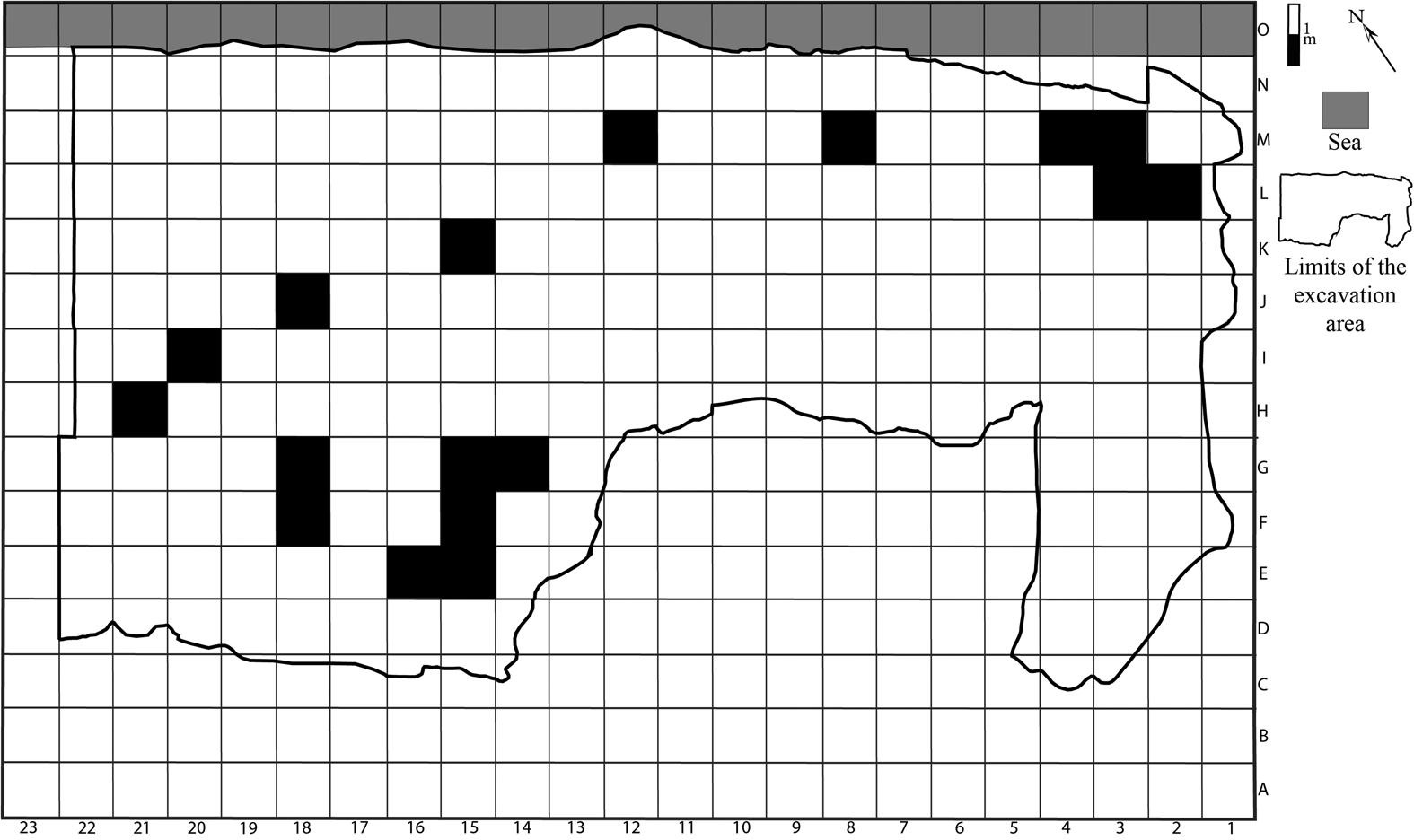
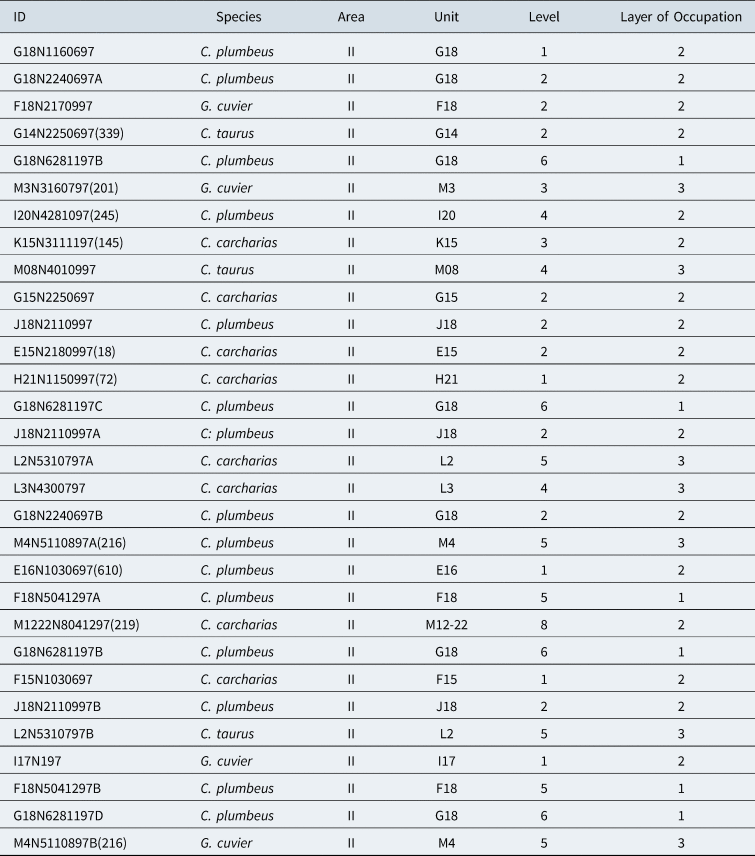
This microwear study used 30 shark teeth selected from the Rio do Meio collection curated at the Museu de Arqueologia e Etnologia da Universidade Federal de Santa Catarina (Table 1; Figure 2). The selection was based on four criteria: spatial distribution of the teeth; modification of the root (which should also reveal microtraces related to use); the absence of heat modification (because it hinders the visibility and interpretation of use wear); and a representation of the four main shark species identified at the site: sandbar shark (Carcharhinus plumbeus), sand tiger shark (Carcharias taurus), great white shark (Carcharodon carcharias), and tiger shark (Galeocervo cuvier). By including samples from different site areas, the sampling strategy also aimed to cover all activities involving shark teeth that took place on the site (Figure 3). Moreover, the selection of teeth with different shapes from different species enabled us to explore potential links between form and function. It appears that the ancient inhabitants of the site selected teeth measuring at least 1 cm in height (including root and enamel): this was apparently their primary criterion. They did not seem to consider the tooth's position along the jaw. However, our experiments suggest that only the active teeth, as well as the first and possibly the second substitutes, possess the solidity and resistance needed for use as tools (Gilson et al. Reference Gilson, St-Pierre, Lominy and Lessa2021).
Examples of manufactured shark teeth from Rio do Meio: (a–c) great white shark: C. carcharias; (d) sand tiger shark: C. taurus; (e–f) tiger shark: G. cuvier; and (g–i) sandbar shark: C. plumbeus. (Color online)

Plotting map of the worked shark teeth in the excavated area of the Rio do Meio site.

Species Identification and Contextual Information of the Shark Tooth Sample.

The number of teeth selected for this analysis was limited due to legal and administrative constraints regarding their transport to the Université de Montréal (Canada), where the microwear study took place. The experimental and preliminary nature of this study also accounts for the small sample size of the modified shark teeth.
The microtraces observed on each artifact and replica were systematically described, recorded, and photographed using an Olympus BX-51 metallographic microscope with incident light at magnifications of 12.5×, 50×, 100×, and 200×. They were then compared to a microwear database on shark teeth that was previously compiled using experimental procedures, the results of which are presented elsewhere (Gilson et al. Reference Gilson, St-Pierre, Lominy and Lessa2021). The database includes microwear produced by scraping, sawing, and barking green wood; scraping and sawing fresh and dry bone; piercing and cutting fresh skin, hide, and leather; cutting and scaling fish; and using the shark teeth as arrowheads.
As shown in a separate study (Gilson et al. Reference Gilson, St-Pierre, Lominy and Lessa2021), experiments using shark teeth as arrowheads produced a typical breakage pattern that allowed us to identify those possibly used as projectile points. This study compared the experimental breakage pattern with 500 shark teeth randomly selected from the Rio do Meio collection.
Results
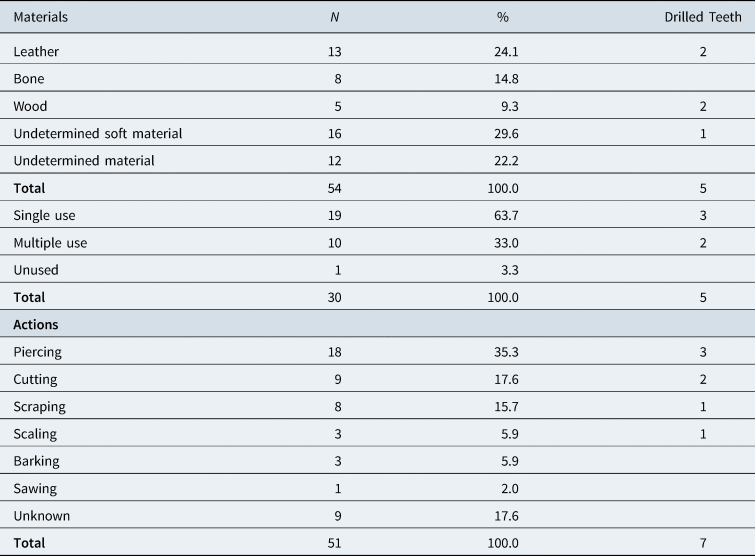
Use-wear analysis enables the identification of different worked materials and actions based on the microwear visible on the shark teeth. Table 2 summarizes these materials and actions, as do the several examples presented in this section. Some of the shark-tooth tools apparently had several purposes; hence the total number of materials and actions exceeds the number of analyzed artifacts.
Materials and Actions Identified in the Archaeological Sample.

The shark teeth from this site mostly worked soft materials (54%), including meat and leather, followed by bone (15%), and finally wood (9%). Piercing (35%), cutting (17%), and scraping (15%) were frequent actions.
Soft Materials
The working of soft materials was detected in 54% of the analyzed teeth. Except for the leather that was worked, the soft materials did not leave heavily developed microwear. Root alteration is therefore the main criterion to support their use with soft materials. As shown experimentally (Gilson et al. Reference Gilson, St-Pierre, Lominy and Lessa2021), working with a hafted shark tooth will produce microwear on the tooth's hafted surface. In the absence of microwear on the tooth's working surface, as when working a soft material, the presence of microwear on the root indicates the tooth's hafting and use as a tool. This microwear takes the form of an intensive rounding and bright polish on the sharp edges of the striae produced during the manufacturing process. The presence of bright polish on the root clearly points to the hafting of the tooth, instead of its use as a pendant. Indeed, hanging the tooth in a pendant would leave a polish with a specific position on the root (Osipowicz et al. Reference Osipowicz, Piličiauskienė, Orłowska and Piličiauskas2020), which was not the case with the teeth examined here.
Four teeth had modifications that we may associate with piercing, cutting, or scaling of soft material such as meat and fresh skin. The microwear appears at the tip of a flake-like removal, associated with a bright polish on the edges (Figure 4a). It is identical to marks produced during the experimental piercing of fresh skin and cutting and scaling fish. Moreover, the polishing of the edges suggests a prolonged period of use. The presence of a strong polish on the edges of the striae left on the root during the manufacturing process (Figure 4b) also supports this interpretation.
Examples of microwear resulting from soft materials: (a) tooth tip with rounding and bright polish, and flake-like removal; (b) root surface with sharp polishing on the edges of the striae (the latter produced during the manufacturing process). Examples of microwear resulting from woodworking: (c) shallow, narrow, long, straight, and parallel striae; (d) abrasive, dull polishing of the edges of the groove; (e) tooth tip with an extensive bright polish; (f) extension of the striae toward the central axis of the teeth. Examples of microwear from debarking: (g–h) shallow, narrow, long, straight, and parallel striae. (Color online)

Wood
Our analysis shows a recurrent microwear pattern on 9 of the 30 analyzed teeth. We may link the action and material to the working of green wood, most likely debarking. This pattern includes shallow, narrow, long, straight, and parallel striae (Figure 4c), along with an abrasive and dull polish found on the edges of the striae (Figure 4d) that is more intensive at the tip of the tooth (Figure 4e). The striae first develop on the tooth's active edge, especially on the serrations, and extend to the convex surface on the central axis of the tooth (Figure 4f). The abrasion process results in a rounding of the serrations (Figure 4d). The tip of the tooth also shows striae that are deeper, with a different angle and a stronger, brighter polish (Figure 4e). This microwear most likely resulted from wood sawing or scraping.
Every tiger shark tooth we analyzed (n = 4) displays this same pattern, but we also found it on great white shark (n = 3) and sandbar shark (n = 2) teeth. Figure 2e shows tiger shark tooth F18N217/09/97, and Figure 2f shows tiger shark tooth M3N316/07/97. This pattern was more pronounced on teeth from tiger and great white sharks, suggesting a more intensive use of the teeth from these two species.
A Great White Shark Debarking Example (M1222N804/12/97). One tooth of a great white shark shows microwear typical of debarking (Figure 4g and 4h), especially regarding the striae. However, in contrast to the replica used during the experimental study, it was difficult to detect use-wear differences on the two sides of the tooth, suggesting its similar use on both sides. This similarity could relate to the more symmetrical form of great white shark teeth, compared to those of the blue shark and sand tiger shark used for the experiments (Gilson et al. Reference Gilson, St-Pierre, Lominy and Lessa2021). Moreover, the use wear is more developed, with much more extensive striae, than on the experimental tool. Such extensive use wear may indicate that some shark teeth used for debarking remained sufficiently sharp for a long period of use, despite the gradual rounding of the serrated edges. Moreover, the tool's useful life may have been extended, at least in this case, by alternating use of its two cutting edges.
Multipurpose Teeth
As expected, our analysis showed that the last action and the last worked material of a multipurpose tooth can obliterate evidence of previous uses (Gates St-Pierre Reference Gates St-Pierre, St-Pierre and Walker2007; Li et al. Reference Li, Tsoraki, Yang, Xin and van Gijn2020; Roberts and Ottaway Reference Roberts and Ottaway2003). Nevertheless, it was sometimes possible to observe and identify residual microtraces of prior uses and to establish the sequence of uses involving different actions and materials. At least 33% of the teeth in our sample have a microwear pattern that could represent multipurpose use. Four examples illustrate this multipurpose use.
Example 1: Tooth G18N116/06/97. This tooth shows microwear that can be associated with at least three different materials and actions. First, the striae and polish observed on both sides of the tooth and on the serrations (Figure 5a) could be associated with the piercing of leather, even though subsequent use partially erased the striae. Second, the same tooth probably served to scrape dry bone as suggested by the abrasion, chipping, and polishing of the serration on one of the two edges of the enamel (Figure 5b and 5c). Last, the tooth was used to saw bone, using one side of the serrated edge (the opposite side of the scraping edge; Figure 5d). Sawing is indicated by the complete destruction of the serrations, which results from an intense abrasion induced by a hard material such as fresh bone.
Microwear on multipurpose teeth, example 1: (a) oblique striation with polishing resulting from piercing leather; (b) eroded, rounded serrations with bright polish; (c) quadrangular chippings on the edge resulting from scraping dry bone; (d) abrasion of the serrations resulting from sawing fresh bone. Example 2: (e) chipping of the serrations resulting from scraping dry bone; (f) striation and polishing on tooth tip resulting from piercing leather; (g) a group of shallow, narrow, long, straight, and parallel striae resulting from debarking green wood. (Color online)

Example 2: Tooth G18N224/06/97A. This tooth presents another clear case of having served multiple functions. The first microwear we see is typical of bone scraping, as indicated by the chipping of the serrations (Figure 5e). Next, we find wood scraping, based on the abrasion and rounding of the serrations (Figure 5f–g). Debarking is suggested by shallow striae (Figure 5g), and finally deep striae connected with a bright polish probably result from piercing leather (Figure 5e–g). Bone scraping seems to have occurred before the woodworking, which abraded the chippings left from the earlier activity. The traces caused by debarking and wood scraping probably developed together during the same manufacturing activity. The drilling of holes in leather was most likely the last activity performed with this tool, given that the polish and striae resulting from this usage cover all other microwears.
Example 3: Tooth L2N531/07/97A. This tooth shows evidence of an association with possibly three materials and three motions. The most visible marks are the long, deep, narrow, and parallel striae associated with the polishing of the edge of the tooth (Figure 6a). These striae are perpendicular to the edge at the tip of the tooth on the first 1.5 mm; they become parallel to the central axis of the tooth as they move away from the tip (Figure 6a–b). These striae also appear at the top of the convex surface of the micro-topography of the serrations, where they are associated with traces of both abrasion and polish, with an orientation perpendicular to the edge (Figure 6d). We also note a stronger polish on the tip between 0.5 and 1.5 mm (Figure 6c–d).
Microwear on multipurpose teeth, example 3: (a) long, deep, narrow, and parallel striae and polished surface parallel to the central axis of the teeth, all resulting from piercing leather; (b) the same kind of striae perpendicular to the central axis of the teeth and possibly resulting from cutting leather; (c–d) sharp polish on the serrations, possibly resulting from scaling fish. Microwear on multipurpose teeth, example 4: (e) fully rounded tip with severe abrasion, and dull polish possibly the result of scaling fish; (f) detachments “in sheets” on the serrations resulting from the scraping of dry bone; (g) worn serrations and (h) abrasion of the enamel, both resulting from sawing fresh bone. (Color online)

When compared to the experimental data, the observed microwear indicates both leather piercing and cutting. The abraded polish seen on the serrations is also similar to that produced during fish scaling. It is more difficult to explain the stronger polish on the tip of the tooth, but it may result from the scaling or cutting of fish. Whatever its nature, the action occurred after the leatherworking activity.
Example 4: Tooth K15N311/11/97. This tooth has a unique combination of microwear. First, the tip is completely rounded as a result of intensive and prolonged friction (Figure 6e). This kind of abrasive dull polish, without flaking or striae, frequently appeared during the experimental scaling and cutting of fish. Second, the tips of the serrations display sheet-like detachments (Figure 6f) resulting from dry bone scraping. Finally, one of the serrations is completely worn (Figure 6g), and others have some abrasion of the enamel; such experimental use wear only resulted from the sawing of fresh bone (Figure 6h).
Arrowheads
Our experimental use of hafted shark teeth showed that they can make very efficient arrowheads because they easily penetrate deeply into the target. However, they are also fragile and will break on impact with a bone. Because the teeth will likely break before acquiring any significant amount of use wear, it is difficult to identify the microtraces typical of arrowhead use (Gilson et al. Reference Gilson, St-Pierre, Lominy and Lessa2021). It is, in fact, the absence of use wear combined with a break line above the root that can be used to identify archaeological shark teeth used as arrowheads (Figure 7a–d).
Shark teeth used as experimental arrowheads: (a–d) showing a typical breaking pattern (reproduced from Gilson et al. Reference Gilson, St-Pierre, Lominy and Lessa2021); (e–g) shark teeth of the Rio do Meio collection showing a similar breaking pattern. This breaking pattern never occurred while using shark teeth for other experimental tasks. It is thus considered typical of arrowhead use. (Color online)

With these experimental observations in mind, we examined 500 teeth from the Rio do Meio site and identified at least three as broken arrowheads (Figure 7e–g). This is a very low frequency (less than 1%), but we must consider that arrowheads were mostly used outside camps and were discarded once broken, which could explain their scarcity on camp sites. Nevertheless, we do have strong experimental evidence for the efficiency of shark teeth when used as arrowheads, as well as some evidence of such use within the assemblage of modified shark teeth from Rio do Meio.
Discussion
The microwear analysis of the assemblage of modified shark teeth from the Rio do Meio site indicates that shark teeth were used for several purposes involving different materials and actions. At least one-third of the analyzed specimens were used as multipurpose tools to accomplish several tasks. Hafted teeth were used in a series of tasks involving wood, bone, leather, and meat, thus highlighting the importance of organic materials in the lifeways of this coastal population. Leather and wood, for example, which are usually absent from archaeological contexts, were clearly worked by the inhabitants of the Rio de Meio site, as indicated by the finding of use wear typical of leatherworking and woodworking.
Our results also highlight the special relationship that developed between humans and sharks along the Brazilian coast in precontact times. Catching sharks was more than a mere subsistence activity, and we should consider other uses for shark bones and teeth in archaeological assemblages. These uses were described as early as the sixteenth century in the chronicles of Gabriel Soares de Souza, who mentioned shark fishing by Brazilian native groups in 1587 (Gilson and Lessa Reference Gilson and Lessa2019a). The Portuguese explorer and naturalist suggested that the main goal of this dangerous activity was to obtain the teeth of the animals, although he did not specify for what uses. The use of shark teeth as arrowheads by Brazilian coastal groups was also acknowledged by Hans Staden (1525–1576), a German gunner hired by the Portuguese Crown who was a captive of the Tupinambá natives for nine months. The Jesuit priest Fernão Cardim (1548–1625), who lived for several years in Rio de Janeiro (Gilson and Lessa Reference Gilson and Lessa2019a), also mentioned the use of shark teeth as arrowheads. In this study, we confirm this function through the identification of typical breakage patterns.
The use of shark teeth as projectile points could partly explain the absence of lithic arrowheads in the assemblage from the Rio de Meio site. In the ethnographic and ethnohistoric literature, the use of arrows with stone points is deemed superior to the use of pointed wood sticks. Such testimonies, compiled and discussed by Ellis (Reference Ellis and Knecht1997), attribute the killing efficiency of arrows mounted with stone points to their ability to penetrate deeper, induce larger lacerations, and cause more bleeding. Even lithic arrowheads’ susceptibility to breaking was seen as an advantage, because they lodge in the body of the prey and cause more damage (Ellis Reference Ellis and Knecht1997), as supported by experiments carried out by Wilkins and coauthors (Reference Wilkins, Schoville and Brown2014). Both shark teeth and lithic arrowheads seem to be relatively brittle (Cheshier and Kelly Reference Cheshier and Kelly2006; Odell and Cowan Reference Odell and Cowan1986).
Although no experiments have measured or compared the relative penetration of arrows armed with shark teeth, we suggest that shark teeth arrowheads have all the advantages of lithic arrowheads (for an introduction, see Waguespack et al. Reference Waguespack, Surovell, Denoyer, Dallow, Savage, Hyneman and Tapster2009; Wilkins et al. Reference Wilkins, Schoville and Brown2014). In fact, the lacerations and bleeding from wounds caused by shark teeth were experienced firsthand by those of us who manipulated shark teeth during the extraction and use experiments (Gilson and Lessa Reference Gilson, Lessa, Wild, Thurber, Rhodes and St-Pierre2021d; Gilson et al. Reference Gilson, St-Pierre, Lominy and Lessa2021). The difficulty of healing from shark-induced wounds was mentioned by Cardim (Reference Cardim1939:75) in his discussion of the use of shark teeth as arrowheads by Indigenous populations of Brazil. Importantly, arrows with lithic points may sink, whereas those mounted with a shark tooth will more likely float and thus can be recovered more easily. In sum, shark-tooth arrowheads may have represented a better—and more readily available—hunting-gear option for coastal populations.
As Knecht (Reference Knecht1997) emphasizes, cultural preferences and beliefs can supersede technical considerations such as raw material quality, workability, efficiency, durability, and maintainability in the making of projectile points. We have not investigated such cultural preferences, but future studies of modified shark teeth in coastal Brazil and elsewhere may wish to consider them. Is it possible, for example, that modified shark teeth also served as objects of personal adornment? We return to this idea later in this discussion. For now, the discovery of shark teeth likely used as arrowheads at Rio do Meio suggests their use for the capture of other animals, possibly land or marine mammals and fish, including sharks themselves.
The sample of shark teeth analyzed in this study includes teeth with or without perforation(s) in the root. This modification must be linked to the function of the tooth. However, our use-wear analysis did not reveal any functional link between the presence of perforation(s) and the material used or the action performed. The function of these perforations thus remains enigmatic: they could relate to specific ways of hafting the teeth or to stylistic and cultural preferences, but apparently not to the function of the hafted shark teeth.
Considering the range of worked materials and identified actions, as well as their use as arrowheads, shark teeth were part of many daily activities of the inhabitants of the Rio de Meio site and potentially at other comparable shallow sites on the Brazilian coast. This finding raises questions about the role of the shark teeth found in the funerary components of shallow sites, where they are often interpreted as personal adornments (e.g., Fossari Reference Fossari2004; Rohr Reference Rohr1959; Schmitz and Bitencourt Reference Schmitz and Vietti Bitencourt1995; Silva et al. Reference Silva, Schmitz, Rogge, Nadal de Masi and Jacobus1990; Silveira Reference Silveira2001). Although the results of our study do not support such an interpretation, we recognize that the contexts are different. Microwear analysis can determine whether modified shark teeth found in burial contexts have microtraces resulting from their use as tools.
Finally, with the exception of tiger shark teeth, which have a unique shape (a short and deeply notched blade), no specific link can be concluded between the form and function of shark teeth. The tiger shark represents an interesting case, because all the teeth from this species (n = 4) were associated with woodworking activities. Even though teeth from other species with other shapes were also used in woodworking, tiger shark teeth seem to have features that were deemed ideal for it. Perhaps it was their higher resistance to pressure and mechanical shocks (Gilson et al. Reference Gilson, St-Pierre, Lominy and Lessa2021). This correlation suggests that the inhabitants of the Rio de Meio site had a deep knowledge of the properties of the teeth of each shark species to which they had access.
Conclusion
The microwear analysis of 30 shark teeth from the Rio do Meio shallow site in coastal Brazil provides new information about their uses and a better understanding of the technology developed by ancient coastal populations of the Brazilian coast. The results of our analyses illustrate the large array of uses of these objects, including the transformation of a significant variety of organic materials, some of which are rarely recovered from coastal sites, such as wood, leather, and other soft materials. Our results do not support earlier interpretations for these objects as ornaments or ritual grave offerings. It is possible, however, that humans imagined they could symbolically acquire sharks’ skills and bravery when using shark teeth in their hunting or crafting activities. Clearly, more research will be needed to further investigate the rich and complex relationship between humans and this spectacular marine predator on the coasts of Brazil during the few centuries before contact with the first Europeans.
Acknowledgments
We thank the Iphan (Instituto do Patrimônio Histórico e Artístico Nacional) and the MArquE-UFSC, in particular Luciane Zanenga Scherer, for granting permission to access and transport the collections. We are also grateful for the financial support provided by the Coordination of Improvement of Higher Level Personnel–Brazil (CAPES) and the National Council for Scientific and Technological Development–Brazil (CNPq). Special thanks go to the students and researchers of the Laboratoire de Préhistoire of the Departement d'Anthropologie (Université de Montréal, Canada) for helping with the use-wear and experimental analyses and Alejandra Matarrese for her last-minute help.
Funding Statement
This research has been funded by the Coordination of Improvement of Higher Level Personnel–Brazil (CAPES—Doctoral scholarship) and The National Council for Scientific and Technological Development–Brazil (CNPq Doctoral stay -201158/2018-3).
Data Availability Statement
The data presented in this article are available at the Laboratoire de Préhistoire of the Departement d'Anthropologie of Université de Montréal (Canada) and at the Museu de Arqueologia e Etnologia of the Universidade Federal de Santa Catarina—MArquE-UFSC (Brazil).
Competing Interests
The authors declare none.