1. Introduction
In December 2006 the Israeli High Court of Justice (HCJ) – headed by President (Emeritus) Aharon Barak, President Beinisch and Vice President Rivlin – delivered its ruling in case 769/02, also known as the Targeted Killing case. The Court set out four specific criteria for when a targeted killing might legally be carried out, and imposed two safeguards on the state to ensure that each operation complies with these criteria.Footnote 1 As summarised by President Beinisch, ‘in light of the extreme character of “targeted killing”, it should not be employed beyond the limitations and qualifications which have been outlined in our judgment, according to the circumstances of the merits of each case’.Footnote 2
Since the ruling by the HCJ Israel has continued to conduct targeted killings to which the ruling applies.Footnote 3 Some important research has been undertaken on the legal merits of the decision and its impacts on Israeli targeting practices,Footnote 4 but no focused examination of Israel's compliance with the ruling has been published.Footnote 5 The issue is, however, an important one. If the Israeli government violates the rules established by its own HCJ, particularly in a matter involving deliberate killing, that is obviously significant in its own right. In addition, the matter involves broader stakes. The practice of targeted killing has been adopted by other countries, including the United States, which has employed it on a far greater scale.Footnote 6 Still, the practice remains highly controversial, including among legal scholars, and as yet no clear set of norms has crystallised around when and where it is legitimate, if at all.Footnote 7 At this moment, the Targeted Killing case remains the only major legal ruling to address this fraught and contested matter.Footnote 8 As such, it has unique potential to anchor international norms regulating this extraordinary use of lethal force and to provide a ‘framework that could guide the future use of targeted killing by States under existing international law’.Footnote 9 Yet its potential is likely to be diminished if the HCJ's ruling has failed effectively to regulate its own state's behaviour, and its prospects would be at least somewhat enhanced if it has.
In this article we examine the compliance of Israeli post-2006 targeted killings with the ruling of the HCJ in the Targeted Killing case. We present evidence which suggests that Israel generally complies with the four requirements but argue that it is unclear whether it complies with the safeguards. In particular, the extent to which the state implements safeguard 1, the independent ex post facto targeted killing investigative committee, remains doubtful. The committee's composition has yet to be verified, and there are reasons to be concerned about its ability to operate objectively and independently. Moreover, there is no public evidence that safeguard 2, judicial oversight, has occurred. Finally, we argue that a careful examination of Israeli practice and policy on targeted killing reveals a troubling process which has marginalised the restraints imposed by the HCJ in 2006. In particular, we describe two landmark points of evolution in the post-2006 Israeli legal position on the status of targeted individuals, with the changes in legal status having the effect of significantly reducing the applicability of the ruling. Yet there are still circumstances under which the HCJ framework continues to bind the State of Israel.
Readers should be mindful of the fact that this article focuses solely on Israel's targeted killing policy operationsFootnote 10 as examined by the HCJ, and that not every lethal operation falls within that classification.Footnote 11 In the cases with which we are concerned, Israel's security agencies brought information before the political leadership which indicated that particular individuals were involved in the planning and execution of attacks. The political echelon approved the killing of these individuals if necessary in order to prevent further attacks. Israel's security forces then proceeded with an examination of opportunities and means to conduct an operation. The critical points here are that these targeted killing operations (i) must be directed against specific persons, (ii) because of their involvement in hostilities, (iii) with the purpose of foiling attacks, and (iv) be authorised in advance by the political echelon.Footnote 12
This article has two main sections and a conclusion. The first section presents the HCJ's four requirements and two safeguards for performing targeted killings; the second section presents the article's findings for each requirement and safeguard. Our methodology in evaluating Israeli compliance with the Targeted Killing case involves a close reading of the decision to identify the exact requirements it sets out (Section 2), followed by a prolonged process of collection and synthesis of the best publicly available evidence concerning Israel's efforts to comply with these requirements and its actual practices, followed by critical assessments of the adequacy of these in relation to those precise requirements (Section 3).
2. The Requirements and Safeguards of the High Court of Justice
In the Targeted Killing case the Court heard and deemed justiciable a petition contesting the legality of Israel's targeted killing policy, although an earlier petition (HCJ 5872/01) was rejected on the ground of non-justiciability.Footnote 13 The case arose because of a shift in Israeli security policy in response to the Second Intifada (a violent Palestinian uprising which started in September 2000) towards the more frequent and more open (as opposed to covert) use of targeted killings against alleged Palestinian militants.Footnote 14 The subject of this article is the Israeli government's subsequent compliance with the terms of the Court's decision in the Targeted Killing case.
The Court began its judgment in the Targeted Killing case by establishing that the legal framework regulating the issue at hand was one of international armed conflict between the State of Israel and various terrorist groups. This status included the Gaza Strip and the West Bank.Footnote 15 Additionally, as the parties to the petition disagreed on the legal status of terrorists in this context, the Court resolved this dispute.Footnote 16 It rejected the petitioner's view of terrorists as ‘civilian criminal[s]’,Footnote 17 but also rejected the state's contention that they fell into a new third category of unlawful combatant.Footnote 18 Instead, it determined that at least some terrorists could be classified as civilians participating directly in hostilities and that these might be targeted legally if four conditions were met.Footnote 19 The Court also required the state to adopt two safeguards to ensure that all of the required conditions were met in each targeted killing. The four conditions and two safeguards are outlined below.
2.1. Requirement 1: Distinction
The Court required the state to abide by the principle of distinction, a core requirement of international humanitarian law (IHL), in its targeted killing operations. To do so, Israel was required to obtain a considerable amount of information on a civilian before that person could be considered a legitimate target. The civilian's identity and activities were the most important details to be obtained. Beyond this, the Court emphasised three types of information – or components – as especially significant in order to determine whether a specific civilian could be deemed a legitimate target.Footnote 20
The first component to be determined by the state is whether that civilian was taking part in hostilities. The Court defined acts of hostility by a civilian as acts which reflect the intention to harm military or civilian targets. Additionally, such activities had to be undertaken within the context of an armed conflict. Hence, a civilian preparing an act intended to harm military or civilian targets outside the context of an armed conflict could neither be participating in one nor consequently be targeted.Footnote 21
The second component to be determined is whether those acts of hostility were of direct participation. If those acts were merely of indirect participation, then the use of lethal force was forbidden. The Court stated that it was the function of the act that revealed whether it was of direct or indirect participation. The function of the civilian's act was to be compared with the acts of combatants. In essence, if the civilian performed acts typically carried out by a combatant, then the civilian was taking a direct part in hostilities.Footnote 22
The Court provided examples of acts which it considered to be direct participation in hostilities. These included gathering intelligence on the military, handling or overseeing weapons used by terrorists, or any other service conducive specifically to acts of terrorism (regardless of the proximity to the theatre of operations).Footnote 23 Moreover, the Court indicated that whoever enlisted or sent another person, or decided and planned an attack, was directly participating in hostilities.Footnote 24 Furthermore, civilians who chose to serve as human shields of their own free will were also directly participating in hostilities.Footnote 25
However, the Court also provided examples of acts which it considered to be indirect participation in hostilities. It asserted, for example, that civilians who were forced to be human shields were not taking a direct part in hostilities;Footnote 26 nor were those who spread propaganda, who sold food or medicine, or provided aid to terrorists by ‘general strategic analysis, and grant[ed] them logistical, general support, including monetary aid’.Footnote 27
The third component to be determined by the state is whether the civilian, who was found to be taking a direct part in hostilities, constituted a threat in the present and the future. This time component prohibited Israel from targeting a civilian who did not constitute an ongoing threat. If, for instance, a civilian performed a single combatant action and intended nothing more, then this person's civilian immunity from attack would be lost only ‘for such time’ as the attack was being conducted and restored afterwards. However, the Court recognised that a civilian whose history exhibited a repeated pattern of direct participation in hostilities was abusing the civilian protection afforded by international law. In such cases, the Court argued that the intervals between attacks were merely resting periods or preparation for the next involvement in hostilities. Thus, the Court determined that such terrorists represented an ongoing threat – they lost their civilian immunity and remained legitimate targets between attacks.Footnote 28
2.2. Requirement 2: Alternative Means of Action
The Court also required the state to explore and consider all non-lethal alternatives before proceeding to the option of targeted killing. The preference set by the Court was to capture the individual, conduct an interrogation and, if appropriate, initiate a trial. However, it allowed two exceptions: (i) when an operation to capture a person would endanger the lives of the arresting forces in an unreasonable manner; and (ii) when it was believed that an attempt to capture would result in a greater number of civilian casualties than would be the case when performing a targeted killing.Footnote 29
2.3. Requirement 3: The Principle of Proportionality
The HCJ stressed that targeted killings must not violate the IHL principle of proportionality. The test of proportionality requires that anticipated collateral damage – primarily civilian casualties – must not be disproportionate to the military advantage expected to be gained by conducting an operation.Footnote 30 As Justice Barak stated, ‘proportionality is determined according to a values based test, intended to balance between the military advantage and the civilian damage’.Footnote 31 Justice Rivlin added that the intention of the test is to minimise collateral damage, and that this matters greatly to the legality and morality of an operation. Its effect may be reflected not only in the prohibition of some operations judged to pose too great a danger to innocent civilians, but also in the choice of smaller and more precise munitions, or by choosing the angle of attack least likely to cause unintended harm, or awaiting a moment when the target is isolated from bystanders, or all of the above.Footnote 32 However, he added that in the final analysis it may be difficult to assess when planned operations do or do not breach the rule: ‘It is often necessary to consider values and attributes which are not easily compared. Moreover, each of the competing considerations is itself subject to relative variables. None of them can be considered standing alone’.Footnote 33
2.4. Requirement 4: Pre-targeted Killing Examination
The HCJ further concluded that the targeted killings performed under Israel's targeted killings policy cannot be determined to be legal in advance, as the policy encompasses many discrete operations. Therefore, each operation must be examined and evaluated on its own terms to determine compliance with the foregoing criteria.Footnote 34 Hence the HCJ effectively required the state to establish an administrative process around targeted killing – a pre-targeted killing examination – to ensure that each operation complied with its stipulations and that a record of relevant deliberations and determinations was created. In particular, the pre-targeted killing examination had to ensure that each component of the ruling's requirements was addressed before the operation itself was conducted.
2.5. Safeguard 1: Ex Post Facto Targeted Killing Investigative Committee
In addition, the HCJ required that an independent and objective committee perform an ex post facto review of every targeted killing operation ‘in which it is alleged that harm was caused to innocent civilians who were not taking a direct part in hostilities’.Footnote 35 The investigation was charged with examining how the state conducted the operation from beginning to end, guaranteeing that all of the foregoing requirements were met.Footnote 36
2.6. Safeguard 2: Judicial Review
The HCJ also asserted a right to subject operations to judicial review wherever it deemed it appropriate. For example, the Court might review a targeted killing operation if a petition raised reasonable suspicions that the ruling was not complied with as the Court intended. This second safeguard, however, was by no means meant to replace the ex post facto targeted killing examination, which was to be conducted by an investigative committee (safeguard 1). Rather, it was meant to ensure, among other things, that the investigative committee functioned appropriately, fulfilling its purpose as the HCJ intended. Therefore, the judicial review would examine the committee's work through a review of the decision it made. A corollary of the ability of the HCJ to review the committee was that it could also review the branches of government which participated in the operation. If, or when, the HCJ examined how the state operated, it would check that the state understood the law by which it should have decided whether to proceed and, if so, how it performed in relation to the Court's interpretation of the law. In particular, it would consider the quality of such deliberation and the decision, particularly from the point of view of the commander – asking itself if a reasonable military commander could have arrived at the decision which was made, based on the situation and the knowledge the commander had at that time.Footnote 37
3. Post-2006 Implementation and Compliance
Following the promulgation of the verdict in mid-December 2006, one of the first instances of evidence of implementation appeared in the annual report of the Israeli Defense Forces (IDF) Military Advocate General (MAG) Corps 2007. It reported that the MAG Corps provided legal guidance to the Israeli Air Force (IAF) on how best to implement the Targeted Killing case. Additionally, MAG personnel conducted lectures and courses for various IAF personnel to familiarise them with the ruling.Footnote 38 At first glance, this may not appear to suggest much about Israeli implementation of and compliance with the ruling. However, as noted by Amos Harel, Ha’aretz journalist for military affairs, the IAF is known for its strict obedience to procedures and formalities.Footnote 39 Hence, considering the IAF's organisational culture, this serves as a good sign for implementation and compliance.
3.1. Compliance with Requirement 1: Distinction
Evidence suggests that the procedural requirements of distinction are being met in Israeli targeting decisions: that is, a rigorous process has been established to confirm that targeted person(s) (i) took part in hostilities, (ii) in a direct manner, and (iii) constituted an ongoing threat. Reports in the Israeli press suggest that the state has established a formal procedure for taking targeting decisions which benefit from all relevant intelligence, be it from the Israeli Security Agency (ISA) or IDF intelligence.Footnote 40 This is partially corroborated by scholars who have noted that Israel employs at least two independent intelligence sources in its decisions relating to targeted killings and their final verification before attacking.Footnote 41 Once the political echelon agrees to examine a specific individual as the potential object of a targeted killing, the ISA opens a ‘Madpes’ file, into which all available information related to the person in question is gathered. Only then is the information in the file cross-checked, verified and analysed. Then begins a stage in which Israel tracks the individual around the clock with all available assets.Footnote 42
In the meantime, the state evaluates the intelligence gathered in terms of the Court's own criteria of direct participation in hostilities. This is not only explicitly attested by the IDF's International Law Department (ILD) in the MAG CorpsFootnote 43 but is also supported by the research of Justus Reid Weiner, an international human rights lawyer and scholar-in-residence with the Jerusalem Center for Public Affairs.Footnote 44 Weiner examined Israeli targeted killing cases between November 2000 and May 2008 by cross-checking information concerning various incident-aspects across a variety of sources (statements of non-governmental organisations (NGOs), the IDF and Palestinian militant groups, Israeli and global media, and similar).Footnote 45 He concluded that Israeli targetings were based on solid information, noting that Israel habitually published detailed statements announcing the targeted individual's personal details, group membership and participation in hostilities, and often even added particular examples of attacks in which the terrorist was involved. Importantly, his research shows that details concerning the targeted individual were contested in fewer than two per cent of the cases, and even in those rare cases the argument revolved around ‘the exact armed role of the individual targeted, rather than their membership in an armed group, or involvement in hostilities’.Footnote 46
Weiner's findings are also corroborated by our own review of individual cases in which we can confirm that the target's acts of direct participation are frequently specified.Footnote 47 These news reports also tend to relay information from security sources according to which Israel knew of specific attacks being prepared by the targeted individuals.Footnote 48 Additionally, our investigation has failed to locate a post-2006 Israeli targeted killing case that involved mistaken identification.Footnote 49 It was not, however, for lack of trying. On one occasion, for example, we discovered that the Institute for Palestine Studies reported a case of an Israeli mistaken identification during a targeted killing on 20 April 2008. However, the report proved to be incorrect after an in-depth inspection, which relied on various independent sources (including Palestinian sources such as the Palestinian Centre for Human Rights).Footnote 50 Accordingly, the three components (participation in hostilities, that the participation be direct, and that the target is presenting an ongoing threat) required by the HCJ in the process of distinction seem to have been realised.Footnote 51
Moreover, the IDF created and spread among its personnel a ‘list of activities amounting to direct participation in hostilities, which accords with’ the Court's guidelines.Footnote 52 The list includes activities such as trafficking arms, manufacturing homemade improvised explosive devices (IEDs) or rockets,Footnote 53 preparing and firing rockets as well as retreating from the launch spot, recruiting a person for a specific attack, providing funds or other goods needed to perform a specific operation,Footnote 54 ‘assembling mortars for immediate use, or giving orders regarding military activity’.Footnote 55
However, the IDF does not regard every participation in hostilities as direct participation; it also recognises indirect participation in hostilities. So while the IDF considers involvement in a specific operation as direct participation in hostilities, it ordinarily regards individuals’ participation in hostilities as indirect as long as no activity was oriented at supporting a particular operation. For example, people who call and motivate others to take violent action against Israel, or generally recruit people to terrorist organisations, or financially support terrorist activity in general are perceived as indirect participants in hostilities.Footnote 56 This distinction seems consonant with the discussion by the HCJ of direct and indirect participation in hostilities.
Furthermore, with regard to the third component of interpreting ‘for such time’ as terrorists directly participate in hostilities,Footnote 57 evidence suggests that Israel operates according to the HCJ guideline. In September 2012, for example, Ophir Falk interviewed Avichai Mandelblit, former Israeli MAG, and Pnina Sharvit Baruch, former Head of the ILD, who confirmed that Israel performed targeted killing operations only on terrorists who posed imminent threats.Footnote 58
However, a 2008 article by Ha'aretz journalist Uri Blau on the June 2007 targeted killing of Ziad Malaisha cast some doubt on the insistence by Mandelblit and Sharvit Baruch that Israel targeted only those who posed imminent threats. Blau used leaked classified documents to show that IDF former Chief of Staff, Gabi Ashkenazi, as well as Sami Turgeman, IDF former Head of the Operations Directorate, suggested postponing an operation against Malaisha, who was described as a ‘ticking bomb’,Footnote 59 because of political matters. Indeed, the operation was shelved for several weeks.Footnote 60 The implication appears to be that whatever threat Malaisha posed, it was not so imminent that it could not give way to other considerations when politically convenient.
That being said, however, it is important to note that the HCJ did not require the civilian directly participating in hostilities to be an imminent threat, but only that the person present an ongoing threat as determined based on past activities and current intelligence.Footnote 61 In Malaisha's case, he was known to be a senior Palestinian Islamic Jihad (PIJ) militant leader who had been involved in the planning of suicide bombings, including an attempt at Rishon Letzion four months before his killing.Footnote 62 Thus, even if Malaisha was not known to pose an imminent threat, he seems likely to have fallen within the HCJ's broader criterion of an ongoing threat. To date, the available information on the substance of Israel's deliberations over targeting decisions suggests that the Court's guideline is being realised.
3.2. Compliance with Requirement 2: Alternative Means of Action
The evidence that we gathered suggests that Israel complies with the Court's second requirement. Before resorting to the practice of targeted killing, Israeli security forces appear to prioritise the capture and interrogation of terrorists. In some part this is arguably because it results in more intelligence,Footnote 63 which in turn can lead to the prevention of additional attacks. Therefore, as Avi Dichter, former Director of the ISA, has claimed repeatedly, the arrest of terrorists – rather than an operation that will lead to their deaths – is the preferred method of action.Footnote 64 Dan Harel, former IDF Deputy Chief of Staff, affirmed Dichter's observation, and added that there is also an interest in using that information as evidence in court.Footnote 65
Moreover, even in cases where the state has the physical ability to apprehend the terrorist, the Court has allowed targeted killing under two circumstances: (i) when an operation to apprehend a wanted person would unreasonably jeopardise the lives of the security forces; and (ii) when assessments suggest that launching a capture operation would cause more civilian casualties than conducting a targeted killing.Footnote 66 In 2010 Dan Haloutz, former IDF Chief of Staff, stressed specifically that these factors were examined during the process of planning and authorising operations.Footnote 67 Similar comments have been made by others, such as ISA former Director, Yuval Diskin, and former Deputy Head of the Research Directorate of the IDF Intelligence Corps, Shlomo Mofaz.Footnote 68
However, there remains some controversy regarding the consistency of compliance with this requirement. Blau's article on Malaisha's targeted killing, for example, raised doubts about whether the requirement to favour alternative means of action was met. In light of the information that Blau provided, Professors Kretzmer and Kremnitzer have questioned the legality of Malaisha's targeted killing as it took place within the West Bank, an area where an arrest was supposed to be feasible.Footnote 69 Furthermore, in November 2010 a petition was submitted to the HCJ against the nomination of Yair Nave to the position of IDF Deputy Chief of Staff on the grounds that Nave's authorisation of Malaisha's targeted killing violated the legal guidelines of the Targeted Killing case.Footnote 70 However, in spite of the controversy sparked by Blau's publication, the HCJ ultimately ruled that the case was one in which the IDF did seek to arrest Malaisha, but prepared for the possibility that such an arrest would not be possible with a back-up plan of using lethal force. The key point is that the field commander received the authorisation to resort to killing Malaisha if circumstances did not enable an arrest.Footnote 71 In such circumstances, Malaisha's killing would meet the HCJ targeted killing criteria. It is doubtful, therefore, that this case exhibits a failure of compliance with the Targeted Killing case.
Additionally, there is at least one aspect of the HCJ's ruling that was not considered explicitly in the Haas case (HCJ 8707/10), yet warrants attention: the actual attempt to arrest prior to the targeted killing. It is important to note that the discussion in this case focused its examination mainly, if not exclusively, on the decision making and preparations before Malaisha's targeted killing operation was carried out. That was also the focus of the petition based on Blau's article.Footnote 72 Hence, an essential aspect is missing for the purpose of evaluating Israeli compliance with the requirement to prioritise the arrest of Malaisha: did the arresting force attempt to arrest Malaisha, or actually pre-emptively rule out the viability of such an effort? In other words, did the circumstances actually justify resort to deliberately killing Malaisha?
We sought answers for those questions through a more detailed examination of the operation. The operation took place around 01:00 on 20 June 2007, at Kafr Dan, northwest of Jenin. It began with the infiltration of an Israeli Border Police Special Forces unit into the village. They were under cover, using civilian clothing and with vehicles carrying Palestinian licence plates. The unit positioned itself and prepared the ambush for Malaisha. Once they were ready, IDF vehicles moved into the village and, as anticipated, word quickly spread through the village of the IDF presence. As word spread, armed locals began moving towards the IDF. Malaisha, too, left his hideout, and was thus lured into the ambush. As Malaisha and another PIJ militant, Ibrahim Abed, were en route to participate in the hostilities, they were intercepted. Local Palestinian witnesses claimed that the Israeli unit called on them to surrender and that they would be arrested, but they refused. The PIJ members began fighting, shooting and throwing some 20 IEDs at the Israeli force. Malaisha and Abed were killed in the ensuing exchange of fire.Footnote 73 Based on these circumstances, it appears that Israel made a genuine effort to arrest Malaisha and was in fact prevented from doing so without assuming excessive risk. It therefore complied with the HCJ's ruling during Malaisha's targeted killing.
Shlomo Mofaz, in his May 2010 interview with Michal Viner, briefly discussed operations similar to the one described above, in which an Israeli force strives to apprehend a wanted terrorist but may resort to targeted killing as a result of circumstances in the field. Mofaz attested that in most cases Israel was able to arrest the terrorists even under difficult conditions and, as a result, there was no need to perform targeted killings. He noted that as part of the procedure in these cases the force gives the terrorists an opportunity to surrender immediately after declaring their intention to arrest them. Refusal by the terrorists to comply may then lead to them being killed, depending on the risks associated with completing the arrest(s).Footnote 74
3.3. Compliance with Requirement 3: The Principle of Proportionality
The evidence we gathered suggests that Israel appears to comply with the rule of proportionality. In this part we first present evidence of Israeli efforts to comply with the principle of proportionality. These focus on the decision makers’ efforts prior to the authorisation to attack, and the steps taken to customise operations in order to avoid or minimise collateral damage. This part draws primarily on media reports, scholars, Israeli officials and former officials. Second, we present empirical evidence in the form of targeted killing data in order to evaluate the extent to which these efforts have made a difference on the ground. The empirical evaluation is valuable because it offers a real means of testing and assessing both the reliability and the significance of the qualitative material. However, it is also important to emphasise that the relevant legal standard governing the legitimacy of operations in this respect – encapsulated in the principle of proportionality – is intended to be applied separately and ex ante for each operation. Therefore, any aggregated statistic of resulting casualties can provide only a very loose indication of whether there is more or less reason to be concerned about whether proportionality is being violated as the data is both ex post facto and averaged across operations. If, for example, a series of operations produces no civilian casualties, then it is comparatively unlikely that there are violations of proportionality (although it is still in principle possible). On the other hand, if a hundred civilians were killed in a small number of operations, this would provide compelling reason to carefully investigate the operations, but it would not necessarily prove that any specific operation violated proportionality.Footnote 75 This examination shows that while the data generally buttresses the qualitative evidence, it also raises some concerns, so there remain reasons to be cautious in our conclusions.
There is a rich body of evidence indicating that Israel takes great care to weigh the danger of civilian casualties in approving targeting operations. For example, Haloutz, Diskin and Mofaz have claimed that the comparison of military advantage against collateral damage is taken into account before authorising each targeted killing operation.Footnote 76 The decision makers are provided with all available information and assessments in order to determine whether the military advantage will be greater than the estimated collateral damage.Footnote 77 Mofaz added that, from his personal experience, the spirit and atmosphere in the meetings in which the security agencies seek approval for a targeted killing from the Israeli security cabinet is serious and the decision is not taken lightly. He described the presentation of the plan for such an operation as a task similar to being the defendant who is ‘standing before the court’ (in Hebrew) being pressed to justify everything.Footnote 78 One must come well prepared in order to answer all questions raised by the decision makers, and be prepared to explain all possible outcomes, including those which are most unfavourable. Mofaz said that many operations were aborted, postponed or altered because of concerns about collateral damage. The decision makers may also make approval of a particular operation contingent on confidence that collateral damage will not exceed a certain level beyond which they fear that it may become disproportionate.Footnote 79
In addition, reports indicate that a great deal of effort is invested in the planning of operations to minimise collateral damage. This is done, for example, by examining various methods of action and assessing the anticipated collateral damage.Footnote 80 Also, intelligence personnel and performance specialistsFootnote 81 contribute critically to how the targeted killing will potentially be performed.Footnote 82 While there is little public material available on the internal deliberations around the planning of Israeli targeted killing operations, a general sense of the procedures can be garnered by examining public reports on military campaigns during which targeted killings are commonly conducted. For instance, in Israel's report, ‘The 2014 Gaza Conflict’, the IDF attests that it ‘chooses the means and methods of attack with a view to avoiding, and in any event minimizing, incidental loss of civilian life, injury to civilians, and damage to civilian objects’.Footnote 83 Specifically, aspects taken into account include the timing of the attack, choice of munitions, and other operational planning such as the employment of ‘engineers and other specialists in damage assessment to select angles of attack and points of impact that would minimize collateral damage’.Footnote 84 This applies for as many aspects of the operation as circumstances allow, regardless of whether the operation occurs during a military campaign or not.Footnote 85
A study by Professor Michael N Schmitt and US Major John Merriam concurred on the high standards and cutting-edge procedures employed by Israel to minimise collateral damage and comply with the rule of proportionality. For example,Footnote 86
[T]he IDF often employs specifically configured smaller warheads with reduced explosive material against targets in urban areas to limit collateral damage. Other warheads have been re-engineered to generate lighter fragments upon detonation so that the fragments travel shorter distances from the point of impact. Additionally, pilots and operational planners with training in physics and aerodynamics determine the appropriate angle of attack – the vector upon which munitions will be released from attack platforms – in order to direct the blast away from nearby civilian persons or objects while achieving the desired effect. Of particular note is the fact that, whenever feasible, the IDF uses engineers alongside munition experts and pilots to better understand the impact of an attack on structures. Operating as a team, the various participants can assess such issues as the penetrating characteristics and explosive effects of the weapons in the context of particular targets, the accuracy needed to achieve the desired destructive effect, the fusing that will ensure warheads detonate in such a way as to contain and direct the blast, and the effects of weather and other variables.
Israel's State Comptroller (Ombudsman), the former Justice Yosef Haim Shapira, also published a special audit report which reviewed Israel's activities with regard to international law during operation Protective Edge (in the Gaza StripFootnote 87) and its measures for reducing civilian harm. Shapira accessed materials otherwise unavailable to the public, and this report thus serves as a valuable source. The report provides quotes from a number of Israeli officials derived from transcripts of Cabinet meetings during the operation and from Shapira's audits.Footnote 88 Shapira concluded:Footnote 89
It is evident that both the political echelon and the senior military echelon explicitly considered the limitations and rules set forth in international law …. It is further evident that the Attorney General and his team, as well as the MAG and his team, provided ongoing legal advice to the political echelon and the senior military echelon regarding compliance with the rules of international law. In addition, the Minister of Defense and the military echelon emphasized in the cabinet meetings the legality of the targets that were attacked and the actions taken to reduce collateral harm to uninvolved civilians. The military echelon also described to the political echelon the efforts it was making to reduce the harm to uninvolved civilians and to prevent it where possible.
Shapira concluded that great effort and ingenuity have been invested in realising the PM's explicit directive that ‘[e]very attack should take into account the damage to the uninvolved civilian population alongside the operational need, while understanding the importance of minimizing the damage’.Footnote 90
Additionally, Haloutz asserts that Israel also conducts after-action reviews following every targeted killing operation. In these reviews all participants meet and discuss the operation. As a result, lessons are learned and implemented to further reduce collateral damage in future operations.Footnote 91 This claim is corroborated by one of Michal Viner's interviewees, a reserve brigadier general, who said that as a result of the lessons learned after Salah Shehade's targeted killing in July 2002, Israel has made a significant effort to improve the capabilities of the IAF to perform targeted killings while terrorists are within vehicles because this type of operation is less likely to harm civilians (as opposed to strikes launched at buildings).Footnote 92 This assertion might also explain why Israel sought to develop new munitions especially designed to kill wanted terrorists while inside vehicles. It appears that by December 2003 the IAF had started to employ these newly customised munitions. The Israeli press discovered this fact via Palestinian sources in the Gaza Strip who reported that in recent targeted killings, unlike in the past, the framework of cars that had been struck remained intact, with the majority of the damage occurring inside the vehicle.Footnote 93
Harel's article of December 2007 confirmed these stories and provided additional details, including the fact that Eliezer Shkedi, former IAF Chief, set the reduction of civilian deaths in targeted killing operations as a major priority. Accordingly, a substantial effort was made to reduce the ratio of civilian deaths to terrorists killed. The main part of this effort focused on attacking wanted terrorists while inside vehicles, but this was also complemented by the adoption of stricter safety rules.Footnote 94
Many reports in the Israeli media also provide evidence of Israel's compliance with the rule of proportionality. The following small selection of illustrative incidents exemplifies the seriousness of Israeli procedures mentioned above:
(1) Blau's exposure of IDF protocols revealed how, during several different discussions regarding the targeted killing of Malaisha, various highly ranked officers, among them the IDF Chief of Staff, personally set the maximum number of innocent civilians who they deemed it proportional to risk during the operation.Footnote 95
(2) The November 2012 targeted killing of Ahmed Jaabari, the Head of the Hamas military wing, illustrates the selection of location to minimise civilian casualties. The ISA found out Jaabari's whereabouts and, using this intelligence, the IAF deployed aerial surveillance to complement ISA sources on the ground. They discovered that Jaabari would travel briefly – estimated at approximately 30 seconds – through a street called Omar al-Mukhtar in a silver Kia. This piece of information was significant as Omar al-Mukhtar is a wide street on which Israel had performed targeted killings in the past. Because there would be little time in which to contact the decision makers once the ISA agents received confirmation from their sources on the ground that Jaabari was indeed within the vehicle, the then ISA Director, Yoram Cohen, contacted PM Netanyahu and the then IDF Chief of Staff, Benjamin Gantz, in advance. In this way, once Jaabari's presence was confirmed, the IAF, which was tracking the vehicle, could obtain approval and proceed with the strike. Ultimately an IAF drone fired two missiles in rapid succession, which struck the vehicle as it passed through that street.Footnote 96
(3) The August 2014 targeted killing attempt on Muhammed Deif, Head of the Hamas military wing, provides additional evidence of care in meeting the test of proportionality. After Israeli intelligence intercepted an informative phone call, Israel used aerial surveillance and human sources on the ground to survey the area around the a-Dalu family house, and they spotted Deif's arrival. The political echelon had already approved targeting Deif and the intelligence on the house itself and its surroundings was described as highly reliable. Once it was decided to explore the possibility of conducting a targeted killing operation, IAF specialists began to analyse how best to perform it. In order to ensure Deif's death while avoiding any harm to civilians outside the house, the specialists worked to customise the munitions to be used. First, they examined all available aerial imagery of the house, including old records showing the evolution of the building over time. This enabled them to determine the structure of the house and even the thickness of the walls. Their intention was then to customise their munitions to penetrate the exterior and make a sufficient impact at the centre of the house, where Deif was believed to be. However, as preparations were completed, PM Netanyahu aborted the operation because a ceasefire came into force. It was only after the ceasefire ended that an examination of the entire operation was repeated and the intelligence refreshed, including that on the house and its surroundings. Ultimately, Netanyahu personally oversaw the operation and authorisation was given again to strike.Footnote 97
(4) A few days after the foregoing operation, Yoav Zeitun, Chief Journalist for Military Affairs of Ynet (Israeli media), reported that two very high-value targets in Gaza – Raed al-Attar, Hamas Rafah Division Commander, and Mohammed Abu Shmallah, Hamas Southern Division Commander – had been under surveillance for months, although neither of them was hit because of issues that included the lack of detailed intelligence to assess potential collateral damage and consequent concern about harming civilians, especially given that both were in crowded urban areas. Nevertheless, once high-quality intelligence came in, which revealed that the two were to meet each other inside the same building, the balance of considerations shifted, and the decision makers – among them, the Minister of Defence – deemed the strike to be proportionate. In this case, too, professionals examined the situation, matched munitions and recommended an angle of strike.Footnote 98
(5) The interviews conducted by Dror Moreh, director of the 2012 documentary film The Gatekeepers, disclosed two interesting illustrations of seriousness and care concerning proportionality. First, Dichter revealed that if, for instance, the wanted terrorist was inside a vehicle and was under surveillance, then whenever the vehicle was out of sight, confirmation was required that the terrorist remained in the vehicle and of anyone else in the vehicle. This is not only because the target might otherwise not be in the vehicle when Israel struck, but also because an innocent person might have got into the vehicle; this could be the factor that determines whether to continue with the operation.Footnote 99 The second illustration is Diskin's description of the tremendous sense of responsibility, seriousness and difficulty at times when the operation commander of the proposed targeted killing had reached the final stage before executing the operation. In particular, he focused on the moment when it became necessary to determine whether an operation that potentially endangered unknown persons was proportional or not, even at times when the targeted terrorist was one who had taken part in multiple lethal attacks, and even when the intelligence at hand clearly indicated that a further grave attack was imminent.Footnote 100
These cases reflect the seriousness that Israeli officials are frequently reported to demonstrate in striving to comply with the principle of proportionality. However, they cannot by themselves establish whether these efforts generally are successful. Here some uncertainty remains. Harel, for example, in his December 2007 article, seemed cautious in reporting the IDF's terrorist-to-civilian fatality ratios, reportedly checking the statistics against data collected by (unspecified) Palestinian NGOs. Ultimately Harel concluded that the ratio appeared to have improved, but he noted also that the improvement might not be as significant as presented by the IDF statistics.Footnote 101 Consequently, the next part of our examination of Israeli compliance with the proportionality requirement considers whether the publicly available quantitative evidence corroborates the foregoing testimonies of Israeli efforts to reduce civilian casualties. In essence, the second part is a means of checking the information gathered in the first part.
This quantitative check employs data compiled by B'Tselem, The Israeli Information Center for Human Rights in the Occupied Territories. It is regarded as the most comprehensive and most cited publicly available database covering Israeli targeted killings from 2000 to 2014. However, there are also at least three major concerns in relying on it: (i) B'Tselem's political agenda; (ii) a lack of detailed methodology and sourcing; and (iii) missing cases. First, B'Tselem is highly critical of Israel, and is one of the leading critics of its targeted killing practices.Footnote 102 Some analysts have suggested that this bias has shaped its methodology and particularly the way it classifies Palestinian fatalities resulting from targeted killings.Footnote 103 Second, B'Tselem does not provide any formal methodology for the identification or processing of targeted killing operations.Footnote 104 It is not clear exactly how it defines targeted killings, or the basis on which casualties resulting from targeted killings are classified into categories, or in particular what B'Tselem does when there are conflicting or uncertain reports. Third, B'Tselem's data clearly omits cases of targeted killing.Footnote 105 In fact, after comparing B'Tselem's raw data with Falk's (private) database, it seems that B'Tselem's data is missing at least 30 per cent of the targeted killing cases between November 2000 and November 2010.Footnote 106
The biggest problem for our purposes, which involve testing Israeli claims of compliance with the proportionality principle, concerns the categories that B'Tselem uses to present Palestinian fatalities resulting from targeted killings. These are ‘Palestinians who were the object of a targeted killing’Footnote 107 and ‘Palestinians killed during the course of a targeted killing’.Footnote 108 The problem is that these categories do not accurately reflect the distinction between participants and non-participants in hostilities that is at the heart of the proportionality principle. These categories also mark a deviation from the way in which B'Tselem generally classifies Palestinian fatalities, which does clearly distinguish between those who participated in hostilities and those who did not, along with cases where participation cannot be determined (unknowns).Footnote 109 This is a more standard way of classifying fatalities because it maps onto the proportionality principle. It does this by putting legitimate targets (participants in hostilities) killed on one side and non-legitimate targets (non-participants in hostilities) on the other and inviting us to compare the numbers, while also acknowledging cases where no classification could be made (unknowns). When B'Tselem reports targeted killing operations, however, it moves away from this practice. B'Tselem places those whom it deems to be ‘the object of a targeted killing’ on one side, implying they were legitimate targets (participants in hostilities), and puts everyone else into the other category of ‘Palestinians killed during the course of a targeted killing’, which suggests that they were non-participants in hostilities (hereinafter, for convenience, we return to using the terms ‘terrorists’ and ‘civilians’ correspondingly). However, this is not the case, for those killed besides the target often do include other terrorists who regularly participated directly in hostilities. In fact, B'Tselem includes those placed in the category of ‘Objects of a targeted killing’ again in the category of ‘Palestinians killed during the course of a targeted killing’, which also results in double-counting.Footnote 110 Hence the B'Tselem categories give a misleading impression with regard to proportionality. Consequently, they are not useful for us as indicators to assess even very roughly the success of Israeli efforts at compliance with the HCJ requirement.
Fortunately, B'Tselem itself provides a means to mitigate this last issue with its data. In its raw data on targeted killings (which is available for download from its website as Excel files) it records various variables for each fatality. The two most germane of these variables are (i) the ‘[armed group] affiliation’ variable, and (ii) the ‘took part in the hostilities’ variable.Footnote 111 After examining the data in depth, we concluded that although the classification under the ‘took part in hostilities’ variable seemed to be the best available proxy for separating terrorists and civilians killed, it was simply impractical before 19 January 2009.
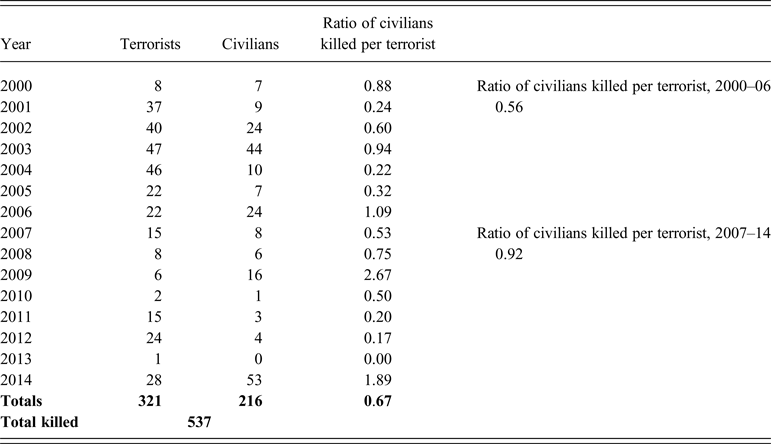
The main reason for this is that until 19 January 2009, B'Tselem recorded some cases in the variable of ‘took part in hostilities’ as ‘object of a targeted killing’ rather than a simple ‘yes’ or ‘no’ (none was ever classified as an ‘unknown’).Footnote 112 These constituted 43.5 per cent (234 out of 537) of the recorded fatalities.Footnote 113 Yet in these cases there is no definitive indication of whether the persons participated in hostilities – only that they were the object of the attack. Moreover, we were unable to find any explanation by either B'Tselem or any other source to explain this classification. Accordingly, for the purposes of discerning between terrorists and civilians, we categorised all of the individuals B'Tselem registered as members of armed groups as terrorists and the rest as civilians until 19 January 2009. Afterwards, as B'Tselem stopped using the ‘object of a targeted killing’ classification and clearly classified individuals as either ‘yes’ or ‘no’ under the ‘took part in the hostilities’ variable, then whoever B'Tselem classified with a ‘no’ was considered a civilian, and those classified as ‘yes’ were categorised as terrorists for the calculations in this article.Footnote 114 We suggest that the results, in Table 1, provide a rough indicator of how the proportions of terrorists and civilians killed in Israeli targeted killings have evolved over time.
B'Tselem Data on 2000–14 Israeli Targeted Killings Distinguishing Terrorists and Civilians
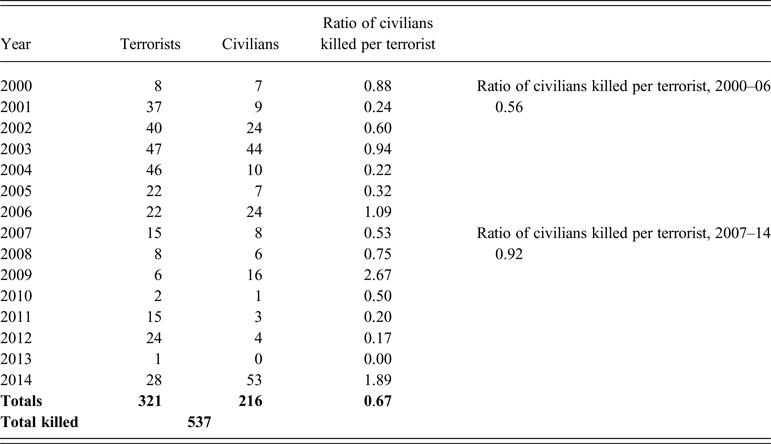
These results raise two major concerns about Israeli efforts to reduce civilian fatalities resulting from targeted killings. First, while Israeli efforts to reduce the real number of civilian casualties seem to be bearing fruit (falling from 125 in total and 17.9 per year between 2000 and the HCJ decision at the end of 2006, to 91 in total and 11.4 per year from 2007 to the end of 2014), the proportion of civilians killed per terrorist has actually risen (increasing from 0.56 before the HCJ decision to 0.92 afterwards). This is even more troubling considering the fact that B'Tselem recorded 130 operations in 2000–06 and only 59 operations in 2007–14.Footnote 115 The drops in total civilians killed therefore are to be expected and the rise in the proportion is even more puzzling in the face of seemingly greater selectivity in conducting targeted killings. Second, the ratio of civilian deaths is also relatively high when compared with some comparable programmes. Specifically, the average 2000–14 ratio of civilians killed per terrorist killed is 0.67 and the real number was 216. By comparison, US drone strikes in Pakistan, Yemen and Somalia since 2001 may be as high as 0.26 civilians killed per terrorist, according to the Bureau of Investigative Journalism (TBIJ), although the total number of civilians who may have been killed is also much higher at 1,252.Footnote 116
A number of possible reasons can be suggested to explain why the ratio of civilian fatalities has actually risen following the HCJ decision, some of which are also salient when comparing the Israeli and US ratios. These reasons may help to reconcile these statistical outcomes with the reports of Israeli efforts to reduce civilian casualties. An outstanding consideration here is the Israeli withdrawal of ground forces from the Gaza Strip in September 2005 and the subsequent concentration of Israeli targeting in that densely populated area.Footnote 117 Correspondingly, the munitions used to perform targeted killings changed from ground forces firing bullets to aircraft firing missiles. This explanation comports well with the sharp jump in the ratio that Table 1 shows in 2006 (from 0.32 to 1.09), for example. The differences in the density of the population is also a relevant factor when juxtaposing the Israeli and US ratios, with Israel operating in significantly more densely populated areas.Footnote 118
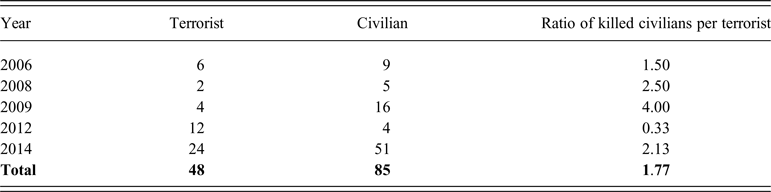
Moreover, the striking rise in the ratio in 2008–09 (0.75 to 2.67) suggests a further explanation – that is, that the jumps in civilian fatalities correlate with the Israeli military campaigns in Gaza since 2005. These include Operation Summer Rains in 2006, Operation Hot Winter in 2008, Operation Cast Lead in 2008–09, Operation Pillar of Defence in 2012, and Operation Protective Edge in 2014, during which Israel undertook particularly aggressive targeting of terrorists in the Gaza Strip. This causal explanation finds very strong statistical support if targeted killings during these military campaigns are distinguished from the remainder.
There are two key takeaways from Table 2. The first is that it appears that the pace of targeted killing operations is elevated during these relatively brief periods of military campaigns. Operation Protective Edge, for example, lasted for 51 days in 2014 during which time 75 people were killed in targeted killing attacks, whereas during the remainder of the year only six people were killed. Similarly, 16 people were killed in targeted killings during Operation Pillar of Defense, which lasted for only one week, while only 12 people were killed during the remainder of the year. Again, 20 people were killed by targeted killings during Operation Cast Lead, which lasted for 22 days, and only two were killed during the rest of 2009.
Targeted Killings during Military Campaigns in Gaza Strip, 2005–14
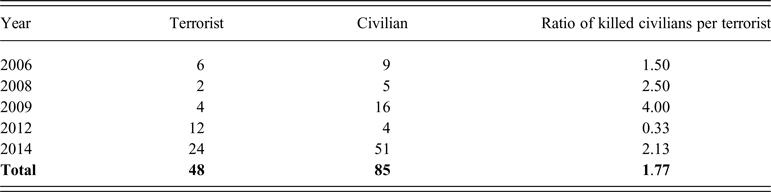
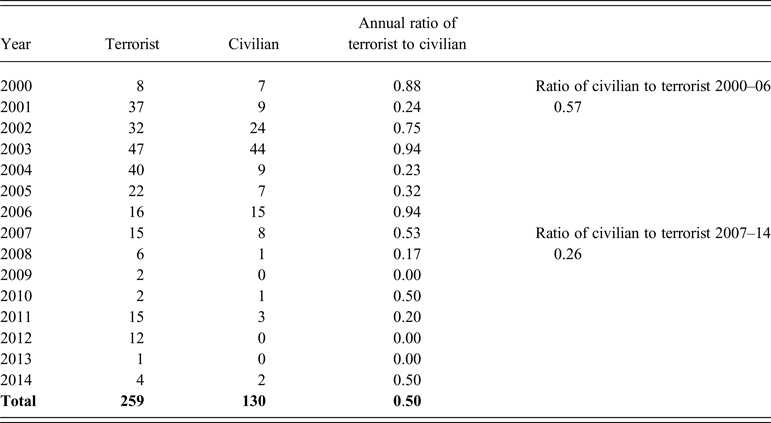
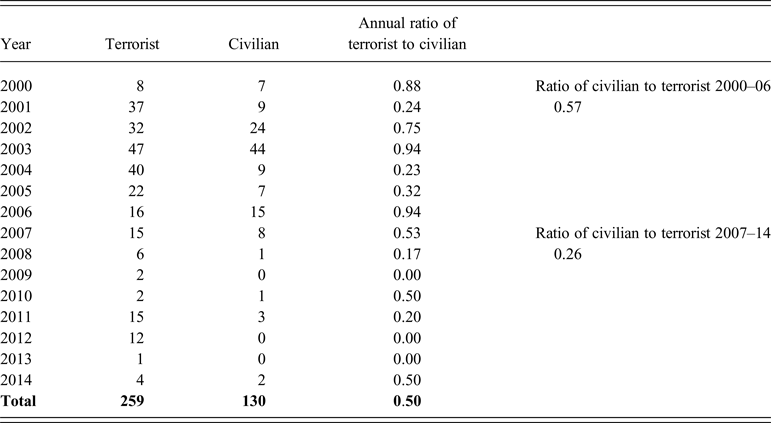
The second takeaway from Table 2 is that these accelerated operations resulted in a relatively high ratio of civilian fatalities at 1.77 per terrorist killed, in contrast to the overall average ratio of 0.67. This 1.77:1 ratio is notably high in comparison with the rate that Israel has achieved outside military campaigns (see Table 3) or that the United States has achieved with its drone strikes in Pakistan, Yemen and Somalia. Correspondingly, both the total and proportion of civilian casualties resulting from Israeli targeted killings outside military campaigns have been lower than the average for the 2000–14 period. Table 3 shows that since 2000 Israel's targeted killing operations outside military campaigns have resulted in an average rate of 0.5 civilian deaths for each terrorist killed – less than one third of the rate for targeted killings during military campaigns (1.77). Moreover, Table 3 shows a sharp drop in the ratio of civilian to terrorist casualties after the Targeted Killing case, falling from 0.57:1 in the pre-judgment period to a ratio of 0.26:1 thereafter. It is especially striking how much lower the 2000–14 rate is than the comparable number during military campaigns (0.26 versus 1.77).
Terrorist and Civilian Fatalities resulting from 2000–14 Israeli Targeted Killings, Excluding Those Occurring during Military Campaigns
Unfortunately, the frequency of military campaigns and the accelerated rate of targeted killings during these periods has been sufficient to obscure the statistical improvement that Israel has achieved in its targeted killings outside such campaigns. Still, if the civilian casualty ratios of Israeli targeted killings inside and outside military campaigns are compared with estimates from other armed conflicts of the late twentieth and early twenty-first centuries, the former appears to be well within the recorded range, and the latter distinctly towards the low end. For example, the Israeli targeted killing ratio of civilians killed per terrorist (0.67:1 overall) is at the very low end of the general estimates for civilian casualties in conflicts in the 1990s (which range from 0.5:1 to 8:1).Footnote 119 It is one seventh of the civilian fatality rate (5.19:1) for the Iraq War (2003–11).Footnote 120 It is also lower than the 0.92:1 rate recorded in the Afghanistan War (October 2001 to October 2018).Footnote 121 In fact, it is only the US drone campaigns in Pakistan, Yemen and Somalia that look more precise.
However, much of the difference with the US drone campaigns disappears when one compares them with Israeli strikes outside military campaigns – that is, the types of targeted killing that are most analogous to the US strikes (as they are undertaken generally in the absence of major ground operations and/or sustained bombing campaigns). In these cases the casualty ratio from Israeli strikes drops to 0.5:1, and fell noticeably after the Targeted Killing case to 0.26:1. This post-2006 ratio equals the high-end estimate (from TBIJ) for the ratio achieved by the US drone campaign (0.26:1). Evidently this is a higher level of precision than achieved in the other conflicts or periods noted in the previous paragraph, and gives additional credibility to the claims of Israeli officials to have worked hard to ensure that the proportionality requirements of the Targeted Killing case are met.
However, there remains the troubling issue of the strikes undertaken in the context of military campaigns, which exhibit a strikingly higher civilian casualty rate. This may be caused by any number of factors, from trying to aggressively take out rocket launchers which are often set up in proximity to civilians, to a higher pace of operations, to some operations involving force protection or close air support, to reduced military assets available, to the acceptance of a higher rate of civilian casualties in pursuit of especially urgent military goals. Whatever the reason, it does seem clear that Israel is unable to maintain consistently the same precision while undertaking military campaigns that it otherwise demonstrates. This may suggest that the more Israeli leaders see the situation as one of active conflict (rather than low-intensity conflict), the more difficulty they have in maintaining high levels of precision. As we show later in this article, this concern compounds worries that arise over a shift in Israeli policy towards treating Gazan terrorists as members of organised armed groups rather than civilians participating in hostilities.
In sum, there is extensive testimonial evidence from Israeli (ex-)officials of the care devoted both to compliance with the proportionality principle and, more generally, the minimisation of civilian casualties both in the planning and conduct of targeting operations. These accounts are strongly corroborated by a number of independent studies and by detailed accounts in the press. Finally, a careful examination of B'Tselem's database produced more mixed results. On the one hand, it did confirm that Israel has reduced the ratio of civilians to terrorists killed during strikes outside military campaigns to levels comparable with the most precise military campaigns waged in recent decades. On the other hand, the data shows that the ratio of civilians to terrorists killed rose to considerably higher levels for targeted killings during military campaigns, and as a result of the number of such operations in the 2007–14 period, the overall ratio rose slightly during that period in comparison with the earlier period. However, there are also reasons to think that these strikes were undertaken in significantly more challenging conditions. Moreover, the resulting ratio remains at the lower end of comparable armed conflicts, and is significantly exceeded only by the US drone campaigns in Pakistan, Yemen and Somalia (the only other officially – or at least semi-officially – acknowledged targeted killing campaign). This suggests that Israel has sustained on average a relatively high level of precision. On this basis we conclude that the Israeli government has made considerable efforts to comply with the requirement of proportionality, although the available evidence is insufficiently complete to assess individual operations. Nonetheless, one area of concern that warrants continued attention is the ratio of civilian casualties resulting from targeted killings conducted during military campaigns.
3.4. Compliance with Requirement 4: Pre-targeted Killing Examination
As described throughout the third section of this article, pre-targeted killing examinations are conducted to ensure compliance with requirements 1, 2 and 3. Therefore, the state appears to implement this requirement.
3.5. Compliance with Safeguard 1: Ex Post Facto Targeted Killing Investigative Committee
Our findings are complex with regard to the implementation of and compliance with the requirement to establish an ex post facto targeted killing investigative committee. In this subsection we first present the findings relating to the establishment of the committee. We focus on the characteristics that the HCJ required of the committee: to be independent and objective.Footnote 122 In essence, we find evidence that while its establishment was delayed, it now exists, at least on paper. Based on what has been reported, the composition of the committee seems plausible but its degree of independence may be insufficient, which only exacerbates concerns about its objectivity. We then present our findings with regard to Israel's compliance with this safeguard. The available evidence raises concerns about whether the government has given the committee the jurisdictional scope that the HCJ intended. These concerns emanate from two landmark points of evolution in post-2006 Israeli legal interpretation regarding the legal status of targeted individuals, which have significantly decreased the applicability of the Targeted Killing case.
To begin with, there is evidence that Israel did not move quickly to establish the ex post facto review committee. In 2008, Aviad Glickman, law correspondent for Ynet, exposed an exchange of correspondence between Menachem Mazuz, the then Attorney General, and Ehud Olmert, the then PM, regarding delay in the establishment of the ex post facto targeted killing investigative committee. It appears that Mazuz had to call on Olmert repeatedly to establish a permanent investigative committee.Footnote 123 This foot-dragging is not to be confused with the ad hoc commission that Olmert established on 23 January 2008 (under considerable public pressure) to review the targeted killing of Salah Shehade.Footnote 124 Several meetings and discussions regarding the permanent review committee took place in the months after the ruling was delivered, yet the committee seems not to have begun working at the time of Glickman's publication, which was nearly two years after delivery of the HCJ verdict. If the letter is to be believed, Olmert was responsible for the delay, as he had yet to appoint the members of the ex post facto committee.Footnote 125
However, as a part of Haas’ petition in November 2010 in HCJ 8707/10, the state's representative announced that ‘a committee was recently appointed to examine cases of targeted killings during which innocent civilians were harmed, as ordered by the HCJ's Targeted killing case’ (in Hebrew).Footnote 126 Moreover, in his letter to the Turkel Commission in April 2011, the then Deputy State Attorney, Shay Nitzan, wrote that the established committee resembled the ad hoc commission on the targeted killing of Salah Shehade. He added that a former judge chaired the committee, and that it had the authority to review the conduct of the security services as well as of the political echelon.Footnote 127
A more recent publication provided additional evidence regarding the resemblance of the composition of the ex post facto investigative committee and the ad hoc commission. In 2014, senior Ha'aretz journalist, Amir Oren, quoted the response he received from the Ministry of Defence to his question regarding the members who compose the investigative committee. The state's response was: ‘A committee was set up headed by a former president of a magistrate's court and among its members are a senior expert in international law, a former member of the [ISA] and a reserve General’.Footnote 128 The ILD attested that ‘the committee's staffing reflects the need for its members to be both independent and to possess legal and operational expertise’.Footnote 129
Based upon a further case, HCJ 8794/03, the ILD does seem to have a solid basis for the claim that the composition of the ex post facto committee satisfies the standards imposed on it.Footnote 130 In February 2008 the state announced to the HCJ the identity of the three members comprising the Salah Shehade inquiry commission: the chair was Res. Brigadier General Zvi Inbar (former Legal Adviser to the Knesset and former MAG); Res. Major General Izhak Eitan (former Chief of IDF Central Command); and Mr Izhak Dar (former Head of the ISA Operations Directorate). Shortly afterwards, the petitioners contested the appointment of those members. It was argued that their ability to be objective was doubtful as they were all ex-security officials. The petitioners claimed that a judge or a public representative must be a part of the inquiry commission. However, the justices rejected the petitioners’ argument, finding no flaw in the composition of the commission.Footnote 131 So, in essence, the HCJ approved a targeted killing inquiry composed of three ex-security personnel who were very similar to the members of the permanent review committee. On top of that, a retired justice chairs the review committee; thus it appears that its composition would even have satisfied the petitioners in HCJ 8794/03.
Nevertheless, Nitzan wrote with good reason that the ex post facto investigative committee resembled – as opposed to being exactly like – the ad hoc Salah Shehade inquiry commission.Footnote 132 The main reason was not the specific members appointed to it, but that the inquiry commission was an external independent commission.Footnote 133 In his letter, however, Nitzan wrote clearly that it was decided that the ex post facto investigative committee would not be an external committee. This decision was made after the Government Attorney, the Ministry of Justice and the MAG consulted over this matter.Footnote 134 They decided that in the case of the ex post facto investigative committee, what the state called ‘functional independence’ would be sufficient, as opposed to the ‘institutional independence’ which characterised the Shehade commission.Footnote 135 In other words, the type of independence required of the permanent committee was less demanding than that of the commission on Salah Shehade's targeted killing.
The precise meaning of these terms ‘institutional independence’ and ‘functional independence’ requires further explanation. In December 2010, Mandelblit submitted the IDF's second position paper to the Turkel Commission, arguing that according to the Court's ruling the investigative committee was not required to be of institutional independence but only of functional independence. He explained that this meant that the committee can be within the same institution that conducts the targeted killing, provided that it has appropriate expertise and latitude to formulate its own conclusions.Footnote 136 However, no further information was given to suggest that the investigative committee indeed has this ‘functional’ independence. Consequently, it was not without reason that Professors Cohen and Shany argued that ‘in fact, the MAG's position paper … demonstrates the state's attempt to evade its duty to investigate cases of civilians’ deaths in targeted killings, in external commissions of inquiry’ (in Hebrew).Footnote 137
To sum up, it is unclear whether the Court's requirement that the ex post facto targeted killing investigative committee be independent and objective is being met fully.Footnote 138 Although there are a number of documents which suggest that the committee has been formed and which provide indications of what its composition might look like, evidence to establish unequivocally its independence is lacking. The official statements on this question, particularly concerning the distinction introduced between ‘institutional’ and ‘functional’ independence, cause concern. This is all the more disturbing as the PM appoints the members of the committee who are later expected also to review the PM's own decision making, along with that of the other decision makers.Footnote 139 Nevertheless, if the composition of the committee is truly as reported, then it suggests that the committee possesses the professional capability to conduct a thorough review of the operations. This is, of course, essential in order for the committee to be able to review state conduct in an independent manner, without over-reliance on the state's personnel to advise it. Hence, if the committee has the expertise claimed, it does provide partial support for Mandelblit's argument for functional independence. The question that still needs to be addressed is whether the committee has sufficient latitude to exercise genuine independence, or whether being established within the very institution that it is intended to oversee subjects it to influence and pressure, which undermines its purpose as a safeguard. More information than is publicly available at the moment is required in order to answer this question, but what does seem clear is that the appearance is problematic, and that this is exacerbated by secrecy. This also raises questions about the motive Israeli leaders may have in pursuing this course.
Given the paucity of data on the organisation of the ex post facto committee, the best means to dig deeper may be to examine what is known of its activity. Again, the results are inconclusive, but troubling. One reason that the findings are inconclusive is that we cannot be certain whether we are aware of all of the committee's proceedings, or even of all of the operations with which the committee might be concerned. It is entirely possible, for example, that targeted killings have been performed in the West Bank but are unknown to the public. This might particularly be the case where Israel offers the explanation that its intent had been to arrest a civilian who was directly participating in hostilities but where it also authorised targeted killing should the arrest prove impractical. It is known, based on Blau's exposure of classified documents, that Israel does include such operations among those that the investigative committee may need to review. This is based on the fact that both Ashkenazi and Turgeman explicitly referred to arrangements being made so that the investigative committee would examine Malaisha's targeted killing if it proved necessary to do so.Footnote 140
Nonetheless, there are reasons to be concerned about the way in which Israel has defined the jurisdiction of the committee. While Mandelblit clearly stated in his December 2010 IDF position paper that the investigative committee began to examine targeted killings that occurred after delivery of the HCJ's ruling, he also clearly indicated that it did not review all cases. Indeed, he helpfully clarified which targeted killing cases are and are not investigated by the committee. In particular, he specified that it does not investigate targeted killings in which innocent civilians were not harmed. Additionally, he added that the committee reviews targeted killings only of individuals whose status was of a ‘civilian taking a direct part in hostilities’, as the Targeted Killing case exclusively relates to the targeting of these individuals. Importantly, he noted that Hamas terrorists within the Gaza Strip do not have this legal status; therefore, the committee does not review such killings.Footnote 141 However, while the former justification for not reviewing targeted killings is based on the HCJ's own clarifications in 2007 in Haas (HCJ 8794/03),Footnote 142 the latter proviso does raise questions about the committee's jurisdiction, and even raises doubts about whether the committee has ever been activated.Footnote 143
While it is outside the scope of this article to assess Israel's determination of the legal status of potential targets, it must nonetheless be acknowledged that the wholesale exclusion of members of Hamas armed forces from ex post facto review would greatly reduce the scope of this key safeguard. It is therefore worth examining how the Israeli government came to espouse this position and what its effect is on how the HCJ's Targeted Killing decision is applied. Thus, this article briefly reviews two landmark points of the post-2006 evolution of Israeli targeting practices. These changes express Israel's position on whether the HCJ's ruling was applicable to certain targeted killings that it performed. These positions, of course, directly influenced whether or not the ex post facto investigative committee was activated.
Since December 2006, when the HCJ delivered its ruling, two milestone points of evolution in Israeli targeting practices have occurred. The first milestone point occurred when Israel determined that members of Hamas armed forces – members of the organisation's branches which directly participate in hostilities – have the legal status of combatant for targeting practices.Footnote 144 This position was based on Hamas’ violent coup in June 2007, displacing the previous Palestinian Authority rule within the Gaza Strip. As Hamas established independent military and administrative control of Gaza, it shifted in the eyes of the Israeli government from being a militant-social organisation to a state-like entity. At the same time, it went through a significant process of intensified militarisation (in terms of weaponry, organisational structure, and the like) towards something akin to an army. For example, it used its power as the administrative authority to annex the Gazan internal security forces (such as the police) as additional forces which were to participate in the hostilities against Israel during a ground conflict.Footnote 145 Documents concerning Operation Pillar of Defense, which took place in November 2012, corroborate Mandelblit's description of this approach, as Israel continued to maintain that members of Hamas armed forces in Gaza had the legal status of combatant for targeting purposes.Footnote 146 Consequently, their targeting was not subject to the conditions outlined in the Targeted Killing case.
The second milestone in the evolution of Israeli targeting practices had even more extensive significance; it extended the change to the legal status of members of Hamas armed forces to members of other Gazan terrorist organisations. The first evidence for this milestone appears in Israel's official report covering Operation Protective Edge, the Gaza military campaign which began on 7 July 2014. By then Israel had adopted the approach found in the International Committee of the Red Cross ‘Interpretative Guidance for the Notion of Direct Participation in Hostilities under International Humanitarian Law’ towards ‘members of organized armed groups’ (OAG).Footnote 147 The key point here is the underlying legal logic and its implications that according to the interpretative guidance, members of an OAG do not hold civilian status, and are effectively treated as combatants for targeting purposes.Footnote 148 According to the report:Footnote 149
In determining whether a particular entity constitutes an organised armed group for targeting purposes, the IDF relies on comprehensive, timely intelligence assessments (which are reviewed and updated as necessary) and consultations with military lawyers as well as with the highest military echelons. Such determinations have been subject to oversight by Israel's highest legal echelons, including the Ministry of Justice.
The Palestinian Islamic Jihad (PIJ) was then given as an example of an entity recognised as an OAG and, accordingly, the IDF targeted and killed PIJ operatives without having to meet the conditions and safeguards outlined in the Targeted Killing case.Footnote 150
In essence, then, Israel's evolving view, which subsumes members of Hamas armed forces and members of other terrorist organisations under the same legal status, appears to have had the effect of drastically shrinking the scope of the Targeted Killing judgment. This conclusion seems ineluctable considering the underlying legal logic described in Mandelblit's December 2010 position paper, which contends that the HCJ's ruling was concerned only with individuals whose legal status was civilian, and consequently it does not apply to individuals whose status for targeting practices is not civilian. The implication is that Israel no longer sees the framework of the Targeted Killing case as applicable for the targeted killing of individuals whose legal status was as members of an OAG and therefore not civilian. Thus, initially, the HCJ's ruling ceased to apply to those members of Hamas who were designated as having combatant status for targeting purposes,Footnote 151 and later ceased to apply also to the members of other Gazan terrorist organisations classified with the legal status of OAG.Footnote 152
In this way Israel ceased to treat the Targeted Killing case as applicable to those terrorists whose legal status were as members of an OAG, even as it expanded the scope of those designated with this legal status to cover the vast majority of those whom it sought to target and kill. For instance, all of the targeted killing cases recorded by B'Tselem since 2006 have occurred in the Gaza Strip.Footnote 153 This means that none of the legal requirements or safeguards laid out in the Targeted Killing case (such as giving preference to capture where possible) would apply to the targeting of such individuals.Footnote 154 Correspondingly, even if innocent civilians were killed as a result of a targeted killing operation, the ex post facto investigative committee need not be activated. That seems to continue to be the case for contemporary Israeli targeted killings.Footnote 155
This shift in the Israeli government's treatment of those in the armed forces of terrorist organisations also compounds concerns raised in the foregoing section on proportionality. One of the most striking facts that emerged from a review of Israel's performance in conducting targeted killings was how much higher the ratio of civilian casualties was during periods of military campaigns. In the course of such times, Israel ratcheted up the pace of targeted killings, going after targets more aggressively, which resulted in more than tripling the ratio of civilian casualties. The concern then is that, as Israel changes its view of its targets from civilians directly participating in hostilities to members of OAGs, it might be tempted also to adopt the more aggressive targeting posture characteristic of military campaigns rather than the more careful practice that has characterised the periods between such campaigns. This concern is all the greater if oversight is relatively weak. The narrower the jurisdiction of the oversight body, the greater these concerns will be.
Nevertheless, it is possible to address the question of whether the ex post facto investigative committee should have been activated to review specific targeted killing operations. Although it is unknown when exactly between 21 November 2012 (Operation Pillar of Defense) and 7 July 2014 (Operation Protective Edge) Israel adopted this new legal perspective, there were still periods of time in which specific targeted killing should have activated the investigative committee. Bearing in mind that ex post facto review should have been triggered by any targeted killing against a civilian directly participating in hostilities that harmed innocent civilians, such contexts included (i) the targeted killing of any terrorist, including Hamas members, between December 2006 and June 2007; and (ii) the targeted killing of any terrorist who was not a member of Hamas armed forces from June 2007 until Israel adopted the legal perspective of treating militants of other groups as OAG members (the last certain date would be 21 November 2012, the last day of Operation Pillar of Defense).
There were targeted killing operations which should have activated the review process of the ex post facto investigative committee. For example, during the first timeframe described – December 2006 to June 2007 – there was at least one targeted killing operation which should probably have triggered the committee's review. That was the 20 May 2007 targeted killing of Sameh Farwaneh, which resulted in the killing of two Hamas terrorists and six civilians.Footnote 156 The second timeframe – June 2007 to November 2012 – provides ample relevant cases of targeted killing of non-Hamas armed forces.Footnote 157 For example, an 18 August 2011 targeted operation in Rafah (Gaza Strip) killed five Popular Resistance Committee members and the child of one of them. Among the five terrorists was the head of the group, Kamal Nirab, and the head of the group's military wing, Immad Hamed.Footnote 158 Such a targeted killing, in which an innocent civilian was killed, should have activated the investigative committee.
Nonetheless, no real evidence to date has been found to show that the ex post facto investigative committee has actually examined any targeted killing operation. There is silence regarding its activity. This may suggest that the committee is either not active, or is effectively marginalised, or simply that its work is being kept secret. Whatever the case, it provides little assurance to the public that this safeguard is viable. In conclusion, it is currently difficult to determine the level of compliance with the safeguard of an ex post facto targeted killing investigative committee. The available evidence raises serious concerns that Israel has not implemented the ex post facto review as required by the HCJ. If these concerns are justified, then operations such as those described above would be outside the bounds of legality as defined by the Court.
Finally, it should be added that even today the contemporary Israeli legal perspective that sees most targets as OAG members does not render the framework of the Targeted Killing case entirely obsolete. This is particularly the case regarding hybrid terrorist organisations (consisting of military and non-military wings).Footnote 159 In order to illustrate this, consider the following passage from the Operation Protective Edge report:Footnote 160
The IDF did not target Hamas lawmakers, politicians or law enforcement officials because of their affiliation with Hamas. The IDF recognises that civilians affiliated with Hamas are not lawful targets as [members of an OAG simply because of their affiliation]. In cases where the IDF targeted persons holding positions in Hamas, it did so based on reliable intelligence that the individuals had become lawful targets … by directly participating in hostilities (e.g., planning and/or commanding attacks against Israeli civilians or soldiers) or by serving as members of organised armed groups.
Since the IDF recognises Hamas as a hybrid terrorist organisation, it assigns different legal statuses for targeting purposes to different members of Hamas. For example, at the time of this writing, Yahya Sinwar is the leader of Hamas.Footnote 161 As a politician, he is of civilian status for targeting purposes, but, as previously shown, an individual who gives orders regarding military activities may be considered as one who directly participates in hostilities.Footnote 162 The IDF sees such an individual as a ‘lawful target when that individual's duties include command and control of the military wing's activities; the fact that the individual also leads the civilian activities of the group does not affect this determination’.Footnote 163 As a result, a targeted killing on such an individual would be directed at a ‘civilian taking a direct part in hostilities’. In turn, the Targeted Killing case would apply and, in the case of collateral damage, the ex post facto investigative committee should be activated. So, while the evolution of Israeli targeting practices has significantly marginalised the applicability of the ruling, it has not rendered it obsolete.
3.6. Compliance with Safeguard 2: Post-2006 Judicial Review
There is no publicly available evidence to show that the HCJ has reviewed any decision of the ex post facto targeted killing investigative committee.Footnote 164 Moreover, as of December 2011 the Court's statements led Cohen and Shany to believe that if a petitioner wishes the HCJ to review a specific decision reached by the committee or the MAG regarding a particular targeted killing, that petitioner would need to bring new concrete information or evidence that would lead the Court to entertain doubts as to the decisions made.Footnote 165 Additionally, in order to make things as clear as possible, it should be emphasised that the HCJ did not review the decision of the investigative committee in HCJ 8707/10, but the MAG's decision.Footnote 166 It therefore differs from the judicial review safeguard set out in the Targeted Killing case. The reason for this is that, according to the HCJ's ruling, the Court's review will examine the legality of the targeted killing operation via the work and the decision made by the ex post facto investigative committee,Footnote 167 not the MAG. So while HCJ 8707/10 serves as the closest case of activation of the judicial review safeguard, it should be recalled, as previously mentioned, that it was only during the discussion of this case that Israel finally established a permanent ex post facto investigative committee.Footnote 168
4. Conclusion
In 2006 the Israeli High Court of Justice delivered its ruling in the Targeted Killing case. The HCJ set out four requirements and two safeguards by which the state must abide in targeted killings that it conducts under its targeted killing policy in order to perform these in a lawful manner.Footnote 169 This article presents findings on Israel's implementation of and compliance with the Court's ruling. It points to evidence which suggests that Israel has complied with the four requirements, although an unequivocal determination certainly cannot be made with regard to the proportionality requirement, especially during military campaigns. However, the extent to which Israel implements safeguard 1, the ex post facto targeted killing investigative committee, remains unclear. In particular, the committee's composition has yet to be verified, and there are concerns regarding its ability to operate objectively and independently. In addition, the two landmark points of evolution in Israeli post-2006 targeting practices have significantly marginalised the applicability of the HCJ's ruling. Yet, as explained above, there are still circumstances (albeit narrow) under which the HCJ framework continues to apply and bind the State of Israel. Finally, there is no publicly available evidence that the second safeguard of judicial oversight over post-2006 targeted killings has actually occurred. Therefore, despite some tangible gestures towards implementation, state compliance with the Targeted Killing case remains uncertain, especially with regard to the ex post facto targeted killing investigative committee.