The current situation for environmental education is certainly critical. Human civilisation, dependent for 12,000 years (Waters et al., Reference Waters, Zalasiewicz, Summerhayes, Barnosky, Poirier, Gałuszka and Wolfe2016) on the relatively stable environmental conditions of the Holocene, is set to undergo radical transformation due to the change in the climate that it has been produced by human action. Climate change, named as the Anthropocene, is set to see global climatic changes that could make humans become extinct, and has already begun a sixth great extinction event (Colebrook, Reference Colebrook2013). The question that confronts those of us who are interested in environmental education is: What can we do to have any effect on this global situation? The new materialisms and posthumanism certainly present exciting options for educationalists interested in exploring this field (Payne, Reference Payne2016); however, by extinguishing humans from the field of inquiry, new materialism and posthumanism can be counter-productive in terms of opposing and working against the negative effects of climate change through education. It is suggested in this article that a Deleuzian philosophy, from which it could be argued that the new materialisms and posthuman spring (Cole, Reference Cole2019a), has a good chance of working effectively as a philosophical backdrop to environmental education in the conditions of the Anthropocene.
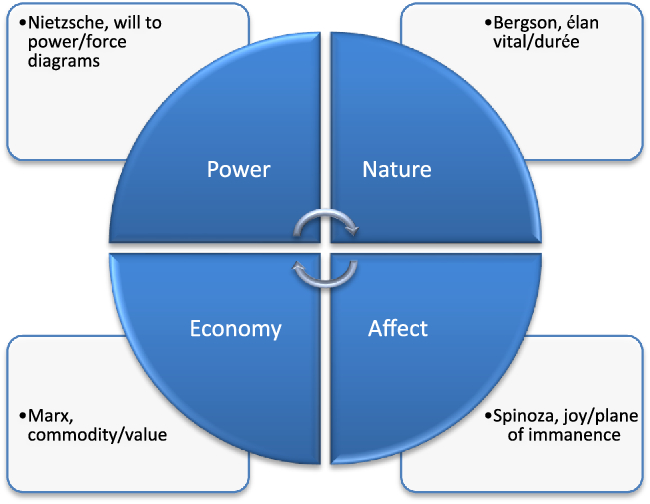
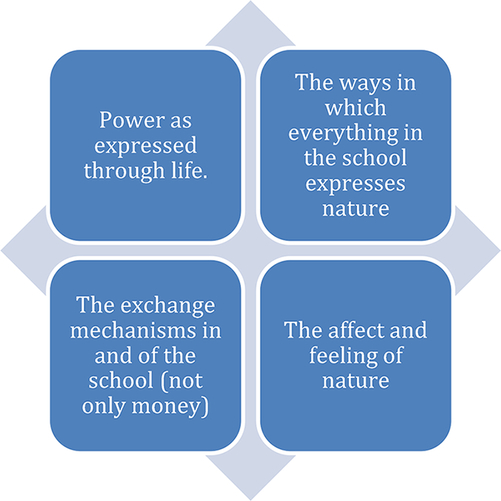
This is because the educational life-forms (Cole, Reference Cole2011) that this philosophy alludes to directly work with human attributes such as power, exchange and affect, as well as everything non-human (Figure 2). While Deleuzian philosophy can be characterised as being unnecessarily complex (Cole, Reference Cole2011), it is hoped that in and through this article, some of this complexity may be unravelled with respect to the acts of teaching and learning about the environment. One of the many reasons for this complexity is that Deleuze developed an approach through his writing that has been called ‘immanent materialism’ (Cole, Reference Cole2012). This means that it combines the emancipatory aspects of materialist critique, while extending this critique to nature in terms of immanence. In so doing, Deleuze creates a space for emancipation, while attending to the complexities and sensitivities of nature (Figures 1 and 2). The intellectual aspects of Deleuze’s synthesis translate to an environmental education that is immersed in and part of nature, and is able to critique and defend itself against the most pernicious and subtle aspects of capitalism. In effect, this results in the creation of a ‘plane of immanence’, or a space where transcendental distinctions are nullified; from which one can respond to and make progress against the sometimes bewildering ways in which the human psyche may be assailed in and by the contemporary moment. The Deleuzian approach to the environmental includes a strengthening and force to sustain, despite (and in many ways in relation to) the many ways in which the (non-human) environment could be said to be presently exploited, ignored, and in some ways, defeated (Weisman, Reference Weisman2008), and this exploration will be carried forth in terms of the assemblage.
Deleuzian philosophy sketched out as a cartographic approach to environmental education, which is the connection between the four quadrants.

Deleuzian philosophy as applied to environmental education at school.

Environmental Education in Lieu of Capitalism
It is a huge leap to go from the ways in which children are educated at school about and in the environment, to the global economic system called capitalism. At primary school, children play outside in the dirt, make community gardens, and get to draw and write about nature. At secondary school, students are principally involved with intellectual work in the subject areas of geography and biology, and their contact with nature is henceforth limited unless they opt for practical and vocational subjects that see them directly employed in outside environments, and which do not principally lead to higher qualifications (e.g., Birdsall, Reference Birdsall2010). In contrast, capitalism is a global, pan-international system, wherein flows of capital are invested and produced through complicated patterns of surplus and labour. In order for environmental education as it is presently conceived to be able to challenge the hegemony and power of capitalism according to this Deleuzian schema for change (Figures 1 and 2), it must take on characteristics similar to great music:
In order for music to free itself, it will have to pass over to the other side — there where territories tremble, where the structures collapse, where the ethoses get mixed up, where a powerful song of the earth is unleashed, the great ritornelles that transmutes all the airs it carries away and makes return. (Deleuze, Reference Deleuze1998, p. 104)
For this to happen, environmental education has to be transformed from an engagement with nature in the early years of life that gradually rescinds into the learning of abstract knowledge for examinations about nature, to a thoroughgoing encounter with the dynamics of life; including the ways in which life, death, and capitalism are intimately and irresolvably connected. For example, as Reza Negarestani (Reference Negarestani, Bryant, Srnicek and Harman2011) has suggested, after reading Deleuze and Guattari’s Anti-Oedipus (Reference Deleuze and Guattari1984):
Freud’s theory of thanatropic regression [the death drive] has become a recurrent speculative tool in building a double-faced and hence elusive image of capitalism, which despite its adherence to the conservative interests of humans, registers itself as a planetary singularity, which is at once inevitable and disenchantingly emancipating. (p. 183)
This quote gives us an introduction to the ways in which capitalism evades categorisation and has become an involuntary aspect of human behaviour and imagination.
Importantly, capitalism is able to become indiscernibly involved in one’s life, a process that can be signalled through the recognition that capitalism is linked to the death drive. In contrast, for example, to the approaches of social ecology (Curran, Reference Curran1999) and ecosophy (Guattari, Reference Guattari2014) to capitalism and environmental education, which are founded on the connective renewal of life, the Deleuzian approach sketched out here uncovers and questions the centrality of the death drive inherent in capitalism (as disjunction and repetition). This means that the annihilating and exterminating forces in capitalism are part of this Deleuzian schema for change, and not sidelined in a utopic ecological future that will not be realised. This may be uncomfortable news for those practitioners of environmental education used to dressing up the contemporary situation in terms of ‘possible green futures’ (e.g., Saari & Mullen, Reference Saari and Mullen2018), but I believe it is a necessary move, given the gravity of the global environmental situation in the Anthropocene and the sixth great extinction event. In short, it is argued here that environmental education from a Deleuzian perspective should tackle the death drive inherent in capitalism.
Furthermore, and extending the argument of Negarestani (Reference Negarestani, Bryant, Srnicek and Harman2011) above, the realisation of the death drive in and qua capitalism, opens up the field of investigation in terms of exactly what environmental education is, and what it can become. In line with a panpsychic, Whiteheadian reading of a Deleuzian approach to environmental education (Cole & Mirzaei Rafe, Reference Cole and Mirzaei Rafe2017), wherein the death drive of capitalism, as the ultimate freedom of and from human activity, could be read in the very cosmic fabric of the universe; that is, as ‘mind in matter’:
Brassier Reference Brassier(2007) proposes that Freud’s theory of thanatropic regression must be reinscribed on a cosmic level, so that not only the organic dissolves into the inorganic, but the inorganic gains a dissipative or loosening tendency … The ‘cosmological re-inscription of Freud’s account of the death-drive’ unshackles the disenchanting and hence emancipative truth of extinction from capitalism … It is in loosening every index of interiority and deserting their domain of influence that the truth of extinction forces thought to be a speculative imagination for and of the cosmic abyss. (Negarestani, Reference Negarestani, Bryant, Srnicek and Harman2011, p. 189)
However, one may question this cosmic inscription of the death drive in terms of what real effects it could have on capitalism. With respect to environmental education, the investigation into and discovery of the death drive, not only in the ways in which capitalism is hurtling us into and through the sixth great extinction event, but also as part of the universe, to an extent relieves capitalism of it responsibility for this destruction (Payne, Reference Payne2016). Surely we can hold capitalism to account for its non-ecological and extinction-riddled ways? The point here is that capitalism has become so involved in and as part of our natures, that the ‘loosening’ and the ‘matter-mind’ transference of the panpsychic reading of the death drive makes thought possible in this seemingly trapped context (Cole & Mirzaei Rafe, Reference Cole and Mirzaei Rafe2017). For example, capitalism drives a certain agenda towards standardisation, as has been theorised in terms of globalisation, and as the ‘non-place’ (Cole, Reference Cole2019b). In contrast, we might want children to be fully immersed in and understanding their specific places where they live and learn through environmental education. Therefore, to resist the tendency towards the non-place that is inherent within capitalism, we need to deal with how it impacts and subsumes the imaginations of young people, so that the next generation cease to dream of science fictional cities replacing natural/chaotic forms (Saari & Mullen, Reference Saari and Mullen2018). The proposal of this article is that a Deleuzian approach to environmental education enables such a resistance by introducing the freedom to think about the current moment in all its complexities and darkness. The freedom to think through the darkness of the Anthropocene is an especially pointed topic, and it enhances the power and potential of environmental education to cut through in the current moment, as it would be able to see in the dark.
Of course, there is a politics that accompanies this Deleuzian approach to replacing capitalism with environmental education. Likewise, there is a politics to the current environmental situation that is being expressed; for example, through ‘Extinction Rebellion’ and secondary students going on strike to try and force governments to act on climate change. In many ways, the current political situation is so dire that the politics of the past has to be forgotten, and a new way forward must be realised that does not continue with the limited and narrow oscillations between the left and the right, as bound to and by human logic. As Brassier (Reference Brassier, Mackay, Pendrell and Trafford2014) has pointed out:
A hundred years ago, it was the Left that laid claim to the future, whereas the Right wanted to return to or re-establish the past. Now the situation seems to have been reversed, and what’s striking about the kind of abject terror sparked by evocations of ecological catastrophe is that it is politically paralysing. But you cannot have an emancipatory politics rooted in fear, because freedom from fear is the precondition of emancipation. The politics of fear is ultimately the politics of reaction, of self-preservation at all costs. But a species whose only concern is its own perpetuation does not deserve to exist. If the best we can hope for is just our own perpetuation then there is no reason to perpetuate ourselves. (p. 160)
The way forward as proposed by this article is for a thoroughgoing and complete environmental education based on Deleuzian philosophy. This approach circumvents the politics of fear through a deep understanding of the current situation and a questioning of the ways in which capitalism currently takes hold and subverts all thought (to make profit). Rather, environmental education needs to work on all levels to resist capitalism, including that of the death drive and politics, as mentioned above, and as will be drawn out below in terms of the assemblage. This, of course, is not an easy task, and an important part of this project is the reimagining of the social so that it does not oscillate back to the old politics and the stasis of the left and the right under pressure from the repetitions of the death drive of capitalism (Payne, Reference Payne2016). In order to do this, and to establish the fundamental orientation towards the social in this Deleuzian approach to environmental education, one must engage with the notions of utopia, social ecology, and, more generally, the future.
Environmental Education, Deleuze, and the Social
Science fiction and the future are closely aligned with the study of technology and the projections of science. In this article, and through a meshing with Deleuzian philosophy, I would like to suggest that environmental education holds the real key to this future. This key is apparent if we open up the concept, and include in it the elements and synthesis as described and represented above (Figures 1 and 2). The result is a new configuration of environmental education that not only enables students to grapple with and in nature, but also engages with the three other points of the quadrant, that is, affect, economy, and power. The point here is that it is not enough for our children to be made aware of and sensitised by nature, they need to be able to adjust to its natural rhythms, and for that to guide them in terms of affect, the economy, and power (Cole, Reference Cole2011). One might say that embedded in this idea are echoes of Guattari’s (Reference Guattari2014) three ecologies, wherein the environmental precedes but is fully connected to the psychic and the social. It is interesting that Deleuze, while not in disagreement with his great writing partner (as he collaborated so effectively with him), does not extend his analysis to ecology or the ecological, and therefore does not figure connectivity between human society and nature in such a manner. Guattari (Reference Guattari2014) sketches out the real ecological danger in the contemporary moment as a certain aspect of stupefying capitalism (e.g., as in its representations in the media), which has latterly become one with the Anthropocene, while Deleuze is more cautious to name the danger as such. Rather, in Deleuze’s solo works and with Guattari, even though the most perilous and terrifying aspects of capitalism such as its contiguity with the repetitions of the death drive are portrayed (Deleuze & Guattari, Reference Deleuze and Guattari1984), a definite respect and understanding of the natural power that capitalism is able to harness is acknowledged (echoing Marx). This respect aligns itself in a specific way with the social ecology of Bookchin (Reference Bookchin1980), who argued that ‘the very concept of dominating nature stems from the domination of human by human, indeed, of women by men, of the young by their elders, of one ethnic group by another, of society by the state, of the individual by bureaucracy, as well as of one economic class by another’ (p. 76).
Bookchin (Reference Bookchin1980) suggests that we may enable a new respect for nature and society once we have circumvented this dominating aspect or ‘front of power’ and its subsequent differentiation in human nature. Deleuze’s analysis is not so clear-cut, which sets up the divergence between his approach and its application in this paper about environmental education, the social ecology of Bookchin, and the ecosophy of Guattari. Both the social ecology of Bookchin and the ecosophy of Guattari theorise a renewal with and diving into nature as human/non-human (ecological) post-capitalist society; and this assumes that the exploitative, dominating, stupefying, resource-hungry (often male) aspects of capitalism have been effectively neutralised and reversed. Deleuze does not venture such a straightforwardly utopic or radical, social (re)theorisation and consequent social revolution. The closest he gets to mentioning such a move is in Anti Oedipus, where he says with Guattari (Deleuze & Guattari, Reference Deleuze and Guattari1984) that the only way that capitalism will stop is when it has sufficiently ravaged the earth in its relentless search of profit, a process that they called deterritorialisation. In a short essay, Deleuze (Reference Deleuze1992) speaks about the control society, in and through which the mechanism of control, aligned with corporate capitalism, is becoming ever more powerful, dominating and pertinent. Writing in the 1990s, Deleuze (Reference Deleuze1992) was prescient about the ways in which these mechanisms of control, which flow through all social organs such as schools and universities, makes independent thought more and more unlikely. In brief, his position was that corporate capitalism was inventing and spreading a delimitation on thought in line with its cultural mores, making true thinking impossible; a process that one could argue has been perpetuated and accelerated through contemporary digital networks and the frequently mindless organs of social media (e.g., Bradley & Cole, Reference Bradley, Cole, Cole and Bradley2018). In Deleuze’s last published book with Guattari (Deleuze & Guattari, Reference Deleuze and Guattari1994), they return briefly to the topic of utopia, in several places arguing that it is a ‘bad concept’ that should not be used to designate the social (e.g., p. 99), but one that becomes ethically important given the pressures of capitalism. In What is Philosophy? (Deleuze & Guattari, Reference Deleuze and Guattari1994), utopia is associated with a reimagining of the Greek polis and as a potential motivator for a perpetual, immanent revolution, perhaps made all the more likely given the current ‘eco-strophy’ of the Anthropocene as global warming and the anthropomorphic transformation of the climate. Ultimately, Deleuze does not prioritise a complete rethinking of the social as ideal, or posit a fully conceived social utopia, but examines instead the mechanisms and drives which work to snuff out thought.
What does this mean for environmental education? Primarily, one can state that the application of Deleuzian philosophy for environmental education is a sophisticated one. In contrast to simple notions of a green revolution that forecast a green society running on renewable energy tomorrow, the Deleuzian approach acknowledges the ‘road-bumps’ in this wonderful (ideal) clean, and clear picture of the future; these roads bumps are that the fossil fuel resources currently in motion as capital are regulated and controlled as integral parts and drivers of global trade (Newell & Paterson, Reference Newell and Paterson2010). In other words, any change to the established fossil fuel present will not happen without an enormous struggle, and inevitably, violence. This is in contrast to the peace-loving, benign picture of environmental education, with children happily playing and learning in and through nature. The truth of the contemporary moment is that the princes, politicians, business owners and many, many others who directly benefit from the fossil fuel industries and all that they entail will not give it up without a fight. The media spreads news of the fossil fuel elite and their mores, continually defined, (re)defined and exacerbated through global (fossil fuel) capitalism, and this presents what has (perhaps unhelpfully) become the social. But: Does this mean that there is no hope of social change? Does this mean that we should give up, and simply enjoy the benefits of fossil fuel capitalism, as we move inexorably into a superheated, greenhouse, global future? The best we can imagine from a purely Deleuzian perspective is a thought experiment outlined below, that deploys the concept of assemblage from 1000 Plateaus (Deleuze & Guattari, Reference Deleuze and Guattari1988) as environmental education.
Environmental Education as Assemblage
The assemblage from 1000 Plateaus (Deleuze & Guattari, Reference Deleuze and Guattari1988) is a complex, multifaceted concept, that conjoins the different plateaus of the book, which are points in time, wherein intensities may be woven together and (re)invented through planes of immanence. The assemblage does not lend itself to a theory of everything (DeLanda, Reference DeLanda2006), nor does it act as a linking theory between humans and non-humans that eliminates the social as would be the case with actor network theory (ANT) (Latour, Reference Latour2005). Rather, the assemblage is a deliberately non-normative rendering of things and actors, it is a means to experimentally realise the arrangement of things, which in the case of this article is the reality of environmental education in schools. There is, therefore, an assemblage of environmental education that will be specific to every school and consists of:
-
the children of the school, with their particular histories, stories and cultures, including their parental situations, and imagined futures;
-
the teachers, administrators, and other workers in the school with their beliefs, values and personalities;
-
the school itself, with its history, buildings, objects, ethos, presence, past students and future;
-
the natural setting of the school, with all the animals, plants, water, land, climate and their interactions;
-
the current environmental education curriculum and pedagogy, and all that entails, including how it may be changed;
-
the current political situation as it relates to the school and how it could be changed;
-
the current economic situation through which the school is funded and resourced;
-
the articulation of all these factors in environmental education;
-
the reimagining of all these factors in environmental education.
Of course, there are many other factors and aspects of environmental education in schools that constitute the changing, specific and mutable assemblage. The point of the articulation of the assemblage of environmental education, as other researchers have stated, is that it gives a flexible, open, rendered approach to environmental education, which, for example, can work to conjoin the understandings of scientific processes with political, ethical, cultural and social ones (Payne, Reference Payne2016). This is a genuinely interdisciplinary approach to figuring and reinventing the Anthropocene, and one that opens up environmental education to the world stage through its very specificity. Like many others, I wish to find a way forward for environmental education in the current situation that is dominated by fossil fuel capitalism; one that does not repeat the false paths of the past, such as the imagining of false utopias (Frankel, Reference Frankel1987). Some have accused Deleuze of projecting petit bourgeois, elitist, neoliberal protectionist, and/or deliberately obfuscating thought in his rejection of utopia, and in his timidity with respect to transforming the social (e.g., Bookchin, Reference Bookchin1995). I would suggest this is a conscious move on his part, which could help us to explore the real contradictions in thought as Deleuze and Guattari (Reference Deleuze and Guattari1994) do in What is Philosophy?, such as the fact that the desire for a better, greener future society will lead to deep division and war (e.g., over the remaining fossil fuel resources). One may understand the Deleuzian approach to environmental education as being in a similar groove to the words of China Miéville (Reference Miéville2019):
How could there not be those of us for whom the myth that keeps us striving, in full knowledge that we can’t know what will be, in fact whatever, however clamorous, the desperately needed thereafter might be, the yearning that drives us to deploy the insights of words and of the silences therein and beyond, is for the quiet of the deep, of stone, a chorus all speaking that silent underground language, an ultimate abstraction, silence beyond the silent silence as the Gnostics had it, but all heresies aside, for silentium, just to take a breath and hear nothing, for silence itself … (p. 22)
It is against the backdrop of an ‘always on’, 24-hour global capitalism (Crary, Reference Crary2014), largely run by and for the fossil fuel empire, that we pit environmental education from a Deleuzian perspective. To create the opportunity for thought in the midst of this tremendous cacophony is, of course, nearly impossible, requiring the greatest of risks, and the most enormous and almost unsurmountable of challenges. It is only in the full application of a Deleuzian philosophy (Figures 1 and 2) that works on every level from the unconscious, deeply engrained and automatic, to the most highly evolved, rational, and created by the most innovative of human thought, that any answers will emerge. The binding force that knots together the 1000 Plateaus (Deleuze & Guattari, Reference Deleuze and Guattari1988) and all the divergent, mutating and interconnecting assemblages, including that of environmental education, is the rhizome (see Bazzul & Kayumova, Reference Bazzul and Kayumova2016). The rhizome, operationalised through ‘rhizomatics’, is vegetal thought (and not a metaphor). One could therefore ask: How can vegetal thought run through all these assemblages, how can such tubers connect anything? The answer is simple: the rhizome works exactly how a rhizome works, through underground interconnections in the earth, and specifically of a non-human centred kind. It is therefore an unhinging of (human) thought, a crack in standard thought, a sliding away from the agreed-upon conventions that have governed thought in the past; it is a semiotics of the outside (Jickling, Reference Jickling2013). In this sense, environmental education is mixed up and entangled with everything else; for example, any other educational value and practice for teaching and learning in a school. What separates and distinguishes environmental education from other pedagogic moves is that on the continuum of the rhizome, it has the real possibility to become other, to make a space for thought that challenges the human status quo of now. As an assemblage, environmental education has mobility; it slides, creeps, adjusts, it creates new unhuman worlds for seeing, it interprets what the humans are doing with surprise and alacrity. As the potential of a ‘vegetable-untapped-animal’ looking in, environmental education has the power to unleash new through-lines for education that are presently not realised, and are in many ways currently unthinkable. Deleuze (Reference Deleuze1984) gave us a clue how to get there in one of his lectures on the tree versus grass model of the brain from a course given on December 11, 1984:
In other words, sensing the future world is not about a tree that planted in our heads. What we have planted in our heads is grass! And we must live that way! It’s the way we live in relation to our brain.
When I say, ‘lived relation’, I think of the great author: Henry Miller. He has a prodigious gift: he has always lived in his brain as grass does. Very curious, but it is not a metaphor! He saw the inside of his head as filled with grass.
The Americans, the Americans, they have a talent for that! The Americans, it is well known, do not believe in trees. They believe in the prairie! Well, they’ve always experienced what was going on in their heads as something grassy, since one of their greatest poets [Walt Whitman’s Leaves of Grass] since he was the founding poet of America, it was like always like that.
But it’s very curious! So when Miller said to himself, ‘In what form shall I be reborn? (Because he pretended to believe in rebirths [metempsychosis]), he said he would be reborn as a park; I would be reborn as a park.’ There are people who want to be reborn as a blade of grass, and then there are people who want to be reborn as a tree. Well, that’s their business!
But as soon as they say that, it’s because they do not have the same type of synapses! Because if one depended on chemical synapses, the tree-brain is done for!
At most one can hope to attend, even to favour the crossbreeding of the bramble and the bindweed. Which is more beautiful? Or do you prefer the strength of a poplar? Then you will be poplar tree, which is what you are already. Or would you will like to be a crossbreed of the bindweed and the bramble. It’s your choice! But in either case you cannot think in the same manner, huh? But perhaps there will still be ways to understand each other! (online).
Conclusion
The challenge for environmental education from a Deleuzian perspective is a call to think coherently and thoroughly in the current situation in a new way. This, of course, is despite all the marketing, politics, psychic and real violence, and false information about climate change that currently bombards us with and through the normalisation of fossil fuel capitalism and its perpetuation (Newell & Paterson, Reference Newell and Paterson2010). In contrast, the Deleuzian intellectual perspective posits real change through thought (Figures 1 and 2). Some may say that this schema for change is too ephemeral and is crushed every time bulldozers clear land for new road construction, or rainforest is burnt for additional cattle production, or by the continued exploitation of fossil fuels and CO2 release due to the immense profits they make. Some might prefer stronger action, real and specific environmental challenges, protest, and the actual destruction of the fossil fuel empire as a starting point. It is important to note that the Deleuzian perspective is not against such action, it just prioritises the power to think otherwise; or, as Bataille (Reference Bataille2004) has said:
It’s the positive practice of freedom, not the negative struggle against a particular oppression, that has lifted me above a mutilated existence. Each of us learns with bitterness that to struggle for freedom is first of all to alienate ourselves. (p. xxiv, emphasis added)
This power of thought will enable students and teachers in the environmental movement to coordinate their actions through the types of thoughts experiments outlined above, that is, by constructing environmental education as assemblage at their schools. If there is hope in the current situation, it is not through the unrealisable dreams of green utopias, but through a coordination of assemblages that genuinely interlock and resist the present, including the most destructive, power-based, murderous, exploitative, deceptive, and false faces of fossil fuel capitalism.
David R. Cole is the founder of the Institute of Interdisciplinary Research into the Anthropocene: https://iiraorg.com/. David is a philosopher of education and author, having produced over 100 significant publications and 15 books. He believes that the problematics of the Anthropocene can only be approached through collective practice. First, the complex dynamics that are at play need to be understood, and rethought beyond limiting assumptions. Second, this exploration has to be translated to practical action to be followed by communities. David works as an Associate Professor in Education at Western Sydney University, Australia.