Introduction
In 1925, the Archbishops of Canterbury and York were two signatories to the public circular about the formation of the Friends of Oxford's Bodleian Library.Footnote 2 Following the Bodleian's example (and also that of Cambridge's Fitzwilliam Museum, whose Friends had been formed nearly two decades earlier), the English Anglican cathedrals started making their own Friends in 1927–28, when associations at Canterbury, Peterborough, York and Birmingham were established. By the start of World War II, at least 23 more cathedrals had followed suit. Friends in the locality and those farther away became part of a network of supporters. Out of love for the buildings and for altruistic reasons, they pledged their subscriptions and prayer for the mother church of the diocese. In return, Friends were kept in touch with their cathedral through regular newsletters, a process which created a well-informed supporter base.
It has been recognized that the Bodleian and the Fitzwilliam are unusual, for until 1950 it was more common for Friends to be located at heritage sites such as cathedrals and churches.Footnote 3 It is therefore somewhat surprising that researchers in the fields of leisure and marketing who focus on friends and membership organizations in the broad heritage sector (which is deemed to include cathedrals) pay little attention to the historical perspective and, in particular, neglect the early development of the cathedral associations.Footnote 4 Furthermore, whereas there has been an acknowledgement of the substantial contribution of today's Friends in terms of service to cathedralsFootnote 5 and of the substantial source of income now provided to cathedrals by the organizations,Footnote 6 the overall significance of cathedral Friends’ associations both today and in the past has been neglected by empiricists. The results of the historical survey documented here, together with (i) a recent analysis of the characteristics and significance of today's cathedral Friends’ associations as revealed by their publications,Footnote 7 and (ii) an assessment of the role and merits of royal patronage for the associations,Footnote 8 seek to redress the balance.
Method
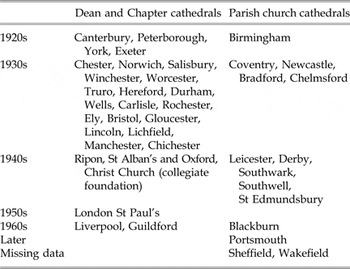
The websites of the 42 Anglican cathedrals in England were surveyed in autumn 2009, and each was found to have a Friends’ association. Publications by and on behalf of the associations were downloaded from cathedral/Friends’ websites and also from the website of the Charity Commission.Footnote 9 Where data were available, the year of each association's establishment was tabulated. If foundation dates were not evident, correspondence with individual cathedrals and Friends’ officers sought to supplement the information in the public domain. Non-responses were followed up on three occasions. As shown in Table 1 later, lack of response eventually resulted in missing data for two associations (5% of the total).
Subsequently, a systematic search was made of The Times newspaper digital archive,Footnote 10 focusing primarily on the 1920s and 1930s (when the majority of the Friends’ associations were formed). The power of newspapers to arouse interest and galvanize the public into cooperative action had been recognized a century earlier by the French theorist de Tocqueville, in his tract on democracy in America.Footnote 11
According to Merrill and Fisher's account of the world's great daily newspapers, ‘[The Times] is much more than a newspaper; it is a national institution’.Footnote 12 It ‘has always been considered the Establishment newspaper, a daily to read to keep up with the affairs of empire’.Footnote 13 As such, The Times has been regarded as the medium for communicating official notices and ecclesiastical news.Footnote 14 For this study, the focus was on both primary and secondary sources: Letters to the Editor, news reports and leading articles about cathedral outreach and the formation of the earliest Friends’ groups (in cathedrals and in prominent institutions in the heritage sector).Footnote 15 For the purposes of this study, it has been assumed that The Times (accessed through its digital archive) is a wholly reliable source of primary documentation (such as Letters). But is it a reliable source of secondary material? Naturally, as Olechnowicz observes, ‘By their nature … newspaper comments, may be deliberately biased, or may be suggestive but “unrepresentative” ’.Footnote 16 Yet, because The Times has been recognized throughout its history ‘for its thoughtful and interpretive articles, for its calm and rational discourses, and for its selective, but thorough news coverage’,Footnote 17 and has been regarded as the paper to read especially for ‘the influential opinion-maker of government, nobility, ruling class’,Footnote 18 there was no reluctance to rely on its accuracy in reportage of the events and opinions.
Analysis and Discussion
The First Friends’ Schemes
The first recorded British museum Friends’ group dates from 1909 at the Fitzwilliam in Cambridge.Footnote 19 The group was inspired by the example of Les Amis du Louvre in Paris,Footnote 20 formed in 1897.Footnote 21 The Fitzwilliam Museum now boasts that, all over the world, institutions (such as cathedrals) are sustained with the financial and practical support of Friends’ organizations like their own.Footnote 22 Rich and influential Cambridge residents were approached to be Friends of the museum, and the Director used the national press to encourage alumni, undergraduates and other visitors to become loyal subscribers.Footnote 23 Around two decades later, Friends’ groups were being formed elsewhere in the heritage sector to acquire materials that would otherwise have been beyond reach. One example is the Bodleian Library in Oxford, which claims that its Friends, founded in 1925, is one of the oldest of its kind.Footnote 24 At the time, the Bodleian was reputed to be by far the poorest of all the great libraries of Europe, with ‘hopelessly inadequate’ resources.Footnote 25 The ten shilling minimum annual subscription, regarded as low, was justified as follows:
Though money is of course wanted, the main purpose is to create a personal tie of interest between the Bodleian and all those, whatever their pecuniary position and whether they be members of the University or not, who have at heart the welfare of humane letters and culture as an essential part of the highest civilisation.Footnote 26
The Friends of the Old Ashmolean in Oxford, formed in 1928, sought from members a minimum annual subscription of only five shillings, in order to create a fund to purchase desirable objects of historic scientific interest.Footnote 27 A year later, the Friends of the National Libraries was established to assist with the acquisition of such treasures as historical documents, early printed books, and correspondence of eminent people.Footnote 28
The State of the Country, the Church of England, and the Cathedrals in the 1920s/30s
The 1920s/30s was a troubled period for the country, for the Church of England and for the cathedrals alike. The country's social problems, the despondency in its people in the inter-war years, and the resulting north/south divide, are captured by two different histories of the Church of England, thus:
No historian will ever be able to write happily about English history between 1919 and 1939, and it would be hard to find any other period of twenty years in which more people were unhappy, or more people also believed that their unhappiness was neither necessary nor of their own making, but due to some betrayal of the powers-that-be, the custodians and vested interests of the old order, or to the indifference of God himself.Footnote 29
The inter-war period was characterised by unremitting high levels of unemployment, child poverty and the collapse of entire communities due to structural decay in staple industries. Coal-mining, shipbuilding, the iron and steel industries and the textile industries suffered especially badly, creating intense regional economic crises accentuated by the Wall Street Crash of 1929. In general … the north and the Midlands fared worse than London and the south.Footnote 30
Describing domestic politics in the 1930s in his history of English Christianity 1920–85, Hastings also highlights the marked differences between north and south. For example, unemployment among insured workers in 1934 was 44.2 per cent in Gateshead, 67.8 per cent in Jarrow, but only 3.9 per cent in St Albans and 3.3 per cent in High Wycombe.Footnote 31 He explains that heavy unemployment in such northern communities was not an invention of the 1930s; however, this time, it ‘certainly lasted longer, was more heavily concentrated in certain areas’ and was accompanied by ‘a new hopelessness as the industries themselves upon which the people depended for the little they had were so clearly decaying’.Footnote 32 He also contends that the hopeful south and hopeless north rarely converged:
The marked improvement in living conditions of the south-east was pointing up more emphatically than ever a difference which had always existed. The one was getting richer, the other still poorer; and the two nations seldom met, except when hunger marches from the north were viewed uneasily as they tramped … through the streets of some southern town. There seemed plenty of hope for the people of High Wycombe in the 1930s, but none at all for those of Jarrow or Gateshead or the mining villages round Bishop Auckland.Footnote 33
Hylson-Smith portrays a Church of England which, in town and countryside, and at national and local levels, was confused and divided: ‘she struggled with a severe identity problem, and she had no vision or great sense of purpose and direction’.Footnote 34 At the turn of that century, the Church of England entered upon ‘forty of the most difficult, exacting, and discouraging years of all her history’.Footnote 35
At this time, cathedrals were remote from the general populace, not least because sixpenny entrance fees served to deter visitors and pilgrims.Footnote 36 In 1925, Dean Bennett of Chester wrote about the iniquity of cathedral entrance fees:
What began as a Family House of prayer for all, has come to be regarded as something very like the special property of a small corporation … it does not strike people as outrageous if the said small corporation charges those to whom the cathedral really belongs, sixpence or a shilling for going round what is their own.Footnote 37
The aloofness of cathedrals and the low standards of their life and worship hitherto were described by the Archbishop of York in a sermon delivered while on an official visit to Chester in 1925:
Little more than fifty years ago [our English cathedrals] might have been described as the lost heritage of the Church of England. … Their bodies, so to say, remained beautiful and imperishable, but the soul seemed to have gone. A strange blight seemed to fill their great spaces, and a smell as of death seemed often to pervade them. … In many dioceses and in many parishes the cathedral is still a place remote and strange. Individuals may enter it sometimes, but it has little place of its own in the corporate life of the Church.Footnote 38
Then, in 1926, the anonymous Editor of Crockford's clerical directory wrote: ‘The Church as a whole is not yet fully alive to the value, actual and potential, of cathedrals’.Footnote 39 Only three years later, the Editor was able to write about the cathedrals in astonishing terms: ‘There is hardly anything more noticeable in the life of the Church than the resurrection – that is not too strong a word to use – of Cathedral Churches’.Footnote 40 This was judged all the more remarkable because so many cathedrals had been hampered by lack of revenue for many years.Footnote 41 So what had happened to dispel the ‘blight’ and promote this change?
A Vision for Cathedrals in the Inter-war Period: Becoming Useful and Lovable
Bennett's Pioneering Work at Chester Cathedral
The cathedrals’ renaissance had two distinct phases, each with a visionary proponent: first, the cathedrals had to be made useful, and second, they had to be made lovable.Footnote 42 BensonFootnote 43 is cited as the pioneer of the modern effort (in the previous century) to think through the role of the cathedral; and BennettFootnote 44 is credited with having the genius to bring a fresh and original mind to the question of a cathedral's purpose in the 1920s.Footnote 45
Chester is recognized as the first to abolish entrance fees.Footnote 46 Four years after Bennett's appointment there as Dean, a journalist provided what has been deemed the best of all the testimonies to his work:Footnote 47
No traveller can enter Chester Cathedral today without feeling at once that it is different from other cathedrals. … If he is used to the ways of English cathedrals, he may even feel a little ill at ease when he can find no notices forbidding him to do this or that, no locked gates, and not a single official demanding 6 d. He begins by wondering whether he has had the bad luck to be an intruder upon a specially invited party, and whether he ought not apologetically to slip out. A very little perseverance will show him that he, too, has been specially invited, and that all day and every day throughout the year the whole cathedral is open and free and his.Footnote 48
A year later, in a landmark book on the nature of cathedrals,Footnote 49 Bennett declared: ‘a cathedral can[not] even begin to do its proper work until it has replaced visitors’ fees with pilgrims’ offerings’. Commending ‘aggressive hospitableness’, he aimed to return cathedrals to the people.
Bennett's pioneering work is described as ‘domesticating a cathedral’.Footnote 50 He transformed Chester from a ‘cold and remote institution’ into a ‘powerhouse of pastoral activity, known and loved by increasingly large numbers of people’.Footnote 51 Chester was rendered interesting by displaying notices that explained the purpose of various parts of the cathedral; and Bennett subsequently had the ruined monastic refectory rebuilt, which encouraged parishes and other organizations to visit the cathedral for some religious purpose.Footnote 52 In a moving and solidly evidenced account of Bennett's vision and influence, Lloyd attributes Bennett's genius to his gifts as a pastor (with a profound interest in people, and no sense of class-consciousness), his flair for the right kind of publicity, and his power to persuade people to give money to the cathedral to support his dreams.Footnote 53
Following the Chester Model: Outreach at other Anglican Cathedrals in England
Lloyd describes Bennett as ‘the greatest Dean of his generation’.Footnote 54 For his part, Beeson asserts that Bennett not only transformed his cathedral but also exerted an enormous influence on cathedral life throughout the country;Footnote 55 while Moorman remarks that Bennett ‘inspired many cathedral chapters to unlock their doors and welcome the stranger’.Footnote 56
The remarkable effect of parallel changes at Salisbury was captured by the author of a cathedrals guide in 1923. Comparing this cathedral with Chichester and Winchester (where the visitor was said to feel like a trespasser), Gostling wrote: ‘at Salisbury all that feeling has been swept away and we are left to stroll about as freely and unconcernedly as though we were in some splendid but rather empty museum’.Footnote 57 The Salisbury Dean subsequently made this observation, published in the second edition of Gostling's cathedrals guide: ‘It is far better to open a house of prayer to all comers … the atmosphere is quite different since we ceased to make a charge for seeing the cathedral: the voluntary offerings are double what we got by sixpences. But the vergers are always ready to show people round without charge’.Footnote 58
Canterbury is another cathedral to follow the Chester model. After his installation at Canterbury in March 1924, one of Dean Bell's first acts was to visit Chester; he wanted to witness for himself what the Dean had achieved there, determined that ‘Canterbury must not lag behind’.Footnote 59 The next year, Bell ‘achieved a cherished desire’ and abolished entrance fees in his own cathedral for an experimental period of two years.Footnote 60 Though small when considered individually, Bell's improvements at Canterbury (for example, positive notices replacing prohibitory ones, a series of penny leaflets on various features, vergers instructed to allow lady sightseers to enter without hats) are said to have been ‘important cumulatively, especially by their psychological effect in welcoming instead of repelling visitors’.Footnote 61 At the end of the two-year experiment, the Chapter decided to make the system permanent.Footnote 62 By that stage, experience at Bristol, Chester, Salisbury and Worcester had shown that visitors made voluntary gifts greater than receipts in fees hitherto.Footnote 63 When Bell was translated to the See of Chichester by the end of that decade, commentators on his appointment remarked upon ‘the charming kindness’ that he showed to Canterbury pilgrimsFootnote 64 and on the ‘marked change in the atmosphere at Canterbury Cathedral’.Footnote 65
In 1926, a Times correspondent told of the Bristol experiment, which illustrates how Bennett's vision was spreading in the south:
On three Sunday afternoons in August, when the regular choir was on holiday and the 3.30 evensong suspended, the Dean and Chapter opened the whole of Bristol Cathedral to visitors. The Dean and the Sub-Dean announced that they would be there to explain the building and to conduct parties round. The response to this invitation was quite remarkable, the numbers beginning with 250 on the first Sunday and rising to double that on the last. Widespread interest in the Cathedral has been aroused … The experiment has been abundantly justified … It has been an object lesson in the growing desire on the part of the public to know more about their cathedrals and their readiness to respond to information and guidance when put within their reach.Footnote 66
Also in the south, St Albans provides an example of a cathedral wishing to follow suit. But it did not find the Chester model easy, as two letters to the Editor of The Times reveal.Footnote 67 A lay person at St Albans wrote:
The exceedingly interesting article … that appeared in the Times of 28 July is a challenge to all cathedrals, but the good example set by Chester cannot be followed easily in all places, as circumstances differ. Here, at St Albans, there is a huge church, for the repair of which provision has fortunately been made, but otherwise scantily endowed and dependent on the parochial church council of a comparatively small parish for the upkeep of its constant services and of a choir … Hitherto a fee of 6 d. has been charged for admission … For some years there has been a widespread desire to abolish this fee and to substitute voluntary offerings, but something over £900 a year is needed to take the place of the “visitors’ fund”, on which the Cathedral is largely dependent. It has now been resolved to suspend the 6 d. fee for a year as an experiment and to appeal to the diocese for a guarantee fund to cover possible loss, though it is hoped that, as at Chester, voluntary offerings will be sufficient and that the guarantors will not be called on to supply any deficiency. … Perhaps this letter may be of interest as showing that in spite of special difficulties, in spite of poverty, this Cathedral is doing something to follow Chester … and to rise to the full measure of its responsibility.Footnote 68
It is recounted that, when taking up the Deanship at Durham in 1933, Alington recognized that ‘changing social conditions required from the cathedral a changing response’: he decided it ‘must be open and available to everyone, and not just to the chosen and well-heeled few’.Footnote 69 One of his first innovations was to throw open the cathedral and abolish customary vergers’ fees (at the same time, increasing their salaries).
The Canterbury, Bristol and St Albans experiments and the transformation at Salisbury and Durham are but five examples. While one historian has suggested that Bennett's pioneering work was widely though not quickly followed,Footnote 70 it is the case that the Dean's 1925 manifesto appears to have found relatively widespread favour: in a book published three years later,Footnote 71 he recorded that only a few cathedrals then charged fees.Footnote 72 Bennett was thus at the forefront of a spirit of openness which paved the way for an increasing involvement of lay people in the cathedrals, which had been rendered lovable.
The Formation of Cathedral Friends’ Associations
It is not surprising that cathedrals should start to make Friends at this time of transformation. Gradually, sixpenny entrance fees were abandoned; and supporters were encouraged to pledge five shilling subscriptions to their cathedrals. After the examples set in the late 1920s by the ancient foundations at Canterbury, Peterborough, York and Exeter, and also at Birmingham (a former parish church), 22 more cathedral Friends’ associations were established in the 1930s. Of the remainder, eight associations were founded in the 1940s, one in the 1950s, three in the 1960s (all at newer cathedrals), and one just 20 years ago (as shown in Table 1).
Formation dates of the Friends’ Associations at Anglican Cathedrals in England

‘Dean and Chapter Cathedral’ and ‘Parish Church Cathedral’ categories follow: Archbishops’ Commission on Cathedrals, Heritage and Renewal (London: Church House Publishing, 1994).
The Benefits of Friendship
Benefits for Cathedrals
The establishment of the new associations was driven primarily by a financial imperative to repair, preserve for future generations and contribute to the upkeep and improvement of the fabric of cathedrals. The new Friends were to complement the efforts of The Pilgrim Trust, which had a special interest in preserving the national architectural heritage.Footnote 73 It is documented that ‘between 1930 and 1949, over £112,000 was provided for the repair and preservation of nineteen cathedrals’ by that trust.Footnote 74 But the scale of the task of repairing and preserving the cathedrals was immense. Even with increases in receipts from visitors’ gifts and purchases, Canterbury could not maintain its fabric: a report on the structure of the cathedral in 1924 stated that it was in urgent need of repairs totalling £100,000.Footnote 75 A more stable income stream was thus required.Footnote 76 In 1927, Dean Bell of Canterbury wrote to the Editor of The Times: ‘The society [of Friends] is being formed with a simple object. It is to gather round the Cathedral in association with the Dean and Chapter a body of supporters who are prepared to take some share in caring for it and preserving it for posterity’.Footnote 77 The next year, the Dean and Chapter at York Minster followed suit in launching their Friends’ organization, highlighting also the need to maintain the costly public worship:
The Dean and Chapter of York Minster, who are responsible for maintaining its fabric and traditions, have formulated a scheme which will enable others who value the Minster to assist them in their stewardship.
They have organised like Canterbury and other old foundations, a society which is to be called ‘The Friends of York Minster’. Its immediate objects are to maintain worthily alike the services, which are inevitably costly, and the fabric, which is making abnormally heavy demands at the present time in respect of its stonework, its roofs and especially its unique heritage of stained glass.
An annual subscription of 5 s. will admit to membership, and already subscriptions varying from that amount to £20 have been received or promised.Footnote 78
In launching his new association in 1935, the Dean of Rochester emphasized that those beyond the immediate locality of the cathedral were encouraged to take a share in its preservation:
We are … asking all who care for this venerable church, whether they live in Kent or outside it, to join the Association of Friends of Rochester Cathedral, and thus to help the Dean and Chapter to bear the responsibility of preserving for future generations a building which stands for so much in the history of our National Church.Footnote 79
In their letter to the Editor of The Times four years later, the proponents at Chichester also explained that their new association was aimed not only at those in close proximity: ‘in response to many requests a Society of Friends of Chichester Cathedral has been formed in order to draw together all those in Sussex and elsewhere who have an interest in the Cathedral’.Footnote 80
The association at Lincoln was formed in 1936, three years after a special service of thanksgiving to mark the completion of repairs that had necessitated the raising of approximately £130,000 (mostly from individual Americans and The Pilgrim Trust);Footnote 81 ten years earlier the state of the building had been ‘so bad that its complete collapse was not beyond the range of possibility’.Footnote 82 In July 1936, the Dean of Lincoln wrote to the Editor of The Times to explain the continuing need for extra funds.Footnote 83
Gloucester is also a prime example of a cathedral whose chief motivation in establishing an association was the funding of repairs. The Cathedral Architect had drawn up three lists of works that were deemed ‘essential’ (including the tower and nave roofs: total estimated costs £9,500), ‘desirable’ (£12,000), and ‘expedient’ (£600). Presiding at the launch meeting in the Guildhall there on 24 September 1936, the Dean observed that when Gloucester became a cathedral church after 1541 no provision was made for a fabric fund. An article in The Times reported:
It had been concluded that about £400 yearly, apart from the wages of workmen employed, was the normal expense of the fabric, but that did not include any special demands which might suddenly arise and prove far beyond the means of the Dean and Chapter. Those who had the trusteeship of Gloucester Cathedral proposed to form a band of friends similar to that at Canterbury, for the Dean and Chapter wanted to take up some tasks that were crying aloud to be taken up.Footnote 84
While other cathedrals were attempting to fund repairs and to preserve their buildings for future generations, the new Dean of Durham may have been unusual in seeking funds from his Friends’ association to improve his cathedral. A successor Dean captures Alington's original intention thus: ‘any monies subscribed by the Friends should be used for the embellishment of the cathedral rather than for its general repair and upkeep’.Footnote 85 To this end, the Friends’ first Annual General Meeting resolved that their primary objective was ‘to restore some of the damage done in past generations by mistaken zeal or sheer wanton destruction’.Footnote 86, Footnote 87 However, by the end of the subsequent decade, Alington found it necessary to ask the AGM to vary the objectives to enable income to be used not only for ‘luxuries’ but also for regular expenditure.Footnote 88
Thus, the most direct way that the cathedrals benefitted from their new-found Friends was through income from the annual subscriptions. The newspaper extracts have revealed that there was uniformity in the setting of the initial subscriptions at five shillings. However, in a memorandum to the Canterbury Chapter dated 22 November 1926, Dean Bell had initially suggested a subscription of ten shillings or one pound; eventually, ‘in order to make the basis of the society as wide as possible’ the minimum subscription was fixed at five shillings.Footnote 89 An annual subscription at that level would have been equivalent to ten sixpenny cathedral visits. In 1930, five shillings had the same spending power of today's £8.36.Footnote 90 However, Baldwin (the historian of the Exeter Friends’ association) notes that when a good weekly wage in 1930 was £3 and an annual income of £1,000 meant affluence, even five shillings was not a trivial amount.Footnote 91
While the importance of the new Friends’ financial support cannot be underestimated, Friends’ support through prayer may have been valued as highly as their financial contributions in at least one setting. Explaining the aims of the new association at Norwich, a journalist wrote: ‘The object of the society will be to bind together in a strong fellowship all who have loved the Cathedral Church and are anxious to help it. This help can be given in various ways, spiritual even more than material’.Footnote 92
Benefits for Friends
The greater proportion of the benefits of the new-found Friendship accrued to the cathedrals, but the relationship was not asymmetrical. Although the subscribers may not have given with the expectation of return, it was possible to point to some membership benefits for Friends (either tangible or more esoteric). For example, despite the earnest nature of the task in hand, a remark from a participant at the Gloucester launch illustrates that the benefits of joining were not wholly reckoned in tangible terms: ‘membership of the Society of Cathedral Friends created a tie between them and a famous cathedral that must give pleasure’.Footnote 93
In particular, the new Friends benefitted from information about the cathedrals. For example, the Durham Dean declared: ‘It is … hoped that through the association … it will be possible to keep the Friends of the Cathedral in touch with what is done and contemplated – an object which has been so admirably attained by the other similar associations which I have mentioned’.Footnote 94 Subsequently, a journalist echoed the Dean's remarks:
Even the Friends who live far away oversea (and there are many) can keep in touch with their friend the cathedral through such publications as those put forth by the Friends of Canterbury. The effect is a great increase in well-informed and intelligent appreciation of the many elements that make up the life of that very lively entity, a cathedral church.Footnote 95
While informing cathedrals’ supporters through annual reports, the Friends’ associations were also assembling invaluable historical records about their cathedrals. The cumulative effect of the reports is evidenced by this extract from a volume commemorating the fiftieth anniversary of the installation in 1941 of a Dean of York:
The Annual Reports of the Friends of York Minster … constitute a record of considerable historical importance. They tell not only of the acquisition of ornaments and furnishings, of restoration and adornment, but also recount year by year much of Minster life and the doings of its clergy and officers.Footnote 96
Cathedrals and Social Action Projects: Friends Making Up a Funding Shortfall
The motivations of certain cathedrals forming Friends were somewhat different. In a humble tone, the Dean of Durham wrote to the Editor of The Times:
While the Dean and Chapter have no desire to evade their responsibilities for the major needs of the Cathedral and hope to be able adequately to deal with them, there are many minor works of reparation and improvement which they cannot easily afford, especially since their recent decision to assign half the money contributed by visitors to the relief of distress in the City and County of Durham.Footnote 97
Accordingly, they looked to new Friends to fund repairs and improvements, by making up for a shortfall arising from an effort to alleviate poverty in the immediate vicinity. However, there appears to be a paradox: here was a cathedral seeking funds from new Friends to embellish itself, while at the same time assisting efforts to relieve poverty in the locality. Notwithstanding the incongruity, it is significant that, by heralding the altruistic effort within his appeal to Friends, the Dean is demonstrating that he and the Chapter are sympathetic to the distress of the people in the north-east, that the cathedral is no longer remote from everyday concerns, and that (to quote Stranks) it is there not just for ‘the well-heeled few’.
The Durham decision chimed with a call from Archbishops Temple and Cosmo Lang for the Church to support the people in economic distress;Footnote 98 and preceded, by only a few months, the national cathedral pilgrimage during the first fortnight of July 1934. Following the example of the King and Queen (who became pilgrims to Westminster Abbey), thousands of people bought tickets to visit at least one cathedral and wore a badge to show they had made a donation for the comfort and health of the unemployed in the distressed and derelict areas of the country.Footnote 99 Encouraged by the special pilgrimage prayer (which referred to the suffering of ‘needless want in a world where plenty abounds’), pilgrims were invited to give half a crown, or a shilling, or just a penny or two (according to their ability to pay) to demonstrate solidarity with those lacking employment. Lloyd's account records that pilgrims thronged to Durham Cathedral and contributed the most they could spare, even though some were too poor even to afford a sixpenny badge.Footnote 100
In 1934, the Dean of Carlisle followed his counterparts’ examples, writing to the Editor of The Times:
At a meeting held in this city on June 25 by invitation of the Dean and Chapter it was resolved to form a Company of Friends of Carlisle Cathedral. Last year we celebrated the eight hundredth anniversary of the founding of the See, and the moment seems to us to be specially opportune for inviting all our well-wishers to help us in preserving the legacy for so many centuries.Footnote 101
Like Durham, Carlisle was committing some existing funds to social welfare concerns. Mindful of these other calls on diocesan resources at this testing time, the Carlisle Dean continued:
We are well aware that the present may seem hardly the best time for such an undertaking, and it is equally certain that we can expect little help from this diocese, which is already struggling its hardest to finance the building of three new churches and to supply the pressing needs of our local hospital. We believe, nevertheless, that there may be many of our more distant friends who will be inspired even now to join us in this venture.Footnote 102
Challenged by the need to fund charitable work in their wider dioceses, these cathedrals looked to a new constituency to support their own fabric. In one sense, this broad aim would appear to chime with calls from secretaries of some other philanthropic agencies in the inter-war period for a ‘broadening [of] the base of support’: acutely aware that ordinary income failed to keep pace with rising costs, and foreseeing an inevitable reduction in the larger reservoirs of benevolence, they too recognized that new sources of revenue had to be found.Footnote 103
Parish Church Cathedral Friends
As Table 1 reveals, over four-fifths of the Dean and Chapter Cathedrals had established Friends’ groups by the end of the 1930s, whereas little over one-third of the Parish Church Cathedrals had followed suit.
The Parish Church Cathedrals have been regarded as a problematic group,Footnote 104 and their evolution since the nineteenth century has been described as ‘hesitant, muddled and beset by unclear aims and considerable self-doubt’.Footnote 105 Indeed, Dean Bennett of Chester argued passionately against the principle of choosing old parish churches to be cathedrals in newly created dioceses.Footnote 106
Those Parish Church Cathedrals that have minimal historic endowments and are not buildings of national importance on main tourist routes have been doubly disadvantaged.Footnote 107 But the scale of Parish Church Cathedrals and their retention of parish structures may have rendered financial assistance from a fresh body of supporters less vital in the early twentieth century. The failure of the search of The Times to yield news reports or correspondence regarding the early Friends at Parish Church Cathedrals implies that their formation may not have had the widespread appeal of the associations at the ancient foundations.
The National Movement to Establish Cathedral Friends Gathers Momentum
As the national movement to form cathedral Friends’ associations gathered momentum, leading articles in The Times followed its progress. Commenting upon Friends’ Festivals held at Canterbury and Norwich cathedrals, a columnist referred to Friends as a ‘pleasing notion’; and, recollecting the Fitzwilliam and the Bodleian, analysed the motivations and responsibilities of those who joined such societies:
Some of the libraries and museums have their Friends. In all such cases the first and simplest duty of a Friend is to give all the money he can spare, because there is not in all England a Cathedral, an institution, even a parish church, which is not in sore need of money for mere self-preservation. Next to money come gifts in kind … And outside all giving of material things lies the illimitable services of other kinds, without which all the giving would lack the true fire of benevolence and fail of its complete effect. To put it bluntly, what these recipients really want is not charity but love. That is where Cathedrals have a pull over museums. It is not hard to love the Bodleian; and the Fitzwilliam has been known to arouse an even passionate devotion. But it is impossible not to love one of the great English Cathedrals. Its daily life and its continuous being engage all the arts and please nearly all the senses. It appeals to the intellect, but also to the deepest and shyest of the emotions.Footnote 108
The columnist elaborated the paradigm of a cathedral as a focus of different sorts of activity, and referred to the love that Friends at home and overseas perpetuated and propagated for their cathedrals:
Less and less is a Cathedral thought of as an ancient building that may be seen in bits for sixpence. The ideal of a Cathedral today is a centre of many kinds of active life and art and work; and while English people in the far ends of the earth, as well as at home, may well dream over the ancient beauty of their own Cathedral – be it Canterbury or Norwich or another – the love which these bodies of Friends maintain and spread demands more than a dream for sustenance.Footnote 109
Six years later, a leading article developed the notion of such Friendship as a reciprocal endeavour involving both parties. The opening paragraph observed that ‘Friends of Cathedrals’ was a phrase that had ‘become so familiar that few find anything odd in it’. The writer continued:
Yet, a cathedral is a queer thing to be a friend of. … The words become a little more intelligible when it is remembered that it takes two to make a friendship. From which side came the first advance? It came from the cathedrals – or rather from one particular cathedral. Nearly fifty years ago Truro, then the youngest of the cathedrals, started a Truro Cathedral Union; but it was Chester Cathedral which first realised, something less than twenty years ago, that, if a cathedral wants friends, it had better begin by being friendly.Footnote 110
As has been described above, the friendly act which Chester was said to have committed was to open its doors freely to the public, and The Times leader writer observed that this paid dividends: ‘the gain in interest, in knowledge, in good will, in friendship was incalculable’. The spirit of Friendship spread, and this 1937 journalist noted that ‘it is today almost universal’. Elsewhere in that edition of the newspaper, an article about the formation of Lichfield Cathedral's Friends opened with the observation: ‘The 1937 programmes of the Friends of the Cathedrals, though not everywhere complete, are well advanced. In the last six years the movement has made rapid progress and is now represented in some 30 cathedrals of England and Wales.’Footnote 111
Conclusions
Analysis of the primary and secondary sources has revealed that, during a period of transformation in the Anglican cathedrals in England, new Friends’ associations were formed to encourage local and more distant well-wishers to make annual donations to maintain and to preserve for posterity the fabric of these important buildings. At Canterbury Cathedral, which set the trend, it was a calculated decision to pitch the annual subscription at a relatively low level. This may have broadened the appeal of the associations, and served to encourage the general public to add their names to the membership rolls.
The cathedrals had acknowledged that it takes two to make a friendship: prior to making Friends, cathedrals became friendly through a focused outreach strategy (which, among other acts, involved abandoning sixpenny entrance fees). Thus, a particular value in focusing on the history of the cathedral Friends’ movement is that it highlights the history of the cathedrals themselves in this inter-war period.
The survey has also demonstrated the importance to both sides of the dyad of creating an informed supporter base. The geographical spread of the Friends’ membership necessarily led to differences in the strengths of ties between the cathedrals and those who held a deep affection for them. Accordingly, keeping in touch through publications was an important aspect of the early Friends’ scheme concept; and journalists’ commentaries have demonstrated that publications were expected to engender a well-informed appreciation of the cathedral. Such reciprocity in the relationship (however limited) doubtless reinforced the bonds of love and affection, and helped to sustain the supporter base.
Additionally, it has been shown that, in certain instances, new funds raised through Friendship directly replaced cathedral/diocesan resources being deployed in more needy settings. There are limited grounds to suppose there may have been a north/south divide in the motivations of the deans and chapters who formed the new associations. In the north of England, where regional economic crises hit the populace particularly hard, Friends supported repairs and maintenance, while their cathedral/diocese took a share in social welfare. In sources concerning cathedrals in the more affluent south of England, where employment was comparatively high, no evidence has been uncovered of the early Friends’ movement indirectly helping to sustain such altruism.
There has also been shown to be a divide between the more ancient foundations and the cathedrals that were originally parish churches, in so far as the early Friends’ associations were predominantly founded at Dean and Chapter cathedrals. Winning new Friends may have been less important to parish church cathedrals; but, in reality, their capacity to arouse passionate devotion and attract this new type of supporter may not have seemed as great as that of the historic cathedrals.
A limitation of the analysis may be perceived to be its relatively heavy reliance on a national newspaper for primary and some secondary sources. Four points can be made in response to such a charge. First, it has long been recognized that there is a pivotal link between newspapers and voluntary associations.Footnote 112 Second, it is noteworthy that, like other elements in the nation,Footnote 113 cathedrals appear to have been actively using the press (in this case, The Times) to attract comment. In the spirit of outreach, cathedrals were enhancing their visibility and popularity through this mechanism. Third, the study's use of material sourced elsewhere (from biographies, cathedral stories, a cathedrals guide and Church histories) has provided a measure of triangulation. Fourth, a study of cathedral Chapter minutes and archival material from the Friends’ associations themselves might illuminate further the rationale for founding these groups, the earliest of which date from a time when the Church of England was riven by ecclesiastical politics.
The companion study of the present-day cathedral Friends’ associations, as revealed in their published literature,Footnote 114 demonstrates that there are at least five noteworthy differences between Friends now and then. First, there was a directness and simplicity in the initial approaches in the 1920s and 1930s: appeals tended to come straight from Deans to potential Friends, whereas the relationship between Friends and cathedrals nowadays is most likely to be mediated through formal associations. Second, Friends’ groups today are evidently generators not only of financial resources for the cathedrals, but also of opportunities for social networking for the members (through rich programmes of social events). Third, the associations appear to act as pathways into volunteering, providing working Friends who assist the cathedrals in practical ways (such as stewards and guides, information desk staff, flower arrangers and cleaners). A fourth point of difference, in relation to some associations, is a stated aim to beautify and enhance their cathedral; additionally, some publications make reference to special projects that would not come to fruition without the Friends’ assistance. A fifth point of disparity is the scale of benefits that accrue to members. Whereas it was sufficient to reward the first Friends with esoteric benefits such as pleasure and information, present-day Friends may receive a bundle of fiscal benefits, in addition to regular mailings.
Fiscal benefits of Friendship with a cathedral now might include discounts in the shop/refectory and free entry if it levies a charge. This highlights a sobering difference between some of today's cathedrals and those that adopted Bennett's model. The year 1973 saw the reintroduction of an entry charge,Footnote 115 at a cathedral struggling with a deficit.Footnote 116 In some smaller cathedrals and those beyond the main tourist routes, charges also became essential in order to remain open, whereas in other places, charges had the welcome effect of limiting the number of visitors and recovering ‘the calm’.Footnote 117 Charging for admission has been controversial.Footnote 118 Further, when the cost of entry is around half a Friends’ annual subscription,Footnote 119 there is a temptation to view Friends’ membership in a new way: less an act of devotion and more the acquisition of an annual pass.
The differences in the Friends’ schemes past and present may give the impression that Friends today are not necessarily supporters of mainstream cathedral activity in the exact manner of their forebears. Moreover, as groups that receive privileged treatment and some of whose members may have a regular on-site presence through volunteering, there might also be an anxiety that, as elsewhere in the heritage sector, Friends have become a potential ‘thorn in the side’ of their organizationFootnote 120 and represent stakeholders who expect to enjoy a disproportionate amount of influence there.Footnote 121 Thus, there is particular merit in reflecting on the characteristics of the earliest Friends’ groups, and the directness and simplicity of the bond between cathedral and loyal supporter.