Introduction
The whitefly Bemisia tabaci (Gennadius) is a species complex containing at least 28 morphologically indistinguishable species (Dinsdale et al., Reference Dinsdale, Cook, Riginos, Buckley and De Barro2010; Xu et al., Reference Xu, De Barro and Liu2010; De Barro et al., Reference De Barro, Liu, Boykin and Dinsdale2011; Hu et al., Reference Hu, De Barro, Zhao, Wang, Nardi and Liu2011a; Liu et al., Reference Liu, Yan, Chu, Pan, Jiao, Xie, Wu, Wang, Xu, Zhou and Zhang2012b). In this species complex, two cryptic, invasive species, Middle East-Asia Minor 1 (MEAM1), formerly referred to as the ‘B biotype’, and Mediterranean (MED), formerly referred to as the ‘Q biotype’, have made a great impact on world agriculture in recent years, causing considerable damage to ornamental, vegetable, grain legume and cotton production (Naranjo et al., Reference Naranjo, Castle, De Barro, Liu, Stansly and Naranjo2010; De Barro et al., Reference De Barro, Liu, Boykin and Dinsdale2011). Since the late 1980s, MEAM1 has invaded at least 54 countries from its origin in Middle East-Asia Minor, and since the early 2000s, MED has invaded at least ten countries from its origin in the MED (De Barro & Ahmed, Reference De Barro and Ahmed2011; De Barro et al., Reference De Barro, Liu, Boykin and Dinsdale2011; McKenzie et al., Reference McKenzie, Bethke, Byrne, Chamberlin, Dennehy, Dickey, Gilrein, Hall, Ludwig, Oetting, Osborne, Schmale and Shatters2012).
MEAM1 entered China in the mid 1990s and was already widespread in this country by 2003 (Luo et al., Reference Luo, Yao, Wang, Yan, Hu and Zang2002; Hu et al., Reference Hu, De Barro, Zhao, Wang, Nardi and Liu2010a). MED was first found in Yunnan in 2003 (Chu et al., Reference Chu, Zhang, Cong, Xu and Wu2005) and since then has been found across nearly all the provinces of China (Hu et al., Reference Hu, De Barro, Zhao, Wang, Nardi and Liu2011a). Crossing experiments and observations on mating behaviour showed that MEAM1 and MED are reproductively isolated (Sun et al., Reference Sun, Xu, Luan and Liu2011). Field surveys and crossing experiments in recent years by several research groups in China indicate that China has a diverse fauna of B. tabaci including at least 13 indigenous cryptic species in addition to the invasive species (Xu et al., Reference Xu, De Barro and Liu2010; Rao et al., Reference Rao, Luo, Zhang, Guo and Devine2011; Hu et al., Reference Hu, De Barro, Zhao, Wang, Nardi and Liu2011a; Wang et al., Reference Wang, Sun, Qiu and Liu2011b; Guo et al., Reference Guo, Rao, Luo, Zhang and Gao2012). Circumstantial evidence indicates that the invasions of MEAM1 and MED have resulted in apparent, widespread displacement of most of the indigenous species, especially in the extensive agricultural areas in southern China (Liu et al., Reference Liu, De Barro, Xu, Luan, Zang, Ruan and Wan2007; Pan et al., Reference Pan, Chu, Ge, Wang, Wu, Xie, Jiao, Liu, Yang, Yang, Su, Xu and Zhang2011; Rao et al., Reference Rao, Luo, Zhang, Guo and Devine2011; Hu et al., Reference Hu, De Barro, Zhao, Wang, Nardi and Liu2011a; Guo et al., Reference Guo, Rao, Luo, Zhang and Gao2012). Since 2003, the invasion of MED has been accompanied by the rapid, apparent displacement of the earlier invader MEAM1 in many regions in this country (Pan et al., Reference Pan, Chu, Ge, Wang, Wu, Xie, Jiao, Liu, Yang, Yang, Su, Xu and Zhang2011; Hu et al., Reference Hu, De Barro, Zhao, Wang, Nardi and Liu2011a; Guo et al., Reference Guo, Rao, Luo, Zhang and Gao2012). Field surveys in consecutive years in Shandong (Chu et al., Reference Chu, Wan, Zhang and Brown2010), Hubei (Rao et al., Reference Rao, Luo, Zhang, Guo and Devine2011) and Jiangsu (Shen et al., Reference Shen, Du, Ren and Qiu2011) indicate that complete displacement occurred within 4–6 years in many localities.
While this type of displacement, namely removal of a previously established exotic species by a closely related, new arriver, is common (Reitz & Trumble, Reference Reitz and Trumble2002), the rapid, widespread displacement of MEAM1 by MED in China is somewhat unexpected, partly because many laboratory observations indicated that co-occurrence of these two species in closed arenas usually results in the disappearance of MED after a few months (Crowder et al., Reference Crowder, Horowitz, De Berro, Liu, Showalter, Kontsedalov, Khasdan, Shargal, Liu and Carrière2010a; Sun, Reference Sun2011; Denholm Ian, Rothamsted Research, personal communication; Yi-Dong Wu, Nanjing Agricultural University, personal communication). Detailed behavioural observations coupled with population cage experiments in China (Sun, Reference Sun2011) or population modelling in USA (Crowder et al., Reference Crowder, Horowitz, Breslauer, Rippa, Kontsedalov, Ghanim and Carrière2011) show that the mating interactions between the two species result in asymmetric reproductive interference in favour of MEAM1 which could lead to sexual exclusion of MED. Observations of asymmetric reproductive interference between the two species in favour of MEAM1 have also been reported from Spain (Pascual & Callejas, Reference Pascual and Callejas2004; Pascual, Reference Pascual2006) and Japan (Tsueda & Tsuchida, Reference Tsueda and Tsuchida2011). These reports indicate that asymmetric reproductive interference between MEAM1 and MED is widespread among populations of the two species and could offer a considerable advantage to MEAM1 in its competitive interactions with MED in the field. The question then arises why the rapid, widespread displacement of MEAM1 by MED has been occurring in many regions in China?
Competitive displacement among insects is a complex process mediated by many intrinsic and environmental factors (Reitz & Trumble, Reference Reitz and Trumble2002). Competitive capacity reflects an interspecific relationship rather than an inherent species characteristic, and thus competitive displacement must be investigated with respect to multiple interspecific differences in the context of the environments where they interact. Apart from reproductive interference between the two species, other major differences between MEAM1 and MED include lower susceptibility to insecticides of MED than MEAM1 (Horowitz et al., Reference Horowitz, Gorman, Ross and Denholm2003, Reference Horowitz, Kontsedalov, Khasdan and Ishaaya2005) and variation in host plant use (Iida et al., Reference Iida, Kitamura and Honda2009; Tsueda & Tsuchida, Reference Tsueda and Tsuchida2011; Liu et al., Reference Liu, Yan, Chu, Pan, Jiao, Xie, Wu, Wang, Xu, Zhou and Zhang2012a). Several recent studies in China show that populations of MED have developed significantly higher resistance than those of MEAM1 to nearly all commonly used insecticides in whitefly control in this country (Luo et al., Reference Luo, Jones, Devone, Zhang, Denholm and Gorman2010; Wang et al., Reference Wang, Yan, Yang and Wu2010; Rao et al., Reference Rao, Xu, Luo, Zhang, Jones, Devine, Gorman and Denholm2012; Yuan et al., Reference Yuan, Wang, Zhou, Du, Zhang and Wang2012). Since host crops of whiteflies across all regions of China have been heavily sprayed every year with insecticides, mainly neonicotinoids and a few other insecticides such as pyriproxyfen, acetamiprid and pymetrozine (Luo et al., Reference Luo, Jones, Devone, Zhang, Denholm and Gorman2010; Wang et al., Reference Wang, Yan, Yang and Wu2010; Rao et al., Reference Rao, Xu, Luo, Zhang, Jones, Devine, Gorman and Denholm2012; Yuan et al., Reference Yuan, Wang, Zhou, Du, Zhang and Wang2012), and a variety of crops are usually grown in each region, differences in resistance to insecticides as well as in host plant use between the two species could be among the major factors mediating competitive interactions between MEAM1 and MED in the field.
In this study, we conducted laboratory competition experiments between MEAM1 and MED with or without insecticide application, as well as competition experiments between the two species on different host plants. We also conducted field sampling of the two whitefly species in plots with or without insecticide application. Our objectives were to examine the contribution of resistance to insecticides and host plant use in MEAM1 and MED to competition between the two invasive whiteflies.
Materials and methods
Whiteflies and plants
The population of MEAM1 (mtCO1 GenBank accession no. AJ332557) used in this study was collected from cucumber in September 2009, in Rui'an, Zhejiang, and the population of MED (mtCO1 GenBank accession no. GQ371165) was collected from sweet pepper in Ningbo, Zhejiang, China. The full details of methods for maintaining the populations were described in Luan et al. (Reference Luan, Ruan, Zang and Liu2008). Briefly, the populations were maintained in separate climatic cubicles on cotton, Gossypium hirsutum (Malvaceae) cv. Zhe-Mian 1793, a host plant suitable to both MEAM1 and MED (Sun, Reference Sun2011). The purity of each of the two populations was monitored every three generations using the random amplified polymorphic DNA–polymerase chain reaction (RAPD-PCR) technique with the primer H16 (5′-TCTCAGCTGG-3′) (De Barro & Driver, Reference De Barro and Driver1997). Newly emerged whitefly adults from each population were used in the species competition experiments and behavioural observations (see Luan et al., Reference Luan, Ruan, Zang and Liu2008).
Four species of crop plants were used in this study: (i) cotton, cv. Zhe-Mian 1793; (ii) tomato, Solanum lycopersicum (Solanaceae), cv. He-Zuo 903; (iii) cabbage, Brassica oleracea var capitata (Brassicaceae) cv. Jing-Feng 1; and (iv) pepper, Capsicum annuum var longrum (Solanaceae), cv. Cai-feng 1. All plants used in the experiments were cultivated singly in potting mix (a mixture of peat moss, vermiculite, organic fertilizer, perlite in a 10:10:10:1 ratio by volume) in 1.5 litre pots in whitefly-proof glasshouses where temperature and humidity were controlled at 24–30 °C and 50–70% RH, and natural lighting was supplemented with 14 h of artificial lights during the daytime (from 06:00 to 20:00 h). All experiments used plants at the 5–7 fully expanded true leaf stage and were conducted in climatic chambers at 27±1 °C, L14:D10 (light 06:00–20:00 h) and 70±10% RH.
Test for insecticide susceptibility
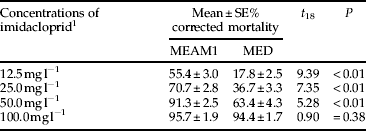
The susceptibility of MEAM1 and MED to imidacloprid was tested using soil drench treatments of cotton plants and newly emerged whitefly adults. The formulated imidacloprid (100 g kg−1 WP, Zhenjiang Pesticide Factory, China) was diluted in distilled water to give four concentrations of 12.5, 25.0, 50.0 and 100 mg l−1 for soil drench. Two days prior to the plants being used in a treatment, a shallow furrow was dug about 5 cm around the stem of each plant and 100 ml imidacloprid solution was spread evenly along the furrow. After insecticide application, the furrow was covered with soil. Two days later, whitefly adults were placed on the lower surface of a plant leaf enclosed in a clip cage (Xu et al., Reference Xu, Lin and Liu2011), with ten adults (five females and five males) per cage. For both MEAM1 and MED, we conducted ten replicates for each of the four concentrations (table 1) and five replicates for a control with distilled water. Mortality was assessed after 120 h. Adults showing no sign of movement were scored as dead.
Corrected mortality of MEAM1 and MED adults reared for five days on cotton plants that were soil-drench treated with various concentrations of imidacloprid.

1 Ten replicates were conducted for each of the two species at each of the four concentrations.
Species exclusion experiments with insecticide application
We conducted a population cage experiment to observe changes in relative abundance in mixed populations of MEAM1 and MED, as affected by insecticide application. Six treatments were conducted on cotton plants with different concentrations of imidacloprid applied in the soil and/or different initial relative abundance of the two species (table 2). The plants in Treatments III–VI were treated with imidacloprid using the soil drench method as in the test of insecticide susceptibility. The experiment was conducted using steel-framed insect rearing cages (55 cm×55 cm×55 cm). To initiate each replicate of a treatment, newly emerged adults were introduced to a cage containing two cotton plants. The plants were then watered as necessary.
Treatments and final outcome of species exclusion experiments with MEAM1 and MED conducted using cotton plants treated with different concentrations of imidacloprid and/or different initial relative abundance between the two species.

1 The adults of each of the two species in each replicate had 50% females and 50% males.
For both MEAM1 and MED, the development time from egg to adult emergence takes, on average, 23–25 days on the test host plant and temperature conditions (Sun, Reference Sun2011; Xu et al., Reference Xu, Lin and Liu2011). Thus, every 25 days, 30 whitefly adults were sampled randomly from each replicate of Treatments I and II, 100 whitefly adults were sampled randomly from each replicate of Treatments III–VI, and identified to species by RAPD–PCR. To avoid overcrowding and maintain the population in each replicate, after each sampling of adults, the older plant of the two in each cage was cut and taken out with all the eggs and nymphs on it, and a new clean younger plant was added. Note that in Treatments IV–VI, the new plants had always been treated with imidacloprid of required concentrations before they were placed into the cages. Sampling ended when one of the whitefly species was no longer detected in the sample, a situation by which extinction of the species missing was assumed.
Species exclusion experiments with different host plants
In addition to cotton that was used as a host plant in the species exclusion experiment above, we conducted a population cage experiment on three other host plants: tomato, cabbage, and pepper. For each of the host plants, six replicates of mixed cohorts with the two species of whiteflies and two control cohorts with either MEAM1 or MED were conducted. To initiate each replicate of the mixed cohorts on a host plant, ten females and ten males of MEAM1 and ten females and ten males of MED (all newly emerged adults) were introduced to a cage containing two plants of a given species. To initiate the control cohorts, 20 females and 20 males of either MEAM1 or MED were introduced to a cage containing two plants of a given species. Then, every 25 days (for tomato and cabbage) or 30 days (for pepper), 100 whitefly adults were sampled randomly from each replicate of the mixed cohorts, and 30 whitefly adults were sampled randomly from each replicate of the control cohorts, and identified to species by RAPD–PCR. To avoid overcrowding and maintain the population in each replicate, after each sampling of adults, the older plant of the two in each cage was cut and taken out with all the eggs and nymphs on it, and a new clean plant was added. Sampling ended when one of the whitefly species was no longer detected in the sample.
Field sampling
Field sampling was conducted on the Xindi Vegetable Farm in a northern suburb of Hangzhou in summer–autumn 2010. This farm has 20 ha of arable land for vegetable cultivation and was operated by a commercial company. Vegetable crops were grown under large greenhouses covered on the top with plastic sheet and on the walls with plastic net. During summer–autumn 2010, 10 ha were used to grow tomato, 6 ha to grow eggplant, and the remaining 4 ha to grow several other crops including pepper, cucumber, Chinese cabbage, etc.
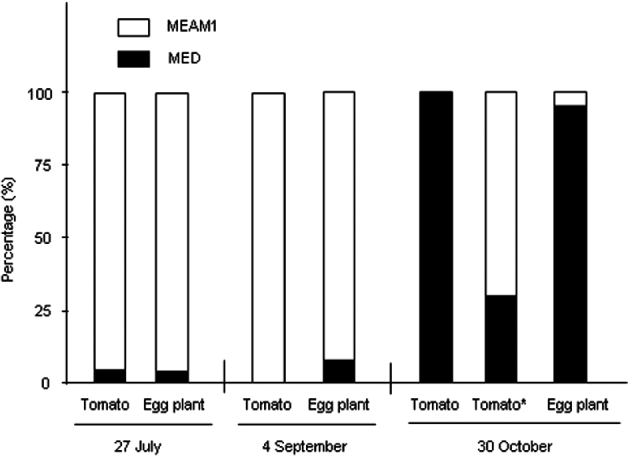
On 27 July, we did the first sampling of whitefly adults on the seedlings of tomato and eggplant. During July to August, apparently because of the high summer temperature in the region, whitefly populations on the crops were low, and partly because of the small size of whitefly individuals and partly because of the belief by the farmer that the seedlings in the greenhouse were isolated from insects outside by the netting, low whitefly populations were unnoticed by the farmer so no insecticide was applied. On 4 September, we did the second sampling on the transplants of both tomato and eggplant. By this time, a warning of whitefly outbreaks and epidemics of tomato yellow leaf curl disease in the province was issued by the Department of Agriculture and received by the farmer. Thus, from early September the farmer sprayed the tomato crops with the neonicotinoid insecticide nitenpyram (66 mg l−1) once per week, and the eggplant crops with nitenpyram (66 mg l−1) once every two weeks. To investigate the effects of insecticide application on the change of relative abundance between the whitefly species, we contracted with the farmer to leave one plot of tomato unsprayed. This plot had an area of 180 m2 and was about 20 m away from the other tomato crops. On 30 October, we did the third sampling on the tomato and eggplant crops as well as on the plot of tomato that had been left unsprayed since 4 September.
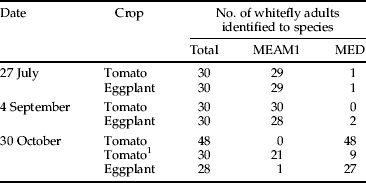
On each of the three sampling occasions, approximately 200 whitefly adults were taken from ten or more plants in each plot. The procedure of sampling was to collect by mouth suction about 20 whitefly adults from each plant and sample one plant from every five plants. In cases when there were <20 whitefly adults on a plant, all adults on that plant were collected and the sampling procedure was continued until approximately 200 whitefly adults were collected. The samples were placed immediately into 95% ethanol and brought back to the laboratory. For each sample from a crop plot, 30–50 whitefly adults were taken out randomly and identified individually to species by RAPD–PCR (table 3).
Field sampling of B. tabaci on Xindi Vegetable Farm in a northern suburb of Hangzhou in summer–autumn 2010.

1> All crop plots were treated with regular insecticide sprays except this small tomato plot which was left without insecticide treatment from 4 September to 30 October.
Data analysis
Student t-test was used to compare levels of mortality between MEAM1 and MED in each of the treatments with different concentrations of imidacloprid (table 1). Mortality was corrected using Abbott's formula, and proportion mortality was transformed by arcsine square root before Student t-test.
Results
Insecticide susceptibility
Mean mortality in the control treatment of MEAM1 was 8% and that in the control treatment of MED was 10%. The control mortality was used in Abbott's formula to calculate the corrected mortality. In each of the three treatments of lower concentrations of imidacloprid, the mean percentage of mortality of MEAM1 was significantly higher than that of MED (table 1). However, in the treatment using 100 mg l−1, mean percentages of mortality did not differ between the two whitefly species.
Species exclusion as affected by insecticide application
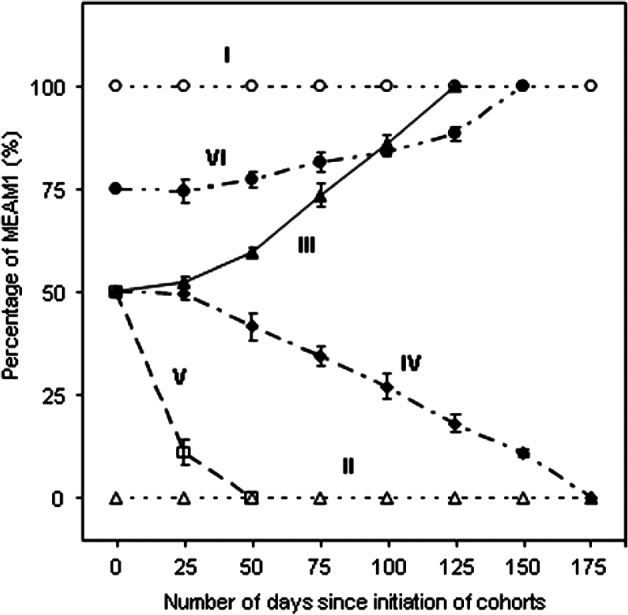
In this cage experiment, no contamination occurred in the two control treatments of MEAM1 and MED, i.e. Treatments I and II (table 2; fig. 1). In Treatments III–V, where equal numbers of both species were used to initiate the mixed cohorts, the changes in relative abundance of the two species and the final outcome of competition differed obviously depending on the application of an insecticide (fig. 1). In Treatment III where no insecticide was applied, the relative abundance of MEAM1 increased steadily and reached 100% by the fifth generation, i.e. MED was completely displaced by MEAM1. In Treatment IV where 12.5 mg l−1 imidacloprid was applied, the relative abundance of MEAM1 decreased steadily and reached 0% by the seventh generation, i.e. MEAM1 was completely displaced by MED. In Treatment V where 50.0 g l−1 imidacloprid was applied, the relative abundance of MEAM1 decreased rapidly and MEAM1 was completely displaced by MED by the second generation. Interestingly, in Treatment VI where 75% of MEAM1 and 25% MED were used to initiate the cohorts, the relative abundance of MEAM1 increased steadily and MED was completely displaced by MEAM1 by the sixth generation despite the same level of imidacloprid (12.5 mg l−1) as applied in Treatment IV (fig. 1).
Changes of mean relative percentage of MEAM1 and MED, expressed as MEAM1/(MEAM1+MED), in mixed cohorts of the two cryptic species as affected by insecticide application. Six treatments were conducted on cotton plants with different concentrations of imidacloprid applied in the soil and/or different initial relative abundance between the two species; for details of the treatments, see Table 2. Error bars indicate standard errors.

Species exclusion as affected by host plants
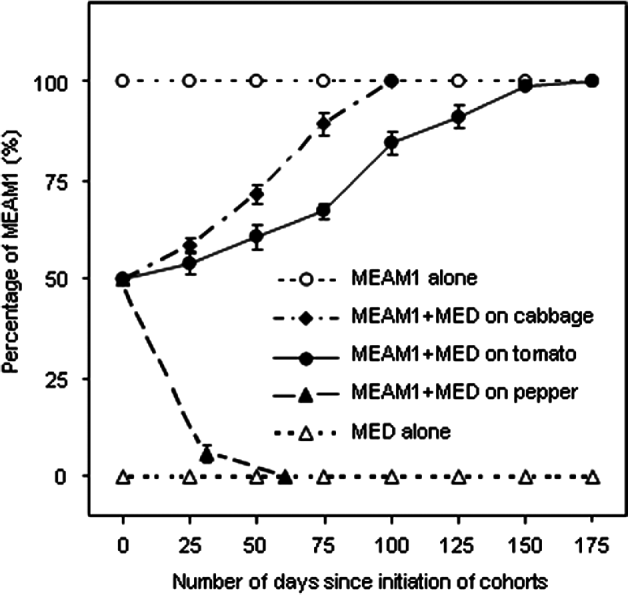
In this cage experiment, no contamination occurred in the two control cohorts on each of the three plant species (fig. 2). In mixed cohorts on the three plant species, changes in the relative abundance of the two species and the final outcome differed obviously depending on the plant species (fig. 2). On cabbage, the relative abundance of MEAM1 increased rapidly and reached 100% by the fourth generation, i.e. MED was completely displaced by MEAM1; in one of the four replicates, MEAM1 reached 100% by the third generation. On tomato, the relative abundance of MEAM1 also increased steadily and reached 100% by the seventh generation; in three of the six replicates, MEAM1 reached 100% by the sixth generation. In contrast, on pepper the relative abundance of MEAM1 decreased rapidly and reached 0% by the second generation, i.e. MEAM1 was completely replaced by MED; in one of the six replicates, MEAM1 reached 0% by the first generation.
Changes of mean relative proportions of MEAM1 and MED, expressed as MEAM1/(MEAM1+MED), in mixed cohorts of the two cryptic species that were reared on three different host plants. Error bars indicate standard errors.

Changes of relative abundance of MEAM1 and MED in the field
Whitefly populations persisted on both tomato and eggplant from July to October 2010 despite the frequent insecticide sprays during September–October. During this period, only MEAM1 and MED of the B. tabaci complex were detected (table 3). In late July, whitefly populations on both crops were dominated by MEAM1. In early September, the whitefly populations were still dominated by MEAM1, and the lack of MED in the sub-sample from tomato might have been because of the relatively small sample size. However, by late October, the whitefly populations on crops of both tomato and eggplant that received regular insecticide sprays were dominated by MED. In fact, no individuals of MEAM1 were detected from tomato despite the increase of sample size. In contrast, on the small plot of tomato that was left unsprayed since early September, the whitefly population was still dominated by MEAM1 (fig. 3).
Changes of the relative abundance between MEAM1 and MED species in crops on Xindi Vegetable Farm from July to October 2010. Crops of both species received no insecticide sprays from 27 July to 4 September and then received regular insecticide sprays except the ‘Tomato*’ plot that was left unsprayed.

Discussion
Effects of insecticide application on competitive displacement
Following the comparative tests on susceptibility to imidacloprid between MEAM1 and MED (table 1), we chose 12.5 and 50 mg l−1 of the insecticide in the species exclusion experiments. The concentration of 50 mg l−1 is within those recommended for field use of this insecticide, but 12.5 mg l−1 is below the recommended rates. However, the use of this low concentration is still relevant to field situations because lower concentrations of this insecticide would occur in the field as the residue of the insecticide decreases with time following an application.
The results of the population experiment with imidacloprid demonstrated the dramatic effects of insecticide application on species exclusion between MEAM1 and MED. When the whitefly cohorts were set up with equal abundance of the two species, MEAM1 displaced MED in five generations when no insecticide was applied; in contrast, MED displaced MEAM1 in a few generations when an insecticide was applied, and the higher the concentration of the insecticide, the more rapid the displacement (fig. 1). A similar contrasting pattern of displacements between the two species was observed in the field (table 3 and fig. 3). It should be noted that the relative abundance of MED on the tomato plot without insecticide application may well be an overestimate, because this plot is close to the plots treated regularly with insecticides where the whitefly population was dominated by MED by 30 October. As whitefly populations disperse in all directions from dozens of meters to several kilometres within a crop season (Naranjo et al., Reference Naranjo, Castle, De Barro, Liu, Stansly and Naranjo2010), it was likely that there were exchanges of whitefly adults between the unsprayed and sprayed plots during the period when samples were taken. Since the unsprayed plot was small relative to the sprayed plots (2:98) on the farm, the whitefly species composition on this plot would be expected to be more affected by the whitefly population on the sprayed plot, rather than the reverse.
Recent assessments on the status of insecticide resistance of MEAM1 and MED in China show that MED is significantly more resistant than MEAM1 to nearly all commonly used insecticides (Luo et al., Reference Luo, Jones, Devone, Zhang, Denholm and Gorman2010; Wang et al., Reference Wang, Yan, Yang and Wu2010; Rao et al., Reference Rao, Xu, Luo, Zhang, Jones, Devine, Gorman and Denholm2012; Yuan et al., Reference Yuan, Wang, Zhou, Du, Zhang and Wang2012). For example, compared with a susceptible whitefly strain, a MEAM1 population hardly exhibited resistance to four neonicotinoids (imidacloprid, pymetrozine, tiamethoxam, and acetamiprid), while four populations of MED from various regions showed tens to hundreds fold resistance (Rao et al., Reference Rao, Xu, Luo, Zhang, Jones, Devine, Gorman and Denholm2012).
While the components of crop ecosystems, such as climate, topography, and crop diversity (spatial and temporal), vary obviously across the provinces in China, one management factor seems most uniform, i.e., regular and heavy insecticide applications against whiteflies. This general observation, together with the species exclusion experiments with an insecticide from this study, as well as the results of assessments on status of resistance to insecticides, strongly suggests that variation in resistance to insecticides coupled with heavy insecticide application has been a major factor affecting competition between the two species in favour of MED in the field in China (Chu et al., Reference Chu, Wan, Zhang and Brown2010; Pan et al., Reference Pan, Chu, Ge, Wang, Wu, Xie, Jiao, Liu, Yang, Yang, Su, Xu and Zhang2011; Rao et al., Reference Rao, Luo, Zhang, Guo and Devine2011; Shen et al., Reference Shen, Du, Ren and Qiu2011; Hu et al., Reference Hu, De Barro, Zhao, Wang, Nardi and Liu2011a). Relatively higher resistance to insecticides in MED has been suggested to be a major factor contributing to the displacement of MEAM1 in many locations in southern Spain (Pascual & Callejas, Reference Pascual and Callejas2004) and Israel (Khasdan et al., Reference Khasdan, Levin, Rosner, Morin, Kontsedalov, Maslenin and Horowitz2005). A recent study on two invasive leafminer flies, Liriomyza sativae and Liriomyza trifolii, in China demonstrates that the apparent displacement between the two species in the field is insecticide-mediated (Gao et al., Reference Gao, Reitz, Wei, Yu and Lei2012).
It is interesting to note that with the application of imidacloprid at the same low concentration (12.5 mg l−1), MEAM1 displaced MED when MEAM1 started at a relatively higher abundance (fig. 1). However, as the data from field sampling (fig. 3) shows, heavy sprays of insecticides in the field can drive the relative abundance of MEAM1 below 50% very rapidly, a situation favourable to MED where insecticide application is regularly practiced.
Effects of host plants on competitive displacement
The species exclusion experiment with different host plants showed that variable population trajectory and contrasting outcomes of competition between MEAM1 and MED may occur depending on the host plants (fig. 2). Such variation may be expected, as the realized reproduction of an insect species often varies widely with different host plants and the relative performance of two insects sharing the same host may also vary widely (Iida et al., Reference Iida, Kitamura and Honda2009; Tsueda & Tsuchida, Reference Tsueda and Tsuchida2011; Xu et al., Reference Xu, Lin and Liu2011; Liu et al., Reference Liu, Yan, Chu, Pan, Jiao, Xie, Wu, Wang, Xu, Zhou and Zhang2012a). No doubt the differential performance of two species on the same host would affect their relative rates of numerical increase on the plant and consequently their competitive interactions (Zang et al., Reference Zang, Liu, Liu, Ruan and Wan2005; Luan et al., Reference Luan, Xu, Lin, Zalucki and Liu2012). The three crop species (cultivars) used in the species exclusion experiment were purposely chosen to reflect a range of host plant suitability for the two whitefly species (fig. 2). On tomato, a crop that shows similar levels of suitability to both species (Sun, Reference Sun2011), MEAM1 displaced MED in seven generations. The course and outcome of species exclusion on tomato were similar to those observed on cotton (fig. 1), and show again the mediating effects of stronger reproductive interference from MEAM1 to MED in the competitive interactions. The replacement of MED by MEAM1 went through quicker on cabbage, a crop that shows higher suitability to MEAM1 than to MED (Liu et al., Reference Liu, Yan, Chu, Pan, Jiao, Xie, Wu, Wang, Xu, Zhou and Zhang2012a). In contrast, on pepper, MED displaced MEAM1 in only two generations (fig. 2). This pepper cultivar is a suitable host for MED but only a marginal host for MEAM1. In fact, in the trials conducted by Xu et al. (Reference Xu, Lin and Liu2011) no individuals of MEAM1 survived from egg to adulthood on pepper. However, in our laboratory rearing, we occasionally found that some MEAM1 individuals developed successfully from egg to adult on this pepper cultivar. In addition, individuals of MEAM1 have been collected from several cultivars of pepper from the field (Xu, Reference Xu2009; Hu et al., Reference Hu, De Barro, Zhao, Wang, Nardi and Liu2011a).
Understanding competitive displacement in the field
The results of this study have important implications for understanding what has been happening with the populations of MEAM1 and MED in the field in China, as well as for predicting what may happen in the future. Competitive interactions between MEAM1 and MED in the field are likely to be widespread, as field populations of the two species in various parts of the world have been frequently recorded to co-occur on the same plots of crops (Moya et al., Reference Moya, Guirao, Cifuentes, Beitia and Cenis2001; Khasdan et al., Reference Khasdan, Levin, Rosner, Morin, Kontsedalov, Maslenin and Horowitz2005; Crowder et al., Reference Crowder, Horowitz, Breslauer, Rippa, Kontsedalov, Ghanim and Carrière2011) and laboratory observations show that the two species occur on similar parts of the plants (Muniz et al., Reference Muniz, Nombela and Barrios2002). The data of our extensive field sampling in Zhejiang and elsewhere in China since 2004 show that MEAM1 and MED exhibit a high degree of niche overlap in the field. For example, we sampled whiteflies on a range of crops and weeds in 22 locations across Zhejiang in summer–autumn 2011. Among the 99 samples taken from 99 crop/weed plots, 63 contained both MEAM1 and MED, nine contained only MEAM1 and 22 contained only MED (Liu, Y.Q. and Liu, S.S., unpublished data).
The available data from different parts of the world indicate that the situation of displacement between the two species is variable in the field. In southern Spain, field surveys in the 1990s and early 2000s indicate displacement of MEAM1 by MED in several localities following co-existence of the two species for a few years (Moya et al., Reference Moya, Guirao, Cifuentes, Beitia and Cenis2001; Simon et al., 2007). Field surveys in Israel also indicate displacement of MEAM1 by MED in some localities (Khasdan et al., Reference Khasdan, Levin, Rosner, Morin, Kontsedalov, Maslenin and Horowitz2005). Field and greenhouse surveys of B. tabaci cryptic species have been conducted extensively in China and USA after the arrival of MED in the two countries around 2003, and two contrasting situations have been recorded. In China, MED has been displacing MEAM1 in many localities across this country, yet in the USA MED had never been found in outdoor vegetable and field crops, although MED has been detected in greenhouses in 23 states (McKenzie et al., Reference McKenzie, Bethke, Byrne, Chamberlin, Dennehy, Dickey, Gilrein, Hall, Ludwig, Oetting, Osborne, Schmale and Shatters2012).
The varying situations of displacement between MEAM1 and MED in different parts of the world are not surprising as competitive interactions between species are mediated by many intrinsic and external factors that are likely to vary from region to region (Reitz & Trumble, Reference Reitz and Trumble2002). Intrinsically, populations of MEAM1 have stronger capacity than MED in reproductive interference (Pascual & Callejas Reference Pascual and Callejas2004; Pascual, Reference Pascual2006; Crowder et al., Reference Crowder, Horowitz, De Berro, Liu, Showalter, Kontsedalov, Khasdan, Shargal, Liu and Carrière2010a, Reference Crowder, Sitvarin and Carrière2010b; Sun, Reference Sun2011; Tsueda & Tsuchida, Reference Tsueda and Tsuchida2011), but are less resistant than MED to the commonly used insecticides (Horowitz et al., Reference Horowitz, Gorman, Ross and Denholm2003, Reference Horowitz, Kontsedalov, Khasdan and Ishaaya2005; Wang et al., Reference Wang, Yan, Yang and Wu2010; Rao et al., Reference Rao, Xu, Luo, Zhang, Jones, Devine, Gorman and Denholm2012). Also, populations of MEAM1 have mostly been shown to have a narrower range of host plants than MED (Iida et al., Reference Iida, Kitamura and Honda2009; Tsueda & Tsuchida, Reference Tsueda and Tsuchida2011; Chu et al., Reference Chu, Tao and Chi2012b; Liu et al., Reference Liu, Yan, Chu, Pan, Jiao, Xie, Wu, Wang, Xu, Zhou and Zhang2012a). However, relative performance between the two whitefly species on a crop/plant species may vary depending on not only the plant species but also the varieties and cultivars (Iida et al., Reference Iida, Kitamura and Honda2009). Still further, populations of the same whitefly species may vary in their capacity to use different plants. For example, while most studies show that MED has a wider range of host plants than MEAM1, a MED population from Arizona was shown to have a poor capacity to adapt to a range of field crops, and this poor adaptation has been speculated to be partly responsible for the inability of MED to establish populations in the field seven years after introduction (Hu et al., Reference Hu, Dennehy, Ni, Zhao, Nichols and Li2011b; McKenzie et al., Reference McKenzie, Bethke, Byrne, Chamberlin, Dennehy, Dickey, Gilrein, Hall, Ludwig, Oetting, Osborne, Schmale and Shatters2012). Indeed, the genetic structure of either MEAM1 or MED shows considerable diversity (e.g., De Barro & Ahmed, Reference De Barro and Ahmed2011; Chu et al., Reference Chu, Hu, Gao, Zhao, Nichols and Li2012a), which may have important implications in the biology of different populations within each of the two species.
Externally many abiotic and biotic factors, such as climate, topography, host plants, and natural enemies, that affect numerical increases and movement of MEAM1 and MED may influence their competitive interactions in the field. In addition, management practices, such as insecticide application and crop cultivation, may impact directly on whitefly populations and indirectly via changing abiotic and biotic factors in the crop ecosystems (Naranjo et al., Reference Naranjo, Castle, De Barro, Liu, Stansly and Naranjo2010). As our study shows, insecticide application can have immediate and dramatic effect on competitive displacement between MEAM1 and MED. Since insecticides have been applied extensively and regularly in all regions of China, this practice coupled with the substantially higher resistance to insecticides in MED than in MEAM1, may have been a major factor driving the displacement of MEAM1 by MED in many localities. Topography at a large geographic scale may have a substantial influence on competitive displacement between the two species. In China, the available data indicate that rapid and extensive displacement seems to have occurred mostly in large plains with extensive agriculture, such as Shandong (Chu et al., Reference Chu, Wan, Zhang and Brown2010), Jiangsu (Shen et al., Reference Shen, Du, Ren and Qiu2011), middle and east Hubei (Rao et al., Reference Rao, Luo, Zhang, Guo and Devine2011), while in the more mountainous regions in the south extensive displacement has rarely occurred (Hu et al., Reference Hu, De Barro, Zhao, Wang, Nardi and Liu2011a). For example, in Zhejiang, where MED was first detected in 2005 (Xu et al., Reference Xu, Wang and Liu2006), both MEAM1 and MED still co-occurred extensively, often on the same crop plots (Xu, Reference Xu2009; Hu et al., Reference Hu, De Barro, Zhao, Wang, Nardi and Liu2011a). This has occurred probably because compared with large plains, mountainous areas have greater environmental heterogeneity, which would promote co-existence of different species (Crowder et al., Reference Crowder, Horowitz, Breslauer, Rippa, Kontsedalov, Ghanim and Carrière2011). Host plants, as shown by the data from this study, could have substantial effect on the competitive interactions between MEAM1 and MED in the field. However, as both of the two species are polyphagous and in every agricultural region in China a range of crops are grown, the effects of host plants on their competitive displacement may be substantial at a local scale but may become less influential at the country-wide scale.
Many studies have shown that species usually do not have complete niche overlap and thus would exhibit niche partitioning in the field (Amarasekare, Reference Amarasekare2003). MEAM1 and MED are two different species (Sun et al., Reference Sun, Xu, Luan and Liu2011), and they differ apparently in many aspects of their biology as shown by many studies in the literature (see the Discussions section above) and the data from this study. The divergence between the two species has been further revealed at the gene level by transcriptome analysis (Wang et al., Reference Wang, Luan, Li, Su, Xia and Liu2011a). Niche partitioning at various levels would promote scale-dependent co-existence, whereby competing species exclude each other in some habitat patches but co-exist at larger scales with greater environmental heterogeneity (Reitz & Trumble, Reference Reitz and Trumble2002). Co-existence of MEAM1 and MED over large geographical areas, apparently promoted by niche partitioning, has been shown in Israel (Crowder et al., Reference Crowder, Horowitz, Breslauer, Rippa, Kontsedalov, Ghanim and Carrière2011), Tunisia (Saleh et al., Reference Saleh, Laarif, Clouet and Gauthier2012) and Spain (Moya et al., Reference Moya, Guirao, Cifuentes, Beitia and Cenis2001). The available data from China also indicate co-existence of the two species across this country although displacement of MEAM1 by MED seems to have occurred in many locations (Chu et al., Reference Chu, Wan, Zhang and Brown2010; Pan et al., Reference Pan, Chu, Ge, Wang, Wu, Xie, Jiao, Liu, Yang, Yang, Su, Xu and Zhang2011; Rao et al., Reference Rao, Luo, Zhang, Guo and Devine2011; Shen et al., Reference Shen, Du, Ren and Qiu2011; Hu et al., Reference Hu, De Barro, Zhao, Wang, Nardi and Liu2011a).
A complicating factor in understanding competitive displacement comes from how field surveys are conducted and interpreted. Owing to the usual scale-dependent pattern of displacement, survey data from a few locations over a large geographical region are likely to offer biased information. In most of the field surveys conducted in China, samples were taken from only a few locations, usually in the easily accessible, extensive agricultural areas, in each of the provinces. Since each of the provinces covers over 100,000 km2 or even 1,000,0000 km2, the field survey data are far from sufficient to show the actual distribution of the two whitefly species across the vast landscape of China. For example, in two field surveys conducted independently in many provinces across China during 2009–2010, one reports the distribution of only MEAM1 and MED (Pan et al., Reference Pan, Chu, Ge, Wang, Wu, Xie, Jiao, Liu, Yang, Yang, Su, Xu and Zhang2011) and the other reports the distribution of eight indigenous species in addition to the two invasive species (Hu et al., Reference Hu, De Barro, Zhao, Wang, Nardi and Liu2011a). The reason for different results of the two field surveys was that Pan et al. (Reference Pan, Chu, Ge, Wang, Wu, Xie, Jiao, Liu, Yang, Yang, Su, Xu and Zhang2011) sampled in mostly 1–2 locations (maximum 4) in only the easily accessible, extensive agricultural areas in each province, while Hu et al. (Reference Hu, De Barro, Zhao, Wang, Nardi and Liu2011a) conducted sampling in 4–10 locations (maximum 18) in each province in both extensive agricultural areas and less accessible, mountainous areas. The likely biases of field survey data may be further illustrated by an example of field sampling of B. tabaci during 2005 in Cyprus, an island country of a total area of 9242 km2. When samples were taken from 21 locations and 12 plant species, only MEAM1 was found (Vassiliou et al., Reference Vassiliou, Jagge, Grispou, Pietrantonio and Tsagkarakou2008). However, when samples were taken from 54 locations and 35 plant species, MED was found in addition to MEAM1 (Papayiannis et al., Reference Papayiannis, Brown, Seraphides, Hadjistylli, Ioannou and Katis2009). In view of the much larger area and far fewer samples for each of the provinces in China than those for Cyprus, the available data from China are likely to provide only part of the actual distribution of the two invasive whitefly species here. Indeed, MEAM1 was still collected during 2010 from some locations in Shandong (Ming Xue, Shandong Agricultural University, personal communication) where complete displacement of MEAM1 by MED had been inferred from more limited field data (Chu et al., Reference Chu, Wan, Zhang and Brown2010; Pan et al., Reference Pan, Chu, Ge, Wang, Wu, Xie, Jiao, Liu, Yang, Yang, Su, Xu and Zhang2011).
In summary, the data obtained from this study show that both insecticide application and host plants can have dramatic effects on the competitive interactions between MEAM1 and MED. Considering the widespread, regular application of insecticides across China since the arrival of MED, as well as the obvious higher resistance to insecticides in MED than in MEAM1, insecticide application may have been a major factor driving the displacement of MEAM1 by MED in many locations. Host plants can also have dramatic effects in mediating the competition between the two species, but their effects on the competitive interactions between the two species in the broad and variable landscapes in China are less clear, partly because each of the two species has access to a range of host plants in each of the provinces despite their differential host ranges. In the long-run, multiple interspecific differences between MEAM1 and MED may promote co-existence of the two species in China although displacement of one species by the other may frequently occur in localized habitats.
Acknowledgements
We thank Professor Myron Zalucki from the University of Queensland, Australia, and Professor Stuart Reitz from Oregon State University, USA, for comments on the manuscript. Financial support for this study was provided by the National Basic Research Program of China (2009CB119203), the National Natural Science Foundation of China (31021003) and the China Agriculture Research System (CARS-25-B-08).