

1. Introduction
Hours worked are of fundamental importance for macroeconomists: they are an essential input into the aggregate production function, and thus a major driver of GDP. But they also matter for welfare: while high levels of GDP imply high consumption possibilities, high levels of hours worked also imply low levels of leisure, and thus low utility from leisure. In this article, I present findings from recent research on hours worked differences across countries. First, I document fundamental differences in hours worked between poor and rich countries. I then zoom in on the set of richer countries and compare hours worked in Europe and the US, also analysing different European regions. Which components of hours worked are the main drivers of the observed differences, employment rates, weeks worked, or weekly hours? Do different demographic compositions contribute to explaining the observed differences? Last, I document that among core-aged individuals, married women are the group that exhibits the largest differences across countries. I then analyse how far the differences in hours worked of married women across European countries and the US can be explained by differences in taxation, which has been suggested as a major explanatory factor for the aggregate Europe-US differences.
2. Data and hours measurement
Aggregate hours worked measures are available from the OECD, but are thus naturally limited to relatively rich countries. Moreover, to understand better the driving factors of hours worked differences across countries, it is essential to be able to dig deeper into the data. If two countries exhibit aggregate hours differences, are these differences universal or driven by specific subgroups of the countries, e.g. do they arise only for men or only for women? Are they driven by different demographic compositions, e.g. an older age structure in one country than in the other? Last, are the differences driven by employment rates, or rather hours worked per worker? If it is the latter, do they arise for usual weekly hours worked, or for weeks worked?
To answer all these questions, one has to move beyond aggregate data and rely on micro data. All the facts I document here thus rely on analyses based on nationally representative household surveys. The key advantage of using household surveys, as opposed to firm surveys or administrative records, is that measures of labour supply are not restricted to activities for which individuals receive a wage, but also include self-employed and unpaid family work. As is well known, the self-employed form an important fraction of the workforce in all countries, and particularly so in developing countries, see e.g. Reference GollinGollin (2008).
In Reference Bick, Fuchs-Schündeln and LagakosBick et al. (2018a), we were able to collect nationally representative data on hours worked for 80 countries with a population of at least one million. All the data refer to the year 2005, or the closest available year. For 32 of our countries, we can draw from harmonised data sets, for which efforts have already been made to standardise questions across countries. These comprise the European Labour Force Survey (ELFS; 26 countries) and the International Public-Use Microdata Project (IPUMS; 6 countries). For the remaining 48 countries, we draw on country-specific censuses, household or labour force surveys, including 19 surveys conducted as part of the World Bank's Living Standards Measurement Studies (LSMS). Of the 80 countries for which we were able to collect data, 49 so-called ‘core countries’ show the highest international comparability: (i) the surveys measure all hours worked in activities involving the production of output counted in the National Income and Product Accounts; (ii) they all ask for actual (not usual) hours worked in a recent reference week in all jobs (not only the primary job), and (iii) they all cover the entire year. The latter issue is important, given the substantial seasonality of hours especially in countries with a large agricultural employment share.
When focusing on Europe and the US (Reference Bick and Fuchs-SchündelnBick and Fuchs-Schündeln, 2017; Reference Bick and Fuchs-SchündelnBick and Fuchs-Schündeln, 2018; Reference Bick, Fuchs-Schündeln and LagakosBick et al., 2018b; Reference Bick, Brüggemann, Fuchs-Schündeln and Paule-PaludkiewiczBick et al., 2019), the data sources are the European Union Labour Force Survey for the European countries, and the Current Population Survey for the US. The European Union Labour Force Survey is a collection of annual labour force surveys from different European countries. It covers Belgium, Denmark, France, Germany, Greece, Italy, Ireland, the Netherlands, and the UK from 1983 onwards, Portugal and Spain starting in 1986, Austria, Norway, and Sweden starting in 1995, Hungary and Switzerland starting in 1996, and the Czech Republic and Poland starting in 1997. More Eastern European countries are added at later years.Footnote 1 The sample size of the EU LFS varies across countries and also within a country over time, but is always of considerable magnitude. The minimum annual sample size in the original data we use is 15,400 for Denmark, a country with roughly 5.5 million inhabitants. For the US, we use the Current Population Survey (CPS), which is a monthly survey of around 60,000 households. The data on hours worked cover around 300,000 individuals per year. While both the CPS and the European Union Labour Force Survey (the latter only since 2005) cover the entire year, we find that they still substantially underestimate vacation days, which inhibits the measurement of hours worked per worker. We thus correct for vacation days from external data sources (see Reference Bick, Brüggemann, Fuchs-Schündeln and Paule-PaludkiewiczBick et al., 2019, for details).
3. Hours worked across the world income distribution
Do individuals in poor countries work more or less hours than individuals in rich countries? To answer this question, in Reference Bick, Fuchs-Schündeln and LagakosBick et al. (2018a) we present evidence from the 49 ‘core countries’ focusing on adults, i.e. all individuals aged 15 or older. We plot average weekly hours worked per adult against the logarithm of GDP per capita. Average weekly hours worked per adult are the product of the employment rate and hours worked per worker. Thus, any adult not working at all enters the construction of the average with zero hours. We group the countries into those belonging to the poorest, middle, or richest third of the world income distribution. We are able to see that hours are decreasing in development; on average, individuals in poor countries work 29 hours per week, and individuals in rich countries 19 hours per week. Thus, individuals in poor countries work ten hours per week, or 50 per cent more than individuals in rich countries. The cross-country pattern of hours worked by development is in line with the time-series pattern of the only country for which a long reliable time-series of hours worked is available, namely the United States. Reference Ramey and FrancisRamey and Francis (2009) document the time-series of hours worked in the US starting in 1900. Yet, even more than a century ago, the United States was as rich as current middle-income countries, so these time series data do not span as large an income range as our cross-sectional data do. Average hours worked per adult in the United States decreased from 27.7 hours per week in 1900 to 23.0 hours in 2005, corresponding to a decline of 4.7 hours per week. This largely corresponds to the decrease in hours we observe between middle- and high-income countries in our data, only with slightly higher overall hours levels in the United States.
The large difference of ten hours per week between rich and poor countries has important implications for the measurement of both welfare and labour productivity differences across countries. Welfare comparisons are of course notoriously hard and depend on the utility function and welfare criterion employed. Relying on a standard representative agent utility function as typically used in the macroeconomic literature, we find that rich countries have twelve times higher welfare than poor countries if only the differences in GDP per capita, and thus consumption, are taken into account. If one adds to this the fact that people in poor countries work longer hours and thus enjoy less leisure than people in rich countries, this large welfare difference increases even more to a factor of 19. People in poor countries are not only consumption-poor, but also leisure-poor, and this matters substantially for welfare.Footnote 2 When it comes to labour productivity comparisons across countries, macroeconomists typically rely on GDP per worker as a measure, which shows a fourteen times higher labour productivity in rich than in poor countries. The development accounting literature finds that this large difference cannot be explained by differences in inputs of physical or human capital (see e.g. Reference Caselli, Aghion and DurlaufCaselli, 2005). We show that, if labour productivity is more accurately measured as GDP per hour worked, the difference between rich and poor countries increases to a factor of 17. Thus, the puzzle for the development accounting literature of what are the fundamental drivers of these cross-country productivity differences becomes even larger.
Are these large differences driven by specific groups? We analyse this question by focusing on men vs. women, different age groups, and different education groups, and find that for all different groups hours worked are decreasing in development. To give one example, we show in Reference Bick, Fuchs-Schündeln and LagakosBick et al. (2018a) average hours worked per adult man and woman. While in all income groups men work on average more hours than women, the decrease over the development spectrum is the same for both men and women. In addition we find that different demographic compositions across countries, e.g. an on average older population in richer countries, are not drivers of the aggregate difference.
When it comes to the two margins of labour supply, both employment rates and hours per worker decrease between poor and rich countries, but with different shapes over the development spectrum: employment rates decrease rapidly between low- and middle-income countries, and then experience a slight increase, while hours worked per worker increase between low- and middle-income countries, and then substantially decrease for high-income countries. Around three quarters of the overall decrease in hours worked per adult between poor and rich countries are driven by the extensive margin.
4. Hours worked in Europe and the US
I now focus on the rich countries, namely those located in Europe and the US. The differences in hours worked found across countries within this group are of course much smaller than the ones found over the entire development spectrum. Nevertheless, they are not negligible and have sparked a substantial literature analysing the driving forces of these differences. This literature traces lower hours in Europe than in the US back to, amongst others, labour income taxation (e.g., Reference PrescottPrescott, 2004; Reference RogersonRogerson, 2006; Reference Faggio and NickellFaggio and Nickell, 2007; Reference Ohanian, Raffo and RogersonOhanian et al., 2008; Reference OlovssonOlovsson, 2009; Reference McDanielMcDaniel, 2011; to name a few), institutions (Reference Alesina, Glaeser and SacerdoteAlesina et al., 2005; Reference Faggio and NickellFaggio and Nickell, 2007), and social security systems (Reference Erosa, Fuster and KambourovErosa et al., 2012; Reference WalleniusWallenius, 2013; Reference Alonso-OrtizAlonso-Ortiz, 2014).
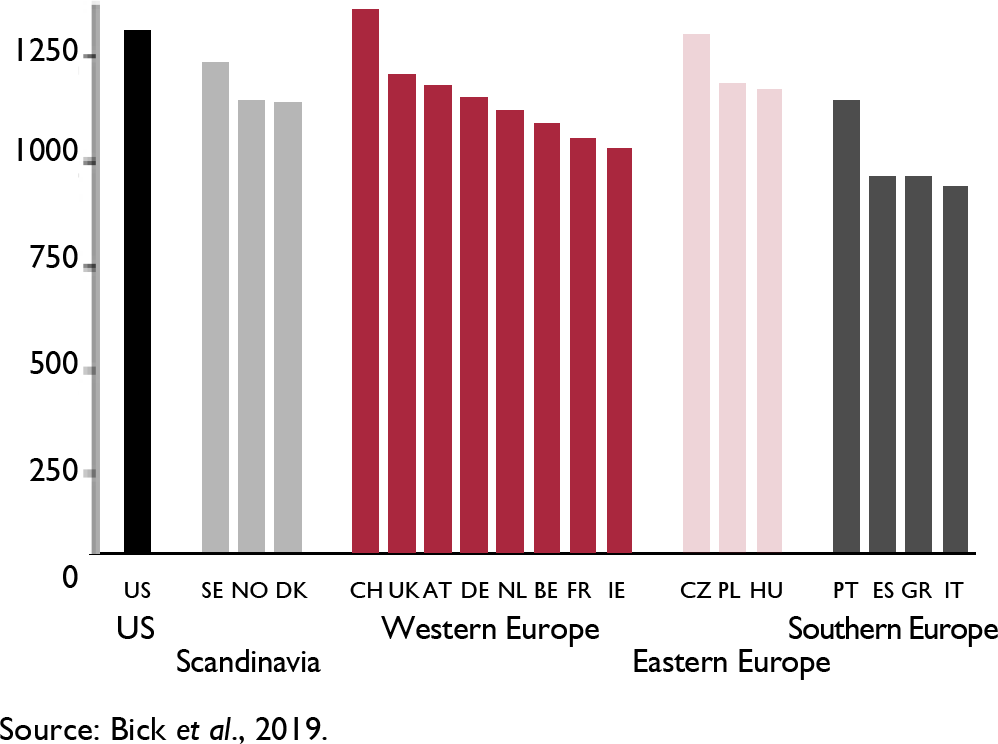
This line of research typically relies on OECD data, which limits the ability to analyse specific subgroups to the few disaggregated statistics that the OECD provides. Based on our micro data, we can conduct a full statistical decomposition of the cross-country differences, which gives useful insights into potential driving forces. In Reference Bick, Brüggemann, Fuchs-Schündeln and Paule-PaludkiewiczBick et al. (2019), we focus on individuals aged 15–64, in line with the OECD, and on the recent cross-section of the years 2013–15. Figure 1 shows average annual hours worked per person for the US and eighteen European countries grouped into Scandinavia (Denmark, Norway, Sweden), Western Europe (Austria, Belgium, France, Germany, Ireland, Netherlands, Switzerland, UK), Eastern Europe (Czech Republic, Hungary, Poland), and Southern Europe (Greece, Italy, Portugal, Spain). Hours worked per person are highest in Switzerland, the US, and the Czech Republic, with more than 1250 annual hours, and lowest in Italy with less than 900 hours per year. The UK lies close to the top of the European countries with 1180 annual hours. Mean hours worked per person in Southern Europe are the lowest (952 hours), while the mean hours worked per person across the other European regions are quite similar, ranging from 1098 hours in Western Europe to 1169 hours in Eastern Europe. The implied Europe-US hours per person gap is 180 hours, or 14 per cent.
Average hours worked per person (aged 15–64), 2013–15

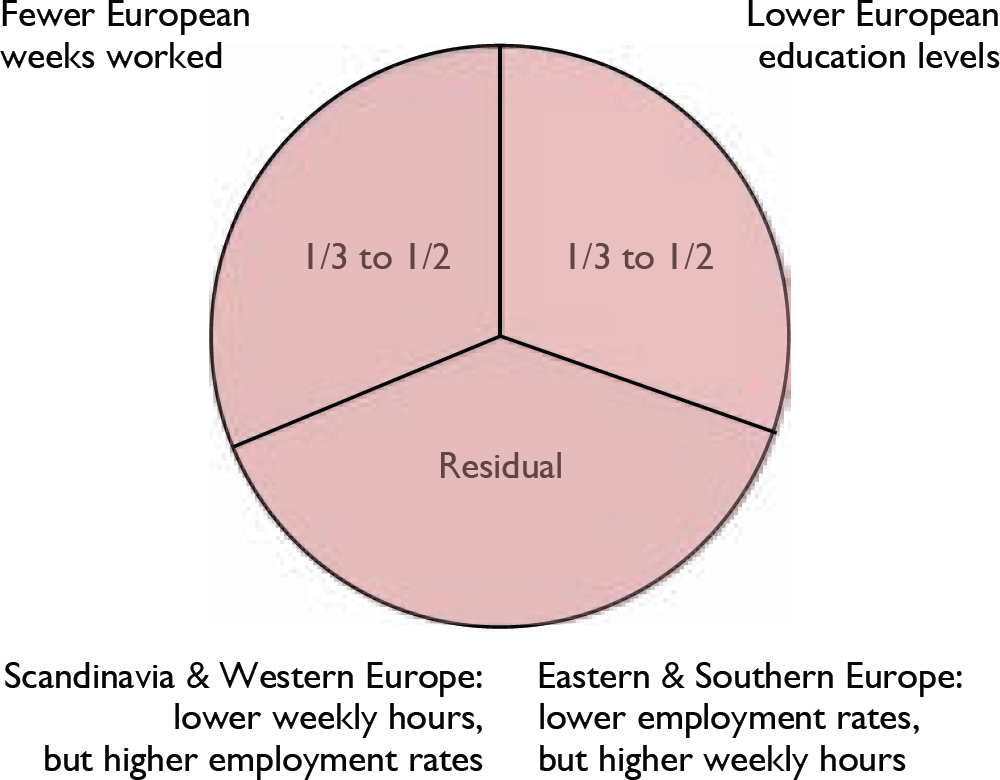
In a statistical exercise, we decompose these hours worked differences across countries. First, we ask how much each of the three components of average annual hours worked contributes: the employment rate, weeks worked, and weekly hours worked during a typical work week, the latter two conditional on employment. Secondly, we want to understand whether different demographic compositions play a role, and focus on age, education, gender, and sectors. Figure 2 presents the results from the statistical decomposition. Roughly one third to one half of the 14 per cent lower hours in Europe than in the US can be explained by fewer weeks worked in Europe. Put differently, the higher number of vacation weeks and public holidays in Europe than in the US is a substantial statistical driver of the hours worked difference.Footnote 3 Another roughly one third to one half can be explained by lower average European education levels. We find that in all countries, employment rates are sharply increasing by education. A higher share of low-educated individuals in Europe, especially in Southern and Eastern European countries, thus statistically leads to lower average hours. While vacation weeks and the educational composition thus matter for all countries, there is still a substantial residual which shows strong differences across Europe even after accounting for these two factors. For Eastern and Southern European countries, lower employment rates explain a substantial part of the lower hours than in the US, while usual weekly hours worked are even higher in Eastern Europe than in the US. By contrast, in Scandinavian and Western European countries lower weekly hours worked are substantial drivers of the lower overall hours than in the US, while employment rate differences alone would predict higher hours than in the US.
Statistical decomposition of the hours worked differences between Europe and the US

Thus, employment rates tend to be higher in Western Europe and Scandinavia than in the US, but hours worked during a working week are uniformly lower. In Southern and Eastern Europe, by contrast, weekly hours tend to be higher than in the US, but employment rates lower. As a result, we observe a strong negative correlation between weekly hours and employment rates across countries; countries with high employment rates tend to have low weekly hours, and vice versa. By contrast, there exists no clear correlation between weeks worked and either employment rates or weekly hours.
5. Taxation and the labour supply of married women
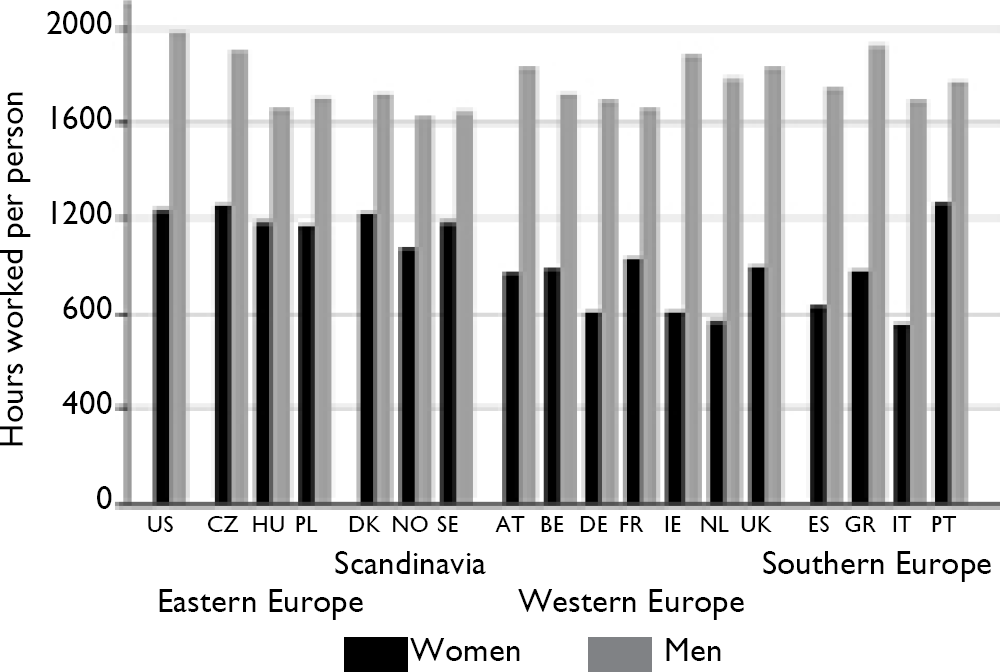
Focusing on core-aged individuals, i.e. those aged 25–54, there is one group that stands out with their labour supply differences across countries in two dimensions, namely the group of married women. First, despite having the lowest mean hours worked per person among the four groups of married and single men and women, married women exhibit by far the largest differences in hours worked across countries; the standard deviation of their annual hours per person across the US and 17 European countries amounts to 180 hours, as compared to values between 101 and 111 hours for single women, married men, and single men.Footnote 4Figure 3 shows the hours worked of married couples in 2001–8; clearly, the variation among married women is larger than the one among married men.
Hours worked of married men and women aged 25–54, 2001–8

Secondly, while countries in which married men work few hours also tend to exhibit relatively low hours for single men and single women, the same is not true for married women. The cross-country correlation of their labour supply with that of married men is with 0.06 almost zero, while it is 0.64 between single women and married men, and 0.79 between single men and married men. What drives these large and unique labour supply differences of married women across countries? We analyse this in a series of papers, namely Reference Bick and Fuchs-SchündelnBick and Fuchs-Schündeln (2017; Reference Bick and Fuchs-Schündeln2018), and Reference Bick, Brüggemann, Fuchs-Schündeln and Paule-PaludkiewiczBick et al. (2018b).Footnote 5
As mentioned above, the macroeconomic literature has analysed taxation as one of the major drivers of hours worked differences across countries. Reference PrescottPrescott (2004) and Reference Ohanian, Raffo and RogersonOhanian et al. (2008) both analyse the continuous decrease in hours worked in European countries since World War II, as compared to rather stable hours in the US, and show that increasing taxes in Europe are an important driver of this decrease. Yet, on the first view it seems unlikely that taxes can explain the labour force differences of married women across countries; higher taxes should induce all individuals in a country to work fewer hours, though maybe to a different degree, depending on their labour supply elasticity. Why do we observe then the essentially zero correlation between the labour supply of married men and married women across countries?
We show that indeed taxation can at least partially explain this phenomenon, as well as a significant part of the labour supply differences of married women across countries. However, it is not enough to take linear income taxes into account, as most of the macroeconomic literature does. Instead, one has specifically to model the differences in the tax treatment of married couples across countries. The tax treatment of married couples can be divided fundamentally into joint vs. separate taxation. In a separate taxation system, each spouse's tax obligation depends only on his/her own income. In a system of joint taxation, by contrast, the income of one spouse also affects the tax burden of the other. Germany has the starkest system of joint taxation among the analysed countries. In the German system, the incomes of husband and wife are summed together and the resulting household income is divided by two. The tax function is then applied to each half of the household income. One effect of this system is that it entails a so-called ‘marriage bonus’; the total tax burden of a married couple is always smaller than the tax burden they would face as singles. Only at the limit, when both spouses earn exactly the same income, is the tax burden the same. However, this system also influences the marginal tax rates faced by both spouses; upon earning an additional euro, both spouses face exactly the same marginal tax burden, namely the one applying to half the household income. As a consequence, relative to separate taxation the marginal tax rate of the primary income earner decreases, but the one of the secondary income earner increases. A progressive tax system is a precondition for these effects to arise.
The effects of the different tax treatments of married couples on labour supply can most easily be explained using the example of three countries, namely the US, Germany, and Sweden. As the first two columns of table 1 show, married men in Germany and Sweden work 14 and 16 per cent fewer hours, respectively, than married men in the US. By contrast, married women in Sweden work almost as many hours as married women in the US, but married women in Germany work 34 per cent fewer hours. Can these differences be explained by taxation?

The third column of the table shows that both the US and Germany have a system of joint taxation, while Sweden has a system of separate taxation.Footnote 6 The fourth column shows as an exemplary tax rate for the income tax level the tax rate that a household faces in which the husband works the average hours of US married men and earns the average country-specific male wage, and the wife does not work. This tax rate, including social security contributions, amounts to 21 per cent in the US, but 31 per cent and 33 per cent, respectively, in Germany and Sweden. Thus, it correlates strongly with the hours worked of married men; German and Swedish married men might work fewer hours than US ones because they face higher taxes.
The fifth column of table 1 shows the average marginal tax rate that the wife in this household faces if she starts working and works the average hours of US married women, earning the country-specific average female wage.Footnote 7 We construct this tax rate by dividing the additional taxes that the household has to pay when the wife starts working by her labour earnings. In Sweden, a country of separate taxation, this average marginal tax rate of the wife in column 5 is somewhat smaller than the average tax rate of the single-earner household in column 4. This is the case because the wife has lower earnings than the husband, due to both lower hours and a gender wage gap; thus, given the progressive tax schedule, her tax rate is somewhat smaller. In the two countries with joint taxation, by contrast, the tax rate of the wife in column 5 is larger than the one of the single-earner household; as the wife starts working, she is right away taxed as if she already earns half of the household income. The difference is especially large in Germany, with 19 percentage points, due to the higher progressivity of the German tax system. As it turns out, the two hypothetical women in the US and Sweden face almost the same average marginal tax rate of 29 per cent, resp. 30 per cent: in the US, this is the consequence of having relatively low average tax rates, but a system of joint taxation, while in Sweden it is the consequence of having relatively high average tax rates, but a system of separate taxation. Germany combines high tax rates with joint taxation and high progressivity, and as a consequence the average marginal tax rate of the hypothetical married woman is 50 per cent.
In Reference Bick and Fuchs-SchündelnBick and Fuchs-Schündeln (2017, Reference Bick and Fuchs-Schündeln2018) and Reference Bick, Fuchs-Schündeln and LagakosBick et al. (2018b), we build a macroeconomic model of labour supply featuring joint utility maximisation of couples, and feed into this model the full country-specific non-linear tax codes, which also take into account the tax treatment of married couples. We also make these tax codes available in a user-friendly format on our webpages, in addition to the data on hours (see for example here: https://sites.google.com/site/brueggemannbettina/data-tax-codes). In Reference Bick and Fuchs-SchündelnBick and Fuchs-Schündeln (2018), we show that non-linear labour income taxes are a crucial driver of the cross-country differences in hours worked in the recent cross-section, while in Reference Bick, Brüggemann, Fuchs-Schündeln and Paule-PaludkiewiczBick et al. (2018b), we show that they can also explain a large part of the time-series changes of hours worked per employed married woman in eight sample countries since the 1980s.
Lastly, in Reference Bick and Fuchs-SchündelnBick and Fuchs-Schündeln (2017), we use the model to conduct a policy experiment. After a country-specific calibration of the model, we ask how the hours worked of married couples would change in each country if the country went from the current system of taxation to a system of strictly separate taxation of married couples. In these experiments, we keep the average tax burden of married couples constant by applying a linear tax or subsidy; thus, only the marginal tax rates of husband and wife change in the experiment.
The results show the predicted change in annual hours worked by married men and women caused by the policy experiment. In four countries, namely Greece, Hungary, Sweden, and the UK, nothing changes, as these countries already have a system of separate taxation in the time period of observation (2001–8). For the other countries, generally hours worked by married men decrease slightly, but at most by 50 hours annually. By contrast, married womens’ hours are predicted to increase; for five countries (Austria, Norway, Czech Republic, Portugal, and Poland), the predicted increases are relatively small with at most 50 hours. For France, Spain, Denmark, Italy, the Netherlands, and the US, the model predicts that married women would increase their labour supply by around 100 hours annually upon moving to a system of separate taxation. This predicted increase is 150 hours in Ireland, but really stands out in Germany and Belgium with 280 and 340 annual hours, respectively. Thus, Belgium and Germany have by far the strongest elements of joint taxation built into their tax codes, and these elements substantially suppress the labour supply of married women in the two countries.
6. Conclusion
I document several new facts on hours worked differences across countries. First, hours worked are substantially higher in poor countries than in rich countries. This is true for both margins of labour supply and for different demographic groups. Secondly, lower hours in Europe than in the US are in a statistical sense partly driven by a higher number of vacation weeks in Europe, and by a different demographic composition with a higher average share of low educated individuals. Moreover, there is a strong negative correlation between hours worked during a typical working week and employment rates; countries in Southern and Eastern Europe tend to have lower employment rates than the US, but higher weekly hours, while the reverse is true for countries in Western Europe and Scandinavia. Last, among core-aged individuals, married women are the group that exhibits the largest cross-country variation in hours worked. Non-linear labour income taxes, and especially the tax treatment of married couples, are an important driver of these differences.