Implications
Pyrethroids are widely used as insecticides and are present not only in the environment but also in animal organisms. Some pyrethroids are known to inhibit phosphatase calcineurin, which plays an important role in oocyte maturation. Little is known about the effects of calcineurin-inhibiting pyrethroids on mammalian oocyte maturation. We demonstrated that these pyrethroids have an effect on the in vitro maturation of pig oocytes. A similar effect was observed in calcineurin inhibitors, which are not pyrethroids. On the other hand, calcineurin non-inhibiting pyrethroids have no effect on pig oocyte maturation. Based on these data, we suggest that calcineurin-inhibiting pyrethroids have the potential to affect mammalian reproduction.
Introduction
Pyrethroids are highly active synthetic derivatives of natural toxins occurring in the plant Chrysanthemum cinerariaefolium. Since the 1970s, pyrethroids have ranked among important insecticides used for control of insect pests. Cypermethrin, deltamethrin and fenvalerate belong among pyrethroids that are widely used for crop protection, for protection of domestic animals against insects, for the control of insect vectors carrying infectious diseases and for control of insects in households. These pyrethroids contain the alpha-cyano group, which prolongs their effects (Soderlund et al., Reference Soderlund, Clark, Sheets, Mullin, Piccirillo, Sargent, Stevens and Weiner2002).
As pyrethroids are widely used as insecticides, they are present in the environment in considerable amounts (Weston and Lydy, Reference Weston and Lydy2010). They are considered to be a potential toxic pollutant, and there is proof of their significant direct risk to aquatic ecosystems. Although it is reported that pyrethroids are quickly metabolized in mammalian bodies, and therefore their toxicity is very limited, their toxic effects in mammals must not be underestimated (Soderlund et al., Reference Soderlund, Clark, Sheets, Mullin, Piccirillo, Sargent, Stevens and Weiner2002).
Many agrochemicals, including pesticides, can have detrimental effects on human and animal reproduction (Casas et al., Reference Casas, Bonilla, Ducolomb and Betancourt2010). This is also the case of pyrethroids (Meeker et al., Reference Meeker, Barr and Hauser2009), and this is also the reason for research on the molecular mechanisms of these compounds. Toxic effects of the pyrethroids cypermethrin, deltamethrin and fenvalerate were demonstrated not only on the nervous system (Wolansky and Harrill, Reference Wolansky and Harrill2008), but also on various types of mammalian somatic cells cultured in vitro (Prasanthi et al., Reference Prasanthi, Muralidhara and Rajini2005) and even on gametes – sperm (Yuan et al., Reference Yuan, Wang, Gao, Kong, Chen, Li, Song and Wang2010).
The effects of pyrethroids on the insect nervous system are attributed mainly to their action on ion channels (Soderlund et al., Reference Soderlund, Clark, Sheets, Mullin, Piccirillo, Sargent, Stevens and Weiner2002). However, pyrethroids such as cypermethrin, deltamethrin and fenvalerate are also known to be very potent and specific inhibitors of calcineurin (Enan and Matsumura, Reference Enan and Matsumura1992).
Calcineurin (also known as protein phosphatase 2B) is a serine/threonine phosphatase that is known to play an important role in the conversion of signals of calcium ions to intracellular events (Chang, Reference Chang2007). Based on their biochemical parameters, the family of mammalian serine/threonine protein phosphatases is divided into classes PP1, PP2A, PP2B or calcineurin, PP4, PP5, PP6 and PP7 (Cohen, Reference Cohen2002). The role of PP1 and PP2A in the regulation of oocyte maturation was clearly demonstrated (Rime and Ozon, Reference Rime and Ozon1990). Data on the role of other serine/threonine phosphatases in mammalian oocyte maturation, including the role of calcium-dependent protein phosphatase 2B – calcineurin, are limited. It is known that the activity of calcineurin is necessary for the completion of oocyte meiosis in Drosophila, and in this species the blockage of calcineurin interrupts the progression of oocyte meiosis at the stage of anaphase I (Takeo et al., Reference Takeo, Hawley and Aigaki2010). Recently, an important role of calcineurin was demonstrated for meiosis regulation in Xenopus eggs (Mochida and Hunt, Reference Mochida and Hunt2007). This indicates that vertebrate oocytes express calcineurin and may be sensitive to its inhibition by pyrethroids.
The oocyte population in mammalian ovaries is not homogeneous. Various specific physiological processes occur in oocytes entering different stages of oogenesis. These oocytes have different levels of competence for meiotic maturation. Pig oocytes attain full meiotic competence, that is, ability to mature to metaphase II, when they reach an internal diameter of about 120 μm. Partial meiotic competence, when maturation is spontaneously blocked at the metaphase I stage, occurs when oocytes reach an internal diameter of about 110 μm. Porcine oocytes with an internal diameter smaller than 90 μm are meiotically incompetent and do not mature in vitro (Wassarman, Reference Wassarman1988; Tichovská et al., Reference Tichovská, Petr, Chmelíková, Sedmíková, Tůmová, Krejčová, Dörflerová and Rajmon2011).
We can hypothesize that calcineurin-inhibiting pyrethroids are capable of affecting the maturation of mammalian oocytes and that the effects of calcineurin inhibitors differ in oocytes at different levels of meiotic competence. The objective of our study was to investigate the effects of calcineurin-inhibiting pyrethroids on the meiotic maturation of pig oocytes using in vitro culture of oocytes. We tested the effect of the pyrethroids cypermethrin, deltamethrin and fenvalerate, all of which are inhibitors of calcineurin, on in vitro maturation of pig oocytes. To test the possibility that the observed effects were caused by the ability of pyrethroids to inhibit calcineurin, we also investigated the effects of non-pyrethroid inhibitors of calcineurin – cyclosporin A and hymenistatin I. We also tested the pyrethroids allethrin and permethrin, which have no inhibitory effects on calcineurin. The effects of all the compounds were tested on two categories of pig oocytes: growing oocytes with partial meiotic competence and fully grown pig oocytes with full meiotic competence. The results of our experiments could indicate the damage that can be caused after exposure of female germ cells to pesticides.
Material and methods
Isolation and culture of oocytes
Pig ovaries were obtained from a local slaughterhouse from gilts at an unknown stage of the estrous cycle and transported to the laboratory within 1 h in a saline solution (0.9% natrium chloride) at 39°C. Fully grown oocytes were collected from follicles by aspirating follicles that were 2 to 5 mm in diameter with a 20-gauge needle. Only oocytes with compact cumuli were selected for further study.
Growing oocytes of different size categories were obtained from thin strips (10 to 15 mm in length, 1 to 2 mm wide) dissected from the surface of the ovaries using a scalpel. The strips of ovarian tissue were placed in Petri dishes containing a culture medium. The oocytes were released from their follicles by opening the follicular wall using the tip of a 25-gauge needle. The internal diameter of the oocytes (without the zona pellucida) was measured with an ocular micrometer mounted on a microscope. Only oocytes surrounded by several layers of cumulus cells were chosen for further experiments. Before culture, the oocytes were washed three times in a culture medium.
Modified M199 medium was used as the culture medium. Medium M199 (GibcoBRL, Life Technologies, Paisley, Scotland) was supplemented with sodium bicarbonate (0.039 ml of a 7.0% solution per milliliter of the medium), calcium lactate (0.6 mg/ml), gentamicin (0.025 mg/ml), HEPES (1.5 mg/ml), 13.5 IU eCG: 6.6 IU hCG/ml (P.G.600 Intervet, Boxmeer, Holland) and 10% fetal calf serum (GibcoBRL, Life Technologies, Paisley, UK).
The oocytes were cultured for 24, 48 or 72 h in 3.5 cm diameter Petri dishes (Nunc, Roskilde, Denmark) containing 3.0 ml of the culture medium at 39oC in a mixture of 5.0% CO2 in the air.
Pyrethroid treatment
Calcineurin-inhibiting pyrethroids, cypermethrin, deltamethrin and fenvalerate and pyrethroids without specific effects on calcineurin, allethrin and permethrin, were purchased from Sigma-Aldrich (Sigma-Aldrich, Munich, Germany). The stock solution of 50 mM was diluted in dimethyl sulfoxide (DMSO). Preliminary control experiments showed that the addition of pure DMSO at the same concentrations as used during culture of the oocytes with pyrethroids had no significant effect on oocyte maturation in vitro.
At the start of each culture we added the stock solution to the culture medium to reach a final concentration of the tested substance. In fully grown oocytes with full meiotic competence, cypermethrin was tested in concentrations of 0, 5, 10, 25 and 50 μM, deltamethrin was tested in concentrations of 0, 10, 25, 50 and 100 μM and fenvalerate was tested in concentrations of 0, 10, 25, 50 and 100 μM. The growing oocytes with partial meiotic competence were tested with cypermethrin in concentrations of 0, 10, 25 and 50 μM. Deltamethrin was tested in concentrations of 0, 25, 50 and 100 μM and fenvalerate was tested in concentrations of 0, 10, 25, 50 and 100 μM.
Control experiments were performed under the same schedule with the non-pyrethroidal inhibitors of calcineurin – cyclosporin A and hymenistatin I. These inhibitors were tested on fully grown pig oocytes with full meiotic competence at concentrations of 0, 0.1, 1, 4 and 8 μM cyclosporin A or 0, 0.5, 2, 4 and 8 μM hymenistatin I. Growing pig oocytes with partial meiotic competence were exposed to 0, 1, 4 and 8 μM cyclosporin A and 0, 2, 4 and 8 μM hymenistatin I.
In further control experiments we tested the effects of the pyrethroids permethrin and allethrin, which have no inhibitory effect on calcineurin. These pyrethroids were tested at concentrations of 0, 10, 25, 50 and 100 μM in fully grown pig oocytes and at concentrations of 0, 10, 25, 50 μM in growing pig oocytes with partial meiotic competence.
The range of concentrations of the tested chemicals was based on our preliminary experiments (data not shown), and only concentrations with a significant effect on oocyte maturation are presented. In control experiments, where we did not observe any effect (treatment with allethrin or permethrin), we used similar concentrations as in pyrethroids inhibiting calcineurin.
Oocyte evaluation
At the end of the culture, the oocytes were mounted on slides, fixed with acetic alcohol (1 : 3, v/v) for at least 24 h and stained with 1.0% orcein. The oocytes were examined under a phase contrast microscope. The stages of oocyte nuclear maturation germinal vesicle (GV), late diakinesis (LD), metaphase I (MI), anaphase I (AI), telophase I (TI) and metaphase II (MII) were evaluated in accordance with the criteria described by Motlík and Fulka (Reference Motlík and Fulka1986). Abnormal chromatine configuration that did not fit the above-mentioned criteria was assessed as degeneration. The viability of the cultured oocytes was evaluated after Trypan blue staining. Forty oocytes from each category, that is, fully grown meiotically competent oocytes, growing oocytes with partial meiotic competence and growing meiotically incompetent oocytes, were evaluated after treatment with each respective chemical, that is, cypermethrin, deltamethrin, fenvalerate, cyclosporin A, hymenistatin I, allethrin and permethrin. The oocytes were examined using Trypan blue staining after 48-h culture, as this represents the time necessary for pig oocyte maturation. As none of our experiments revealed any effect of pyrethroids on oocyte viability, only results obtained after the culture with the highest concentration used in the respective experiment investigating oocyte maturation are presented.
Statistical analysis
Each specific treatment with selected concentration of the tested chemicals was performed with 40 oocytes. Each treatment was performed three times. The correlation between pyrethroid concentration and its effect on the maturation of pig oocytes was assessed using Spearman's rank correlation coefficient.
The concentration of the respective pyrethroid required to induce inhibition of maturation in 50% of fully grown oocytes (inhibition concentration 50, InhM50) and the concentration of pyrethroids required to induce maturation to MII in 50% of growing oocytes with partial meiotic competence (induction concentration 50, IndM50) were calculated using non-linear regression.
The meiotic phase percentage in each concentration of the respective pyrethroid was compared with the control group of oocytes using the χ 2-test. The pooled percentage of oocytes reaching the given stage of maturation in all trials did not vary from the pooled percentage by more than 2.5%.
The probability of P < 0.05 was considered significant.
Results
We examined the meiotic competence of growing and fully grown pig oocytes.
Under control conditions, 99% of fully grown oocytes with full meiotic competence reached the stage of MI after 24-h culture. After 48-h culture, 92% of fully grown oocytes matured to the stage of MII. The remaining oocytes were mainly at the stages of AI or TI.
Growing oocytes with an internal diameter of 110 μm have partial meiotic competence. The majority of these oocytes are unable to mature beyond the stage of MI. The maturation of oocytes with partial meiotic competence is not only delayed but actually blocked at the stage of MI, because further culture for a longer time did not result in an increased proportion of oocytes completing maturation up to the stage of MII. About 63% of growing oocytes reached the stage of MI after 24-h culture. The same percentage of growing oocytes remained at the stage of MI after 48 h of culture, with about 17% of oocytes proceeding to the stage of MII. This situation did not change even after 72-h culture.
Effects of pyrethroids on growing oocytes with partial meiotic competence
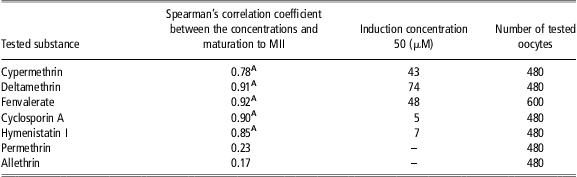
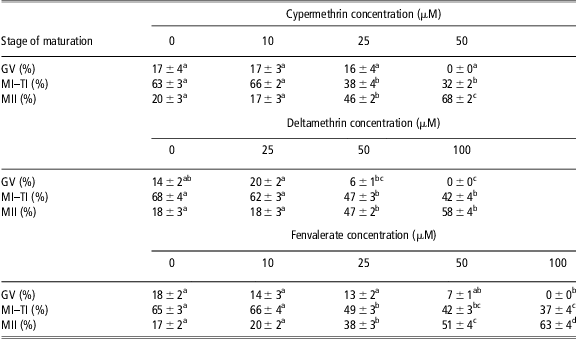
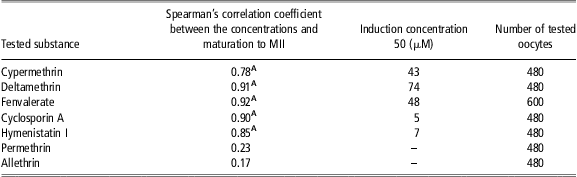
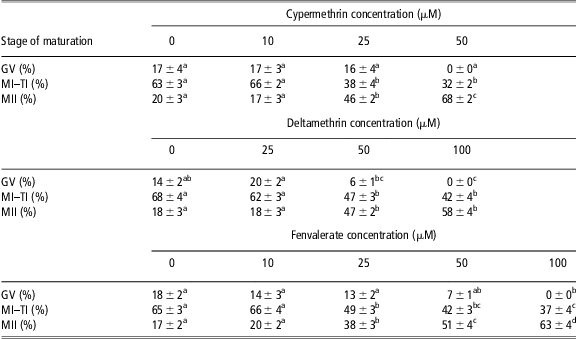
After 48-h in vitro culture under the influence of calcineurin-inhibiting pyrethroids, the percentage of growing oocytes maturing up to the stage of MII significantly increased, and the percentage of oocytes which were unable to resume meiosis and undergo Germinal Vesicle Break Down (GVBD) significantly decreased (Tables 1 and 2).
Effect of culture of growing pig oocytes with partial meiotic competence (internal diameter 110 μm) with cypermethrin, deltamethrin, fenvalerate, cyclosporin A, hymenistatin I, permethrin and allethrin
MII = metaphase II.
Spearman's correlation coefficient between the concentrations of respective substances and the percentage of oocytes maturing to the stage of MII was significant (A) when probability of P was <0.05.
Induction concentration 50 – the concentration of the respective pyrethroid required to induce maturation to MII in 50% of growing oocytes with partial meiotic competence.
Effect of calcineurin-inhibiting pyrethroids on maturation of growing pig oocytes with partial meiotic competence
GV = germinal vesicle; MI = metaphase I; TI = telophase I; MII = metaphase II.
a,b,c,dDifferences (P < 0.05) among percentages of oocytes in a respective stage of nuclear maturation with the different treatments (i.e. differences within rows) are indicated by different superscripts.
In all, 120 oocytes were used for each treatment (i.e. for each pyrethroid concentration).
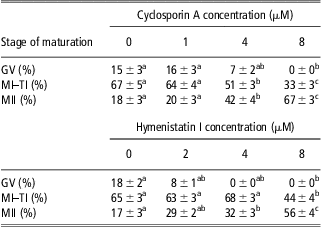
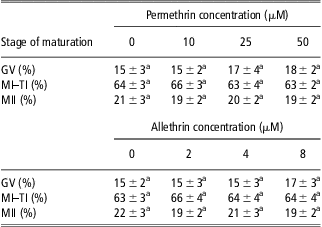
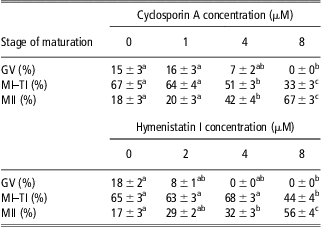
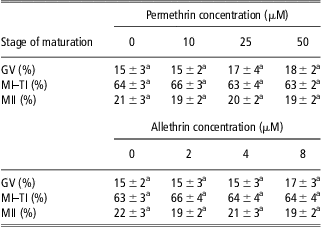
Similar effects were observed after the culture of growing pig oocytes with the specific non-pyrethroidal inhibitors of calcineurin – cyclosporin A or hymenistatin I (Tables 1 and 3). On the other hand, when growing oocytes with partial meiotic competence were cultured for 48 h with pyrethroids that do not inhibit calcineurin (10, 25 or 50 μM of permethrin; 10, 25 or 50 μM of allethrin), the maturation did not significantly differ from the maturation of the category of oocytes in a non-supplemented medium (Tables 1 and 4).
Effect of specific non-pyrethroidal inhibitors of calcineurin on maturation of growing pig oocytes with partial meiotic competence
GV = germinal vesicle; MI = metaphase I; TI = telophase I; MII = metaphase II.
a,b,cDifferences (P < 0.05) among percentages of oocytes in a respective stage of nuclear maturation with different treatments (i.e. differences within rows) are indicated by different superscripts.
In all, 120 oocytes were used for each treatment (i.e. for each inhibitor concentration).
Effect of calcineurin non-inhibiting pyrethroids on maturation of growing pig oocytes with partial meiotic competence
GV = germinal vesicle; MI = metaphase I; TI = telophase I; MII = metaphase II.
aThere are no differences (P < 0.05) among percentages of oocytes in a respective stage of nuclear maturation with different treatments (i.e. differences within rows), which are indicated by superscripts.
In all, 120 oocytes were used for each treatment (i.e. for each pyrethroid concentration).
During the 48-h culture of growing pig oocytes with partial meiotic competence with the maximum concentration of all tested substances, that is, with 50 μM cypermethrin (n = 50), 100 μM deltamethrin (n = 50), 100 μM fenvalerate (n = 50), 8 μM cyclosporin A (n = 50) or 8 μM hymenistatin I (n = 50), 50 μM allethrin (n = 50) or 50 μM cypermethrin (n = 50), we did not observe degeneration of oocytes. Viability was not significantly compromised after 48-h culture.
Effects of pyrethroids on fully grown oocytes
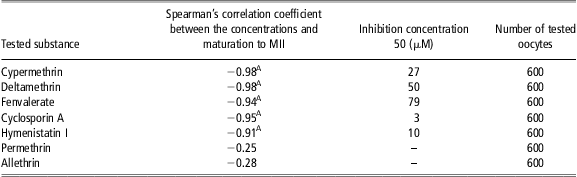
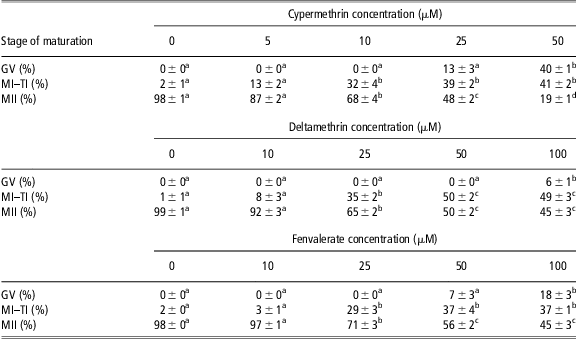
The ability of fully grown oocytes with full meiotic competence to mature in 48 h under in vitro conditions was affected by the tested calcineurin-inhibiting pyrethroids, and this effect was dose-dependent (Tables 5 and 6). The maturation of oocytes was only delayed. When oocytes were cultured for 72 h with 50 μM cypermethrin, 25 μM deltamethrin or 100 μM fenvalerate, the majority of oocytes matured up to the stage of MII (88% of MII in cypermethrin, 96% of MII in deltamethrin and 100% MII in fenvalerate).
Effect of culture of fully grown pig oocytes with full meiotic competence with cypermethrin, deltamethrin, fenvalerate, cyclosporin A, hymenistatin I, permethrin or allethrin
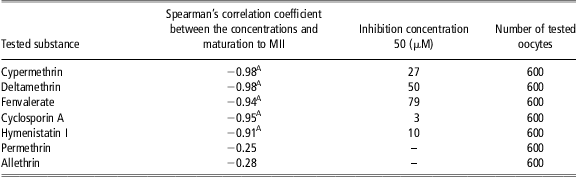
MII = metaphase II.
Spearman's correlation coefficient between the concentrations of respective substances and the percentage of oocytes maturing to the stage of MII was significant (A) when probability of P was <0.05.
Inhibition concentration 50 – the concentration of the respective pyrethroid required to induce inhibition of maturation in 50% of fully grown oocytes.
Effect of calcineurin-inhibiting pyrethroids on maturation of fully grown pig oocytes
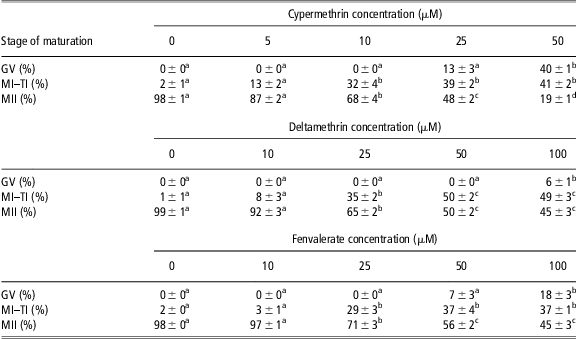
GV = germinal vesicle; MI = metaphase I; TI = telophase I; MII = metaphase II.
a,b,c,dDifferences (P < 0.05) among percentages of oocytes in a respective stage of nuclear maturation with different treatments (i.e. differences within rows) are indicated by different superscripts.
In all, 120 oocytes were used for each treatment (i.e. for each pyrethroid concentration).
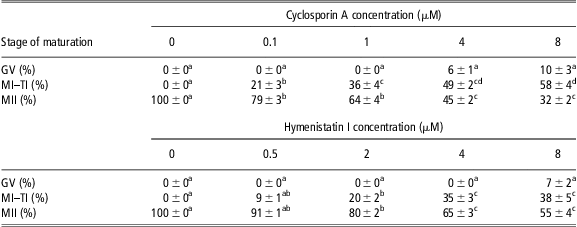
Similar effects were observed in fully grown pig oocytes with full meiotic competence after their 48-h culture with the specific non-pyrethroidal inhibitors of calcineurin – cyclosporin A or hymenistatin I. (Tables 5 and 7). The non-pyrethroidal inhibitors of calcineurin also only slowed the maturation of fully grown oocytes. When culture was prolonged from 48 to 72 h, 91% of the oocytes matured to the stage of MII in a medium supplemented with 8 μM of cyclosporin A and 88% of fully grown oocytes matured to the stage of MII when cultured 72 h with 8 μM hymenistatin I. All remaining oocytes reached the stage of MI. Prolongation of the oocyte culture with non-pyrethroidal inhibitors of calcineurin by 24 h (total culture time 72 h) resulted in maturation at the same level as 48-h culture in an inhibitor-free medium.
Effect of specific non-pyrethroidal inhibitors of calcineurin on maturation of fully grown pig oocytes
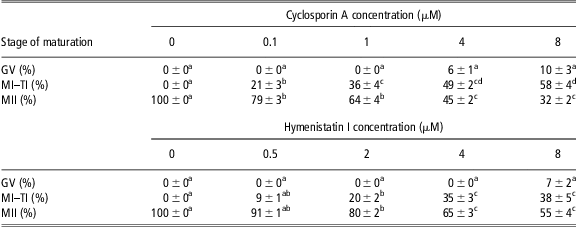
GV = germinal vesicle; MI = metaphase I; TI = telophase I; MII = metaphase II.
a,b,c,dDifferences (P < 0.05) among percentages of oocytes in a respective stage of nuclear maturation with different treatments (i.e. differences within rows) are indicated by different superscripts.
In all, 120 oocytes were used for each treatment (i.e. for each inhibitor concentration).
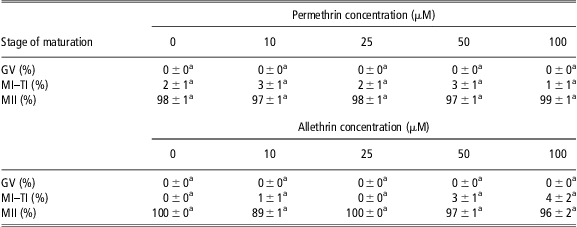
Culture of 48 h with pyrethroids, which do not inhibit calcineurin (10, 25, 50 or 100 μM permethrin; 10, 25, 50 or 100 μM allethrin), had no effect on the maturation of fully grown oocytes (Tables 5 and 8) despite the fact that concentrations were similar to those used in pyrethroid inhibitors of calcineurin. Maturation of oocytes cultured with permethrin or allethrin did not differ from the maturation of control oocytes cultured in a pyrethroid-free medium.
Effect of calcineurin non-inhibiting pyrethroids on maturation of fully grown pig oocytes
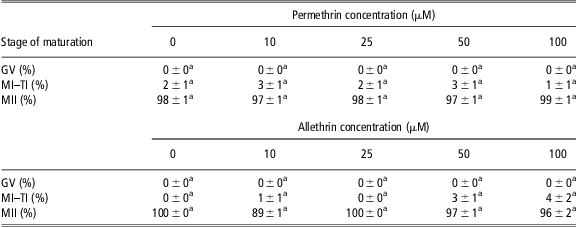
GV = germinal vesicle; MI = metaphase I; TI = telophase I; MII = metaphase II.
aThere are no differences (P < 0.05) among percentages of oocytes in a respective stage of nuclear maturation with different treatments (i.e. differences within rows), which are indicated by superscripts.
In all, 120 oocytes were used for each treatment (i.e. for each pyrethroid concentration).
During the 48-h culture of fully grown pig oocytes with full meiotic competence with the maximal concentrations of all tested substances, that is, with 50 μM cypermethrin (n = 50), 100 μM deltamethrin (n = 50), 100 μM fenvalerate (n = 50), 8 μM cyclosporin A (n = 50), 8 μM hymenistatin I (n = 50), 100 μM allethrin (n = 50) or 100 μM permethrin (n = 50) we did not observe degeneration of oocytes. Also, the viability of oocytes was not significantly compromised after 48 h culture.
Discussion
In our study, we used in vitro maturation of pig oocytes with different levels of meiotic competence for investigation of the effects of pyrethroids on meiotic maturation of mammalian oocytes. Under the tested concentrations of cypermethrin, deltamethrin or fenvalerate, the maturation of growing pig oocytes with partial meiotic competence was enhanced. On the other hand, we observed significant delay in the maturation of fully grown pig oocytes with full meiotic competence.
The mechanism for the effects of pyrethroids on oocyte maturation is not clear. The toxic effects of pyrethroids are usually connected to their effects on ion channels of the nerve cells (Soderlund, Reference Soderlund2010). Ion channels also play an important role in the maturation of mammalian oocytes (Tosti and Boni, Reference Tosti and Boni2004), and we cannot exclude the possibility that pyrethroids exert their effects on oocytes through ion channels. However, cypermethrin, deltamethrin and fenvalerate are also known as very specific inhibitors of protein phosphatase calcineurin (Enan and Matsumura, Reference Enan and Matsumura1992). Therefore, there is a possible explanation that the effects of pyrethroids observed in our study are mediated through their effects on calcineurin.
This suggestion was further supported by experiments in which oocytes were cultured with the specific non-pyrethroid inhibitors of calcineurin cyclosporin A and hymenistatin I. The effect of these inhibitors on the maturation of pig oocytes was very similar to the effect of pyrethroids inhibiting calcineurin. On the other hand, non-specific effects of the pyrethroids seem to have low probability taking into account that the pyrethroids allethrin and permethrin, which do not inhibit calcineurin, had no significant effect on the maturation of pig oocytes.
Moreover, the effects of cypermethrin, deltamethrin and fenvalerate on ion channels can be due to the inhibition of calcineurin, which is involved in the regulation of calcium channels (Yakel, Reference Yakel1997). In our previous studies (Rozinek et al., Reference Rozinek, Vaňourková, Sedmíková, Lánská, Petr, Rajmon and Jílek2003) we observed delayed maturation of fully grown pig oocytes with full meiotic competence after specific inhibition of L-type calcium channels. Of course, we cannot exclude other effects of calcineurin inhibitors.
The opposite effect, that is, meiosis induction in growing pig oocytes with partial meiotic competence and meiosis inhibition in fully grown oocytes with full meiotic competence after the treatment with calcineurin inhibitors seems paradoxical. Maturation of mammalian oocytes depends on cyclin-dependent kinase 1 (CDK1) associated with cyclin B. Exit from MI is possible after partial inactivation of this complex called Maturation Promoting Factor (MPF). The spontaneous blockage of maturation of growing oocytes with partial meiotic competence at the stage of MI is caused by the inability of these oocytes to inactivate, at least partially, MPF, as the decrease of MPF activity is essential for exit from the stage of MI and entry to the stage of AI (Hampl and Eppig, Reference Hampl and Eppig1995). MPF may be inactivated by the destruction of cyclin B from the complex of cyclin B with CDK1 (Yu, Reference Yu2002). However, there are alternative pathways for MPF inactivation, for example, its binding to separase or phosphorylation or dephosphorylation of MPF (Gorr et al., Reference Gorr, Reis, Boos, Wuhr, Madgwick, Jones and Stemmann2006). Protein phosphatases including calcineurin can play an important role in several mechanisms of MPF activation and inactivation. We can speculate that different mechanisms are targeted by calcineurin inhibitors in growing oocytes with partial meiotic competence and fully grown oocytes with full meiotic competence and it results in an opposite effect on maturation.
Oocytes exposed to chemicals that distort the course of meiotic maturation have limited ability for in vitro fertilization (Casas et al., Reference Casas, Bonilla, Ducolomb and Betancourt2010). Similarly, pyrethroids can affect the quality of oocytes. Fully grown oocytes with maturation delayed under the effects of pyrethroids may have limited ability for fertilization and further development. The enhanced maturation of growing oocytes with partial meiotic competence can also impair female reproduction because these oocytes resume meiosis without the completion of the synthesis of the messenger RNA, which is necessary both for correct maturation and for the proper course of the initial mitotic cycles of embryonic development (Wassarman, Reference Wassarman1988). The developmental competence after in vitro fertilization or parthenogenetic activation of growing oocytes exposed to inhibitors of calcineurin is not known and experiments on this topic are underway in our laboratory.
The effects of pyrethroids on mammalian oocytes deserve attention because people or animals are exposed to pyrethroids on many occasions. The primary source of pyrethroid contamination is diet. However, these compounds are also present in the home environment (Julien et al., Reference Julien, Adamkiewicz, Levy, Bennett, Nishioka and Spengler2008). Metabolites of pyrethroids have been observed in a significant proportion of the human population (Heudorf and Angerer, Reference Heudorf and Angerer2001). Pyrethroids are also applied topically to people (Taplin and Meinking, Reference Taplin and Meinking1987) or animals (Sassine et al., Reference Sassine, Moura, Morais Léo and Vega Bustillos2004). The total dose in these treatments is in grams. The absorption of pyrethroids varies widely (from 0.5% to 50%) but is generally low in man (Perger and Szadkowski, Reference Perger and Szadkowski1994).
As the majority of pyrethroids are rapidly metabolized or excreted, the levels of pyrethroids and their residues, except immediately after spray or exposure, are usually very low (Elflein et al., Reference Elflein, Berger-Preiss, Preiss, Elend, Levsen and Wunsch2003). The levels of pyrethroids and their residues in the blood of people exposed to pyrethroids are either very low (1 ppb) or undetectable (Ramesh and Ravi, Reference Ramesh and Ravi2004; Liao et al., Reference Liao, Hsieh, Chiang, Lin, Chen and Wu2011). The levels of pyrethroids and their residues in urine are usually higher (up to 1 μM) despite undetectable levels in the blood of the same people (Leng et al., Reference Leng, Kühn and Idel1997). Moreover, the plasma levels of pyrethroids do not reliably reflect the levels of these insecticides in other body parts (Kim et al., Reference Kim, Anand, Kim, White, Fisher, Tornero-Velez and Bruckner2010). Pyrethroids are lipophilic and are stored in fats including milk fat. Dairy cows topically treated with cypermethrin excreted from 0.025 mg up to 0.168 mg cypermethrin per 1 kg of milk (Rothwell et al., Reference Rothwell, Burnett, Hacket, Chevis and Lowe2001; Sassine et al., Reference Sassine, Moura, Morais Léo and Vega Bustillos2004). Similar levels of pyrethroids were detected in human milk (permethrin 14 μg/l, cypermethrin 4 μg/l, deltamethrin 8 μg/l) (Bouwman et al., Reference Bouwman, Seereda and Meinhadt2006). Fat, but also skin and muscles, are able to accumulate pyrethroids (up to 10 μg/ml) and act as slow-release depots (Kim et al., Reference Kim, Anand, Kim, White and Bruckner2008).
In our study, the effects of pyrethroids on pig oocyte maturation were observed in concentrations (IndM50 or InhM50) that are much higher than levels usually detected in the organisms of people or animals exposed to pyrethroids. From this point of view it seems that our results have only limited significance. On the other hand, many authors have shown that pyrethroids can temporarily reach comparable levels, especially in some tissues (Kim et al., Reference Kim, Anand, Kim, White, Fisher, Tornero-Velez and Bruckner2010). Animals and people can be accidentally or deliberately exposed to doses of pyrethroids, which at least temporarily elevate levels of these substances to the level comparable to the concentrations used in our study.
The lipophilic nature of pyrethroids enhances their affinity to tissues and cells with high fat content. Lipid content in oocytes varies widely with species. Pig oocytes typically contain 156 ng lipids (McEvoy et al., Reference McEvoy, Coull, Broadbent, Hutchinson and Speake2000), much more than mouse (4 ng per oocyte, Lowenstein and Cohen, Reference Lowenstein and Cohen1964), cattle (58 ng per oocyte, Ferguson and Leese, Reference Ferguson and Leese1999) or sheep (89 ng per oocyte, Coull et al., Reference Coull, Speake, Staines, Broadbent and McEvoy1998) oocytes. We cannot exclude the possibility that pig oocytes are exposed to higher loads of lipophilic pyrethroids due to their high level of lipids.
According to the best of our knowledge, this study is the first that demonstrated a significant effect of pyrethroids on the maturation of mammalian oocytes under in vitro conditions. With respect to the increasing problems with infertility in mankind, it is necessary to further investigate this topic.
Acknowledgments
This study was supported by grants from GACR – 502/10/0794 and 523/08/H064 and MSM 6046070901. The authors thank Mrs Lois Russell for her editorial assistance with this manuscript and Mr Daniel Žalman for technical support.