Our comprehension of prosocial behavior and its impact on well-being in adults is still in its early stage. In most cultures, prosocial behaviors have frequently been linked to psychological well-being and mental health (Baldassarri & Grossman, Reference Baldassarri and Grossman2013; Caprara et al., Reference Caprara, Steca, Zelli and Capanna2005; Carlo, Crockett, Wilkinson & Beal, Reference Carlo, Crockett, Wilkinson and Beal2011). Nevertheless, research on this subject has primarily been carried out with child and adolescent samples, highlighting in both cases that children and adolescents who display prosocial behaviors have less risk of internalizing and externalizing behaviors (Caprara & Steca, Reference Caprara and Steca2005; Nantel-Vivier, Pihl, Côté, & Tremblay, Reference Nantel-Vivier, Pihl, Côté and Tremblay2014). There are few studies with adults (Anik, Aknin, Norton, Dunn, & Quoidbach, Reference Anik, Aknin, Norton, Dunn and Quoidbach2013), but they, too, have linked prosocial behavior to low levels of depression, job satisfaction, high levels of life satisfaction and self-esteem, or to the presence of high quality social relations, even when the diverse occupations related to work or the community compete with each other (Anik et al., Reference Anik, Aknin, Norton, Dunn and Quoidbach2013; Caprara et al., Reference Caprara, Steca, Zelli and Capanna2005; Weinstein & Ryan, Reference Weinstein and Ryan2010).
Prosocial behavior refers to the individual tendency to undertake voluntary actions aimed at benefiting others. This kind of behavior facilitates social interactions (Alessandri, Caprara, Eisenberg, & Steca, Reference Alessandri, Caprara, Eisenberg and Steca2009; Sánchez-Queija, Oliva, & Parra, Reference Sánchez-Queija, Oliva and Parra2006) and includes actions such as helping, sharing, care-taking, or supporting others (Mestre, Samper, Tur, Cortés, & Nácher, Reference Mestre, Samper, Tur, Cortés and Nácher2006).
Although prosocial behavior is conceptually recognized as a universal element in evolutionary development, there is ongoing debate about the construct and the psychological variables that condition it (DuBois, Reference DuBois2012; Eisenberg, Fabes, & Spinrad, Reference Eisenberg, Fabes, Spinrad, Eisenberg, Damon and Lerner2006; McGinley, 2008). It has been related to complex psychological and evolutionary processes involving cognitive (attention, perception), affective (empathy, self-efficacy, self-regulation), or sociocognitive domains (moral reasoning, values), as noted by Balconi and Canavesio (Reference Balconi and Canavesio2013); Caprara, Alessandri, and Eisenberg, (2012); Caprara et al. (Reference Caprara, Steca, Zelli and Capanna2005); or Gutiérrez, Escartí, and Pascual (Reference Gutiérrez, Escartí and Pascual2011). It has also been consistently linked to socialization practices and to some parenting-related dimensions such as attachment, affection, discipline, education in values, etc. (Richaud de Minzi, Lemos, & Mesurado, 2011). In spite of this, there is very little research integrating the diverse relevant variables into complex models that allow observing their combined influences and interactions (DuBois, Reference DuBois2012; McGinley, 2008).
Additionally, methodological problems also determine the scarce comprehension of prosociality and the mediators involved in adulthood. In spite the fact that a consistent part of research has addressed specific forms of prosocial behavior, such as volunteering or organizational citizenship behavior (Okun, Yeung, & Brown, Reference Okun, Yeung and Brown2013; Podsakoff, Whiting, Podsakoff, & Blume, Reference Podsakoff, Whiting, Podsakoff and Blume2009), in practice, there is a lack of general measures of prosociality and, particularly, measuring instruments designed for adults.
Adult Prosocialness Scale
The Adult Prosocialness Scale, developed in the Italian context by Caprara et al. (Reference Caprara, Steca, Zelli and Capanna2005), is practically the only specific scale of prosociality for adults, which aims to understand prosociality globally. It analyzes the individual’s tendency to display a series of prosocial behaviors in different settings and for different reasons.
It is a brief instrument, easy to use and to understand, and very applicable in research. It consists of 16 items that reflect behaviors and feelings related to one of four areas: sharing, helping, care-taking, and feeling empathy for others’ needs and requirements (Caprara et al., Reference Caprara, Steca, Zelli and Capanna2005; Caprara & Pastorelli, Reference Caprara and Pastorelli1993). Although the first three components were not new, the incorporation of empathy as an integral part of prosociality, and not as a variable merely correlating with such behavior, was a novelty. The instrument was administered in Italy to a representative adult sample with regard to age (18 to 92 years, M = 44.5, SD = 17), made up of 2,574 individuals (1,278 men and 1,296 women).
By means of different studies (Alessandri et al., Reference Alessandri, Caprara, Eisenberg and Steca2009; Caprara et al., Reference Caprara, Steca, Zelli and Capanna2005; Caprara & Steca, Reference Caprara and Steca2005, Reference Caprara and Steca2007), the psychometric robustness of this scale at the item and scale level have been confirmed, showing a high discriminative capacity in both genders, especially at the intermediate and lower levels of prosocial behavior. Its concurrent validity was confirmed through its correlations with constructs such as personal and social self-efficacy and life satisfaction.
This questionnaire seems to be an adequate instrument to study in depth the conceptual construct of prosociality in adulthood. Nevertheless, it has not yet been adapted to other languages, among them, Spanish.
The present study
As has been suggested, the literature shows methodological limitations in the assessment of general tendencies to behave prosocially, so at this stage, there are few studies, despite the apparently mediating role of prosociality in individual well-being (Caprara & Steca, Reference Caprara and Steca2005, Reference Caprara and Steca2007). In order to have access to an instrument in the Spanish language to explore the role of prosociality in psychological well-being in adulthood, we propose the adaptation of the Adult Prosocialness Scale of Caprara et al. (Reference Caprara, Steca, Zelli and Capanna2005).
The main goal is to analyze the instrument’s metric goodness for use in Spanish samples. For this purpose, besides construct analysis, we will compare the instrument’s functioning in a Spanish sample with that observed in a sample of young Italian adults (culture of origin of the scale), in order to confirm its invariance for use in different contexts.
A secondary goal of the study is to verify the instrument’s validity as a function of values and gender. On the one hand, some authors (Alessandri et al., Reference Alessandri, Caprara, Eisenberg and Steca2009; Caprara, Alessandri, Di Giunta, Panerai, & Eisenberg, Reference Caprara, Alessandri, Di Giunta, Panerai and Eisenberg2010; Caprara & Steca, Reference Caprara and Steca2007, Schwartz, Reference Schwartz, Mikulincer and Shaver2010) point out that values could explain an important part of the tendency to act prosocially. Values are understood as the priorities in life that control people’s actions, constituting a motivational force that conditions their prosocial behavior (Caprara et al., Reference Caprara, Alessandri and Eisenberg2012). In the present study, as an example of values of Self-transcendence, we studied Benevolence and, as an example of values of Promotion or Power Achievement, we used the value of Power. We expect that the value of Benevolence will be positively related to prosociality in adults (Daniel, Bilgin, Brezina, Strohmeier, & Vainre, Reference Daniel, Bilgin, Brezina, Strohmeier and Vainre2015; DuBois, Reference DuBois2012). In contrast, we expect that the value of Power will be negatively related to prosociality (Caprara & Steca, Reference Caprara and Steca2007; Joosten, van Dijke, van Hiel, & De Cremer, Reference Joosten, van Dijke, van Hiel and De Cremer2015).
Gender has been identified as an essential variable in adulthood because of its differential association with diverse patterns of prosociality. The general tendency in the different studies carried out (Alessandri et al., Reference Alessandri, Luengo Kanacri, Eisenberg, Zuffianò, Milioni, Vecchione and Caprara2014; Mestre et al., Reference Mestre, Samper, Tur, Cortés and Nácher2006) show higher levels of prosocial disposition in women. Moreover, in accordance with Eagly (Reference Eagly2009), men and women not only display different behaviors, but these differences are linked to the contexts in which they develop. Thus, men tend to act more in situations that require fast action or in emergencies, whereas women seem to deploy their altruistic behavior in family or relational contexts, for example, those in which a friend, couple, or work partner needs support, care, or empathic comprehension. We note that the study of gender differences in adults’ prosocial behavior is very limited (Caprara et al., Reference Caprara, Steca, Zelli and Capanna2005) because most of the studies have been carried out with children or adolescents. Moreover, they lack external validity due to the limited range of prosocial behaviors evaluated and the insufficient comprehension of the mediators (Eisenberg et al., Reference Eisenberg, Fabes, Spinrad, Eisenberg, Damon and Lerner2006).
Method
Participants
The sample was made up of two groups, the first one with 646 Spanish participants, 190 men (29.4%) and 456 women (70.6%), aged between 17 and 22 years. All of them were university students studying University Degrees in Psychology, Social Education, Primary Education, and Child Education, in two private universities, one located in Barcelona (37,6%) and the other in Bilbao (62,5%).
A second group of participants came from an Italian university located in Milan, with comparable characteristics, in order to replicate and compare the results obtained with the original study. This group was made up of 236 participants, aged between 17 and 20 years, 103 men (43.6%) and 133 women (56.4%), from the same training areas. The participants, of medium socioeconomic status, came mostly from families with two parents (< 75%) and with one or more siblings (< 88.7%).
Instruments
Prosociality. This was assessed with the Adult Prosocialness Scale (Caprara et al., Reference Caprara, Steca, Zelli and Capanna2005). The 16 items of the questionnaire present behaviors and feelings that reflect aspects linked to sharing, helping, care-taking, and feeling empathy towards others, their needs, or requests. The items are rated on a 5-point Likert-type scale ranging from 1 (never/almost never true) to 5 (always/almost always true). The instrument has been shown to have good psychometric characteristics. Its items have shown construct validity, sensitivity to discriminate subjects’ prosociality, and high internal consistency (α = .91). The instrument was subjected to a process of back-translation, in which two bilingual people participated, the first one was Spanish, and the second one was a native English speaker.
Portrait Values. Values were assessed with a brief version of the Portrait Values Questionnaire (Schwartz, Melech, Lehmann, Burgess, & Harris, 2001) adapted by Páez, Fernández, Ubillos, and Zubieta (Reference Páez, Fernández, Ubillos and Zubieta2004). Each item describes goals, wishes, or important aspirations in the life of a third person (e.g., “Having new ideas and being creative is important for him/her. He/she likes to do things his/her own, original way”). Participants indicate the degree to which they recognize themselves in the descriptions or statements on a 6-point Likert-type scale, ranging from 1 (not at all like me) to 6 (very much like me). Participants’ responses allow inferring their personal values through the self-report of their similarity to person described in the questionnaire. These items are organized in 10 dimensions that correspond to the 10 values identified from the theoretical proposal of the authors which, in turn, were organized into 4 higher dimensions: Self-Transcendence (dimensions: Universalism and Benevolence); Self-Promotion (dimensions: Power and Achievement); Openness (dimensions: Autonomy and Stimulation); and Conservation (dimensions: Safety, Tradition, and Conformity). Lastly is the dimension of Hedonistic Values, which, according to this classification, shares elements of the values of Openness and Self-transcendence. Each dimension is assessed through two items, except for Universalism, which is assessed with three items. The reduced version showed cultural equivalence and construct and convergent validity (Schwartz, Reference Schwartz2014) with the complete 40-item scale.
In this study, only two of the ten dimensions of the questionnaire were considered: Benevolence (a dimension of Self-transcendence) and Power (a dimension of Self-Promotion), as they are more closely related—positively or negatively—with the construct of prosociality. The levels of internal consistency, Cronbach’s alpha, of these two dimensions, respectively, were .65 (Power) and .67 (Benevolence). These reliabilities are low because each dimension has only 2 items which must tap conceptually broad constructs.
Procedure
This is a cross-sectional, correlational design. All the students of the above-mentioned degrees were invited to participate. The study was approved by the Ethics Committee of the universities, and after receiving the corresponding permissions from the academic staff, we administered the questionnaire in university classrooms. At all times, we guaranteed the voluntary nature of participation and the confidentiality of the data.
The administration was carried out in the presence of two researchers in order to resolve any doubts that might arise.
Analysis Strategy
Firstly, we analyzed the distribution of items of the Adult Prosocialness Scale through the following indexes: Frequency of choice of each response option, means, standard, deviations, skewness, kurtosis, correlation of each item with the scale, and the value of the coefficient alpha if the item was deleted. We also tested the scale’s internal consistency and applied the Kolmogorv-Smirnov normality test.
The criteria for the possible elimination of items were: Having low communalities, having a Pearson coefficient lower than .40 between the item and the scale, and increasing Cronbach’s alpha of the scale by more than .03 if the item was deleted. After calculating the characteristics of the distribution of each item, we analyzed the interrelation of the elements of the scale. For this purpose, we calculated the Kaiser-Meyer-Olkin (KMO) index and conducted Bartlett’s Sphericity test. The KMO index confirmed that the partial correlations were low. KMO values above .70 and a statistically significant sphericity test indicate that factor analysis is adequate.
With regard to the main goal, analysis of the Adult Prosocialness Scale’s, we attempted to confirm the authors’ original structure, using structural covariance techniques. We calculated the fit of our data to the measuring models using the AMOS program and the maximum likelihood method (ML). To analyze the goodness of fit of the model, we used: Root mean square error of approximation (RMSEA) and its confidence interval, considering values between .05 and .08 as acceptable, and values below .05 as very good. We also used the goodness of fit index (GFI) and the comparative fit index (CFI), considering values higher than .90 as adequate (Hair, Black, Babin, Anderson, & Tatham, Reference Hair, Black, Babin, Anderson and Tatham2006). For the structural coefficients, we used a standardized solution, whose recommended value is at least .50, and it should be statistically significant (Hair et al., Reference Hair, Black, Babin, Anderson and Tatham2006). Besides these indicators, another criterion for item selection was the changes suggested by the modification indexes of AMOS.
In a second step, we analyzed the cross-cultural invariance of the Adult Prosocialness Scale. The analysis of the equivalence of transcultural scores is essential to confirm the applicability of a measuring instrument in different cultures or countries. The analysis of invariance provides relevant information about the degree to which the responses to the items of the questionnaire have the same meaning in different groups.
For the analysis of invariance of the scores obtained by the questionnaire in the Spanish and Italian groups, we carried out the steps indicated in the model of Little (Reference Little1997), which requires, for complex analyses, the analysis of 4 types or models of invariance: Configural, metric, scalar, and strict (Gregorich, Reference Gregorich2006). For the configural invariance in both groups, the same set of items is associated with the same construct or specific factor of the scale. For this purpose, no equality constraints are established in any of the parameters of the model (Model 1). In metric invariance, factor loadings are constrained to be equal (Model 2). Evidence for this second model would indicate that the Prosocialness factor has the same meaning for both groups. In scalar invariance, the intercepts are constrained to be equal, that is, the factor loadings are retained and the intercepts are fixed to be equal (Model 3, which examines whether the comparison of the means of the groups can be an object of analysis). Lastly, in strict invariance, the factor loadings, intercepts, and residual errors of the items are considered conjointly. This is, constraints of equality of residual errors of the items are added while maintaining factor loadings and intercepts fixed to be equal in the two groups (Model 4, which analyzes whether the group comparisons of observed measures or the variances of compound scores are significant).
To study the above-mentioned invariance models, we performed multi-group comparison (for example, configural model vs. metric model). To interpret the results, we used the ΔCFI value. Specifically, values of this indicator equal to or less than .01 were used as the criterion to determine the invariance between models (Cheug & Rensvold, 2002).
Regarding the secondary goal, we performed Pearson correlation analysis, taking into account the Self-transcendence (Benevolence) and Self-promotion (Power) dimensions. In accordance with the literature review, we expected the values of Benevolence and Power to present significant coefficients pointing in the opposite direction. Finally, prosociality scores are compared according to gender by Student’s t statistic in both samples.
Results
Item distribution
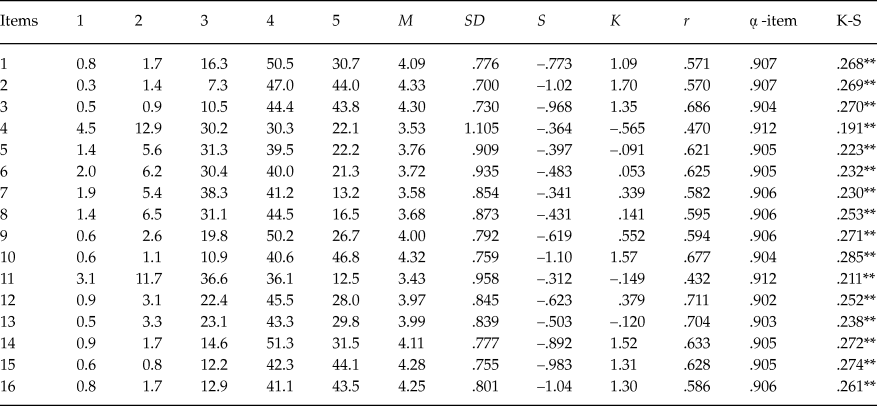
Scores obtained on the Adult Prosocialness Scale in Spanish population (Table 1) were medium-high (Table 1). High scores indicate participants’ greater recognition of or identification with the statements described in the items. Participants identified themselves as displaying and experiencing each behavior, attitude, and feeling described in the instrument to a high degree in their daily lives, obtaining a mean score for each of the items very close to or higher than 4 points.
Item Distribution and Descriptive Characteristics of the Prosocialness Scale

Note: M = Media; SD: Standard Deviation; S = Skewness; K = Kurtosis; r = item-global scale correlation; α- item = reliability index of the global scale if the item is removed; K-S = Kolmogorov-Smirnov Normality test.
**p < .001
This grouping at the higher extreme of the scale was verified by the negative skewness of all the items, near the value of –1.25 for Items 2, 3, 10, 15, and 16, which refer to sharing and helping others, as well as special sensitivity if the other person is a friend. In this set of items, high values of skewness indicate a larger accumulation of scores at the higher pole.
Various items had high values of kurtosis, with the highest values in Items 2, 3, 10, 15, and 16, as with skewness. However, for this indicator in particular, we note the values obtained for Items 1 and 13. All this highlights the great homogeneity of the data for this set of items in particular. We also obtained negative values of kurtosis for Items 4, 5 and 13, which shows the high presence of cases at the extremes.
Regarding the correlation of the items with the overall scale, the mean association index was high (.61), ranging between .43 for Item 11 and .71 for Item 12. All the items had correlations higher than .40, allowing us to affirm that all of them contribute substantially to the whole instrument, and suggesting that the configuration of the total score should be retained.
Moreover, in all cases, the normality test was significant, which suggests a violation of this assumption.
Lastly, the KMO index and the Bartlett Sphericity test indicated that the data matrix was factorizable, so the next step was to perform Confirmatory Factor Analysis of the instrument.
Construct Validity of the Adult Prosocialness Scale.
With regard to our first goal, the first step was to verify the construct validity of the instrument in the Italian sample. We replicated a unifactorial structure (Figure 1) in which all the items of the instrument were subsumed in a single Prosociality factor. All the standardized coefficients were statistically significant and over .50, except for Items 1 (λ = .42), 2 (λ = .35), 4 (λ = .39), 11 (λ = .41), and 14 (λ = .40). However, these items obtained values close to those recommended in the literature. The model presented adequate goodness of fit, as all the selected indexes were considered at the limit of acceptance, according to the criteria described above (GFI = .90, CFI = .91, and RMSEA = .075). Lastly, the index of internal consistency of the scale was .88, which is higher than the recommended optimal value of .70 (Hair et al., Reference Hair, Black, Babin, Anderson and Tatham2006).
Confirmatory Factor Aalysis of the Unifactorial Structure and Cross-Cultural Invariance of the Prosocialness Scale.

Also in the Spanish sample (Figure 1), we found the unifactorial structure of the original scale (GFI = .93, CFI = .94, and RMSEA = .071) with all the items included in a single global dimension. Like in the Italian sample, all the standardized coefficients were statistically significant and over .50, except for Items 4 (λ = .48) and 11 (λ = .45). However, as in the previous model, these items had values approaching the recommended ones. We also obtained a high consistency index, specifically a value of .91.
Invariance Analysis
With regard to the analysis of invariance between groups, the results revealed empirical evidence of configural (Model 1) and metric invariance (Model 2) when comparing the responses from Spain and Italy in the prosociality construct (see table 2). The overall results indicate the viability of constraining the factor loading to be the same across the groups. However, the CFI difference between Model 3 and Model 2 is superior to .001, which indicates that there is not complete invariance of the intercepts across the two groups. Following modification indices, we relaxed the constraints associated with the two single intercepts that MI analysis proposed: Items 4 (Model 3P) and 12 (Model 3P2). However, the ΔCFI still indicated a lack of strong invariance, as it was still larger than the cut point of .01 (see Table 2). The lack of invariance at this level does not allow the analysis of strict invariance, so we could not conduct analysis of differences in the latent or observed variables. The finding of invariance at the metric level assures that comparisons can be made as to the relationships between the factors coefficients across age groups. The results indicate, however, that caution should be used in analyses involving comparison of means between groups
Fit Indices for Invariance Tests

Note: χ2 = chi-square; df = degrees of freedom; p = probability; CFI = Comparative fit index; ΔCFI = Change of the Comparative fit index; RMSEA = Root Mean Square Error of Approximation; RMSEA (IC-90%) = RMSEA confidence interval.
Personal Values: Benevolence and Power.
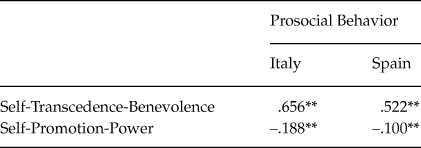
In the Italian sample, we found high, positive, and significant correlations between prosociality and the Benevolence dimension (r = .66, p = .001); and moderate, negative, and significant correlations with the Power dimension (r = –.19, p = .001). Hence, participants who perceive themselves as people who value helping and being concerned about others, as well as being loyal to their loved ones, reported more identification or agreement with the practice of prosocial behaviors in their lives. In contrast, participants for whom the accumulation of wealth and respect/obedience from the people of their environment is more important indicated less practice of this type of prosocial behaviors.
In the case of Spain (Table 3), the results were similar to those of the Italian sample. We observed high, positive, and significant correlations between prosocial behavior and Benevolence (r = .52, p = .001). In contrast, prosocial behavior correlated moderately, negatively, and significantly with the value of Power from the dimension of Self-promotion (r = –.10, p = .001).
Correlations between the Dimensions of Benevolence and Power of 21–PVQ and Adult Prosociality

Note: **p < .001
Gender differences
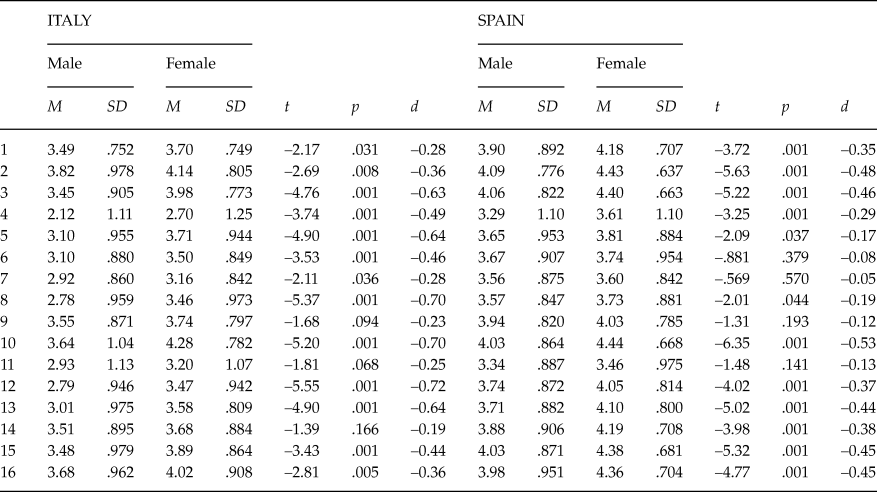
In the case of Italy (Table 4), the difference of responses for each of the items of the prosociality scale was statistically significant in all cases, except for Items 9 (t = –1.68, p = .095), 11 (t = –1.81, p = .068), and 14 (t = –1.39; p = .166). These three items refer to the degree to which participants recognize themselves as people who share with others their skills or knowledge (Item 9), material aspects like money (Item 11), as well as good opportunities with close friends (Item 14). For the rest of the cases, women’s scores were significantly higher than men’s, expressing a greater degree of agreement or identification with the practice of prosocial behaviors in the situations and dimensions of the questionnaire.
Differences between Items by Participant’s Gender

Note: M = Mean; SD = Standard Deviation; t = t-student; p = probability value; d = d-Cohen.
In the case of the Spanish sample (Table 4), there was a pattern of statistically significant gender differences for each of the items of the prosociality scale, except for 4 items, two that are shared with the Italian sample, Item 9 (t = –1.31, p = .193) and Item 11 (t = –1.48, p = .141), related to willingness to share material objects with others, and two differential ones: Item 6 (t = –.881 p = .379) and Item 7 (t = –.569, p = .570), referring to helping others or to preventing a possible risk. For the rest of the cases, women scored higher than men.
Discussion
The present study focused on the translation and validation of the Adult Prosocialness Scale designed by Caprara et al. (Reference Caprara, Steca, Zelli and Capanna2005) for use in a Spanish sample. The analysis of the construct and concurrent validity in two similar samples of young adults (Spanish and Italian), has provided robust evidence of the adequacy of the instrument for use in Spanish, replicating the instrument’s suitability in the Italian sample.
The study of the scale’s adaptation to the Spanish setting was carried out with a group of 646 university students. The initial descriptive data allowed us to support the adequacy of all the items, in spite of the homogeneity of the participants in the study. That is, the group of participants presented a high level of prosociality, understood as the tendency to practice in their lives the behaviors, attitudes, and feelings described in the instrument. This was especially evident in those items related to the tendency to share, and to show empathy to others in situations of loneliness, sadness, or distress.
The analyses to confirm construct and the concurrent validity were also carried out with the Italian sample in order to have a comparable reference group. The original unifactorial structure, with all the items contributing to the latent construct (prosociality), supported the construct validity, and the high internal consistency of the instrument in both samples (.88 in the Italian sample vs. .91 in the Spanish sample) confirmed the high reliability of the original scale. Practically all the items presented correlations higher than .50 with the construct. Items linked to care-taking, empathetic comprehension, and emotional support were more strongly correlated with the latent construct.
Regarding the cross-cultural adaptation of the instrument, configural invariance is confirmed. This datum indicates that the construct of prosociality is conceptualized in the same way in both samples (Cheung & Rensvold, Reference Cheung and Rensvold2002). Therefore, the results obtained in the present study allow us to conclude that the participants from two different cultural groups (or countries), Spain and Italy, share the same definition of the construct of prosociality.
With regard to the second model, we also observed metric invariance in the scores obtained with the instrument in the two countries; that is, the factor loadings in Spain and Italy are equivalent. In this sense, the data indicate that the Spanish participants probably interpret the meaning of each one of the items that make up the prosocialness scale in the same way as the Italian participants.
Nevertheless, the results obtained do not allow us to confirm a full or partial scalar invariance of the scale between these two groups. This type of invariance is a prerequisite for a comparison of means between the observed and latent variables of a model (Gregorich, Reference Gregorich2006). As it did not meet the acceptance criterion, this analysis could not be carried out. Absence of scalar invariance seems to indicate that the variables not directly related to the common factor measured by the instrument may lead to more or fewer responses to the items in one group compared with the other (Gregorich, Reference Gregorich2006). That is, the differences in the obtained scores may not reflect real differences in the measured construct but instead a differential functioning of the instrument in each group included in the study (Millsap & Kwok, Reference Millsap and Kwok2004). In this sense, sample size may affect the absence of this type of invariance. We highlight the notable difference between the two groups, with the Spanish sample being three times as large as the Italian sample. In short, this composition of the groups may constitute a factor that affects the results linked to this type of invariance. As a result, the hypothesis of strict invariance is not supported.
The values of Benevolence and Power were also confirmed in the present study in relation to prosociality in Spanish and Italian students. In both samples, the same pattern of results was found, in agreement with the tenets of Schwartz. The dimension of Benevolence—being concerned about others’ well-being—was positively related to prosocial behavior, and the dimension of Power—valuing one’s own interests, the accumulation of wealth, respect, and obedience—was negatively related to prosocial behavior, as found in previous studies (Alessandri et al., Reference Alessandri, Caprara, Eisenberg and Steca2009; Caprara et al., Reference Caprara, Alessandri, Di Giunta, Panerai and Eisenberg2010; Caprara & Steca, Reference Caprara and Steca2007). Therefore, our results support the theoretical proposal that considers values as vital priorities that constitute motivational forces that control behavior (Caprara et al., Reference Caprara, Alessandri and Eisenberg2012; Schwartz, Reference Schwartz, Mikulincer and Shaver2010).
This association is consistent with findings of other studies, even cross-cultural ones like the one recently developed by Daniel et al. (Reference Daniel, Bilgin, Brezina, Strohmeier and Vainre2015) in samples of German, English, Turkish, and Israeli university students, showing the cross-cultural stability of the relations. The magnitude of the correlations found seems to vary, although they appear to be associated with the measure employed in the study, as the effect sizes were higher when self-report measures rather than observational measures were used (Caprara & Steca, Reference Caprara and Steca2007; Daniel et. al, Reference Daniel, Bilgin, Brezina, Strohmeier and Vainre2015). Higher correlations have also been found in this study, which may imply a methodological bias due to social desirability.
Lastly, the analyses of gender contribute to support the validity of the study. In all the items and in both samples, the score was higher for women than for men, although the differences were nonsignificant in some items. These items are the same as those that research has linked to more instrumental and assertive behaviors, that is, more typically male. In the case of Italy, items with no gender differences (Items 9, 11, and 14) were associated with sharing skills, knowledge, money or opportunities; in the case of Spain, these items also included intervention in situations of risk or emergency (Items 6, 7, 9, and 11). These items had lower factor loadings.
This distinction of the items is not surprising because various studies have found more expression of prosociality in women than in men (Alessandri et al., Reference Alessandri, Luengo Kanacri, Eisenberg, Zuffianò, Milioni, Vecchione and Caprara2014; Mestre et al., Reference Mestre, Samper, Tur, Cortés and Nácher2006) or they highlight that the expressions occur in different contexts (Eagly, Reference Eagly2009), with the men tending to act more in instrumental situations related to emergencies, and women tending to act in situations associated with closely related people. In spite of this, studies with adults are very scarce and most of them evaluated a limited range of prosocial behaviors (Eisenberg et al., Reference Eisenberg, Fabes, Spinrad, Eisenberg, Damon and Lerner2006).
This pattern of results could be justified by the socialization of gender roles (Eisenberg et al., Reference Eisenberg, Fabes, Spinrad, Eisenberg, Damon and Lerner2006) and its consequence on the division of work and the interaction between physical attributes and social structure (Eagly, Reference Eagly2009). That is, shared beliefs are culturally generated and internalized from childhood, which explains the division between men and women in prosociality (e.g., responsibility for the care of children or of old people, responsibilities in relational vs. instrumental volunteer activities, etc.), as pointed out by Rotolo and Wilson (Reference Rotolo and Wilson2007). Culture subsequently reinforces and rewards the division.
However, the results obtained in this study raised some questions about the absence of men’s predominance in some items, as occurred in the original study. This may be due to the particular characteristics of the values in the group of participants, that is, students studying university degrees related to helping professions. We can anticipate that, depending on their training, students will vary in the values they develop, and these will act as mediators in the prosocial behavior of men and women. This hypothesis about the mediating role of values has been previously confirmed (Arenas, Reference Arenas2013; Carlo & Randall, Reference Carlo and Randall2002) although there are very few studies.
Lastly, we note that the use of a convenience sample is a limitation on the generalizability of the results. It is important to continue the study of prosociality in more heterogeneous samples, in terms of age and training, as well as to use multi-method designs to contrast the bias due to the retrospective recall and social desirability in studies using self-reports. At the level of design, it is important to continue the study of validation of this instrument, incorporating it to longitudinal studies that can overcome the limitations of cross-sectional studies, through which we can analyze the stability of the measures and their change at different developmental moments. At the same time, the voluntary participation of students and the type of studies in which they are enrolled (i.e., social sciences) may introduce a bias to take into consideration when generalizing these results. In this sense, a more representative sociodemographic profile should be an inclusion requirement in further studies. Lastly, in order to check the scalar and strict invariance, in future studies, we recommend using similar sample sizes.
The present study confirms the adequacy, sensitivity, and configural and metric invariance of the instrument for the study of prosociality in young adults in a Spanish sample. In accordance with the literature, the data have revealed the persistence of gender differences in feelings and prosocial behaviors and the relevance of underlying values, leaving open a debate about the cultural aspects shown in the internalization of values and gender roles, which could be mediators of prosocial behavior. The instrument is a relevant contribution to investigate adult psychological well-being in a Spanish sample.