Introduction
Multiple health care system classification proposals have been made in the literature. Most of these focus particularly on health care financing mechanisms (Roemer, Reference Roemer1960; Field, Reference Field1973; Terris, Reference Terris1978; Mossialos et al., Reference Mossialos, Dixon, Figueras and Kutzin2002; OECD, 2004). In addition to the financing dimension, some classification proposals also take into account how health care is provided (Frenk and Donabedian, Reference Frenk and Donabedian1987; OECD, 1987; Lee et al., Reference Lee, Chun, Lee and Seo2008; Wendt, Reference Wendt2009; Toth, Reference Toth2016). Some authors complement service financing and provision methods with a third dimension, i.e., regulation (Rothgang et al., Reference Rothgang, Cacace, Grimmeisen and Wendt2005; Wendt et al., Reference Wendt, Frisina and Rothgang2009; Rothgang et al., Reference Rothgang, Cacace, Frisina, Grimmeisen, Schmid and Wendt2010; Böhm et al., Reference Böhm, Schmid, Götze, Landwehr and Rothgang2013). In elaborating classification schemes that enable to categorise the different health care systems, scholars have dwelt mostly on the logics behind the financing and the overall regulation of the system, paying less attention to how health care is provided.
This article proposes to reason whether it is possible to classify the various national health care systems based exclusively on how the network of health care providers is organised. By providers, we mean individual professionals engaged in directly providing medical and health care services, as well as the facilities where such professionals lend their services (hospitals, outpatient clinics, primary health care centres, private practices, etc.).
In some of the previously mentioned classification proposals (OECD, 1987; Rothgang et al., Reference Rothgang, Cacace, Grimmeisen and Wendt2005; Wendt et al., Reference Wendt, Frisina and Rothgang2009; Lee et al., Reference Lee, Chun, Lee and Seo2008; Rothgang et al., Reference Rothgang, Cacace, Frisina, Grimmeisen, Schmid and Wendt2010; Böhm et al., Reference Böhm, Schmid, Götze, Landwehr and Rothgang2013), the traditional distinction between public and private providers is used. Within the private sector, we can further distinguish between for-profit and non-profit providers (Rothgang et al., Reference Rothgang, Cacace, Frisina, Grimmeisen, Schmid and Wendt2010; Böhm et al., Reference Böhm, Schmid, Götze, Landwehr and Rothgang2013; Mossialos et al., Reference Mossialos, Osborn, Sarnak and Wenzl2016). Those who utilise the said criteria evidently think that the providers’ public or private nature deeply influences the behaviour of the health care professionals and their relationship with patients.
The criterion of the providers’ legal status is certainly a relevant element, but not the only one which can be used to describe how the provision system operates. In this article, we propose an alternative criterion, based on the mode of integration of the health care provision system. To this end, we will present two rivalling models: on the one hand, the integrated model and, on the other, the separated model.
An initial general presentation of the two models will be offered in the next section (Section 2). These models will be defined based on five dimensions: (1) integration of insurer and provider; (2) integration of primary and secondary care; (3) the presence of gatekeeping mechanisms; (4) patient's freedom of choice; and (5) solo or group practice of general practitioners. We will devote one section to each criterion (Sections 3–7). For every criteria analysed, the distinctions proposed on a conceptual level will be applied in practice to the health care systems of 24 OECD countries: Australia, Austria, Belgium, Canada, Denmark, France, Germany, Greece, Ireland, Israel, Italy, Japan, The Netherlands, New Zealand, Norway, Poland, Portugal, the Republic of Korea, Spain, Sweden, Switzerland, Turkey, UK and the United States.
In the eighth section, the various criteria will be combined, so as to have a complete overview of each national system. This way, it will be possible to understand which health care systems – among those of the 24 countries under study – come closest to the separated model, and which ones better adhere to the integrated model.
The data related to each national case were gathered from multiple sources. The main source is the Health Systems in Transition (HiT) series, edited by the European Observatory on Health Systems and Policies. Some recent comparative research has proven to be very useful in cross-checking the data (Kringos et al., Reference Kringos, Boerma, Hutchinson and Saltman2015; Mossialos et al., Reference Mossialos, Osborn, Sarnak and Wenzl2016; OECD, 2016).
Organisational integration and clinical integration
Before we proceed, we ought to clarify an aspect so as to avoid dangerous misunderstandings. In the last three decades, much has been written on health care integration: dozens of scientific articles have been published, and some journals have even been exclusively dedicated to further exploring this topic. Unfortunately, the tumultuous burgeoning of contributions on the subject has encouraged a lax and not very rigorous use of the concept of integrated care. It is common opinion that this literary current lacks commonly shared definitions and conceptual coherence (Kodner and Spreeuwenberg, Reference Kodner and Spreeuwenberg2002; Suter et al., Reference Suter, Oelke, Adair, Waddell, Armitage and Heubner2007; Thaldorf and Liberman, Reference Thaldorf and Liberman2007; Kodner, Reference Kodner2009; Evans et al., Reference Evans, Baker, Berta and Barnsley2013; Goodwin et al., Reference Goodwin, Stein and Amelung2017). Combing through the various contributions on the subject matter, we find that the concept of health care integration is applied to different levels of the system and has resulted in multiple subcategories. There is talk of clinical integration, functional integration, organisational integration, normative integration, professional integration, vertical integration, horizontal integration, system integration, virtual integration (Gillies et al., Reference Gillies, Shortell, Anderson, Mitchell and Morgan1993; Conrad and Shortell, Reference Conrad and Shortell1996; Robinson and Casalino, Reference Robinson and Casalino1996; Burns and Pauly, Reference Burns and Pauly2002; Delnoij et al., Reference Delnoij, Klazinga and Glasgow2002; Suter et al., Reference Suter, Oelke, Adair, Waddell, Armitage and Heubner2007; Valentijn et al., Reference Valentijn, Schepman, Opheij and Bruijnzeels2013; Amelung et al., Reference Amelung, Stein, Goodwin, Balicer, Nolte and Suter2017). Yet, each of these labels is used differently, and there is no consensus as to how each concept ought to be used. As commented by Kodner and Spreeuwenberg (Reference Kodner and Spreeuwenberg2002), the concept of health care integration is a modern Babel Tower.
Since hereinafter we will dwell on the concept of integration, an initial disambiguation is necessary. A fundamental boundary can be traced between organisational and clinical integration (Gillies et al., Reference Gillies, Shortell, Anderson, Mitchell and Morgan1993; Shortell et al., Reference Shortell, Gillies, Anderson, Erickson and Mitchell2000; Kodner, Reference Kodner2009; Valentijn et al., Reference Valentijn, Schepman, Opheij and Bruijnzeels2013). Organisational integration concerns the formal contractual agreements that bind health care providers together. Clinical integration instead evaluates to what extent different providers treating the same patient coordinate their efforts. Organisational integration therefore applies to the theoretical structure of the health care provision system. Clinical integration instead refers to the actual interaction of individual professionals, to the operational method used – in practice – to deliver care to patients.
In this article, we will deal solely with organisational integration, leaving out clinical integration. We should in fact point out that organisational integration and clinical integration are not necessarily related (Goodwin et al., Reference Goodwin, Stein and Amelung2017).
Integrated model vs separated model
The integrated and the separated models should be considered ideal types, in the Weberian acceptation of the term (Weber, Reference Weber1922). Neither model expresses a principle that is in itself right or wrong; nor should we give them a preconceived positive or negative meaning. They simply represent two diametrically opposed models that embody two antipodal logics based on which the health care provision system can be structured. We will shortly see how the separated model seeks to coordinate the various health care providers through contractual relationships that are not necessarily stable and lasting. Conversely, the integrated model strives for coordination through internal organisation, placing providers under a single proprietorship (Bazzoli et al., Reference Bazzoli, Shortell, Dubbs, Chan and Kralovec1999).
The separated model
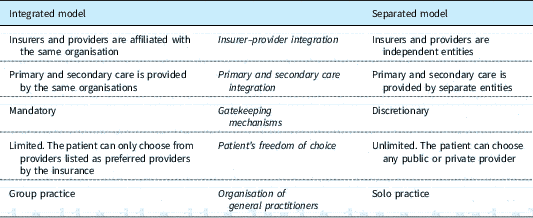
The separated model is hence characterised by: (1) utmost autonomy of the players; (2) contractual relationships between the parties; and (3) ample freedom of choice (both for patients and health care professionals). In such a model, the players are independent legal entities, which enjoy a high degree of autonomy, also from a functional perspective. We should therefore expect a network of providers largely comprised of self-employed physicians and health care facilities (hospitals or outpatient clinics) independent from one another.
To a large extent, relationships between players are governed by contracts, which the counterparts are free to enter into at their sole discretion. Another peculiarity of the separated model is the great freedom of choice granted to the individual players: the parties meet and collaborate voluntarily, selecting one another on grounds of reputation and mutual trust. A minimum degree of pluralism is an essential prerequisite to ensuring that the players actually have power of choice: one must, indeed, always have the possibility to pick from several counterparts (i.e., patients should be able to choose from several specialists, physicians should be in a position to refer their patients to several hospital facilities, and so on).
The integrated model
Unlike the separated model, which – in many respects – recalls a market system, the integrated model is more similar to an internal organisation. A distinctive trait of the integrated model lies in the fact that the players are affiliated with the same organisation; this entails adhering to a single role structure, supporting a shared culture, and abiding by common rules. Over time, all these factors should lead the players to become increasingly homogeneous, and to share – at least in part – the same objectives. Internal cohesion is also favoured by stable employment relationships between the organisation and its employees. Relationships between the parties are therefore not governed by voluntary and casual work contracts, as is the case with the separated model, but rather through the hierarchical structure and the internal policies of the organisation. The latter define the form of cooperation between players, who are no longer free to choose their counterparty. The relationships therefore tend to be biunique, mandatory and permanent.
Compared with the separated model, the integrated model has opposite characteristics: (1) the players are not independent entities but are affiliated with the same organisation; (2) relationships between the parties are governed by permanent employment contracts; and (3) freedom of choice is severely limited.
The five dimensions
Given their opposite characteristics, the integrated model and the separated model lend themselves to be conceived as the extremes of a continuum along which the 24 national cases contemplated in this research can be placed depending on their closeness to one ideal model or the other.
In order to bring into focus the main differences between the integrated model and the separated model, we propose the use of the following dimensions.
1) insurer–provider integration;
2) primary and secondary care integration;
3) the presence or absence of gatekeeping mechanisms;
4) the greater or lesser freedom of patients in choosing their providers;
5) the solo or group practice of general practitioners.
The following three criteria were used for the selection of these five variables: (1) they are identified in the literature as significant dimensions to assess the level of integration of health care services; (2) for each one of these variables it is possible to formulate a straightforward and not overly complicated operational definition; and (3) based on the operational definition thus provided, up-to-date, reliable and comparable data are available for the 24 countries taken into consideration in this analysis.
Each of these five dimensions will be analysed separately in the following sections. We can, however, already point out that they not only involve the relationships existing among the various providers but also those established between the latter and the other two actors of the so-called health triangle (Mossialos et al., Reference Mossialos, Dixon, Figueras and Kutzin2002; Rothgang et al., Reference Rothgang, Cacace, Grimmeisen and Wendt2005), namely insurers and patients. The first dimension concerns the relationships between providers and insurers. Freedom of choice and, to some extent, gatekeeping have to do with the relationships between providers and their patients. The other dimensions are applicable to the relationships between different providers.
Insurer–provider integration
The first dimension by which to distinguish the different provision systems is a form of vertical integration (Shortell et al., Reference Shortell, Gillies and Anderson1994; Burns and Pauly, Reference Burns and Pauly2002; Thaldorf and Liberman, Reference Thaldorf and Liberman2007), involving, in particular, the relationships between insurers and providers.
In integrated systems, health insurance and health care service provision are managed by the same organisations. In separated systems, they are instead dealt with by different, formally independent entities. In other words, in the integrated model, the entities that act as insurers (therefore the public service, non-profit health insurance, or private insurance companies) have their own health care facilities and staff, and provide, through them, most of the services required by their registered members. In such a model, insurer and provider thus coincide, as they form one single organisation.
Conversely, in the separated model, the insurers do not have their own hospitals or outpatient clinics, nor do they employ medical and health care personnel: health care is provided by third parties, and the insurers are only committed to reimbursing them. Hence, there is a substantial difference between the two models: in the separated model, relationships between providers and insurers are entertained by distinct entities and are regulated by contracts; in the integrated model, exchange and production decisions are taken within the same organisation through a hierarchical structure.
Let us now assess the level of insurer–provider integration within the 24 national health care systems analysed in this article. To divide the countries into separate classes, we will adopt the following operational criterion: a national system is to be considered as integrated if the majority of physicians (general practitioners, outpatient clinic and hospital specialists) are affiliated with organisations that – in addition to provision activities – also provide insurance against health risks. Those systems where the majority of physicians work autonomously or within organisations that do not provide insurance coverage are instead considered as separated.
Ten countries fall under the definition of integrated system: Denmark, Greece, Ireland, Italy, New Zealand, Norway, Portugal, Spain, Sweden and the UK.
Conversely, the health care systems of Australia, Austria, Belgium, Canada, France, Germany, Israel, Japan, The Netherlands, Poland, the Republic of Korea, Switzerland, Turkey and the United States are separated systems.
In considering the two classes identified in the foregoing, the reader could expect the systems with a high insurer–provider integration to be those where there is a single insurance entity (universal single-payer systems) and, vice versa, the separate systems to be those with a multiplicity of insurers (social health insurance and private insurance systems). Yet, this is not necessarily true. Systems such as those implemented in Australia or Canada, for instance, do not rely on integration between insurer and providers, albeit their single insurance scheme: physicians are indeed autonomous with respect to the public insurance programme; they are reimbursed by Medicare, but do not have an employment relationship with Medicare.
In countries like the United States, Switzerland and Israel, we find examples of the opposite phenomenon. Insurers and providers are integrated, but within a system characterised by a multiplicity of competing insurers. Some American and Swiss Health Maintenance Organisations (HMOs), similarly to the Israeli health funds (such as Clalit), actually own some health care facilities (hospitals and outpatient clinics) and have medical and health care personnel on their payroll, through whom they guarantee an ample range of basic to highly specialised services (De Pietro et al., Reference De Pietro, Camenzind, Sturny, Crivelli, Edwards-Garavoglia, Spranger, Wittenbecher and Quentin2015; Rosen et al., Reference Rosen, Waitzberg and Merkur2015; Toth, Reference Toth2016).
Primary/secondary care integration
The second dimension that differentiates the integrated model from the separated model concerns the relationships between providers of primary and secondary care. Although the boundaries between these two spheres of activity are often blurred, primary care is understood as basic procedures performed in response to the most common illnesses and problems. To a large extent, it is provided by family doctors, that is by general practitioners who follow the patient from a continuous and broad-spectrum perspective (Starfield, Reference Starfield1998; Starfield et al., Reference Starfield, Shi and Macinko2005; Saltman et al., Reference Saltman, Rico and Boerma2006; Valentijn et al., Reference Valentijn, Schepman, Opheij and Bruijnzeels2013). Primary care is provided in the consulting rooms of general practitioners, in outpatient clinics located throughout the area and, at times, even at the patient's home (Blank et al., Reference Blank, Burau and Kuhlmann2018).
Secondary care is medical care of a specialised nature. Unlike primary procedures, secondary care requires advanced knowledge and more sophisticated equipment; for this reason, it is provided primarily in hospitals, by medical specialists who have a more sectorial approach to illnesses, and whose relationships with patients are occasional and usually limited to single pathological episodes (Starfield, Reference Starfield1998; WHO, 2008; Blank et al., Reference Blank, Burau and Kuhlmann2018).
An aspect peculiar to the integrated model is the close coordination that exists between primary and secondary care providers, ensured by the fact that general practitioners and hospital specialists are affiliated with the same organisation; this is to say that integrated systems revolve around organisations whose scope is to provide the entire range of medical and health care services, from basic to specialist levels.
Conversely, in the separated model, primary and secondary cares are largely disjointed spheres of activity: community and hospital services are managed by different, independent entities. As for integration between insures and providers, also in this case the discriminating factor between separated and integrated systems is whether or not the providers are affiliated to the same organisation. To be more precise, the criterion by which to classify the individual cases pertaining to each country will be the following. We will consider as integrated those systems that meet at least one of the following requisites: (1) the majority of general practitioners work for organisations that also provide secondary care; (2) the majority of hospital doctors are affiliated with organisations that also provide primary care. In all other cases, i.e., if neither of the two aforesaid requirements is met, the systems will be considered separated.
Based on this classification criterion, Israel, Portugal, Spain and Sweden have integrated systems.
A separate category includes Ireland, Italy, New Zealand, Norway and the UK. These five cases are formally less integrated than the previous ones in one respect: in these countries, general practitioners are not employees of the public service, but self-employed professionals contracted to the public health service. Given the ensuing commitment and constraints, the contractual relationship creates a preferential and long-term bond between physicians and the public service; such a bond is perhaps not comparable to an employment relationship, but is certainly quite distant from occasional contracts. We, therefore, propose to regard these five countries as quasi-integrated.
Countries where separated systems apply are: Australia, Austria, Belgium, Canada, Denmark, France, Germany, Greece, Japan, The Netherlands, Poland, the Republic of Korea, Switzerland, Turkey and the United States.
Some studies reveal that, in recent decades, and even in countries classified as separated in this work, there is a general trend towards integration between primary and secondary care (Rico et al., Reference Rico, Saltman and Boerma2003; WHO, 2008; Amelung et al., Reference Amelung, Stein, Goodwin, Balicer, Nolte and Suter2017; European Commission, 2017).
Gatekeeping
The relationships between patients, general practitioners and specialists vary depending on the presence or absence of a formalised gatekeeping mechanism (Delnoij et al., Reference Delnoij, Van Merode, Paulus and Groenewegen2000; Rothgang et al., Reference Rothgang, Cacace, Grimmeisen and Wendt2005; Calnan et al., Reference Calnan, Hutten and Tiljak2006; Kroneman et al., Reference Kroneman, Maarse and van der Zee2006; Wendt, Reference Wendt2009; Reibling and Wendt, Reference Reibling and Wendt2012). Over the past few decades, in most countries belonging to the European Union and the OECD, policy makers have tended to favour and reinforce gatekeeping mechanisms (Reibling and Wendt, Reference Reibling and Wendt2012; European Commission, 2017). Let us try to understand the reasons behind this trend.
Gatekeeping is the principle by which access to specialist health care is possible only through referral by general practitioners. This principle influences many aspects of the provision system: the patient's freedom of choice; the relationship between family doctors and their patients; the overall demand for specialist services; the connection between primary and secondary care.
In a mandatory gatekeeping system, the general practitioner is the patient's primary contact with the health system, exception being made for cases of emergency where citizens can go directly to the emergency room; the family doctor is called upon to provide a wide range of primary care services and refer patients to specialists for all examinations and procedures that do not fall within his sphere of competence. The general physician therefore plays a fundamental role in sorting and filtering health care needs. On the one hand, he has to recommend the most suitable specialist to the patient following an initial diagnosis; on the other hand, he must ensure access to specialist care only to those patients who have a real need for it.
The gatekeeper physician is also assigned an additional task: advising and guiding the patient throughout his care process within the health system. In essence, the mission of the general practitioner would be to remedy the disconnect that easily occurs between different health care providers (Kodner, Reference Kodner2009): it often happens to be examined by a number of different specialists, none of whom have an overview of the entire diagnostic and therapeutic process undertaken by the patient. Hence, the family doctor should coordinate the different specialist services, ensuring continuity of treatment.
Health systems are therefore divided between those which adopt the principle of gatekeeping, and those which grant direct access to secondary care (Kroneman et al., Reference Kroneman, Maarse and van der Zee2006). The presence of a mandatory gatekeeping mechanism for the majority of the population, and for a significant portion of secondary care, is typical of the integrated model. The absence of mandatory and formalised gatekeeping mechanisms is rather typical of the separated model.
Countries with mandatory gatekeeping are: Australia, Denmark, Israel, Italy, The Netherlands, New Zealand, Norway, Portugal, Spain and the UK.
There are, by contrast, health care systems in which the majority of the population has free access to specialist care, without any referral by the general practitioner. For the avoidance of doubt, we should immediately point out that some form of gatekeeping exists also in these countries. It is simply not mandatory, and in any event it neither applies to the majority of the population, nor to most specialised care procedures. The countries belonging to this second group are Austria, Belgium, France, Germany, Greece, Japan, the Republic of Korea, Sweden, Switzerland, Turkey and the United States.
In the United States and Switzerland, the gatekeeping mechanism is only implemented by some insurance plans (like HMOs): individual users, however, are free to subscribe or not to subscribe to such insurance plans. In countries like Belgium, France, Germany and Turkey, in order to promote some forms of gatekeeping – which are nonetheless still discretionary – economic incentives are granted to patients who access secondary care following referral by their general practitioner; this has engendered some interesting results that could perhaps become more widespread in the future, but that at present involve only a minority of the population.
Canada, Ireland and Poland raise classification issues, and will thus be considered as mixed systems. In these three countries, gatekeeping is not formally defined as mandatory, but the majority of the population behaves as if it were. The Canadian system provides for effective economic incentives in favour of gatekeeping, making it convenient for patients: this means that, in most Canadian provinces, general practitioners act as gatekeepers (Marchildon, Reference Marchildon2013; Mossialos et al., Reference Mossialos, Osborn, Sarnak and Wenzl2016). In Ireland, patients usually access secondary care only after having obtained referral by their family doctor, although this is formally required only for some specialist services (McDaid et al., Reference McDaid, Wiley, Maresso and Mossialos2009). In Poland, it is customary for general practitioners to act as gatekeepers, even if referral by a general practitioner is required only for a portion of specialised care; we should also recall that some categories of Polish patients are not required to present a referral by the general practitioner, and can therefore access specialist care directly (Sagan et al., Reference Sagan2011).
Patients’ freedom of choice of providers
Health care provision systems can be distinguished according to the greater or lesser freedom of choice granted to patients (Reibling and Wendt, Reference Reibling and Wendt2012; Blank et al., Reference Blank, Burau and Kuhlmann2018). A distinctive feature of the separated model is the ample freedom given to patients to choose the physician and the hospital that will provide health care services. The citizens – if covered by an insurance plan – may choose freely from all providers operating throughout the country.
Conversely, in the integrated model, the patient's freedom of choice is rather limited: the physician and hospital are identified by the insurance company, the sickness fund, or the public service, and the patient can at most choose from a subset of available providers.
In the last three decades, we have witnessed a generalised tendency towards strengthening of the freedom of choice granted to patients in OECD countries (Saltman and Figueras, Reference Saltman and Figueras1998; Toth, Reference Toth2010; Reibling and Wendt, Reference Reibling and Wendt2012; Victoor et al., Reference Victoor, Delnoij, Friele and Rademakers2012).
Where granted, the patient's right to freedom of choice may be exercised at different levels; it may, indeed, relate to the general practitioner, the medical specialist, the hospital and also the individual physician within the chosen health care facility.
As for the choice of a general practitioner, there is no need for lengthy considerations: the right to choose one's family doctor is in fact recognised – at least in theory – in all of the 24 countries examined in this work (Kringos et al., Reference Kringos, Boerma, Hutchinson and Saltman2015; OECD, 2016). It is however worth dwelling on the greater or lesser freedom accorded to patients to select the specialist and the hospital that will provide the health care services; in this respect, the differences among the various health systems are noteworthy.
There are systems where the choice of provider is free, meaning that patients have the right to choose among all the specialists and hospitals in the country, whether public or private. The countries where citizens can freely choose their health care providers are: Austria, Belgium, Canada, France, Germany, Japan, The Netherlands, Norway, the Republic of Korea, Sweden and Turkey. In some of these countries (including Australia, Austria, Norway and Sweden), it is not always possible to choose the individual physician once the hospital of choice has been determined; despite this, patients in the said countries enjoy an extensive right to freedom of choice. In the Netherlands, the choice of provider is in part limited only for those citizens – currently a minority – who voluntarily subscribe to an in-kind policy (Kroneman et al., Reference Kroneman, Boerma, van den Berg, Groenewegen, de Jong and van Ginneken2016).
There are, on the contrary, countries where the freedom enjoyed by the majority of patients is somewhat limited. In these systems, patients can only choose among health care providers who have entered into a service supply agreement with their insurer. Some private insurance companies, for example, impose on the insured a list of ‘preferred providers’, with which they have executed a specific agreement. Programmes funded through general taxation often limit the choice of patients to public providers and, at most, to private providers under contract with the public service (hence, only some private providers).
The countries where the patients’ right of freedom of choice is limited are: Australia, Denmark, Greece, Ireland, Israel, Italy, New Zealand, Poland, Portugal, Spain, Switzerland, the UK and the United States. In all of these countries, for one reason or another, the majority of the population cannot freely choose the hospital or specialist for the health treatments they need. This is confirmed by the fact that each of these systems counts a wide array of private providers whose services, when requested, impose on the patient additional costs, if not the full cost of the service.
General practitioners: solo or group practice
Let us now look into the manner in which general practitioners are organised. There are, again, two rival models. In the first model, general practitioners practice separately, each in his/her own consulting room: this is referred to as solo practice. In the second model, general practitioners are associated (group practice), sharing common spaces and equipment; this second model expresses – at least on a structural level – a higher degree of integration with respect to solo practice. We can therefore consider solo practice to be typical of the separated model, whereas group practice exemplifies the integrated model.
If we somewhat synthesise the issue, we can define solo practice as the traditional way of organising primary care; conversely, group practice is the emerging model, which has been gradually supplanting the traditional model for at least 20 years now (Rico et al., Reference Rico, Saltman and Boerma2003; Saltman et al., Reference Saltman, Rico and Boerma2006; Damiani et al., Reference Damiani, Silvestrini, Federico, Cosentino, Marvulli, Tirabassi and Ricciardi2013; European Commission, 2017). Indeed, among general practitioners, group practice has become the most common mode in most OECD countries (OECD, 2016). Australia, Canada, Denmark, Greece, Ireland, Israel, Japan, The Netherlands, New Zealand, Norway, Poland, Portugal, Spain, Sweden, Turkey, UK and the United States are all countries where general practitioners practice mainly in an associated form.
Health care systems where solo practice still prevails are a minority. They are operative in Austria, Belgium, France, Germany, Italy, the Republic of Korea and Switzerland. Nonetheless, in some of these countries, and especially in France and Italy, group practice is progressively taking root (Kringos et al., Reference Kringos, Boerma, Hutchinson and Saltman2015; Mossialos et al., Reference Mossialos, Osborn, Sarnak and Wenzl2016; European Commission, 2017).
Let us make one last consideration on the subject of group practice. In seven countries (Greece, Ireland, Israel, Spain, Portugal, Sweden and Turkey), primary care is organised in primary care centres. The latter differ from other forms of group practice because of their multidisciplinary nature: indeed, these facilities comprise not only general practitioners but also other professionals including medical specialists, nurses, physiotherapists and auxiliary personnel.
The integration–separation continuum: 24 countries compared
If we combine the five dimensions reviewed in the foregoing, we can arrange the 24 national cases along a continuum that has the integrated model and the separated model at the two opposite poles. To do this, it is sufficient to compare the properties of each single national system with the five elements that characterise each of the two models (see Table 1).
Integrated model vs separated model

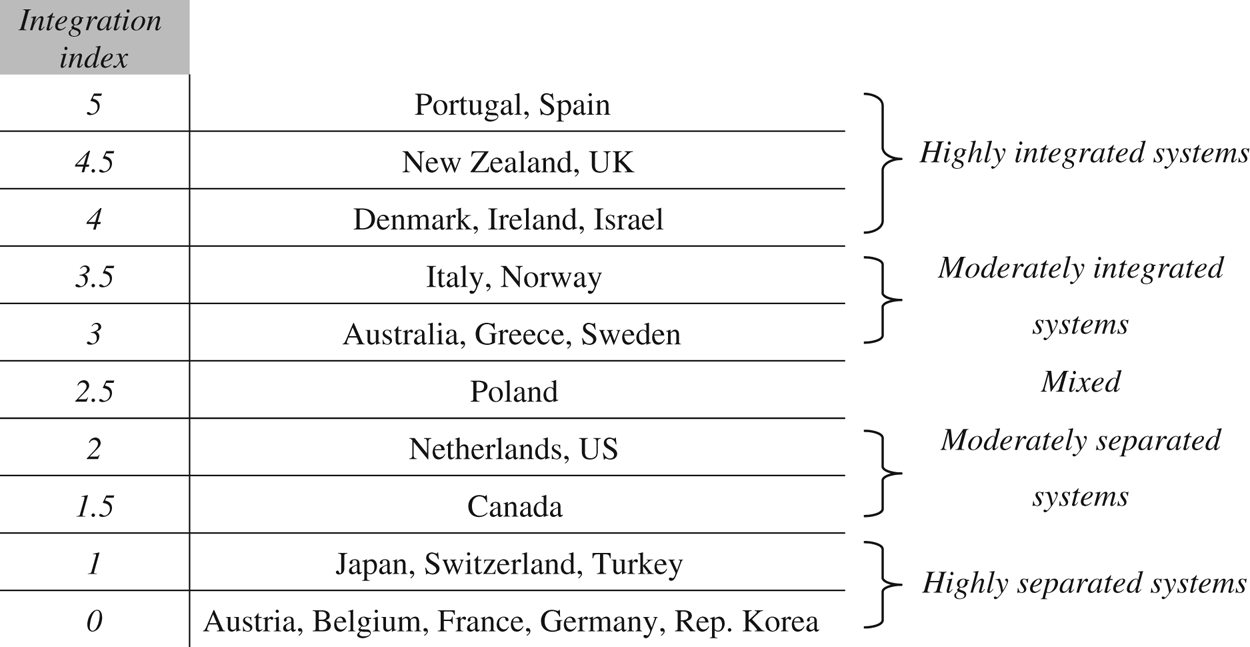
In Figure 1, the countries are listed by descending degree of organisational integration: at the top we find the national systems that are closest to the ideal of the integrated model, while at the bottom are the countries that mostly adhere to the separated model.
The integration index. The 24 countries compared.

This ranking is obtained by introducing a simple integration index, the value of which may vary between 0 and 5. Zero indicates maximum separation, while 5 stands for maximum integration. The value 1 was attributed to each one of the five characteristics of the integrated model. The value 0 was assigned to each characteristic element of the separated model. With respect to the second dimension, the one pertaining to the relationship between primary and secondary care, the countries classified as quasi-integrated were assigned the value 0.5. The mixed gatekeeping cases were also attributed half a point. For each country, the overall integration index is given by the sum of the scores related to the five dimensions analysed.
Figure 1 shows that the health care systems that more closely embody the principles of the integrated model are those implemented in Portugal and Spain. Indeed, these two countries have all five of the characteristics proper to the ideal model.
Conversely, the separated model is rather well represented by countries such as Austria, Belgium, France, Germany and the Republic of Korea. These five national systems indeed have all the distinctive features of the separated model.
Apart from these pure cases, the other countries considered in this work are spread over all the intermediate positions included between the two extremes.
Conclusions
Based on the classification proposed in the preceding sections and the integration index presented in Figure 1, the health care systems of the 24 OECD countries analysed in this work can be subdivided into different classes. We wish to reiterate that this classification is based on how health care providers are organised in each country.
The first group of countries comprises Portugal, Spain, New Zealand, UK, Denmark, Ireland and Israel. These seven countries are to be considered highly integrated, in that they have at least four of the five characteristics of the integrated model (sure enough, they have an integration index value greater than or equal to four). The fact that these countries, with the sole exception of Israel, have a National Health Service is certainly noteworthy.
Five other countries have at least three of the five characteristics of the integrated model. They are Italy, Norway, Australia, Greece and Sweden. To differentiate them from the first seven, we might label these five countries as moderately integrated.
At the opposite end, we can identify a group consisting of: Austria, Belgium, France, Germany, the Republic of Korea, Japan, Switzerland and Turkey. These eight countries are to be considered highly separated as they have at least four distinctive features of the separated model. It should be noted that none of these latter countries has a universal single payer funding system.
Similarly to what was done previously, we could identify a group of countries that can be categorised as moderately separated due to the fact that they have at least three (but not four) elements proper to the separated model. These countries are Canada, The Netherlands and the United States.
The only country left, that is Poland, is to be considered as a mixed system, since it combines – in roughly equal parts – some typical features of the integrated model with characteristics of the separated model.
The reader should be made aware that the classification illustrated in the foregoing is a simplification of an otherwise overly complex scenario. For each of the five dimensions analysed herein, the individual national systems were in fact classified based on the country's prevailing organisational model, namely the model used for the majority of the population and for most health care services. The provision systems of each country have therefore been considered as homogeneous within themselves. But we acknowledge this to be a simplification: the individual national systems are segmented into different sub-systems (Toth, Reference Toth2016), and the latter can present different levels of organisational integration. Let us take the United States as an example: within the American system there coexist sub-systems with a high level of organisational integration (such as the Veterans Health Administration or the staff-model HMOs) and other sub-systems that are in large measure separated (like the Medicaid programme or the traditional indemnity plans). Canada is another country where the models implemented by the individual provinces present different degrees and methods of integration (Fierlbeck, Reference Fierlbeck2011; Marchildon, Reference Marchildon2013). As a further example, we can state that in most countries with a NHS it is possible to refer to private providers by spending out-of-pocket: in these countries, the public provision system is usually more integrated, whereas the private system more closely resembles the separated model. This serves to reiterate that this article – for reasons of space and conceptual parsimony – is not the proper venue to address sub-national variations, albeit their relevance in some countries.
In closing this article, it is opportune to recall what has already been expounded in the introduction. The classification proposed in this work does not pertain to the clinical integration of the different health care systems, but rather to organisational integration. The integrated and separated models illustrated in the foregoing sections embody two different and rivalling strategies on how to structure, as a whole, the health care provision system. These strategies refer to the formal relationships between the different health care providers.
A high level of organisational integration does not necessarily imply a higher level of clinical integration. It may happen that two health professionals belonging to the same organisation and involved in delivery of health care services to the same patient do not coordinate their activities. In such a situation, organisational integration is not matched by clinical integration. Of course, the opposite situation may arise, in that two professionals who are either self-employed or working with different companies may, however, coordinate their respective activities in a patient's care. In the latter case, there will be clinical integration, despite the absence of organisational integration. As mentioned in the introduction, organisational and clinical integration are two distinct properties, and this work deals only with the former.
We cannot determine what type of relationship exists between these two properties. Does a highly integrated system actually promote a high level of clinical integration? Conversely, does the adoption of a separated model necessarily entail less coordination among providers in terms of functionality? The issue is beyond the scope of this article, but could be the subject of further research and discussion.
Supplementary Material
To view supplementary material for this article, please visit https://doi.org/10.1017/S1744133118000476