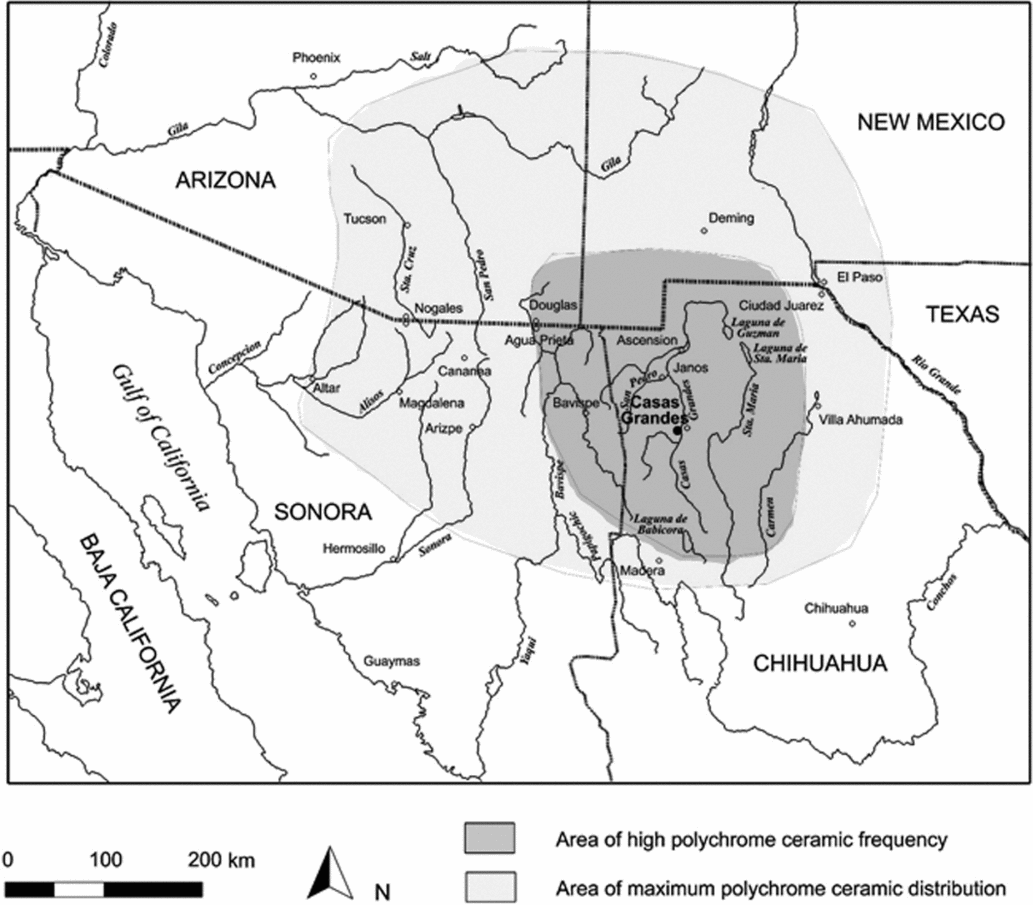
The Casas Grandes region, including the site of Casas Grandes, or PaquimeFootnote 1 (Figure 1), has long been recognized as an important prehistoric cultural region (Bandelier Reference Bandelier1892; Brand Reference Brand1943; Hewett Reference Hewett1908; Lumholtz Reference Lumholtz1902; Noguera Reference Noguera1926; Sayles Reference Sayles1936). Charles Di Peso's work in the 1950s especially highlighted the importance of Paquime as a large “urbanized” center in the greater Southwest, by which we mean the southwestern United States and northwestern Mexico (Di Peso Reference Di Peso1974).
Location of Paquime and the extent of the Casas Grandes interaction sphere based on Chihuahuan polychrome ceramic distributions. Distributions are based on Sayles's surface collections at the Arizona State Museum.

Di Peso interpreted Paquime as a major trade and production center during the height of its occupation, the Medio period, which lasted from approximately AD 1200 until about 1400 (Dean and Ravesloot Reference Dean, Ravesloot, Woosley and Ravesloot1993; Ravesloot et al. Reference Ravesloot, Dean, Foster and Reyman1995; see also Braniff Reference Braniff, Joan Mathien and McGuire1986). Di Peso had placed the Medio period earlier, from about AD 1100 to about 1300, but Whalen and Minnis (Reference Whalen and Minnis2009:41–70) recently analyzed 84 radiocarbon samples from four sites to the west of Paquime provide further support for the revised dating for the Medio period. They divide it into an early (ca. AD 1200–1300) and late (AD 1300–ca. 1450) phase (Whalen and Minnis Reference Whalen and Minnis2009:67–70).Footnote 2 More recent archaeological research in northwestern Chihuahua has concentrated on defining the nature and the intensity of interaction in the Casas Grandes region and the extent of intra-regional social and political organization (e.g., Carpenter Reference Carpenter, Skibo, McCluney and Walker2002; Douglas Reference Douglas1995; Douglas and MacWilliams Reference Douglas, MacWilliams, Minnis and Whalen2015; Fish and Fish Reference Fish, Fish, Schaafsma and Riley1999; Gamboa Carrera and Mancera-Valencia Reference Gamboa Carrera, Mancera-Valencia, Webster and McBrinn2008; Kelley and Villalpando Reference Kelley, Elisa Villalpando C, Fish and Jefferson Reid1996; LeBlanc Reference LeBlanc, Cordell and Gumerman1989; Minnis and Whalen Reference Minnis and Whalen2015; Pitezel Reference Pitezel2011; Schaafsma and Riley Reference Schaafsma, Riley, Schaafsma and Riley1999; VanPool and VanPool Reference VanPool and VanPool2007; Whalen and Minnis Reference Whalen, Minnis, Fish and Reid1996, Reference Whalen and Minnis2001, Reference Whalen and Minnis2003, Reference Whalen and Minnis2009; Wilcox Reference Wilcox and Reyman1995, Reference Wilcox, Schaafsma and Riley1999). Of particular interest is the question of how dominant Paquime was in the political and economic system.
Among other archaeological evidence, the distribution of diagnostic ceramics is frequently used to model socioeconomic organization and exchange systems. The extensive distribution of distinctive Chihuahuan polychrome ceramics, for instance, has been traditionally interpreted as evidence for the wide interaction sphere of Casas Grandes (e.g., Brand Reference Brand1935; Carpenter Reference Carpenter, Skibo, McCluney and Walker2002; Di Peso Reference Di Peso1974:2:622–624; Phillips Reference Phillips1989:383–384; Woosley and Olinger Reference Woosley, Olinger, Woosley and Ravesloot1993; see Figure 1). Within the framework of these research interests, one of the questions is whether Paquime was a major producer of Chihuahuan polychrome pottery or if these ceramics were produced at multiple settlements. In our study, we concentrate on painted ceramics because they are perceived to be both temporally and culturally diagnostic, and their production may have required specialized skills. In this article, we address two issues: we aim to contribute to a better understanding the socioeconomic organization of Casas Grandes and the challenges and limitations of ceramic sourcing.
Polychrome Ceramics and the Casas Grandes Economic System
Many arguments regarding the economic role of Paquime have focused on the production and distribution of prestige goods, such as shell, copper, turquoise, and macaws (see Supplemental Text 1 for a discussion of economic models and additional references). For a more comprehensive understanding of economic organization, however, it is important to consider other types of economic goods as well, including utilitarian objects (e.g., Carpenter Reference Carpenter, Skibo, McCluney and Walker2002; Sprehn Reference Sprehn2003, VanPool and Leonard Reference VanPool and Leonard2002) and subsistence goods (e.g., Minnis et al. Reference Minnis, Whalen and Emerson Howell2006). Various modes of exchange can be operational in the movement of prestige goods and other commodities. Prestige goods may have been part of an integrated exchange network and may have served as a form of currency that could be traded for other objects. On the other hand, the exchange of different types of goods could have been organized in different spheres (e.g., Adams Reference Adams1974; Douglas [Reference Douglas1992:19] and Carpenter [Reference Carpenter, Skibo, McCluney and Walker2002:163] argue for precisely that kind of scenario in the Casas Grandes regional system), and prestige goods may not have been exchangeable for other commodities such as subsistence goods (e.g., Bohannan Reference Bohannan1955). Yet, prestige items may mediate the movements of other materials (e.g., Malinowski Reference Malinowski1922).
In most nonegalitarian societies, it is likely that elites tried to control access to rare, highly valued goods. The degree of control by the central authority of the production and distribution of other types of goods, however, varies significantly among different societies. If elites interfered with economic activities concerning nonprestige goods, it may indicate a high degree of elite power and control.Footnote 3 Thus, the study of various goods is critical for the assessment of centralization and control by elites. Moreover, such studies serve to evaluate the degree of economic differentiation and integration. In many societies, high-skill and low-output production, such as metal work, tends to be conducted by specialists. If the production of other types of goods that are distributed in larger quantities is also specialized, it may suggest a higher degree of economic differentiation and integration.
In this regard, the study of ceramics is particularly important. Ceramics are among the most abundant artifacts in the archaeological record, and they were usually produced in high quantities. Accordingly, in the Southwest, the distribution of diagnostic ceramics is frequently used to model socioeconomic organization and exchange systems (e.g., Abbott Reference Abbott, Fish and Jefferson Reid1996; Habicht-Mauche Reference Habicht-Mauche, Mills and Crown1995; Hantman and Plog Reference Hantman, Plog, Ericson and Earle1982; Hegmon et al. Reference Hegmon, Hurst, Allison, Mills and Crown1995; Lightfoot and Jewett Reference Lightfoot, Jewett, Sullivan and Hantman1984; Upham Reference Upham1982; Upham et al. Reference Upham, Lightfoot and Feinman1981).
Late prehistoric Southwest polychrome ceramics are particularly well suited for the study of economic systems and regional interaction because they exhibit rich stylistic information, and they are perceived as being both culturally and temporally diagnostic. The distribution of distinct Chihuahuan polychromes, for example, has been interpreted as evidence for the extensive interaction sphere of Paquime (Carpenter Reference Carpenter, Skibo, McCluney and Walker2002; Di Peso Reference Di Peso1974:2:622–624; Pailes and Reff Reference Pailes, Reff, Foster and Weigand1985: 358; Phillips Reference Phillips1989:383–384; Woosley and Olinger Reference Woosley, Olinger, Woosley and Ravesloot1993) and is generally used to delineate a Casas Grandes regional system (LeBlanc Reference LeBlanc, Cordell and Gumerman1989; Whalen and Minnis Reference Whalen, Minnis, Fish and Reid1996, Reference Whalen and Minnis2001).
In terms of their sociopolitical meaning, Di Peso (Reference Di Peso1974:Vol. 2) saw Chihuahuan polychrome ceramics as prestige goods. This view is similar to that of some scholars regarding the social function of contemporaneous painted polychrome ceramics in the northern Southwest (e.g., Cordell and Plog Reference Cordell and Plog1979; Lightfoot and Jewett Reference Lightfoot, Jewett, Sullivan and Hantman1984; Upham Reference Upham1982). Di Peso assumed that Chihuahuan Polychromes were one of the principal high-value trade goods and that they were produced by highly specialized craftspersons living at Paquime. His argument, however, was not based on much archaeological evidence (see Minnis Reference Minnis1988:185). Except for a few pieces of unfired, utilitarian brown ware, there is little direct evidence for pottery manufacture at Paquime, and possible tools such as polishing stones and sherd scrapers are dispersed throughout the site (see also Sullivan Reference Sullivan1988; Triadan Reference Triadan1989). If these tools were used in pottery manufacture, it may indicate that ceramics were not produced at special facilities. Moreover, a number of archaeologists are inclined to think that fourteenth-century Southwest ceramics, including polychrome pottery, were produced at the household level and that access to them was neither restricted to nor controlled by elites (Crown Reference Crown1994; Hagstrum Reference Hagstrum, Mills and Crown1995; Mills Reference Mills, Fish and Reid1996; Mills and Crown Reference Mills, Crown, Mills and Crown1995:13; Triadan Reference Triadan1997; Zedeño Reference Zedeño1994; see also Pool Reference Pool, Bey and Pool1992). Douglas (Reference Douglas1992) argues that most nonlocal ceramics found at Paquime may not have been prestige goods. Thus, an interesting question is whether or not this latter view of Southwest ceramic production equally applies to Chihuahuan polychromes.
Based on morphological and stylistic analyses of whole vessels, Sprehn (Reference Sprehn2003, Reference Sprehn and Powell2006) argues that some Chihuahuan polychrome jars and incurved bowls were produced by part-time specialists and that elites were using the iconography on one of the types, Ramos Polychrome, to transmit power (see also VanPool and VanPool Reference VanPool, VanPool and Powell2006, Reference VanPool and VanPool2007, Reference VanPool, VanPool, Minnis and Whalen2015). She measured standardization of vessel size and form and skill of design execution and found very low coefficients of variations (CVs) for some of the variables she measured. Similarly, a regression analysis by Whalen and Minnis (Reference Whalen and Minnis2009:159, Figure 5.6, 163) indicates high standardization in the forming of Ramos Polychrome jars. If Chihuahuan polychromes were produced in a more centralized or specialized manner, this may indeed support the notion that Paquime was one of the most developed production and distribution centers in Southwest prehistory.
Polychrome Ceramics in the Casas Grandes Region
At the beginning of the Medio period, the decoration on painted pottery at Paquime and contemporary sites in the Casas Grandes region changed from predominantly bichrome red-on-brown to polychrome, while the utilitarian coarse wares stayed more or less the same. This change in painted decoration is a pan-Southwestern phenomenon in ceramic assemblages during this time (see Adams Reference Adams, Charles Adams and Hays1991:117; Carlson Reference Carlson1970, Reference Carlson1982; Crown Reference Crown1994, Reference Crown, Mills and Crown1995, Reference Crown, Fish and Reid1996; Hays Reference Hays, Charles Adams and Hays1991:26; Kintigh Reference Kintigh1985; Montgomery and Reid Reference Montgomery and Jefferson Reid1990; Smith Reference Smith1971).
During the late thirteenth and throughout the fourteenth century AD, Chihuahuan polychromes were relatively abundant in an area that ranges from southeastern Arizona and southwestern New Mexico to the Babicora plains in the south, and from the vicinity of Villa Ahumada to the east to the Bavispe drainage in northeastern Sonora (Brand Reference Brand1935:Figure 1, Reference Brand1943; Carpenter Reference Carpenter, Skibo, McCluney and Walker2002:Figure 1; Sayles Reference Sayles1936). Small quantities of these polychrome ceramics are also found in site assemblages as far as the Gila River basin, the middle Rio Grande, around El Paso, and in Trincheras sites in Sonora (Gallaga Reference Gallaga, Newell and Gallaga2004).
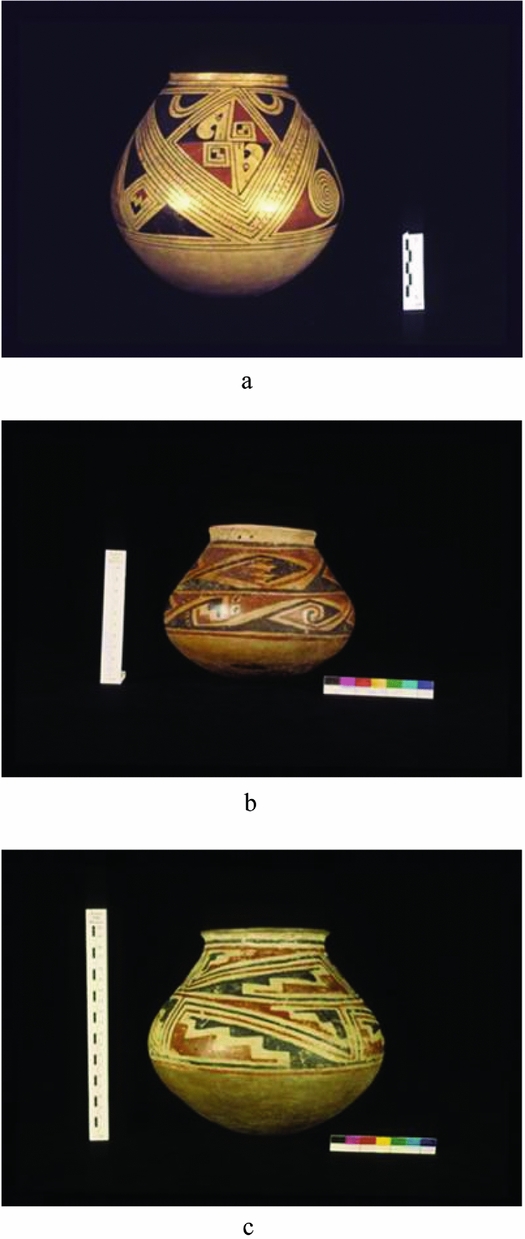
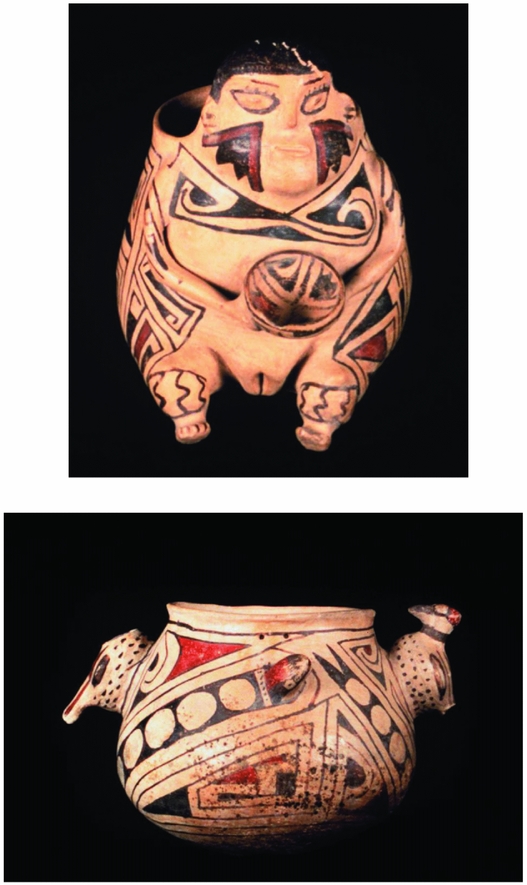
In marked difference to other polychrome wares of this time period from other areas of the Southwest, Chihuahuan polychromes occur predominantly as ovoid jars (Figure 2). Effigy vessels are another distinct trait of Chihuahuan Polychrome ceramics (Figure 3). They occur as “hooded” jars, as well as what Kidder (Reference Kidder1916:258) called true effigies, and exhibit anthropomorphic and zoomorphic features (e.g., Di Peso Reference Di Peso1974:2:337–338; Hewett Reference Hewett1908:Plate XIV; Kidder Reference Kidder1916:Plates I–III; Lumholtz Reference Lumholtz1902:Plates I–II).
Chihuahuan polychrome pottery: (a) Ramos Polychrome, (b) Babicora Polychrome, and (c) Villa Ahumada Polychrome. Photographs by Daniela Triadan, courtesy of Museo de las Culturas del Norte (a) and Arizona State Museum (b and c).

Examples of effigy vessels. Photographs by Daniela Triadan, courtesy of Arizona State Museum.

Various types of polychrome pottery have been identified and described for the Medio period at Paquime (Di Peso et al. Reference Di Peso, Rinaldo and Fenner1974:6:183–316), the most abundant of which is Ramos Polychrome (Figure 2a). It is the hallmark of the Chihuahuan polychrome tradition and is also the most abundant type in the region. Babicora Polychrome (Figure 2b) is the second most abundant type of the Medio period polychrome ceramics. Villa Ahumada Polychrome (Figure 2c) occurs in slightly lower frequencies at Paquime than Babicora Polychrome, and in very low numbers in assemblages of contemporary sites about 70 km to the northwest of Paquime (Whalen and Minnis Reference Whalen and Minnis2001:114). Other polychrome types such as Carretas, Corralitos, Dublan, Escondida, and Huerigos occur at Paquime and in very small numbers at sites in northwestern Chihuahua (Di Peso et al. Reference Di Peso, Rinaldo and Fenner1974:6:534; Whalen and Minnis Reference Whalen and Minnis2001:81–82, Figure 3.14). Also, some of these types are not easily classified when found as sherds. (For a more detailed description of the types and their regional distribution, see Supplemental Texts 1 and 2, Supplemental Figure 1.)
At Paquime, polychrome ceramics are not associated with specific archaeological contexts, nor are they unevenly distributed in any of the excavated room blocks (Di Peso et al. Reference Di Peso, Rinaldo and Fenner1974:6:79). They are found in burials, on room floors, and in room fill, as well as in extramural areas, and in general seem to have been part of household assemblages. In fact, a number of polychrome jars show exterior sooting and were probably used for cooking (Di Peso Reference Di Peso1974:2:532–533; Di Peso et al. Reference Di Peso, Rinaldo and Fenner1974:6:85–86). For example, Di Peso and colleagues (Reference Di Peso, Rinaldo and Fenner1974:6:251) record 39.4% of Ramos Polychrome jars as sooted. Whalen and Minnis have extensively excavated four sites west of Paquime (Whalen and Minnis Reference Whalen and Minnis2009:4, Figure 1.2). They also found polychrome ceramics in all excavated contexts, including room fill, on floors, and in middens, at the one site where they recovered such sherds (Whalen and Minnis Reference Whalen and Minnis2009:115–134).
Sourcing Chihuahuan Polychrome Ceramics
To investigate the production and regional distribution of Medio period polychrome ceramics in the Casas Grandes region, we initiated a large-scale sourcing project with extensive regional coverage in collaboration with the Instituto Nacional de Antropología e Historia Chihuahua; the Arizona State Museum and its now retired archaeological curator Michael Jacobs; the Paquime Regional Project, directed by Michael Whalen and Paul Minnis; and the Chihuahua Archaeological Project, directed by Jane Kelley and Joe Stewart. One of the objectives was to compile a regional compositional database for these ceramics. We decided to focus on Ramos, Babicora, and Villa Ahumada Polychrome because they are the most abundant and widely distributed polychrome types in the region. We took a multitechnique approach and employed instrumental neutron activation analysis (INAA), petrography, and inductively coupled plasma mass spectrometry (ICP-MS).
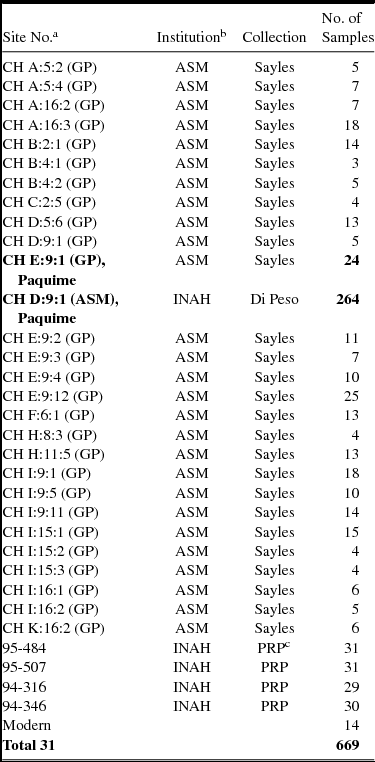
To date we have analyzed 655 samples of Chihuahuan polychrome ceramics from 31 sites by INAA (Table 1). We should emphasize that the sample is heavily biased toward Paquime with from which 288 ceramics have been analyzed. We also analyzed 14 samples of modern pottery made by two potters, Manuel Olivas from Casas Grandes and Manuela Dominguez from Anchondo, and took samples of the clays they used. Thus, the total number of sampled pottery is 669 (see Table 1).
Sampled Sites.

a GP indicates a site number given by Gila Pueblo; ASM is a site number recorded in the Arizona State Museum system.
b ASM = Arizona State Museum, INAH = Instituto Nacional de Antropología e Historia
c PRP = Proyecto Regional Paquime
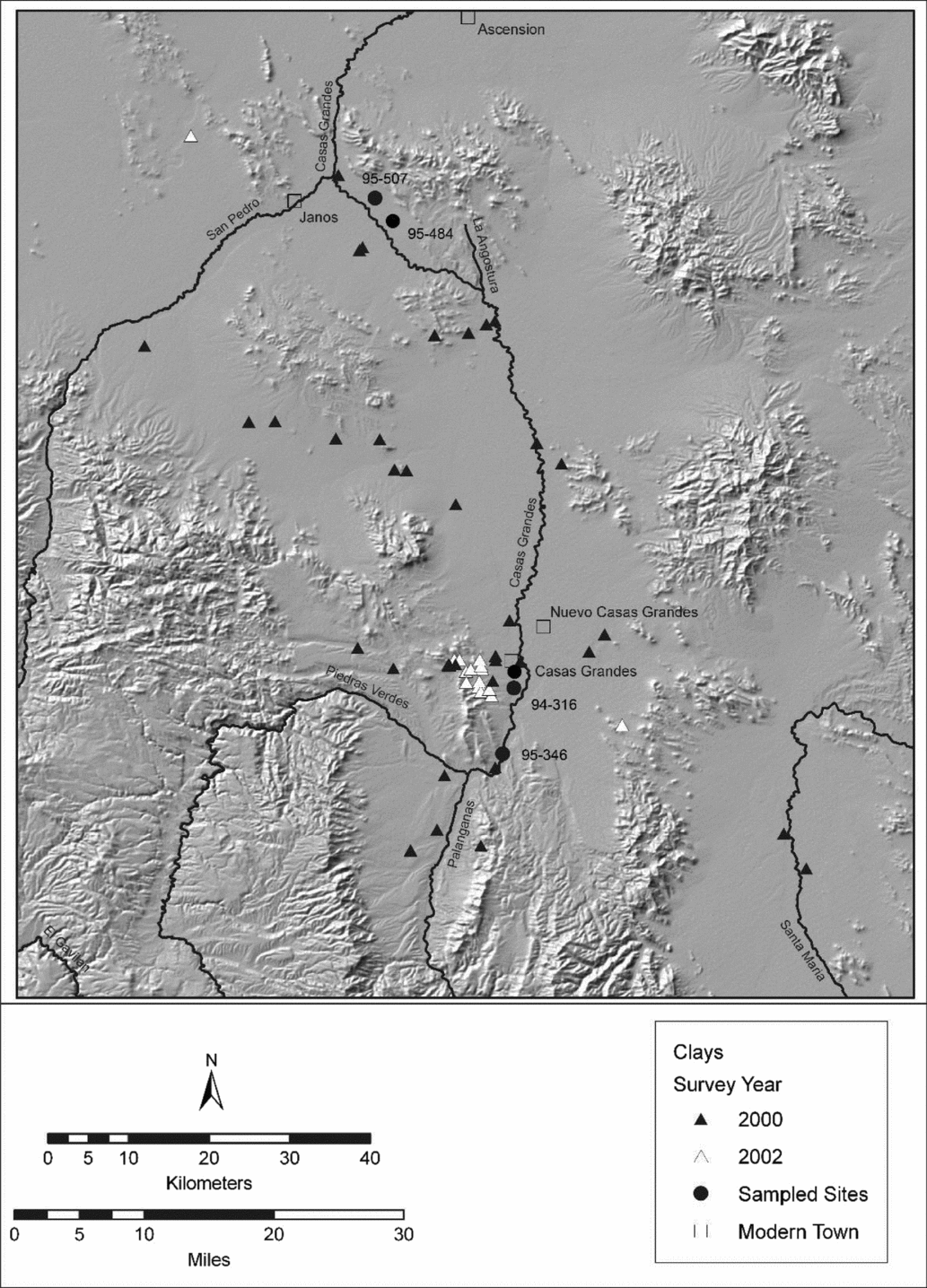
To determine the production loci for these ceramics, we carried out two raw material surveys covering an area of approximately 50 km2 and four major drainages (Figure 4). Our sample included clays that are used by the two modern potters mentioned, as well as sources that are used by potters in the village of Mata Ortiz (Bell 1994). In total, we analyzed 66 primary and secondary clays by INAA (Supplemental Table 2). To determine the mineralogy of the ceramics and some of the clays, we also analyzed 52 of the ceramics, including all three types, and 22 clays petrographically (Supplemental Tables 2 and 3). (For a more detailed discussion of methods and sampling strategies, see Supplemental Text 3).
Sampled clay sources and location of sampled sites in the Casas Grandes River valley. Map by M. James Blackman.

Results
Instrumental Neutron Activation Analysis
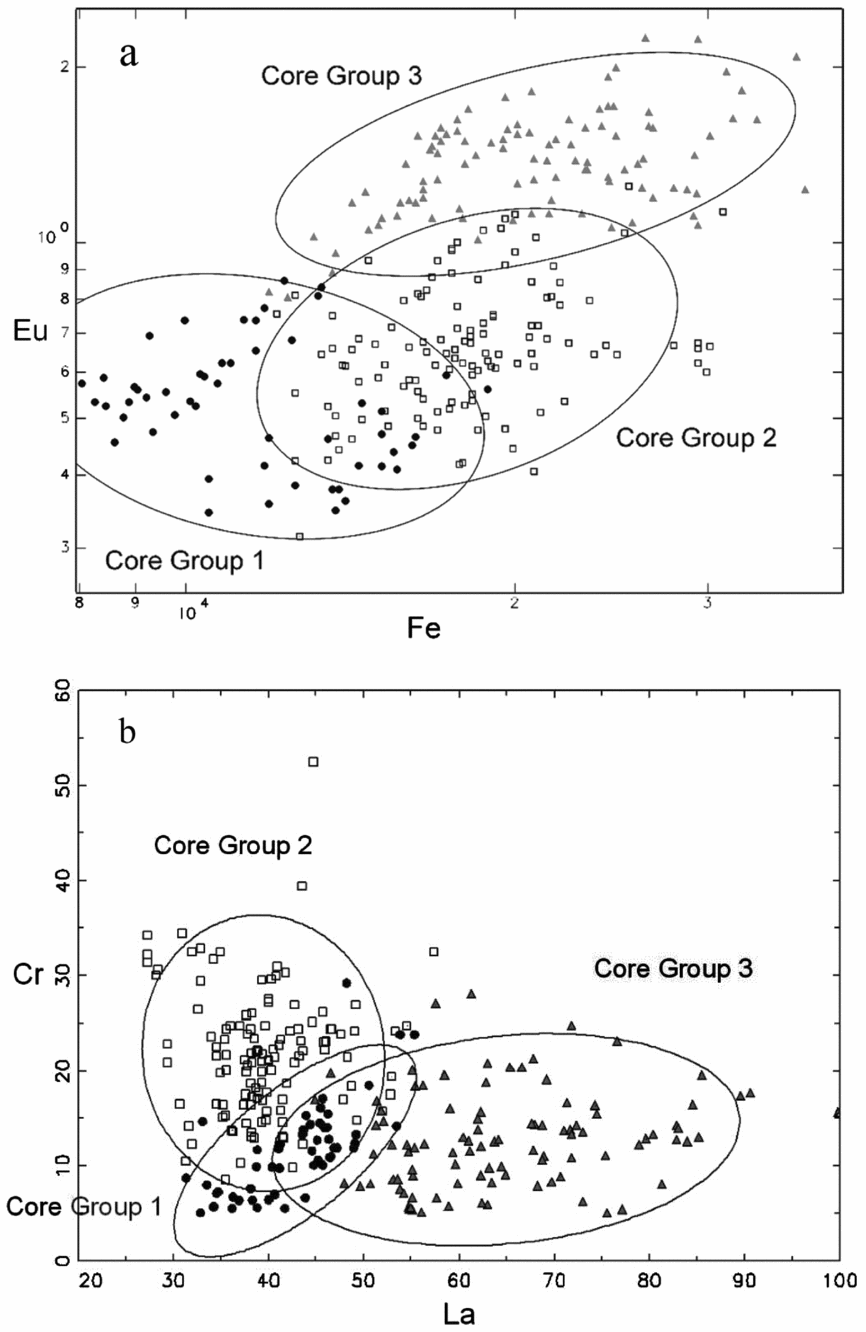
Based on the INAA, we were able to define three large compositional core groups (Figures 5a and 5b). We call these core groups because they formed the most statistically robust groups. We included samples that had group membership probabilities of more than 1% for their own compositional group and lower probabilities of belonging to any other groups (Table 2). Samples that showed similar probabilities of belonging to two or more groups were excluded from the final grouping. When looking at Table 2 and Figures 5a and 5b, it is clear that Core Group 3 is quite distinct from the other two groups; it is generally higher in rare earth elements. Core Groups 1 and 2 are well defined but more similar to each other than to Core Group 3. The three core groups predominantly contain sherds from Paquime sherds from the four large and very large sites surveyed by the Paquime Regional Project and from sites at the periphery of the main ceramic distribution area (see Figure 1, Supplemental Figure 2, and Supplemental Table 1). They also contain all three polychrome types (see Table 2). The sherds from Paquime come from all excavated room blocks (or units in Di Peso's terminology; see Supplemental Table 1). These three core groups can be subdivided into several smaller compositional subgroups, and a large quantity of additional ceramics can be assigned to eight smaller groups (Supplemental Table 1; see also Bishop et al. Reference Bishop, Triadan, James Blackman and Gamboa Carrera1998). These eight smaller groups also all have some samples from Paquime and from regional sites, and they contain all three types.
Bivariate plots of (a) iron (Fe) and europium (Eu) and (b) lanthanum (La) and chromium (Cr) concentrations of the three compositional core groups. Concentrations are plotted in ppm and ellipses represent a 90% confidence interval.

Membership Probabilities for the Three Compositional Core Groups.*

Note: Mahalanobis distance calculations are based on the samples in the three core
groups and the following elements: Na, K, Sc, Cr, Fe, Rb, Cs, La, Ce Sm, Eu, Yb, Lu,
Hf, Ta, and Th. The probabilities are jackknifed.
* Probabilities are expressed in %.
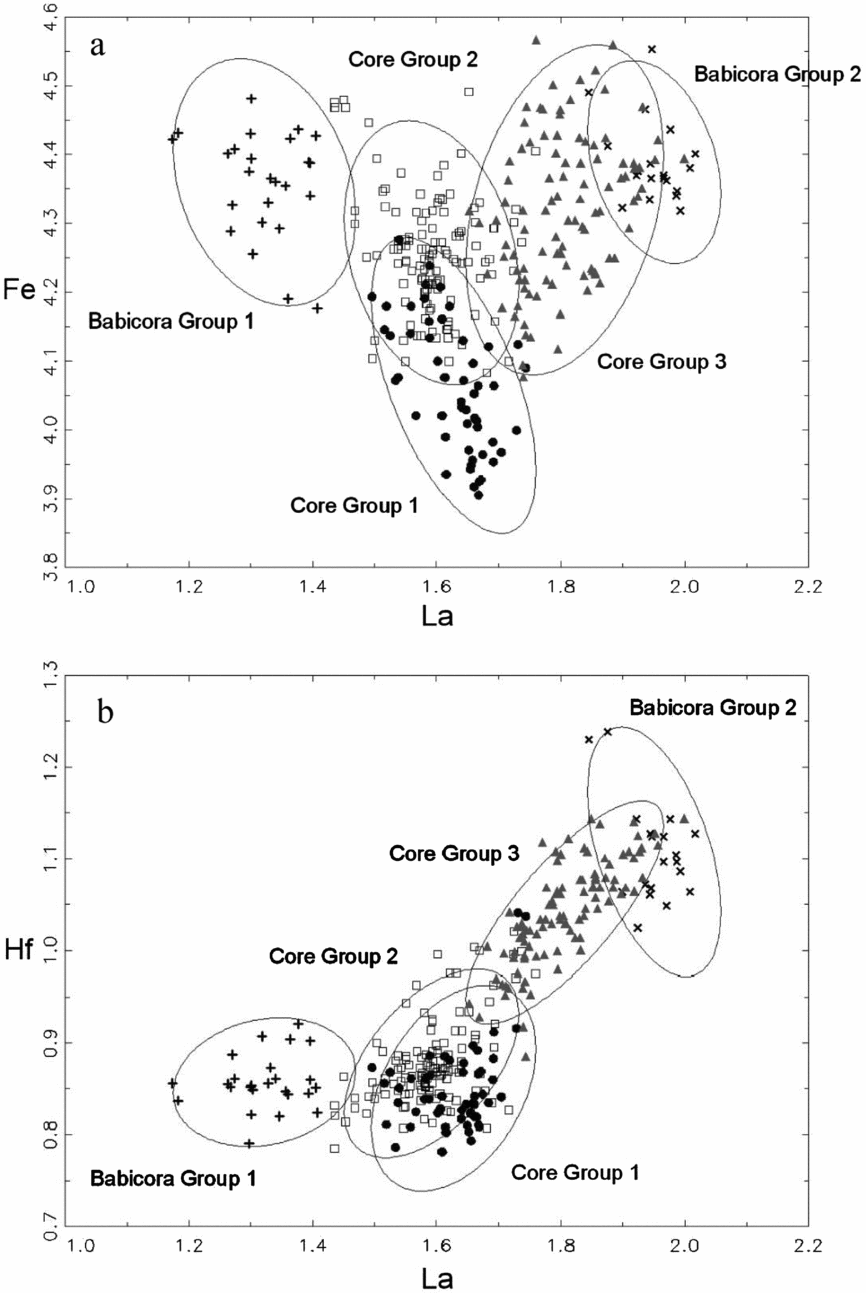
In addition to the three core groups and these smaller, mixed type, and mixed provenience groups, we can also define two groups that contain predominantly Babicora Polychromes, designated Babicora Groups 1 and 2 (see Figures 6a and 6b, Supplemental Table 1) for a total of 13 compositional groups. Most of the sherds in the Babicora 1 and 2 groups come from sites around the Babicora Basin and the upper reaches of the Santa Maria and Santa Clara Rivers (see Figure 1). Babicora Group 2 (n = 19) consists exclusively of Babicora Polychromes and a little over half come from site CH I:9:1 (GP) (or H:9:1 [ASM]; see Supplemental Figure 2 and Supplemental Text 3, which explains the site designation protocol) close to the Laguna de Babicora. This site is probably located in a cluster of sites around the town of Las Varas, about 25 km northeast of the Laguna de Babicora that is described by Carey (Reference Carey1931:336, Figure 3). Five sherds come from CH H:11:5 (GP) to the east of Babicora, and one sherd each comes from CH I:15:3 (GP) and CH I:16:1 (GP) in the upper Santa Maria River valley and CH H:8:3 (GP) to the northeast of Babicora, but there is also one sherd from CH F:6:1 (GP) in the group. This site is most likely Villa Ahumada. Babicora Group 1 (n = 25) contains mostly Babicora Polychrome sherds (but also a few sherds that have a light brown to brown paste and are clearly painted in Ramos style) and two Villa Ahumada sherds. Most of the sherds in this group come from sites in the upper reaches of the Santa Maria River southeast of Namiquipa (CH I:15:1 [GP], CH I:15:2 [GP], CH I:15:3 [GP]), from the upper Santa Clara River valley (CH I:16:1 [GP], CH I:16:2 [GP]), and a few from sites close to the Laguna de Babicora (CH I:9:11 [GP], CH I:9:5 [GP]), but six sherds that belong to this group were found at Paquime (Supplemental Table 1).
Bivariate plots of (a) lanthanum (La) and iron (Fe) and (b) lanthanum (La) and hafnium (Hf) concentrations of the three compositional core groups and the two southern Babicora Polychrome groups. Concentrations are plotted in log10 values of ppm and ellipses represent a 90% confidence interval.

Based on the differences in iron and trace element concentrations, the three large core groups probably represent three different clay sources that were used to make the pottery. It is interesting that all three of the core groups contain the three different polychrome types (see Supplemental Tables 1 and 2). In other words, some of the three different pottery types were made using the same clays, exploiting three different sources, if not more when one includes the smaller groups as potentially representing additional clay sources. There is little evidence that special clay sources were used to make Ramos Polychrome. This coincides well with some of Sprehn's (Reference Sprehn2003) findings. Her analyses demonstrated that ovoid jars and incurved bowls of the three types showed similar standardization in vessel sizes and basic design execution (Sprehn Reference Sprehn2003:141–144, 185, 204–206).
We emphasize that the proveniences of the sampled ceramics—that is, the sites where they were found—represent their consumption, not necessarily the loci of their production. If the ceramics were produced elsewhere, then their provenience also provides information about distributional patterns but not the mechanisms involved in their distribution (see Shepard [Reference Shepard1985:336–341] Triadan [Reference Triadan1997] and Zedeño [Reference Zedeño1994] for discussions of mechanisms of pottery circulation).
Unfortunately, none of the core or the smaller groups correlate with specific sites or regions of the distribution area. Each of the core groups contains sherds found at Paquime, the four large sites from the Casas Grandes valley, and sites from all areas on the periphery of the main polychrome ceramic distribution (see Figure 1, Supplemental Table 1). This may indicate that the ceramics circulated over a wide area. Moreover, we cannot match any of the source clays to the core groups. Thus, we do not have direct evidence for specific production areas or resource procurement zones (see Rands and Bishop Reference Rands, Bishop and Fry1980) for the ceramics that constitute these three compositional core groups, but patterns within the groups suggest some broad interpretations.
Of all analyzed prehistoric sherds (n = 655), 274 or 42% can be assigned to the three core groups, and an additional 205 or 31% can be assigned to the two southern groups and the eight smaller compositional groups. In total, 479 or 73% of all analyzed sherds can thus be assigned to compositional groups; 176 or 27% of the analyzed sherds remain unassigned. This is similar to results for other large sourcing studies in the Southwest (e.g., Crown Reference Crown1994:29, 32, Table 3.1; Triadan Reference Triadan1997:32).
Of all analyzed sherds from Paquime (n = 288), 176 or 61% fall into the three core groups, and another (1.9%) can be assigned to Babicora Group 1. This lends support to the idea that the three core groups may in general represent production in the region around Paquime. If we look at all analyzed Ramos Polychrome (n = 328) from all sampled sites, a little over half (170 or 51.8%) could be assigned to the three core groups. Of all analyzed Babicora Polychrome (n = 219), 82 or 37.4% could be assigned to the three core groups and 36 or 16.4% to the two southern Babicora groups, and of all analyzed Villa Ahumada (n = 108), 22 or 20.4% could be assigned to the three core groups. Again, if the three core groups represent production in and around Paquime, this could indicate that a substantial quantity of Ramos Polychrome pottery was produced in this area. Under the same assumption, this would also indicate that some Babicora and Villa Ahumada Polychromes were made in this area. The pattern of compositional attribution for Babicora Polychrome also shows that some of this pottery was made in the southern periphery. Villa Ahumada Polychrome may have been made at several locations outside this putative zone of production around Paquime.
Of all the analyzed samples that were found at Paquime (n = 288), over 60% of both the Ramos and Babicora Polychrome (67.8 and 62.4% respectively) and 34.9% of the Villa Ahumada Polychrome can be assigned to the three core groups (see Supplemental Table 1). This indicates that people at Paquime consumed considerable quantities of the Ramos and Babicora vessels that may have been produced in and around the settlement. Because Babicora and Villa Ahumada Polychromes occur in similar quantities in Paquime excavation contexts (see our discussion above), which shows that their consumption was at similar levels, the lower percentage of Villa Ahumada grouping with the three core groups suggests that larger proportions of Villa Ahumada seem to have been brought in from other areas. We should reiterate that, overall, the quantities of Babicora and Villa Ahumada Polychrome are much lower than Ramos Polychrome at Paquime.
When looking at the two Babicora groups, we can be more specific. The pattern described above suggests local production of these ceramics in the southern area of the Chihuahuan polychrome distribution zone and fairly localized consumption for most of them. If these two groups indeed represent southern production, then the sherds from Paquime that fall into Babicora Group 1 indicate that some pottery, specifically Babicora Polychrome, from these areas reached Paquime. This supports Sprehn's (Reference Sprehn2003:238) assumption that vessels may have moved into Paquime from other areas demonstrating long-distance connections. Interestingly, all of the brown-paste, Ramos-style sherds in Babicora Group 1 are from the southern sites, while all the sherds from Paquime that fall into this group are Babicora Polychrome (see Supplemental Table 1). The brown-paste, Ramos-style sherds assigned to this group may indicate that people tried to emulate Ramos Polychrome in this southern area using locally available materials. Triadan (Reference Triadan1997:94) describes a similar scenario for fourteenth-century Fourmile Polychrome of the White Mountain Red Ware series at Grasshopper Pueblo.
Instrumental Neutron Activation Analysis of Modern Pottery
Our results also show that the 14 samples of modern pottery have no compositional similarity with any of the prehistoric sherds. As a next step we compared clays that were used by the modern potters to their own pottery wasters (Supplemental Table 2). The clay that Anchondo potter Manuela Dominguez uses (CHC20) does not match her pottery compositionally. Potassium, chromium, iron, and some of the rare earth element concentrations are significantly higher in the clay than the wasters, while the cesium concentration is considerably lower in the clay than in the wasters. The potter levigates her clay (see Rice Reference Rice1987:18), which could account for some of the dilution that we see in the modern sherds, while the considerable amount of sand that she adds as temper could account for the enrichment of the other elements.
In the case of the modern pottery of Manuel Olivas from Casas Grandes, secondary clays from the Laguna del Fierro to the southeast of the town of Nuevo Casas Grandes (samples CHC06, CHC07, and CHC08), a road-building pit close to the potter's home (CHC09), and a brown clay from the Convento site (Di Peso Reference Di Peso1974:Vol. 1; CHC10) generally are a better fit with his wasters than clays from a primary source to the northeast of the potter's workshop (samples CC111, CC112, CC113, CHC16, CHC17, CHC18, CHC19) that he also uses (see Supplemental Table 2). Based on principal components analysis calculated on the basis of the modern sherds, at 99.99% variance the probabilities for the secondary clays to match the sherds range from 30 to 57%. This potter also levigates his materials and mixes several clays from different sources together. He also uses considerable quantities of alluvial sand as temper. These results indicate that the technology of these two modern potters is different from the technology employed by the prehistoric potters, which we discuss below. We believe that these differences in manufacturing technology, as well as the use of different raw material sources, can account for the fact that the modern sherds do not match the prehistoric pottery. More importantly though, the example of the Anchondo pottery shows that paste preparation can result in pottery that does not chemically resemble the clay that was used for its manufacture.
Petrography
Fifty-two Chihuahuan polychrome sherds and 22 clay samples that were analyzed by INAA were also subject to petrographic analysis (Supplemental Table 3). The samples included Ramos, Babicora, and Villa Ahumada sherds. They were all taken from the Sayles collections at the Arizona State Museum (see Supplemental Table 1 for provenience details) and included sherds from Paquime, sites in the Casas Grandes River valley (site numbers that start with CH E), and sites from the periphery of the polychrome distribution area (Figure 1 and Supplemental Figure 2). Samples were chosen from each of the potential subgroups of the three large core groups, the small compositional groups, and the two Babicora groups (Bishop et al. Reference Bishop, Triadan, James Blackman and Gamboa Carrera1998) to investigate whether different temper recipes were used that correlate with the three polychrome types or the compositional groups. The analysis revealed that most of the sherds contained fairly large, angular rhyolitic ash fragments—basically, crushed rhyolite rock. We could not distinguish specific temper groups based on the mineralogy. It should be emphasized that we also could not discern any differences in temper between Ramos, Babicora, and Villa Ahumada Polychrome. That is to say, Ramos Polychrome contained the same type of inclusions as the other two types. This supports Di Peso and coauthors’ observation that “it would appear that the paste of most pottery types was essentially similar, particularly in the case of the Medio period ceramics, as the potters added to their moist clay base opaque white angular particles (probably tuff), along with some clear crystalline grains (probably phenocrysts), and a few varied colored ones, such as red, black, yellow, and tan” (Di Peso et al. Reference Di Peso, Rinaldo and Fenner1974:6:1). The petrography thus indicates that similar paste recipes were used for ceramics that were distributed over a wide area. In contrast, the analyzed primary source clays that are weathering in situ in rhyolite deposits contain heavily weathered rock fragments, which were absent in the analyzed sherds. Rhyolite, capped by younger basalts, forms the hills west of the Casas Grandes River (Secretaría de Programación y Presupuesto Reference Secretaría de1989a, Reference Secretaría de1989b) and is thus easily available as a tempering material. In that sense the temper we observed in the samples could be considered local. Rhyolites form the bedrock of the Sierra Madre, however, and thus occur throughout the ceramic distribution area. Petrographic analysis of Ramos Polychrome sherds from Joyce Well in southwestern New Mexico shows that they all had crushed or decomposed rock temper from igneous sources and could be sorted into three larger temper groups containing welded tuffs, latite, or crushed conglomerates (Carpenter Reference Carpenter, Skibo, McCluney and Walker2002:157–159). Carpenter argues that these tempers indicate that they were produced locally. The tuff and conglomerate were available around Joyce Well. The latite source is about 16 km north of the site. Because we have not been able to directly compare thin sections from Joyce Well with our samples, it is difficult to say how different they actually are from each other, but crushed rock seems to have been a temper of choice at Joyce Well.
Our petrographic findings have important implications regarding the technology of Chihuahuan polychrome production. Based on the chemistry, we are fairly certain that the prehistoric potters used noncalcareous primary clays. Primary clays are often not very plastic and hard to work (Rice Reference Rice1987:37; Shepard Reference Shepard1985:11), and if they were used for pottery production, some of the coarser nonplastic inclusions may have been removed by the potters. Adding temper is usually not required because these clays have plenty of naturally occurring nonplastic inclusions. The results of the petrographic analysis, however, show that the prehistoric potters actually added crushed rhyolitic ash as temper. One sample shows signatures of crushing in the form of a conchoidal fracture in a quartz fragment. This indicates that the clays must have been substantially processed to make the polychrome pottery. It looks as if the naturally occurring coarse, weathered, nonplastic fractions were removed, maybe by sieving or winnowing, and then temper was added deliberately to the paste. The modern potters in the Casas Grandes region levigate their clays, but there is no archaeological evidence that the prehistoric potters used this method. There is also no evidence that Native Americans used levigation historically. For instance, Shepard (Reference Shepard1985:52) states that “although potters take great care and spend much time removing coarse particles of clay, and although their methods are varied, I have found no record of an American Indian potter levigating clay.” Instead, prehistoric potters may have used winnowing baskets to remove coarse particles from the clay after it was dried and crushed. For example, sieving is often used in clay preparation by traditional potters (see Dillingham Reference Dillingham and Elliott1992:44; Fontana et al. Reference Fontana, Robinson, Cormack and Leavitt1962:51, Figure 43, 56; Guthe Reference Guthe1925:Plate 9, 19).
The potters who made Chihuahuan polychromes seem to have employed a paste preparation technology that is very labor intensive, and different from other areas of the greater Southwest. In other regions, such as the southern Colorado Plateau, the Mogollon Mountains, and the Hohokam area, contemporaneous prehistoric potters used well-sorted, plastic secondary clays and added different types of temper to make polychrome ceramics (e.g., Crown Reference Crown1994:41; Triadan Reference Triadan1997:32–40, 49; Triadan et al. Reference Triadan, Mills, Duff, Glowacki and Neff2002). In general, secondary clays are preferred by traditional potters because they are widely available, finer, better sorted, and have less nonplastic inclusions and are thus easier to work with (Shepard Reference Shepard1985:51).
Laser Ablation Inductively Coupled Plasma Mass Spectrometry
We analyzed a subsample of each of the three compositional core groups and all primary clays by laser ablation ICP-MS in collaboration with Hector Neff of California State University, Long Beach (see Supplemental Tables 1, 2, and 4, and 5). The objective was to analyze only the fine matrix of the sherd samples. We hoped that with this approach we could eliminate the potential distorting effects of temper and naturally occurring nonplastic inclusions (see Neff et al. Reference Neff, Bishop and Sayre1988, Reference Neff, Bishop and Sayre1989), and possibly be able to correlate some of the sampled source clays with the prehistoric pottery.
Matching source clays to ceramics is difficult because potters almost never use clays as they are found in nature (see Triadan Reference Triadan1997:17–18 for a discussion). As mentioned, they usually add nonplastic materials as temper and may even mix clays to obtain desired properties for the pastes. INAA is a bulk chemical analysis, meaning that both clay and temper are represented in the elemental profiles measured by this technique (Neff et al. Reference Neff, Bishop and Sayre1988, Reference Neff, Bishop and Sayre1989). Thus, finding source clays that match ceramics is rare, apart from the difficulty of actually locating sources that were used to make prehistoric pottery. We used the laser ablation study as an additional test to evaluate whether any of the sampled clays could have been used to make the ceramics represented in the three compositional core groups.
We analyzed 30 sherds that were assigned to the three compositional core groups determined by INAA. The selected sample consisted of 10 sherds for each core group that had 70–100% probability of belonging to their respective group (see Supplemental Table 1 and 5). As mentioned, we also analyzed all of the sampled primary clays (n = 19; see Supplemental Table 2). In total, we analyzed 49 samples by laser ablation ICP-MS. The laser ablation ICP-MS replicated the groups determined by INAA, except for two samples that fell into different groups than those determined by INAA (see Supplemental Table 4). This indicates that the clay matrix of the sherds is an important contributor to the chemical profiles of the groups. Nevertheless, we could not match any of the analyzed clays to the sherds, however.
Conclusions
The same clays from at least three sources seemed to have been used to make a large quantity of all three analyzed Chihuahuan polychrome types. In addition, the petrographic analsis revealed that there was no difference in the tempering materials used in the production of these three types. This suggests that access to specific raw material sources was not restricted, and that many potters had access to the three clay sources represented by the three compositional core groups. It also indicates that the technology involved in making the three ceramic types was the same. These results strongly support the idea that the makers of Ramos Polychrome were not using special clay sources or paste recipes.
Our study provided new details about the manufacturing technology of the polychrome ceramics. People in the Casas Grandes region seem to have used primary, residual clays and crushed rhyolite temper to make these vessels. This indicates sophisticated paste processing techniques, very different from other regions in the greater Southwest, where potters generally used well-sorted secondary alluvial clays and then added the appropriate tempering agents (see Triadan Reference Triadan1997:32–40, 49; Triadan et al. Reference Triadan, Mills, Duff, Glowacki and Neff2002). The petrographic analysis has also shown a remarkably consistent general paste recipe for producing the three polychrome types. Following Whalen and Minnis's (Reference Whalen and Minnis2009) convincing argument, some Babicora Polychrome samples may date to the early Medio period. If that is the case, then we see continuity in resource exploitation and general technology, supporting their argument for the local development of the polychrome pottery tradition.
We are not yet able to attribute production to specific sites or even circumscribed resource procurement zones (see Rands and Bishop Reference Rands, Bishop and Fry1980). There are several potential reasons for this: One possibility is that we might not have found the actual sources that were used prehistorically. Alternatively, paste preparation, especially the use of rhyolitic ash, may have altered the bulk chemical compositions of the sherds to a degree that they cannot be matched with source clays. The laser ablation ICP-MS of the fine-grained matrix of the sherds reproduced the chemical groups, however, which indicates that the clay signature in the analyzed prehistoric pottery is robust and contributes significantly to the bulk compositional profiles of the sherds. We believe that the main reason for our difficulties in matching source clays to the compositional groups lies in the regional geology.
The geology in northern Chihuahua is relatively uniform over a large region (Secretaría de Programación y Presupuesto Reference Secretaría de1989a, Reference Secretaría de1989b). In general, the areas to the west of the Casas Grandes River consist of massive rhyolite deposits capped by basalts. Thus, on the macro-level, there is not much geological variability even between different drainage basins. On the other hand, within these rhyolitic deposits, the variability of rare earth concentrations is high. For instance, there is relatively high elemental variability between sampled source clays that are located relatively near each other, and we could not establish systematic trends in rare earth concentrations over a sampled area of approximately 50 km2, covering four different drainages. It seems clear that in this geologic environment, finding specific, characteristic, local chemical signatures is exceedingly difficult.
Establishing place of production based on comparisons with raw materials is difficult in the best of circumstances. An approach that uses raw materials to establish provenance beyond the macro-regional level may not be possible in the Casas Grandes region. For a higher level of resolution, such as drainage basins or individual sites, the only promising approach may be to establish compositional reference groups that are linked to specific production loci, such as wasters or unfired pottery of the types analyzed in the study (see Schneider et al. Reference Schneider, Hoffmann and Wirz1979). Unfortunately, to date we are not aware of any available archaeological material that would satisfy these criteria.
Polychrome ceramics from all excavated room blocks at Paquime were assigned to the three core groups, which suggests that all three sampled types were likely made on a household basis by many producers and that they were predominantly domestic goods. It also suggests that their consumption was not restricted to a small segment of the population of Paquime (see also Rakita and Cruz Reference Rakita, Cruz, Minnis and Whalen2015:64, 81; Sprehn Reference Sprehn2003:215). The fact that we can distinguish many compositional groups, albeit not all as well defined as the three core groups, indicates that the production of the three polychrome types was not very centralized. This observation is supported by Cruz Antillón and coauthors (Reference Cruz Antillón, Leonard, Maxwell, VanPool, Harmon, VanPool, Hyndman, Brandwein, Newell and Gallaga2004). They present results of their investigations at three sites located east and southeast of the Casas Grandes valley. Based primarily on the distributions of polychrome ceramics in these sites, they argue that the regional economic system was not very well integrated and that there is no evidence that Paquime controlled the regional economic system or functioned as a large-scale redistribution center. Whalen and Minnis's (Reference Whalen and Minnis2009) and Pitezel's (Reference Pitezel2011) ceramic data from excavated sites support this interpretation. They also show that polychrome ceramics are found in all contexts in their sites, refuting restricted consumption by a small segment of their populations.
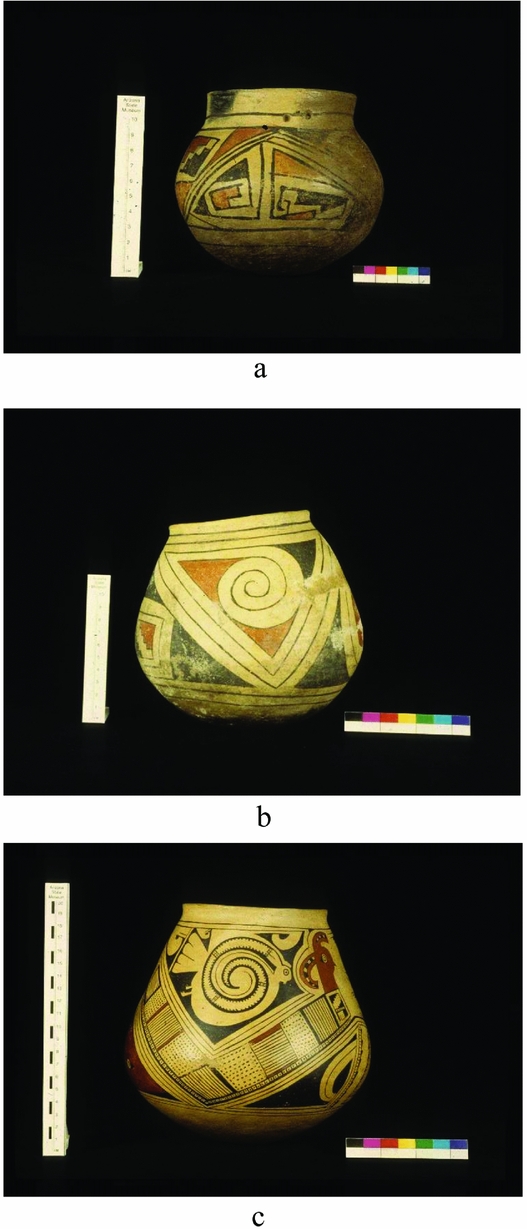
Sprehn's (Reference Sprehn2003) analysis does show a high level of standardization for the forming of incurved bowls and ovoid jars of the three polychrome types, and high skill levels in design execution, which lead her to conclude that these vessels, and especially Ramos jars, were made by part-time specialists. It should be emphasized, though, that she analyzed whole vessels from museum collections. Most of these vessels had no secure proveniences and only 42 of the 699 that she analyzed were from Paquime. Considering that most vessels came from looted contexts and thus predominantly from burials, it may very well be that there is an inherent bias for relatively better made vessels in her sample. In general, there is quite a range in the skill of design execution on Ramos Polychrome vessels. Figure 7 shows three vessels from the Arizona State Museum collections. Figure 7a may have been a vessel made by somebody still learning to paint the design. Figure 7b is representative of what we would call a typical Ramos jar, and Figure 7c shows a vessel with superior design execution. Vessels that exhibit this type of painting complexity and sophistication are rare in both museum collections and archaeological sherd assemblages. Nevertheless, the CV values for ovoid jars of Ramos, Babicora, and Villa Ahumada Polychromes show high standardization in forming the vessels, and higher skill for decorating Ramos Polychrome in general. So it is quite plausible that some vessels were made by specialists for special occasions and maybe people of relatively higher social status. The lack of evidence of any ceramic workshop activities, however, suggests that these specialists operated within their own households. We also note that the CV values for the variables Sprehn measured were comparable for the whole Casas Grandes region (Sprehn Reference Sprehn2003:210–230), indicating that production skills were high regardless of where the polychromes were made.
Ramos Polychrome vessels showing variability in design execution. Photographs by Daniela Triadan, courtesy of the Arizona State Museum.

Similarly, VanPool and Leonard (Reference VanPool and Leonard2002) argue that highly standardized metates possibly were made by many specialists: “If specialists produced utilitarian items such as metates, then the scale of specialized production (sensu Costin 1991) indicates that specialized production was not something in which only a few people participated, but was instead a fundamental organizing principle of the system centered at Paquimé” (VanPool and Leonard Reference VanPool and Leonard2002:712). Like Ramos Polychrome ceramics, they were consumed by many households, and access does not seem to have been restricted, although the authors do suggest that these metates signify status differentiation at Paquime (VanPool and Leonard Reference VanPool and Leonard2002:725–726).
Whalen and Minnis's ceramic analyses (Reference Whalen and Minnis2009:167–169, Table 5.4) show that vessels from Paquime tend to be larger, but their analyses included all ceramics, and the majority were unpainted. They postulate that there may have been more emphasis on public feasting at Paquime and that these vessels were used for social and political purposes (Whalen and Minnis Reference Whalen and Minnis2009:150–180). They also note that Paquime has much higher frequencies of polychrome pottery (18% of all recorded pottery) than the two small sites they excavated, which had 3–5% polychromes. Nonetheless, their earlier systematic surface collections (Whalen and Minnis Reference Whalen and Minnis1995) have frequencies that range from 1.8 to 18.2%, and the frequency at Paquime is well within the range observed for fourteenth-century sites with varied painted wares and types in other areas of the Southwest (Triadan Reference Triadan1997:58–64, 97, 2013:218–225; Zedeño and Triadan Reference Zedeño and Triadan2000). The contexts in which they were found – and therefore the consumption patterns – are also comparable. We thus contend that the majority of Chihuahuan polychrome vessels, including Ramos Polychromes, were probably made and certainly used by a broad segment of population of Paquime. This is also supported by a recent iconographic analysis of Chihuahuan polychrome whole vessels by Searcy (Reference Searcy, Villalpando and McGuire2014). He found that decorative motifs that he believes are associated with Mesoamerican influence were essentially equally distributed in what he defines as more hierarchically organized sites and simpler sites in the region (Searcy Reference Searcy, Villalpando and McGuire2014:66–68).
The question of whether Paquime was a major producer of polychrome and especially Ramos Polychrome ceramics cannot be definitively answered at this time we cannot match any of the core groups to raw material sources close to Paquime. Similarly, petrographic studies of the ceramics revealed no mineralogical distinctions. Based on the overall volume of these polychromes at the site and in the region, and the fact that 61% of analyzed ceramics from Paquime can be assigned to the three core groups, we believe that a significant portion of these vessels were probably produced at Paquime or at least in the core area of distribution. If the three core groups represent production in and around Paquime, then that would also suggest that significant quantities of this pottery were consumed at Paquime and that some of it moved out in all directions into the distribution area. This should not be surprising, given that Paquime and the four sampled sites in the core area are the largest settlements with the most people, and thus these results may simply reflect population densities. The results do not preclude the possibility that polychrome ceramics were also produced outside the core area and that some moved into Paquime and surrounding settlements. In fact, some Babicora Polychrome probably came to Paquime from the southern areas of the polychrome ceramic distribution zone. It should be kept in mind, however, that none of the other smaller compositional groups consisted of ceramics that came predominantly from a specific site or area such as the northern fringes of the distribution sphere in southern New Mexico, except for the two Babicora groups. Those two groups suggest that some Babicora Polychrome and some brown-paste, Ramos-style ceramics were made in the southern parts of the distribution area and seem to have been distributed and consumed mostly in that region.
In summary, many Chihuahuan polychrome ceramics, including Ramos Polychrome, were likely made at Paquime and surrounding settlements, probably by many households, but it is not clear that Paquime dominated their production and distribution. Access to polychrome vessels was not restricted, and all segments of the population seem to have used them for often mundane activities, such as cooking, indicating that the ceramics were not a prestige item controlled by people with relatively higher status. This supports an interpretation that economy of Paquime was not very centralized or politically integrated.
Acknowledgments
The research for this project was started during Triadan's postdoctoral fellowship at the Smithsonian Center for Materials Research and Education and supported by a National Science Foundation grant (BCS 9911104). The Smithsonian Institution and the National Institute of Standards and Technology provided access to the INAA and exceptional support throughout the course of the project. This project would not have been possible without the collaboration and help of many colleagues. Michael Jacobs, archaeological collections curator at the Arizona State Museum (now retired), provided access to the extensive whole vessel collections and Sayles surface collections. Our colleagues at the Instituto Nacional de Antropología e Historia Chihuahua and at the Museo de las Culturas del Norte, especially Elsa Rodriguez, then the director of the former, and Frida Mateos and José Luis Punzo, directors of the latter, were simply fabulous. They and their teams provided access to sites and collections and frequent hospitality, and made this a truly fun project. We thank our collaborators Michael Whalen, Paul Minnis, Jane Kelley, and Joe Stewart for providing access to their ceramic collections and their support and valuable feedback during various stages of the research. Art MacWilliams contributed much appreciated comments on some of the hairier problems that presented themselves. Gary Christopherson contributed time and patience to the creation of the GIS map of the source clay locations. Deborah Bergfeld analyzed the petrographic thin sections, and Hector Neff conducted the laser ablation ICP-MS analysis. We also thank three anonymous reviewers for their thoughtful comments and suggestions.
Data Availability Statement
The analyzed ceramic sherds are housed at the Arizona State Museum and the Museo de las Culturas del Norte in Casas Grandes, Mexico, which should be contacted for access. For samples from the Paquime Regional Project that are housed at the Museo de las Culturas del Norte Dr. Michael Whalen, Dept. of Anthropology, University of Tulsa, Oklahoma should be contacted. All thin sections are in the possession of Daniela Triadan, School of Anthropology, University of Arizona and request should be directed to her. The databases resulting from the various analyses are also maintained by Daniela Triadan and requests for data should be directed to her.
Supplementary Material
Supplemental materials are linked to the online version of the manuscript, accessible via the SAA member login at https://doi.org/10.1017/laq.2017.52
Supplemental Text 1. Models of Economic Organization in the Casas Grandes Region.
Supplemental Text 2. Type Descriptions and Regional Distribution of the Sampled Chihuahuan Polychrome Types.
Supplemental Text 3. Analytical Methods and Sampling.
Supplemental Figure 1. Ramos Polychrome jar with light brown paste, ASM #14431. Photograph by Daniela Triadan, courtesy of the Arizona State Museum.
Supplemental Figure 2. Map showing 15 and 7½ minute topographic quadrangles and alphanumeric designations in the Arizona State Museum and Gila Pueblo site recording systems for Chihuahua. Letters in () are the Gila Pueblo designations. Shaded areas are the quadrangles in which sampled sites are located.
Supplemental Table 1. Sampled Ceramics.
Supplemental Table 2. Analyzed Source Clays.
Supplemental Table 3. Samples Analyzed by Petrography.
Supplemental Table 4. Group Membership Probabilities for the Samples Analyzed by ICP-MS (probabilities in %).