introduction
This paper examines the impact of decentralisation reforms on service users’ participation in decision-making processes regarding the delivery of water and health services at the village level in rural Tanzania, using a gender perspective. There is a growing body of literature on gender and decentralisation that emphasises the importance of women's participation in local decision-making processes (Agarwal Reference Agarwal2001, Reference Agarwal2010; Maharaj & Maharaj Reference Maharaj and Maharaj2004; Agrawal et al. Reference Agrawal, Yadama and Bhattacharya2006; Todes et al. Reference Todes, Sithole and Williamson2010). Based on the premise that decentralisation ‘brings government and services closer to the people’ (Devas & Grant Reference Devas and Grant2003; Bergh Reference Bergh2004; Maharaj & Maharaj Reference Maharaj and Maharaj2004), women's participation in local structures is seen as a means of increasing gender-sensitivity to local conditions and priorities, thus enabling greater influence of women over planning and service delivery (Beall & Todes Reference Beall and Todes2004; Maharaj & Maharaj Reference Maharaj and Maharaj2004; Hicks Reference Hicks2011). This helps to ensure better understanding of the gender dimensions of service requirements and community needs (Beall Reference Beall2005; Lakwo Reference Lakwo2009; Matembe Reference Matembe2010). Others view it as a way of empowerment to transform unequal power relations, enable new actors (in particular women) to gain influence in development processes, increase women's bargaining power in the private and public spheres, and address gender inequality and close gender gaps (Agarwal Reference Agarwal2001; Bryld Reference Bryld2001; Agrawal et al. Reference Agrawal, Yadama and Bhattacharya2006; Goetz Reference Goetz2007; Todes et al. Reference Todes, Sithole and Williamson2010).
However, despite the popularity of decentralisation reforms in recent decades, and a long history of initiatives to mainstream gender in development (Todes et al. Reference Todes, Sithole and Williamson2010), much of the debate on gender and politics in sub-Saharan Africa has been on women's representation in political institutions at national and regional levels. Studies on gender and decentralisation in sub-Saharan Africa are few and mainly focus on women's participation in district or municipal structures, rarely going beyond these levels to the lower village levels. Examples include studies in Ghana (e.g. Gyimah & Thompson Reference Gyimah and Thompson2008), Uganda (e.g. Lakwo Reference Lakwo2009; Matembe Reference Matembe2010) and South Africa (e.g. Todes et al. Reference Todes, Sithole and Williamson2010; Hicks Reference Hicks2011). The evidence from these studies, as well as those from rural India where the village-level panchayat institutions have been extensively studied (e.g. Bryld Reference Bryld2001, Ban & Rao Reference Ban and Rao2008), show that women's participation in local institutions remains low, and is determined by the socio-cultural rules and norms, relationships, structures, processes of local governance, and the historical and political context of communities (Bryld Reference Bryld2001; Ban & Rao, Reference Ban and Rao2008; Hicks Reference Hicks2011). In addition, women's triple role in production, reproduction and community management (Moser Reference Moser1993) leave them with very limited time to participate in local governance (Gyimah & Thompson Reference Gyimah and Thompson2008). Hence, increasing women's bargaining power and involvement in decision-making processes at different levels requires changing these structural constraints to render them more responsive to women (Agarwal Reference Agarwal2001).
Against this background, the present paper focuses on the experiences of women's participation in village level institutions in Tanzania. After more than a decade of implementing decentralisation reforms, recent studies in Tanzania show that the extent of people's participation in planning and decision-making processes at the local level is limited, minimal or ineffective (Kessy & McCourt Reference Kessy and McCourt2010; Norman & Massoi Reference Norman and Massoi2010; Venugopal & Yilmaz Reference Venugopal and Yilmaz2010), and that institutional arrangements under decentralisation are not facilitating participation for local development (Mollel Reference Mollel2010). However, empirical studies looking at the gender dimensions of these processes are scant. Although it is widely acknowledged that men and women have different access to decision-making processes due to socially constructed gender roles and needs, most studies are gender-neutral and assume that decentralisation affects men and women equally. In Tanzania (and in other sub-Saharan African countries) most studies on gender and politics have focused on women's representation in parliaments (e.g. Meena Reference Meena2003; Ballington & Karan Reference Ballington and Karan2005; Shayo Reference Shayo2005) or district councils (e.g. Meena Reference Meena2003; PMO-RALG 2006). The village level, where decisions that directly affect the lives of men and women are made, has been much less examined.
Thus, whether decentralisation results in increased participation and decisions that are in the interests of village-level service users in general, and of women in particular, remains an empirical question that warrants further investigation. This paper addresses this issue by suggesting answers to the following questions. First, to what extent have decentralisation reforms enhanced the opportunities for service users to participate in decision-making processes? Second, how do men and women make use of these opportunities to participate in decision-making processes regarding the delivery of public services? Third, how are practical and strategic gender needs reflected in decision-making processes about service delivery at the local level? Fourth, which factors constrain or promote women's participation in these processes?
The paper contributes to the literature on gender and decentralisation in Tanzania using the cases of water and health services. It focuses on the micro-level processes at the village level where men and women, the actors in and beneficiaries of decentralisation reforms, live. Analysis at the village level is crucial for revealing the interfaces between the macro- and micro-level processes, and between the formal and informal institutions. The following section presents the theoretical framework that informs this analysis.
DECENTRALISATION, PARTICIPATION AND GENDER: A THEORETICAL FRAMEWORK
Three main concepts are central to our analysis: decentralisation, participation and gender. Decentralisation is broadly defined as ‘the transfer of power and responsibility to plan, make decisions and manage public functions from a higher level of government to a lower one’ (Conyers Reference Conyers, de Valk and Wekwete1990: 19). The literature treats decentralisation and participation as having a ‘symbiotic relationship’ (Bergh Reference Bergh2004: 781), where men and women are assumed to participate equally in local politics (Lakwo Reference Lakwo2009). Decentralisation is often expected to foster women's participation in local decision-making structures because it focuses on basic services that address women's needs (Beall Reference Beall2005; Lakwo Reference Lakwo2009; Matembe Reference Matembe2010). However, a closer look suggests that this relationship is not straightforward, given the hegemonic power relations and gender inequalities at the local level that become evident when incorporating a gender perspective into our analysis (Matembe Reference Matembe2010). This entails looking at the influence of gender on people's opportunities, social roles and interactions (FAO 1999) and exploring how men and women contribute to and benefit from local governance as citizens or as service users (Beall Reference Beall1996). Our second research question thus relates to men's and women's agency in decision-making processes, while the third and fourth consider the content and extent of women's participation in decision-making processes and the factors that constrain or encourage their participation. All of these questions are necessary in unpacking the gender perspective.
In addition, the paper uses principal-agent theory to explain whether participation in decision-making processes enables service users to exercise their roles as principals. The theory proposes a ‘principal’ who has specific objectives, and ‘agents’ who are required to implement activities to achieve those objectives (Bossert Reference Bossert1998; Bossert & Beauvais Reference Bossert and Beauvais2002; Brinkerhoff & Azfar Reference Brinkerhoff, Azfar, Connerley, Eaton and Smoke2010; Hiskey Reference Hiskey, Connerley, Eaton and Smoke2010). In the context of decentralisation, there is a complex ‘agency relationship’ where local governments act as agents for two different principals: the national government and the citizens or service users. The theory is a useful analytical tool because it focuses both on the relationship between actors in decentralised institutions and on the duties and responsibilities that the decentralisation reforms impose on these actors (Hiskey Reference Hiskey, Connerley, Eaton and Smoke2010). The approach helps to explain how participation in decision-making processes is structured at the village level. Despite its widespread use in the decentralisation literature (e.g. Bossert Reference Bossert1998; Bossert & Beauvais Reference Bossert and Beauvais2002; Brinkerhoff & Azfar Reference Brinkerhoff, Azfar, Connerley, Eaton and Smoke2010; Hiskey Reference Hiskey, Connerley, Eaton and Smoke2010), however, this theory has not been linked to gender. This paper addresses this missing connection.
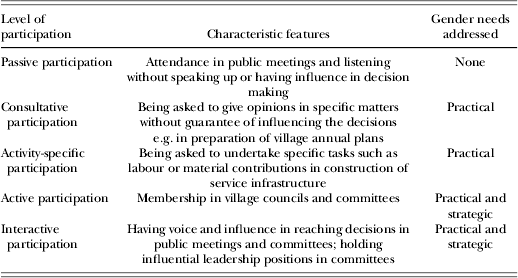
The assumption is that decentralisation reforms have created formal local institutions that provide opportunities for men and women to participate and exercise their agency as principals or as agents representing other service users. We refer to these institutions as spaces for participation. To examine the effectiveness of participation in these spaces, we draw on the typology of participation developed by Agarwal (Reference Agarwal2001), as presented in Table I. We argue that achieving effective participation entails a shift from the lower level, where participation merely involves attending meetings, towards the higher levels, where men and women have ‘voice’ and influence in reaching decisions (Agarwal Reference Agarwal2001, Reference Agarwal2010).
Typology of gendered participation in village structures

Source: Adapted from Agarwal (Reference Agarwal2001) and modified by authors.
The strong point of the typology is that it emphasises how men and women participate in the available spaces and whether their participation can be considered effective in addressing women's practical and strategic gender needs (Moser Reference Moser1993). Practical gender needs relate to the immediate perceived necessities articulated from women's experiences, and are based on the sexual division of labour within the household and community. Strategic gender needs relate to women's subordination to men and the need for equal organisational and structural relationships between men and women (Moser Reference Moser1993). This categorisation is relevant in the context of decentralisation because women's participation is expected to champion women's interests (Beall Reference Beall2005; Lakwo Reference Lakwo2009; Matembe Reference Matembe2010).
We measured practical gender needs in terms of topics men and women talk about in meetings and their involvement in the construction of service infrastructure. Strategic gender needs were measured in terms of women's ability to speak up and influence decisions in meetings and the extent to which women hold influential leadership positions in village committees. Convenience of public meetings to women in terms of time, venue and language is used as an indicator of gender roles and gender division of labour. Gender is further seen as intersecting with other variables such as age, ethnicity and religion, which all play a role in enabling or constraining effective women's participation. The specific discussion must be situated in the context of decentralisation reforms in Tanzania and the spaces for participation created by the reforms at different administrative levels.
GENDERED PARTICIPATION AND DECENTRALISATION: THE RURAL CONTEXT
Since independence in 1961, decentralisation in Tanzania has been implemented as a means of increasing people's participation in development and improving local service delivery (Tordoff Reference Tordoff1994; Cooksey & Kikula Reference Cooksey and Kikula2005). Early decentralisation attempts from the 1960s to mid-1990s, however, did not lead to increased participation because they were checked by a tendency towards administrative deconcentration (Cooksey & Kikula Reference Cooksey and Kikula2005). Over the past decade, however, participation has gained impetus after the commencement of local government reforms implemented through a policy of ‘decentralisation by devolution’. The current reforms aim to establish broad based community awareness and people's participation, and to promote principles of democracy, transparency and accountability. Local government authorities are expected to ‘facilitate the participation of the people in deciding on matters affecting their lives, planning and executing their development programs’ (URT 1998: 4, 2004: 35).
Women's participation and gender are also consistently affirmed in the reform policy documents. The Local Government Reform Agenda states an intent ‘to promote the participation of women in management of local authorities’ (URT 1996: 20). The Policy Paper on Local Government Reform states that local government reforms aim ‘to establish a democratic and gender-sensitive administrative set-up in local governments’ (URT 1998: 13). The Prime Minister's Office – Regional Administration and Local Government (the ministry responsible for local governments in Tanzania) recognises women as ‘potential drivers of change for decentralisation’, stating that ‘most women have something to gain’ from decentralisation reforms (PMO-RALG 2006: 5). Although the Local Government Reform Program II notes that the marginalisation of women's interests in village and district plans was one of the problems encountered in the first phase of the reforms, again, it advocates gender mainstreaming, particularly in the composition of councils (URT 2009a).
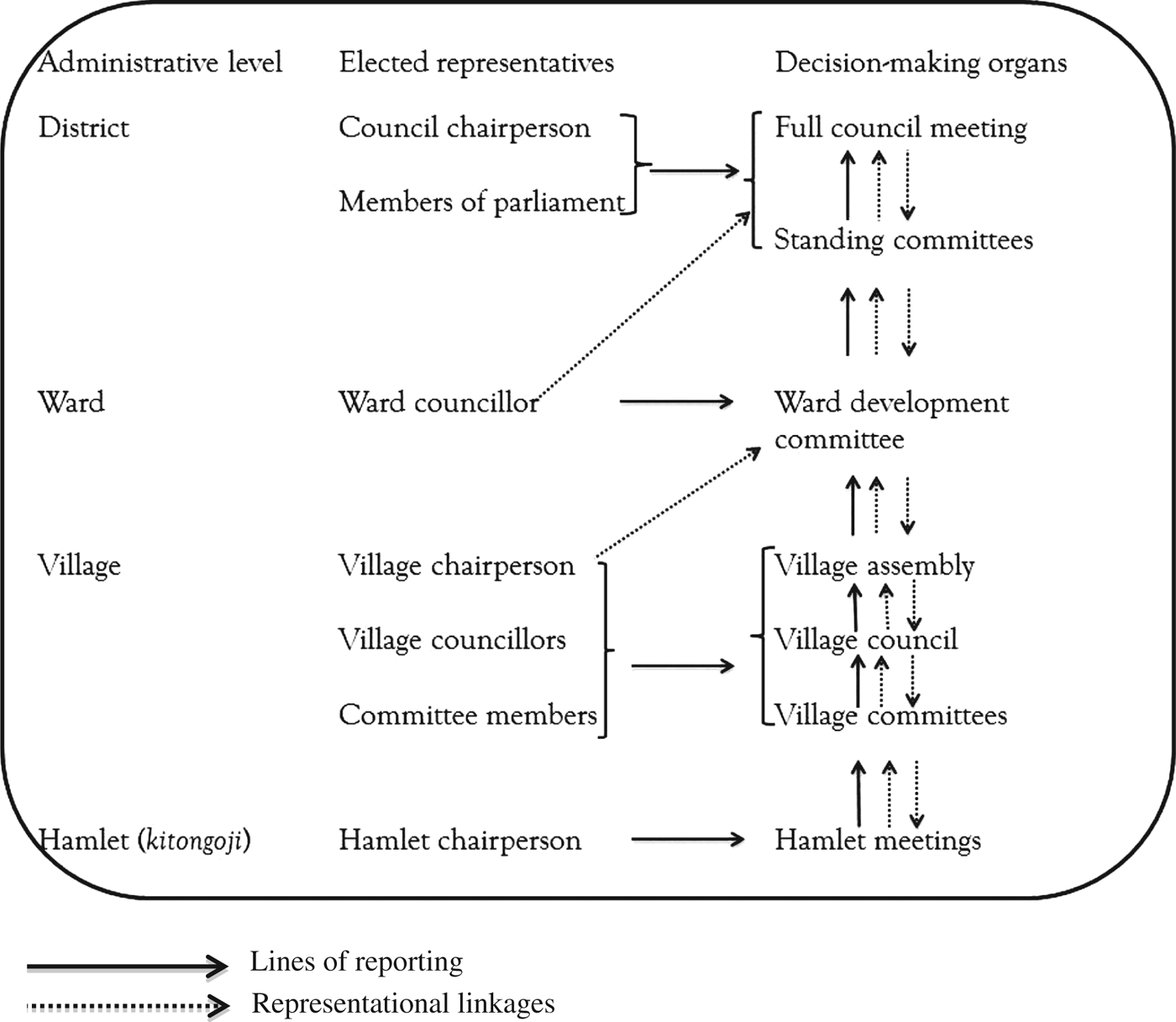
Consequently, the reforms have created a number of spaces for service users to participate in decision-making processes at the local level. These include hamlet (kitongoji) meetings, village assemblies, village councils and committees and district full council meetings. Figure 1 shows the relationship between these spaces at different levels. The hamlet is the lowest administrative level, where residents elect a chairperson who represents them in the village council. The hamlet chairperson can organise residents’ meetings to discuss development issues of the hamlet, although it is not stipulated how often such meetings should be held. The village assembly and village council are the major decision-making spaces at the village level. The village assembly is composed of all adult members of the village, and it elects the village chairperson, a village council of 15–25 members, and other village committees (Shivji & Peter Reference Shivji and Peter2003; Venugopal & Yilmaz Reference Venugopal and Yilmaz2010). The legal framework guarantees women's representation in village structures stating that ‘not less than one quarter of the total members of village councils should be women’. This is implemented through a quota system, in addition to normal local election procedures (Shivji & Peter Reference Shivji and Peter2003: 27). The village assembly meets every three months, while the village council meets monthly.
Local government decision-making spaces.
The most important decision-making space at the district level is the full council meeting which meets once every three months and involves ward councillors, special seat councillors (women), parliamentarians representing constituencies in the district and heads of district council administration. Citizens can also attend full council meetings as observers (Kessy & McCourt Reference Kessy and McCourt2010; Venugopal & Yilmaz Reference Venugopal and Yilmaz2010). Other spaces for participation are consultation meetings during preparation of village plans organised at either the hamlet or the village level, and in the construction and rehabilitation of service infrastructures such as rural water supply schemes, village dispensaries, rural health centres or primary schools. So, how and to what extent do men and women make use of these spaces and, thus, participate in decision-making processes? We address these questions using a gender perspective and principal-agent theory, after a description of the methodology.
study design and methodology
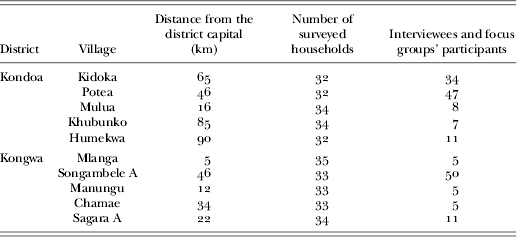
The present paper is based on empirical research carried out between September 2011 and August 2012 in the rural districts of Kondoa and Kongwa in the Dodoma Region in Tanzania. Kondoa is an old colonial district located in the northern part of the region, whereas Kongwa is a relatively new district in the eastern part of the region. The two districts were purposively selected because they differ in terms of both the phase at which they joined the reforms, and in their ethnic and religious composition. Kondoa joined the reforms from the start in 2000 whereas Kongwa was only included in 2005. Kondoa has a more diverse number of ethnic groups including the Rangi, Gogo, Sandawe, Hehe, Bulunge, Masaai and Barbaig. The major ethnic groups in Kongwa are Gogo, Kaguru and Hehe. More than half of respondents (55%) in Kondoa are Muslim, while in Kongwa the majority (96%) is Christian. The fieldwork was carried out in ten selected villages, five in each district (Table II), most of which had been involved in construction of water and/or health service infrastructures in recent years as part of the reforms. Although the findings from two districts may not justify general conclusions on gender and decentralisation throughout the country, they do serve to identify mechanisms of gendered participation in local institutions by service users, and suggest the problems that constrain effective women's participation in specific contexts.
Location and research participants in the study villages
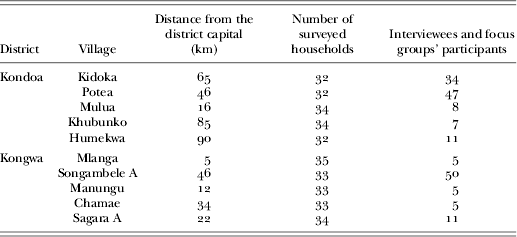
Data were collected using a combination of quantitative and qualitative methods as a strategy for enriching our understanding of the issue (Niehof Reference Niehof1999; Axinn & Pearce Reference Axinn and Pearce2006), and contributing to both the validity and reliability of findings (Scrimshaw Reference Scrimshaw, Rogers and Schlossman1990). A household survey was conducted among 332 randomly selected households, with a minimum of 30 households in each village, allowing a reasonable control over sampling error (Grinnell Reference Grinnell2001). Overall, 115 men and 217 women participated in the survey. Qualitative data were collected through semi-structured and unstructured interviews with district council officials and village leaders. Eight focus group discussions were done with groups of men, women, village water committees and village health committees. Five life histories of individual women leaders were also collected to learn about their experience in local decision-making processes. These qualitative methods provided an opportunity to explore different issues in a flexible manner and to capture the richness of experiences and perceptions of the respondents in their own terms. Review and analysis of available data at district and village levels provided relevant secondary data to complement the primary data.
The household survey data were coded and analysed, and frequency distributions, mean scores and chi-square tests were computed for most variables. Binary logistic regression was used to determine the factors associated with respondents’ ability to speak up and influence decisions in public meetings. Field notes from interviews and focus group discussions were transcribed and analysed using qualitative content analysis so as to interpret and construct meanings from the text. We present and discuss our findings, below, by weaving together the survey and qualitative data, illustrating survey findings with examples, and validating qualitative findings with survey data.
DECENTRALISATION AND PARTICIPATION BY SERVICE USERS
A consideration of four forms of participation allows us to examine how men and women participate, respectively, in the spaces created by the decentralisation reforms. These include: attendance at public meetings, participation in the construction of service infrastructure, membership of village committees, and the ability to speak up and influence decisions (see Table I).
Attendance in public meetings
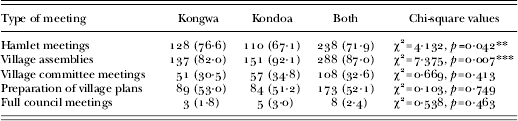
The majority of surveyed households (91%) reported that at least one member had attended public meetings over the year preceding the survey: 87% village assemblies, 72% hamlet meetings and 33% village committee meetings (Table III). Only about half of respondents (52%) reported having attended village planning meetings. Villagers as ‘principals’, men and women alike, do not see themselves as having influence in these ‘consultation’ processes because in most cases village plans are not implemented as planned partly due to limited funding from the district councils.
Although district full council meetings are open to the public, citizen attendance was very low (2%). In two full council meetings (one in each district) observed by the first author, only 30 citizens in Kondoa (22 men and 8 women) and 10 in Kongwa (all men) attended the meetings. Most citizens do not attend full council meetings due to long distances and associated travel costs to the district council headquarters where meetings are held, as well as due to lack of information on meeting schedules which are mostly posted on council headquarters notice boards, and rarely in ward and village offices. The law allows citizens to attend full council meetings as observers (the passive form of participation) but not to speak up (the interactive form of participation). This implies that decision-making at the district level is the responsibility of agents (councillors and parliamentarians). Whether the outcomes of these decision-making processes reflect the voice of the principals depends on the efforts of the councillors (agents) to consult and represent the views of their constituencies. There are no clearly established consultation mechanisms between councillors and citizens. It remains the discretion of the councillor to convene meetings with constituencies. As a result, such consultations may be haphazard and biased (Devas & Grant Reference Devas and Grant2003) and do not necessarily represent the views of different groups within the community.
Attendance at village public meetings differed significantly between districts, with many respondents in Kongwa reporting having attended hamlet meetings (77%), while in Kondoa many attended village assemblies (92%). The district council officials stated that the reforms have been successful in increasing the number of village statutory meetings, including assemblies, councils and committee meetings. Village executive officers are required to report to the district council the number of statutory meetings held in their villages, which acts as a catalyst for such meetings to be held. When villagers (principals) demand such meetings, village leaders (agents) are compelled to convene them. Villagers also ask for financial reports in these meetings, an indication that principals are demanding accountability from their agents. Comparatively, citizens’ attendance in village assemblies in our sample is almost twice what was reported at national level, which was only 44% in 2006 (URT 2009b), and higher than that reported by Kessy & McCourt (Reference Kessy and McCourt2010) in Mwanza City Council and Moshi Rural district, where 55% of the respondents reported having attended village assemblies over the last 12 months.
Citizens' attendance public meetings over the last 12 months by district (n=331)
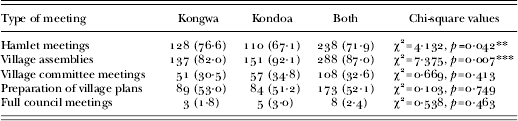
Figures in parentheses are percentages. **Significant at 5% level, ***Significant at 1% level.
A review of village records for 2010/2011 and 2011/2012, however, revealed that none of the study villages had held the four annual village assemblies required by law. This means that the frequency of public meetings is still low, thus limiting the opportunities for service users to voice their concerns and to exercise their agency as principals. At the national level, the United Republic of Tanzania (2009b) shows that just over half (56%) of respondents in 2006 reported that their village assembly had met in the last three months, a situation which does not appear to have substantially improved. The problem appears to be widespread including in other countries; studies in Uganda also point to low attendance at community meetings given the perception that decisions in such meetings are a prerogative of elected representatives (Francis & James Reference Francis and James2003), as well as because meetings at the village level do not happen as frequently as they should (Devas & Grant Reference Devas and Grant2003).
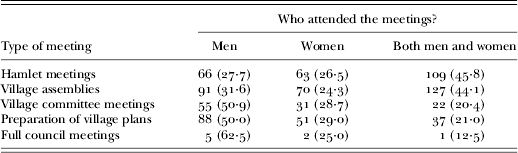
In most households, more men than women attended public meetings. While the proportion of women was generally low for all meetings, the higher the level of the meeting, the higher the proportion of men (Table IV). The relatively high proportion of both men and women in hamlet meetings and village assemblies was partly because of the proximity to the venues of the meetings. Presumably, the more spatially close to home the meeting is held, the more likely that both men and women will attend. These findings are in agreement with what was shown by the United Republic of Tanzania (2009b) that women were slightly under-represented in village meetings.
Citizen's attendance in public meetings over the last 12 months by sex
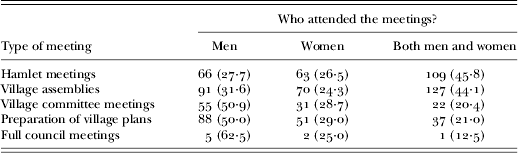
Figures in parentheses are percentages.
In some villages, however, leaders noted that more women than men attend village meetings. In Humekwa, a village leader said: ‘most men in this village have a tendency of neglecting meetings, they usually send their wives’. A woman village councillor in Sagara A remarked: ‘it is the women who mostly attend village meetings compared to men who are always busy in their local brew clubs’. In Kidoka, a village with more than three major ethnic groups, ethnicity played a role as well. In some ethnic groups, women were said to have more freedom to attend public meetings than in others. A leader in this village noted: ‘in this village, it is the Rangi women who mostly attend the meetings, but not the Gogo and Masaai women who are afraid of sitting in a meeting with men because of their culture’. This shows that actual participation in the formal spaces created by the reforms differs with context. It also shows that gendered attendance is a cultural issue. As Pennartz & Niehof (Reference Pennartz and Niehof1999) point out, the relationship between decision-making and power depends on the benefits and status of the specific decision-making area. Shivji & Peter (Reference Shivji and Peter2003) observed that in some parts of the country (Muleba and Sengerema districts), the majority of those who attend public meetings are women, while in other parts (Lindi Rural district), there are hardly any women in meetings, not even the village councillors.
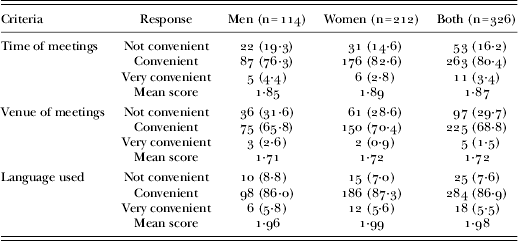
A large majority of respondents ranked the time of village meetings as either convenient or very convenient (81% men and 85% women). Most villages convened their village assemblies in the afternoons, an arrangement that was said to accommodate women's household responsibilities. The few villages that organised their meetings during morning hours (e.g. Chamae, Khubunko and Sagara A), had many incidences of either cancelling or postponing meetings until late afternoon because of poor attendance. Village meetings were mostly held under a big tree, close to the village centre. Most respondents considered the meeting venue as either convenient or very convenient (68% men and 71% women). However, in large villages with scattered hamlets, some respondents (particularly women) complained that the meeting site was too far. Because village meetings are conducted in Kiswahili, a language that is widely spoken in Tanzania, the vast majority of the respondents ranked the language used as either convenient or very convenient (92% men and 93% women). Mean scores for the three indicators did not differ significantly between men and women, and could be interpreted as ‘convenient’ (Table V). Survey results thus suggest that practical considerations of time, venue and language used in meetings did not conflict with women's ability to participate in these spaces.
Respondents' perceptions on convenience of public meetings to women by sex
Figures in parentheses are percentages.
Participation in construction and rehabilitation of service infrastructure
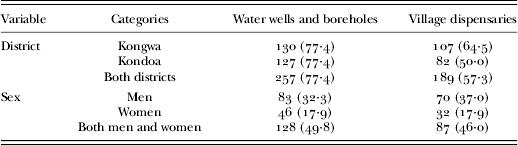
The majority of respondents (88%) reported having participated in construction or rehabilitation of water and health service infrastructures over the past 10 years (90% in Kongwa and 87% in Kondoa). More households had participated in water infrastructures (77%) than in health (57%), reflecting the fact that six of the study villages (Humekwa, Potea, Kidoka, Manungu, Chamae and Songambele A) had constructed boreholes through the decentralised Water Sector Development Program. Construction of village dispensaries had been implemented in the villages of Khubunko, Chamae, Songambele A, Sagara A and Potea, although not many households appeared to have taken part in these activities.
For both services, more men than women were reported to have participated in these activities. Nevertheless, in about half of households (50% in water and 46% in health), both men and women had participated in these initiatives (Table VI). In construction of water wells and boreholes, 32% of the households indicated that only men had participated, compared with 18% reporting only women. In village dispensaries, 37% of households reported men only compared with 17% that reported women only. Although women are the principal care-givers in households and main users of water and health services, their participation in these services-related activities is somewhat lower than that of men. For example, in 68% of households women participated in water projects, compared with 82% with men participating. A similar pattern can be observed in the health projects in which 64% of households reported women participating compared with 83% that reported men participating.
Citizen's participation in service infrastructure activities by district and sex (n=332)
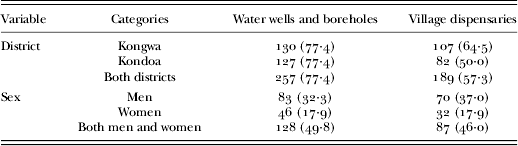
Figures in parentheses are percentages.
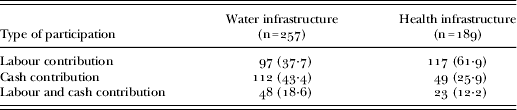
In terms of how service users participated in these activities, three forms of participation were identified: provision of unskilled labour, cash contributions, or a combination of the two. Many respondents participated in construction of water infrastructures through cash contributions (43%) and most (62%) contributed their labour in construction of village dispensaries (Table VII). The relatively high participation in water services infrastructure projects through cash was because villages were required to raise 5% of the total initial costs for drilling, pump and engine installation, and for water distribution. In some villages, each adult member contributed a fixed amount (e.g. in Chamae and Humekwa) while in others each household contributed a fixed amount regardless of household size (e.g. in Songambele A, Potea and Kidoka). In most male-headed households, it was the husband or older male member who was responsible for paying this contribution.
In villages that had constructed new dispensaries, women participated by collecting and bringing sand, stones, gravel and water to building sites while men were involved in brick making and other masonry work. This ‘activity-specific’ form of participation is common in many ‘participatory development projects’ and reproduces the traditional gender division of labour within the community.
Type of participation in construction or rehabilitation of water sources
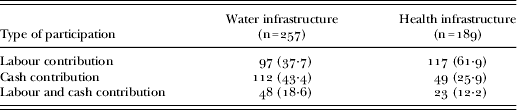
Figures in parentheses are percentages.
Membership of village committees
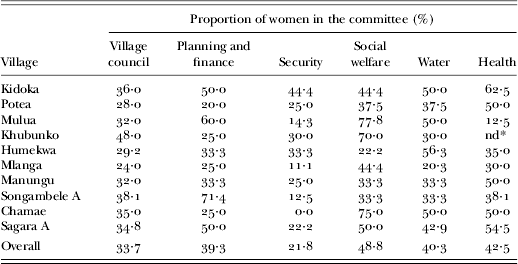
The village council has three standing committees: for planning and finance, social welfare, and security. In addition, it can establish other committees depending on the needs of the village or as directed by the district or central government. The most common ones in all villages are water, health, school, environment and disaster management committees. In this study, the proportion of women in village councils ranged from 24% to 48%, with an average of 34% (Table VIII). At the global level, the figure of one-third has gained popularity as the critical mass for gender quotas in various institutions from parliament to village councils (Agarwal Reference Agarwal2010). The affirmative action imposed by the reforms that village councils should have at least one-fourth women councillors (Shivji & Peter Reference Shivji and Peter2003) mainly through the ‘special’ women seats appears to have an effect: 90% of the study villages are above the one-fourth and 70% above the one-third thresholds.
The proportion of women was higher in the social welfare, health and water committees than in the security, village councils or planning and finance committees. The former relate more to women's practical gender needs and were seen as ‘feminine’, while the latter were seen as ‘masculine’. Very few women held leadership positions in the committees, and if they did, mostly as secretaries or treasurers. Women's presence in village structures in our study thus exhibits the form of ‘active’ participation, but rarely the ‘interactive’ form of participation. This parallels findings elsewhere. Hemson's (Reference Hemson2002) study on women's participation in rural water committees in South Africa showed that women tended to hold the less powerful positions as ‘vices’ or ‘auxiliaries’ to the main positions. Agarwal (Reference Agarwal2010) found that women in community forestry institutions in rural India and Nepal usually occupied ‘supportive’ leadership positions as vice-presidents, joint secretaries and co-treasurers. In Kenya, Friis-Hansein et al. (Reference Friis-Hansen, Duveskog and Taylor2012) reported that while membership in farmer field school groups was dominated by women, elected leadership positions tended to be held by men, apart from the post of group treasurer, which was often held by a woman. These findings raise the question, then, of the extent to which women's presence in village structures has enabled them to articulate their needs, both practical and strategic, and perhaps translate them into locally relevant policy outcomes, by speaking up and influencing decisions in these spaces. We turn to this question in the next sub-section, as we move up the ladder of participation from ‘active’ to ‘interactive’ participation.
Proportion of women in village committees by village
* nd=no data could be obtained.
Speaking up and influence in meetings
The survey findings show that fewer than half of respondents who attended public meetings either spoke up (45%) or felt they were able to influence decisions (49%) in such meetings. Nevertheless, significantly more men than women reported to either having spoken up or felt that they had influence (Table IX). The focus group discussions revealed that despite the relatively high number of women in public meetings, very few of them speak up. In Potea, focus group discussion participants explained that only three women speak up in public meetings, and in Songambele A between five and seven. One participant (a woman) in Potea said: ‘if a woman is too talkative in public meetings, men will say don't marry from that household, their women are very noisy’. While in the south Asian context Agarwal (Reference Agarwal2010: 107) concluded that ‘the greater the percentage of women in a meeting, the more likely that some or most of them will speak up’, our findings show that despite women's numerical strength in public meetings, many of them participate only ‘passively’. Apparently, the gendered power relations have not been transformed to allow women's equal access to ‘effective’ and ‘interactive’ participation. Because of this, men have gained more leverage to play their roles as principals in public meetings than their female counterparts.
Proportion of respondents who can speak up and influence decisions by sex

Figures in parentheses are percentages. *** Significant at 1% level.
The findings also revealed gender variations on what men and women spoke about in public meetings. Women mostly talked about water, health and education services for their children. It was argued that women have first-hand experiences with these services and, therefore, know better what is working and what needs to be improved. Men talk about financial matters, roads, elections or recalling village leaders. One interviewee (a man) in Songambele A said: ‘it is the women who take children to clinics and fetch water. If there are any problems in these services, they are the first ones to experience them. So, if they don't speak about them, how do we [men] know if there is problem?’ Another woman added: ‘although we are always silent most of the time leaving men to talk about their politics, we just wait for our topics [water and health], that is where we talk and they have to listen to us’. ANK, a special seats councillor and former village chairperson explained how she had facilitated the construction of a village dispensary and a new borehole amidst resistances from male village councillors because they did not see them as priorities. There are thus ‘masculine’ and ‘feminine’ topics for discussion, and domains of decision-making. Practical gender needs such as water and health services are acknowledged by men and women as being a women's domain.
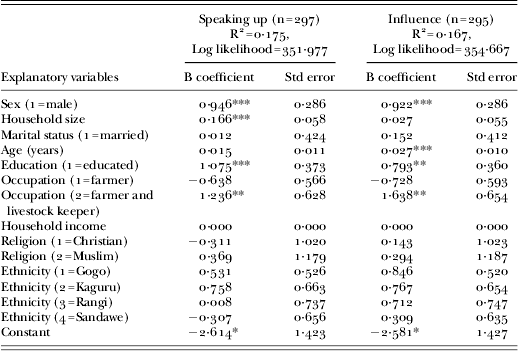
In addition to gender, other factors associated with the ability to speak up and influence decisions in public meetings were education and occupation (Table X). Literate villagers were more likely to speak up and influence decisions. Livestock keepers were more likely to speak up because having a large herd of cattle is considered as a sign of wealth and respect in the community. Family size had an influence on speaking up because having many children means more prestige and respect in the community for both men and women. Age was positively associated with ability to influence decisions, again for both men and women. Older women in their late forties or fifties, married and mostly with grandchildren were more respected, more likely to be committee members, and could speak up and be listened to. They were regarded as ‘gender-neutral’ and could mix with men in public settings. These women often talked to village leaders in public, or privately after meetings, to exert pressure on them for the improvement of certain services of interest to women. Other women in the village gave their opinions and asked these women to speak on their behalf. Young women are often refused permission to involve themselves in public affairs by their husbands, since these are still regarded as ‘men's domain’. Gender thus intersects with age, as it does with ethnicity (see above) in shaping the extent of participation. These patterns reflect the power relations interwoven within both the formal and informal community structures. Perhaps because of this, few women participate ‘effectively’ and ‘interactively’ in local spaces and are able to address both the practical and strategic gender needs.
Factors influencing ability to speak up and influence in public meetings
* Significant at 10% level, **Significant at 5% level, ***Significant at 1% level.
Factors constraining women's participation in decision-making processes
A number of constraints to effective women's participation in decision-making processes were identified: patriarchy, household responsibilities, complicated election procedures and personal qualities of women. Many respondents mentioned the patriarchal system prevailing at household and community levels as a major constraint. The fact that there is a Swahili term for patriarchy, mfumo dume, which literally means ‘a male-dominated system’, shows that patriarchy is an emic concept within the community, although men and women conceptualise it differently. Men expressed patriarchy using phrases like: ‘women are inferior to men’, ‘men disrespect women leaders’, ‘a woman's place is in the home doing what is told by her husband’, ‘decision-making is the responsibility of men and not women’ or ‘we (men) cannot be led by women’. Women expressed patriarchy using phrases like: ‘they (men) don't respect us’, ‘women are denied by their husbands to join village committees’, ‘they (men) say a woman leader cannot help us in anything’, ‘they (men) say women are weak’, ‘young men are just rude to women’ or ‘they (men) discriminate against us’. This suggests that men see patriarchy as a given feature of society, while women identify it as a social problem, and express the dissatisfaction they experience in their communities. Feelings of being sidelined, marginalised, excluded, discriminated and denied dominate among women (Hicks Reference Hicks2011), ‘they reinforce internally what is stated externally’ and inhibit women's effective participation in local structures (Hemson Reference Hemson2002: 13).
When asked why this was happening, women in one mixed focus group discussion in Songambele A replied: ‘ask these men who behave like bulls’. Peer pressure especially among young men, ethnicity and the custom of paying bride price were reported as contributing to the perceptions that men ‘buy’ their wives and therefore must exercise ‘control’ over them. One male respondent in Potea commented: ‘my wife cannot stay outside the home doing community work for many hours. To me that is a sign of disrespect.’ Another man in Songambele A remarked: ‘I don't allow my wife to contest for any leadership position in this village. I contest for leadership and she only votes for me.’
Village leaders explained that in most cases it is men who competed for leadership positions. Most women village councillors and committee members came through the ‘special’ women seats and rarely through the normal election procedures involving competition with men. In the village of Potea, even getting the required number of ‘special’ seats for women on the village council and committees was said to be quite challenging. One village leader told us: ‘We have serious problems getting women in the village committees as required by law. In the past, we used to advertise committee vacancies and ask people to apply, but no women would turn out. Nowadays, we just ask people in a meeting to mention names of potential candidates and vote for them in a public meeting.’ However, even this strategy seemed not to work quite well because ‘some women are elected in public meetings to become members of village committees, but most of them drop out because their husbands refuse them to join the committee. The husband might even be present in the meeting when the wife is elected and does not say anything publicly, but the moment they get home the trouble begins’ (said a man village leader). Explaining her more than 20 years’ experience in leadership at village and ward levels, ANK noted: ‘when I was a village chairperson, many men were questioning why they were led by a woman. Don't we have men to take up this position?, they said.’ In Potea where most of the population is Muslim, respondents associated patriarchy with religion, arguing that Muslim women are not allowed to stay outside their homes for many hours, although this was not a serious issue in other villages. This shows the intersection between gender and religion, which are both influenced by patriarchy.
Most respondents did acknowledge that things were changing, though slowly, among other reasons because of economic groups with mixed membership and because women's economic activities involve travelling outside the village or interacting with outsiders. Community awareness and sensitisation initiatives by NGOs, politicians and government officials from the district, regional or national levels were also contributing to the change, although with limitations. The district gender officer in Kondoa said that the district council was conducting gender awareness meetings at village level, but only three villages were reached in the previous year. Kongwa district did not have a gender desk, and gender issues were handled by the community development department.
Household responsibilities due to the gender division of labour were another constraint noted by interviewees. In particular, membership in village committees was said to be very time-consuming, making it difficult for most women to combine household responsibilities and committee work. While this is true for some women, particularly those with young children, this idea was dismissed by some of the women leaders interviewed. They explained how they were able to combine committee work with household responsibilities. ANK said that: ‘leadership is not like being an executive officer where you have to be in the village office on daily basis. All you need to know is when you have meetings or other committee work and plan accordingly. I have done this for more than 20 years and I have always managed to handle both my leadership and family responsibilities. My family does not complain that I don't do my household work.’ SHP, a member of the village water committee and former village councillor pointed out that: ‘I have time to do my household work and committee work. I have no problems combining both; all I do is to plan.’ These observations support the idea that ‘women have ingrained organisational abilities which allow them to plan their day successfully and create a balance’ (Maharaj & Maharaj Reference Maharaj and Maharaj2004: 269). This also challenges the men's conviction that women are unable to fulfil leadership roles because of their household responsibilities.
Women leaders mentioned the complicated election processes as another constraint. For village councillors, this included being a member of a political party, filling in application forms that must go through party committees for scrutiny and appraisal, and campaigning. Since few women belong to a political party (Shayo Reference Shayo2005), most women are ‘institutionally’ excluded from village leadership. The women village councillors who went through these processes reported that the ‘playing ground’ was not equal for men and women. RNS commented: ‘I competed with men, but the election procedures were difficult. Many of my competitors [men] had friends in the party committees who supported them, they had money to bribe voters, and many laughed at me that I was just wasting my time.’ ANK said: ‘in the past elections were very objective, how you expressed yourself in campaign meetings mattered a lot. But nowadays, elections are crowded with corruption and other rough games. Most women are afraid of confronting all these problems.’ Devas & Grant (Reference Devas and Grant2003) and Venugopal & Yilmaz (Reference Venugopal and Yilmaz2010) found that vote buying and vote bargaining are common features of local level elections. These practices exclude those who cannot afford such political purchases, particularly women.
Other constraints related to assumed personal qualities of women, such as being shy and uncomfortable in speaking among men, lack of self-confidence, lack of experience in public affairs, and fear of making ‘mistakes’ and being laughed at or ridiculed. Again, these factors are related to socio-cultural norms which circumscribe women's activities and behaviour in the public domain. This shows that despite the mechanisms instituted by the reforms to increase women's participation in decision-making processes, their participation is inhibited by social dynamics of inclusion and exclusion at the intra-household and extra-household levels (cf. Devas & Grant Reference Devas and Grant2003; Conyers Reference Conyers2007; Matembe Reference Matembe2010).
The experience of the five women leaders interviewed in depth shows that despite the challenges they were facing, their participation was an empowering process. The life histories revealed that many of them were afraid of speaking up in public meetings or sitting in meetings with men in the past, but are now able to do these things. These women can argue and convincingly pursue their interests and those of the women they represent, thus meeting both practical and strategic gender needs by participating ‘actively’ and ‘interactively’ with men. They were motivated by their participation in local leadership and were able to challenge the community stereotypes of women leaders because the community recognised their potential. Some were also involved in mobilising other women to be engaged in local politics and in the formation of groups to help women earn additional incomes. RNS reported how she had facilitated the formation of a group of 15 women involved in a piggery project and another group of 30 women running a village community bank. At group meetings women discuss different issues, including public services. These local organisations function as informal institutions for women to meet their practical gender needs, but they also gradually encompass strategic gender needs.
CONCLUSION
The foregoing discussion shows that decentralisation reforms have created spaces for service users’ participation in the form of village assemblies, councils, committees and consultations during preparation of annual village plans. Participation in these spaces is realised through attending meetings, construction of service infrastructures (through labour, cash or both), membership in committees, speaking up and influencing decisions in meetings. Attendance in lower level hamlet and village meetings is higher compared with high-level district council meetings. The quota system imposed by the reforms of at least one-fourth women members in village councils and committees has contributed to increasing the proportion of women in the local structures, enabling some women to participate actively and to address both practical and strategic gender needs.
In some aspects, the factors constraining service users’ participation in these spaces are not gender specific, but are related to the institutional set-up and power levels. Villagers as principals, men and women alike, perceive themselves as having little influence on their agents. They participate passively, by consultation or through activity-specific spaces. Some constraints, however, are more specific to women. Despite their numerical strength in public meetings, most of them do not speak up and have low influence. Thus, there is a missing link between attendance and influence because women's attendance in public meetings is generally ‘passive’. Indeed, speaking up and influencing decisions in public meetings is more complicated than just attending them. As has been found elsewhere in the world, village women tend not to speak in male-dominated forums even when they have something to say (Devas & Grant Reference Devas and Grant2003; Agarwal Reference Agarwal2010). Thus, it is relatively easy to increase the number and range of people who participate in local institutions, but much more difficult to increase the extent to which they influence decision making, due primarily to the local power structures that determine how decisions are made (Pennartz & Niehof Reference Niehof1999; Conyers, Reference Conyers2007). While holding leadership positions in committees is an important indicator for effective women's participation in local institutions (Agarwal Reference Agarwal2010), signifying a move towards the ‘interactive’ form of participation, few women in fact hold leadership positions in village committees. Those few who did were mostly present in the less influential ones. The patriarchal system is a major constraint to women's effective participation, reflecting Sachs & Alston's (Reference Sachs and Alston2010) argument that patriarchy constantly reproduces itself and filters through the practices of male bureaucrats who are likely hold influential positions.
The reforms have mainly focused on creating and strengthening formal institutions such as councils and committees, but not on addressing the informal power structures that influence the behaviour of the different actors in these institutions. The formal local structures are more ‘responsive to informal institutions, systems, and relations of power than to formal rules and procedures’ (Beall Reference Beall2005: 257). Consequently, stereotypical behaviour and perceptions against women that exist within the community continue to be reflected in these spaces and influence decision-making processes. This interface between formal and informal institutions at the village level is to the advantage of men and limits women's capability to participate effectively and to exercise their agency as principals in village decision-making spaces. While decentralisation is thus carried out in the expectation that it can help to address gender inequalities, it in fact often reproduces them, because the socio-cultural barriers that have long prevented women from effective participation in local decision-making processes are not addressed.
Gender roles and needs are given some consideration in organising public meetings and in reaching decisions on services that have direct implications for women's lives. Women's participation is thus in some way helping to address the practical gender needs in fields that both men and women consider a women's domain. However, because the norms that justify social inequality have hardly changed, women's opportunities to address their strategic gender needs are minimal. Few women leaders have the power and bargaining ability to ensure that women's interests are reflected in decision-making processes, enabling them to participate ‘actively’ and ‘interactively’ and do something about both women's practical and strategic gender needs. Activities and programmes that contribute to women's empowerment, such as local initiatives in the form of income-generating activities, economic activities involving interactions with outsiders, and community awareness initiatives by NGOs and government agencies could all be seen as catalysts for change to address strategic gender needs.