Introduction
The family Plectidae was established by Örley in 1880. Members of this family are regarded as bacterial feeders (Yeates et al. Reference Yeates, Bongers, De Goede, Freckman and Georgieva1993). Anaplectus De Coninck & Schuurmans Stekhoven, Reference De Coninck and Schuurmans Stekhoven1933, was placed in the subfamily Pakirinae Inglis, Reference Inglis1983, for species having a crown of four cephalic setae and a set of preanal tubuli in the males. Later, Anaplectus was placed by Holovachov (Reference Holovachov2006) in the family Plectidae along with Arctiplectus Andrássy, Reference Andrássy2003; Perioplectus Sanwal in Gerlach & Riemann, Reference Gerlach and Riemann1973; Plectus Bastian, Reference Bastian1865; Ceratoplectus Andrássy, Reference Andrássy1984; Tylocephalus Crossman, Reference Crossman1933; Ereptonema Anderson, Reference Anderson1966; Neotylocephalus Ali, Farooqui & Tejpal, Reference Ali, Farooqui and Tejpal1969; and Wilsonema Cobb, Reference Cobb1913. In addition, he raised the rank of Pakirinae to family level. Brezeski (Reference Brzeski1963) indicated the “widen prostom hexagonal in cross-section” as a distinct characteristic from Plectus. Holovachov (Reference Holovachov2016) indicated the transverse amphid opening in Anaplectus as a distinguishing characteristic versus a unispiral amphid in Plectus. Several authors synonymized the genus Anaplectus with Plectus Bastian, Reference Bastian1865 (Schneider Reference Schneider1939; Goodey Reference Goodey1951, Reference Goodey1963). However, most authors considered Anaplectus a valid taxon (Chitwood & Chitwood Reference Chitwood and Chitwood1937; Maggenti Reference Maggenti1961; Brzeski Reference Brzeski1963; Killick Reference Killick1964). The first extensive study of the genus Anaplectus was made by Allen and Noffsinger (Reference Allen and Noffsinger1968), followed by others who added more information about the taxonomy of the genus along with a key to its species (Andrássy Reference Andrássy1984, Reference Andrássy, Csuzdi and Mahunka2005; Truskova Reference Truskova1972; Holovachov et al. Reference Holovachov, Boström, Winiszewska and Háněl2004, 2016).
The genus Anaplectus is one of the most widely distributed genera within family Plectidae followed by the genus Plectus (Holovachov et al. Reference Holovachov, Boström, Winiszewska and Háněl2004; Holovachov Reference Holovachov2016; Jahan et al. Reference Jahan, Khan, Mahboob and Tahseen2020). Anaplectus is currently represented by fifteen valid species (Holovachov et al. Reference Holovachov, Boström, Winiszewska and Háněl2004; Jahan et al. Reference Jahan, Khan, Mahboob and Tahseen2020), including A. granulosus (Bastian, Reference Bastian1865) De Coninck and Schuurmans Stekhoven, Reference De Coninck and Schuurmans Stekhoven1933; A. atubulatus Andrássy, Reference Andrássy and Mahunka1987; A. brzeskii Holovachov, Boström, Winiszewska, and Háněl, Reference Holovachov, Boström, Winiszewska and Háněl2004; A. eurycerus (Massey Reference Massey1964) Andrássy, Reference Andrássy1984; A. grandepapillatus (Ditlevsen, Reference Ditlevsen1928) Andrássy, Reference Andrássy1973; A. labiosulcus Jahan, Khan, Mahboob and Tahseen, Reference Jahan, Khan, Mahboob and Tahseen2020; A. magnus Brzeski, Reference Brzeski1963; A. octo Zullini, Reference Zullini1973; A. parasimilis Truskova, Reference Truskova1978; A. porosus Allen & Noffsinger, Reference Allen and Noffsinger1968; A. similis Allen and Noffsinger, Reference Allen and Noffsinger1968; A. subgranulosus Truskova, Reference Truskova1978; A. sudhausi Jahan, Khan, Mahboob and Tahseen, Reference Jahan, Khan, Mahboob and Tahseen2020; A. tortus Andrássy, Reference Andrássy1986 and A. varicaudatus Allen and Noffsinger, Reference Allen and Noffsinger1968. Furthermore, Holovachov et al. (Reference Holovachov, Boström, Winiszewska and Háněl2004) emended the diagnostic characteristics for Anaplectus, which facilitates accurate identification of the genus.
Detailed phylogenetic analysis of this group was performed by Holovachov (Reference Holovachov2006), supplemented with new data on morphology and development of the superfamily Plectoidea Örley, Reference Örley1880. Afterward, the monophyletic origin of the family Plectidae was verified based on SSU rDNA (Meldal et al. Reference Meldal, Debenham, De Ley, De Ley, Vanfleteren, Vierstraete, Bert, Borgonie, Moens, Tyler, Austen, Blaxter, Rogers and Lambshead2007; van Megen et al. Reference van Megen, van den Elsen, Holterman, Karssen, Mooyman, Bongers, Holovachov, Bakker and Helder2009; Shokoohi et al. Reference Shokoohi, Mehrabi-Nasab, Abolafia and Holovachov2013). Meldal et al. (Reference Meldal, Debenham, De Ley, De Ley, Vanfleteren, Vierstraete, Bert, Borgonie, Moens, Tyler, Austen, Blaxter, Rogers and Lambshead2007) considered Plectida and Rahbditida to be sister groups by using 18S rDNA. Recently, the genetic study of the whole mitochondrial genome of the two species of Plectus supported the close relationship of the mentioned groups (Kim et al. Reference Kim, Kern, Kim, Sim, Kim, Kim, Park, Nadler and Park2017).
The present paper deals with the description of a new species of the genus Anaplectus, namely A. deconincki n. sp., from Kirstenbosch National Botanical Garden of Cape Town, South Africa, isolated from natural grass. In addition, molecular analysis is performed and the phylogenetic position of the Anaplectus deconincki n. sp. based on 28S rDNA is discussed.
Material and methods
Nematode isolation and morphological observation
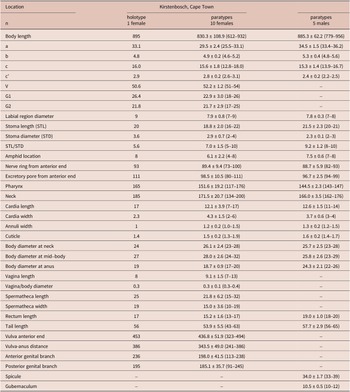
The soil sample having Anaplectus deconincki n. sp. was taken from Kirstenbosch National Botanical Garden of Cape Town, South Africa. Nematodes were extracted from a Stenotaphrum secundatum (Buffalo grass) soil sample by Baermann’s (Reference Baermann1917) funnel technique, fixed with a hot 4% formaldehyde solution and processed to anhydrous glycerin by the method of De Grisse (Reference De Grisse1969). Female and male specimens were extracted from the exact soil samples and preserved permanently on glass slides. Measurements (Table 1) were taken directly using a Zeiss Lab A1 microscope (Jena, Germany) equipped with digital camera, and drawings were made using the light microscopy (LM) photographs taken by a digital camera.
Measurements of Anaplectus deconincki n. sp. from Cape Town, South Africa. All measurements are in μm and the format: mean±standard deviation (range).

Statistical analysis
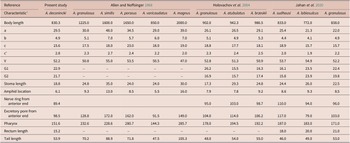
Discriminant analysis (DA) was performed on morphometric parameters derived from fixed specimens of the present study and the morphometrics that are available in the database for Anaplectus spp. (Allen & Noffsinger Reference Allen and Noffsinger1968; Holovachov et al. Reference Holovachov, Boström, Winiszewska and Háněl2004; Jahan et al. Reference Jahan, Khan, Mahboob and Tahseen2020). The features used for DA included body length, a, b, c, c’, V, G1 (% length of the anterior female gonad in relation to body length), G2 (% length of the posterior female gonad in relation to body length), stoma length, amphid location, nerve ring position from anterior end, excretory pore from anterior end, pharynx length, and tail length (Table 2). Using a stepwise model, the above-mentioned characteristics were used for DA (Addinsoft 2007).
Morphometric characters used for discriminant analysis (DA) for different species of Anaplectus.

* Average recovered from original works of literature; some of them rounded.
DNA extraction, PCR, and phylogenetic analysis
DNA extraction was done using the Chelex method (Straube & Juen Reference Straube and Juen2013). Three specimens of the species were hand-picked with a fine-tipped needle and transferred to a 1.5 ml Eppendorf tube containing 20 μl of double distilled water. The nematodes in the tube were crushed with the tip of a fine needle and vortexed. Thirty microliters of 5% Chelex® 50 and 2 μL of proteinase K were mixed to the microcentrifuge tube containing the crushed nematodes. The microcentrifuge tube with the nematode lysate was incubated at 56°C for 2 h and then set at 95°C for 10 min to deactivate the proteinase K and finally spin for 2 min at 16000 rpm (Shokoohi Reference Shokoohi2022). The supernatant was extracted from the tube and stored at –20°C. Following this step, the forward and reverse primers, 988F (5-CTCAAAGATTAAGCCATGC-3) and 1912R (5-TTTACGGTCAGAACTAGGG-3) (Holterman et al. Reference Holterman, Van Der Wurff, Den Elsen, Van Megen, Bongers, Holovachov, Bakker and Helder2006) and D2A (5’–ACAAGTACCGTGAGGGAAAGTTG–3’), D3B (5’–TCGGAAGGAACCAGCTACTA–3’) (De Ley et al. Reference De Ley, Felix, Frisse, Nadler, Sternberg and Thomas1999), were used in the polymerase chain reactions (PCRs) for partial amplification of the 18S and 28S rDNA regions, respectively. PCR was conducted with 8 μl of the DNA template, 12.5 μl of 2X PCR Master Mix (NEB, Ipswich, USA), one μl of each primer (10 pmol μl-1), and ddH2O, for a final volume of 30 μl. The amplification was done using a BioRad master cycler (Hercules, California, USA) with the following program: initial denaturation for 3 min at 94°C, 37 cycles of denaturation for 45 s at 94°C; 54°C and 56°C annealing temperature for 18S and 28S rDNA, respectively; extension for 1 min at 72°C, and finally, an extension step of 6 min at 72 °C followed by a temperature hold at 4°C. After DNA amplification, 4 μl of PCR product was loaded on a 1% agarose gel in TBE buffer (40 mM Tris, 40 mM boric acid, and 1 mM EDTA) for evaluation of the DNA bands. The bands were stained with a SafeView (Applied Biological Materials, Richmond, BC, Canada) and visualized and photographed on a UV transilluminator. The amplicon of the gene was stored at –20°C. Finally, Inqaba Biotech (Pretoria, South Africa) purified the PCR product for sequencing. The ribosomal DNA sequence was analysed and edited with BioEdit (Hall Reference Hall1999) and aligned using CLUSTAL W (Thompson et al. Reference Thompson, Higgins and Gibson1994). The phylogenetic tree was generated using the Bayesian inference method as implemented in the program Mr Bayes 3.1.2 (Ronquist & Huelsenbeck Reference Ronquist and Huelsenbeck2003). The GTR + I + G model was selected using jModeltest 2.1.10 (Guindon & Gascuel Reference Guindon and Gascuel2003; Darriba et al. Reference Darriba, Taboada, Doallo and Posada2012). Analysis was initiated with a random starting tree and run with Markov Chain Monte Carlo (MCMC) simulations for 106 generations. The tree was visualized with the TreeView program. Outgroup, Rhabditis blumi Sudhaus, Reference Sudhaus1974 (MT012150, MT043860 for 18S rDNA; KM233155, KM233156 for 28S rDNA) were selected following Holovachov et al. (Reference Holovachov, Boström, De Ley, Robinson, Mundo-Ocampo and Nadler2013). The original partial 18S and 28S rDNA sequences of Anaplectus deconincki n. sp. were deposited in GenBank under the accession numbers OQ743744 and OM905072, respectively.
Results
Anaplectus deconincki n. sp.
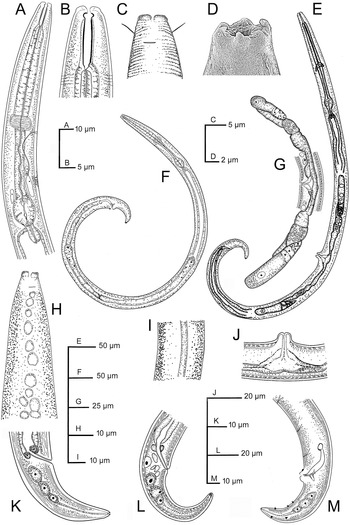
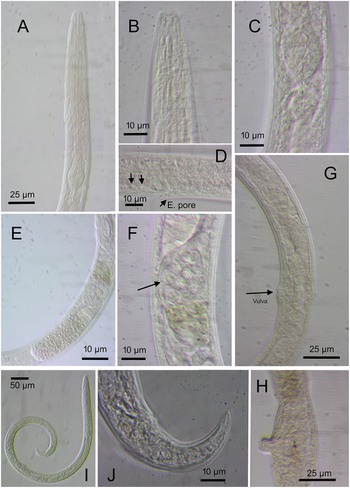
Measurements and morphology of Anaplectus deconincki n. sp are shown in Table 1 and Figures 1-3.
Anaplectus deconincki n. sp. A: Neck; B: Anterior region; C: Amphid; D: Lip region; E: Entire female; F: Entire male; G: Female reproductive system; H: Anterior lateral gland; I: Lateral field; J: Vulva region; K, L: Female posterior end; M: Male posterior end.

Anaplectus deconincki n. sp. (LM). A: Anterior end; B: Stoma; C: Pharyngeal-intestinal junction; D: Excretory pore and glands (arrows); E: Anterior genital branch; F: Spermatheca; G, H: Vulval region; I: Entire female; J: Female posterior end.

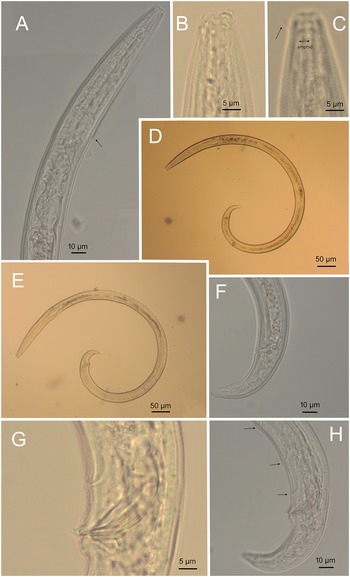
Anaplectus deconincki n. sp. (LM). A: Anterior end (arrow indicates excretory pore); B: Stoma; C: Amphid and setae (arrow indicates setae); D: Entire female; E: Entire male; F: Female posterior end; G: Spicule; H: Male posterior end (arrows indicate supplementary organs).

Description
Female. Description is based on seven females in a good state of preservation. Body small, cylindrical, ventrally arcuate upon heat fixation. Cuticle with fine transverse striations, annulus 0.8–0.9 μm wide at mid-body. Lateral field with two ridges (alae) (Figure 1I), 3–4 μm wide at mid-body, occupying 14–15% of the corresponding body width. Head regions narrow, continuous with body contour. Lip region offset from body contour, truncated, twice as wide as high. The lip region consists of six separate lips (Figure 1D) with shorter interspersed ‘liplets.’ Labial sensilla indistinct. Cephalic sensilla setiform, originating on the fourth or fifth body annule (4–6 μm from the anterior end), 2–4 μm long. Somatic setae absent, except for caudal setae. Amphidial openings transverse (Figure 1C), 2–3 μm width, located at level with anterior part of stegostom. Stoma plectoid, cylindrical, 2.0–2.6 times longer than lip region diameter, cheilostom short, gymnostom well cuticularised, wide, slightly arched, stegostom narrower. Hypodermal glands arranged in four (ventral, dorsal, and sublateral) rows and open to the outside via pores, first sublateral gland 7–15 μm from anterior end (Figure 1H), 17 glands from anterior end to the end of pharynx. Glands in females along one side of the entire body 91–109. Pharynx 117–176 μm long, essentially cylindrical; basal bulb spheroid, 15 × 31 μm in size, 1.7–3.1 times cardia length. Basal bulb with a grinder, in anterior part, haustrulum narrow. Post-bulbar extension 7–8 μm long. Cardia 10–17 μm long, one coelomocyte presents anterior to cardia. Intestine without granules. Rectum 0.8–0.9 anal body diameter long. Nerve ring at 48–54% of neck length. Secretory-excretory pore just posterior to nerve ring, at 58–60% of neck length. Reproductive system didelphic, amphidelphic with reflexed ovaries. Uterus tubular, ovaries reflexed dorsally. Both genital branches equally developed; entire reproductive tract (reproductive branches plus reflexed ovaries) 7–9 times longer than the mid-body diameter. Vulva protruded (Figure 1E) at 51–54% of body length from anterior end. Spermatheca containing spherical to ovoid sperm, 6–7 μm dimension. Tail 43–63 μm long, conoid in its anterior part and cylindrical in its posterior part, ventrally curved in the posterior half. One pair of very short ventral setae located 10–11 μm from the tail end, and one dorsal very short located 30 μm from the tail end. Spinneret present. Three caudal glands are present (Figure 1K,L), arranged in tandem.
Male. Generally similar to female in morphology. Reproductive system diorchic, anterior testis outstretched, posterior testis reflexed. Anterior testis 136–237 μm long, along with vas deferens on right-hand side and posterior testis 78–133 μm long (Figure 1F), on left-hand side of intestine. Three sclerotized preanal tubular supplements or tubuli present of the first one opening at 11–15 μm, the second one at 31–39 μm and the third one at 57–72 μm anterior to cloacal opening (Figure 1M, Figure 3H). Tail short, ventrally arcuate. Spicules arcuate, with oval or round manubrium slightly wider than adjoining calamus. Gubernaculum enveloping one third of spicules length distally. Gubernaculum plate-like with a dorsal triangular projection perpendicular to corpus, 11–12 μm long. One ventral papillae 4–5 μm anterior to cloacae. Five pairs of post cloacal papillae with four ventral and one subdorsal close to tail tip.
Type locality and habitat
The specimens examined were found in Kirstenbosch National Botanical Garden of Cape Town, South Africa (GPS coordinate: S: 33°59’17.0"; E: 18°25’52.1"), associated with the rhizosphere of the lawn Stenotaphrum secundatum (Buffalo grass).
Type material
Four slides including 10 females and 5 males were deposited in the Nematology collection of the Aquaculture Research Unit of the University of Limpopo, South Africa. One slide contains two specimens that were deposited in the laboratory of the Virginia Tech University, USA.
Differential diagnosis and relationship
A. deconincki n. sp. is characterized by 612–932 μm long body in females, hypodermal glands present along the body, 16–22 μm long stoma, lip region offset from the body contour, bearing six separated lips, 7–9 μm in diameter, amphids openings transverse slits located in the middle part of stoma or 4–8 μm from anterior end, two lateral incisures, 117–176 μm long pharynx, amphidelphic female reproductive system (V = 51–54), vulva 323–494 μm from anterior end, tail elongate-conoid (43–63 μm, c = 12.8–18.0, c’ = 2.6–3.1 in females; 56–65 μm, c = 13.9–16.7, c’ = 2.2–2.5 in males) with rounded terminus and functional spinneret, bearing one setae on the ventral and one visible setae on the dorsal side of females tail. Males with body length of 779–956 μm, spicule 33–39 μm long, gubernaculum 10–12 μm long.
The new species, A. deconincki, resembles several species of Anaplectus, namely A. porosus based on hypodermal glands, and A. granulosus based on body length, tail length, and cuticularized spinneret. However, the new species differs from A. porosus in female body (612–932 vs 1600 μm), tail length (43–63 vs 71–75 μm), and spicule length (33–39 vs 47 μm) (see Allen & Noffsinger Reference Allen and Noffsinger1968). Compared with A. granulosus, the new species differs in the anterior gland (present vs absent), vulva (protruded vs not protruded), stoma length (16–22 vs 25–29 μm), G1 (18–26 vs 14–18), and G2 (17–25 vs 12–10) (see Holovachov et al. Reference Holovachov, Boström, Winiszewska and Háněl2004). Compared with A. granulosus studied by Jahan et al. (Reference Jahan, Khan, Mahboob and Tahseen2020), they differ in stoma length (16–22 vs 21–24 μm), and a value (25.5–33.1 vs 19.2–24.6). Besides, the new species differs from the population reported by Allen and Noffsinger (Reference Allen and Noffsinger1968) in lower range of female tail (43–63 vs 58–65 μm), and body length (vs 700–1500 μm). Compared with A. grandepapillatus (described as A. submersus (Hirschmann, Reference Hirschmann1952) Maggenti, Reference Maggenti1961), the new species differs in female body length (612–932 vs 1000–1700 μm) and anterior gland (present vs absent) (Allen & Noffsinger Reference Allen and Noffsinger1968). Compared with A. similis, the new species differs in body length (612–932 vs 1200–1600 μm), the position of the amphids (4–8 vs 7–13 μm), stoma length (16–22 vs 26–35 μm) and anterior gland (present vs absent) (Allen & Noffsinger Reference Allen and Noffsinger1968). Compared with A. varicaudatus, the new species differs in stoma length (vs 22–26 μm), anterior gland (present vs absent), and spinneret (cuticularized vs not cuticularised) (Allen & Noffsinger Reference Allen and Noffsinger1968). Compared with A. magnus, the new species differs in body length (612–932 vs 2000 μm), stoma length (16–22 vs 30 μm), and amphid position (4–8 vs 16 μm) (Allen & Noffsinger Reference Allen and Noffsinger1968). Compared with A. atubulatus, the new species differs in body length (612–932 vs 867–1000 μm), lip region (continues with body vs offset from the body), spinneret (present vs absent), and anterior gland (present vs absent) (Holovachov et al. Reference Holovachov, Boström, Winiszewska and Háněl2004). Compared with A. brzeskii, the new species differs in body length (612–932 vs 863–1131 μm), lip region (continuous with the body contour vs offset from body contour), vulva (protruded vs depressed), anterior gland (present vs absent), and amphid location (4–8 vs 7–11 μm) (Holovachov et al. Reference Holovachov, Boström, Winiszewska and Háněl2004). Compared with A. sudhausi, the new species differs in stoma length (16–22 vs 23–27 μm), G1 (18–25 vs 16–17), and male tail (56–65 vs 46–52 μm) (Jahan et al. Reference Jahan, Khan, Mahboob and Tahseen2020). Compared with A. labiosulcus, they differ in stoma length (16–22 vs 25–27 μm), a (25.5–33.1 vs 19.2–23.2), c’ (2.6–3.1 vs 1.8–2.2) values, and caudal gland arrangement (tandem vs grouped) (Jahan et al. Reference Jahan, Khan, Mahboob and Tahseen2020). Compared with A. eurycercus, the new species differs in tail shape (conoid in its anterior part and cylindrical in its posterior part vs plump), and higher c’ value (2.6–3.1 vs 2.0–2.5). Compared with A. octo, the new species differs in shape of stoma (arched anteriorly vs hourglass shaped) (Holovachov et al. Reference Holovachov, Boström, Winiszewska and Háněl2004).
Etymology
The species is named after Prof. L.A.P. De Coninck for his excellent research on the Plectida nematodes.
Discriminant analysis of Anaplectus deconincki n. sp.
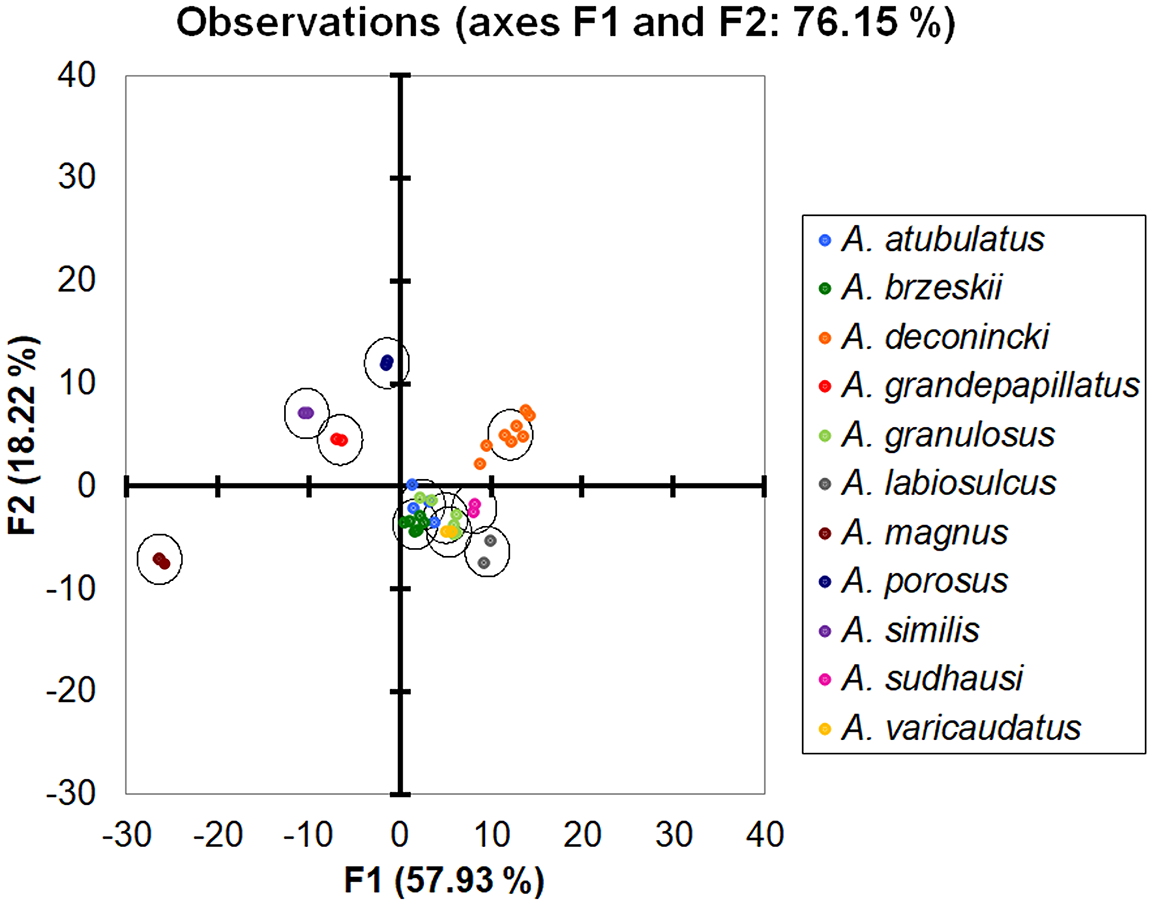
Based on 15 morphometric characters (Table 2), the comparative analysis of variation was made. Discriminant function analysis revealed six groups (Figure 4), including 1) A. magnus, 2) A. grandepapillatus, 3) A. similis, 4) A. porosus, 5) A. deconincki, and 6) A. sudhausi, A. varicaudatus, A. granulosus, A. brzeskii, A. atubulatus, and A. labiosulcus. The first two functions explain 76.15% of the total variation in the data, which is sufficient for the analysis. The result of discriminant analysis indicated that A. deconincki n. sp. differs from other Anaplectus species included in the analysis based on morphometric characters.
Discriminant analysis plot for Anaplectus species based on the important morphometric characteristics.

DNA characteristics
Nblast of the 18S rDNA of the new species indicated 99% similarity with an unidentified Anaplectus (AJ966473) and A. porosus (MF622934) from Belgium. Moreover, nblast of the 28S rDNA indicated 98% similarity with A. granulosus (MF325169; MF325170; MF325171; MF325172) from Germany. Furthermore, the new species showed 93% similarity with A. porosus (MF622938) from Belgium. Compared with an unidentified species of Anaplectus (MG994930) from the UK, it showed 93% similarity.
Discussion
Anaplectus is a bacterivorous nematode genus with 15 valid species (Holovachov et al. Reference Holovachov, Boström, Winiszewska and Háněl2004; Jahan et al. Reference Jahan, Khan, Mahboob and Tahseen2020). This group of nematodes occupies various habitats, and the presence of hypodermal glands with conspicuous pores may provide an added advantage by presumably trapping bacteria in mucous cords (Tahseen Reference Tahseen2012).
The application of discriminant analysis previously showed that it is a helpful technique for species identification (Shokoohi & Moyo Reference Shokoohi and Moyo2022). Similarly, Stock and Nadler (Reference Stock and Nadler2006) analysed the Panagrellus and differentiated the species sufficiently using the same method. Results of the present study separated A. deconincki from other Anaplectus. Our discriminant analysis showed that A. magnus, A. grandepapillatus, A. similis, and A. porosus are morphologically different from the other species of Anaplectus selected for study. Anaplectus magnus has a longer body and tail than the other Anaplectus species (Allen & Noffsinger Reference Allen and Noffsinger1968; Holovachov et al. Reference Holovachov, Boström, Winiszewska and Háněl2004). In contrast, A. similis and A. grandepapillatus differentiate based on the posteriormost tubular supplements (half of the spicule length vs equal to spicule length) (Holovachov et al. Reference Holovachov, Boström, Winiszewska and Háněl2004). Additionally, A. porosus and A. deconincki n. sp., diverge from the other species of Anaplectus, which both have dorsal and ventral hypodermal glands and pores in the anterior part of the body (Allen & Noffsinger Reference Allen and Noffsinger1968; Holovachov et al. Reference Holovachov, Boström, Winiszewska and Háněl2004). However, A. deconincki n. sp., has a shorter body and tail length. In addition, the lateral field bears two incisures compared with three in A. porosus (Allen & Noffsinger Reference Allen and Noffsinger1968). On the other hand, several species overlap with the morphometric characteristics, including A. ganulosus. Jahan et al. (Reference Jahan, Khan, Mahboob and Tahseen2020), indicating morphometric variation within A. ganulosus may potentially imply a cryptic species.
On the phylogenetic position of the Anaplectus deconincki n. sp.
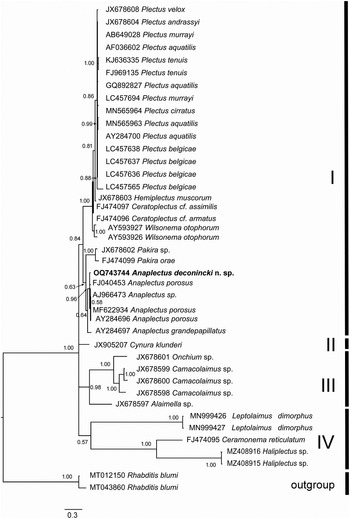
The phylogenetic analysis was based on 18S and 28S rDNA markers. The consensus tree inferred from 18S rDNA (Figure 5) revealed that within the family Plectidae, Anaplectus is a monophyletic group, consistent with the results of Holovachov et al. (Reference Holovachov, Boström, De Ley, Robinson, Mundo-Ocampo and Nadler2013). The phylogenetics resulted in four well-supported clades: I) Plectus species, Hemiplectus muscorum Zell, Reference Zell1991; Ceratoplectus cf. armatus (Bütschli, Reference Bütschli1873) Andrássy, Reference Andrássy1984; C. cf. assimilis (Bütschli, Reference Bütschli1873) Andrássy, Reference Andrássy1984; Wilsonema otophorum (de Man, Reference De Man1880) Cobb, Reference Cobb1913; Anaplectus and Pakira Yeates, Reference Yeates1967 species with 0.84 posterior probability; II) Cynura klunderi Murphy, Reference Murphy1965 with 1.00 posterior probability; III) Onchium sp., Camacolaimus sp. and Alaimella sp. with 0.98 posterior probability, and IV) Leptolaimus dimorphus Gharahkhani, Pourjam, Holovachov & Pedram, Reference Gharahkhani, Pourjam, Holovachov and Pedram2020; Ceramonema reticulatum Chitwood, Reference Chitwood1936, and Haliplectus sp. with 0.57 posterior probability. The result of 18S rDNA placed Anaplectus species close to Pakira, which is the same result obtained by Holovachov et al. (Reference Holovachov, Boström, De Ley, Robinson, Mundo-Ocampo and Nadler2013) and Gharahkhani et al. (Reference Gharahkhani, Pourjam, Holovachov and Pedram2020). Two genera, including Anaplectus and Pakira, are similar in having lip region truncate, amphidial fovea a transverse slit, and females with didelphic reproductive system (Holovachov Reference Holovachov2006; Reference Holovachov2016). However, they differ in deirid (present in Anaplectus vs absent in Pakira), renette cell of excretory system (enveloping distal part of pharynx in Anaplectus vs enveloping the anterior part of intestine in Pakira), caudal gland (present in Anaplectus vs absent in Pakira), and male supplementary tubular organs (2–5 in Anaplectus vs 2 in Pakira) (Holovachov Reference Holovachov2006; Reference Holovachov2016). In addition, Anaplectus species form a clade by 0.96 posterior probability. The same result was obtained by Gharahkhani et al. (Reference Gharahkhani, Pourjam, Holovachov and Pedram2020).
Bayesian tree inferred from 18S rDNA sequences in the genus Anaplectus, including A. deconincki n. sp. and closely related species.

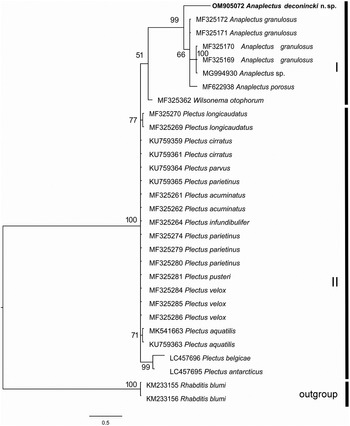
The consensus tree inferred from 28S rDNA (Figure 6) revealed that within the family Plectidae, Anaplectus is a monophyletic group, aligning with results published Holovachov et al. (Reference Holovachov, Boström, De Ley, Robinson, Mundo-Ocampo and Nadler2013). The phylogenetics result grouped in two well-supported clades: I) Plectus species with 1.00 posterior probability; II) Anaplectus species and Wilsonema otophorum with 0.99 posterior probability. Anaplectus and Wilsonema have similar characteristics, such as deirids, rennet cells of the excretory system enveloping the posterior part of pharynx, and the female reproductive system, which is didelphic. However, Wilsonema differs in the unique lip region, which is complicated and expanded (Holovachov Reference Holovachov2006; Reference Holovachov2016).
Bayesian tree inferred from 28S rDNA sequences in the genus Anaplectus, including A. deconincki n. sp. and closely related species.

The present analysis of the 18S and 28S rDNA sequences indicates a close relationship between A. deconincki n. sp. with A. porosus and A. granulosus, although, the new species is well separated from the other two species identified molecularly. Allen and Noffsinger (Reference Allen and Noffsinger1968) indicated that A. porosus can be distinguished from other species by the presence of an anterior series of dorsal and ventral hypodermal pores. Despite the fact that this characteristic has been observed in the South African new species even posterior to the pharyngeal region, it is distinguished by shorter body length and tail length. Furthermore, the anterior gland was not reported previously by Allen and Noffsinger (Reference Allen and Noffsinger1968) or Holovachov et al. (Reference Holovachov, Boström, Winiszewska and Háněl2004) for A. granulosus; therefore, it can be clearly distinguished from the other two species of Anaplectus identified molecularly.
Ethical standards
The paper reflects the authors’ own research and analysis in a truthful and complete manner. All authors have been personally involved in substantive work leading to the manuscript and contributed to preparing the final draft of the manuscript.
Data and specimens’ availability
This material is the authors’ original work, which has not been previously published elsewhere and has no conflict of interest. Four slides of Anaplectus deconincki n. sp. were deposited in the Nematology collection of the Aquaculture Research Unit, University of Limpopo, South Africa. One slide was deposited in the Nematode Collection of Virginia Tech University.
Authors’ contributions
ES collected the samples. ES identified the species, analysed the data, wrote and revised the manuscript. JE took LM of the species. ES conducted the statistical analysis. All authors revised the manuscript and contributed to the final draft of the manuscript.
Acknowledgments
The authors thank the financial support received for the Research Support Plans from Virginia Tech University. Furthermore, the authors acknowledge Dr. Amini (University of Limpopo; Aquaculture Research Unit) for the statistical analysis.
Financial support
This study was financially supported by the University of Limpopo and the University of Virginia Tech (USA) for the LM photographs.
Competing interest
The authors declare that they have no conflicts of interest.