
Introduction
The market of the concentrated solar power plants is extending and several commercial plants are operating using steam-based Rankine cycles below 870 K. A major improvement can be achieved by using gas-based Brayton cycles that could ideally heat an air coolant beyond 1070 K, which requires the use of high-temperature materials for solar surface receivers.[Reference Poživil, Aga, Zagorskiy and Steinfeld1] Heat exiting from the Brayton cycle could be then sent to a steam generator following a secondary Ranking cycle. A recent paper has shown that the combination of gas-based Brayton, steam-based Rankine, and organic-based Rankine cycles could afford to reach an efficiency (defined as the ratio of the electric power produced to the incoming solar power) of 33%.[Reference Sachdeva and Singh2]
The efficiency of the solar receiver to convert the incoming solar flux into thermal energy mainly relies on two radiative properties: (i) the solar absorptivity α which determines the fraction of the incoming solar flux that could be absorbed and (ii) the total emissivity ε that determines the radiative thermal losses. An ideal receiver would present an absorptivity close to 1 and an emissivity close to 0. This is difficult to obtain because solar spectrum and blackbody emittance areas overlap when the temperature is increasing. Additionally, the formation of an oxide layer can seriously affect satisfactory native properties as already observed for TaC.[Reference Charpentier and Caliot3]
Nickel-based Inconel alloys are limited by their poor oxidation resistance in air at a temperature above 1000 K. Various authors reported the oxidation behavior of Inconel 718,[Reference Greene and Finfrock4] Inconel 625,[Reference Kumar, Venkataramani, Sundararaman, Mukhopadhyay and Garg5,Reference Seo, Sayar and Ogawa6] and Inconel 617[Reference Kim, Jang and Ryu7] at temperature up to 1620 K. They observed the formation of porous chromia oxide layers following a parabolic kinetics, but the Inconel 617 loses mass after 36 h oxidation in air at 1373 K due to the spallation of this porous chromia layer.[Reference Kim, Jang and Ryu7] Ceramics like SiC are resistant to oxidation at higher temperatures (1470–1770 K) but are sensible to cracking, which would quickly break the solar modulus.[Reference Leray8]
Recently, we developed high-temperature chemical vapor deposition (HT-CVD) to coat a metallic alloy with a ceramic AlN coating at 1400 K.[Reference Pons, Boichoit, Coudurier, Claudel, Blanquet, Lay, Mercier and Pique9] Optimization of this process could enable the synthesis of new composite materials that combine the main advantages of the metallic substrate (machinability and resistance to thermal stresses) and the main advantages of ceramic coating (improvement of the radiative properties and oxidation resistance). The aim of this work is to investigate the oxidation resistance and the high-temperature radiative properties of such composite materials.
Materials and methods
Two kinds of substrates are selected for the HT-CVD of AlN coatings: (i) a molybdenum-based alloy named TZM (Goodfellow Metal, 99 wt% Mo, 0.5 wt% Ti, 0.1 wt% Zr and C) and (ii) an oxide dispersion-strengthened FeCrAl alloy named Kanthal APMT [Sandvik, Kanthal, 22 wt% Cr, 5 wt% Al, 0.1 wt% Y, 0.1 wt% Zr and Fe (balance)]. In the analysis below, it is convenient to denote these two substrates by TZM and APMT, respectively. The choice of TZM as substrate material is due to its similar thermal expansion coefficient to those of SiC and AlN in the temperature range of 800–1600 K.[Reference Touloukian, Kirby, Taylor and Desai10,Reference Touloukian, Kirby, Taylor and Lee11] APMT is selected as an alternative substrate material for its superior oxidation resistance up to 1500 K, which allows the study of the optical properties of the coatings at high temperature. AlN coatings (40 µm) are grown by HT-CVD at around 1400 K and 2000 Pa using NH3 (99.999%) and AlCl3 [in situ formed via chlorination of high-purity Al pellets (99.999%) and Cl2 (99.999%) at 800 K] as precursors. The ratio N/Al, defined as the NH3/AlCl3 ratio in the gas phase, is fixed to 3 to promote the growth of large grains.[Reference Pons, Boichoit, Coudurier, Claudel, Blanquet, Lay, Mercier and Pique9] SiC coatings are deposited at 1400 K using SiH4 and C3H8 as precursors, but an intermediate AlN layer is required to avoid the carburation and/or silicidation of the metallic substrate. The thickness of the intermediate AlN and SiC coatings are 15 and 80 µm, respectively.
We carry out our experiments using two solar facilities previously described. The first one is the “REacteur Hautes Pression et Température Solaire” (REHPTS),[Reference Charpentier, Balat-Pichelin and Audubert12] and the second one is the “Moyen d'Essai et de DIagnostic en Ambiance Spatiale Extrême” (MEDIASE).[Reference Paulmier, Balat-Pichelin, Le Quéau, Berjoan and Robert13–Reference Brodu, Balat-Pichelin, Sans, Freeman and Kasper15] Both reactors are located in Odeillo, at an altitude of 1500 m, so that the surrounding atmospheric pressure is 87 kPa. Concentrated solar fluxes are of interest to generate thermal shocks with temperature rates up to 100 K/s during heating and cooling.
The coated and uncoated samples are oxidized inside REHPTS. The temperature (whose level can be adjusted by a shutter as previously described[Reference Charpentier, Balat-Pichelin and Audubert12]) is measured using a monochromatic (5 µm) optical pyrometer Ircon Modline 7 that has been previously calibrated on a blackbody. The temperature measurement is ranged from 1400 ± 15 to 2500 ± 25 K and the duration of each temperature plateau is 20 min. A video camera enables an in situ filming of the experiments. The mass variation expressed in mg/cm2 is obtained from the weighting of the samples before the experiments and after each plateau.
The solar concentrated radiation heats the samples placed inside the MEDIASE facility at the focus of the 1 MW solar furnace and previously described.[Reference Paulmier, Balat-Pichelin, Le Quéau, Berjoan and Robert13–Reference Brodu, Balat-Pichelin, Sans, Freeman and Kasper15] A CI Systems SR-5000N spectroradiometer measures the normal spectral emissivity on the back face of the sample on a range from 1.4 to 14 µm at various temperatures in the 1100–1600 K interval and these measurements are integrated on the 1.4–2.8 and 1.4–14 µm intervals according to the following equations:
 $$\varepsilon _{{\rm 1}{\rm. 4}-{\rm 2}{\rm. 8}}\lpar T \rpar = \displaystyle{{\int_{1.4}^{2.8} {\varepsilon \lpar {\lambda, T} \rpar .I_{\rm sol}\lpar \lambda \rpar .{\rm d}\lambda}} \over {\int_{1.4}^{2.8} {I_{{\rm sol}}\lpar \lambda \rpar .{\rm d}\lambda}}} $$
 $$\varepsilon _{{\rm 1}{\rm. 4}-{\rm 14}}\lpar T \rpar = \displaystyle{{\int_{1.4}^{14} {\varepsilon \lpar {\lambda, T} \rpar .E_{\rm bb}\lpar {\lambda, \; T} \rpar .{\rm d}\lambda}} \over {\int_{1.4}^{14} {E_{\rm bb}\lpar {\lambda, \; T} \rpar .{\rm d}\lambda}}} $$
where I sol is the spectral solar irradiance AM1.5[16] and E bb is the blackbody emittance at T that can be computed from Planck's law. The average emissivities given by Eqs. (1) and (2) are, respectively, the approximate values of the solar absorptivity α and of the total emissivity ε, the α/ε ratio being of interest to analyze the thermal equilibrium of materials in extreme solar environment.[Reference Balat-Pichelin, Robert and Sans14] A bi-color pyro-reflectometer developed at PROMES-CNRS in order to get the real temperature of a surface with unknown or variable emissivity[Reference Hernandez, Sans, Netchaieff, Ridoux and Le Sant17] measures the temperature. The pyro-reflectometer and the spectroradiometer have also been previously calibrated on a blackbody.
In this work, radiative properties measurements are performed in the air on coated and uncoated Kanthal APMT at temperatures from 1100 to 1500 K, the same sample being exposed at increasing temperatures. The time required to reach the desired temperature and to get stable emittance values is generally around 5 min. Nevertheless, the first measurements we performed on uncoated materials requested a longer time and presented important deviations due to the in situ growth of an oxide layer that would affect the radiative properties (up to 50% deviation can be observed due to the advancement of the oxidation). Measurements are therefore performed on the uncoated alloy that was previously oxidized in the air inside a muffle furnace during 100 h at 1370 K, so that the influence of in situ oxidation in the air would be less significant.
Room-temperature optical measurements are also performed to investigate the consequences of the high-temperature treatments on the optical properties of the materials using two apparatus. The Perkin-Elmer Lambda 950 is used to perform reflectivity measurement in the solar spectrum range from 0.25 to 2.5 µm. SOC 100 HDR is used to perform reflectivity measurements in the far-infrared region from 2 to 25 µm. From these measurements, the spectral emissivity can be deduced and it can be integrated on 0.25–2.5 and 0.25–25 µm according to equations similar to Eqs. (1) and (2) to access the values of α and ε at room temperature. These room-temperature measurements are performed on a wider wavelength range that the measurements were done in MEDIASE, so both analyses are complementary.
The surface evolution is observed using scanning electron microscopy (SEM) with a Hitachi S-4500 apparatus.
Results
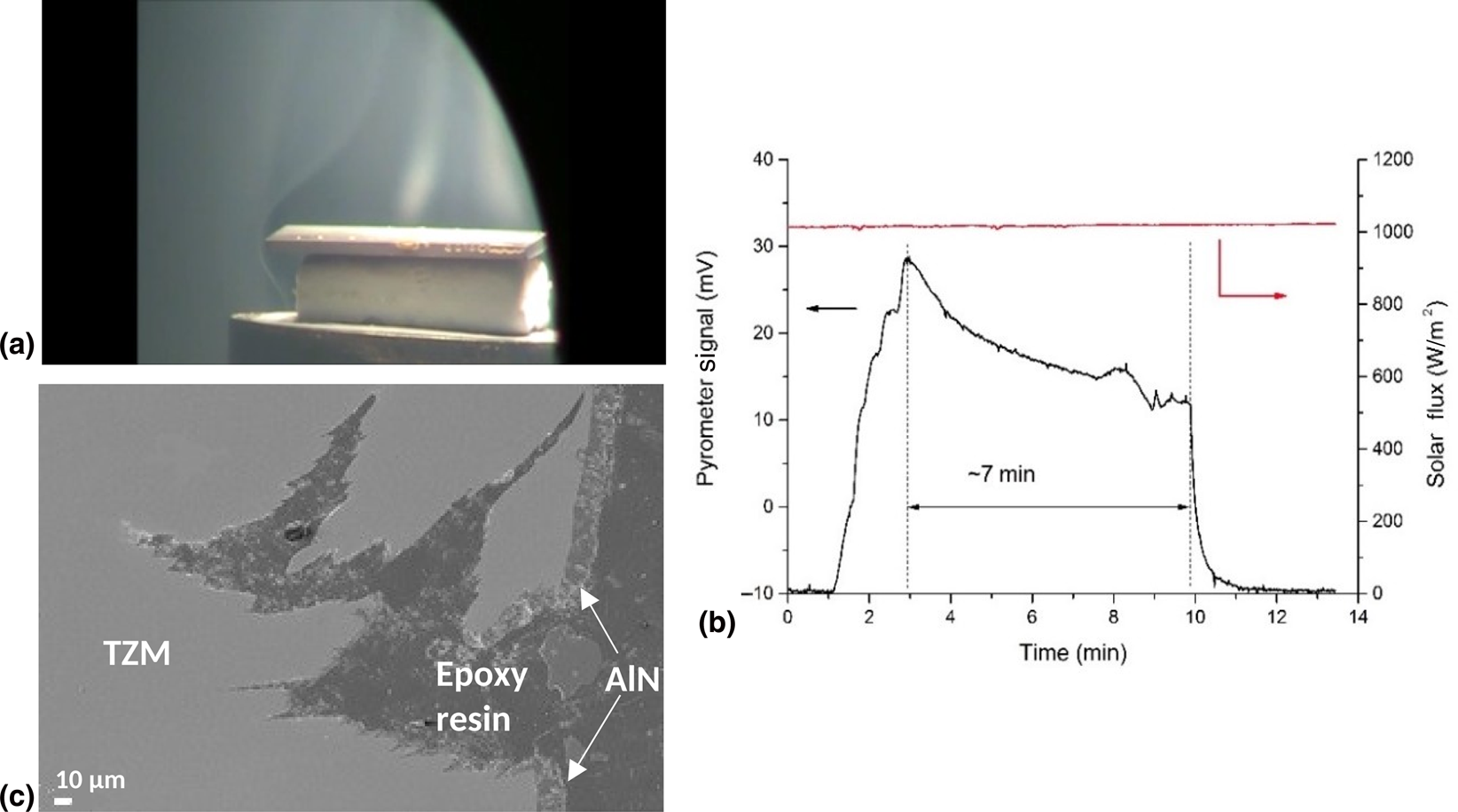
The first results show the difficulties to protect TZM from fast oxidation: smokes of gaseous molybdenum oxide appeared and provoked a significant drop in the signal measured by the optical pyrometer as shown in Figs. 1(a) and 1(b). The temperature was difficult to estimate due to this opacification but should not have been higher than 1200 K. Figure 1(c) presents the cross-section image of AlN-coated TZM samples. The defects in the TZM substrate were uncovered by the AlN coating, and these micrometric uncovered areas are exposed to severe oxidation.
(a) Video caption of the oxidation of AlN/TZM sample after 7 min exposure in air. (b) Pyrometer signal measured during the experiment. (c) SEM image of the section of as-coated TZM samples showing uncovered defects.

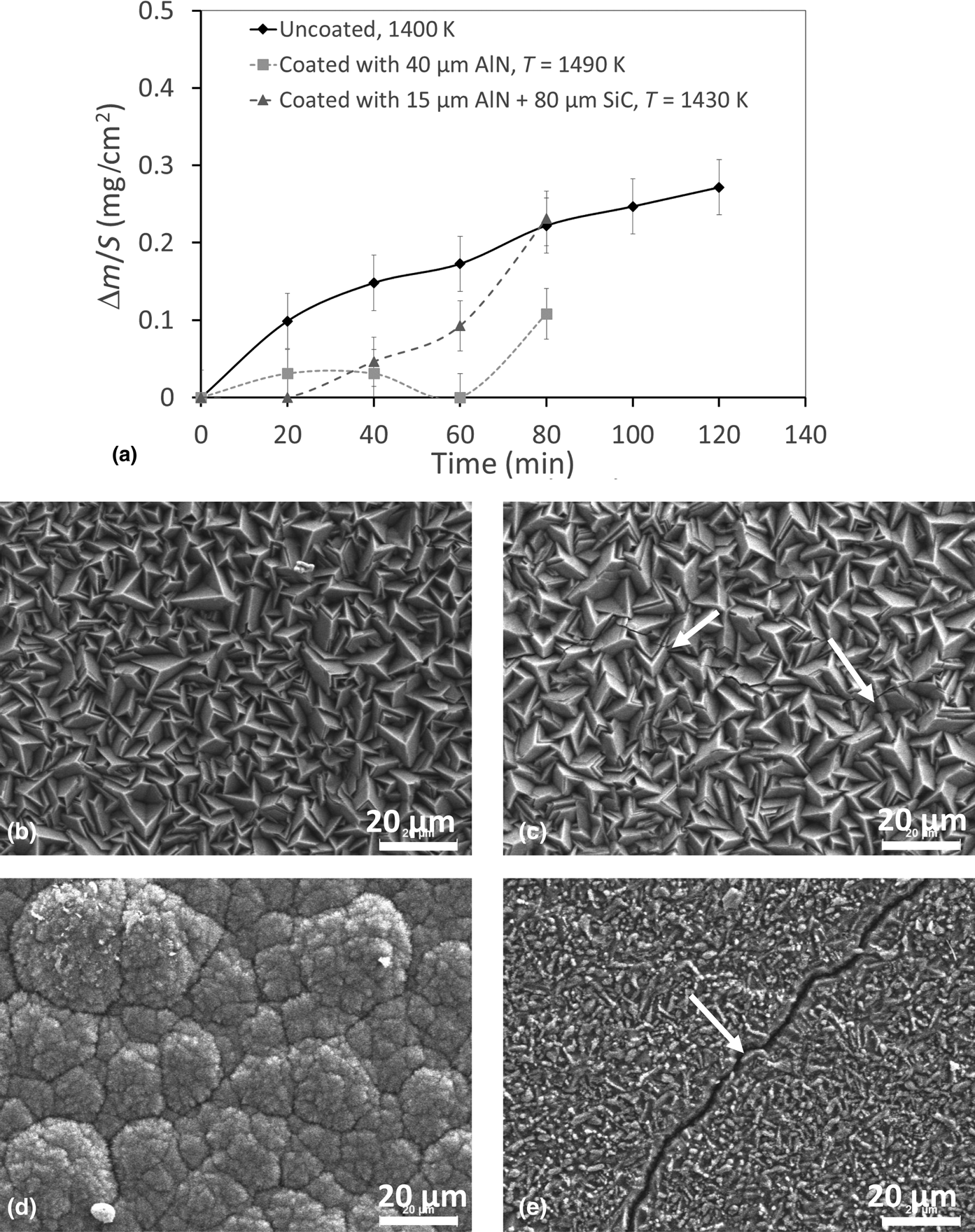
Kanthal APMT supports oxidizing atmospheres better than TZM and Fig. 2(a) presents the evolution of the weight change with time for the as-received alloy, AlN and AlN/SiC-coated samples, heated at 1400 K in the air using REHPTS facility. Figures 2(b)–2(e) show the SEM images of the surfaces of the AlN (Figs. 2b and 2c) and AlN/SiC (Figs. 2d and 2e) coated before (Figs. 2b and 2d) and after (Figs. 2c and 2e) the oxidation carried out in Fig. 2(a). The oxidation of the uncoated sample follows a diffusion-controlled semi-parabolic kinetics, which is due to the growth of a dense and protective alumina scale.[Reference Badini and Laurella18,Reference Liu, Gao and He19] The coating reduces the oxidation kinetics during the first hour, then an increase is observed during the last cycle. The growth of alumina does not affect the aspect of the AlN-coated sample, whereas one glassy silica layer recovers the AlN/SiC-coated one. Cracks are observed through the coating [Fig. 2(e)], and these cracks may favor the oxygen diffusion and therefore enhance the sample oxidation. These cracks formed due to the thermo-mechanical stresses generated by the large temperature variation from 300 to 1400 K.
Weight changes with time of the coated and uncoated APMT samples oxidized in air at T ≈ 1400 K (a), and SEM images (SE mode) of the AlN-coated (b,c) and AlN–SiC-coated (c,d) APMT samples before (b,d) and after (c,e) 80 min oxidation in air.

Residual stresses measurements in AlN coating and growing Al2O3 layer are performed by Raman spectrometry and photoluminescence at room temperature. Fifteen thermal cycles in 30 h are performed from 1373 to 300 K during this experiment in a conventional furnace. It is shown that the stress in the AlN layer is always compressive and increases from −1.7 GPa before oxidation to −2.7 GPa after 30 h. In the growing Al2O3 layer, the stress is also compressive with a mean value of −2.3 GPa. These high values come from a complex dependence on the high thermal stresses developed during cooling and creeping rate of the metal substrate at high temperature. However, these values remain lower than the theoretical compressive strength of AlN (−2.81 to −3.2 GPa[Reference Subhash and Ravichandran20,Reference Heard and Cline21] ) and Al2O3 (−4 GPa[Reference Subhash and Ravichandran20]). For the experiments carried out in the REPHTS, the thermal shocks are higher and cracking of the films occurs. The complete modeling including thermal stresses, high-temperature creep, and oxidation will be published later.
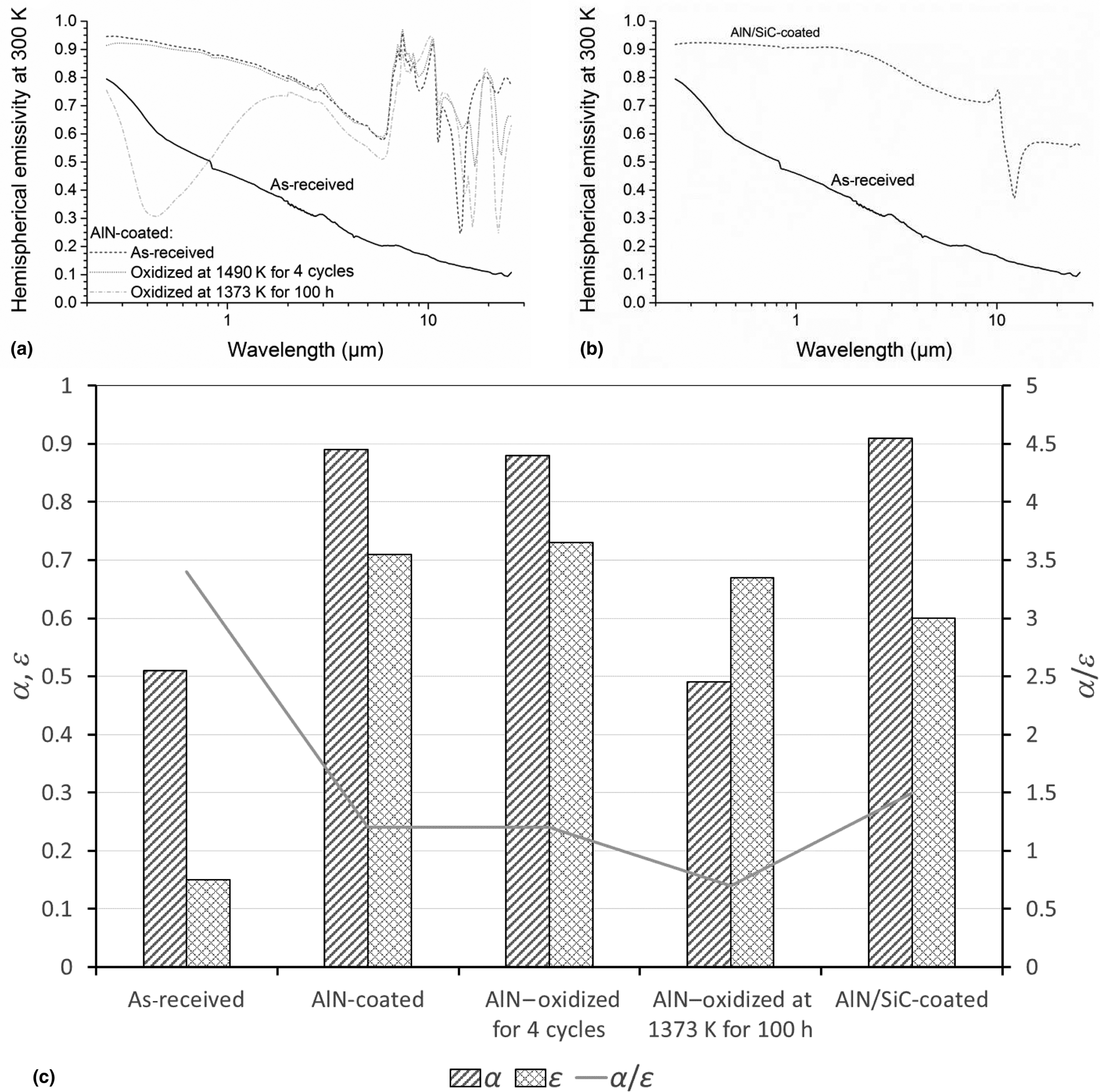
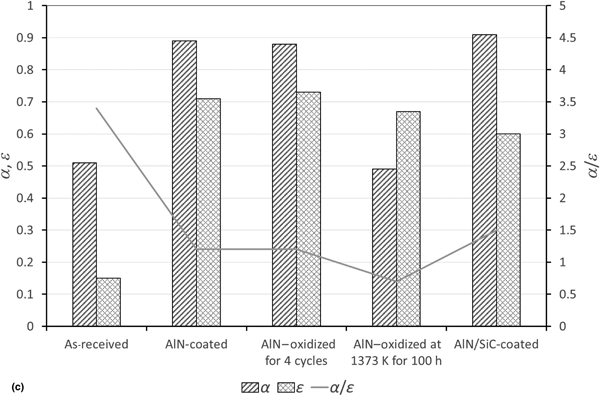
Figure 3 presents the optical properties at room temperature of the uncoated, AlN and AlN/SiC-coated APMT, before and after oxidation in the REHPTS or in the muffle furnace. Figure 3(a) shows that the AlN coating makes the spectral emissivity increase in the solar spectrum and also in the infrared region. A short-time oxidation (four cycles of 20 min) does not significantly affect these properties. Nevertheless, a thicker oxide layer grown after 100 h exposure in the muffle furnace at 1373 K leads to a significant drop in the spectral emissivity. Figure 3(b) shows that the AlN/SiC coating has better optical properties than the AlN coating, with an improvement of the spectral emissivity in the solar spectrum range and a smaller increase in the infrared domain. The calculated solar absorptivity and total emissivity at 300 K [Fig. 3(c)] confirm that the AlN and AlN/SiC coatings improve the solar absorptivity, but long-term oxidation of AlN provokes the inversion of the spectral selectivity, with a total emissivity that gets higher than the solar absorptivity.
Spectral hemispherical emissivity at 300 K of uncoated and AlN-coated APMT, before and after oxidation inside REHPTS (four cycles of 20 min at 1490 K) or muffle furnace (100 h at 1373 K) (a), spectral hemispherical emissivity at 300 K of uncoated and AlN–SiC-coated APMT (b), and room-temperature solar absorptivity α, total emissivity ε, and evolution of the α/ε ratio (c) for the five presented samples.

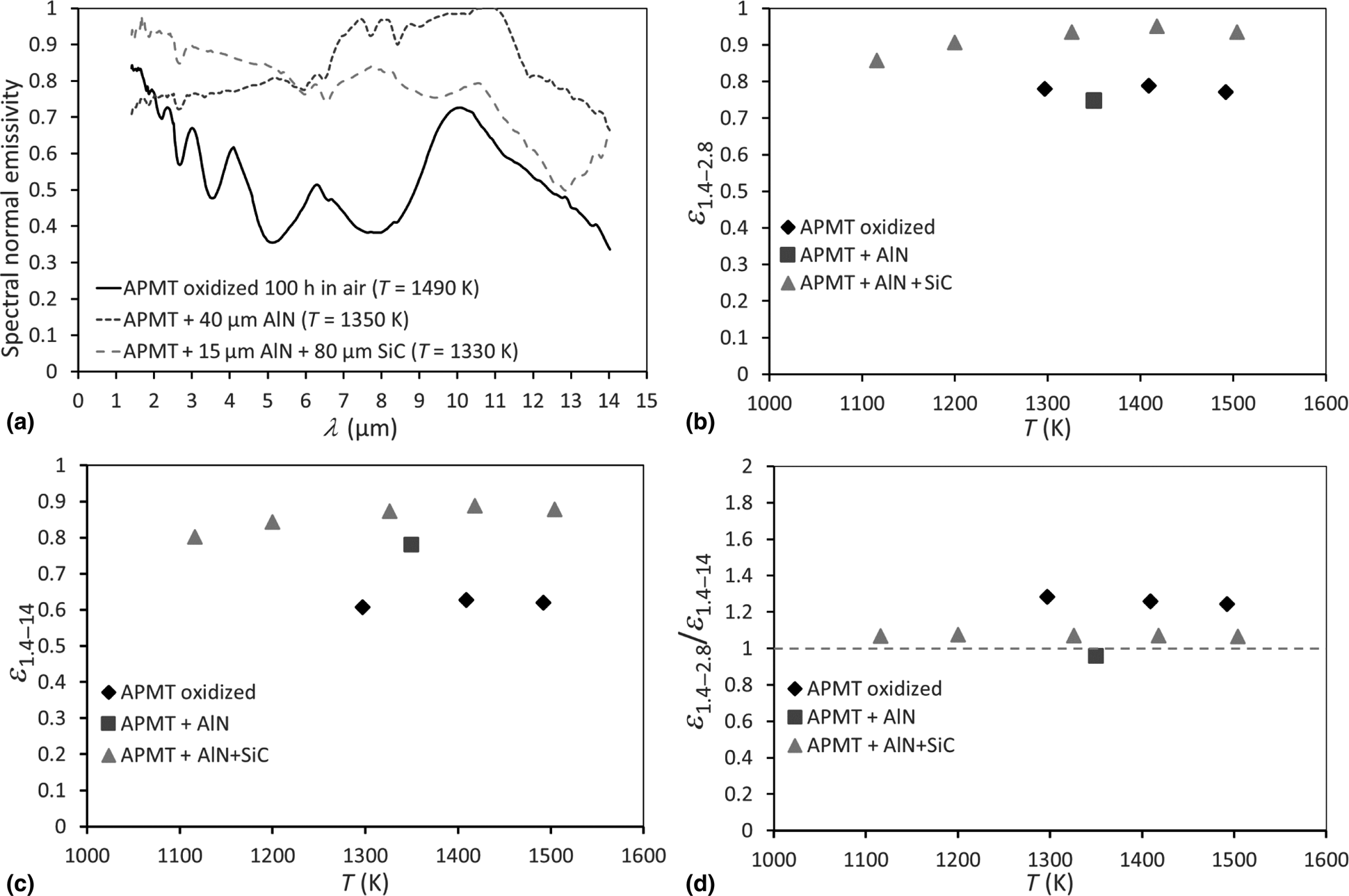
Finally, Fig. 4 presents the high-temperature emissivity measurement in the air using the MEDIASE set-up. At around 1350 K, the spectral emissivity of the coated APMT is higher than the one of the oxidized APMT [Fig. 4(a)]. Whereas the spectral emissivity of the AlN/SiC-coated material tends to decrease when the wavelength increases, the one of the AlN-coated material tends to increase. This is confirmed by Figs. 4(b)–4(d): at 1350 K, the AlN-coated materials present a lower value of ε 1.4–2.8 than ε 1.4–14, 0.75 versus 0.8, respectively. So, the spectral selectivity of AlN-coated materials does not look promising. At the opposite, the AlN/SiC coating seems promising to increase the solar absorptivity, keeping a satisfying spectral selectivity: at 1330 K, ε 1.4–2.8 is higher than ε 1.4–14, 0.95 versus 0.85, respectively. It is worth mentioning that SiC oxidized in the air into SiO2, and this slight oxidation does seem to affect these radiative properties. Nevertheless, the appearance of cracks observed in Fig. 2(e) prevents currently the analyses of the long-term evolution of these properties in air.
Spectral normal emissivities measured in air at T ≈ 1350 K for oxidized and coated APMT (a) and variations with T of the integration on the 1.4–2.8 µm wavelength interval (≈α) (b), of the integration on the 1.4–14 µm wavelength interval (≈ε) (c), and of the ratio of ε 1.4–2.8 on ε 1.4–14 (≈α/ε) (d).

Conclusions
We have presented here the first results on the influence of a ceramic coating on the oxidation resistance and optical properties of metallic alloy. We did not succeed in preventing TZM alloys from severe oxidation in the air due to the difficulty to fully recover the defects of TZM substrates; nevertheless, the results on APMT have shown that the AlN and AlN/SiC coatings could reduce the oxidation kinetics of the substrate. Thermal shocks generated may crack the coating. The room-temperature optical and high-temperature radiative measurements have shown that the AlN coating is not the ideal material for high-temperature solar receivers due to the decrease in its solar absorptivity after long-term oxidation (>100 h). AlN/SiC coatings seemed to improve the solar absorptivity of the substrate while maintaining an interesting spectral selectivity.
Our next investigations will therefore mainly aim at reducing the thermal stresses in the coating by reducing the heat rate conditions or developing other accommodation layers. The direct growth of SiC on pre-oxidized APMT is now under development regarding this axis.
Supplementary material
The supplementary material for this article can be found at https://doi.org/10.1557/mrc.2019.130.
Acknowledgments
This work was supported by the French “Investments for the future” program funded by the French National Research Agency (ANR) under contracts ANR-10-LABX-22-01-SOLSTICE and ANR-10-EQPX-49-SOCRATE, and by the 2MAC-CSP project also funded by the ANR under contract ANR-16-CE08-0019. We also thank Christophe Escape from PROMES-CNRS and Yonko Gorand from the University Perpignan Via Domitia (UPVD) for their help for the reflectivity measurements and SEM imaging, respectively.