


Introduction
Research on evidence-based treatments (EBT) rarely leads to evidence-based practice (EBP) in routine clinical care without careful training and quality assessment of the delivery of treatment. Beidas and Kendall's (Reference Beidas and Kendall2010) review of empirical evaluations of strategies for training clinicians in EBP shows that didactic training alone has some impact on practitioners’ perceived declarative knowledge, but minimal influence on their treatment adherence and skilfulness. Motivational interviewing (MI) is an EBT with a firm evidence base across a wide variety of health behaviours (Hettema et al., Reference Hettema, Steele and Miller2005; Lundahl et al., Reference Lundahl, Kunz, Brownell, Tollefson and Burke2010, Reference Lundahl, Moleni, Burke, Butters, Tollefson, Butler and Rollnick2013). MI is a client-centred and directional therapeutic method for strengthening clients’ motivation and commitment to change (Miller and Rollnick, Reference Miller and Rollnick2013). Miller and Rollnick (Reference Miller and Rollnick2013), the founders of MI, have emphasized that MI is not a set of specific techniques, but a skilled style of counselling that requires careful training. As interest in MI continues to grow, training in MI is also becoming more established. However, there is a lack of knowledge regarding the content and structure of effective MI training. Previous research indicates that the most common training format, a two-day workshop consisting of didactic instructions and experiential exercises, may not be sufficient for providing the majority of practitioners with long-term proficiency in MI, and that subsequent supervision, including systematic feedback and coaching, is more likely to enhance skills (Madson et al., Reference Madson, Loignon and Lane2009; Barwick et al., Reference Barwick, Bennett, Johnson, McGowan and Moore2012; de Roten et al., Reference de Roten, Zimmermann, Ortega and Despland2013; Schwalbe et al., Reference Schwalbe, Oh and Zweben2014).
Supervision theory and research
In general, supervision suffers from an absence of empirical support of effectiveness as well as a lack of well-defined supervisory procedures that can be reliably observed and measured (Reiser and Milne, Reference Reiser and Milne2011). However, there is some previous research indicating that supervision has a beneficial effect on supervisees in terms of self-awareness, skills, self-efficacy, theoretical orientation, and the supervisee‒client relationship (e.g. Wheeler and Richards, Reference Wheeler and Richards2007; Watkins, Reference Watkins2011). In recent years, scholars have emphasized the importance of competency-based clinical supervision (Borders et al., Reference Borders, DeKruyf, Fernando, Glosoff, Hays, Page and Welfare2011; Falender and Shafranske, Reference Falender and Shafranske2012; Bernard and Goodyear, Reference Bernard and Goodyear2014). Competency-based supervision is a meta-theoretical approach to supervision that explicitly identifies the knowledge, skills and attitudes that comprise clinical competencies, inform learning strategies and evaluation procedures, and meet criterion-referenced competence standards consistent with EBP (American Psychological Association, 2015; Falender and Shafranske, Reference Falender and Shafranske2007). This type of supervision often relies upon direct observation of practice, performance feedback and coaching as a means to train therapists to become adherent and competent in their practice of EBTs (Falender and Shafranske, Reference Falender and Shafranske2012; American Psychological Association, 2015), particularly in clinical trials (Martino et al., Reference Martino, Gallon, Ball and Carroll2008; Roth et al., Reference Roth, Pilling and Turner2010). However, certain elements of competency-based training and supervision have often been neglected in the transmission of new treatments to routine clinical settings (Roth et al., Reference Roth, Pilling and Turner2010; Olmstead et al., Reference Olmstead, Abraham, Martino and Roman2012). One example of a competency-based supervision approach used in several MI effectiveness trials and developed as a toolkit for use in clinical settings is the Motivational Interviewing Assessment: Supervisory Tools for Enhancing Proficiency (MIA: STEP) (Martino et al., Reference Martino, Ball, Gallon, Hall, Garcia and Ceperich2006). In a recent randomized controlled trial of the MIA: STEP used in community treatment programmes, when compared with supervision as usual (SAU), clinicians allocated to the MIA: STEP showed greater increases in the skill in which they used MI strategies, although not in the frequency of MI than clinicians allocated to SAU. Moreover, there were no differential beneficial effects by types of supervision on client treatment retention or outcomes, and MIA: STEP was substantially more expensive to deliver than SAU (Martino et al., Reference Martino, Paris, Anez, Nich, Canning-Ball and Hunkele2016). Clearly, more research is needed concerning how clinical supervision should be conducted to promote effective implementation of EBP in routine clinical care.
The aim of the present study was to explore ten supervisors’ behaviour in a primary prevention intervention of childhood obesity (PRIMROSE) conducted at child health centres in Sweden (Doring et al., Reference Doring, Hansson, Andersson, Bohman, Westin and Magnusson2014). The PRIMROSE study results showed no significant intervention effect on either body mass index (BMI) or physical activity, but a small positive effect on children's eating habits (Doring et al., Reference Doring, Ghaderi, Bohman, Heitmann, Larsson and Berglind2016). Additionally, two previous studies showed that the relatively comprehensive MI training package offered to intervention nurses in the trial, including both initial workshop training and nine supervision sessions, was not effective in developing sufficient proficiency in MI among the supervisees (Bohman et al., Reference Bohman, Forsberg, Ghaderi and Rasmussen2013; Eno Persson et al., Reference Eno Persson, Bohman, Forsberg, Beckman, Tynelius, Rasmussen and Ghaderi2016). Results suggest the need to examine more closely the way the supervisors behaved while conducting supervision and the attitudes they had towards some of the key components of the supervision they were expected to deliver during the trial. The present study used mixed qualitative and quantitative methods to address these questions
Method
Study setting: the PRIMROSE trial
The present study was conducted with supervisors of the PRIMROSE trial, a randomized controlled primary prevention intervention of childhood obesity conducted in eight county councils of Sweden (Doring et al., Reference Doring, Hansson, Andersson, Bohman, Westin and Magnusson2014). Nurses at child health services conducted the manual-based programme with participating families. Focus for the individual sessions was for parents to improve and/or maintain their own healthy eating and physical activity habits. In the programme, behaviour changes were primarily conceptualized in terms of MI, but were additionally informed by learning theory and principles of cognitive behavioural therapy (CBT). Manual content was designed to be congruent with the style of MI. Prior to the trial, nurses in the intervention group were trained in MI and dietary and physical activity interventions, as well as the basic principles and procedures of learning theory (e.g. stimulus control, conditioning) and CBT (e.g. monitoring, homework). The training in MI, which consisted of a workshop followed by supervision including systematic feedback and coaching, has been described in detail elsewhere (Bohman et al., Reference Bohman, Forsberg, Ghaderi and Rasmussen2013). Following the MI training, which included four supervision sessions on practice samples, nurses received systematic feedback based on 20-minute segments of audio-recorded practice samples in five additional supervision sessions. For a detailed description of the supervision, please see ‘Supervision in the PRIMROSE Trial’ below. The audio-recorded samples were coded according to the Swedish translation of the Motivational Interviewing Treatment Integrity (MITI) Code version 3.0 (Forsberg et al., Reference Forsberg, Kallmen, Hermansson, Berman and Helgason2007), a standardized assessment instrument that can be used as a treatment integrity measure for clinical trials of MI, and to provide structured, objective feedback to increase clinical skills in the practice of MI. The MITI coding was performed by the Motivational Interviewing Coding (MIC) Lab at the Department of Clinical Neuroscience at Karolinska Institutet in Stockholm, Sweden. According to a system for interpreting an intra-class correlation coefficient (ICC) proposed by Cicchetti (Reference Cicchetti1994), the coders’ inter-rater reliability ranged from fair (i.e. an ICC between 0.40 and 0.59) to excellent (i.e. an ICC between 0.75 and 1.00) during the three-year period of supervision within the PRIMROSE study (Bohman et al., Reference Bohman, Forsberg, Ghaderi and Rasmussen2013). The PRIMROSE study has been registered (ISRCTN16991919), and approval was obtained from The Regional Ethical Review Board in Stockholm, Sweden, for both the PRIMROSE trial and the present study (2006/525-31/2).
Participants
Participants were the ten supervisors in the PRIMROSE trial. The mean age was 49.4 years (SD = 9.9, range = 34.0‒68.0). Seven were females and nine had previous training in CBT. Five were psychologists, three were nurses, one had a university degree in behavioural sciences, and one was an occupational therapist. On average, the supervisors had 7.0 years (SD = 6.5, range = 2.5‒25.0) of experience as MI trainers, and 4.0 years (SD = 3.7, range = 1.0‒15.0) of experience as MI supervisors. All supervisors were members of the Motivational Interviewing Network of Trainers (MINT), which organizes practitioners trained to train others in MI. Participation was voluntary and confidential, and prior to the interviews all the supervisors signed an informed consent form.
Supervision in the PRIMROSE trial
The supervision was conducted from May 2008 to April 2011. Even though the PRIMROSE trial was based on both MI and CBT, the supervisors’ sole focus during supervision was the nurses’ skills in MI. On average, the ten supervisors had 4.8 supervisees (SD = 2.8, range = 2.0‒11.0) in supervision. To establish and facilitate a good working relationship, all the supervisors attended the last day of the MI training workshop in which they engaged in role-plays with the supervisees, discussed the procedures related to recording of practice samples and planned for the forthcoming supervision sessions. All the supervisees in the trial were offered a total of nine individual telephone-based supervision sessions based on practice sample recordings. The first four practice samples contained self-selected families who were not participants of the PRIMROSE trial. Supervision of these samples was conducted to help the supervisees gain proficiency in MI. The last five recordings were randomly sampled from the available intervention families. The primary purpose of the supervision of these samples was to facilitate further development of MI skills and to ensure that the supervisees were following the basic principles of MI. The recordings were uploaded on the project website for supervisors to listen to before the sessions. The first and the fifth to the ninth of the recordings were coded according to the MITI. The protocols were then sent to the supervisors before supervision, and to the supervisees before or during the supervision sessions. Hence, the first and the fifth to the ninth supervision sessions were based on both the session recordings and the MITI protocol, whereas the remaining three supervision sessions were based on the session recordings only. The MITI protocols included both summary scores related to the recommended reference values for basic MI competence, and written examples of good MI practice along with examples of areas of improvement. Each of the supervision sessions was planned to last for 30 minutes with intervals of 3 weeks between the first four sessions, 2 months for the following two sessions, and 3 months for the last three supervision sessions. Additionally, the supervisors had at their disposal 30 minutes for preparation (e.g. listening to the recorded practice samples) and 30 minutes for compiling the supervision for each session. The supervisors were asked to record the total amount of time spent on the three parts. On average, the supervisors spent 18.6 minutes (SD = 7.6, range = 5.0‒75.0) on preparation, 32.1 minutes (SD = 6.5, range = 15.0‒60.0) on supervision, and 11.2 minutes (SD = 4.6, range = 5.0‒30.0) on compiling the supervision. The ninth supervision session was extended to 45 minutes to allow time for a summary of the training period, with a focus on the supervisees’ MI progress and maintenance of the acquired skills.
The intention was that the PRIMROSE supervision would be conducted according to the following instructions. When available, the supervision would be based on the results of the MITI. The supervisors would structure each session using a form with four questions: (1) What did the supervisee do well?; (2) What can the supervisee do more of?; (3) What can the supervisee do less of?; and (4) What does the supervisee take into consideration for future practice? The purpose of the questions was to find and reinforce MI-consistent behaviours, and to identify the MI-inconsistent behaviours that could use improvement. The supervisors should always start by asking what area the supervisees would like to focus on in the development of skills, and then initiate a discussion of that area while blending in the results of the MITI. Lower scores on the MITI should be framed as starting points in the learning process. The supervisors had access to telephone supervisory meetings once a month throughout the supervision period and were also supported by local PRIMROSE trial coordinators in case of practical difficulties with the practice sample recordings.
Data collection
Data on supervision content and process were collected in one-to-one semi-structured telephone interviews with the supervisors. As there was no existing tool in the literature to assess the supervisors’ perception of their behaviours during supervision, the study authors developed the interview protocol to ascertain the supervisors’ behaviours and attitudes as they related to the expected supervision practice (Table 1). The final protocol consisted of 32 questions presented in a consistent order. The first eight questions covered aspects of participants’ demographics (gender, age, education and professional experience). The remaining 24 questions covered PRIMROSE trial-specific aspects of MI supervision, as well as generic aspects of supervision based on supervision research. Several response formats were used, including forced-choice, free text, and visual analogue scales. The protocol was sent by e-mail prior to the interview so that the supervisors would have time to reflect on the questions. As the first author was a supervisor in the PRIMROSE trial, the second author interviewed the first author to avoid response bias. Thereafter the first author interviewed all other supervisors. The interviews lasted between 28 and 34 minutes.
Questions 9 to 32 of the interview protocol

Data analysis
This was an exploratory study using a mixed method approach; both qualitative and quantitative data were collected. Qualitative analysis: A conventional qualitative content analysis (Hsieh and Shannon, Reference Hsieh and Shannon2005) was used to analyse the textual data from the interviews. Coding was developed inductively (from the data content) as opposed to employing a predefined coding scheme. Following the transcription of the interviews, two members of the research team independently analysed the supervisors’ qualitative statements. Common themes and contrast statements (either words, phrases or sentences) across interviews were extracted; data were coded and similar elements were summarized thematically. The two research team members then compared their results and discussed the ratings they disagreed upon until they reached a consensus. Quantitative analysis: Descriptive statistics were generated and presented as mean (SD, range) for the demographic characteristics and for the amount of time spent on preparing, conducting and summarizing the supervision session. For the forced-choice questions and the visual analogue scales, frequencies and percentages (SD, range) were reported. All these analyses were performed using the SPSS (version 22, SPSS Inc., Chicago, IL, USA).
Results
The five primary themes identified in the analysis were: Structure of the sessions, Educational methods and techniques, Assessment of learning needs, Supervision in an MI-consistent manner, and Difficulties and opportunities.
Structure of the sessions, Educational methods and techniques, and Assessment of learning needs
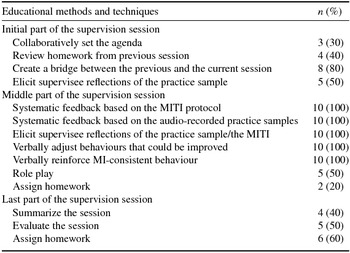
As the most important starting point for the agenda setting, five supervisors indicated their own listening to the supervisees’ recorded practice samples, two reported the results of the MITI, two reported the supervisees’ individual requests, and one described elements of focus from earlier supervision sessions. Three parts of the supervision sessions could be discerned from almost all the interview responses: All ten supervisors mentioned an initial and a middle part of the supervision session that included somewhat different educational methods and techniques, and six of the them also mentioned a third part at the end of the supervision session (Table 2):
In the introduction, which takes about 7 minutes, I begin by asking if she has listened to the recording and received the protocol. Then I ask for her thoughts and give her feedback. I also follow up on my notes from previous sessions and check to see if she has been practising. Finally, we set the agenda – what should we talk about this time?
In the end I let her summarize: What does she take with her from the supervision session? What does she think would be a good focus for practice? What's her plan for practice? When will she do it and when will she record her next practice sample? I always give a maximum of two things to practise. The last thing we do is to evaluate: What worked in this session and what would she like more of in the next? This takes about five minutes.
Educational methods and techniques in the three parts of the supervision session

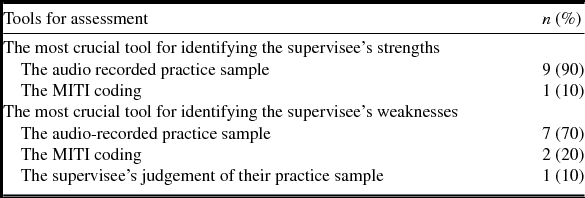
The majority of the supervisors reported that listening to the recorded practice samples were their most crucial tool for identifying strengths and weaknesses in the supervisees’ MI practice (Table 3). On average, the ten supervisors reported spending 72.0% (SD = 12.3, range = 40.0‒85.0) of supervision session time focusing on strengths in supervisees’ MI practice, and 28.0% (SD = 12.3, range = 15.0‒60.0) focusing on weaknesses.
The supervisor's tools for assessment of the supervisee's learning needs

Supervision in an MI-consistent manner
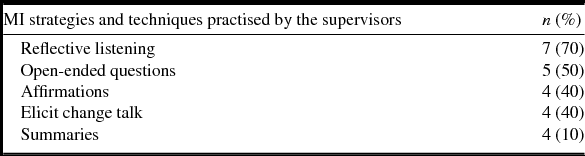
On average, the supervisors estimated that 44.4% (SD = 11.3, range = 30.0‒70.0) of supervision session time was used for talk produced by themselves, and that they on average influenced 55.6% (SD = 14.0, range = 25.0‒70.0) of the supervision session content. The supervisors also estimated that they focused on the supervisees’ talk 66.0% (SD = 15.2, range = 50.0‒85.0) of the total time, relative to the client's talk, when listening to the recorded practice samples. All ten supervisors reported that they tried to deliver the supervision in a style consistent with MI, with somewhat different MI strategies and techniques (Table 4):
I use my listening skills; affirmations, reflections and also give support to the supervisee during the session. I also always set an agenda, structure the goals for the session and use collaboration skills.
MI is difficult and time is limited. It means that I cannot always be as MI consistent as I want. Sometimes, for example, I inform rather than explore.
The five most common MI strategies and techniques practised by the supervisors

On average, the supervisors estimated the extent to which they practised MI in the supervision sessions to 68.0 (SD = 18.1, range = 25.0‒85.0) on a scale ranging from 0 (not at all) to 100 (to a very large extent).
Difficulties and opportunities
Five supervisors reported the supervisees’ individual thoughts and reflections about the practice samples being the most important factor for learning MI skills, while four supervisors reported their own feedback, and one the role-plays. None of the ten supervisors described the results of the MITI as the most important factor for learning MI skills, and five supervisors argued that feedback based on the results of the MITI might have a negative effect on the supervisees’ learning:
The protocol sometimes has a punishing effect. I try to moderate it by highlighting the positive aspects of the codings and supporting her confidence in her ability to learn and develop.
The supervisee's experience of her MI performance as poor – which is compounded by her listening to the protocol – sometimes gets confirmed by the protocol. I try to highlight what worked and normalize the difficulties of learning a new skill.
Nonetheless, the majority (n = 8) of the supervisors tended to conceptualize feedback according to the MITI as an opportunity for learning, and four supervisors did not believe that the MI supervision involved any negative features whatsoever:
MITI gives you a picture of the supervisee's skills in that session, especially where she's strong. It's a tool for identifying strengths and difficulties, and opportunities for development. It also gives you the opportunity to monitor progress over time. It's one of many ways to obtain information about the supervisee's skills.
It's a tool for learning MI. We have this tool to learn. It provides areas to choose from when considering learning objectives. It gives an overview of the session and helps to set priorities.
Supervisors estimated the extent to which telephone supervision is as useful as face-to-face supervision to 78.6 (SD = 21.7, range = 25.0‒100.0) on a scale ranging from 0 (not at all) to 100 (to a very large extent). Four supervisors believed that a manual-based intervention such as the PRIMROSE trial was consistent with MI, whereas six supervisors believed it to be only partially consistent.
Discussion
The aim of the present study was to explore the supervisors’ experiences of MI supervision in a primary prevention intervention of childhood obesity (Doring et al., Reference Doring, Hansson, Andersson, Bohman, Westin and Magnusson2014). The results from the interviews showed that many of the reported MI supervision behaviours were similar among the supervisors during supervision, but also that a number of behaviours varied. The results also showed that none of the supervisors felt that the MITI was relatively important for supervisees to learn MI, and half of them felt that MITI-based feedback might have a negative effect on supervisees’ learning.
Supervisor's use of MITI as a training tool
The most surprising finding was that not all supervisors used the available objective measure of proficiency (i.e. the MITI protocol) as the primary source for performance evaluation and systematic feedback: eight of the ten supervisors reported using sources other than the protocol as the most important basis for the supervision sessions, nine supervisors suggested listening to the recorded sessions and not the MITI as being the most crucial tool for identifying the supervisee's strength in practising MI, and seven supervisors suggested their own listening and one the supervisees’ individual judgement as the most crucial tool for identifying the supervisees’ weaknesses. Additionally, although eight of the supervisors conceptualized feedback according to the MITI as an opportunity for learning, none of them reported the results of the MITI as the most important factor for learning MI.
MITI-based feedback
Five of the ten supervisors argued that feedback based on the results of the MITI might have had a punishing effect on the supervisees. This illustrates the impact of the emotional context in the process of developing competence during clinical supervision. Some previous research proposes that supervisees may be anxious and fear negative evaluations from their supervisors (Friedberg et al., Reference Friedberg, Gorman and Beidel2009; Lombardo et al., Reference Lombardo, Milne and Procter2009; Abernethy and Cook, Reference Abernethy and Cook2011; Clarke and Giordano, Reference Clarke and Giordano2013). Other findings suggest that the common belief that recording and monitoring of therapy sessions is debilitating to the supervisee or to the supervision process is a misconception (Ellis, Reference Ellis2010). In a summary of sixteen studies investigating supervisee anxiety over approximately 20 years (Ellis, Reference Ellis2010), supervisees were not found to be overly anxious, and the results showed that supervisees in general quickly adopt to the recording and monitoring of therapy sessions. However, the summary also showed that when there was a deficient working relationship between supervisor and supervisee, anxiety ran high, as opposed low anxiety with the existence of a satisfactory working relationship. Also, in a study of 128 supervisees’ experiences of supervision, both positive and challenging feedback seemed to be uniquely beneficial to supervisees, leading to the conclusion that supervisors should recognize that supervisees can handle challenges, especially within a positive supervisory relationship (Ladany et al., Reference Ladany, Mori and Mehr2012). Conducting MI supervision in a manner consistent with MI, in which both the knowledge and techniques are tailored and used as learning strategies, has been proposed as a way to provide the supervisee with experience of the method, to model its use during supervision, and to work with the supervisory relationship (Martino et al., Reference Martino, Gallon, Ball and Carroll2008; Clarke and Giordano, Reference Clarke and Giordano2013). Moreover, an MI approach to MI supervision has the advantage of relying on theoretical principles and empirical knowledge of factors facilitating behaviour change (Martino et al., Reference Martino, Gallon, Ball and Carroll2008; Stein et al., Reference Stein, Clair, Soenksen, Martin and Clarke2015), and is consistent with the proposed components of the supervisory relationship (American Psychological Association, 2014). All the supervisors of the PRIMROSE trial reported delivering an MI-consistent supervision style with reflective listening, using open-ended questions and eliciting change talk about supervisees’ MI behaviours as the most common strategies.
Supervisor drift
Therapist drift is a well-known concept with a range of origins: cognitive bias, emotional reactions and context-driven behaviours (Waller, Reference Waller2009). Just as practitioners must keep in mind that they are prone to the same biases as their clients, supervisors must be cognizant of distortions that could drift them off track; and just as practitioners need to be both skilled and adherent for their practice to be effective, supervisors must deliver supervision in a competent manner. In this study, eight of the ten supervisors used their own listening to the recorded sessions instead of the MITI protocol as the primary source for performance evaluation and systematic feedback, and half of them expressed concerns that MITI-based feedback might have had a negative impact a on supervisees’ skill acquisition. It is not clear how the supervisor practices affected the learning of the supervisees in the trial, or the non-significant intervention effect. However, standardized assessment, such as the MITI, provides an objective and structured form of feedback and may, in addition to checking for adherence, have an important training function. Increasing evidence base for supervision practice (American Psychological Association, 2015) also raises demands for adherence to these practices. Adherence monitoring of supervision sessions together with step-by-step guidelines, or a more broad focus on core supervision competencies, might be essential training elements for efficient implementation of EBP in routine clinical care.
Limitations
This exploratory study contained a number of limitations. The supervisors’ behaviours were self-reported and not based on observations or objective measures of performance, which may raise questions about the reliability and validity of the results. A standardized instrument with known psychometric properties would have improved the reliability and validity of the results. However, a significant number of open-ended questions and a mixed method approach were deemed necessary because of the exploratory nature of the study. In future supervision studies the supervisory sessions would ideally be recorded in order to provide objective data. Despite these limitations, the present study provides important insights to help advance the scientific knowledge about supervision in MI.
Conclusion
Many of the reported supervisory behaviours were in line with both the study instructions and with recommendations from the supervision literature (Falender and Shafranske, Reference Falender and Shafranske2007; Martino et al., Reference Martino, Gallon, Ball and Carroll2008; American Psychological Association, 2015). However, the supervisors’ drift away from key practices might have had a negative effect on supervisees’ learning, which may have affected both the supervisees’ skill acquisition and, indirectly, the intervention effects of the trial. The present study suggests that, in addition to clear supervision structures and principles that specify the content and procedure of the supervision, adherence monitoring of the supervision sessions may be crucial to ensure that appropriate supervision activities are conducted in each MI supervision session.
Acknowledgements
The authors would like to thank Lina Öhman for valuable help with the analysis of the supervisees’ qualitative statements, the supervisors for sharing their opinions and experiences with us, and Sydney Lloyd Smith for editing this manuscript.
Financial support: The PRIMROSE trial has been supported by grants from: The Swedish Council for Working Life and Social Research (2006-0226 and 2011-0413); the Swedish Research Council (K2006-27X-20069-01-3 and K2012-69X-22058-01-3); the Research and Development Committee, Stockholm County Council (2006-0324); the Regional Research Council of the Uppsala and Örebro Health Care Region (RFR-12404); Uppsala County Council, Sörmland County Council, the Public Health Committee of Stockholm County Council (0803-377); the Vårdal Foundation (B2007-006); AFA insurance (H-06:05/070001); the Foundation of the Swedish Diabetes Society (TMA2006-004); and the Karolinska Health Care Sciences Postgraduate School (2008). The trial has also received the Karolinska Institutet for PhD student grants 2012 and 2013. Trial registration: ISRCTN16991919.
Ethical standards: The authors assert that all procedures that contribute to this work comply with the ethical standards of the regional ethical review board in Stockholm, Sweden, and with the Helsinki Declaration of 1975 and its most recent revision.
Conflicts of interest: The authors have no conflicts of interest with respect to this publication.




Comments
No Comments have been published for this article.