Malaria is a life-threatening disease caused by parasites that are transmitted to people through the bites of infected mosquitoes. Although the last century observed many successful programs that eradicated malarial fevers, many parts in the world are still suffering from the disease. There were about one million deaths from malaria in 2008, but it is noteworthy that about 247 million cases of malaria were reported throughout the world that year.Footnote 1 The high rate of incidence has burdened malaria-endemic countries with substantial economic costs due to medical costs and income loss among infected individuals. The World Health Organization (WHO) reports that household and government expenditure on malaria-related prevention and treatment accounts for up to 40 percent of total public health expenditure in countries heavily burdened by malaria.Footnote 2 Many studies have estimated that malarial infections significantly lower household income, consumption, labor productivity, cognitive development, and long-run economic development.Footnote 3
This article investigates the long-term effect of migration to malaria-endemic regions on individuals' wealth accumulation in mid-nineteenth-century America. So far, the relation between malaria and migration has been studied in two main respects. First, migration has been related to malaria to examine whether people's movements contribute to the transmission of malarial infections and whether effective programs for malaria control are hindered when applied to populations that are mobile.Footnote 4 The economic development of malaria-endemic countries can be hindered because trade with—or migration to—malarial regions exposes people to an increased burden of malaria.Footnote 5 Second, malaria has been considered a main deterrent of migration in malaria-endemic countries. Migration deterrence limits long-term economic development by inhibiting the movement of labor to regions where it is most productive. However, the relationship between exposure to high-risk malaria by migration and individuals' economic status has been less studied due to a lack of longitudinal individual-level data in current malaria-endemic countries. To overcome this limitation, this study utilizes longitudinal samples that are linked to the 1850 and 1860 U.S. census records.
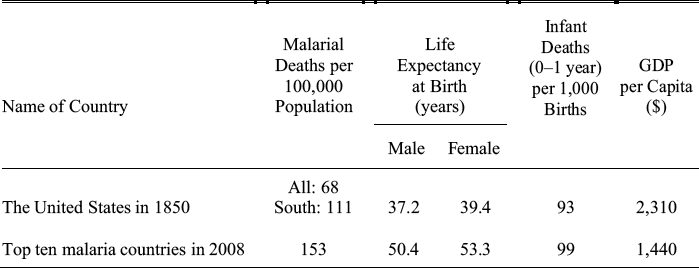
Mid-nineteenth-century America has historical conditions that are useful in several respects for estimating the economic burden of migration to malaria-endemic regions. The foremost is that the extent of malarial infections, public health status, and economic conditions in mid-nineteenth-century America were similar to those of today's malaria-endemic countries, as presented in Table 1. Although malaria was eradicated from the United States in the early 1950s, it had been prevalent in many areas prior to the 1870s.Footnote 6 According to the 1850 U.S. mortality census, the mortality rate from malarial fevers was about68 out of every 100,000 individuals.Footnote 7 The malarial mortality rates in some malaria-endemic states were closer to the average malarial mortality rate of the top ten malarial countries in 2008: 152 deaths from malarial fever for every 100,000 in Louisiana, 132 in Mississippi, and 166 in Texas. In addition, life expectancy at birth was lower and the infant mortality rate was higher in the United States in 1850 than in the modern African nations with high malaria rates.
PUBLIC HEALTH AND ECONOMIC CONDITIONS: THE UNITED STATES IN 1850 AND THE TOP TEN MALARIA COUNTRIES IN 2008

Notes:
The malarial mortality rate in U.S. Southern states in 1850 is the average rate of Kentucky, Tennessee, Alabama, Mississippi, Arkansas, Louisiana, and Texas. The infant mortality rates of the top ten malaria countries in 2008 are the estimated values in 2010. The U.S. GDP per capita in 1850 is measured in 2009 U.S. constant dollars; those for the African countries are in 2009 PPP dollars.
Sources:
The United States in 1850: The U.S. Census Bureau, Mortality Statistics, for malarial deaths and infant mortality; Haines, “Life Tables,” for life expectancy; and Johnston and Williamson, U.S. GDP, for distribution workers in agriculture. The top ten malaria countries in 2008 were Congo (Republic), Guinea, Guinea Bissau, Uganda, Nigeria, Niger, Congo (Democratic Republic), Burkina Faso, Mali, and Chad. The data for these countries is from United Nations Statistics Division, Millennium Development, for malarial deaths and CIA, World Factbook, for life expectancy, infant deaths, and GDP per capita.
The United States also experienced great internal migration throughout the mid-nineteenth century. In 1850 the net gain in the population through internal migration of the native born was about 2.2 million in the states of the Old Northwest and South, while the New England and Mid-South Atlantic states experienced a net population loss of about 2.4 million through internal migration.Footnote 8 Since the Old Northwest and South faced higher levels of malaria risk, it is likely that a large number of people moved from low-risk malaria regions to high-risk malaria regions throughout the mid-nineteenth century.
The longitudinal data in this study show that about 22 percent of the sample migrated by 1860 to counties that featured greater risks of malaria compared to the counties where they had lived in 1850. Although people in 1850 and 1860 probably knew the risk of the disease in the new counties, they had only limited information on how to prevent the disease because the malarial parasite (Plasmodium) was first discovered only in 1880, and malaria's transmission via mosquitoes was not clearly revealed until 1898. After controlling for the various socioeconomic characteristics of individuals, counties, and states, this study shows that people who migrated to counties with higher malaria risk accumulated less wealth. The negative relationship was more substantial among farmers who required physical strength and frequent outdoor work than among other occupational groups.
DATA AND MEASUREMENT OF MALARIA RISK
This study uses a longitudinal data set developed by Joseph Ferrie (hereafter referred to as “the Ferrie sample”). He located 4,936 adult males found in the manuscript schedules of the 1850 and 1860 federal population censuses, using the 1860 federal census index.Footnote 9 From that sample, I select those individuals between the ages of 20 and 59 in 1850; this is the group likely to have been economically active in both 1850 and 1860. The analysis is then limited to 1,222 individuals who moved to other counties by 1860. Ferrie showed that the migrants had significantly different socioeconomic characteristics and wealth accumulation patterns compared to those who did not choose migration.Footnote 10 Hence, limiting this study to movers is intended to preclude the confounding effect that is potentially caused by the selection between moving and staying. This allows the analysis to focus only on the selection between low- and high-risk malaria counties among the movers.
The measure of economic productivity is the value of individual real estate wealth as recorded in the 1850 and 1860 population censuses.Footnote 11 Real estate wealth is an imperfect measure of individual labor productivity because it can be affected by nonlabor-productivity mechanisms such factors as soil type, crop mix, and capital gain or loss associated with local economic conditions, the development of transportation, and improvements in local sanitary conditions. Inclusion of various individual and local socioeconomic characteristics in analysis controls for some of these factors.
The census sample has no information on malaria infections; therefore, I collect information on the counties where each individual lived in 1850 and 1860 and assign indexes of county-level malaria risk in order to scale the extent to which the individual was exposed to malarial environments. Thus, analysis focuses on the economic success of people exposed to malarial environments and cannot directly measure the impact of malarial infection on the individual's productivity.
In measuring county malaria risk, one useful ecological variable is the county-level malarial incidence rate or mortality rate. Although the pathogen of malaria had not been revealed as of the mid-nineteenth century, surgeons in that period could distinguish malarial fevers from fevers due to other diseases by the pattern of fever; they generally classified malarial fevers into two forms: intermittent and remittent. The cross-county death rate of the fevers was first reported in the 1880 mortality census, which can be used to approximate the risk of malaria in 1850–1860. But this may misestimate the actual probability of people contracting malarial fevers in mid-nineteenth-century America for several reasons. First, the case-fatality rate of malaria is relatively low, less than 1 percent in recent years; therefore, the county malarial mortality rate may not properly represent the likelihood of county residents' contracting malaria. Second, two kinds of malarial parasite were widespread in nineteenth-century America: vivax and falciparum. Vivax can survive even at low temperature and thrived in the northern states. Vivax did not cause excessively high mortality rates and thus was less of a burden than falciparum, which was prevalent in states south of the thirty-fifth parallel.Footnote 12 Third, malarial data in the 1880 census might underestimate the risk in the Old Northwest in 1850 and 1860. Daniel Drake observed that malarial fevers were in both the South and Old Northwest states such as Illinois and Ohio throughout the mid-nineteenth century.Footnote 13 Beginning in the 1870s malaria retreated to the South mainly because of agricultural drainage in the Old Northwest.Footnote 14
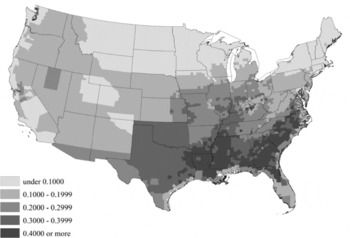
Because of these problems, I use an alternative measure based on geographic and climate factors that foster malaria that is an improvement on the measure I described in this Journal in 2007. Malarial parasites are transmitted by mosquitoes, and so the temperature, rainfall, and elevation and interactions between these variables influence mosquito breeding, vector densities, and vector survival, and thereby, malarial incidence.Footnote 15 The measure is developed by estimating a regression of the relationship between the malarial incidence rate among soldiers in the 143 U.S. Army forts located across the United States between 1829 and 1874 on the annual mean temperature, annual accumulated precipitation during the months when the mean temperature was higher than 59 degrees Fahrenheit, standard deviation of elevation approximating the existence of wetlands or swamps, the extent to which land was improved for agriculture, and whether or not the region was adjacent to the ocean. The county-level malaria risk is imputed by plugging county-level risk factors into the estimated regression equation. The estimated risk by location is mapped in Figure 1. It can be considered to be the annual probability of an individual's contracting malaria within a county in the mid-nineteenth century.
ESTIMATED MALARIAL ECOLOGY INDEX OF U.S. COUNTIES IN THE 1850S

In 2007 I imputed the climate conditions for counties without weather stations by finding the nearest weather station to that county. In the current measure, I impute the climate values for counties without weather stations using a “Kriging interpolation” technique. Kriging algorithms estimate the climate value at a given (target) location as a weighted sum of the data values at surrounding locations. Kriging assigns the weights in relation to the squares of the inverse distances with respect to the target location; that is, it puts a lower weight when the surrounding weather station is located farther from the target location.Footnote 16
Although the focus of the article is on malaria, the malaria index might also capture the risk of other diseases that thrived in the same environments and lowered productivity. In Figure 1, the South was characterized by a high risk of malarial infections because most Southern states were generally warm and wet and consisted of more wetlands and swamps. Other infectious diseases that thrived in warm and hot weather—such as hookworm, yellow fever, cotton pests, and so on—were prevalent in the South throughout the nineteenth century.Footnote 17 There is evidence that these other Southern diseases lowered labor productivity.Footnote 18 To the extent that other disease rates were positively correlated with malarial rates and climate conditions and negatively correlated with labor productivity, the results of this study may overestimate the economic burden of malaria.Footnote 19 This problem is reduced to some extent in the empirical analysis by the inclusion of a measure of the crude death rate as a control variable.
MIGRATION TO HIGH-RISK MALARIA COUNTIES AND WEALTH ACCUMULATION
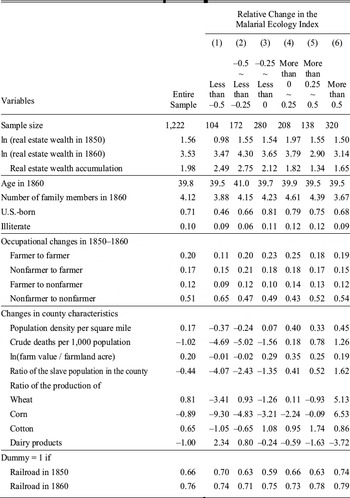
Comparisons of means show that there is a negative relationship between migrating to a malarial region and wealth accumulation. Table 2 reports sample means for six groups in the Ferrie sample of 1,222 movers classified by the change in the measure of the malarial environment. The difference in the logarithm of real estate wealth between 1860 and 1850 measures the level of wealth accumulation. People who moved to less malarial environments experienced increases in log real estate wealth that exceeded 2.1, while those who moved to more malarial environments saw their log real estate wealth rise by 1.82. The gap in real estate accumulation was even larger when comparing moves with the largest and smallest changes in malarial environments.
The comparisons of means may suffer from omitted variable bias to the extent that characteristics of the movers and the locations where they moved are correlated with both real estate wealth accumulation and changes in exposure to malaria. To obtain estimates of the impact of exposure to malaria while controlling for some of this omitted variable bias, I estimate the following ordinary least squares (OLS) regression model.

where the logarithm of individual i's real estate wealth in 1860 (ln RW 1860i) is a linear function of individual i's relative change in the county malarial ecology index by migration (ΔMi) conditional on the logarithm of the initial real estate wealth in 1850 (ln RW 1850i) and other control variables. To control for the effects of individual characteristics on wealth accumulation, I include individual demographic variables as of 1860 (XIi) such as the age, number of family members, dummy variables that indicate whether he was native-born, whether he was literate, and occupational change between 1850 and 1860. To control for local economic conditions, changes in various county-level variables between 1850 and 1860 (XCi) are included. The change in the county population density per acre controls for several aspects of urbanization: local sanitary conditions, the extent of industrialization, and the land price. The change in the county crude death rate controls for the effect of other local epidemiological conditions on wealth accumulation.Footnote 20 Since an individuals' real estate wealth would depend on changes in the market for local real estate, I include the change in the logarithm of the county farm value per farmland acre obtained from the 1850 and 1860 agricultural censuses. To control for differences between slave and non-slave agriculture and differences related to crops, the model includes changes in the ratio of slaves to the county population and changes in the share of the value of agricultural output devoted to wheat, corn, cotton, and dairy products. Two dummy variables show whether a county was connected by railroads in 1850 and 1860, and state fixed effects (δstate) for the individual's locations in 1850 and 1860 control for other unmeasured features common to the counties of the states in those time periods.
SAMPLE CHARACTERISTICS BY COUNTY MALARIAL RISK CHANGE

Notes:
The table reports the sample mean of each variable for six groups clustered according to the relative change in the county malarial risk through migration. The value of real estate wealth in 1850 was converted into 1860 constant dollars. The ratio of the production of wheat, corn, cotton, or dairy products is the ratio of the respective market value relative to the total agricultural output value in the county.
POTENTIAL FOR ENDOGENEITY BIAS
To the extent that the recognition of malaria risk might have affected people's settlement patterns in the mid-nineteenth century, there might be endogeneity bias in the OLS coefficient. There is plenty of evidence that people recognized the risks of living in areas where malaria thrived. Although the malarial pathogen and its transmission via mosquitoes were not clearly identified until 1898 by the English physician Ronald Ross, people could identify the disease in the 1850s from its unique intermittent or remittent fever pattern of chills, fevers, and sweating. Belief in miasma theory led most Americans to think the fever was caused by malignant air; “malaria” was coined from mala aria in Italian, meaning bad air. Because people frequently experienced malarial fevers around wet and swampy environments, swamp fever was often used to indicate malarial fever in the nineteenth century.
In 1850 and 1854 Daniel Drake published two volumes of American medicine on malaria, which he termed autumnal fever, in the interior valley of North America. Based on his experience in traveling about 30,000 miles, spanning the Mississippi Valley, the Great Lakes region, the Southern states, and Lower Canada over a period of ten years, he described in detail how malarial fevers were widespread up through to Lower Canada. Especially, he speculated ecological conditions, which lent a geographically unequal prevalence to autumnal fever, in many parts of the volumes as follows:Footnote 21
As we ascend the Mississippi, to the mouth of the Missouri, we find its annual floods leaving small lakes, ponds, swamps, and lagoons; which in the aggregate, are of great extent, and but partially drained or dried up, before the next inundation. Now, as we have seen, the whole of this region is infested with autumnal fever, beyond any other portion of the valley.
The fact that autumnal fever prevails perpetually and virulently, within the tropics, but ceases long before we reach the polar circle, demonstrates that a high temperature is one of the conditions necessary to its production.
I have already shown, that neither heat nor moisture, by itself, can produce the fever, and will now proceed to state certain objections to the hypothesis that is results from their combined influence.
It is astonishing that in the mid-nineteenth century Drake knew that temperature and humidity promote malarial environments by their interactions. Of course, he did not mention mosquitoes as the vector of malarial fevers. He just thought that the conditions of heat and moisture would make a special agent that causes the fever. He also said that this meteoric hypothesis was believed by some physicians. Therefore, it is likely that Americans in the mid-nineteenth century sufficiently recognized malarial fevers and to some extent the relationship between climatic conditions and the fever. This suggests that they likely recognized the level of malaria risk in the counties to which they planned to move.
Given that the migrants likely recognized the risks of malaria, the potential for endogeneity bias needs to be considered. Knowing the risks, the migrant would be more likely to move to an area with higher risk of malaria if there was the opportunity for a compensating larger increase in economic success. Such a positive relationship between risk of malaria and increased wealth would cause the OLS coefficient estimate of the change in malaria risk associated with migration to understate the causal negative relationship between greater exposure to malaria and opportunities for economic success. On the other hand, the coefficient would overstate the causal negative relationship in a situation where unmeasured aspects of the migrant's productivity were positively correlated with the growth in wealth and negatively correlated with the change in malaria risk. Such a situation might occur if individuals with unmeasured high productivity attributes were less likely to move to areas with more risk of malaria. I have experimented with several different instruments to control for potential endogeneity bias, but each instrument I tried seemed likely to belong in the real estate equation or was not strongly enough correlated with the change in malarial risk associated with migration while controlling for the other variables in the wealth equation. Thus, care should be exercised in drawing causal conclusions from the results reported here.
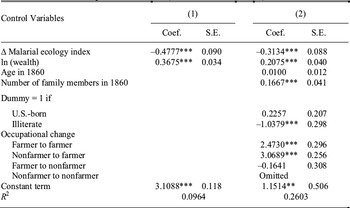
OLS REGRESSION: MIGRATION TO MALARIAL COUNTIES AND REAL ESTATE WEALTH ACCUMULATION
Dependent variable: ln(real estate wealth in 1860)

Notes:
The sample size is 1,222. Robust standard errors are reported. A single asterisk denotes statistical significance at the 90 percent level of confidence, double 95 percent, and triple 99 percent. This table reports the estimation results that do not control for county characteristics and states fixed effects. See Table 3b for the results with the fullest list of controls.
RESULTS
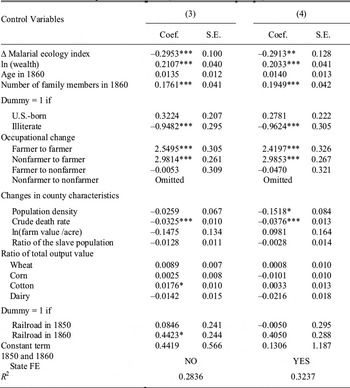
Tables 3a and 3b report the estimated coefficients and their robust standard errors for a series of specifications as more control variables are added to the analysis. The main finding is that the coefficient of relative change in the county malarial ecology index is negative and statistically significant in all specifications. People who migrated to higher-risk malaria counties by 1860 accumulated significantly less real estate wealth than otherwise.
To calculate the magnitude of the negative effect, I use the coefficient of -0.2913 for the relative change in the county malarial ecology index through migration from model 4 (Table 3b), the specification with the fullest list of controls. Holding real estate wealth in 1850 and a wide range of other factors constant, a migrant who moved to an area where the malaria index was one unit higher had a natural log of real estate wealth that was -0.2913 lower, which translates to about 75 percent less wealth. A unit difference between migrants in the change of the malarial index associated with migration was not unusual. The sample mean of the variable is 0.8107 among migrants who moved to higher-risk malaria counties in 1850–1860, about 1.1 units higher than the mean of -0.2839 among the people who moved to lower-risk malaria counties.Footnote 22
OLS REGRESSION: MIGRATION TO MALARIAL COUNTIES AND REAL ESTATE WEALTH ACCUMULATION Dependent variable: ln(real estate wealth in 1860)

Notes:
See the notes for Table 3a.
Other factors also determined wealth accumulation. Movers accumulated more wealth in 1860 if they had higher real estate wealth in 1850, more family members in 1860, were literate, or were farmers in 1860. Exposure to death rates aside from malaria also lowered wealth accumulation, as the coefficient of the crude mortality rate was negative and statistically significant. Movers accumulated more wealth if they moved to areas with more cotton production and areas with lower population density.
REDUCTION IN LABOR PRODUCTIVITY AMONG FARMERS
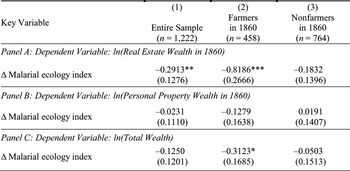
The mechanism of reduction in the labor productivity can be better understood by examining the economic burden of exposure to malaria risk by occupation. To estimate the occupational disparities in the burden, the OLS regression in equation 1 is run separately for farmers and nonfarmers in 1860. The coefficients of the relative change in the county malaria risk through migration and its robust standard errors are reported in Panel A of Table 4. The result shows that the negative effect of migration to high-risk malaria counties on real estate wealth accumulation was larger among farmers than among nonfarmers. Although the sign of the coefficient for nonfarmers indicates a negative effect of increased malaria risk on wealth accumulation, it is statistically insignificant.
Some may think that farmers favorably possessed and accumulated their wealth in the form of real estate so that nonfarmers were less affected in accumulating real estate wealth by exposure to malaria risk than farmers. But this looks unlikely. First, according to the 1860 IPUMS data set, farmers and nonfarmers in 1860 possessed about 60 percent and 55 percent, respectively, of their total wealth in the form of real estate.Footnote 23 Second, Panels B and C of Table 4 show that the occupational disparities in the economic burden of exposure to malaria risk through migration is found when personal property wealth or total wealth—the sum of real estate and personal property wealth —are employed as the dependent variable, although the statistical significance and magnitude of the coefficients decline.
The occupational disparities in the economic cost of malaria might well be explained by the seasonality of malarial infections and the difference in working property between farmers and nonfarmers for several reasons. First, the fevers and chills of malaria were especially prevalent during the planting and harvest seasons when farmers needed to work long hours in the fields for the farm to be successful. Weakness and absences due to fever during planting and harvest times would have caused substantial economic losses to farmers.Footnote 24 Second, farming generally required greater physical strength than many other types of occupation. Thus, if exposure to malarial infections caused a reduction in productivity and efficiency at work, the effect would have been more substantial among farmers than among other occupational groups. Third, family members were a key source of labor supply in farming during the nineteenth century.Footnote 25 If multiple members of the farm family suffered from malarial infections during the planting and harvest seasons, the success of farming would have been hit harder than if multiple members of an urban family had contracted the disease.
OLS REGRESSION: DISPARITIES IN THE EFFECT OF MIGRATION TO MALARIAL COUNTIES ON REAL ESTATE WEALTH ACCUMULATION BETWEEN FARMERS AND NONFARMERS

Notes:
The table reports only the coefficients of the key explanatory variables in the regression models. Robust standard errors are reported in parentheses. A single asterisk denotes statistical significance at the 90 percent level of confidence, double denotes 95 percent, and triple denotes 99 percent. I run the OLS regression in model 4 of Table 3b for two occupational groups: farmers and nonfarmers in 1860. The regression models in Panels B and C use the personal property wealth and the sum of the real estate and personal property wealth as the dependent variables, respectively.
CONCLUDING REMARKS
So far this study has been based on mid-nineteenth-century America, which provides a solid historical foundation for the estimation of the long-term economic burden of malaria. Although the prevention of malarial fevers was ineffective because the transmission of malarial parasites via mosquitoes had not yet been revealed, people at the time recognized the risk of malaria and some even believed that malaria would be associated with climatic conditions. Nevertheless, many people migrated to malarial counties in the South and Old Northwest. Those who moved to areas with higher malaria risk experienced less growth in their real estate wealth than others who moved to areas with less malaria risk. The negative relationship was much stronger for farmers than others because malarial fevers struck most often during the harvest and planting seasons when high effort was most needed and farming required more physical strength than many other occupations.
Although malaria retreated into the South mainly because of agricultural drainage beginning in the 1870s, the economic burden of malaria continued at least until the 1910s, when eradication campaigns began.Footnote 26 Throughout the mid-twentieth century, many countries succeeded in eradicating malaria. In the remaining countries, especially sub-Saharan Africa, between 300 and 500 million people suffer annually from malarial infections today. Thus, the impact of malaria on later health conditions and human capital accumulation is a matter of grave concern even today.Footnote 27 The longitudinal analysis in this study shows that migration to malarial regions is related to lower wealth accumulation, as well as short-term losses in income and higher medical costs.
Finally, this study will be useful for understanding how individuals' settlement patterns and economic productivity were affected by disease environments throughout the mid-nineteenth century. Americans had extensive experience with various infectious diseases from the colonial era to the early-twentieth century, including smallpox, scarlet fever, yellow fever, measles, cholera, and pneumonia.Footnote 28 Although those disease environments were promoted by different pathogens, they are thought to have had adverse impacts on labor productivity, human capital accumulation, and health conditions over time. The results here for malarial regions are suggestive that moves to areas where other diseases were prevalent also were likely to be associated with less wealth accumulation.