

1. INTRODUCTION
Self-determination theory is a major theory of human motivation, which aims to explain individuals’ goal-directed behaviour via different types of motivational processes (Deci & Ryan Reference Deci and Ryan1985; for a recent overview, see Deci & Ryan Reference Deci, Ryan, Van Lange, Kruglanski and Higgins2011). Two of the central concepts of the theory are internal and external motivation. Briefly, internal motivation represents a high degree of self-determination, and refers to the participation in activities for their own sake, to experience pleasure and satisfaction that the given activity yields. By contrast, external motivation represents a low degree of self-determination, and refers to the participation in activities for external reasons, which are not inherent in the activity itself but are imposed upon the individual. In other words, internal motivation drives the performance of a given task to satisfy internal demands, while external motivation drives the performance of a given task to satisfy external demands (e.g. Ryan & Deci Reference Ryan and Deci2000, Deci & Ryan Reference Deci and Ryan2008).
In recent years various efforts have been made to incorporate the tenets of self-determination theory into language studies. In their pioneering work, Kim Noels and her colleagues integrated the internal–external motivational distinction into models of second language learning (Noels et al. Reference Noels, Pelletier, Clément and Vallerand2000, Noels Reference Noels, Dörnyei and Schmidt2001, Noels, Clément & Pelletier Reference Noels, Clément and Pelletier2001, Comanaru & Noels Reference Comanaru and Noels2009). Their studies showed that both internal motivation (i.e. learning the second language to experience the pleasure it yields) and external motivation (i.e. learning the second language because it is imposed by outside sources) are pertinent constructs in second language learning and can validly predict its outcomes.
Another body of research has adapted the self-determination perspective into broader theoretical models of bilingualism. The model of self-determination and ethnolinguistic development (SED; Landry et al. Reference Landry, Allard and Deveau2007) considers the role of self-determinism alongside social determinism in language maintenance in bilingual settings. Landry and his colleagues argue that during the course of language socialization individuals acquire a certain sense of autonomy in their native language(s) through ‘contacts with members of linguistic groups and through language learning experiences’ (Landry et al. Reference Landry, Allard and Deveau2009:206). This autonomy will then be a psychological basis for their ethnolinguistic behaviour, attitudes and motivations towards the given languages (see Landry et al. Reference Landry, Allard and Deveau2007).
However, in bilingual settings, language socialization can occur under different scenarios and hence have rather different outcomes (Bayley & Schecter Reference Bayley and Schecter2003). On the one hand, language socialization can vary heavily according to the linguistic composition of the family (e.g. King, Fogle & Logan-Terry Reference King, Fogle and Logan-Terry2008, Lambert Reference Lambert2008, Morris & Jones Reference Morris, Jones and Hornberger2008, King & Fogle Reference King and Fogle2013). In monolingual families, where both parents speak the same first language, language socialization may foster internal motivation toward the first language, while motivation toward the second language may be more external, depending on the societal pressure and the demands of the ethnolinguistic environment. At the same time, in bilingual families, where the parents speak different mother tongues, language socialization may result in a high level of internal motivation towards both languages. As a consequence, individuals socialized in both languages may easily adapt their language behaviour to the ethnolinguistic environment without perceiving the same sort of external pressure or demand as those who are socialized in a single language (Lojander-Visapää Reference Lojander-Visapää2008).
Language socialization can also vary according to the ethnolinguistic environment (Pease-Alvarez Reference Pease-Alvarez2002; Landry et al. Reference Landry, Allard and Deveau2007, Reference Landry, Allard and Deveau2009). The ethnolinguistic environment defines the overall social strength of the languages (‘ethnolinguistic vitality’; Giles, Bourhis & Taylor Reference Giles, Bourhis, Taylor and Giles1977) as well as the amount of contact with their speakers (e.g. Bourhis, Sioufi & Sachdev Reference Bourhis, Sioufi, Sachdev and Giles2012). In localities where one's first language dominates the ethnolinguistic environment and receives sufficient social support, one has opportunity to freely use it, and thus ethnolinguistic behaviour can be self-determined. Conversely, in localities where the ethnolinguistic environment is dominated by one's second language, one cannot behave autonomously; rather one will do what is dictated or expected by the broader ethnolinguistic environment. Under such circumstances, language behaviour will be more socially determined than self-determined (Deveau, Landry & Allard Reference Deveau, Landry, Allard and Magord2006).
Taking a self-determination perspective, the present study aims at assessing how linguistic background shapes internal and external motivation towards Finnish among young Swedish-speaking Finns. Importantly, while we generally speak about Swedish-speaking Finns, we draw an important distinction between those who are socialized in monolingual Swedish families (‘Swedish speakers’) and those who are socialized in bilingual, Finnish-Swedish families (‘bilinguals’). This distinction is essential for the purpose of the study because Finnish may be seen as a second language for Swedish speakers, but for bilinguals it is one of their two first languages.
1.1 Swedish in Finland
From a legal point of view, Finland is a bilingual country with two national languages, Finnish and Swedish, which have equal rights. Language rights are ensured by the Language Act (Ministry of Justice 2004), according to which Finnish or Swedish can be used officially in localities where the speakers of the language make up at least 8% of the local population or 3,000 persons. The high status of Swedish is accompanied by a broad institutional network at both formal and informal levels, which provides cultural autonomy for the Swedish-speaking minority (e.g. Moring & Husband Reference Moring and Husband2007). Still, from a demographic point of view, Swedish speakers make up just a small portion of the populace: only 5.4% of the total population or 291,000 people have registered Swedish as their mother tongue (Finnäs Reference Finnäs2013). The distribution of Swedish speakers is characterized by a considerable variation at both regional and local levels. In addition, more than one-third of the Swedish speakers live in bilingual families, and the overwhelming majority of children from bilingual families attend Swedish-medium schools (Finnäs Reference Finnäs2013).
1.2 Hypotheses
In this study we propose and test four hypotheses. First, we argue that individuals who are socialized in bilingual families where both Swedish and Finnish are spoken internalize values associated with both languages. By contrast, individuals who are socialized in monolingual Swedish families adapt less to the values associated with the Finnish language. Therefore, we anticipate that bilinguals will show a higher level of internal motivation towards Finnish than Swedish speakers (Hypothesis 1), whereas Swedish speakers will show a higher level of external motivation towards Finnish than bilinguals (Hypothesis 2).
At the same time, we also believe that the role of the family-level language socialization in developing motivation towards Finnish will vary according to the linguistic composition of the ethnolinguistic environment. Since in Swedish-dominated localities Finnish receives considerably less support from the ethnolinguistic environment than in Finnish-dominated localities, the role of family in the development of internal motivation towards Finnish will be greater in Swedish-dominated localities than in Finnish-dominated localities. Thus, while we expect that bilinguals will in general show a higher level of internal motivation towards Finnish than Swedish speakers in both Swedish-dominated and Finnish-dominated localities, we also expect that this difference will be greater in Swedish-dominated localities than in Finnish-dominated ones (Hypothesis 3).
Although greater use of Finnish may be required more in Finnish-dominated localities than in Swedish-dominated ones due to the different ethnolinguistic environment, bilinguals will not perceive the same sort of external pressure to use Finnish as Swedish speakers. For Swedish speakers Finnish is a second language, and therefore they use it only when it is externally demanded or imposed upon them. Consequently, Swedish speakers will show a higher level of external motivation towards Finnish in Finnish-dominated localities (where the use of Finnish is more required) than in Swedish-dominated localities. At the same time, for bilinguals, Finnish is not a second language but one of their two first languages; therefore their use of Finnish is mostly internally motivated: they speak the Finnish language for the inherent satisfaction and pleasure that it yields. Consequently, bilinguals will not show much difference in external motivation in Swedish-dominated and Finnish-dominated localities because their internal motivation towards Finnish will suppress the perception of external demands. Thus, while we expect that Swedish speakers will in general show a higher level of external motivation than bilinguals in both Finnish-dominated and Swedish-dominated localities, we also expect that this difference will be greater in Finnish-dominated localities than in Swedish-dominated ones (Hypothesis 4).
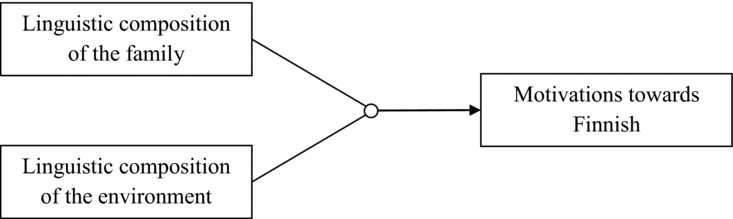
The schematic representation of the hypotheses we test is presented in Figure 1. Taken together, our purpose is to examine how the linguistic composition of the family and of the ethnolinguistic environment interact in predicting internal and external motivation towards Finnish.
Schematic representation of the examined relationships.

2. METHOD
2.1 Participants
Self-report questionnaire data were collected in 2014 among students in Swedish language secondary schools in Esbo/Espoo and Raseborg/Raasepori in Finland. Participants who had two Finnish-speaking parents were excluded from the analysis. The final sample consisted of 233 participants. With respect to age, the participants were between 16 and 19 years old. With respect to gender, 55% of the participants were females and 45% were males.
2.2 Measures
2.2.1 Linguistic composition of the family
To define the linguistic composition of the family we used a dichotomous variable based on the mother tongue of the parents. Our data showed that 51% of the participants came from monolingual Swedish families, whereas 49% came from bilingual families. The variable was dummy-coded (0 = Swedish, 1 = bilingual).
2.2.2 Ethnolinguistic environment
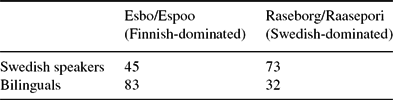
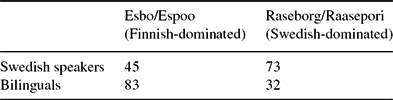
Swedish speakers make up 66% of the population in Raseborg/Raasepori and 9% of the population in Esbo/Espoo. Taken together, 56% of the respondents were from Esbo/Espoo and 44% from Raseborg/Raasepori. The variable was dummy-coded (0 = Raseborg/Raasepori, 1 = Esbo/Espoo). Table 1 summarizes the proportion of Swedish-speaking and bilingual participants in the two localities.
Distribution of the participants in the two localities.
2.2.3 Motivation towards Finnish
Motivation towards Finnish was measured with two scales adapted from the ‘Situational Motivation Scale’ (Guay, Vallerand & Blanchard Reference Guay, Vallerand and Blanchard2000). Internal motivation was measured with four four-point items (e.g. ‘I use Finnish because I feel good when doing it’). The internal consistency of the scale (α = .87) was over the conventionally accepted standard (α = .70) indicating a high reliability. The four items were aggregated and averaged. In a similar fashion, external motivation was also measured with four four-point items (e.g. ‘I use Finnish because I am supposed to use it’). The internal consistency of this scale signified a high reliability (α = .77). The items were aggregated and averaged. Higher values indicate greater motivation.
2.3 Analysis
In statistics, moderation is defined as a process by which the effect of one variable on another variable depends on a moderator variable (e.g. MacKinnon Reference MacKinnon2008). In more general terms, this implies that two variables interact in predicting a third one. We performed two moderated OLS-regressions. In the first regression, internal motivation was defined as the dependent variable; in the second, external motivation was defined as the dependent variable. The linguistic composition of the family, the linguistic composition of the ethnolinguistic environment and the product term of the two variables were defined as predictors; in addition, gender was selected as a control variable. The statistical analysis was performed by the means of the PROCESS SPSS macro, which is a novel statistical tool developed for such types of analyses (Hayes Reference Hayes2013).
3. RESULTS
The first regression was significant and explained 14% of the variance in the internal motivation for respondents towards Finnish, R2 = .14, F(4,210) = 8.38, p < .01. The linguistic composition of the family significantly predicted the dependent variable (B = .60, p < .01), but the effect of the ethnolinguistic environment (B = .01, p = .92) and the interaction term (B = –.21, p = .36) were not significant; gender had no significant effect either (B = .06, p = .58). Supporting our first hypothesis, bilinguals were in general more internally motivated towards Finnish than Swedish speakers. However, in contrast to our third hypothesis, the linguistic composition of the ethnolinguistic environment did not moderate the role of the family in developing internal motivation towards the Finnish language. In other words, respondents reported the same level of internal motivation towards Finnish in both localities.
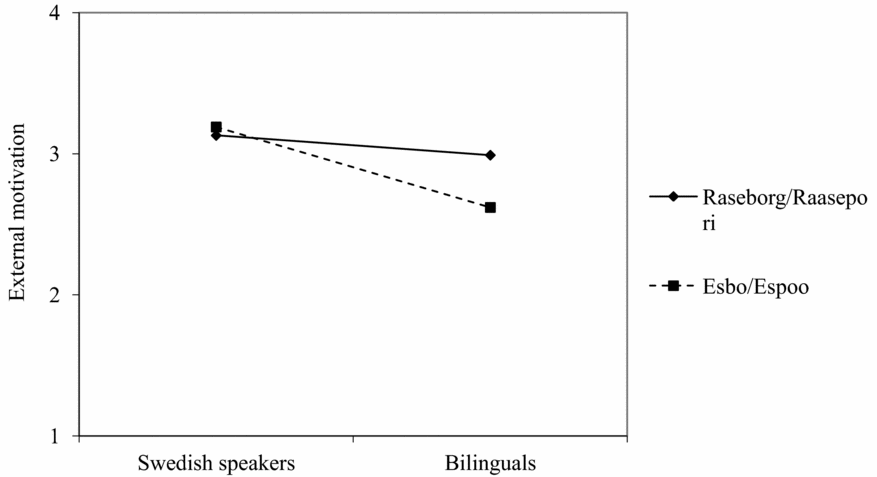
The second regression was also significant and explained 14% of the variance in the external motivation towards Finnish, R2 = .13, F(4,206) = 7.38, p < .01. Gender had no significant effect on the dependent variable (B = –.08, p = .43). The interaction between the linguistic composition of the family and the linguistic composition of the ethnolinguistic environment was significant (B = –.44, p < .05). Supporting our second hypothesis, Swedish speakers were in general more externally motivated towards Finnish than bilinguals. Also, in keeping with our fourth hypothesis, the detected effect was great and significant in the Finnish-dominated locality (B = –.58, p < .01) but small and non-significant in the Swedish-dominated one (B = –.14, p = .37). Swedish speakers reported a higher level of external motivation in the Finnish-dominated locality than bilinguals, however Swedish speakers and bilinguals reported a similar level of external motivation in the Swedish-dominated locality. The interaction effect is presented in Figure 2. As can be seen, the slope is steeper for Esbo/Espoo (i.e. the Finnish-dominated locality) than for Raseborg/Raasapori (the Swedish-dominated locality) confirming that family-level socialization plays a greater role in developing external motivation towards Finnish in the Finnish-dominated locality than in the Swedish-dominated one. Interestingly though, and in contrast to our argumentation, it can also be seen that Swedish speakers reported the same level of external motivation in both localities, while bilinguals reported a higher level of external motivation in the Swedish-dominated locality than in the Finnish-dominated one.
Predicted values of external motivation towards Finnish based on the linguistic composition of the family in the two localities.
4. DISCUSSION
The purpose of the present paper was to shed some light on how the linguistic background shapes motivations towards Finnish among young Swedish-speaking Finns. More specifically, we examined how the linguistic composition of the family and the linguistic composition of the ethnolinguistic environment interact in predicting internal and external motivation towards Finnish. The results provided considerable support for our hypotheses; yet there were also some unexpected findings.
In accordance with our first two hypotheses, we found that bilinguals demonstrated a higher level of internal motivation, whereas Swedish speakers demonstrated a higher level of external motivation towards Finnish. This set of findings highlights that language socialization within the family plays a determining part in developing motivations towards languages (Deveau et al. Reference Deveau, Landry, Allard and Magord2006; Landry, Allard & Deveau Reference Landry, Allard and Deveau2007, Reference Landry, Allard and Deveau2009; Lambert Reference Lambert2008; King & Fogle Reference King and Fogle2013). Whereas our bilingual participants may feel an inherent pleasure when using the Finnish language, Swedish speakers may feel compelled to speak Finnish because of external demands or pressures.
Furthermore, and in contrast to our third hypothesis, the results indicated that the development of an internal motivation towards Finnish did not depend upon the broader ethnolinguistic environment. Indeed, our respondents showed similar levels of internal motivation towards Finnish in both Finnish-dominated and Swedish-dominated localities. This finding suggests that the broader ethnolinguistic environment cannot subdue the primacy of family in developing an internal motivation towards languages.
At the same time, we found that the linguistic composition of the family played a greater role in developing external motivation in the Finnish-dominated locality than in the Swedish-dominated locality. While in itself this finding supports our fourth hypothesis, the detected effect painted a different picture than the one expected. Remarkably, our results showed that the level of external motivation towards Finnish among Swedish speakers did not vary according to the linguistic composition of the ethnolinguistic environment, while bilinguals reported a higher level of external motivation in the Swedish-dominated locality than in the Finnish-dominated one.
One possible explanation for this unexpected finding is grounded in the complexity of language socialization in bilingual settings. It is likely that Swedish speakers reported the same level of external motivation in the two localities because their use of Finnish in general is based more on external motivation depending on their monolingual family background and less on the ethnolinguistic environment. In other words, it is possible that whenever they use Finnish, be it on a more regular basis or only now and then, they do so because it is expected of them and hence the motivation is always more external regardless of the ethnolinguistic environment. The language socialization of bilinguals seems, however, to be a more complex process and it may be more influenced by the ethnolinguistic environment. It is possible that in Swedish-dominated localities where the ethnolinguistic environment promotes their socialization into Swedish, they feel and behave more like Swedish speakers. By contrast, in Finnish-dominated localities the ethnolinguistic environment promotes their socialization into Finnish, and they feel and behave more like Finnish speakers. These tendencies may be reflected in their motivations towards Finnish.
Concurrently, we note that the overall effects sizes detected in the two regressions were relatively low. This suggests that motivations towards Finnish do not depend merely on the linguistic composition of the family and of the ethnolinguistic environment, but some additional factors are also at play. For instance, one can speculate that contact with Finnish speakers contributes to internal and external motivations towards Finnish. More particularly, it is probable that pleasant and frequent contact with Finnish speakers may foster internal motivation towards the Finnish language, while unpleasant and rare contact with Finnish speakers may contribute more to external motivation towards Finnish.
Taken together, despite the limitations of our research (for example, selecting a specific age group and using a convenience sample), we believe that our results are valuable and stimulating. Indeed, the findings presented here clearly illustrate how internal and external motivation towards the dominant language are formed in a bilingual setting. Although the present study utilized only a part of the SED model set out by Landry et al. (Reference Landry, Allard and Deveau2007), our findings support the view that self-determination theory can be fruitfully utilized to understand the motivational background of ethnolinguistic behaviour in bilingual contexts. We propose that future investigations should pursue this avenue more thoroughly and examine internal and external motivations in the context of larger conceptual models and also in other bilingual settings.
ACKNOWLEDGEMENTS
The authors express their appreciation to Gunnar Ólafur Hansson and three anonymous reviewers for their constructive and helpful comments. The work of the first author was supported by a grant of the Finnish Cultural Foundation, Helsinki, Finland.