Introduction
The Black Sea is nutrient-rich. As a result, it promotes the growth and development of fish with its ideal ecological environment (Kıdeyş et al., Reference Kıdeyş, Gordina, Bingel and Niermann1999; Oğuz & Salihoğlu, Reference Oğuz and Salihoglu2000; Bat et al., Reference Bat, Şahin, Satılmış, Üstün, Özdemir, Kıdeys and Shulman2007). According to research conducted in different regions, anchovies can live up to 3–4 years in the Black Sea (Samsun et al., Reference Samsun, Samsun and Karamollaoğlu2004, Reference Samsun, Samsun, Kalaycı and Bilgin2006; Şahin et al., Reference Şahin, Akın, Hacımurtazaoğlu, Mutlu and Verep2008; Sağlam & Sağlam, Reference Sağlam and Sağlam2013). Similarly, Engraulis encrasicolus (L., 1758) has been reported to live up to 3–4 years in the Atlantic (Uriarte et al., Reference Uriarte, Prouzet and Villamor1996). Anchovy can reach 4 years of age in the western basin of the Mediterranean. Few E. encrasicolus have been reported to live up to 5 years (Morales-Nin & Pertiera, Reference Morales-Nin and Pertierra1990; Cardinale et al., Reference Cardinale, Ratz and Cheilari2009). On the other hand, it was discovered that E. encrasicolus could survive in the Adriatic Sea for up to 6 years (Santojanni et al., Reference Santojanni, Arneri, Barry, Belardinelli, Cingolani, Giannetti and Kirkwood2003). The short lifespan of E. encrasicolus is a critical population characteristic that contributes to fluctuations in stock size and supports effective recruitment (Giannoulaki et al., Reference Giannoulaki, Ibaibarriaga, Antonakakis, Uriarte, Somarakis, Sanchez and Machias2014). Engraulis encrasicolus has been reported to live up to 3 years in the Gulf of Cadiz, the Aegean Sea and the Strait of Sicily (Cardinale et al., Reference Cardinale, Ratz and Cheilari2009; Ruiz et al., Reference Ruiz, Gonzalez, Prieto and Navarro2009).
The primary factors for the decline in fish stocks are overfishing, pollution from waste and climate change. Even in the absence of human activity, fish stocks can fluctuate (Baumgartner et al., Reference Baumgartner, Soutar and Ferreira-Bartrina1992; Guraslan et al., Reference Guraslan, Fach and Oguz2017). Ecosystem changes adversely affect the vital functions of feeding, recruitment and reproduction of living resources (Bat et al., Reference Bat, Şahin, Satılmış, Üstün, Özdemir, Kıdeys and Shulman2007). When heavy fishing activity is combined with adverse environmental conditions, the risk of stockpiles collapsing increases (Cushing, Reference Cushing1996; Bakun & Weeks, Reference Bakun and Weeks2006). Pelagic species with a short lifespan are highly sensitive to their physical environment (Lloreta et al., Reference Lloreta, Lleonarta, Soléb and Fromentinc2001; Erzini, Reference Erzini2005; Basilone et al., Reference Basilone, Guisande, Patti, Mazzola, Cuttitta, Bonanno and Maneiro2006). Adequate nutrients and warmth promote growth and reduce mortality by predatory species (Cole & McGlade, Reference Cole and Mcglade1998). According to the data of the Turkish Statistical Institute (Anonymous, 2022), while a continuous increase was detected in Turkey's sea fishing production until 1988, there was a decrease in fisheries with fluctuations following that year and production in the fishing industry gradually decreased (Anonymous, 2020).
European anchovy is a crucial fishing resource for the Black Sea and Mediterranean basins shaped by Turkey, both ecologically and economically (Lleonart & Maynou, Reference Lleonart and Maynou2003; Anonymous, 2021). Tsagarakis et al. (Reference Tsagarakis, Machias, Giannoulaki, Somarakis and Karakassis2008) reported that European anchovy is caught using a midwater trawl, usually off the coasts of France, the Adriatic Sea and the Sicilian Channel, rather than in the Black Sea (Lleonart & Maynou, Reference Lleonart and Maynou2003; Basilone et al., Reference Basilone, Guisande, Patti, Mazzola, Cuttitta, Bonanno and Maneiro2006). Turkey, Russia, Ukraine and Georgia catch anchovy herds in the Black Sea basin using purse seines and mid-water trawls (Castilla-Espino et al., Reference Castilla-Espino, García-Del-Hoyo, Metreveli and Bilashvili2014; Gücü et al., Reference Gücü, Genç, Dağtekin, Sakınan, Ak, Ok and Aydın2017; FAO, 2018). To maintain the anchovy stock in Turkish territorial waters, a fishing length restriction of 9.0 cm is in place (Anonymous, 2020). In EU member states, similar restrictions apply (Pertierra & Lleonart, Reference Pertierra and Lleonart1996). There is no quota for anchovy fishing in the Mediterranean. There is, however, a prohibition on fishing with a length of less than 9.0 cm, an engine power limitation on fishing vessels, and a gross tonnage limit (Martin et al., Reference Martin, Giannoulaki, De Leo, Scardi, Salomidi and Knittweis2014).
The total number of fishing vessels in Turkey is 18,483. Fishing vessels engaged in sea fishing account for 15,302 of this total. Of the total number of fishing vessels, 786 are trawlers, 413 are purse seines and 114 are carriers. Within this amount, the number of fishing vessels over 12 m is 859. The gross tonnage of fishing vessels is between 49 and 490 GT, their engine power is between 400 and 4300 HP, and the number of ship personnel varies between 20 and 30 depending on the size of the fishing vessel (Anonymous, 2021, 2018b). Turkey is the largest anchovy fisher in the Mediterranean and Black Sea basins (FAO, 2018). The total amount of anchovy landed by Turkey in the 1999–2000, 2009–2010 and 2017–2018 seasons was reported as 280, 228.7 and 96.4 tons, respectively. 260.7, 203.0 and 42.7 thousand tons of these totals were collected from the Black Sea according to the reports for the aforementioned fishing seasons (Anonymous, 2021). Between 2014 and 2016, the average catches of the EU nations Bulgaria and Romania were 8617 tons and 32,000 tons, respectively. The amount of anchovy landed by Georgia, Ukraine and Russia was 57,650 tons, 44,506 tons and 95,692 tons, respectively. Anchovy accounts for ~43% of this fishing (FAO, 2018).
This research primarily focused on monitoring the stock status of anchovy (E. encrasicolus) in the Black Sea. The impacts of fishing pressure in different years were estimated by evaluating population characteristics and Relative Yield per Recruit (Y'/R) between 2002 and 2018 in the south-eastern Black Sea. We believe that this study will serve as a convenient resource for future research on the sustainable management of maximum yield and population of Engraulis encrasicolus, a significant fishing resource for EU member countries and other Black Sea countries in the Black Sea basin.
Materials and methods
Data collection
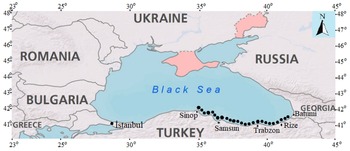
This study was carried out between 2002 and 2018 (a total of 61 sampling months) on the south-eastern Black Sea coasts of Turkey, up to the Georgian border (Figure 1). Purse-seiners used in anchovy fishing in the Black Sea are 800–1600 m in length and 120–200 m in depth. The purse seine has a mesh size of 10–16 mm. The mouth width of the mid-water trawls used in pelagic fishing varies between 30 and 60 m and the height varies between 10 and 50 m (Samsun et al., Reference Samsun, Samsun, Kalaycı and Bilgin2006; Anonymous, 2020). Random samples of E. encrasicolus were taken using purse seine and trawl fishing products. Anchovy samples were measured in the laboratory with an accuracy of 1.0 mm full length (TL) and weighed up to 1.0 g using a digital balance. Monthly length-frequencies were recorded at 0.5 cm intervals.
Sampling area, coastal waters of Turkey, south-eastern Black Sea.

The average monthly temperature of seawater during the sampling period was between 13.6 and 16.4°C (Anonymous, Reference Giannoulaki, Ibaibarriaga, Antonakakis, Uriarte, Somarakis, Sanchez and Machias2018a).
Growth
The length-weight relationship of E. encrasicolus was calculated using Le Cren's (Reference Le Cren1951) formula (W = aL b), where W is fish weight, L is fish length, ‘a’ and ‘b’ are the regression constants.
The ELEFAN method is a reliable approach for estimating the von Bertalanffy growth (VBGF) parameters for short-and medium-lived species (Wang et al., Reference Wang, Zhang, Sun, Xu, Ji, Ying and Ren2021). The monthly length-frequency distribution of E. encrasicolus was analysed via the FISAT II (Version 1.2.2) software (Pauly & David, Reference Pauly and David1981; Gayanilo et al., Reference Gayanilo, Sparre and Pauly1996). The Von Bertalanffy Growth Function (VBGF) adapted to FISAT II (ELEFAN) was used to determine the growth parameters; growth rate (K), asymptotic length (L), and growth performance index (φ).
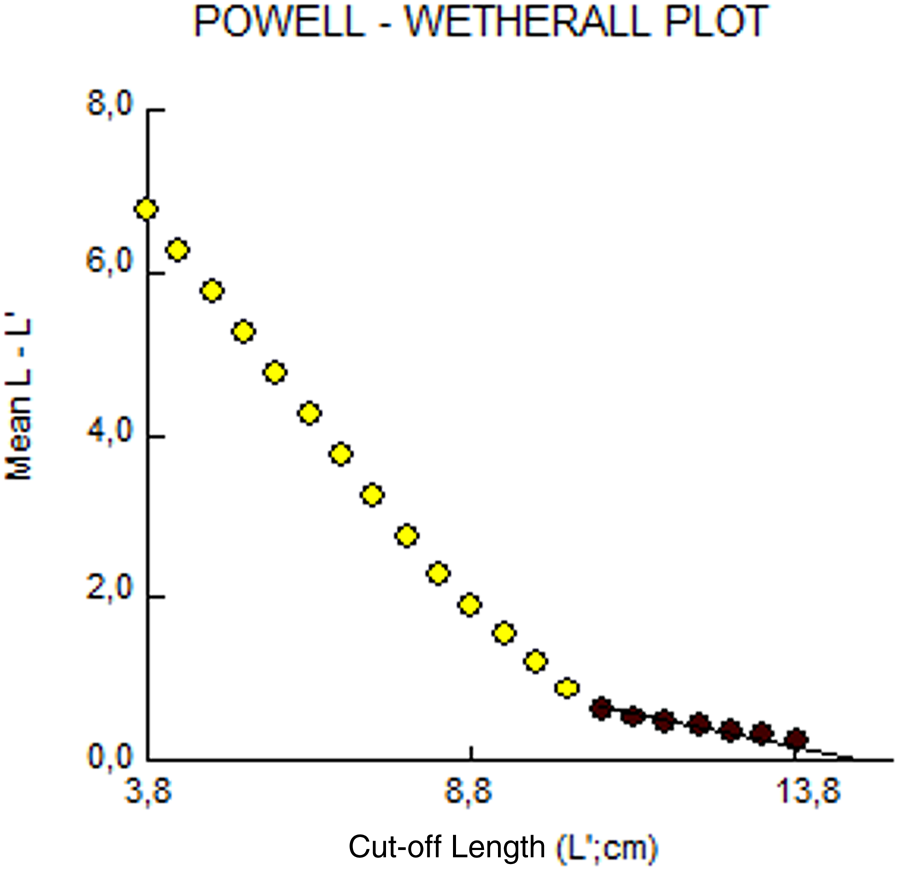
The Powell–Wetherall Plot adapted to FISAT II was used to obtain the Z/K ratio for the assessed fish species (Pauly, Reference Pauly1984). The average growth of each fish toward asymptotic length at an instantaneous growth rate (K) with length time was determined using the Von Bertalanffy Growth Function (VBGF) (Pauly, Reference Pauly1979):

The ELEFAN method was used in the estimation of von Bertalanffy growth parameters. ELEFAN estimated only L ∞ and K using three growth parameters. Therefore, Pauly's (Reference Pauly1979) empirical equation was used in determining the third parameter (t 0).

where t 0 denotes the theoretical age at length zero, K is the Growth coefficient, L ∞ is the Asymptotic length. The growth performance index for comparing the growth rate of the fish species with other published values was developed using the following equation (Munro & Pauly, Reference Munro and Pauly1984):

The Powell–Wetherall Plot fitted in FISAT II was used to obtain the Z/K ratio for the assessed fish species (Pauly, Reference Pauly1984).
Maximum lifespan (t max ) was calculated by the equation used by Taylor (Reference Taylor1958).

Mortality
The natural mortality rate (M) was calculated using Pauly's (Reference Pauly1980) empirical formula:

where L ∞ and K are the VBGF parameters, T is the seawater temperature (°C) (Table 1). Beverton & Holt (Reference Beverton and Holt1959) reported confidence limits for M/K in most fish species to be between 1.12 and 2.5. The length-converted catch curve method adapted to FISAT-II was used to estimate total mortality (Z) (Pauly, Reference Pauly1984).
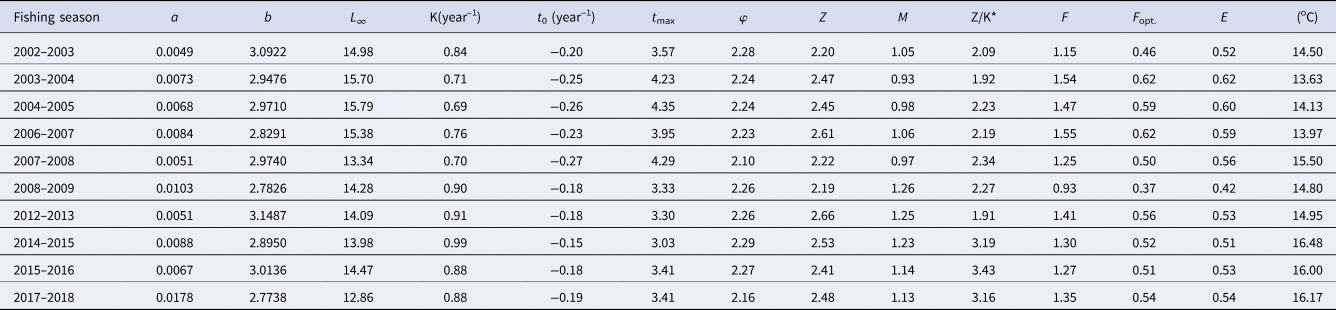
Growth parameters and mortality rates of Engraulis encrasicolus in coastal waters of Turkey, south-eastern Black Sea

a and b: regression constant; Z/K*: According to the Powell–Wetherall plot.
Fishing mortality rate, F, was calculated using the Gulland (Reference Gulland1969) relationship:

where Z is the total mortality, F is the fishing mortality, M is the natural mortality.
The exploitation rate, E, was calculated by the relationship (Gulland, Reference Gulland1969):

The optimum fishing mortality rate (F opt) was calculated using Pauly's (Reference Pauly1984) formula:

Length at first capture (Lc50)
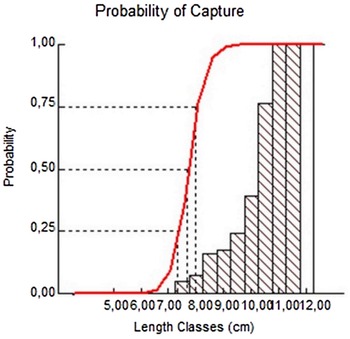
Using Pauly's (Reference Pauly1987) technique, the ascending left arm of the length conversion catch curve was used to evaluate the probability of capture for each length class. Plotting the cumulative probability of a catch against the mid-length obtained a catch curve corresponding to the cumulative probability at 50% of the length at first capture (Lc50). The lengths with both 25 and 75% probability of capture were also plotted against the cumulative probability of 25 and 75%, respectively.
Recruitment pattern
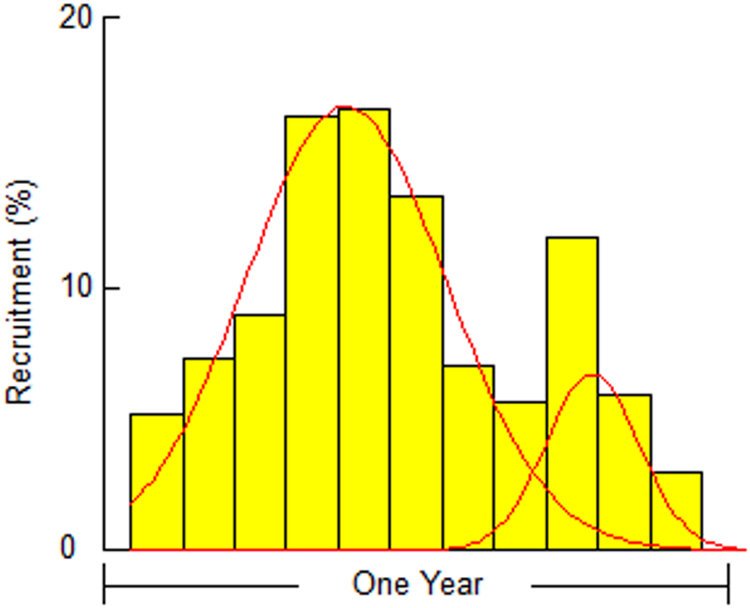
The recruitment model was created using the FISAT software by projecting the current length-frequency dataset backwards on the length axis. This method reconstructs the contribution pulse from a collection of length-frequency data to estimate the number and relative strength of oscillations that occur annually. NORMSEP (Pauly & Caddy, Reference Pauly and Caddy1985) from the FISAT package was used to estimate the recruitment model. The parameters L ∞, K and t 0 (t 0 = 0) were used as inputs in the recruitment model. The recruit length (L r) was determined as the midpoint of the smallest length group of anchovy sampled from the obtained fishing product (Gheshlaghi et al., Reference Gheshlaghi, Vahabnezhad and Taghavi Motlagh2012).
Length at first maturity (Lm50)
The first maturity length at which the fish begin to contribute to the stock was determined using the Hoggarth (Reference Hoggarth2006) formula: Lm 50 = (2 x L ∞)/3
Relative yield per recruit (Yʹ/R) and relative biomass per recruit (Bʹ/R)
The FiSAT package included the modified version (Pauly & Soriano, Reference Pauly, Soriano, Maclean, Dizon and Hosillos1986) of the Beverton and Holt (Reference Beverton and Holt1979) model to estimate relative yield per recruit (Y'/R) and relative biomass per recruit (B'/R). The maximum exploitation rate (E max), which provides the maximum relative yield-per-recruit, was determined based on the findings. E 0.1 is the exploitation rate at which the marginal increase in relative yield per recruit is 10% of the value at E 0.1, and E 0.5 is the rate (per recruit) at which 50% of the non-exploited relative biomass (B'/R) is exploited as estimated.
Yield isopleth
To identify the yield isopleth in the relative yield per recruit (Y′/R) and relative biomass per recruit (B′/R), models developed by Beverton & Holt (Reference Beverton and Holt1979), optimized by Pauly & Soriano (Reference Pauly, Soriano, Maclean, Dizon and Hosillos1986), and adapted to the FISAT II package were used. The effect of modifications on the product based on changes in exploitation rate (E max) and critical length ratio (Lc50/L ∞) was described using yield contours. The M/K ratio was used as an input in the package.
Results
Length–frequency distribution
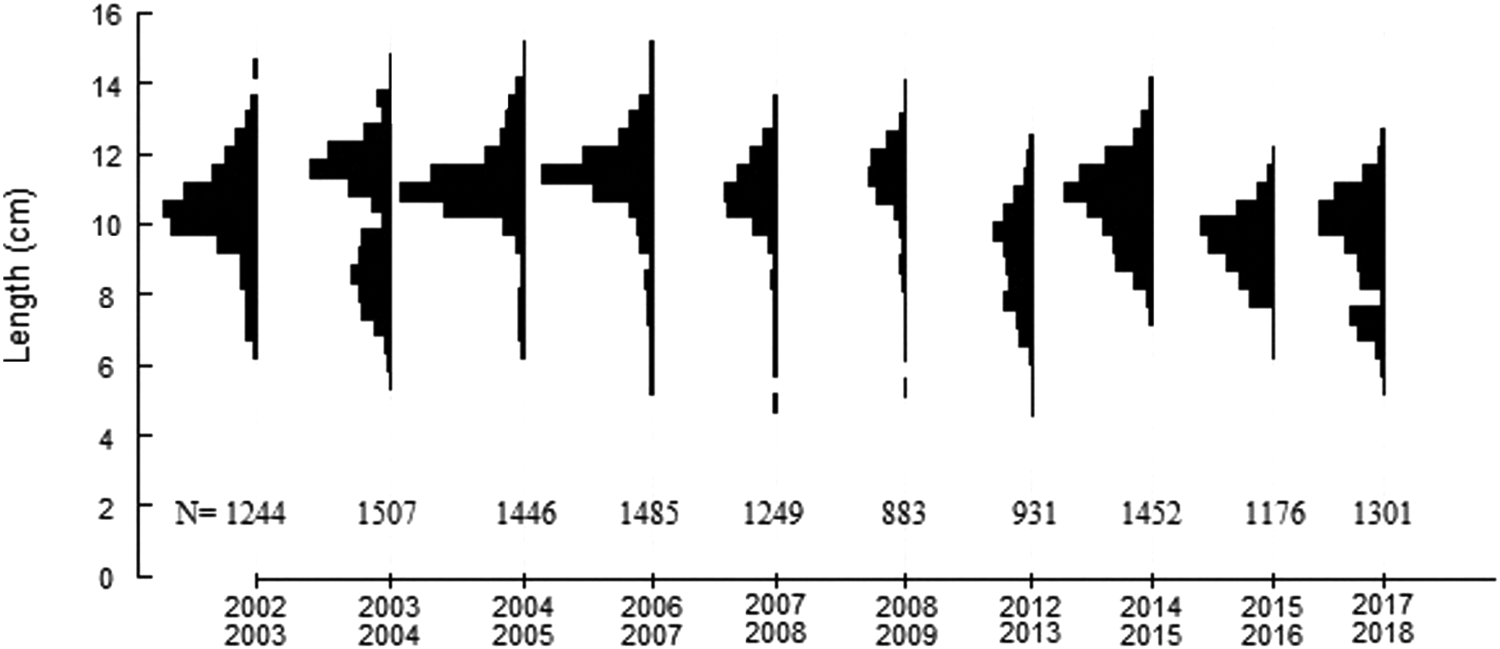
A total of 12,674 samples were analysed in the study. The smallest sample was 5.2 cm in laboratory studies, and the longest specimen was 15.3 cm (Figure 2). The weights of the E. encrasicolus were determined to vary between 0.49 and 20.46 g.
Seasonal length-frequency distributions of Engraulis encrasicolus in the south-eastern Black Sea.

Growth
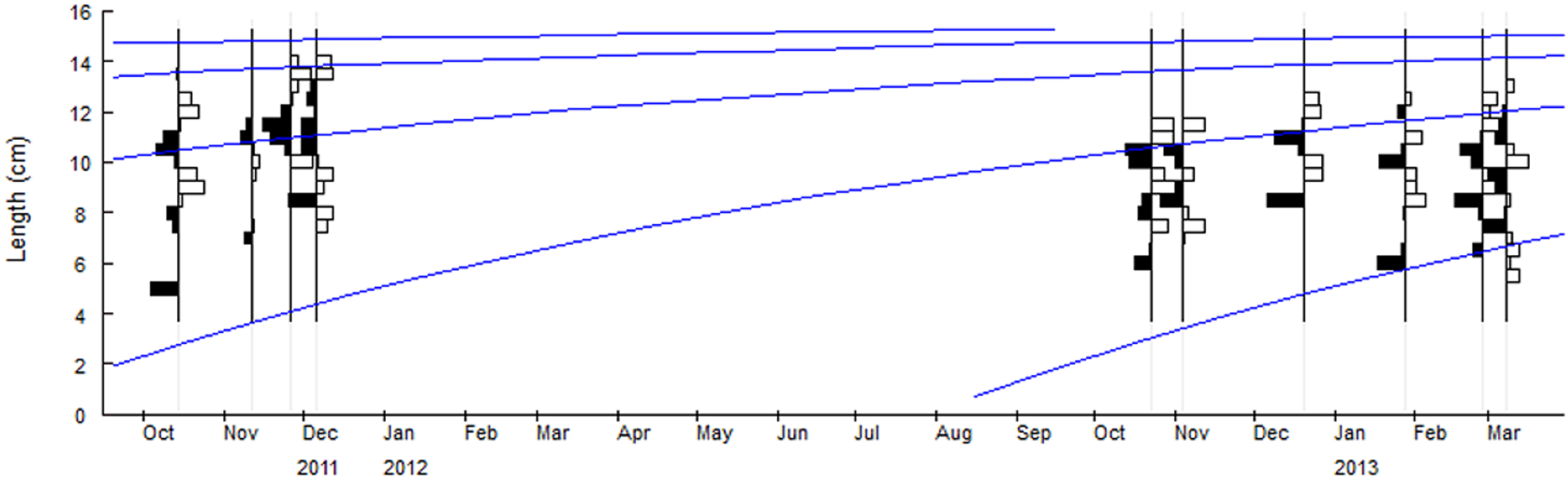
For all fishing seasons except three, the ‘b’ value calculated for E. encrasicolus indicated negative allometric growth for both sexes combined. According to the ELEFAN analysis, the asymptotic lengths (L ∞) were calculated to be between 12.86 and 15.79 cm, growth indexes (K) were between 0.70 and 0.99, theoretical birth age (t 0) calculated according to Pauly (Reference Pauly1983) varied between 0.15 and 0.27 years, and the tmax values calculated according to Taylor (Reference Taylor1958) were between 3.03 and 4.35 year–1. Growth performance indexes (φ) in fishing seasons were calculated to range between 2.10 and 2.29 (Figure 3, Table 1).
Reconstructed length-frequency distribution superimposed with growth curve for 2012/2013 fishing season (sample application).

The estimated maximum Z/K ratio was 3.90 in the 2015/2016 fishing season (Figure 4, Table 1).
Z/K ratio for the 2015/2016 fishing season (sample application).

Length at first capture (L c50), length at first maturity (L m50) and recruitment pattern
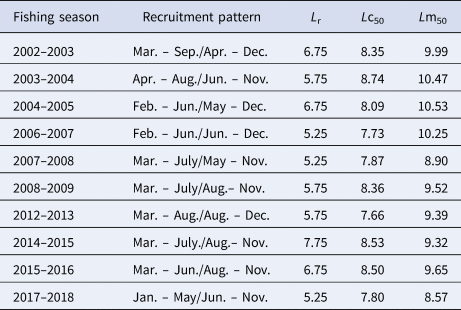
The estimated first capture length (Lc50) in different fishing seasons varied between 7.66 and 8.75 cm, and the first maturity length (Lm50) ranged between 8.57 and 10.53 cm. The distributions of the first capture at lengths (Lc50) and first maturity lengths (Lm50) are given in Figure 5 and Table 2.
Probability of capture (Lc50 = 7.66 cm, 2012/2013 fishing season).

Recruitment pattern, L r, Lc50 and Lm50 for Engraulis encrasicolus in coastal waters of Turkey, south-eastern Black Sea

Lr, Length at first recruitment; Lm50, Length at first maturity; Lc50, length at first capture.
Engraulis encrasicolus recruitment continued throughout the year during the aforementioned fishing seasons, but was more intensive at certain times of the year varying according to fishing season. The first recruit period was estimated to be between March and June–July, while the second recruitment period was between June and November (Figure 6). The first recruit length (L r) was determined as 5.25 cm (Table 2).
Recruitment pattern for 2012/2013 fishing season (sample application).

Mortality
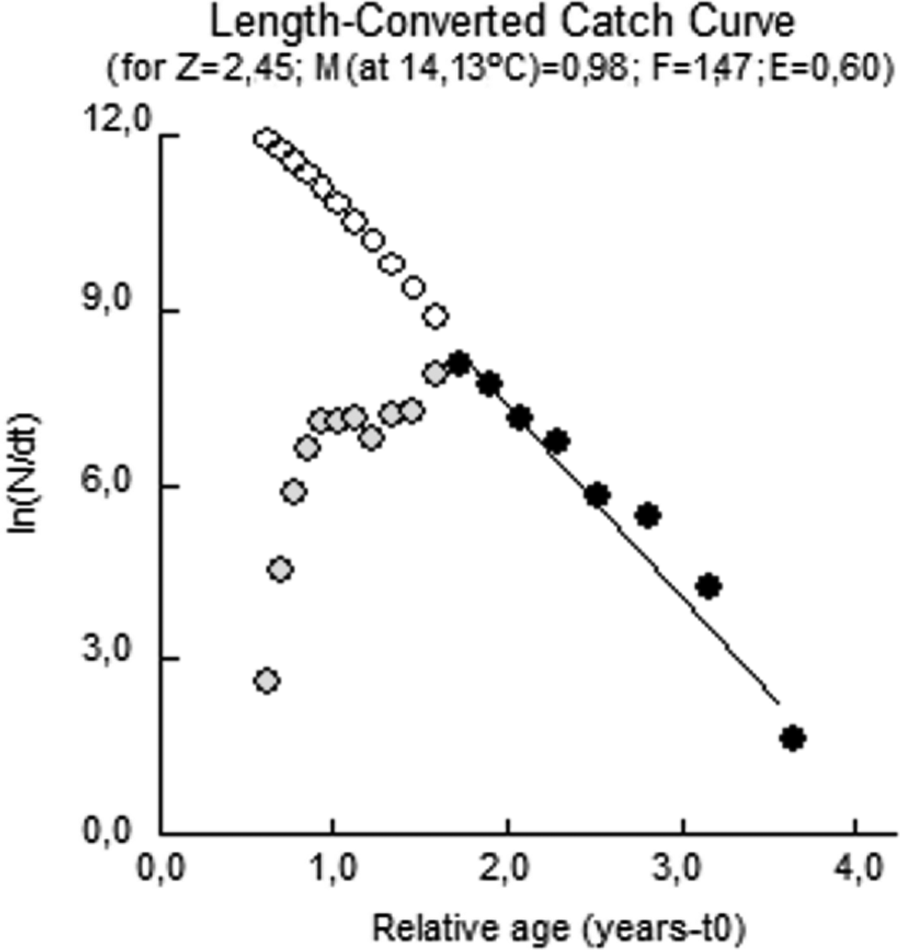
Total mortality (Z) rate estimates were between 1.82 and 3.29, and natural mortality (M) rate estimates between 1.05 and 1.45. A high level of fishing pressure and exploitation rate among all fishing seasons were estimated in 2004/2005 (Figure 7, Table 1). The reliability of our estimates of natural mortality rates (M) during fishing seasons was assessed using the M/K ratio. The M/K ratio, which has been reported to be between 1.12 and 2.5 for many fish species, was formulated by Beverton & Holt (Reference Beverton and Holt1959). During the study, exploitation (E) rates were estimated to be between 0.38 and 0.63. The highest levels of exploitation were estimated for the 2007/2008, 2008/2009 and 2014/2015 fishing seasons (Table 3).
Length-converted catch curve for the 2004/2005 fishing season (sample application).

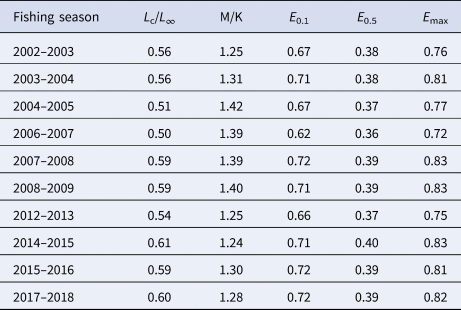
Estimated of current economic yield target (E 0.1), optimum sustainable yield (E 0.5) and maximum sustainable yield (E max) from the Y/R’ and B/R’ analysis of Engraulis encrasicolus in coastal waters of Turkey, south-eastern Black Sea

Relative yield per recruit (Y′/R) and relative biomass per recruit (B′/R)
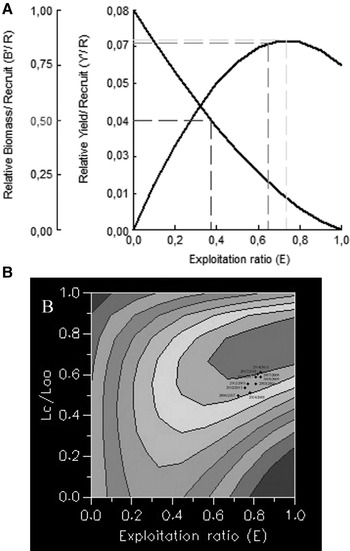
Table 4 presents the maximum exploitation levels (E max) for the maximum relative yield per recruit and the exploitation levels (E 0.1) for 10% of the relative yield per recruit marginal increase. Figure 8A, B and Table 2 show the exploitation levels (E 0.5), which correspond to 50% of the relative biomass per recruit in the unexploited stock. The maximum exploitation rate (E max) was 0.76 in the 2012/2013 fishing season, although it fluctuated in subsequent and previous fishing seasons. It was estimated to be 0.81, 0.83, 0.83, 0.83, 0.81 and 0.82 in the 2003/2004, 2007/2008, 2008/2009, 2014/2015, 2015/2016 and 2017/2018 fishing seasons, respectively.
(A) Relative yield and relative biomass per recruit (B'/R) for 2012/2013 fishing season (sample application), (B) Yield Isopleth per recruit (Y′/R) of Engraulis encrasicolus for 10 fishing seasons.

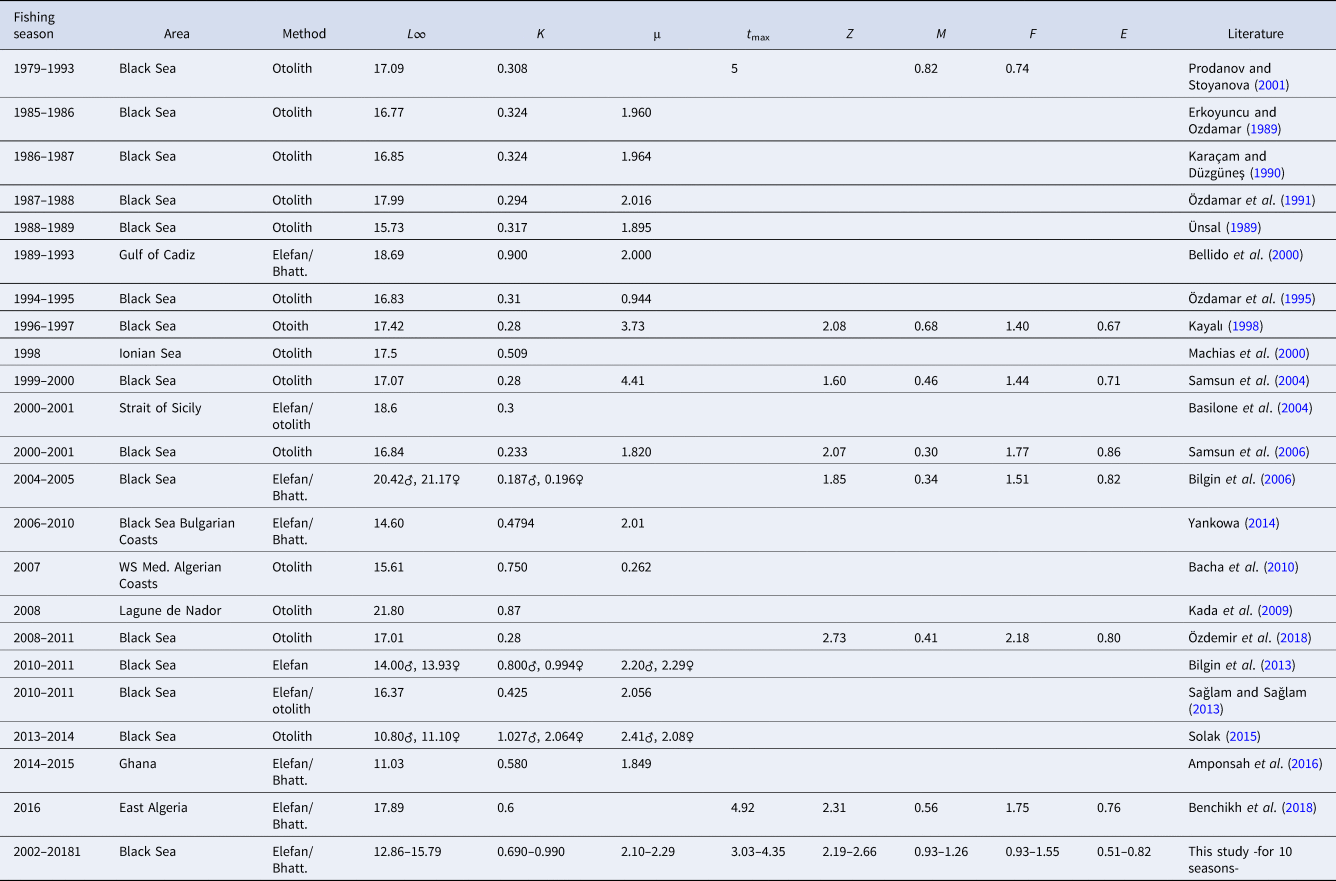
Von Bertalanffy growth function (VBGF) parameters, mortality rates (Z, M, F), growth performance (μ) and exploitation rates (E) calculated for Engraulis encrasicolus

1 The results are shown as the smallest and the biggest range of results because the findings of this study pertain to 10 different fishing seasons. Table 1 shows the detailed results of all fishing seasons.
Discussion
The weight-length relationship of E. encrasicolus indicated negative allometric growth. The same conclusion was reached in other studies conducted in the Black Sea (Erkoyuncu & Ozdamar, Reference Erkoyuncu and Ozdamar1989; Samsun et al., Reference Samsun, Samsun and Karamollaoğlu2004; Bilgin et al., Reference Bilgin, Samsun, Samsun and Kalaycı2006; Sağlam & Sağlam, Reference Sağlam and Sağlam2013).
Asymptotic lengths (L ∞) were estimated for anchovy in various studies conducted throughout different fishing seasons in the Black Sea. In their research in the eastern Black Sea, Prodanov & Stoyanova (Reference Prodanov and Stoyanova2001) calculated the L ∞ value as 17.09 cm. On the Bulgarian coast, Yankowa (Reference Yankowa2014) found the L ∞ value as 14.60. In their study in the western Black Sea, Ünsal (Reference Ünsal1989) estimated the L ∞ value as 15.73, while Özdemir et al. (Reference Özdemir, Erdem, Özdemir, Erdem and Hakan2018), Sağlam & Sağlam (Reference Sağlam and Sağlam2013), Bilgin et al. (Reference Bilgin, Samsun, Samsun and Kalaycı2006) and Karaçam & Düzgüneş (Reference Karaçam and Düzgüneş1990) estimated it as 17.01, 16.37, 18.73 and 16.85 cm, respectively; in their study in the eastern Black Sea region, Solak (Reference Solak2015) calculated the asymptotic lengths of female and male anchovy as 11.10 and 10.80 cm, respectively. In research conducted in the Strait of Sicily, the asymptotic length (L ∞) was reported as 18.6 cm (Basilone et al., Reference Basilone, Guisande, Patti, Mazzola, Cuttitta, Bonanno and Maneiro2006), while Amponsah et al. (Reference Santojanni, Arneri, Barry, Belardinelli, Cingolani, Giannetti and Kirkwood2016) calculated the asymptotic length (L ∞) as 11.03 cm on the Ghana coast. In another study conducted by Ramos & Santos (Reference Ramos and Santos1999) in northern Portugal, the asymptotic length (L ∞) was determined as 15.8 cm, whereas it was calculated to be 17.5 cm in a study conducted in the Ionian Sea (Machias et al., Reference Machias, Somarakis, Drakopoulos, Magoulas and Koutsikopoulos2000). In research carried out on the eastern Algerian coast (Benchikh et al., Reference Benchikh, Diaf, Ladaimia, Bouhali, Dahel and Djebar2018), L ∞ was calculated as 17.89 cm, while it was determined as 10.68 cm in a study in Lagune de Nador (Kada et al., Reference Kada, Abdellaoui, Ramdani and Nachit2009). All of these discrepancies could be attributed to a variety of factors, including sampling procedures, calculation methods and length frequencies. According to Özdamar et al. (Reference Özdamar, Kihara and Erkoyuncu1991), anchovy's growth constant (K) in the Black Sea was an estimate of 0.31. Özdemir et al. (Reference Özdemir, Erdem, Özdemir, Erdem and Hakan2018) and Bilgin et al. (Reference Bilgin, Samsun, Samsun and Kalaycı2006) determined the growth constant (K) of anchovy in the central and eastern Black Sea coasts of Turkey as 0.28, 0.99 and 0.156, respectively (Table 4).
In the study conducted by Solak (Reference Solak2015), the K value of anchovy was found to be 2.06 for females and 1.03 for males, while it was determined to be 0.43 for both sexes in the study conducted by Sağlam & Sağlam (Reference Sağlam and Sağlam2013). In their study in the Strait of Sicily, Basilone et al. (Reference Basilone, Guisande, Patti, Mazzola, Cuttitta, Bonanno and Maneiro2006) calculated the growth constant (K) of anchovy as 0.3; in the study conducted by Prodanov & Stoyanova (Reference Prodanov and Stoyanova2001) in the Black Sea, it was calculated as 0.308. On the Algerian coasts (SW Mediterranean), it was calculated as 0.87 (Bacha et al., Reference Bacha, Moali, Benmansour N, Brylinski, Mahe and Amara2010). In their study of E. encrasicolus in the Bay of Cádiz, Bellido et al. (Reference Bellido, Pierce, Romero and Millan2000) found it to be 0.90. The K value was estimated as 0.51 in the Ionian Sea (Machias et al., Reference Machias, Somarakis, Drakopoulos, Magoulas and Koutsikopoulos2000) and 0.6 and 0.87 in two studies performed in east Algeria and Lagune de Nador, respectively (Kada et al., Reference Kada, Abdellaoui, Ramdani and Nachit2009; Benchikh et al., Reference Benchikh, Diaf, Ladaimia, Bouhali, Dahel and Djebar2018). Our study's finding for this value is greater than those of other studies conducted in the Black Sea region, except for Solak's (Reference Solak2015). The growth performance index (K) results of studies conducted in seas other than the Black Sea are lower than that of our study. These differences might be related to the amount of nutrition available in the environment, water temperature, predators and the fishing gear used. In two different studies, one conducted by Benchikh et al. (Reference Benchikh, Diaf, Ladaimia, Bouhali, Dahel and Djebar2018) on the eastern Algerian coast, and the other in the coastal waters of Ghana by Amponsah et al. (Reference Santojanni, Arneri, Barry, Belardinelli, Cingolani, Giannetti and Kirkwood2016), the maximum age (t max) of E. encrasicolus was reported as 4.2 and 5.8, respectively. These maximum age estimates were close to ours (Table 4). In a study conducted in the north-eastern Mediterranean, the maturity length (L m) of E. encrasicolus was estimated at 12 cm (Pertierra & Lleonart, Reference Pertierra and Lleonart1996). In our study, this value was calculated to range between 8.57 and 10.53 cm for 10 fishing seasons. This difference may be explained by ecological factors.
According to our findings, E. encrasicolus recruitment continued throughout the year, but peaked twice a year. This case corroborated Pauly & Murphy's (Reference Pauly and Murphy1982) assertion that tropical fish species frequently undergo double recruitment in a single year. The occurrence of all-year recruitment showed that E. encrasicolus had no difficulty being recruited in the coastal waters of the south-eastern Black Sea. Anchovy recruitment occurs primarily during October, December and August, according to research conducted on the South African coast (Painting & Korrûbel, Reference Painting and Korrûbel1998). A study conducted in the Chesapeake Bay reported that anchovy recruitment occurs during the spring and summer months (Sukgeun & Houde, Reference Sukgeun and Houde E2004). Anchovy recruitment occurred between March and September, and between August and November according to our findings (Table 2). Although three outcomes of the two studies are comparable, it was considered that disparities in recruitment were due to environmental factors. The fact that the length at first capture (Lc50 = 7.66 cm) was longer than the length at first recruit (L r = 5.25 cm) supports this claim, indicating that the majority of the juveniles were already recruited into the population prior to measurement. In our study, the first spawning length of anchovy was calculated as 8.57 cm (Table 2). In a study conducted in Senegalese waters, the maturity length of anchovy was calculated as 9.6 cm (Ismaila et al., Reference Ismaila, Salimata, Tidiane, Diaw, Omar and Mika2021). In a study conducted on Morocco's coasts, the first maturity length of anchovy was calculated as 9.82 cm (Baali et al., Reference Baali, Bourassi, Falah, Abderrazik, El Qoracy, Amenzoui and Yahyaoui2017). In a study conducted in the Gulf of Suez, the first maturity length of anchovy was calculated at 5.9 cm (Mehanna et al., Reference Mehanna, El-Sherbeny, Ahmed, El Kafrawy and Khalil2020). The differences are believed to have occurred due to variances in water temperature, nutrient abundance and ambient conditions. In our study, the length at first capture of anchovy was estimated to be 7.66 cm. In a study conducted by Salarpouri et al. (Reference Salarpouri, Kamrani, Kaymaram and Mahdavi2018) in the Persian Gulf, this value was calculated as 6.48 cm, while in a different study conducted in the Suez Gulf, it was calculated as 6.1 cm (Mehanna et al., Reference Mehanna, El-Sherbeny, Ahmed, El Kafrawy and Khalil2020). These differences can be attributed to the size of the purse seine and mesh employed in fishing. The Z/K ratio shows the relationship between mortality and growth in a fish population. When the Z/K ratio is 1.0, the mortality rate is equal to the rate of population growth. However, if the rate is greater than 1, mortality is dominant (Etim et al., Reference Etim, Sankare, Brey and Arntz1998). Z/K ratios were estimated to be greater than 1 for all fishing seasons in our research. According to these estimates, the E. encrasicolus population in the waters off the Black Sea's south-eastern coast is suffering from a high mortality rate (Table 1).
In this research, the growth performance index (φ') estimates were lower than the estimates of all other investigated research in the Black Sea, except for that of Solak (Reference Solak2015). Total mortality (Z), natural mortality (M) and fishing mortality (F) rates showed similarities with the results of other studies conducted in the Black Sea. However, our estimates were higher for natural mortality (M) rates. Predators, ecological factors, calculation methods or estimation methods could have contributed to this discrepancy (Sparre & Venema, Reference Sparre and Venema1992). Pauly (Reference Pauly1984) reported that the optimum fishing mortality rate (F opt) should be about 40% of natural mortality (M). If the fishing mortality (F) rate exceeds the optimum fishing mortality (F opt) rate, anchovy fishing is overexploited. During the 10 fishing seasons examined in this study, fishing mortality (F) rates were estimated well above the optimum fishing mortality rates (F opt) (Table 1). This status indicates that E. encrasicolus is overexploited in the south-eastern Black Sea's waters. In a study carried out in the Black Sea region, natural mortality (M), fishing mortality (F), total mortality (Z) and exploitation (E) rates were calculated as 0.68, 1.40, 2.08 and 0.67, respectively (Kayalı, Reference Kayalı1998). In two different studies conducted in the eastern and central Black Sea coastal waters (Bilgin et al., Reference Bilgin, Samsun, Samsun and Kalaycı2006; Özdemir et al., Reference Özdemir, Erdem, Özdemir, Erdem and Hakan2018), mortality and exploitation rates were determined to be 0.34 and 0.41, 1.51 and 2.18, 1.85 and 2.73, and 0.82 and 0.80, respectively. In two separate studies conducted in the central and eastern Black Sea coasts, mortality rates were calculated as 0.66 and 0.54, 2.18 and 1.02, 2.84 and 1.56, and 0.77 and 0.65, respectively (Şahin et al., Reference Şahin, Akın, Hacımurtazaoğlu, Mutlu and Verep2008; Sağlam & Sağlam, Reference Sağlam and Sağlam2013). In another study conducted in the eastern Black Sea waters, these rates were determined to be 1.01 and 0.59, 2.44 and 2.70, 3.45 and 3.30, and 0.70 and 0.82 for females and males, respectively (Solak, Reference Solak2015) (Table 4).
Differences in population characteristics of anchovy may be a result of population changes, fishing pressure, environmental and ecological factors, and estimation methods. In their study conducted in Ghana's waters, Amponsah et al. (Reference Santojanni, Arneri, Barry, Belardinelli, Cingolani, Giannetti and Kirkwood2016) estimated the fishing mortality rate (F), natural mortality rate (M) and total mortality rate (Z) of E. encrasicolus to be 1.81, 1.59 and 3.40, respectively. In a study conducted on the eastern Algerian coast, fishing mortality (F), natural mortality (M) and total mortality (Z) were calculated as 1.75, 0.56 and 2.31, respectively (Benchikh et al., Reference Benchikh, Diaf, Ladaimia, Bouhali, Dahel and Djebar2018) (Table 4). While there are some variances, these findings are consistent with ours. It may be concluded that these differences are also due to the environment's nutrition, predators and habitat temperatures, as well as fishing pressure.
When evaluated using the Beverton & Holt Y'/R analysis, the marginal increase in yield per recruit of E. encrasicolus fishing in the south-eastern Black Sea waters was estimated to be higher than the optimum exploitation rate (E 0.5) in all 10 fishing seasons. This status relates to commercial fishing. For all fishing seasons, the marginal increase in yield per recruit (E 0.1) was estimated to be close to the maximum sustainable exploitation (E max) rate (Table 3). According to the quadrant rule (Pauly & Soriano, Reference Pauly, Soriano, Maclean, Dizon and Hosillos1986), Lc50/L ∞ and E max isopleths fell very close to the C quadrant (red zone) in two fishing seasons (2014/2015 and 2017/2018). Pauly & Soriano (Reference Pauly, Soriano, Maclean, Dizon and Hosillos1986) also observed that Lc50/L ∞ and E max isopleths were near the C quadrant (red zone) for other fishing seasons (Figure 8B, Table 3). This status shows that E. encrasicolus fishing has progressed from productive fishing to intensive, or quadrant D, fishing. The stock structure of E. encrasicolus living in Ghana waters is stronger than that of the anchovy living in the south-eastern Black Sea waters. This situation is assumed to be due to the fishing method and prey pressure in Ghana waters (Amponsah et al., Reference Santojanni, Arneri, Barry, Belardinelli, Cingolani, Giannetti and Kirkwood2016) (Table 4).
According to the findings of this study, E. encrasicolus stocks began to shift away from productive fishing toward a growing overfishing process. To ensure the protection and sustainability of the stocks, measures should be taken to prevent the capture of small anchovy. It should be permitted to catch anchovy after breeding at least once. Fishing quotas should be implemented uniformly over all nations in the Black Sea. To preserve the continuity of anchovy stocks, all Black Sea countries harvesting anchovy should cooperate. We believe that implementing all of these measures will be beneficial for the protection and continuity of E. encrasicolus stocks.
Conflict of interest
The authors declare that the research was conducted in the absence of any commercial or financial relationships that could be construed as a potential conflict of interest.