1. Introduction
Orogeny is a tectonic process that occurs at convergent plate margins. It includes magmatism, metamorphism and thrusting/folding, and typically gives rise to Pacific-type accretionary orogens (Matsuda & Ueda, Reference Matsuda and Ueda1971; Maruyama, Reference Maruyama1997) that develop as a result of subduction of an oceanic plate, and leads to collision-type orogens (Dewey & Bird, Reference Dewey and Bird1970) that form as a result of collision of buoyant masses such as arcs and continents. All orogens have regional metamorphic belts, the subduction-exhumation of which, we would argue, is the most important tectonic process in the evolution of an accretionary or a collisional orogen. Thus, understanding the metamorphic development from subduction to exhumation of a regional metamorphic belt is an essential task in unravelling an orogen.
Since the pioneering work of Barrow (Reference Barrow1893, Reference Barrow1912), the Barrovian metamorphic zones in the Caledonides of Scotland have been well studied for their protolith sedimentation, basin architecture, structural development, metamorphic age and pressure–temperature (P–T) conditions. As a result, the Barrovian zones have become the world type locality for the medium high-pressure (HP) metamorphic facies series (kyanite–sillimanite-type) in collisional orogens (e.g. Dewey & Bird, Reference Dewey and Bird1970; Miyashiro Reference Miyashiro1973; Fettes et al. Reference Fettes, Long, Bevins, Max, Oliver, Primmer, Thomas and Yardley1985). However, the metamorphic peak P–T conditions of the Barrovian zones are still open to question, as well as the much-quoted prograde P–T path (e.g. Fettes et al. Reference Fettes, Long, Bevins, Max, Oliver, Primmer, Thomas and Yardley1985; Baker, Reference Baker1986; Phillips et al. Reference Phillips, Highton, Hyslop and Smith1999; Baxter, Ague & Depaolo, Reference Baxter, Ague and Depaolo2002; Vorhies & Ague, Reference Vorhies and Ague2011). Considerable evidence for ultrahigh-pressure (UHP) metamorphism such as the presence of coesite and microdiamond has been accrued from many collisional metamorphic belts such as the European Alps, Kokchetav, Dabie-Sulu and Himalaya (e.g. Chopin, Reference Chopin1984; Smith, Reference Smith1984; Katayama, Zayachkovsky & Maruyama, Reference Katayama, Zayachkovsky and Maruyama2000; Kaneko et al. Reference Kaneko, Katayama, Yamamoto, Misawa, Ishikawa, Rehman, Kausar and Shiraishi2003; Liou et al. Reference Liou, Tsujimori, Zhang, Katayama and Maruyama2004; Ernst & Liou, Reference Ernst and Liou2008), indicating that the pressures reached during metamorphism were much higher than previously thought, and that typically UHP metamorphic rocks were strongly affected by a Barrovian-type retrograde overprint associated with extensive hydration during exhumation that has almost completely obliterated most peak mineral assemblages (e.g. Katayama, Zayachkovsky & Maruyama, Reference Katayama, Zayachkovsky and Maruyama2000; Maruyama & Parkinson, Reference Maruyama and Parkinson2000). The peak mineral assemblages are most likely preserved in less permeable lithologies such as eclogitic mafic rocks and metacarbonates, or in blocks enveloped by these lithologies (e.g. Zhang, Liou & Ernst, Reference Zhang, Liou and Ernst1995; Kaneko et al. Reference Kaneko, Katayama, Yamamoto, Misawa, Ishikawa, Rehman, Kausar and Shiraishi2003; Ogasawara & Aoki, Reference Ogasawara and Aoki2005).
Considering all available information and international understanding of relevant metamorphic belts (e.g. Agard et al. Reference Agard, Yamato, Jolivet and Burov2009), it seems likely or probable that the present Barrovian zones of the Scottish Caledonides formed by similar processes as other UHP–HP belts worldwide. In this paper we examine or constrain this assumption by re-studying the metamorphic P–T conditions of the highest-grade rocks of the Barrovian zones at Cairn Leuchan in northern Glen Muick, Scotland using relevant petrology, mineral compositions and a recent thermodynamic dataset. In particular, we focus on lenses of garnet-rich rocks and their enclosing garnet amphibolites, which can be expected to retain evidence of the early stages of metamorphism (e.g. Aoki et al. Reference Aoki, Kitajima, Masago, Nishizawa, Terabayashi, Omori, Yokoyama, Takahata, Sano and Maruyama2009). Finally, we discuss the metamorphic development of the highest-grade Barrovian rocks, based on our new data and previously published information.
2. Geological outline
The Barrovian metamorphic rocks in the Northern Highland and Grampian terranes of Scotland (Fig. 1) are sub-divided into the Moine and Dalradian supergroups, based on their protolith stratigraphy and age (e.g. Strachan et al. Reference Strachan, Harris, Fettes, Smith and Trewin2002; Open University, 2003 and references therein). The Moine Supergroup, which occurs between the Moine Thrust and the Great Glen Fault, mainly consists of strongly deformed meta-psammitic and meta-pelitic rocks. The Dalradian Supergroup, which lies in a NE–SW-trending belt extending from the Shetland Islands, through Scotland, into Northern Ireland, is bound to the NW by the Great Glen Fault and to the SE by the Highland Boundary Fault – Fair Head – Clew Bay Line. The Dalradian rocks predominantly comprise metamorphosed marine siliciclastic sediments intercalated with carbonates and volcanic rocks, which formed in an intracontinental rift with volcanic and volcaniclastic intercalations, which evolved progressively into a passive continental margin of Laurentia (Dewey, Reference Dewey1969; Anderson, Reference Anderson1985; Cawood et al. Reference Cawood, Nemchin, Strachan, Kinny and Loewy2004, Reference Cawood, Nemchin, Strachan, Prave and Krabbendam2007; Macdonald & Fettes, Reference Macdonald and Fettes2007). These rocks were deformed and underwent intermediate HP metamorphism during a Cambro-Ordovician arc-continent, collisional, Grampian orogeny (McKerrow et al. Reference McKerrow, Niocaill, Ahlberg, Clayton, Cleal, Eagar, Franke, Haak, Oncken and Tanner2000; Oliver, Reference Oliver2001; Strachan et al. Reference Strachan, Harris, Fettes, Smith and Trewin2002; Oliver, Wilde & Wan, Reference Oliver, Wilde and Wan2008). An upper depositional age limit of c. 520–510 Ma is provided by detrital zircon U–Pb and microfossil data (Tanner & Pringle, Reference Tanner and Pringle1999; Cawood et al. Reference Cawood, Nemchin, Smith and Loewy2003, Reference Cawood, Nemchin, Strachan, Kinny and Loewy2004). The age of the Barrovian metamorphism is estimated to be c. 480–430 Ma, based on various isotopic methods such as Ar–Ar, K–Ar, Rb–Sr and Sm–Nd (Dempster, Reference Dempster1985; Elias, Macintyre & Leake, Reference Elias, Macintyre and Leake1988; Dallmeyer et al. Reference Dallmeyer, Strachan, Rogers, Watt and Friend2001; Oliver, Reference Oliver2001; Baxter, Ague & Depaolo, Reference Baxter, Ague and Depaolo2002). The Barrovian metamorphic rocks preserve textural evidence of multiple stages of deformation. D1 and D2 structures produced a main foliation S2 and isoclinal recumbent folds such as the Tay nappe. D3 structures were refolded with major folds several kilometres in wavelength and steep axial planes, and D4 minor folds with associated S4 foliation overprinted the Tay nappe (e.g. Strachan et al. Reference Strachan, Harris, Fettes, Smith and Trewin2002).
(a) Simplified geological map and mineral zones of the Barrovian metamorphic zones (modified after Barrow, Reference Barrow1893; Hutchison & Oliver, Reference Hutchison and Oliver1998; Open University, 2003), and the Buchan metamorphic zones. NHT – Northern Highland terrane; GT – Grampian terrane; MT – Moine Thrust; GGF – Great Glen Fault; HBF – Highland Boundary Fault; PL – Portsoy Lineament. (b) Map of the Cairn Leuchan study area, located in (a), showing the location of our analysed samples related to their lithology.

The six Barrovian metamorphic zones are defined by the occurrence of index minerals in metapelites: chlorite, biotite, garnet, staurolite, kyanite and sillimanite, in ascending order of metamorphic grade from greenschist facies through amphibolite to granulite facies (e.g. Barrow, Reference Barrow1893, Reference Barrow1912; Winchester, Reference Winchester1974; Atherton, Reference Atherton1977; Fettes et al. Reference Fettes, Long, Bevins, Max, Oliver, Primmer, Thomas and Yardley1985) (Fig. 1). The highest-grade zones are situated in an intermediate structural level, and are bordered symmetrically by lower-grade zones (Kennedy, Reference Kennedy1948). Notably, the highest-grade zones contain eclogitic amphibolite, which is a garnet amphibolite with an augite-plagioclase (Cpx-Pl) symplectite after possible omphacite (Baker, Reference Baker1986). Also, there is a certain discrepancy between the metamorphic P–T estimates of the metapelites and metabasites (e.g. Sivaprakash, Reference Sivaprakash1982; Zenk & Schulz, Reference Zenk and Schulz2004).
In this study, we collected 31 rock samples from the Cairn Leuchan area, Glen Muick (Fig. 1c), which contains the highest-grade Barrovian zones that are mostly garnet amphibolite and sillimanite–K-feldspar gneiss (Baker, Reference Baker1986). The rocks strike about E–W, and the metamorphic peak P–T conditions were P = 0.8 ± 0.15 GPa and T = 820 ± 50°C using quantitative thermobarometry (Baker & Droop, Reference Baker and Droop1983; Baker Reference Baker1985; Vorhies & Ague, Reference Vorhies and Ague2011). However, these calculations were carried out using an electron probe micro-analyser (EPMA) with an energy-dispersive spectrometer (EDS), which is less accurate and precise than an EPMA with a wavelength-dispersive spectrometer (WDS). Thus, in order to estimate more precise metamorphic P–T conditions, we analysed the key minerals and calculated thermodynamic data for garnetite and garnet amphibolite using the WDS and a recent thermodynamic dataset.
3. Sample description and mineral chemistry
The chemical compositions of major rock-forming minerals were determined with a JEOL JXA-8800M EPMA at the Tokyo Institute of Technology. Operating conditions were in WDS mode with 15 kV accelerating voltage, a beam current of 12 nA and a probe diameter focused to < 1 μm. We used natural and synthetic silicate and oxide standards for calibration, and the ZAF method for matrix correction. Representative analyses of the major minerals are listed in Table 1. The abbreviations of mineral names are after Kretz (Reference Kretz1983).
Representative analyses of garnet, clinopyroxene, amphibole, plagioclase and epidote

Total Fe as FeO or Fe2O3
3.a. Field relationships, petrography and mineral compositions
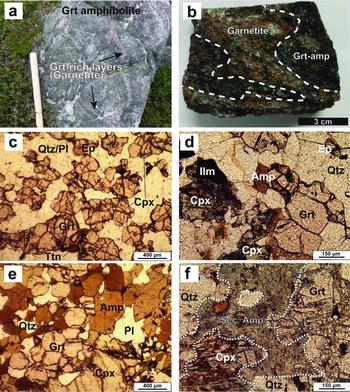
In the Cairn Leuchan area garnetite (consisting chiefly of garnet, Neuendorf, Mehl & Jackson, Reference Neuendorf, Mehl and Jackson2005) lenses and layers are included in garnet amphibolite in the highest-grade zone (sillimanite–K-feldspar; Baker & Droop, Reference Baker and Droop1983) (Fig. 2a, b). The boundaries between the garnetite, garnet amphibolite, amphibolite and the surrounding pelitic-psammitic gneiss are not sheared or faulted. Thus, all metamorphic rocks are coherent and undeformed in this area.
(a) Outcrop of garnetite layers and lenses at Cairn Leuchan, within the regional host garnet (Grt) amphibolite. (b) Investigated sample showing relationship of garnetite and garnet amphibolite (Grt-amp). Microphotographs illustrating representative minerals and textures: (c, d) granoblastic texture of garnetites; (e) granoblastic texture of surrounding garnet amphibolite; (f) clinopyroxene (Cpx) being replaced by secondary amphibole (Sec. Amp). Pl – plagioclase; Amp – amphibole; Ilm – ilmenite; Ep – epidote; Ttn – titanite; Qtz – quartz.

The garnetites have a granoblastic texture and mainly consist of Grt (> 50 vol.%) + Qtz (25–30 vol.%) + Cpx (4–10 vol.%) + Pl (5–15 vol.%) + Amp (4 vol.%) ± Ep (< 2 vol.%) with minor ilmenite, apatite, titanite and zircon (Fig. 2c, d). The garnet amphibolites have a granoblastic texture and the main mineral assemblage is Grt (15–30 vol.%) + Amp (50–60 vol.%) + Qtz (4 vol.%) + Pl (4–7 vol.%) ± Cpx (< 10 vol.%) ± Ep (< 2 vol.%) (Fig. 2e). Secondary light green amphiboles have partially grown on Cpx rims in both rocks (Fig. 2f). Textural relationships in the garnetite and host garnet amphibolite indicate that Grt+Amp+Qtz+Pl+Cpx±Ep was an early stable assemblage, which later changed to Grt+Amp+Qtz+Pl±Ep. Petrographic and compositional characteristics of the early assemblage are described below.
Garnet that comprises over 50% by volume of our garnetites occurs as subhedral porphyroblasts (up to 5 mm) that contain inclusions of epidote, plagioclase and apatite. In the garnet amphibolite, garnet forms euhedral or subhedral porphyroblasts (up to 4 mm across). Garnet compositions in our analysed samples are expressed by four components: almandine (Xalm), grossular (Xgrs), pyrope (Xprp) and spessartine (Xsps). Other components of garnet are negligible. Garnets in the garnetite and garnet amphibolite are compositionally homogeneous with no zoning. Garnets in the garnetite are almandine-rich and have a rather narrow compositional range of Xalm = 0.57–0.63, Xgrs = 0.21–0.38, Xprp = 0.10–0.14 and Xsps = 0.02–0.04. The compositions of the garnets in the garnet amphibolite are very similar to those in the garnetite, i.e. Xalm = 0.52–0.62, Xgrs = 0.21–0.33, Xprp = 0.10–0.13 and Xsps = 0.02–0.05 (Fig. 3a).
Chemical compositions of the main minerals in garnetite and garnet amphibolite. (a) Garnet compositions in an almandine (Alm) – grossular (Grs) – pyrope (Prp) ternary diagram. (b) Clinopyroxene compositions in an acmite (Acm) – jadeite (Jd) – augite + Ca-Tschermak (Aug + Cats) ternary diagram. (c) Compositional variations of Ca-amphibole on a Si–Mg/(Mg+Fe2+) diagram (Leake et al. Reference Leake, Woolley, Arps, Birch, Gilbert, Grice, Hawthorne, Kato, Kisch, Krivovichev, Linthout, Laird, Mandarino, Maresch, Nickel, Rock, Schumacher, Smith, Stephenson, Ungaretti, Whittaker and Youzhi1997). (d) Compositional ranges of epidote. (e) Plagioclase compositions in an orthoclase (Or) – albite (Ab) – anorthite (An) ternary triangle.

Clinopyroxenes in the garnetite and garnet amphibolite occur as polygonal grains (up to 6 mm long) with a pale green/colourless pleochroism. The compositions are expressed by four components: jadeite (Xjd), acmite (Xacm), augite (= Di + Hd: Xaug) and Ca-Tschermak (Xcats) calculated as AlVI–AlIV, Fe3+, Ca–AlIV and AlIV, respectively. Clinopyroxenes in the garnetite and garnet amphibolite are defined as augite and have a compositional range of Xaug = 0.82–0.91 and 0.83–0.90, respectively (Fig. 3b). No compositional heterogeneity was found.
Brown primary amphiboles in the garnetite and garnet amphibolite occur as anhedral grains. Most amphiboles have the composition of ferroan pargasite (Fig. 3c). Structural formulae and the Fe3+/Fe2+ ratio in the amphiboles were estimated on the assumption that the average of the maximum and minimum values for O = 23. The amphibole nomenclature is based on Leake et al. (Reference Leake, Woolley, Arps, Birch, Gilbert, Grice, Hawthorne, Kato, Kisch, Krivovichev, Linthout, Laird, Mandarino, Maresch, Nickel, Rock, Schumacher, Smith, Stephenson, Ungaretti, Whittaker and Youzhi1997).
Epidote grains in the garnetite and garnet amphibolite are anhedral. The XFe3+ (Fe3+/Al+Fe3+) ranges from 0.19 to 0.27 and from 0.15 to 0.25, respectively (Fig. 3d). Systematic chemical zoning was not recognized in any sample. Plagioclases in the garnetite and garnet amphibolite are compositionally homogeneous and contain anorthite contents of Xan (= Ca/(Ca + Na + K)) = 0.38–0.45 and 0.37–0.39, respectively (Fig. 3e).
3.b. Equilibrium relationships
Field relationships, petrography and the mineral compositions of the garnetite and the surrounding garnet amphibolite indicate: (1) the garnetite, the surrounding garnet amphibolite and the pelitic-psammitic gneiss are mineralogically coherent, (2) Grt+Amp+Qtz+Pl+Cpx±Ep changed to Grt+Amp+Qtz+Pl±Ep at a late stage, and (3) the chemical compositions of the main constituent minerals are the same in both the garnetite and garnet amphibolite. Therefore, these relationships clearly show that the garnetite and the surrounding garnet amphibolite are not exotic and underwent the same metamorphism at similar P–T conditions as the surrounding pelitic-psammitic gneiss. Thus, our P–T estimates for the garnetite and garnet amphibolite likely reflect well the metamorphic P–T conditions that the subducting and exhumed rocks underwent. The difference in quantitative ratios of the main minerals reflects the bulk composition of the protoliths.
4. Thermodynamic calculations of the metamorphic P–T conditions
4.a. P–T pseudosection and isopleths
P–T pseudosection and isopleth calculations for the garnetite were carried out by forward modelling with a computer program PERPLEX ver. 6.6.6 (Connolly, Reference Connolly2005 and its update) with an internally consistent dataset of Holland & Powell (Reference Holland, Baker and Powell1998 and its update). The chemical system is assumed to be: MnO–Na2O–CaO–FeO–MgO–Al2O3–SiO2–H2O (MnNCFMASH). Minor components of Fe3+, K and Ti, and minor phases (apatite, ilmenite, titanite and zircon) were ignored for simplification. H2O is regarded as an excess phase. The effective bulk composition, estimated from the modal proportions of the minerals and their chemistry, is: MnO:Na2O:CaO:FeO:MgO:Al2O3:SiO2 = 0.16:1.10:9.34:15.43:5.43:12.74:55.60 on a wt% basis (sample no. UKB5). The calculated P–T range was 0.5–2.0 GPa and 550–950°C. The solution models used are: garnet after Holland & Powell (Reference Holland, Baker and Powell1998), clinopyroxene after Holland & Powell (Reference Holland and Powell1996), amphibole after Dale, Holland & Powell (Reference Dale, Holland and Powell2000), chlorite after Holland et al. (Reference Holland and Powell1998), orthopyroxene after Powell & Holland (Reference Powell and Holland1999) and plagioclase after Newton, Charlu & Kleppa (Reference Newton, Charlu and Kleppa1980). Zoisite and quartz have an end-member composition.
The calculated P–T pseudosection diagram is shown in Figure 4a, in which the stability field of Grt+Cpx+Amp+Qtz+Pl is about 0.7–1.6 GPa and 650–870°C. On the other hand, the stability field of the secondary assemblage (Grt+Amp+Qtz+Pl±Ep) ranges from 580 to 700°C and from 0.5 to 0.8 GPa, which is on the lower P–T side than the Cpx-bearing early assemblage. However, the stability field of Grt+Cpx+Amp+Qtz+Pl+Ep was not confirmed in this calculation. These results suggest the possibility that epidote formed at a late stage. But, total iron in the system was assumed to be FeO, and therefore it should be noted that the stability field of epidote might have some error regarding the activity of zoisite. Although there are two possibilities for the timing of epidote formation, i.e. an early stage or late stage, this does not affect the P–T estimate, because no mineral that dominantly consists of Fe2O3 was used in the estimate.
P–T pseudosection and isopleths calculated with PERAPLEX (Connolly, Reference Connolly2005). (a) P–T pseudosection of garnetite (sample no. UKB5). Amp (2) indicates coexistence of Ca- and Na-amphiboles. (b, c) Xalm and Xgr values in garnet. (d) XCa-cpx values in clinopyroxene. (e) XCa-amp values in amphibole. (f) Stability P–T field of the early assemblage in garnetite (UKB5), based on combined pseudosection and isopleth calculations.

The isopleth results are shown in Figure 4b, c, d, e. The isopleths were calculated using the chemical compositions of garnet, clinopyroxene and amphibole, because these compositions are sensitive to metamorphic P–T changes. The Xalm and Xgr values of the investigated samples are 0.58–0.62 and 0.21–0.25, respectively. Likewise, Xaug and XCa-amp (Ca/Ca+NaB) are 0.82–0.88 and 0.92–0.98, respectively. Combination of these results with the P–T pseudosection diagram indicates that the early assemblage of Grt+Cpx+Amp+Qtz+Pl in the garnetite was stable at P = c. 1.3–1.4 GPa and T = c. 770–800°C (Fig. 4f).
4.b. THERMOCALC calculations
In order to examine the similar metamorphic P–T conditions among the highest zone rocks in Glen Leuchan, the computer program THERMOCALC version 3.33 was applied with the internally consistent thermodynamic dataset of Holland & Powell (Reference Holland and Powell1998 and its updates). The activity of each mineral end-member used for the THERMOCALC calculations was computed using the AX program; H2O activity is assumed to be unity. Mineral compositions at the contact point were utilized for their thermodynamic calculations. The THERMOCALC average P–T calculation was used when retrieving the early metamorphic P–T conditions, the mineral paragenesis of Grt+Qtz+Cpx+Amp+Pl in the garnetite (UKB5 and UKM11) and the enclosing garnet amphibolite (UKB3) leads to the following 12 equilibrium reactions in the Na2O–CaO–FeO–MgO–Al2O3–SiO2–H2O system.
 \begin{equation}
\eqcellsep\eqcellsep{\rm Ca \hbox{-} tschermakite} + {\rm quartz} = {\rm anorthite}\end{equation}\\
 \begin{equation}
\eqcellsep\eqcellsep{\rm pyrope} + {\rm 2grossular} + {\rm 3quartz}\nonumber\\
\eqcellsep\eqcellsep\quad= {\rm 3anorthite} + {\rm 3diopside}\end{equation}\\
 \begin{equation}
\eqcellsep\eqcellsep 2{\rm grossular} + {\rm almandine} + 3{\rm quartz} = 3{\rm anorthite}\nonumber\\
\eqcellsep\eqcellsep\quad +\, 3{\rm hedenbergite}\end{equation}\\
 \begin{equation}
\eqcellsep\eqcellsep 12{\rm diopside} + 3{\rm tschermakite} = 2{\rm pyrope}\nonumber\\
\eqcellsep\eqcellsep\quad +\, 4{\rm grossular} + 3{\rm tremolite}\end{equation}\\
 \begin{equation}
\eqcellsep\eqcellsep 21{\rm anorthite} + 6{\rm ferroactinolite} = 11{\rm grossular}\nonumber\\
\eqcellsep\eqcellsep\quad +\, 10{\rm almandine} + 27{\rm quartz} + 6{\rm H}_2 {\rm O}\end{equation}\\
 \begin{equation}
\eqcellsep\eqcellsep{\rm almandine} + 12{\rm hedenbergite} + 3{\rm tschermakite}\nonumber \\
\eqcellsep\eqcellsep\quad = 3{\rm pyrope} + 4{\rm grossular} + 3{\rm ferroactinolite}\end{equation}\\
 \begin{equation}
\eqcellsep\eqcellsep 12{\rm anorthite} + 18{\rm diopside} + 3{\rm pargasite} = 5{\rm pyrope}\nonumber\\
\eqcellsep\eqcellsep\quad + 10{\rm grossular} + 3{\rm albite} + 3{\rm tremolite}\end{equation}\\
 \begin{equation}
\eqcellsep\eqcellsep{\rm pyrope} + 2{\rm grossular} + {\rm glaucophane} = 2{\rm anorthite}\nonumber\\
\eqcellsep\eqcellsep\quad +\, {\rm albite} + 2{\rm diopside} + {\rm pargasite}\end{equation}\\
 \begin{equation}
\eqcellsep\eqcellsep 5{\rm pyrope} + 3{\rm ferroactinolite}\nonumber\\
\eqcellsep\eqcellsep\quad = 5{\rm almandine} + 3{\rm tremolite}\end{equation}\\
 \begin{equation}
\eqcellsep\eqcellsep 2{\rm anorthite} + {\rm glaucophane}\nonumber\\
\eqcellsep\eqcellsep\quad = 2{\rm albite} + {\rm tschermakite}\end{equation}\\
 \begin{equation}
\eqcellsep\eqcellsep 2{\rm pyrope} + 4{\rm grossular} + 3{\rm tschermakite} + 12{\rm quartz}\nonumber\\
\eqcellsep\eqcellsep\quad = 12{\rm anorthite} + 3{\rm tremolite}\end{equation}\\
 \begin{equation}
\eqcellsep\eqcellsep 18{\rm anorthite} + 9{\rm diopside} + 6{\rm pargasite} = 11{\rm pyrope}\nonumber\\
\eqcellsep\eqcellsep\quad +\, 13{\rm grossular} + 6{\rm albite} + 6{\rm H}_2 {\rm O}\end{equation}
These reactions give 12.9 ± 1.9 kbar and 832 ± 71°C (UKB5) and 11.7 ± 2.2 kbar and 888 ± 128°C (UKM11) for the garnetite and 12.9 ± 1.7 kbar and 878 ± 81°C (UKB3) for the surrounding garnet amphibolite (Table 2). Although the P–T estimate of UKM11 has slightly larger errors than other samples, these results are consistent with the P–T pseudosection and isopleths analyses (Fig. 5). Thus, to sum up, the highest zone rocks in Glen Leuchan underwent the same metamorphism at similar P–T conditions at about 1.2–1.4 GPa and 770–800°C, and subsequently they underwent metamorphism at about 580–700°C and 0.5–0.8 GPa.
Summary of estimated metamorphic conditions of examined samples using THERMOCALC v. 3.33

P–T diagram showing retrograde P–T path of the metamorphic rocks in Cairn Leuchan. The light grey area is a metamorphic P–T estimation calculated with THERMOCALC. The dark grey and hatched areas indicate early and late retrograde P–T conditions, respectively, gained from PERPLEX. Metamorphic facies divisions are from Maruyama, Liou & Terabayashi (Reference Maruyama, Liou and Terabayashi1996). EC – eclogite facies; HGR – high-pressure granulite facies; LGR – low-pressure granulite facies; AM – amphibolite facies.

5. Discussion
5.a. Retrograde P–T path
Thermodynamic calculations indicate that the early and late periods of metamorphism were at P = c. 1.2–1.4 GPa and T = c. 770–800°C, and P = c. 0.5–0.8 GPa and T = c. 580–700°C, respectively. These conditions correspond to the high-pressure granulite facies (HGR) and amphibolite facies (AM), respectively (Fig. 5). The P–T conditions of the later metamorphism are consistent with previous estimates from the sillimanite zone (e.g. Baker, Reference Baker1985; Baxter, Ague & Depaolo, Reference Baxter, Ague and Depaolo2002; Zenk & Schulz, Reference Zenk and Schulz2004). On the other hand, the metamorphic P conditions of the early stage of metamorphism were higher than in previous works. Similar P–T conditions of mafic rocks were reported by Friend, Jones & Burns (Reference Friend, Jones and Burns2000) from the highest-grade Barrovian zone in the Naver Nappe in the Northern Highland terrane (Fig. 1a). According to that study, the rocks underwent HGR metamorphism at P = 1.1–1.2 GPa and T = 650–700°C, and then AM metamorphism during exhumation. These conditions are comparable to ours. Therefore, we are confident that the highest-grade Barrovian rocks underwent HGR metamorphism.
Figure 5 demonstrates that the retrograde P–T path of the investigated samples underwent a temperature decrease with decompression from HGR to AM. Similar P–T trajectories were reported from low-grade and high-grade Barrovian metamorphic rocks in the Central Highlands (e.g. Phillips et al. Reference Phillips, Highton, Hyslop and Smith1999; Zenk & Schulz, Reference Zenk and Schulz2004). But, some data also indicate that the decompression retrograde path changed to an isobaric temperature increase at some stage during exhumation, e.g. Vorhies & Ague (Reference Vorhies and Ague2011), who suggested that a thermal pulse was supplied by synorogenic magma intrusion and an associated elevated crustal heat flow. These granitoids occur in Barrovian rocks that show an isobaric temperature increase path (e.g. Macdonald & Fettes, Reference Macdonald and Fettes2007; Oliver, Reference Oliver2001 and references therein). However, Barrovian metamorphic zones also occur in the southwestern Grampian terrane where there are few granitoids, and they also have a retrograde path showing isothermal decompression or temperature decrease with decompression (e.g. Zenk & Schulz, Reference Zenk and Schulz2004; Vorhies & Ague, Reference Vorhies and Ague2011). These relations suggest that Ordovician granitoid intrusions could not have had a direct influence through all parts of the Barrovian zones, but only in a few areas. Hence, it is likely that the retrograde P–T path of the Barrovian metamorphic rocks was basically a temperature decrease with decompression during exhumation regardless of the metamorphic grade.
5.b. Timing of the HGR metamorphism
This study indicates that the highest-grade Barrovian rocks underwent HGR metamorphism at a depth of more than 40 km. However, there are strong doubts about whether this metamorphic condition was prograde, because Baker (Reference Baker1986) described eclogitic amphibolites containing Cpx-Pl symplectites at Tomatin (Fig. 1a) This symplectitic assemblage was interpreted as a pseudomorph after omphacite; this raises the possibility that the HGR metamorphism occurred after the eclogite facies (EC) metamorphism. Therefore, to confirm this possibility, we conducted preliminary laser-ablation, inductively coupled plasma-mass spectrometry (LA-ICP-MS) zircon U–Pb analyses, specifically to determine the retrograde AM metamorphism of the Tomatin eclogitic amphibolite. The U–Pb isotope analyses of zircons were performed with a LA-ICP-MS at the Tokyo Institute of Technology (currently, the machine is owned by Kyoto University). Ablation was performed using a pulsed 227 femtosecond laser (see Iizuka & Hirata, Reference Iizuka and Hirata2004 and Hirata & Kon, Reference Hirata and Kon2008 for more detailed analytical procedures). In order to analyse metamorphic zircons, cathodoluminescence (CL) images and Th/U ratios (< 0.1; Hoskin & Black, Reference Hoskin and Black2000) were used. Plagioclase and quartz inclusions were confirmed in the analysed zircon. Two analysed points give Th/U ratios of < 0.05, and these data plot on the concordia curve, for which the 206Pb–238U ages are 446 ± 32 and 485 ± 37 Ma (Fig. 6; Table 3). Although these results have large errors, the ages are comparable to published isotopic ages from the Barrovian metamorphic rocks (e.g. Oliver Reference Oliver2001 and references therein). Thus, we confirm that the retrograde AM metamorphism of the Tomatin eclogitic amphibolite occurred during the ‘Barrovian metamorphism’ in the Grampian episode.
LA-ICP-MS U–Pb data for zircon from Tomatin eclogitic amphibolite

All errors are equated at two sigma level
CL image of the analysed zircon from Tomatin eclogitic amphibolite. The U–Pb ages are shown for each analysis spot, the size of which is approximately 30 μm.

Relics of Na-amphibole, which characterizes blueschist facies (BS) metamorphism in Barrovian greenschists, are known in Mayo, Ireland (Gray & Yardley, Reference Gray and Yardley1979; Yardley et al. Reference Yardley, Barber, Gray and Taylor1987; Chew et al. Reference Chew, Daly, Page and Kennedy2003). Although it is not yet clear that the BS rocks in Mayo and the EC rocks in Tomatin were coeval, it is worth considering that the HP-type metamorphism characterized by the BS and EC could have occurred in the Caledonides, in the light of previous studies of UHP and HP rocks worldwide (e.g. Katayama, Zayachkovsky & Maruyama, Reference Katayama, Zayachkovsky and Maruyama2000; Maruyama & Parkinson, Reference Maruyama and Parkinson2000; Liou et al. Reference Liou, Tsujimori, Zhang, Katayama and Maruyama2004; Kawai et al. Reference Kawai, Windley, Terabayashi, Yamamoto, Maruyama and Isozaki2006; Aoki et al. Reference Aoki, Kitajima, Masago, Nishizawa, Terabayashi, Omori, Yokoyama, Takahata, Sano and Maruyama2009).
The HGR metamorphic age has not yet been determined, but HGR rocks underwent the retrograde AM metamorphism as well as the Tomatin eclogitic amphibolite. As mentioned above, the retrograde AM metamorphism occurred at the same time as the ‘Barrovian metamorphism’. Moreover, although the peak P–T conditions of the Tomatin eclogitic amphibolite cannot be determined because the prograde trace was obliterated, the metamorphic P–T conditions of the HGR rocks are shown to be on the relatively low-P/T side compared with the P–T range defined by EC (e.g. Maruyama, Liou & Terabayashi, Reference Maruyama, Liou and Terabayashi1996). Thus, as well as the more obvious retrograde AM metamorphism, the HGR metamorphism can be interpreted as a retrograde metamorphism after the BS–EC metamorphism.
This study points out the possibility that the highest-grade rocks in the Barrovian zones underwent prograde HP-type metamorphism characterized by the BS and EC, and then underwent retrograde metamorphism from HGR to AM during exhumation. It is well known that UHP–HP metamorphic belts worldwide are strongly and widely affected by retrograde overprinting associated with extensive hydration during exhumation (e.g. Liou et al. Reference Liou, Tsujimori, Zhang, Katayama and Maruyama2004; Maruyama et al. Reference Maruyama, Masago, Katayama, Iwase, Toriumi, Omori and Aoki2010). Hence, almost all rocks in the Barrovian zones might undergo similar retrogression during exhumation, which would obliterate the prograde trace almost completely.
6. Conclusions
(1) The Barrovian metamorphic rocks at Cairn Leuchan retain evidence of metamorphic conditions from HGR to AM metamorphism. (2) The relevant metamorphic P–T conditions were c. 1.2–1.4 GPa and 770–800°C, and c. 580–700°C and 0.5–0.8 GPa, respectively. (3) The retrograde P–T path of the highest-grade Barrovian metamorphic rocks defines a temperature decrease during decompression. (4) The highest-grade Barrovian metamorphic rocks likely underwent HP-type metamorphism characterized by BS and EC before the HGR metamorphism.
Acknowledgements
We thank S. Yamamoto, T. Saito and K. Suzuki for assistance with the fieldwork. We are indebted to Y. Kon for help with the zircon U–Pb analyses. We are grateful to M. Allen, B. Yardley and T. Tsujimori for constructive and helpful comments during review. This study was financially supported by a Research Fellowship of the Japan Society for Promotion of Science for Young Scientists (23-6135 to K. A.).