INTRODUCTION
Despite the high number of molluscan species recorded in the Macaronesian archipelagos (Azores, Madeira, Canaries, and Cape Verde) (e.g. Watson, Reference Watson1897; Nobre, Reference Nobre1937; Nordsieck & Talavera, Reference Nordsieck and García-Talavera1979; Ávila, Reference Ávila2000; Cervera et al., Reference Cervera, Calado, Gavaia, Malaquias, Templado, Ballesteros, García-Gómez and Megina2006; Rólan, Reference Rólan2005) diversity in these regions is much smaller when compared with the Atlantic and Mediterranean European shores (e.g. Fretter & Graham, Reference Fretter and Graham1994; Poppe & Gotto, Reference Poppe and Gotto1991, Reference Poppe and Gotto1993; Macedo et al., Reference Macedo, Macedo and Borges1999). Perhaps this results from less availability of shallow and intertidal areas but in most cases these archipelagos remain poorly studied and together with the deep sea they are the last frontier where many new and unrecorded species of molluscs are still likely to be discovered in the north-east Atlantic Ocean (Gofas, Reference Gofas and Jordaens2007).
The study of the opisthobranch fauna of the Azores (37–40°N 25–31°W) began during the second half of the 19th Century (see Malaquias, Reference Malaquias2001 and references therein), but it was only in the mid-nineties of the 20th Century that the first efforts to make an inventory of the opisthobranchs of the region were attempted by Mikkelsen (Reference Mikkelsen1995; for the Cephalaspidea), Wirtz (Reference Wirtz1998) and Malaquias (Reference Malaquias2001). Recently, Cervera et al. (Reference Cervera, Calado, Gavaia, Malaquias, Templado, Ballesteros, García-Gómez and Megina2006) published a comprehensive catalogue of the opisthobranchs inhabiting the Iberian Peninsula and offshore archipelagos and recorded a total of 133 species in the Azores. This figure may look remarkable but if compared with the known diversity in the Canary Islands (252 species), one can predict that more species are likely to be discovered in the nine islands of the Azores, particularly on the remote and barely sampled central and western groups (Figure 1). In this paper we report the results of recent fieldwork undertaken in the islands of Faial and São Jorge (central group, Azores). New data on the ecology of species is given.
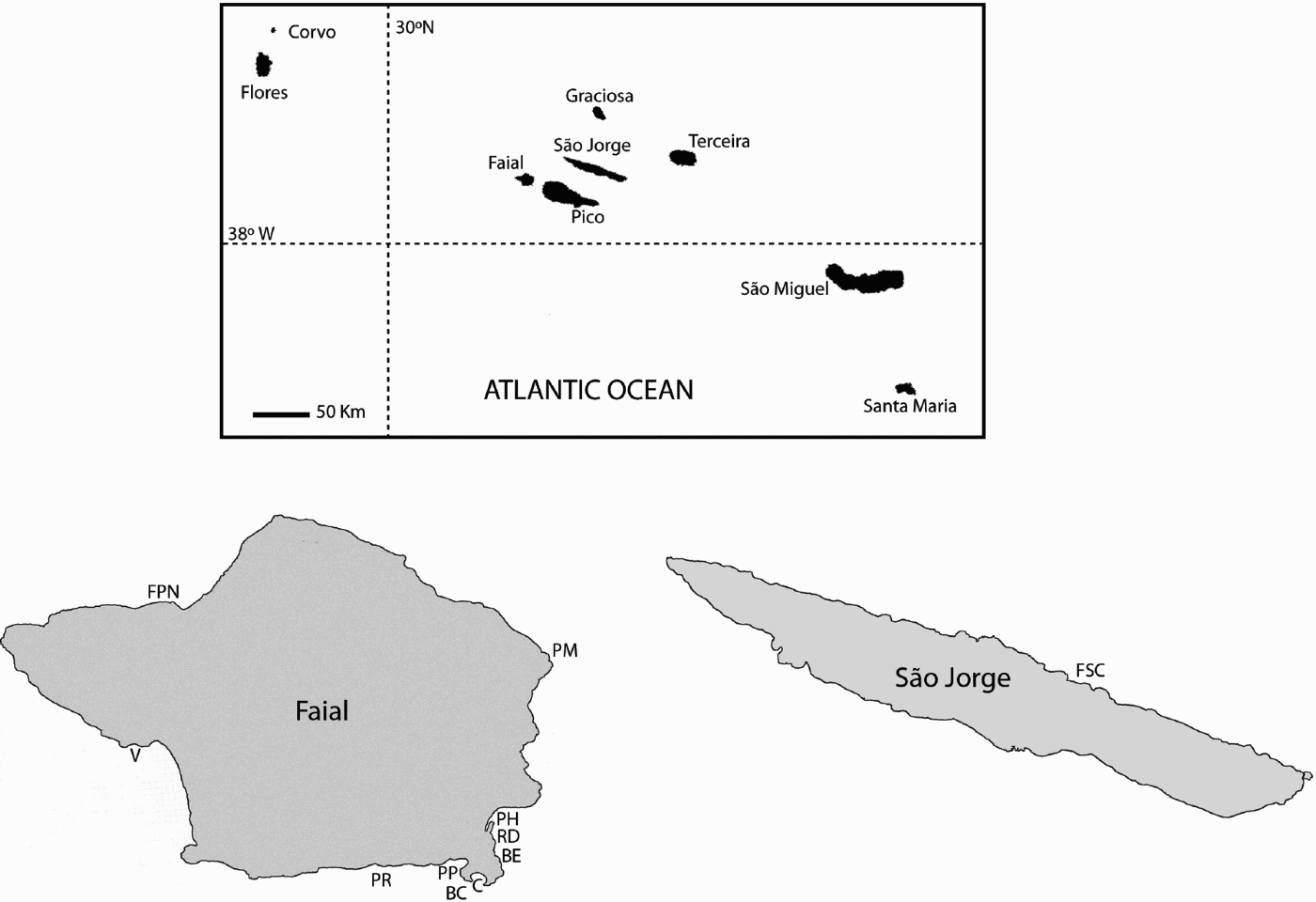
Archipelago of the Azores (inset) and sampling sites. BC, Baía das Caldeirinhas (27 August 2007); BE, Baía de Entremontes (27 August 2007); C, Caldeirinhas (28 August 2007); FPN, Porto da Fajã da Praia do Norte; FSC, Lagoa da Fajã de Santo Cristo; PH, Porto da Horta (21, 23, 25 August 2007); PM, Porto de Pedro Miguel (21 August 2007); PP, Baía de Porto Pim (22 August 2007); PR, Poça da Rainha (23 August 2007); RD, Redondo da Doca (30 August 2007); V, Porto Velho do Varadouro (20, 24 August 2007).

MATERIALS AND METHODS
Sampling took place between 19 and 31 August 2007 at the islands of Faial and São Jorge on the central group of the Archipelago of the Azores. This campaign was part of a broader three years programme to study amphi-Atlantic relationships and cryptic speciation in Atlantic species of opisthobranch gastropods.
Ten different sites were sampled at daytime at the island of Faial and one at the island of São Jorge (Figure 1). Sampling techniques comprised snorkelling and SCUBA diving down to 35 metres deep. Specimens were obtained by: (1) manual collecting through direct observation; (2) brushing suitable habitat surfaces (sponges, hydrozoans, algae, etc.); and (3) using an underwater suction device. These last two methods were particularly suitable to collect cryptic and small species.
In the laboratory, assemblages obtained by brushing and suctioning were separated in trays with seawater and left to rest from a few hours to overnight. The decline in dissolved oxygen led molluscs to crawl up to the surface, easing the process of finding them. All specimens were measured, photographed, and fixed both for DNA extraction (96% ethanol) and anatomical studies (frozen overnight in seawater followed by defrosting and preservation in 70% ethanol).
Unless stated otherwise previous citations of species in the Azores can be found in Cervera et al. (Reference Cervera, Calado, Gavaia, Malaquias, Templado, Ballesteros, García-Gómez and Megina2006). The following abbreviations are here used: H, maximum animal length; BMNH, Natural History Museum, London; MCNM, Museo de Ciencias Naturales de Madrid. Sampling localities are in abbreviated format; full names as in Figure 1. Voucher numbers were attributed to species of doubtful taxonomy.
RESULTS AND DISCUSSION
Forty-four species have been collected of which eight are recorded for the first time in the Azores, namely Chelidonura africana, Odontoglaja sabadiega, Aplysia juliana, Elysia flava, Thuridilla picta, Catriona maua, Doris sticta, and Taringa armata.
SYSTEMATICS
BE, 1 specimen, H = 2 mm; V, 1 specimen, H = 4 mm.
Remarks: subtidal, 2–8 m deep, on brown algae. First record in the Azores. Madeira and Canaries; southern Atlantic coast of the Iberian Peninsula and Mediterranean Sea.
BE, 2 specimens, H = 3–4 mm; V, 1 specimen, H = 5 mm.
Remarks: Figure 2A. Subtidal 2–8 m deep, on brown algae. First record in the Azores. Madeira and Canaries Islands; seems to be a species of oceanic affinities.
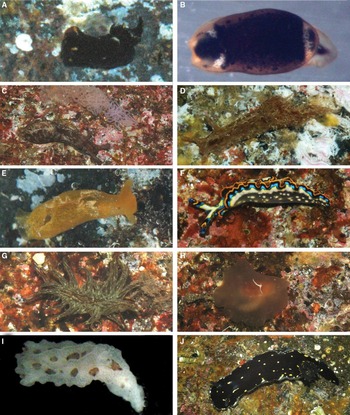
(A) Odontoglaja sabadiega (Varadouro, Faial; H = 5 mm); (B) Runcina cf. africana (Porto da Horta, Faial; H = 2 mm); (C) Aplysia juliana (Caldeirinhas, Faial; H = 25 mm); (D) Stylocheilus striatus (Varadouro, Faial; H = 20 mm); (E) Elysia flava (Baía de Porto Pim, Faial; H = 6 mm); (F) Thuridilla picta (Fajã de Santo Cristo, São Jorge; H = 23 mm); (G) Aplysiopsis formosa (Fajã de Santo Cristo, São Jorge; H = 25 mm); (H) Berthella stelata (Fajã de Santo Cristo, São Jorge; H = 18 mm); (I) Aegires sublaevis (Varadouro, Faial; H = 7 mm); (J) Hypselodoris picta (Porto da Horta, Faial; H = 70 mm).

BE, 7 specimens, H ~15 mm; FPN, 1 specimen, H = 4 mm; FSC, 5 specimens, H = 2–3 mm; V, 14 specimens; H = 4–15 mm (BMNH 20070452 / 20070453).
Remarks: subtidal 3–10 m deep, on the brown alga cf. Halopteris sp.; at Varadouro numerous egg masses were found attached to the algae. The systematics of the genus is confused and before a comprehensive revision is available is difficult to ascertain the taxonomic identity of the Azorean specimens. Therefore, we follow the identification used by previous authors (see Cervera et al., Reference Cervera, Calado, Gavaia, Malaquias, Templado, Ballesteros, García-Gómez and Megina2006). Nevertheless, it is worth pointing out that H. orteai was described based on specimens collected on salt marshes (muddy bottoms) in southern Spain (Talavera et al., Reference Talavera, Murillo and Templado1987), a very different environment from the oceanic setting of the Azorean Islands. Figured by Wirtz & Debelius (Reference Wirtz and Debelius2003: 190).
PH, 1 specimen, H = 4 mm.
Remarks: subtidal 2–6 m deep, on brown algae.
PH, 1 specimen, H = 2 mm (MCNM 15.05/47.824).
Remarks: Figure 2B. Subtidal 2–6 m deep. It can show a variable chromatic pattern that may lead to misidentifications with R. coronata. Detailed comparative descriptions of both species were provided by Cervera et al. (Reference Cervera, García-Gómez and García1991) and Schmekel & Cappellato (Reference Schmekel and Cappellato2002). The coloration of this species is different from R. coronata but resembles the more characteristic chromatic pattern of R. africana. Only further molecular and/or anatomical analyses could confirm the taxonomy of our specimen. First record in the Azores. Morocco, Canary Islands, Strait of Gibraltar and Mediterranean French coast.
BC, 30 specimens, H = 1–3 mm; BE, 27 specimens, H = 1–3 mm; FPN, 2 specimens, H = 2 mm; PH, 16 specimens, H = 1.5–3.5 mm; PM, 2 specimens, H = 1.5 mm; PP, 2 specimens, H = 2.5–2 mm; PR, 28 specimens, H = 1.5–4 mm; V, 17 specimens, H = 1–2.5 mm.
Remarks: it is a common species in the Azores; can be found subtidally between 1 and 12 m deep on mats of brown algae. Figured by Gosliner (Reference Gosliner1990: 136).
BC, 1 specimen, H = 2 mm; BE, 5 specimens, H = 2–3 mm; PM, 1 specimen, H = 1.5 mm; PP, 1 specimen, H = 2 mm; PR, 3 specimens, H = 0.5–2 mm; V, 8 specimens, H = 1–1.5 mm.
Remarks: subtidal 1–12 m deep, on mats of brown algae. Azores and Canary Islands. Figured by Ortea & Moro (Reference Ortea and Moro1999: 73, 74).
PP, 1 specimen, H = 1.5 mm.
Remarks: one juvenile specimen; 1–2 m; on rocks with brown algae.
BC, 1 specimen, H = 1.5 mm; PP, 1 specimen, H = 45 mm; V, 1 specimen, H = 20 mm.
Remarks: this species secrets a white fluid and when adult has an average length of 10–15 cm. Easily recognized by the broad and posteriorly rounded foot. Figured in Wirtz (Reference Wirtz1998: 3).
BC, 1 specimen, H = 16 mm.
Remarks: one juvenile specimen; 20–30 m deep, probably on the red algae Asparagopsis. This species is easily distinguished from all other Atlantic species by the presence of posteriorly unfused parapodial lobes. Figured by Wirtz & Debelius (Reference Wirtz and Debelius2003: 191).
BC, 40 specimens, H = 1–11 mm; FPN, 4 specimens, H = 1.5–9 mm; PH, 29 specimens, H = 1–12 mm; PP, 5 specimens, H = 1.5–5 mm; PR, 3 specimens, H = 4–5 mm; V, 6 specimens, H = 1.5–5 mm.
Remarks: common on rocks with algae assemblages both in sheltered and exposed areas between 1 and 30 m deep. Only juvenile specimens were collected but those can be easily differentiated by their reddish coloration with bright white blotches enclosed in black circles. Figured by Wirtz & Debelius (Reference Wirtz and Debelius2003: 191).
C, 2 specimens, H = 25–30 mm (BMNH 20070605/20070606).
Remarks: Figure 2C. First record in the Azores. Collected at 10 m deep under rocks whilst laying eggs. When molested, a white secretion was released, a feature only shared with the Atlantic species A. depilans (Eales, Reference Eales1960), but the latter reaches maturity only between 100 and 150 mm in length. Aplysia juliana occurs worldwide and has been referred on both sides of the Atlantic (Eales, Reference Eales1960; Martínez, Reference Martínez1995). The global distribution, reported length, and colour variation (Eales, Reference Eales1960) may in fact mask the existence of more than one species. Despite the recent systematic studies on Aplysiidae (Martínez, Reference Martínez1995; Medina et al., Reference Medina and Walsh2000, Reference Medina, Collins and Walsh2001) a thoroughly comprehensive anatomical and molecular phylogenetic study including all putative species across their entire range is still unavailable, and the taxonomy of many of the worldwide species remain doubtful.
V, 2 specimens, H = 12, 20 mm.
Remarks: Figure 2D. Subtidal 3–6 m deep, on brown algae. Previously recorded in the Azores by Wirtz & Debelius (Reference Wirtz and Debelius2003), it is also known in the eastern Atlantic from Cape Verde (Ortea & Martínez, Reference Ortea and Martínez1990, as S. longicauda; personal observations), Selvagens Islands (Malaquias & Calado, Reference Malaquias and Calado1997, as S. longicauda) and Madeira (Cervera et al., Reference Cervera, Calado, Gavaia, Malaquias, Templado, Ballesteros, García-Gómez and Megina2006).
BC, 8 specimens, H = 1.5–6.5 mm; PH, 1 specimen, H = 3 mm; PP, 1 specimen, H = 6 mm; PR, 7 specimens, H = 0.5–3 mm.
Remarks: several juvenile specimens collected in sheltered areas; 1–10 m deep.
PM, 1 specimen, H = 15 mm.
Remarks: subtidal 4 m deep, under a rock. It is an amphi-Atlantic species. Figured by Wirtz (Reference Wirtz1998: 5).
PP, 3 specimens, H = 4–6 mm (MCNM 15.05/47.823).
Remarks: Figure 2E. Specimens collected under rocks at 6 m deep. Coloration reddish in opposition to typical yellow pattern. First record in the Azores. It is an amphi-Atlantic species.
PH, 1 specimen, H = 2.5 mm.
Remarks: subtidal 2–6 m deep. The taxonomic validity of this species was discussed by Cervera et al. (Reference Cervera, Calado, Gavaia, Malaquias, Templado, Ballesteros, García-Gómez and Megina2006); it can be differentiated from E. viridis by the presence of a pinkish-white coloration that covers the edge of the parapodia, rhinophores, head and mid-dorsal region of body; but the most remarkable feature of this species is the possession of orange extra capsular yolk (Cervera & López-González, Reference Cervera and López-González1996). This is the second reference to this species in the Azores (Wirtz & Debelius, Reference Wirtz and Debelius2003: 194 as E. margaritae, figured).
FSC, 14 specimens, H = 12–23 mm.
Remarks: Figure 2F. Found only in a shallow sheltered lagoon at São Jorge Island where it was common between 1 and 3 m deep on rocks with sponges and algae. First record in the Azores; it is an amphi-Atlantic species.
FSC, 17 specimens, H = 2–25 mm.
Remarks: Figure 2G. This cryptic species was common in a shallow sheltered lagoon at São Jorge Island on beds of the green algae cf. Cladophora sp. upon which it probably feeds on. White egg masses were abundant and hinted the presence of the species.
FSC, 1 specimen, H = 4 mm.
Remarks: subtidal 2 m deep, under a rock.
Pleurobranchus garciagomezi Cervera, Cattaneo-Vietti & Edmunds, 1996
BC, 2 specimens, H = 40, 55 mm; PP, 1 specimen, H = 90 mm.
Remarks: subtidal 5–30 m deep, under rocks. Previously recorded in the Azores as Pleurobranchus sp. (Fontes et al., Reference Fontes, Tempera and Wirtz2001; Wirtz & Debelius, Reference Wirtz and Debelius2003). Figured by Wirtz & Debelius (Reference Wirtz and Debelius2003: 196).
C, 6 specimens, H = 2–15 mm; FSC, 1 specimen, H = 18 mm; PH, 2 specimens, H = 20–30 mm; PP, 4 specimens, H = 8–20 mm.
Remarks: Figure 2H. Subtidal 2–10 m deep, under rocks. It is an amphi-Atlantic species.
BC, 2 specimens, H = 4, 7 mm; C, 1 specimen, H = 7 mm; PM, 3 specimens, H = 2–5 mm; V, 2 specimens, H = 4 mm.
Remarks: only juvenile specimens were collected. Subtidal 6–30 m deep, under rocks. Figured by Wirtz (Reference Wirtz1998: 7).
BC, 1 specimen, H = 6 mm.
Remarks: subtidal, 25 m deep, under a rock. Figured by Wirtz (Reference Wirtz1998: 11).
RD, 2 specimens, H = 20, 23 mm; V, 2 specimens, H = 9–14 mm.
Remarks: subtidal 4–6 m deep. Figured by Wirtz (Reference Wirtz1998: 11).
BE, 2 specimens, H = 35 mm; C, 1 specimen, H = 45 mm; PH, 41 specimens, H = 25–90 mm; V, 2 specimens, H = 50 mm.
Remarks: this species was very common inside the commercial harbour of Horta, but only seldom was observed on other sampling sites. The reasons for this localized high density are difficult to ascertain but it could be due to the abundant presence of its prey, the bryozoa Bugula dentata, which grows on the rocky walls of the harbour. This bryozoan was also present in others sampling sites but in very low density and patchily distributed. Figured by Wirtz (Reference Wirtz1998: 14).
V, 3 specimens, H = 3–7 mm.
Remarks: Figure 2I. Subtidal 4–6 m deep, on brown algae mats. Only juveniles of the white form were collected.
PM, 1 specimen, H = 40 mm; PR, 1 specimen, H = 40 mm.
Remarks: subtidal 1–4 m deep, under rocks. Figured by Gosliner (Reference Gosliner1990: 137) and Wirtz (Reference Wirtz1998: 10).
PH, 6 specimens, H = 55–70 mm; V, 3 specimens, H = 32–50 mm.
Remarks: Figure 2J. Subtidal 1–4 m deep, crawling on rocks. Regardless the anatomical similarities between specimens from other regions and those from the Azores (Ortea et al., 1996) the latter ones because of their unique colour pattern and smaller dimensions have been regarded as a different subspecies—H. picta azorica. In fact striking chromatic differences are recognized between geographical localities and these have cast doubts on whether H. picta is a single or a complex of species across its entire amphi-Atlantic range. Figured by Gosliner (Reference Gosliner1990: 137) and Wirtz (Reference Wirtz1998: 10).
PH, 3 specimens, H = 10–22 mm; PP, 2 specimens, H = 17, 20 mm; RD, 1 specimen, H = 20 mm.
Remarks: subtidal 2–10 m deep, crawling on rocks. The nomenclature of this species is controversial; authors divided between the use of the names H. midatlantica and H. tricolor. We here follow the nomenclature used by Gosliner & Johnson (Reference Gosliner and Johnson1999). Figured by Gosliner (Reference Gosliner1990: 137) and Wirtz (Reference Wirtz1998: 10).
V, 1 specimen, H = 15 mm.
Remarks: subtidal 6 m deep, crawling on rocks. Figured by Gosliner (Reference Gosliner1990: 136) and Wirtz (Reference Wirtz1998: 10).
FPN, 2 specimens, H = 6–9 mm.
Remarks: Figure 3A. Subtidal 3–6 m deep, on an exposed area. First record in the Azores.
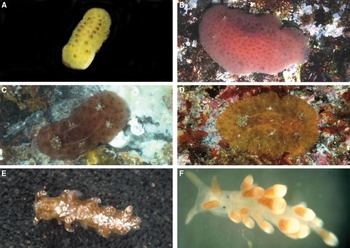
(A) Doris sticta (Fajã da Praia do Norte, Faial; H = 9 mm); (B) Jorunna tomentosa (Porto da Horta, Faial; H = 20 mm); (C) Taringa armata (Boca das Caldeirinhas, Faial; H = 6 mm); (D) Geitodoris sp. (Caldeirinhas, Faial; H = 17 mm); (E) Spurilla neapolitana (Baía de Entremontes, Faial; H = 5 mm); (F) Catriona maua (Fajã da Praia do Norte, Faial; H = 2 mm).

C, 3 specimens, H = 9–20 mm; FSC, 2 specimens, H = 7–14 mm; PH, 6 specimens, H = 7–20 mm (MCNM 15.05/47.821); PP, 1 specimen, H = 9 mm.
Remarks: Figure 3B. Subtidal 2–8 m deep, under rocks with whitish sponges; only present in sheltered areas.
PP, 2 specimens, H = 70, 90 mm.
Remarks: subtidal 8 m deep, under rocks. Figured by Wirtz (Reference Wirtz1998: 11).
BC, 1 specimen, H = 6 mm (MCNM 15.05/47.820); FPN, 1 specimen, H = 4 mm (MCNM 15.05/47.819); V, 1 specimen, H = 3 mm.
Remarks: Figure 3C. Subtidal 6–10 m deep, under rocks on moderately and exposed areas. Taringa armata is known in eastern (Swennen, Reference Swennen1961), central (Perrone, Reference Perrone1992; Köhler, Reference Köhler2007) and western (Sánchez-Tocino, personal communication) Mediterranean Sea. Our specimens have the external features of the genus (Ortea et al., Reference Ortea, Pérez-Sánchez and Llera-González1982; Valdés & Gosliner, Reference Valdés and Gosliner2001) and their colour pattern matches that described in the literature (e.g. Perrone, Reference Perrone1992) and illustrated in the MedSlugs website (Köhler, Reference Köhler2007). Nevertheless, separation between species of the genus Taringa can be difficult and in most cases only the study of the internal anatomy can provide an accurate identification. First record in the Azores.
C, 1 specimen, H = 17 mm; FPN, 1 specimen, H = 27 mm (BMNH 20070607); PH, 1 specimen, H = 18 mm (BMNH 20070608).
Remarks: Figure 3D. Subtidal 2–10 m deep, under rocks. We attribute these specimens to the genus Geitodoris based on the presence of simple tubercles stiffened by integumentary spicules on the dorsum, a head with two conical oral tentacles and an anterior border of the foot grooved and notched (Valdés, Reference Valdés2002). Further anatomical studies are required to identify this species.
PP, 1 specimen, H = 65 mm; V, 1 specimen, H = 60 mm.
Remarks: subtidal 4–10 m deep under rocks. Azorean specimens have a dark-brownish background coloration that contrasts with the most usual pale reddish colour of this species (Valdés et al., Reference Valdés, Ortea, Ávila and Ballesteros1996). Figured by Wirtz (Reference Wirtz1998: 11).
V, 1 specimen, H = 4 mm.
Remarks: subtidal 4 m deep, on brown algae mats. Figured by Wirtz (Reference Wirtz1998: 7).
BC, 1 specimen, H = 4 mm; BE, 1 specimen, H = 2 mm; PH, 2 specimens, H = 5 mm; PP, 2 specimens, 4, 5 mm.
Remarks: subtidal 2–30 m deep. Species recorded once in the archipelago by Calado (Reference Calado2002).
V, 3 specimens, H = 4–7 mm.
Remarks: subtidal 4–6 m deep, on brown algae mats. Species recorded once in the archipelago by Calado (Reference Calado2002).
FSC, 22 specimens, H = 3–8 mm; PH, 1 specimen, H = 7 mm.
Remarks: species very abundant inside a coastal lagoon (FSC) at São Jorge Island crawling on rocks between 1 and 2 m deep. An additional specimen was found inside Horta's harbour, Faial at 1 m deep on top of a rock. Figured by Wirtz & Debelius (Reference Wirtz and Debelius2003: 206).
BE, 1 specimen, H = 5 mm; V, 1 specimen, H = 9 mm.
Remarks: Figure 3E. Subtidal 2–6 m deep. Specimens match the white-pinkish colour pattern described for this species (Trinchese, Reference Trinchese1878; Swennen, Reference Swennen1961; Perrone, Reference Perrone1989; Valdés et al., Reference Valdés, Hamann, Behrens and DuPont2006).
V, 1 specimen, H = 3 mm.
Remarks: subtidal 4 m deep.
FPN, 1 specimen, H = 2 mm (MCNM 15.05/47.822).
Remarks: Figure 3F. Subtidal 3–6 m deep. First record in the Azores; it has an amphi-Atlantic distribution.
Biogeographic considerations
The marine biogeographic affinities of the Azorean Islands, half way between the American and European continents, have long puzzled biogeographers. Despite prevailing currents of western Atlantic origin, the marine fauna of the Azores is closely allied to the Lusitanian and Mediterranean provinces. This paradox was earlier emphasized by Mac Andrew (Reference MacAndrew1854) for molluscs, but several authors have pointed it out for an array of taxonomic groups (e.g. fish, amphipods, desmosponges, etc.; see Ávila, Reference Ávila2000 and references therein). The processes that drive this pattern are still poorly understood and this remains one of the most exciting biogeographic challenges in the North Atlantic.
Twenty-five per cent of the species reported in the present work (Aplysia juliana, A. parvula, Stylocheilus striatus, Elysia flava, E. ornata, Thuridilla picta, Berthella stelata, Hypselodoris picta, Aegires sublaevis, Spurilla neapolitana, Catriona maua) have an amphi-Atlantic distribution occurring both in the Caribbean region and Macaronesian/Lusitanian/Mediterranean provinces, whereas the remaining have strict eastern Atlantic affinities. This is in line with the results reported by Ávila (Reference Ávila2000) for the entire Azorean molluscan assemblage, and shows the dominance of eastern Atlantic elements in the Azores but also the relation of these islands with the Caribbean province.
Nonetheless, the systematics of several species regarded as amphi-Atlantic need to be revised. We have drawn attention to the Hypselodoris picta ‘complex’ (see taxonomic list) but this is not the only case. For example, when images of Thuridilla picta here depicted (Figure 2F) are compared with those of Caribbean specimens showed by Valdés et al. (Reference Valdés, Hamann, Behrens and DuPont2006: 58) doubts of their conspecificity arise. In fact poor taxonomy can hamper interpretation of biogeographic relationships (Paulay & Meyer, Reference Paulay and Meyer2006), and cases highlighted here clearly show that much systematic work is still required to clarify the taxonomic status of several Atlantic species of opisthobranchs.
ACKNOWLEDGEMENTS
We are greatly indebted to the Department of Oceanography and Fisheries, University of the Azores (DOP) to welcome and house the expedition and facilitate access to all required facilities. In particular we are most grateful to G. Carreira, J. Gonçalves, N. Serpa, R. Bettencourt and R.S. Santos, without whom it would have been impossible to undertake this campaign. Thanks are due to J.S. Ryland (University of Swansea, UK) for help with identification of bryozoan specimens. This work was funded by the Spanish Project CGL2006-05182 of which J.L. Cervera is the principal investigator. The first author holds a research grant from the Fundação para a Ciência e Tecnologia (FCT, Portuguese Government, SFRH/BPD/26209/2006); G.C. holds a grant from FCT, Portugal (BPD/7133/2001); V.P. was granted a fellowship from CNPq–Brasil.