INTRODUCTION
Harbour porpoises Phocoena phocoena in European waters are listed under Annexes II and IV of the EU Habitats and Species Directive. Annex IV species, which include all cetaceans, are afforded ‘strict protection’ whereby the deliberate capture, killing and disturbance of these species are strictly prohibited (Council Directive 92/43/EEC). Harbour porpoises and bottlenose dolphin Tursiops truncates are the only two species of cetaceans listed under Annex II. Species listed under Annex II are afforded the designation of Special Areas of Conservation (SACs) whereby ‘the viability, population size and range of a species’ should be maintained in the long term (Council Directive 92/43/EEC). In order for an SAC to be established there has to be a clearly identifiable area representing the physical and biological factors essential to their life and reproduction (Reid et al., Reference Reid, Evans and Northridge2003). Bottlenose dolphin populations in the Moray Firth, Scotland and Cardigan Bay, Wales have met the criteria and two SACs have been designated for this species. However, although the harbour porpoise qualify for the designation of an SAC under the Habitats Directive none has yet been established in the UK. This could reflect the fact that the harbour porpoise are a mobile species where the spatial and temporal distribution in British waters is changeable (Council Directive 92/43/EEC) and seasonal variation can occur in the abundance of animals in coastal regions (Verfuß et al., Reference Verfuß, Honnef, Meding, Dähne, Mundry and Harald Benke2007). Unlike bottlenose dolphins, it is extremely difficult to recognize individual porpoises and thus know if the same animals are repeatedly using a particular area or to what extent individual animals range. However, dedicated surveys are the first step in providing valuable information for conservation and management decisions to be made for this species.
Large scale estimates of Small Cetaceans Abundance in the North and Adjacent Seas (SCANS) was carried out in 1994 (Hammond et al., Reference Hammond, Berggren, Benke, Borchers, Collet, Heide-Jorgensen, Heimlich, Hiby, Leopold and Oien2002) and in 2005 SCANS-II—Small Cetaceans in the European Atlantic and North Sea (http://biology.st-andrews.ac.uk/scans2/index.html). These international surveys are important for identifying changes in population size and distribution that may be caused through by-catch and other large scale anthropogenic threats or natural variation due to changes in prey species. The large scale surveys such as SCANS are essential for effective conservation and management of harbour porpoises across European waters. However, at smaller spatial scales in coastal areas there may be human activities that need to be managed in relation to the localized distribution of porpoises that large scale surveys such as SCANS may not be able to identify. For example, through the Renewables Obligation the UK government is seeking to increase the amount of electricity produced from renewable sources to 15% by 2015 (Oxley, Reference Oxley2006). Wind power is recognized as the predominant renewable with off-shore wind farms having already been established. However, it is unlikely that wind power will be able to deliver all the renewable energy and marine renewables are an emerging technology that use tidal and wave energy (Oxley, Reference Oxley2006). There is potential for conflict between marine renewable energy devices and marine mammals (Wilson et al., Reference Wilson, Batty, Daunt and Carter2007). For managers to make appropriate site assessment for the deployment of renewable devices, fine scale surveys need to be undertaken to assess the distribution and habitat use of species that may be effected by the renewable energy devices. Abundance estimates and the means to monitor populations underpin any management framework and play an essential role in environmental impact assessments of human activities that may threaten cetacean populations (Hastie et al., Reference Hastie, Barton, Grellier, Hammond, Swift, Thompson and Wilson2003; Wilson et al., Reference Wilson, Reid, Grellier, Thompson and Hammond2004). Furthermore, surveys in areas where none have been carried out before create a baseline of data for future surveys and monitoring to be compared to (Hastie et al., Reference Hastie, Barton, Grellier, Hammond, Swift, Thompson and Wilson2003). Over time, site monitoring may allow boundaries for a candidate SAC to be identified, confirm that distribution patterns remain similar through time, assess potential impact of proposed new human activities within the area and allow advice on mitigation measures against impacts of such developments (Hastie et al., Reference Hastie, Barton, Grellier, Hammond, Swift, Thompson and Wilson2003). Without this knowledge effective management of a species would be difficult—as reflected by the current situation of the harbour porpoise in Anglesey waters.
Preliminary research consisted of effort related land based visual surveys between 2001 and 2002 which identified large numbers of porpoise including calves or regular use by a few individuals off the north coast of Anglesey, Wales, UK (Leeney, Reference Leeney2003; Weare, Reference Weare2003). The need for abundance and density estimates was highlighted as a key factor in the conservation and management of the harbour porpoise in Anglesey waters by the Countryside Council for Wales (CCW). Moreover, proposed extension of the wind farms from Liverpool Bay to Anglesey and the potential of the area for marine renewable energy devices presented a problem to managers and planners due to the lack of knowledge of harbour porpoise populations in north Wales.
In this study we present the results from a boat based line transect study to: (1) estimate the density and number of harbour porpoises using the north coast of Anglesey, Wales, UK; (2) to identify fine scale spatial distribution of harbour porpoises within the survey area; and (3) to compare the number of porpoises with increasing distance from the coast line. This is the first study undertaken to estimate abundance and fine scale spatial distribution of harbour porpoises on the north coast of Wales, UK.
MATERIALS AND METHODS
The study site—Anglesey
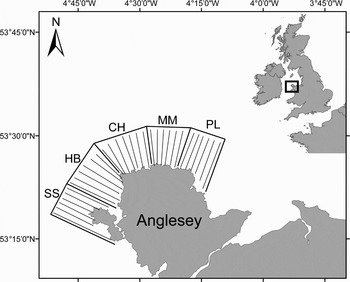
Anglesey lies within the Irish Sea and is separated from mainland Wales by a narrow channel the Menai Strait (Figure 1). Tidal streams run north-north-east and south-south-west across the entrance of Holyhead Bay (HB) on the west coast of Anglesey and change direction around Carmel Head (CH) and the Skerries and run east and west along the coast to Point Lynas (PL) on the north-east coast (Figure 1) (Hydrographic Department of Great Britain, 1993). The maximum rate of the tidal streams are observed off the salient points and can reach rates of up to 7 knots in areas such as Point Lynas (PL) and South Stack (SS) (Figure 1) (Hydrographic Department of Great Britain, 1993). Such conditions have been shown to aggregate prey and represent important foraging habitats for harbour porpoises (Pierpoint et al., Reference Pierpoint, Baines and Earl1998; de Boer, Reference de Boer2001; Johnston et al., Reference Johnston, Westgate and Read2005).
The study area of north coast of Anglesey split in to the 5 sectors with the transect lines. SS, South Stack; HB, Holyhead Harbour; CH, Carmel Head; MM, Middle Mouse; PL, Point Lynas.

Survey design
The study area consisted of a block approximately 489 km2 extending from the east of Point Lynas (53°29.9′N 04°15.6′W) to the west of South Stack (53°20.9′N 04°48.8′W) of Anglesey (Figure 1). The survey area was divided into approximately five equal blocks distinguish by headlands and bays based on the results from the land based survey (not shown here) with the aim to survey each block once a month from May through to August (Figure 1). Dividing the study area into blocks based on land based sightings ensured that fine scale spatial distribution of porpoises and potentially important habitats could be identified. Each block was divided into 6 or 7 transect lines, spaced approximately 1 km apart allowing each block to be surveyed in either one or two days. The total survey area consisted of 31 transect lines extending approximately perpendicular to the coast from the 10 m isobath to approximately 15 km offshore (Figure 1). Not all transect lines could be positioned exactly perpendicular to the shore due the shape of the coastline which caused transects to be slightly skewed. However, this was not considered to be a problem as transects were 1 km apart and the survey design offered the best coverage of the study area. Furthermore, transects approximately perpendicular to the coastline were used to remove any depth bias that could occur if the transect lines followed the contour of the coastline and hence a depth contour. Moreover, perpendicular transects eliminated bias associated with sampling over areas where populations have a heterogeneous density. It would also allow direct comparisons to be made between frequencies of animals detected at different distances from the coastline.
Potentially, porpoises detected on one transect line may be detected on the next, due to the transect lines being approximately parallel and 1 km apart. To test for repeat detections, the mean encounter rate expressed as the number of porpoises detected per km of survey effort was calculated for all 31 transect lines and for every other transect line. The mean encounter rate for the 31 transect lines was 0.33 porpoises per km and for every other transect line it was 0.36 porpoises per km. It was considered that no significant proportion of the porpoises detected was being observed on 2 or more transect lines in a survey day and this will not be discussed any further.
The 10 m isobath was used to standardize the starting point from the coastline as this was the shallowest depth that the survey vessel could work safely. The positions and the length of each transect line were determined using the Holyhead to Great Ormes Head Admiralty Chart (United Kingdom Hydrographic Office, 1977) and fixed into the Global Positioning System (GPS) of the survey vessel so each transect line could be followed and the same transect line could be covered on repeat surveys.
Two survey vessels were used over the 3 year period—the ‘Seawitch’, a 33 ft charter boat and the ‘Endeavour’, a 40 ft custom built dive charter boat. The survey vessels had a relatively low platform height of 2.5 m and it was decided to concentrate search effort in the area 0–500 m either side of the transect line due to the detectability of harbour porpoises decreasing rapidly with distance. Furthermore, detections nearer the transect line are of greater importance for ensuring reliable estimation of density and abundance (Buckland, personal communication).
Surveys were carried out over a 3 year period (2002, 2003 and 2004) and from May to September in each year. Summer period was chosen due to a great chance of having calm sea conditions and the increased day length enables a survey block to be completed in 1 or 2 days. A random transect line was selected within the survey block each time it was surveyed. The vessel proceeded along the transect line in passing mode at a speed of 6–8 knots and did not deviate from the course or adjust its speed even if a porpoise/porpoise school was detected. A transect line took approximately 1 hour to complete depending on its length. Once a line was complete the survey vessel would move across approximately 1 km and proceed down the next transect line.
Eight observers rotated between each transect spending approximately 1 hour surveying at any one time. Two observers were situated on the bow of the vessel scanning a total of 180º along the transect line. A third and fourth observer were situated behind the wheelhouse on the starboard and port side of the vessel and scanned approximately 10º from the trackline to 90º. Care was taken that each set of observers were visually and audibly isolated. Observers searched the area approximately 0–500 m either side of the transect using the naked eye and periodically with 7 × 40 binoculars.
A data recorder was used for all three observers when possible so that those observing did not deviate from searching. Environmental variables which affect the detectability of the animals (wind, sea state, swell, cloud cover, precipitation and visibility) were recorded every 15 minutes. The detectability of porpoises decreases rapidly with an increase in sea state (Barlow, Reference Barlow1988); surveys only took place in calm sea states (Beaufort scale 0–2). Calm sea states are defined as wind speeds of no more than 6 knots with no white caps present.
For each porpoise or school of porpoises that were sighted the bearing and the distance from the survey vessel were recorded. Distance was estimated by eye whilst the bearing of the animal(s) was obtained using angle boards which were mounted to the survey vessel. The GPS position of the survey vessel was obtained from a hand held GPS at the time the sighting was recorded. Several training sessions were undertaken before the start of the survey season whereby observers were trained in use of the GPS and the angle boards as well as trained and tested in estimating distance and completing the recording sheets. In most cases however observers with prior experience were recruited.
Abundance and density estimates
Porpoise abundance was estimated using standard line-transect methods and will not be discussed in great detail here (see Buckland et al., Reference Buckland, Anderson, Burnham, Laake, Borchers and Thomas2001 for detailed line-transect methodology).
The assumption that g(0) = 1, i.e. that all animals are detected on the trackline is a critical assumption of line-transect sampling (Borchers et al., Reference Borchers, Buckland, Goedhart, Clarke and Hedley1998). However, in practice animals will almost certainly be missed on the trackline thus, g(0) < 1. If it is assumed that all animals on the trackline are detected when they are not then a considerable negative bias may be introduced to the abundance and density estimate. This is relevant to the estimation of the density and abundance of harbour porpoise. Firstly, a number of animals may go undetected for the simple reason that they are submerged as the survey vessel passes. Secondly, they may move away from the path of the vessel before detection takes place. Thirdly, they may simply be missed by the observers. For the above reasons it is almost certain that animals were missed on the trackline during this survey. It was not possible to independently estimate g(0) for this particular study; values of g(0) from other studies of harbour porpoise were tested and compared to g(0) = 1.
A study of harbour porpoises by Barlow (Reference Barlow1988) using a viewing height approximately 10 m above the sea surface along the west coast of the USA, estimated that g(0) = 0.769, approximately 23% of animals were missed along the trackline. Observer height affects porpoise detection. The survey vessels used in this study had relatively low platform height less than 3 m. It can be assumed that more than 23% of animals were missed on the trackline. A study by Kraus et al. (Reference Kraus, Gilbert and Prescott1983) using a vessel with a platform height of 2.5 m estimated that up to 50% of the porpoises were missed on the trackline g(0) = 0.5. As the observing platform height in this study is approximately the same height as the platform in the Kraus et al. (Reference Kraus, Gilbert and Prescott1983) study we apply g(0) = 0.5 to our data and compare it to g(0) = 1 and g(0) = 0.769.
Statistical analysis and model selection
In order to estimate the density and the abundance of harbour porpoise off the north coast of Anglesey in the months between May and September, data from three years of boat-based surveys were pooled. Pooling can improve precision for line-transect data (Barlow et al., Reference Barlow, Gerrodette and Forcada2001) especially if sample sizes are small and can provide reliable density estimates even if the data are pooled over the many factors that may affect detectability during the survey (i.e. observer, time of day, weather etc.). Furthermore it is generally recommended that truncation of 5–10% of the largest perpendicular distances should occur (Buckland et al., Reference Buckland, Anderson, Burnham, Laake, Borchers and Thomas2001) and the data were truncated at 400 m which eliminated 7.98% of detections.
The data were then fitted into various models (half-normal, hazard-rate and uniform) in DISTANCE 5 BETA (Thomas et al., Reference Thomas, Laake, Strindberg, Marques, Buckland, Borchers, Anderson, Burnham, Hedley, Pollard, Bishop and Marques2005) and the most parsimonious model chosen as evaluated by the Akaike's information criterion (AIC). It was then possible to stratify the data and a suitable model could be fitted for each of the five blocks (Figure 1), thus giving separate estimates of density and abundance for each block allowing for comparisons between blocks. Precision of the abundance estimates was estimated using the log-normal, bootstrap confidence intervals and coefficients of variation (CV) which were calculated using DISTANCE 5 BETA (Thomas et al., Reference Thomas, Laake, Strindberg, Marques, Buckland, Borchers, Anderson, Burnham, Hedley, Pollard, Bishop and Marques2005) software. Confidence limits were obtained as the 2.5 and 97.5 percentiles of the bootstrap distribution.
Depth distribution and distance from shore
The distribution of harbour porpoises may be affected by physical characteristics within the study area, such as depth (Redfern et al., Reference Redfern, Ferguson, Becker, Hyrenbach, Good, Barlow, Kaschner, Baumgartner, Forney, Ballance, Fauchald, Halpin, Hamazaki, Pershing, Qian, Read, Reilly, Torres and Werner2006). Therefore, the depth and the distance from the coast were extracted for each observation within a geographical information system (ArcGIS 9.2™). Bathymetric data were obtained for the area from a 1 km2 gridded dataset for the Irish Sea (Brown et al., Reference Brown, Joyce, Aldridge, Young, Fernand and Gurbutt1999) and the distance from the coast was calculated using straight line distance tools in ArcGIS 9.2™.
RESULTS
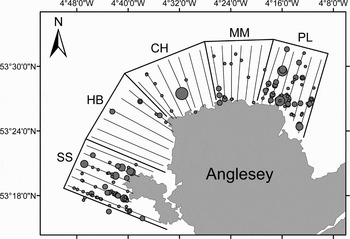
All 31 of the transect lines were surveyed at least once in each of the three survey years. Most were surveyed more than once and some were surveyed up to 5 times. Repeated surveys of the same lines were not treated as independent samples, thus during the analysis line lengths differ markedly dependent on how many times the line was surveyed. The total line length amounted to 1046.054 km, surveyed in 17 days in which 213 sightings consisting of 347 individuals occurred. School size varied from individuals to schools of up to 5 (Figure 2). There was a single sighting of a school consisting of 20 porpoises (Figure 2), however, this was only observed once in three years of survey effort. School in this study is defined as a set of animals no more than approximately 5 m apart from each other and surfacing either together or immediately after each other.
Sightings of porpoises and schools of porpoise in each sector and distance from the coastline. Small circles represent individual sightings while the largest circle represents school size of 20 individuals with the majority of school size being between 1 and 5 individuals. For abbreviations, see Figure 1.

Model selection and density and abundance estimates of harbour porpoises
The following results are based on pooled data collected across the whole of the survey region from May to September for the years 2002, 2003 and 2004, 1046.054 km of transect effort and 213 detections from both the bow and the sides of the vessels with duplicate sightings identified and removed.
Based on minimizing AIC it was found that the perpendicular distance data best fitted the half-normal model with no adjustment terms (AIC = 708.453; χ2 goodness-of-fit test, P = 0.999). Thus, only results obtained from this model will be discussed.
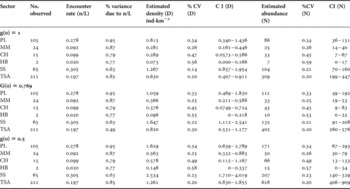
Density is estimated to be 0.630 individulas km−2 (CV = 0.17) assuming g(0) = 1 (see Table 1). High variance was observed in the encounter rate 85.1% and probably occurs due to the fact that the study site is heterogeneous in nature (i.e. not all the area in the study site is suitable habitat for harbour porpoises). The estimated abundance of harbour porpoises off the north coast of Anglesey with g(0) = 1 is 309 (CV = 0.17).
Density and abundance estimates for individual sectors and for total survey area (TSA) where g(0) = 1, g(0) = 0.769 and g(0) = 0.5.% CV (coefficient of variation) refers to bootstrap value whilst CI (confidence interval) refers to the bootstrap 2.5th and 97.5th percentiles. Data of all three years are pooled.

The model was also fitted whereby g(0) was not assumed to be 1 using g(0) = 0.769 (Barlow, Reference Barlow1988) and g(0) =0.5 (Kraus et al., Reference Kraus, Gilbert and Prescott1983). As expected, the resulting analyses showed a higher density and abundance estimate (Table 1) with highest estimates of density and abundance using g(0) = 0.5 (Table 1).
Density and abundance estimation of individual sectors
The following applies to data pooled over the three years (2002 to 2004) whereby the study area is stratified into five sectors (Figure 1). It is recommended that between 60 and 80 detections should be made in order to fit a detection function, however for three of the five sectors (HB, CH and MM) there were fewer than 60 detections. Therefore, as it is a reasonable assumption that the parameters of the detection function are relatively constant across geographical strata (Buckland et al., Reference Buckland, Anderson, Burnham, Laake, Borchers and Thomas2001) it was possible to apply the detection function of the whole study area (global detection function) to each stratum (sector).
The highest density was observed at the sector SS which is higher than that of PL even though there were more animals detected within the PL sector (Table 1; Figure 2). This is because the model corrects for both the amount of survey effort and the area of the sector (km2).
The % of variance due to encounter rate is extremely high for Point Lynas (95.2%) (Table 1) indicating that the animals detected in this area are more highly aggregated than in other sectors (Figure 2). The lowest % of variance due to encounter rate was observed in the SS sector suggesting that animals are more scattered (Table 1; Figure 2).
Low densities were observed in the MM and the CH sectors (Table 1). Values for estimated density between MM and CH only differ by a maximum of 0.015 individual's km−2 (Table 1). However, the coefficient of variation and thus, the confidence intervals differ markedly between CH and MM indicating more variation at CH than MM.
The lowest density is estimated for HB. However, the sample size for HB is extremely small (2 observations) (Table 1), thus caution in the abundance estimates must be taken and should not be considered as an accurate representation of the true abundance and density for this sector.
Depth distribution and distance from shore
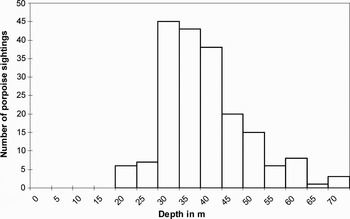
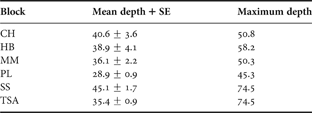
Sixty-five per cent of all porpoise detections were in the water depth between 30 and 45 m (Figure 3). However, this is to be expected as the mean depth for the survey area was 35.4 m with the average depth in each block ranging from 28.9 m to 45.1 m (Table 2).
The number of porpoise detections and water depth.

The mean and maximum depth for each individual sector and for the total survey area (TSA).
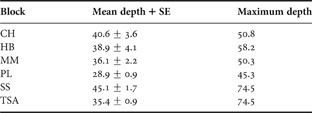
CH, Carmel Head; HB, Holyhead Harbour; MM, Middle Mouse; PL, Point Lynas; SS, South Stack.
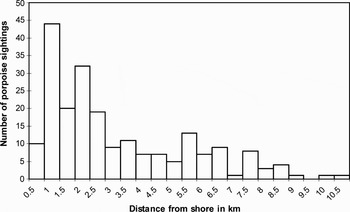
Seventy-five per cent of all harbour porpoises sighted during the three year survey were detected within 5 km of the shoreline whilst 24% were between 5 and 10 km from the shoreline (Figure 4). Only 0.9% of the total number of animals sighted was further than 10 km from the shoreline start point.
The number of porpoise detections and distance from shore.

DISCUSSION
The boat based surveys conducted in 2002, 2003 and 2004 provide a density and abundance estimate of harbour porpoise (Phocoena phocoena) off the north coast of Anglesey during the months of May through to September. The estimates produced refer only to the abundance and density of harbour porpoises for a given area at a given time. The abundance cannot be extrapolated as a year round estimate due to the fact that the boat based survey was not undertaken during the winter months. Year round land-based surveys showed that harbour porpoise sightings increased around the north coast of Anglesey during the summer months and declined in the winter months (D. Powell personal communication). Thus the study was undertaken when harbour porpoises were thought to be at their highest density. It is estimated that the minimum number of porpoises is 309 (bootstrap CI = 199−447) animals that occur off the north coast of Anglesey during the period of May to September based on the assumption that g(0) = 1. The assumption that g(0) = 1, i.e. that all animals are detected on the trackline itself is a critical assumption of line-transect sampling (Borchers et al., Reference Borchers, Buckland, Goedhart, Clarke and Hedley1998). However, in practice animals will almost certainly be missed on the trackline thus, g(0) < 1. If it is assumed that all animals on the trackline are detected when they are not then a considerable negative bias may be introduced to the abundance and density estimate. Using g(0) = 0.5 (Kraus et al., Reference Kraus, Gilbert and Prescott1983) to calculate the abundance and density of harbour porpoises is justified due to similarities in platform height between studies and the fact that harbour porpoise are small and can be difficult to detect and it is most likely that animals would have been missed on the trackline. However, because we were unable to estimate g(0) for this study we recommend that the minimum number of porpoises using north Anglesey waters during the summer months is 309 (bootstrap CI = 199−447). Furthermore, the higher estimates should be taken in to consideration but not used as absolute abundance, i.e. it is highly likely that there were more porpoises using the waters of Anglesey than the minimum estimate.
Heterogeneity in harbour porpoise distribution
The boat-based surveys have shown that there is a high degree of spatial heterogeneity in the distribution of harbour porpoises off the north coast of Anglesey. This applies both to differences between sectors and distances from the shore. It was found that a greater number of porpoises were detected within 5 km of the coast than were detected beyond 5 km, indicating that the waters close to the coastline may provide coastal habitats for harbour porpoises.
The reasons for this observed heterogeneity may be explained by the fine-scale habitat use by harbour porpoises although this study only estimated density and abundance and fine-scale habitat use was not tested directly. Johnston et al. (Reference Johnston, Westgate and Read2005) showed that some harbour porpoises were closely associated to fine-scale oceanographic features such as tidal races and eddies and associated aggregation of prey species. These features have been shown to increase nutrient levels, stimulate primary production (St John & Pond, Reference St John and Pond1992; St John et al., Reference St John, Harrison and Parsons1992) and aggregate plankton and weak nekton (Wolanski & Hamner, Reference Wolanski and Hamner1988; Mann & Lazier, Reference Mann and Lazier1996). This creates localized aggregations of small consumers such as schooling fish which results in concentrated patches of prey for marine predators (Johnston et al., Reference Johnston, Westgate and Read2005).
Harbour porpoises must remain close to food resources and consume prey frequently to meet the energetic demands of maintenance, growth and reproduction (Koopman, Reference Koopman1998) and porpoise distribution is likely to reflect foraging opportunities. Thus the predictable fine-scale oceanographic features that aggregate prey may increase the likelihood of a porpoise encountering and capturing prey. This may aid in conserving energy while foraging (Johnston et al., Reference Johnston, Westgate and Read2005).
The waters around the north coast of Anglesey provide the fine-scale oceanographic features that some porpoises may associate with such as headlands, strong tidal currents, tidal races and eddies that run along the coastline. The data for sector PL showed a high degree of variance in the estimate due to the encounter rate because the population seemed to be highly aggregated in this area. This may be due to porpoises associating closely with the oceanographic features that occur off PL. The oceanographic conditions at PL probably provide the features that concentrate prey species and facilitate foraging. Large aggregations of harbour porpoises have been observed feeding in this area (Calderan, Reference Calderan2003; Leeney, Reference Leeney2003; Weare, Reference Weare2003; D. Powell personal communication). Thus, based on this knowledge we suggest that PL provides a foraging and feeding ground for porpoises.
South Stack (SS) had the second highest density of porpoises to PL during the summer months. The oceanographic features that occur at SS, tidal races, over-falls and eddies, suggest strongly that this area is also used for foraging and feeding. Currently we have no data on the behaviour and fine-scale habitat use of harbour porpoise in the SS area. Porpoises are less aggregated in the SS sector (only 63.7% of the variance in estimate occurs due to encounter rate) suggesting that individuals are relatively more randomly spread out than at PL. However, the fine-scale oceanographic features at SS probably enhance prey concentrations and facilitate feeding. This study has shown that SS is an area of high density of harbour porpoises within the survey area. However, a more detailed study of fine scale habitat use and behaviour is needed to elucidate the reason why harbour porpoises use the waters at SS.
Currently it is thought harbour porpoise are widespread in UK and European waters whereby distribution is likely to be relatively evenly distributed (McLeod et al., Reference McLeod, Yeo, Brown, Burn, Hopkins and Way2002). However, evidence from this study suggests that Point Lynas and South Stack provide coastal habitat for some harbour porpoises in a heterogeneous environment where relatively even distribution on the spatial scale of the study area does not occur due to environmental heterogeneity. Habitat-use studies will allow a better understanding of the ecology of harbour porpoises in the north Anglesey area and would enable managers to conclude whether the other areas represent important coastal habitats and allow informed decisions on appropriate management strategies. The most likely source of disturbance to porpoises around Anglesey is due to recreational activities and increased development of renewable energy devices. Recreational activities increase during the summer months which unfortunately coincide with the critical harbour porpoise calving/breeding season (May–September) (Lockyer et al., Reference Lockyer, Heide-Jørgensen, Jensen, Kinze and Buus Sørensen2001; Börjesson & Read, Reference Börjesson and Read2003). Information from studies like this may enable management strategies to change over time so they give protection at critical times of the year (summer months for Anglesey) and in areas that may have been identified as important habitats for their survival such as feeding grounds and calving/nursery areas.
We strongly recommend that the summer boat-based studies run in conjunction with year round land-based studies. Furthermore, in conjunction with boat- and land-based studies the development of acoustic surveys during the winter period which do not rely on a calm sea state would help in identifying the use of the north Anglesey coast by porpoises in the winter. However, estimates of abundance and density cannot as yet be made from acoustic methods alone.
ACKNOWLEDGEMENTS
This project was funded by the Countryside Council for Wales, Species Challenge Fund. Special thanks go to Scott Waterman of the ‘Endeavour’ and Mel and Pearl Smith of the ‘Seawitch’.
We would like to thank a long list of observers that made this work possible: Ollie Boisseau, Andy Lloyd, Terry, Caroline Neinhuis, Stephanie, Tim Rodgers, Debbie, Sam Holliday, Helen Briggs, Maire Buckley, Beverley Callaghan, Louise Peel, Tom Richardson, Heidi Tillin, Mandy Apps, Garry, Chris Pham, Greg Tatamanidis, Dylan, John Daniels, Sue and Rodger Bird, Dave Powell, Pete Bridston, Kate Smith, Peter Harris, Mandy McMath, Nick Tregenza, and also to the many others that have not been mentioned who have taken the time help with the project.
We would like to express our appreciation to everyone at the Centre for Research into Ecological and Environmental Modelling (CREEM) in St Andrews. Special thanks go to Len Thomas, Steve Buckland, Louise Burt and to Phil Hammond for advice on survey design.
Compilation of the 1 km × 1 km gridded bathymetry for the Irish Sea, Celtic Sea and North Channel was funded by the Department for Transport and the Regions (DETR), and the Ministry of Agriculture, Fisheries and Food (MAFF). Bathymetry data are reproduced from Admiralty Charts and surveys by permission of the UK Hydrographic Office.