Introduction
Palaeolithic cave art has been systematically studied in the Asturias and Cantabria regions of northern Spain and in south-west France. Until relatively recently, however, only six cave art sites were known in the Basque Country, which is between those two well-documented regions. This limited number of cave sites contrasts with the numerous other archaeological sites of Upper Palaeolithic date so far discovered in the same area. Finds of cave art in the Basque Country are limited to large ensembles such as Ekain (Barandiarán & Altuna Reference Barandiarán and Altuna1969), Altxerri (J.M. Barandiarán Reference Barandiarán1964), Arenaza (Grande Reference Grande1974) and Alkerdi (I. Barandiarán Reference Barandiarán1974), some of which are now UNESCO World Heritage sites. Consequently, and despite the archaeological evidence, the Basque Country has been regarded by some as a ‘graphic void’ (Garate Reference Garate2018) between south-west France and Cantabria during pre-Magdalenian times (before 20 000 cal BP), in the belief that depictions were mostly restricted to the Magdalenian period (Ochoa & García-Diez Reference Ochoa and García-Diez2015). But did this void really exist, and if so, why?
Over recent years, methodological advances in archaeological fieldwork and laboratory research (Fritz & Tosello Reference Fritz and Tosello2007; García-Diez & Ochoa Reference García-Diez, Ochoa, García-Díez and Zapata2013), combined with the exploration of known and newly discovered caves, have revealed 17 new Palaeolithic art sites in the Basque Country. This has changed the established view of a Basque ‘void’, bringing the area into line with its neighbours in southern France and Cantabria. These advances also allow us to further our understanding of mobility and interactions between contemporaneous human groups. These newly discovered sites open up novel research questions, including the explanations for the apparent ‘void’ and how these new sites change our understanding of Western European Upper Palaeolithic rock art. By studying graphic convergence and divergence, the artistic links between regions will help to define the geographic spread of graphic styles (Conkey Reference Conkey and Clottes1987; García-Diez et al. Reference García-Diez, Ochoa, Vigiola-Toña, Garrido and Rodriguez-Asensio2016).
The set of images in Danbolinzulo Cave is a particularly significant example of these new discoveries. Stylistically dated to the pre-Magdalenian period, the cave is the north-easternmost site containing the Cantabrian-Iberian style art. This article presents results of the analysis of the depictions within Danbolinzulo Cave and their contextualisation with other sites in northern Spain and southern France. The objective is to understand the graphical, cultural and social relationships of Upper Palaeolithic hunter-gatherers in the region. The stylistic characteristics of Danbolinzulo allow us to reflect on the similarities and differences between sites in Cantabria, Iberia and Western Europe as a whole, and we present a hypothesis to explain why the Basque area and its rock art sites are relevant to the Early and Middle Upper Palaeolithic in a Western European setting.
Danbolinzulo Cave
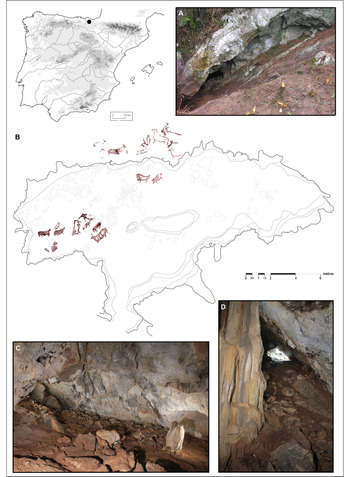
Danbolinzulo Cave is located in Zestoa (Gipuzkoa province in northern Spain), on the slopes of Mount Ertxiña (Figure 1). It was discovered in 1980 when the local Antxieta Arkeologi group (dedicated to promoting archaeological activities) explored the cave and found remains of pottery and fauna that were attributed to the periods from the Eneolithic to the Bronze Age (Altuna et al. Reference Altuna, Mariezkurrena, Armendariz, Barrio, Ugalde and Peñalver1982: 65). In 2014, the same group returned to explore the cave again, this time discovering some graphic representations on the cave walls.
Danbolinzulo Cave: top left) location; A) entrance; B) topography with indication of the placement of the graphic units; C) location of the panels; D) entrance, viewed from the central part of the cave (figure by the authors).

The current entrance to the cave is a small gap, approximately 2m wide and 0.8m high, oriented west-south-west, at 250m asl (Figure 1A). From the entrance, the passage slopes downwards for around 7m into a chamber that is at its maximum 25.5m wide, 7m high and 10m long (Figure 1B–C). In the middle of the chamber is a large speleothem column dividing the space into two. The steep slope of the hillside ensures a commanding view over the valley. It is possible that the original entrance may have been larger and, over time, could have been partially blocked by earth movements.
Methodology
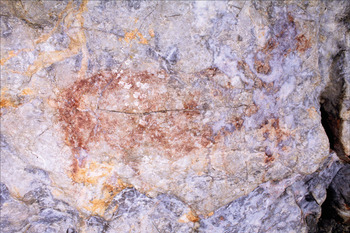
The fieldwork undertaken by the authors concentrated on a detailed survey of all the cave surfaces (including walls, floors and speleothems) and the production of written and graphical documentation of the depictions (García-Diez & Ochoa Reference García-Diez, Ochoa, García-Díez and Zapata2013; Ochoa & García-Diez Reference Ochoa and García-Diez2018). The poor preservation of the images (Figure 2) required the use of image-enhancement software (Adobe Photoshop® and DStretch® for ImageJ®). After the representations were located, individual digital tracings were drawn and subsequently checked and corrected in situ as many times as necessary to achieve clear and accurate records. Later, information on technique, style, composition and placement of the motifs was recorded in the cave using standardised record sheets.
Panel 2, graphic unit 3, which has been affected by calcite formations and humidity (figure by the authors).

Fading, due to the depictions’ proximity to the cave entrance and exposure to faint sunlight, made their identification challenging. Hence, doubts still remain about the possible existence of more figurative or non-figurative representations, particularly on panel 7. Furthermore, in several cases, it was difficult to distinguish between the natural or anthropic character of the pigment. It is therefore possible that, due to poor preservation, some representations may have been missed during fieldwork.
The iconography
The depictions are described according to their position within the cave (Figure 1). They are grouped in a single topographic unit containing seven panels (the grouping of images was usually defined by the characteristics of the rock surface), with a total of 35 graphic units (for an in-depth description of the images, see the online supplementary material (OSM); the number in parentheses refers to the graphic unit number in the OSM and the corresponding number in figures).
The initial panel (panel 1, closest to the cave's entrance), located on a convex surface, shows a dot-shaped pigment stain (1). Located to the right of panel 1, panel 2 is on a vertical and irregular limestone and calcite surface and comprises a group of nine graphic units. In the upper part of the panel, three images are illustrated in Figure 3. They show a zoomorphic representation of a complete ibex or red deer hind (3) drawn in red, with infilling applied as a colour wash. The outline was completed with multiple fine engravings applied to some anatomical parts (see also Figure 2). To the right is one of the most complete zoomorphic figures in the set, an ibex or a red deer hind (6). The anatomical elements are drawn in red and the interior filled with a colour wash, with some parts of the outline further engraved with multiple lines. A second complete ibex (7) is located above this; it is also drawn in red and partially filled with a colour wash.
Panel 2 (upper part) showing graphic units 3, 6 and 7 (figure by the authors).

On the lower part of panel 2, three motifs are illustrated in Figure 4. The first (2) is composed of five straight red lines, some parallel to each other. On the upper right (4), the composition consists of six straight red lines. Below is a pseudo-circular shape (5) made of at least 14 straight and slightly curved red lines, one isolated from the rest to the left. The last graphic units in the panel, not illustrated here, comprise two distinct linear motifs formed by a single straight red line (8 and 9), and a concentration of red pigment with no apparent figurative representation (10).
Panel 2 (lower part) showing graphic units 2, 4 and 5 (figure by the authors).

Panel 3 is located to the right of panel 2, on a ridge in the roof forming a sinuous and flat surface perpendicular to the floor. This panel comprises nine graphic units. First (not illustrated) is a linear motif of three straight red lines forming an angle (11). Immediately after this, two zoomorphic representations (Figure 5.12–13) are depicted in red, with some anatomical parts filled with a wash of colour. The first (12) is a possible acephalous cervid or caprid facing right. Below it is a red deer hind or ibex facing left (13). Next to these two zoomorphic figures are two concentrations of red pigment (14 and 15, not illustrated). Below 12 are two indeterminate zoomorphic figures drawn in red pigment (Figure 5.16–17). One (16) is facing left and has all the anatomical parts of the animal, its neck and head filled with a wash of colour. To the right is a headless animal figure (17), its interior filled with a colour wash. A few centimetres below 17 and facing right is a figure of a complete ibex drawn in red (Figure 5.18), whose fore and hind-quarters are filled with a colour wash. In the same panel is a dispersed concentration of red pigment (19, not illustrated) associated with a ridge in the rock.
Panel 3 showing graphic units 12, 13, 16, 17 and 18 (figure by the authors).

Panel 4 is located in the central part of the cave's north wall. The panel's surface is a sinuous limestone on which figures make up four graphic units (Figure 6). First is an incomplete red ibex (20), with part of its head, and possibly also its hindquarters, filled with a colour wash. Below, and slightly smaller, is an indeterminate zoomorph (21), represented by the rump, tail and buttocks. This figure was probably more complete previously, as suggested by associated concentrations of pigment that may correspond to missing parts of the animal. Immediately to the right of 21 is a mostly complete ibex (22), represented in red with a striking wide line that separates the body from the forequarters. A few short, thin lines associated with the head could be either finely engraved or natural. The panel is completed by three straight, more or less parallel, lines (23).
Panel 4 showing graphic units 20, 21, 22 and 23 (figure by the authors).

Panels 5 and 6 are positioned on a limestone surface covered by thin calcite layers and bacterial colonies. Two indeterminate zoomorphic figures (24 and 25) are visible, partially represented and drawn in red (Figure 7). These may originally have been more complete, as some pigment (26, not shown on Figure 7) remains around the figures.
Panels 5 and 6 showing graphic units 24 and 25 (figure by the authors).

The last of the panels, panel 7, comprises a total of nine mostly zoomorphic graphic units (Figure 8). The poor preservation of their pigment makes them difficult to identify. The first figure is an indeterminate zoomorph (27), of which only the rear limbs and the hindquarters remain. Immediately adjacent to and in contact with 27 is a complex representation of an unidentifiable zoomorph or anthropomorph (28), depicted vertically. Both 27 and 28 are drawn in red. Below these are two groups of linear representations: one straight red line (29) and a collection of 6 and 11 ‘paired marks’, separated by a natural dark fissure (30).
Panel 7 showing graphic units 27, 28, 29, 30, 31, 32 and 33 (figure by the authors).

Immediately above and to the right are two zoomorphic figures depicted in red: a complete horse (31) and an ibex (32). The upper part of the ibex's body was produced by using fingers to create a series of dots for the outline. A third zoomorphic figure of an incomplete red horse (33) is located below the previous group of 31 and 32.
Finally, two linear representations (not illustrated) might originally have been zoomorphic figures. The first (34) consists of two curved lines and several associated concentrations of poorly preserved red pigment. The second (35) is located to the right of 34.
Assessment
The Danbolinzulo Cave representations are relatively homogeneous in theme, technique and style. In terms of identifiable species, there are five ibex, two horses and possibly an anthropomorph. While five animal figures are acephalous, it is unclear whether they were deliberately drawn without a head or whether the absence of heads is due to poor preservation. All the graphic units are drawn in red, although in most cases we have been unable to determine how the pigment was applied. Some of the representations were drawn only as an outline, while the inside of other figures was either partially or completely filled with a colour wash. The technique of using dotted lines to form the outline of a figure is documented in one case (32), and it is possible that others were produced in the same way. In addition, fine multiple- and parallel-engraved lines have been observed in two, or possibly three, graphic units (3, 6 and perhaps 22). These are restricted to some parts of the outline drawn in pigment. The timing of these engravings in relation to the application of the pigment, however, cannot be determined.
Stylistically, the representations in Danbolinzulo Cave are characterised by anatomical disproportion, absence of detail, large bodies, swollen bellies, total or partial interior fill creating dividing lines, and ambiguity in the interpretation of the animal species. The latter often depends on the presence or absence of horns. One characteristic of several figures in Danbolinzulo is the representation of the limbs in frontal view, whereas the body is seen in profile. This is particularly common in the representation of the hind legs (3, 6, 7, 12, 13, 25 and 31), but also appears in some fore legs (13 and 16). Villaverde (Reference Villaverde1994: 116) defines this style in his analysis of the plaquettes from Parpalló Cave (Valencia, east coast of Spain) as a way of representing the limbs “according to a view in straight biangular perspective in which the union of the intermediate space is achieved by a more or less concave line”. At Danbolinzulo, this convention is recorded in 12 out of 26 pairs of limbs; it is more frequent in the rear limbs, although in two cases, it is also found in both pairs of limbs.
The apparent homogeneity of the Danbolinzulo representations suggests a synchronic production, at least in a broader cultural sense. We cannot yet say whether all the graphic units and panels were produced over a short or long time. Regardless, it is clear that the figures were all created within the same graphic-cultural tradition (García-Diez & Ochoa Reference García-Diez, Ochoa, García-Díez and Zapata2013).
Chronology
Defining a chronological framework for the Danbolinzulo representations is challenging due to the lack of direct dating evidence: the cave has never been closed, the images are executed in inorganic, non-datable pigments, and they have not been concealed by archaeological stratigraphy. Hence, we date the depictions on the basis of stylistic and comparative analyses, while acknowledging the inherent limitations and uncertainties of such an endeavour. The Palaeolithic age of the representations is certain, given the themes, techniques and style used in their creation. The covering of a number of motifs by fine layers of calcite also supports a Palaeolithic date (albeit relatively) and the authenticity of the images.
There are two clearly defined epochs for Upper Palaeolithic art in Western Europe. Stylistic nuances allow different phases to be defined within those two wider periods, particularly in the latter, the Magdalenian (c. 20 000–13 000 cal BP) (Ochoa & García-Diez Reference Ochoa and García-Diez2015). During this period, portable art became much more common. Accordingly, Magdalenian art is more easily dated by stylistic comparison, allowing researchers to define at least two phases. Furthermore, the preference for black pigment, particularly charcoal, rather than ochres, facilitates radiocarbon dating of Magdalenian depictions. Conversely, the art that preceded the Magdalenian (c. 43 000–20 000 cal BP) is less well dated, due to a dearth of portable art and the preference for non-organic pigments. Thus, it is simply defined as ‘pre-Magdalenian’. Although this pertains to a 23 ka span, the pre-Magdalenian style is homogeneous, and it is therefore difficult to distinguish different phases within this timeframe. Hence, most of the sites classified as pre-Magdalenian are dated by stylistic means. Certain categories of comparative evidence, however, allow us to assign a pre-Magdalenian date to the Danbolinzulo depictions. These include reliably dated portable art, and a small number of figures (Ochoa et al. Reference Ochoa, García-Diez, Maíllo-Fernández, Arrizabalaga and Pettitt2018) radiometrically dated to between 43 ka and 20 ka BP. Among the oldest are an anthropomorphic representation in Tito Bustillo Cave, which dates to before c. 35.5 kya, and a horse drawn with dots in Altamira Cave, dating to before c. 22 kya (Pike et al. Reference Pike2012). Both are linked to the Danbolinzulo representations by theme (horse and anthropomorph) and technique (dotted lines and simple drawing of the outline).
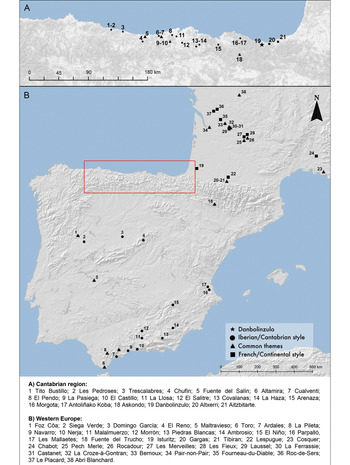
The ‘arch-shaped limbs’ observed in Danbolinzulo have also been identified at Parpalló Cave (Villaverde Reference Villaverde1994). Here, the well-contextualised plaquettes showing this particular trait are almost exclusively pre-Magdalenian. They also exhibit other stylistic similarities that may help to refine the chronology of the Danbolinzulo assemblage. The ‘arch-shaped limbs’, however, are not exclusive to these two sites; similar representations are recorded not only at the northern Iberian sites of El Pendo, La Garma, Candamo and Arenaza (Figure 9), but also in south-west France in portable art (at Gargas and Isturitz) and in parietal art (such as at Gargas, Pech-Merle, Les Fieux, Roucadour, Les Merveilles and Cosquer). On the Iberian Peninsula—especially in the north—this convention is restricted to particular animals, namely red deer hinds (El Pendo, Covalanas, Arenaza) and ibex (La Garma). In France, the convention has been documented in bison (Gargas, Roucadour), ibex (Cosquer, Gargas and Les Fieux), bovids (Gargas), horses (Roucadour, Gargas and Pech-Merle), giant deer (Pech-Merle and Roucadour), mammoths (Pech-Merle), elks (Gargas and Les Merveilles) and stags (Cosquer). In northern Spain, the cave representations using this convention are almost exclusively in red (or sometimes produced with colour wash), whereas in France the techniques are more diverse. Here in France, they include finger-drawn and incised renderings, and painting with both red and black pigments, using either drawing or a colour wash.
Map showing the distribution of the pre-Magdalenian stylistic traits in Western Europe (figure by the authors).

In some cases, such as at La Pasiega and Llonín Caves (Fortea et al. Reference Fortea, Fritz, García, Sanchidrián, Sauvet, Tosello and Otte2004), representations similar to those at Danbolinzulo are found beneath red deer hinds, and made in the Altamira-El Castillo style. This is characterised by multiple fine-line-engraved figures, and is dated by well-contextualised portable art to the Lower Magdalenian (c. 20–17 kya). Consequently, red zoomorphs have traditionally been associated with the pre-Magdalenian (Montes & Sanguino Reference Montes and Sanguino2001; Garcia-Diez & Eguizabal Reference García-Diez and Eguizabal2003; Garate Reference Garate2010). Such multiple fine-line engraving has, however, also been found in combination with drawing in red pigment and has been associated with later phases of the pre-Magdalenian period, a stage preceding the production of the ‘striated’ red deer hinds recorded at Altamira and El Castillo Caves (Barandiarán Reference Barandiarán1994). The outlines of large, engraved acephalous red figures at Les Pedroses cave contrasts with Danbolinzulo, where engravings have only been documented in graphic units 3 and 6. At Les Pedroses, the presence of other representations beneath and superimposed over the painted engraved figures could help to refine the chronology of these graphic units, although opinions differ about the ordering of the superimpositions (Garate Reference Garate2010; Jordá-Pardo & Mallo Reference Jordá-Pardo and Mallo2014).
Discussion
Located between south-western France and the Cantabrian region, the Basque Country is well studied archaeologically, and is considered to have been a zone of interaction between the two regions, as attested by the large number of known Upper Palaeolithic sites (Arrizabalaga et al. Reference Arrizabalaga2016). There was continuous settlement during the Upper Palaeolithic, with the exception of the Early Solutrean (c. 25 kya)—a period of sparse population throughout the Cantabrian area. The Basque Country is also thought to have been the main route of communication between Iberia and the rest of the continent (Arrizabalaga Reference Arrizabalaga, Cazals, González-Urquijo and Terradas2007; Prieto et al. Reference Prieto, García-Rojas, Sánchez, Calvo, Dominguez-Ballesteros, Ordoño and García-Collado2016). Regarding cave art, the region could, however, then be characterised as representing a ‘void’ during the Upper Palaeolithic: its apparent dearth seeming very significant, particularly in the pre-Magdalenian. This dearth could be explained as the result of a ‘boundary’ between cultures, with different styles on either side. The discovery of several new Early to Middle Upper Palaeolithic sites in the Basque Country—Morgota, Ondaro, Askondo, Danbolinzulo and Agarre—has now undermined that interpretation. These sites are important because they provide important information on the geographic extent of graphic territories, the mobility of human groups and the iconographic, cultural and social interactions that may have taken place between them. The location of Danbolinzulo Cave is particularly significant, as it is the easternmost site containing the stylistic characteristics of the Cantabrian-Iberian style.
The pre-Magdalenian Cantabrian-Iberian style is characterised by a high frequency of abstract signs: mainly dots, lines and clouds of dots, paired lines, triangles (associated with vulvae depictions), rectangles (usually infilled), and positive and negative handprints. The figurative themes depicted are animals—usually equids, cervids and caprids—and, exceptionally, anthropomorphic figures. These are represented by using very particular conventions: large bodies with small heads, big bellies, arch-shaped limbs and a general absence of details. They were created by deep engraving or drawing with red pigment using dotted lines traced with a finger, or by drawing with a pigment stick and filling the interior with washes of paint. Most of the figurative depictions are incomplete and many are acephalous. These stylistic characteristics persisted in Iberia—and particularly in the Cantabrian area—for millennia, with very little change (García-Diez Reference García-Diez2002; García-Diez & Eguizabal Reference García-Diez and Eguizabal2003, Reference García-Diez and Eguizabal2007; García-Diez et al. Reference García-Diez, Garrido, Hoffmann, Pettitt, Pike and Zilhão2015).
Most of the Cantabrian-Iberian stylistic traits appear in Danbolinzulo, as attested by the drawing of ibex, horses and one anthropomorphic figure in red. At least one of these representations uses dotted lines, and interior washes are frequent. A small number of abstract signs, comprising two sets of paired lines and a further two executed by dragging a pigment-dipped finger across the wall, complement the figurative depictions. These traits are present in other sites on the western side of the Basque Country, including Arenaza, Venta Laperra, Morgota and Ondaro (Garate Reference Garate1998; García-Diez & Eguizabal Reference García-Diez and Eguizabal2008; Garate et al. Reference Garate, González-Sainz, López-Quintana, Guenaga, García-Gamero, Aranzaba, Medina and López-Quintana2015; López Quintana et al. Reference López Quintana2016). Until now, however, none of these characteristics had been found on the eastern side of the Basque Country, thus emphasising the significance of Danbolinzulo Cave for the pre-Magdalenian period. Numerous similar examples with the same stylistic themes can be cited, not only in northern Spain (e.g. El Arco, Pondra, Covalanas, La Haza, La Pasiega, El Pendo, El Castillo, Chufín, Tito Bustillo, Les Pedroses, Askondo, Altxerri, Salitre, Cualventi, La Llosa and Trescalabres), but also in the rest of the Iberian Peninsula (e.g. Foz Côa, Siega Verde, Domingo García, El Reno, Ardales, Nerja, Morrón, Parpalló, Mallaetes, Navarro, Malalmuerzo, La Pileta, El Niño, Ambrosio, El Moro, Toro, Piedras Blancas and Fuente del Trucho), and in portable art (Parpalló in Valencia and Antoliñako koba in the Basque Country). Partial or total infill with a colour wash is more frequent in northern Spain (García-Diez Reference García-Diez2002; Garate Reference Garate2010), and is found in El Pendo, La Pasiega, Altamira, Covalanas, Morgota, El Arco, La Haza, Arenaza and Pondra caves. Acephalous figures with similar characteristics are relatively common, and have been documented at Morgota, Arco B, Salitre, El Pendo, La Pasiega, Tito Bustillo, Llonín and Les Pedroses, among other sites (García-Diez Reference García-Diez2002; Garate Reference Garate2010) (Figure 9).
Conversely, continental and French pre-Magdalenian art is characterised by a higher number of figurative depictions, with mammoth, lion, bear, rhinoceros, horse and bison being the most common themes (Petrognani & Robert Reference Petrognani and Robert2009, Reference Petrognani and Robert2017). These are depicted by modulated lines to create large-bodied figures. Bovids are frequent and are represented with horns in frontal view. Horses are shown in a well-attested style known as the ‘duck-bill’ style because the shape of the muzzle resembles a duck's beak. There is also a symbol, known as the ‘Placard type’ (an aviform shape named after the cave of Le Placard), which is characteristic of the Pyrenean and Dordogne areas (Petrognani & Robert Reference Petrognani and Robert2009, Reference Petrognani and Robert2017). The most defining characteristic, however, is the presence of female representations, particularly statuettes such as those of Laussel and Lespugue or, farther east, Willendorf or Kostienki. Triangles depicting vulvae are also frequent.
Engraving in different formats, including bas-relief, is the most frequently recorded technique, although drawing—without a particular colour preference—is also important. Two recent discoveries that await full publication, Aitzbitarte III and IX (Garate et al. Reference Garate, Ríos-Garaizar, Rivero and Elkartea2016) and Alkerdi II (Álvarez et al. Reference Álvarez2016), include figures in this style, with engraved bison depicting horns in frontal view. Altxerri B, which was recently re-analysed (Ruiz-Redondo et al. Reference Ruiz-Redondo, González-Sainz and Garate2015), is also associated with the style influenced by depictions in south-west France. Figure 9 illustrates the numerous other examples of this style.
Stylistic traits shared between Iberia and France include: negative and positive handprints found in Gargas, Tibiran, Pech-Merle, Maltravieso, Fuente del Salin, Ardales, El Castillo and Altamira; triangular signs representing vulvae at La Ferrassie, Castanet, Blanchard, Bernoux and Tito Bustillo; ‘arch-shaped limbs’, although in this case this trait is more frequent in Iberia. While more frequently recorded in France—at Cosquer, Croze-à-Gontran, Gargas and Pair-non-Pair, for example—‘duck-bill’ horses also appear in Iberia at Ardales, Askondo, La Pasiega, El Moro, La Pileta and Foz Côa.
The discoveries at Danbolinzulo Cave challenge the idea of a Basque Country ‘void’ and suggest a different hypothesis. Cave art is an indicator of hunter-gatherer cultural and social dynamics, and, as such, it can be regarded as a mirror of Palaeolithic society. Hence, the Basque area could be considered to have been a transitional zone between two graphic traditions or communities, one represented by the Cantabrian-Iberian style and the other by the French/continental style. These communities span large areas, sometimes crossing natural boundaries. They are made up of smaller units that are more or less interconnected—depending on the mobility of each participating group and degree of aggregation—thus varying the communication between them (García-Diez et al. Reference García-Diez, Ochoa, Vigiola-Toña, Garrido and Rodriguez-Asensio2016). This communication would be essential in the groups’ social spheres, as they would share cultural affinities.
A transitional zone is an area where cultural interrelations and communication may have taken place between several communities, and are usually expressed via similarities in graphic styles. In the present case, we can see some common themes that could represent such relationships, such as hand stencils, triangular signs (vulvae) or ‘duck-bill horses’.
The Basque Country, however, is peculiar in one respect. Although the representations in Danbolinzulo Cave are only in the Cantabrian-Iberian style, their presence extends the influence of this particular style farther east than previously thought. By contrast, caves in the immediate vicinity of Danbolinzulo, such as Aitzbitarte III, IV and IX, Altxerri B and Alkerdi II, have stylistic traits typical of the French/continental pre-Magdalenian. It is notable that all of these caves apparently exhibit one style exclusively; they do not seem to reflect interrelations between the communities, or show any of the shared themes. The location of Danbolinzulo could have constituted a transitional territory of multicultural integration of different graphic traditions during the Upper Palaeolithic. Conversely, we could interpret the apparent lack of integration (attested by the Cantabrian-Iberian style at Danbolinzulo and the French/continental style in nearby caves) as representing a territory disputed by the two communities, which used their own styles to reinforce their cultural identity and perhaps their claims to the territory. Support of this hypothesis, however, requires a better understanding of the chronological framework of pre-Magdalenian art.
Conclusions
The recent discovery of rock art in Danbolinzulo Cave is an important development in the study of European Palaeolithic art. The style of the representations, combined with the location of the site, has prompted a reconsideration of previous interpretations, as Danbolinzulo now represents the easternmost instance of this style in the region. The cave art from Danbolinzulo contributes to fill the supposed Basque Country ‘void’. Moreover, the discovery of similar Basque Country cave art assemblages (e.g. Morgota and Askondo) and the reanalysis of others (e.g. Altxerri), largely disproves the notion that this part of northern Spain had no pre-Magdalenian parietal art. The analysis of art styles in Western Europe leads us to consider the following hypothesis: two distinct pre-Magdalenian cultural territories—continental/French and Cantabrian-Iberian—differed in their use of specific stylistic traits, although they shared some themes and characteristics. The Basque region would have acted as a pivotal zone, possibly populated by people from both cultural backgrounds. The absence of sites with mixed styles, however, could indicate either a lack of communication between these cultural territories, or perhaps the reinforcement of identity markers in a border zone.
Acknowledgements
This study was undertaken by the Prehistory Research Group of the University of the Basque Country (UPV/EHU) and was funded by the Basque Government (IT-622-13 and IT-1223-19) and the Spanish Ministry of Science (projects HAR2014-53536-P and HAR-2017-82483-C3-P). The fieldwork in Danbolinzulo Cave was made possible thanks to the authorisation and financial support of the Diputación Foral de Gipuzkoa. Blanca Ochoa's research was partly funded by a Postdoctoral Research Fellowship from the Basque Government.
Supplementary material
To view supplementary material for this article, please visit https://doi.org/10.15184/aqy.2019.236