

Introduction
Haiti is the poorest country in the Western Hemisphere with approximately 80% of the population living under the poverty line and over 50% living in abject poverty.Reference De Wulf, Aluisio, Muhlfelder and Bloem 1 Health indicators within Haiti are poor with the highest under-five mortality rates and the lowest life expectancies in the Western Hemisphere. 2
The health care system has numerous challenges, including limited access to health care, insufficient medical supplies, and understaffing of trained health care professionals. 3 These challenges were further magnified during the earthquake of January 2010, with damages in the health sector exceeding 200% of annual health expenditures and the destruction of over 50 health care institutions. 4
Enhancing resources and health care infrastructure could improve public health metrics greatly. As in most resource-constrained settings, the margin for benefit is greatest in the poorest areas of Haiti. The North East Department, which has a population of approximately 360,000 people, 5 is among the poorest regions of the country with an estimated 84% of inhabitants of the North East living on less than one US dollar per day. 6 Previous research has shown that laypersons function as the primary providers of emergency transport and that out-of-hospital care is nearly non-existent in the region.Reference Sletten and Egset 7 This research highlights the socioeconomic and health infrastructure disparities within this region in Haiti.
It was noted by a 2013 World Health Organization (WHO; Geneva, Switzerland) bulletin that as populations continue to grow and age, there will be increasing demand for acute care services that respond to life-threatening emergencies, acute exacerbation of chronic illnesses, and routine medical problems requiring prompt action. They also note that in order to strengthen health systems, emergency interventions and services should be integrated with primary care and public health measures.Reference Aluisio, Gore, Decome, De Wulf and Bloem 8
In order to achieve the goal of improved integration of emergency care into the existing health systems, and to foster improvements in health care in general, an assessment of the current health care capabilities within the region is a crucial starting point. The aim of this study was to assess the current health care infrastructure and emergency care resources to inform the development and support of health care assets in the North East Department of Haiti.
Methods
This cross-sectional, observational study was carried out to evaluate the current emergency health care capabilities in the North East region of Haiti. The three hospitals run by the Haitian Ministry of Public Health and Population (MSPP; Port-au-Prince, Haiti) and located in the predefined geographic catchment area of the North East Department were selected. All five clinics located within the Fort Liberté District, a relatively accessible sub-region surrounding Fort Liberté town, were included. Data collection occurred over five consecutive days of surveying during October of 2012. The chief administrator or senior clinician at each site was interviewed by researchers who completed the survey orally in French or with the help of a Creole translator.
Institutional Review Board exemption status for this study was obtained from the State University of New York (Albany, New York USA). Approval from the regional MSPP representative was also obtained prior to data collection.
Using modified versions of the WHO Generic Essential Emergency Equipment listReference Hirshon and Risko 9 and the Needs Assessment and Evaluation Form for Resource Limited Health Care Facilities 10 (Appendix 1 and Appendix 2; available online only), researchers conducted interviews with staff members of each facility. Questions that became not applicable due to a previous negative answer or a non-applicable setting were omitted from the original survey. As accessibility to materials was often described as inconsistent, the categorical distinction of “consistently available” material was created.
Available equipment, resources, personnel, and policies were examined. These interviews were conducted in French, by the authors, or in Creole, with the assistance of a Creole translator. Data from the questionnaire were analyzed using STATA version 10.0 (College Station, Texas USA). Descriptive analyses were performed with grouping based on facility type (hospital versus community clinic). Further analytical descriptions based on treatment requirements were done with results reported as frequencies and percentages.
Results
Three hospitals and five community clinics were surveyed. The hospitals evaluated were: Fort Liberté Hospital, the primary referral center in the region; Hôpital Communauté de Référence de Trou du Nord, a hospital run by local Haitian and Cuban staff working together; as well as the Ouanaminthe Hospital, bordering the Dominican Republic. The district clinics evaluated were: Notre Dame de Nativité Center de Malfety and Clinique Ebenezer, funded by nongovernmental organizations; and the Dispensaire de Ferrier, Dispensaire de Derac, and Dispensaire d’Acul Samedi, each MSPP facilities.
Infrastructure
It was noticed that some of the health centers were difficult to reach, requiring multiple modes of transportation, not being passable consistently by 4-wheeled vehicles. It was also noted that none of the MSPP hospitals were in the interior of the region, but were rather at the periphery of the region, accessible by the main roads transecting the region.
All hospitals had a designated emergency ward with 24 hour staffing by a medical doctor. They all had an interrupted electricity supply with backup generators and access to running water; however, none had a potable supply. None of the clinics had running water and only one of the clinics (20%) had electricity. No health facilities surveyed had a respiratory isolation area.
Equipment
Two out of the three hospitals reported having a list of emergency equipment, while none of the clinics had such a list. All hospitals reported that their emergency equipment was available intermittently and that there was no formal training of staff for the use of this equipment. All health facilities studied reported the consistent availability and use of biohazard disposal and sharps disposal containers.
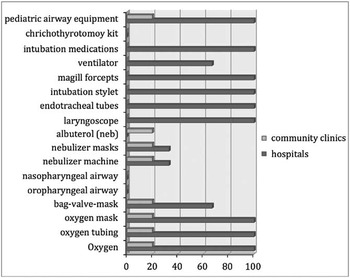
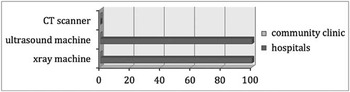
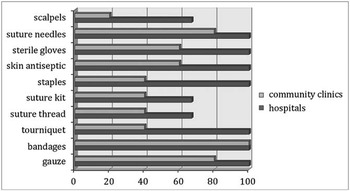
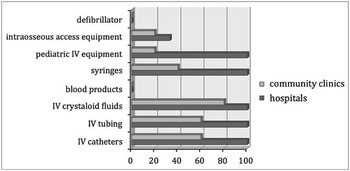
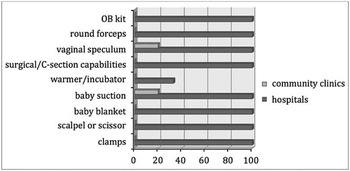
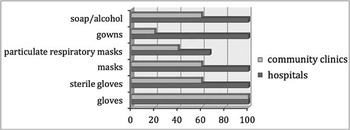
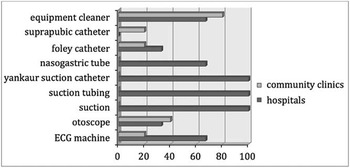
Additional available equipment differed greatly between hospitals and community clinics, with hospitals generally having increased access to equipment (Figure 1 through Figure 9). In particular, hospitals had more access to airway equipment and medications (Figure 1) and radiology services (x-ray and ultrasonography; Figure 2) than community clinics. No computed tomography existed in the region. Hospitals also had increased access to materials to manage basic injuries (Figure 3), hemodynamic resuscitations (Figure 4), and obstetric and gynecological emergencies (Figure 5). Health clinics did not have basic equipment to manage obstetrical emergencies or imminent deliveries (Figure 5). Personal protective equipment and antiseptic consistently were more available in hospitals (Figure 6), as was most miscellaneous medical equipment (Figure 7).
Percentage of Health Facilities with Consistent Airway Equipment Access.

Percentage of Health Facilities with Consistent Equipment Access. Abbreviation: CT, computed tomography.

Percentage of Health Facilities with Consistent Materials Access.

Percentage of Health Facilities with Consistent Resuscitation Materials Access. Abbreviation: IV, intravenous.

Percentage of Health Facilities with Consistent OB Materials Access. Abbreviation: OB, obstetrics.

Percentage of Health Facilities with Consistent Personal Protective Equipment Access.

Percentage of Health Facilities with Consistent Miscellaneous Medical Equipment Access. Abbreviation: ECG, electrocardiogram.

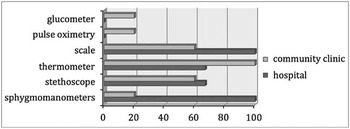
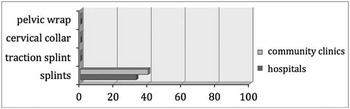
Equipment for patient monitoring was not available in all hospitals (Figure 8). In particular, pulse oximetry and glucometers were only available in a single community clinic. Stethoscopes were not present in all clinics (3; 60%). Materials for traumatic fracture management (Figure 9) largely were absent, and thoracostomies and the attendant equipment for penetrating chest trauma were not available.
Percentage of Health Facilities with Consistent Patient Monitoring Equipment Access.

Percentage of Health Facilities with Consistent Trauma Equipment Access.

Medications
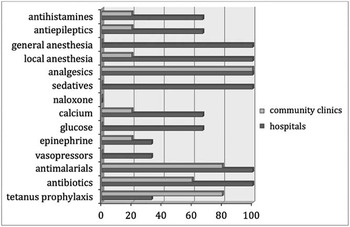
Overall, hospitals had more access to medications, particularly anesthetics, sedatives, and analgesics (Figure 10).
Percentage of Health Facilities with Consistent Medications Access.

Services
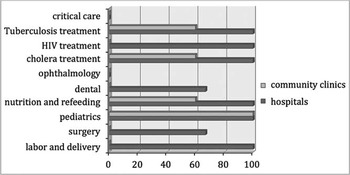
All hospitals reported labor and delivery services, nutritional support services, as well as treatment of cholera, HIV-related illnesses, and tuberculosis (Figure 11). Surgical services and dental care were available at two of the three hospitals. All health centers reported the ability to care for pediatric patients. No critical care or ophthalmological services were available. There was no clinic-based HIV care, and cholera and tuberculosis could be treated from the clinic in three (60%) of the clinics.
Percentage of Health Facilities with Consistent Treatment and Services Access.

Protocols
All hospitals and clinics reported maintenance of records for patients seen in the acute care setting. Only one clinic and no hospitals reported the existence of an additional staffing resource list to be used in event of disaster or emergency situations.
Staff reported a protocol for the transfer of patients requiring a higher level of care was present in four (80%) of the clinics and one (33%) of the hospitals. Several persons interviewed reported that when advanced care was needed, they sent the patient with a referral note to the closest MSPP hospital, regardless of whether that facility had the capability to handle this type of case. Some individuals noted that this could be a cause for delay in patient care. Telephone or radio communication with the receiving facility was not utilized. Only one health facility, a hospital, had intermittent access to an ambulance for the transport of patients in event of hospital transfer. No health facility reported the use of a protocol or phones for the transfer of patients.
Health Care Personnel
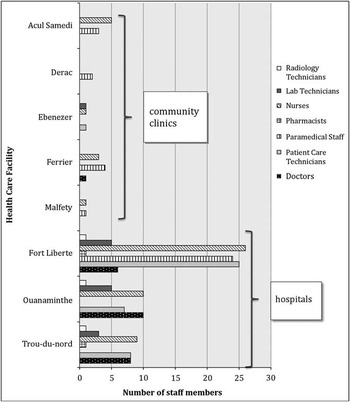
All hospitals and no clinics reported being open for 24 hours a day. Supervisory level physicians were reported as consistently available during the entire 24 hours in two (66%) of the hospitals. Other health care personnel, such as nurses, midlevel providers, and technicians, existed in varying numbers in the different health facilities, with larger numbers in the hospitals than the clinics (Figure 12).
Health Care Personnel in Hospitals and Clinics.

Bed Capacity
All hospitals had inpatient adult beds. Two hospitals had pediatric inpatient beds and two hospitals had emergency care area beds. One hospital had a cholera treatment center with beds located in a separate structure (Table 1).
Patient Bed Capacities

Discussion
This study provides quantitative and qualitative data that were unavailable previously on the existing resources in several health care sites within the North East Department of Haiti. The amount of resources in both regional hospitals and district clinics were found to vary widely, but overall, there were significant gaps in the availability of physical resources and protocols needed for the provision of effective emergency care. This information guides areas for future work aimed at health care improvement as well as further study.
Similar to previous studies evaluating the availability of emergency equipment in various settings, hospitals generally had more emergency care equipment than the community clinics. 11 As the majority of critical emergency care is performed in hospitals, this likely is appropriate. However, as clinics are often the first points of contact for those seeking emergency care, some basic resuscitation equipment could be life saving. Further research in resource-limited settings is needed to identify the most cost-effective solutions needed for the stabilization of patients prior to a transfer to an advanced level of care.
Given the high maternal and infant mortality rates in Haiti,Reference Mock, Nguyen, Quansah, Arreola-Risa, Viradia and Joshipura 12 , 13 and the emphasis on improving maternal reproductive health in the United Nations Millennium Development Goals, 14 adequate obstetric care within both clinics and hospitals is a necessity. In regions where distances to hospitals can be long and road access is often poor, lengthy journeys to health centers negatively impact mortality. 15 Clinics may often be the first point of medical assistance for women in labor. However, clinics were not equipped to manage obstetric emergencies or imminent deliveries. While conclusive evidence is not available,Reference Wilson, Hillman and Rosato 16 there is some preliminary evidence that single-use obstetric emergency kits reduce mortality in other resource-limited settings.Reference Hundley, Avan, Braunholtz and Graham 17 There are also indications that the use of disposable obstetric kits could decrease the incidence of neonatal tetanus.Reference Ouma, Chemwolo, Pastakia, Christoffersen-Deb and Washington 18 Furthermore, performing basic neonatal resuscitation, including an appropriately sized bag-valve-mask, has the potential to decrease neonatal deaths up to 30% in resource-limited settings.Reference Raza and Avan 19 It is likely that improved obstetric and neonatal resuscitative equipment in the clinics can have a significant, positive impact on mortality.
Overall, much of the equipment that is available easily in high-income health care settings, such as sphygmomanometers, glucometers, and pulse oximeters, were not available consistently to health care providers in the North East of Haiti. Radiographic equipment was also limited. The finding of equipment scarcity is not a unique challenge in low-income settings. Examples of similar findings come from medical center evaluations in various locations in sub-Saharan Africa.Reference Wall, Lee and Niermeyer 20 - Reference Penoyar, Cohen and Kibatala 24 Research focused on the use and applicability of alternatives to expensive medical equipment in resource-limited settings is sparse, although some alternative sphygmomanometers have been tested successfully.Reference Kingham, Kamara and Cherian 25 , Reference Parati, Kilama and Faini 26 Further research and implementation of practical equipment solutions for low-income settings would be of benefit.
While the absence of certain materials was noted in most health facilities, some of the supply deficits can be mitigated with appropriately focused training. For example, while pelvic binders may not be present in any hospitals or clinics, knowledge of alternative ways of wrapping an unstable pelvis with a sheet could be of great practical benefit, as sheet alternatives have been found to have the same effect on the hemodynamics of pelvic fractures as the more expensive pelvic stabilization devices on the market.Reference Baker, Hezelgrave, Magesa, Edmonds, de Greeff and Shennan 27 Training that is responsive to the needs and priorities of each location could have a substantial positive impact. Promising approaches to increasing the level of training in low-income health centers are being explored, notably through telemedicine, mobile devices, and other information technologies.Reference Prasarn, Conrad, Small, Horodyski and Rechtine 28 - Reference Lewis, Synowiec, Lagomarsino and Schweitzer 30
In the context of significant restrictions in materials and specialized training opportunities, it is not surprising that there are gaps in medical services available. The lack of access to critical care places those with life-threatening conditions at a survival disadvantage. This challenge is not limited to Haiti, as other low-income countries in sub-Saharan Africa also have limited critical care access.Reference Agyeman-Duah, Theurer, Munthali, Alide and Neuhann 21 , Reference Kingham, Kamara and Cherian 25 , Reference Chanda and Shaw 31 This does, however, have practical implications. With limited data on the most effective approaches to resuscitation in resource-limited settings, for example, it is not established currently if the approach to emergency care and resuscitation utilized in high-income settings is appropriate for more resource-constrained environments such as the North East of Haiti.Reference Firth and Ttendo 32 It is possible that prehospital resuscitation guidelines focusing on chest compressions and ventilatory management may be irrelevant if the referral hospital does not have the equipment to sustain artificial ventilations or perform advanced cardiac care. Further study is needed to establish appropriate guidelines for resuscitation in the absence of critical care capabilities.
By not being available at all hospitals, surgical services can be difficult for the population of the North East of Haiti to access. This challenge is not unique in low-resource settings. Similar surgical access limitations have been found in Pakistan and numerous Sub-Saharan African countries, and some of these studies have concluded that preventable deaths have occurred as a result of delayed or inaccessible surgical interventions.Reference Aufderheide, Nolan, Jacobs, van Belle, Bobrow and Marshall 33 - Reference Zafar, Fatmi, Iqbal, Channa and Haider 36 One approach to increasing surgical capacity has been utilized in Tanzania and Somalia, with promising initial findings: the use of task shifting; that is, surgical procedures performed by non-physician clinicians in the face of limited physician human resources.Reference Linden, Sekkide, Galukande, Knowlton, Chackungal and McQueen 37 , Reference Chu, Ford and Trelles 38 Novel approaches such as these warrant further study for generalizability and feasibility in other resource-limited settings such as the North East of Haiti.
All facilities could benefit from improved infrastructure, namely access to potable water and uninterrupted electricity. Clinics without running water or electricity face further obstacles when providing emergency care. A similar infrastructure gap is present in other resource-limited settings such as Ghana, Kenya, Uganda, and Tanzania.Reference Beard, Oresanya, Akoko, Mwanga, Mkony and Dicker 39 Infrastructure investment, while expensive, could likely have far-reaching positive effects in low-income medical settings such as North East Haiti. These investments are likely to be high-yield for regional development and sustainably and improved public health, but they will require coordination between funders, governing bodies, and developers.Reference Hsia, Mbembati, Macfarlane and Kruk 40
An investment in road infrastructure would also improve access to health care services. Researchers conducted site visits to each of the facilities included in this study and noted limited access to multiple health facilities due to challenges utilizing the existing roads. Also, because the MSPP hospitals were near developed roads, and these roads are located along the periphery of the region, those areas of the North East Department without access to the main roads find it much more difficult to access hospitals. As a result, those living within the interior of the North East Department with limited road access likely rely more heavily on the health services provided at local clinics.
The development of a formal emergency care system is a priority of the WHO, requiring the strengthening of informal prehospital systems as well as existing emergency care systems.Reference Yang, Farmer and McGahan 41 The World Health Assembly Resolution 60.22 recommends member states assess the prehospital and emergency care context, such as an emergency care system, in order to identify unmet needs. Efficient transfer methods with effective communication between referring and receiving health facilities are essential components of emergency care. With the knowledge of the capacities of receiving facilities to accept and treat specific cases, efficient transfer protocols, the transfer of medical records, and transportation of patients by medical professionals who can anticipate changes in clinical status, the efficiency and effectiveness of medical care can be maximized. 42 Better communication between facilities and the establishment of formal transfer protocols are initial steps towards a more effective transfer process in this resource-constrained setting. These represent low-cost areas for potential improvement.
Limitations
There are several limitations to this study. To begin with, the study depended on the recall of health facility staff members participating in the study. While efforts were made to ensure that those most familiar with the stockrooms and equipment were study participants, some bias may have been introduced. Also, the survey and list were time consuming to complete, so there may have been fatigue on the part of study participants, introducing another potential source of bias.
As accessibility to materials was often described as inconsistent, this was difficult to quantify. As a result, the distinction of “consistently available” material was made. Inconsistently available equipment is underrepresented in this study.
The WHO Needs Assessment and Essential Emergency Equipment lists contain elements that may not represent the minimum standards for effective emergency care. Several low-cost, potentially life-saving equipment items are missing, and some of the equipment for use by a skilled professional may not be appropriate for the clinic setting, particularly in resource-limited contexts. Modifications will need to be made to the WHO Needs Assessment and Essential Emergency Equipment list in order to make them appropriate reference documents for global use, evaluating capabilities for the provision of emergency care. A better alternative for trauma care evaluation may be found in the WHO Guidelines for Essential Trauma Care, although it is exclusively trauma-focused, thus excluding non-traumatic conditions requiring emergent care.Reference Sethi and Subramanian 43 The authors recommend additional consultation with specialists in Emergency Medicine to broaden the scope of the assessment of emergency capabilities to include nontraumatic emergency conditions.
Additionally, the wording of the Needs Assessment and Evaluation Form was challenging for participants to understand. In particular, terms such as “best practice protocols” needed to be explained to those completing surveys. The verbal explanations of the questions may have introduced some level of bias. Questions requiring documentation of referrals, such as “decreased levels of referrals due to the incorporation of new skills” also requires a level of documentation that infrequently was present and could introduce bias if based on recall alone.
A more recent version of the WHO Needs Assessment, the Tool for Situational Analysis to Assess Emergency and Essential Surgical Care,Reference Mock, Lormand, Goosen, Joshipura and Peden 44 has been more widely used, sometimes in a modified format, but generally was found to be useful.Reference Penfold, Shamba and Hanson 23 , Reference Penoyar, Cohen and Kibatala 24 , 45 - Reference Kwon, Kingham and Kamara 47 This version has more comprehensible wording of questions and does not rely on as extensive documentation of referring health centers; however, it remains focused on surgical interventions to emergencies rather than generalized care for emergent conditions. One preliminary study carried out in Ghana found the tool to be reliable in evaluating health center infrastructure; however, process of care measures were found to be less reliable.Reference Taira, Cherian, Yakandawala, Kesavan, Samarage and DeSilva 48
Conclusion
The World Health Assembly Resolution 60.22 recommends member states assess comprehensively the prehospital and emergency care context in order to identify unmet needs. It also urges the leadership of the WHO to determine standards for the evaluation of health facilities, to support quality improvement mechanisms, and to work with stakeholders in planning, administering, financing, and executing trauma and emergency care. This investigation aimed to assist in achieving these goals.
Existing health care needs can be met through investment in infrastructure, improved availability of equipment and medications, as well as improved emergency care training and protocols. The WHO Essential Emergency Equipment list should be updated to reflect equipment needed for a variety of surgical and nonsurgical emergency conditions. The survey tool could also be updated to be less lengthy and more widely applicable to diverse health care facilities. This study also illuminates numerous potential paths for how, in collaboration with local partners, existing resources in this low-income setting can be maximized to improve the quality of emergency care provided.
Supplementary Material
To view supplementary material for this article, please visit http://dx.doi.org/10.1017/S1049023X15005221