1. INTRODUCTION
When do religious organizations become supporters of democratization? The relationship between religion and democracy has long puzzled comparativists, but the question has only increased in salience over the last decades. The reemergence of organized religion as a major force in politics has discredited vulgar forms of the secularization thesis, which argued that it was doomed to political irrelevance and eventual disappearance (Casanova Reference Casanova1994). Instead, there is a growing concern with the conditions under which religion supports democracy and fosters peace, and those under which it may favor authoritarianism and violence (Philpott Reference Philpott2007). In this regard, the involvement of the Catholic Church in the political transformation of South America remains among the most outstanding instances of organized religious influence on democratization. Although the study of transitions has become a staple of comparative politics, and one with a distinctly Latin flavor (O’Donnell and Schmitter Reference O'Donnell and Schmitter1986; Przeworski Reference Przeworski1991), the complex and prominent role played by the Catholic Church during this period remains poorly understood.
Samuel Huntington was among the first to note that the third wave was in many ways a Catholic wave, since the majority of countries that experienced transitions were predominantly Catholic (Huntington Reference Huntington1991; Philpott Reference Philpott2004). In presenting this finding, Huntington pointed to the many instances in which Catholic authorities defied authoritarian regimes, provided space for oppositions to organize, and lent their moral authority to democratic causes. However, even a cursory examination of the cases makes it clear that the church was not always and everywhere an outspoken advocate for democracy. Thus, while in Brazil the church became the focal point for opposition to the regime, in Argentina several Catholic bishops were outspoken in their support for military rule, and in Uruguay they remained effectively silent in the face of human rights abuses by authorities.
What accounts for this variation in church support for democratization? Scholars have provided a variety of explanations, including changes in church ideology associated with the Second Vatican Council (Huntington Reference Huntington1991; Gutierrez Reference Gutierrez1973), the degree of differentiation between church and state (Philpott Reference Philpott2004), and the presence of protestant competitors (Gill Reference Gill1998). This article contributes to this body of scholarship by providing a general, theoretically grounded explanation for this variation, supported by robust qualitative comparative analysis. It argues that the choices of national churches can be best understood by considering a set of variables typically associated with social movement theory: political opportunities, mobilizing structures and cultural frames (McAdam, McCarthy and Zald Reference McAdam, McCarthy and Zald1996).
The argument presented in this article can be summarized in terms of three propositions. First, in terms of cultural frames, the ideas associated with the Second Vatican Council encouraged pro-democratic stances in most South American countries, but actually weakened them in others, illustrating how the same framing strategy can have a radically different impact depending on context. Second, contrary to monolithic visions of the Catholic Church, variations in national-level mobilizing structures and resources were crucial in explaining the behavior of national churches, insofar as these varied sharply in terms of their capacity to challenge the authoritarian state and withstand its predictably repressive response. Third, the political opportunity for effective pro-democratic activism was shaped, in large part, by the presence of allies and opponents of the church in political society. Each of these three was a necessary cause of pro-democratic activism, and the three were jointly sufficient.
Before proceeding to the examination of the cases, there are a number of key points that require clarification. First, this article focuses almost exclusively on the behavior of national episcopacies in determining how to classify churches along the dependent variable. From a theoretical standpoint, there is a significant difference between the strategic choices faced by members of the hierarchy, who are spokespersons for the national church and thus responsible for the well-being of the organization, and individual priests, whose actions do not necessarily represent the decisions of the broader community. Since this article is concerned with the conditions under which religious organizations become involved in pro-democratic activism, rather than the actions of particular religious individuals, a focus on the hierarchy is clearly warranted. In terms of pragmatism, a focus on actions of bishops significantly reduces the scope of the analysis and increases the ease of measurement — it would be virtually impossible to determine what proportion of priests in a specific country spoke out in favor of democracy, or how consistently they did so.
Second, this article uses a tripartite classification of the positions toward democracy and dictatorship that a national church can assume: consistently and publicly pro-democratic, inconsistently or selectively pro-democratic, and passively or actively pro-authoritarian. In reality, churches, and even episcopacies, are of course polyvocal, and their individual members can (and often did) adopt virtually any position within a continuum ranging from constant, public condemnation to constant, public support, with passivity laying somewhere in the middle. Even assuming a unified stance, episcopacies adopted positions somewhere between the two extremes, although generally on the pro-democratic half of the spectrum.
Significant simplifications thus underlie the classification advanced herein, and these are worth clarifying. It is worth noting that important efforts in favor of human rights and to support the victims of dictatorships were carried out by Catholic groups in every South American country (Smith Reference Smith1979). However, as will be discussed below, the strength and consistency of hierarchy support for these efforts varied significantly, from cases in which they were effectively abandoned after regime repression, to those in which support waxed and waned, and finally to those in which they provided continuous public endorsement. In addition, the classification used here considers passivity as de facto equivalent to pro-authoritarianism. This is because virtually all the authoritarian governments in South America during this period claimed to be acting in support of Christian civilization against atheist Communism, and carried out a variety of policies intended to signal their closeness to the Catholic Church (Johnston and Figa Reference Johnston and Figa1988). The unwillingness of church authorities to publicly distance themselves from these state efforts enhanced the credibility of the latter’s position, thus endowing it with an important degree of legitimacy.
Third, this analysis focuses on the behavior of episcopacies in South America, rather than in all of Latin America. While many Mexican and Central American bishops played important roles in the evolution of church ideology, received and frequently embraced the teachings of Vatican II and liberation theology, and were often active in heroic struggles for democracy and social justice, the political environment in which they operated was fundamentally different from that which faced their South American counterparts. In Mexico, the uniqueness of its gradual and largely electoral transition, combined with the delicate modus vivendi established between the hegemonic Catholic Church and the lay state since 1940, substantially modified the role that religious authorities could play as central actors in the democratization effort (Loaeza Reference Loaeza, Mainwaring and Scully2003; Blancarte Reference Blancarte and Hagopian2009). In Central America, there has been a prevalence of weak states with far less autonomy and capacity than their southern neighbors. Foreign powers, specifically the United States, were directly involved in the political fate of their regimes, and these regimes were generally unable to assert their sovereignty over their territory: while no authoritarian regime in South America became engaged in a civil war, half of Central American states suffered from them, and the other three become unwilling hosts for guerrillas and paramilitary organizations tied to these conflicts (Dunkerley Reference Dunkerley1988). The threats, expectations, and possibilities entailed by these conditions made the political environment in which their bishops operated fundamentally unlike that which existed in authoritarian regimes in South America.
Finally, as stated above, the hypotheses explored herein are framed in terms of necessary and sufficient conditions. In order to test them empirically, I will use fuzzy-set Quantitative Comparative Analysis, as developed by Ragin (Reference Ragin2000, Reference Ragin2006), in the following pages. The debate surrounding the value of this method is both enlightening and extensive but I shall not engage in it directly, other than to provide a very brief description of the technique in Section 4 and, hopefully, as an informative instance of its application.
2. LINKING IDEOLOGY, RESOURCES, AND OPPORTUNITIES
This article advances a theoretically informed argument for why some South American churches adopted public anti-authoritarian stances while others chose to support military rule or remain silent. Like previous research on this topic, it develops a multi-causal argument, identifying a set of causes whose interaction shapes outcomes (Johnston and Figa Reference Johnston and Figa1988; Philpott Reference Philpott2004). However, in contrast to these works, it embeds this argument in an explicit theoretical framework with a broader range of applications, namely the one advanced by scholars of social movements and contentious politics (Tarrow Reference Tarrow1994; McAdam, Tarrow and Tilly Reference McAdam, Tarrow and Tilly2001). Building on these insights and the work of others analyzing religious phenomena using social movement theory (Wald, Silverman and Fridy Reference Wald, Silverman and Fridy2005), it emphasizes the importance of the interaction between cultural frames, mobilizing resources and capacity, and political opportunities.
First, it argues that the emergence of the pro-democratic, pro-social justice frames associated with Vatican II was a necessary condition for pro-democratic activism, in that it predisposed the Catholic hierarchy against cooperation with the kind of conservative dictatorships that it had supported in the past. However, when military regimes successfully co-opted elements of this discourse the result was far more limited pro-democratic activism by the church. Second, significant differences in mobilizing capacity among national churches left small churches vulnerable to regime repression, while others were able to resist the repression effectively. This was therefore another necessary condition for effective pro-democratic activism. Finally, the political opportunity represented by democratization depended on the type of political parties operating in the political arena. When its potential allies were weak and its opponents were strong, churches could tolerate authoritarian rule rather than anticlerical democracy. Thus, the existence of friendly political parties and the absence of strong opponents constitute a third necessary condition. These three conditions are jointly sufficient for a church to develop a sustained pro-democratic position.
2.1. Cultural Framing: Vatican II and Democratic Advocacy
There can be little doubt that changing cultural frames were a key factor shaping the attitudes of national churches regarding democracy and dictatorship. Before Vatican II, one might have been legitimately puzzled by why a church would oppose conservative military rule; after 1968, the puzzle resides in how a church could fail to oppose it. Thus, when religious authorities in Argentina supported the overthrow of Peron by the military in 1955, they were acting in accordance to the implicit norm; in 1983, when they claimed that those who had disappeared under military rule were probably living outside the country, they were clearly operating outside the mainstream of the church (Klaiber Reference Klaiber1998, 70–81). Without the legitimization provided by Vatican II, national episcopacies would almost certainly have remained passive, if not actively supportive, in the face of conservative military rule (Levine Reference Levine1978; Johnston and Figa Reference Johnston and Figa1988).Footnote 1
In South America, the emerging pro-democratic discourse had two interrelated but distinct currents. First, the Second Vatican Council (1962–1965) promoted a vision of the church as a staunch defender of human rights and an advocate of democracy, in sharp contrast with the conservative and even reactionary positions it had frequently espoused up to that point (Smith Reference Smith1975; Huntington Reference Huntington1991; Philpott Reference Philpott2004). Over the next decades, Popes issued a number of statements in favor of peace, toleration, and equitable development, including encyclicals such as Pacem in Terris, Nostra Aetate, and Populorum Progressio. Together, these held the potential to radically de-legitimized authoritarian practices common in South America at the time, and created conditions that allowed priests and bishops to challenge authoritarian governments.
Second, a more leftist strand of thought emerged among some members of the South American clergy, which came to be known as liberation theology. Liberation theology borrowed from Marxist thought its concern with the structural foundations of injustice, and advocated a fundamental re-structuring of society to produce a more equitable distribution of resources as a means of fulfilling the prophetic mission of the Catholic Church (Gutierrez Reference Gutierrez1973; Levine Reference Levine1988). Many young priests seized onto this way of thinking with passionate zeal and became increasingly involved in revolutionary activity (Sigmund Reference Sigmund1992). While this thinking drew upon the principles of Vatican II, failure to draw a conceptual distinction between the two is likely to lead to important misconceptions. Most national episcopacies remained skeptical or even hostile to what they perceived as radical leftist influence, while at the same time accepting the moderate and pro-democratic teachings coming from the Vatican (Mainwaring and Wilde Reference Mainwaring, Wilde, Mainwaring and Wilde1989). Thus, during the 1970s, while the church hierarchy in Brazil embraced both Vatican II and liberation theology, it was probably unique in this regard (Kearney Reference Kearney, Manuel, Reardon and Wilcox2006, 158). As Scott Mainwaring notes:
The Brazilian Church … struck a balance between the base and the hierarchy. Without the deep concern the progressive groups have displayed for institutional questions, especially for working within the whole institution, they would probably have suffered the same marginalization that radical priests’ organizations did elsewhere in Latin America. (Mainwaring Reference Mainwaring1986, 21)
Chile provides another example. After 1976, the Catholic Church stood firmly in favor of human rights and against the dictatorship, but it had already firmly rejected its most radically progressive elements, namely the priests that formed the Christians for Socialism group (Smith Reference Smith1982). In this regard, it is worth noting that following the transition to democracy in 1989 the church consolidated itself as a conservative force in Chilean society and politics (Lies and Malone Reference Lies, Malone, Manuel, Reardon and Wilcox2006; Hagopian Reference Hagopian2008).
While military dictatorships almost always operated in ways that placed them in direct confrontation with both of the progressive trends within the church, there are at least two cases of authoritarianism that benefited from the perceived ideological tension between discourse on democratization and social justice — the dictatorship of Velasco Alvarado in Peru (1968–1975) and that of Rodríguez Lara in Ecuador (1972–1976).Footnote 2 These cases are usually excluded from systematic comparative analyses of church support for democracy in Latin America. This is unfortunate, since the unique combinations of progressive ideology and authoritarian governance that characterized Velasco and, to a lesser extent, the Rodríguez Lama regimes provide important inferential leverage in determining when churches became advocates for democracy and when they did not.
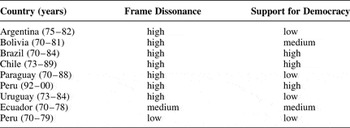
Unlike the military governments elsewhere on the continent, the Velasco regime engaged in a wide range of popular reforms, many of which drew their inspiration from Christian Democracy and the social teachings of the church, and received the endorsement of a number of Christian Democratic intellectuals, some of whom took positions within the regime (Schmidt Reference Schmidt, Mainwaring and Scully2003). Although using similar discourse to justify its policies, the Ecuadorian military adopted far less thorough reforms (Dávila Reference Dávila1981). In addition, both engaged in far fewer violations of human rights than the conservative bureaucratic-authoritarian regimes that governed elsewhere on the continent (Isaacs Reference Isaacs1993; Klaiber Reference Klaiber1998, 143), reducing the pressure on the church to speak out for human rights. In spite of these similarities, the degree of ideological coincidence between the Peruvian church and the military was significantly greater than in Ecuador. From the 1950s to the 1980s, the Peruvian church was among the most progressive in South America (Klaiber Reference Klaiber1996), and actively struggled for social justice; the emergence of a progressive regime capable of enacting important reforms was too good an opportunity to waste. The church explicitly stated its approval of many measures pursued by the Velasco regime, including its seizure of a major privately owned newspaper, and encouraged the faithful to cooperate fully with the reforms initiated by the new regime (Pasara Reference Pasara, Mainwaring and Wilde1989). Although it did speak for the importance of returning to democracy and criticized government policies during the tenure of Velasco’s successor, Morales Bermudez (1975–1979), the church in Peru did not constitute a central or active part of the pro-democracy movement. In contrast, the Ecuadorian church did engage in important anti-authoritarian activities, particularly during the final years of the regime (Gill Reference Gill1998, 115–116). Table 1 summarizes these arguments.
Framing and support for democracy

2.2. Mobilizing Resources: Links and Activism
The second factor shaping church willingness to challenge conservative authoritarianism can be understood in terms of mobilizing resources and capacity, in that church ability to withstand government pressure exhibited significant variation. As was the case in many parts of the world during this period, South American dictatorships presented themselves as defenders of order and civilization against atheist communism and anarchy, and could therefore ill-afford to engage in public displays of violence against the Catholic Church (Johnston and Figa Reference Johnston and Figa1988). Instead, they usually relied on the identification, isolation, and selective suppression of suspect church members. This strategy, however, posed serious logistical challenges, because it depended on a regime’s ability not just to repress individual clergy members, but to monitor and cut-off links among potential activist priests. The number of these links increases rapidly with the size of the church, and specifically with the number of clergy, as will be described below. Large churches had more links among their members, real or potential, to monitor and sever, not to speak of additional links to friendly groups in civil society. Small churches, those with few bishops and priests, were therefore most vulnerable to the kind of strategies used by the military. In contrast, churches with many thousands were virtually impossible to suppress without provoking massive unrest.
The precise operationalization of this measure is obtained by calculating the number of links among clergy members that a regime needs to monitor, converted to a per capita measure in order to compensate for the greater size of the military in larger countries. The formula describing the number of unique connections among members of a group is ∑ (n − 1), where n refers to the total number of members. Thus, a group with five members has 4 + 3 + 2 + 1 = 10 distinct potential connections among its members.Footnote 3 The resulting number is then divided by the average total population (in thousands) during the period covered by military rule.
Simpler measures, such as priests per inhabitant, underestimate how increasing church size expands the logistical issues associated with effective but discreet monitoring of a critical mass of priests. Thus, a priests-per-capita measure presents the Uruguayan church as more resistant to suppression than the Brazilian (19 per hundred thousand versus 11 per hundred thousand), yet monitoring the links among Brazil’s 13,000 priests posed a much greater barrier to effective intimidation than those among Uruguay’s 570, even accounting for the greater capacity of the Brazilian military (Annuario Statistico della Chiesa 1970–2000).
The fate of church-led opposition in the three smallest churches, Bolivia, Paraguay, and Uruguay, bears out this claim. In all three cases, a period of resistance and pro-human rights activism very similar to that carried out elsewhere was followed by repression, after which the church ceased to challenge the regime. In Bolivia, the church first responded to the conservative regime of Hugo Banzer (1971–1978) with wary acceptance, followed by increasing contestation. In 1973, the church organized the Justice and Peace Commission, which investigated cases of human rights violation and organized public prayers and vigils. However, in 1975, the commission went into recess following a string of harassment episodes by the military, culminating in the expulsion of two priests who were among of its leading members (Klaiber Reference Klaiber1998, 126–128). In Paraguay, the period from 1969 to 1973 was marked by substantial church-state conflict, as liberation theology-inspired priests, to the discomfort of many in the hierarchy, collaborated with peasant leagues that were challenging the authority of the Stroessner regime. State persecution of priests was met with the condemnation of bishops. However, by 1973 the church was exhausted by the conflict, and in 1975–1976 the government carried out a violent repression of the leagues combined with selective repression of the church. In 1976, the police twice seized the Jesuit’s school in Asunción, arguing that they had collaborated with a subversive movement. This was followed by the expulsion of 12 Jesuits, and the placement of several seminaries in the country under strict surveillance. The Paraguayan hierarchy, which had only hesitatingly challenged the regime, avoided pro-democratic activism until the waning years of the Stroessner regime (Carter Reference Carter1990; Klaiber Reference Klaiber1998, 96–98). Finally, in Uruguay, a period of protest against the military-backed semi-democratic regime of President Bordaberry (1971–1973) that briefly intensified after the 1973 self-coup, led to the arrests of a Jesuit priest and the bishop of Salto, both of whom were accused of having links to members of the leftist insurgency. By 1974, systematic oppositional activity had ceased and the church did not play a role in pro-democratic advocacy until the final years of the regime (Klaiber Reference Klaiber1998, 114–115).
The vulnerability of these national churches stands in stark contrast to the resilience of church-led opposition in places like Chile. There, the significantly greater resources of the church allowed it to engage in a broad range of activities that diminished the legitimacy of the Pinochet regime, including the Comité por la Paz Chilena (Committee for Chilean Peace (COPACHI)), which provided legal aid to prisoners and those arbitrarily dismissed from their jobs, and its replacement, the Vicariate of Solidarity, which carried out similar activities. The government response was similar to that in Bolivia, Paraguay, and Uruguay, and included arrests, arbitrary searches, expulsion of foreign priests, and campaigns discrediting church-led organizations in the media. These led to the closure of COPACHI in December 1975, but the church responded by establishing the Vicariate in January 1976 (Smith Reference Smith and Levine1986). The ability of the Chilean church to bounce back after increased repression is, without a doubt, a tribute to its democratic commitment, but it also shows how a stronger, larger church organization was less vulnerable to tactics that could shut down smaller churches.
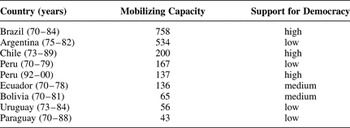
The outliers in the pattern that emerges from Table 2 are Argentina from 1975–1982 and Peru from 1970–1979. The roots of the second exception have already been discussed in terms of how the ideological particularities of the Velasco regime interacted with the cultural frames of the Second Vatican Council. In order to understand the choices made by the Argentinean church, it is necessary to incorporate a third key factor, namely how the political opportunity structure was shaped by the presence (or absence) of potential support for the church in political society.
Resources and support for democracy

2.3. Political Opportunity: Allies and Antagonists in the Political Sphere
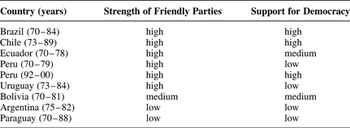
A growing body of scholars of democracy emphasizes the importance of political parties as a crucial feature of the political opportunity structure (Kitschelt Reference Kitschelt1986), and specifically as a means of securing compliance from those groups that stand to lose power or influence under a new regime (Rueschemeyer, Stephens and Stephens Reference Rueschemeyer, Stephens and Stephens1992; Middlebrook Reference Middlebrook and Middlebrook2000). Most research in this area has focused on the political representation of economic elites, but the arguments can be broadly applied to all those for whom democratization entails potentially significant losses and are capable for resisting or destabilizing a democratic regime, making the linkages between groups and representatives a key feature of democratic transitions and stability (Levine Reference Levine1988). During the early 20th century, every South American church suffered serious challenges to its resources and autonomy when groups or parties hostile to its interests gained access to the institutions of the state. Even after the constitutional differentiation was secured, key interests of the church remained highly vulnerable to state interference. Secular authorities could pass legislation restricting religious education, expel foreign clergy, or engage in propaganda campaigns against the church, to name some of the many resources available to the state interested in engaging in any sort of Kulturkampf. Thus, the presence of strong political parties with interests that were at least compatible with those of the church was a necessary condition for whole-hearted support for democratization among the hierarchy. Table 3 presents the correlation between the strength of potential allies in political society and support for democracy.
Opportunity and support for democracy

The strength of opposition parties under authoritarianism is inherently uncertain, since there are no electoral results with which to assess their attractiveness to the citizenry. The estimates used here are therefore based on a combination of pre-authoritarian success and party system evolution under authoritarianism. The second element is not as difficult to evaluate as it may seem at first, particularly given the simple three-level classification scheme used here. Although all opposition parties tended to endure significant measures of persecution, the parties most likely to be hostile to the church — anticlerical socialists and Communists — were those that were most often decimated by systematic state persecution.Footnote 4 Moderate centrist coalitions, based on broadly pro-democratic but fundamentally anti-radical platforms became the most salient players in most of these environments: the Movimento Democrático Brasileiro and its descendants in Brazil, Acción Popular and the Partido Popular Cristiano in Peru, the Concentración de Fuerzas Populares, and Partido Social Cristiano in Ecuador, the Partido Demócrata Cristiano in Chile, and the Partido Nacional in Uruguay, are but some of the parties that emerged as powerful players in the post-authoritarian political arenas. Furthermore, the remains of the left often found refuge under the progressive elements of the Catholic Church. Thus, the Partido Socialista in Chile, the Frente Amplio in Uruguay, and the Partido dos Trabajadores in Brazil emerged effectively free of the anticlericalism of their pre-authoritarian forbearers (Scully Reference Scully, Mainwaring and Scully1995; Gonzalez Reference Gonzalez, Mainwaring and Scully1995; Keck Reference Keck1995). These developments were widely understood, and the relative popularity of particular opposition leaders was usually common knowledge among local elites, who could therefore assess the likelihood that a friendly candidate would capture the main organs of the state.
In the simple three-level coding scheme used here, the strength of potential church allies is considered high if a moderate centrist party or a Christian Democratic party was likely to capture a plurality of votes in a free election. A medium score implies that these parties faced credible competition from anticlerical opponents. Finally, a score of low indicates that the likely beneficiaries of democratization would almost certainly be antagonistic to the interests of the church.
The Argentinean case thus no longer appears as an exception. Literature on Argentina has repeatedly pointed out that its troubling tendency to revert to authoritarianism is directly linked to the inability of its elites to compete effectively in the electoral arena (O’Donnell Reference O’Donnell1979, 167–201; Boron Reference Boron and Middlebrook2000). There is no reason to believe that this dynamic did not also apply to the area of church-state relations. As noted earlier in this study, the final years of Perón’s first presidential tenure were marked by a sharp conflict between Peronistas and the church. The chaos and instability that characterized his second government and that of his wife Isabel consolidated the church’s hostility to the Partido Justicialista, and it was clear that a return to democracy would empower the Partido Justicialista. In addition, the second party in Argentina’s two-party system, the Unión Cívica Radical, also had a troubled history with the Catholic Church, and stood for many socially progressive positions fundamentally inimical to it (Klaiber Reference Klaiber1998, 67–70). Over the course of the 20th century, the church consolidated its alliance with the military and the oligarchy as a means of preserving its influence amidst a clearly hostile political environment.
The two most glaring exceptions to the pattern that appears in Table 3 have already been explored: Peru (1970–1979), due to the ideological nature of the regime, and Uruguay (1973–1984), due to the small size of the church and its subsequent vulnerability to state repression. In both these cases, there were well established and successful parties with strong links to the church and a shared ideological perspective. As noted above, the Peruvian church could rely on an important Christian Democratic party, the Partido Popular Cristiano, which wielded significant influence, and Acción Popular, which constituted a strong, centrist ally for the church (Schmidt Reference Schmidt, Mainwaring and Scully2003, 340–349). In Uruguay, the leftist Frente Amplio included as a key member of its coalition the progressive wing of the Christian Democrats, and the Partido Nacional was conservative in both the economic and social spheres (Gillespie Reference Gillespie1991; Buquet and De Armas Reference Buquet, De Armas and Lanzaro2004). The fact that both churches failed to challenge authoritarian regimes supports the assertion that strong links to political parties are a necessary but insufficient cause for pro-democratic activism.
3. TESTING FOR NECESSITY AND SUFFICIENCY
The evidence provided so far strongly suggests that the development of pro-democratic frames, organizational strength, and allies in political society are necessary causes for pro-democratic activism among South American churches; it also supports the argument that the three causes are jointly sufficient. The logic of fuzzy sets and Boolean algebra provides a systematic means for testing these propositions.Footnote 5 Although a full exposition of these concepts is beyond the scope of this article, a few issues need to be clarified in order to make the following analysis accessible to the non-specialist. These are fuzzy-sets, Boolean addition, Boolean multiplication, the subset principle, and consistency scores.
Membership in a set, that is, the belonging of a particular case to a class of cases, is usually considered “crisp” or dichotomous: either a case belongs in a set or it does not. Thus, Brazil belongs to the set of countries in South America, and does not belong to the set of Spanish-speaking majority countries. Fuzzy sets, on the other hand, are those in which a particular case need not be fully in (scoring 1) or fully out (scoring 0), but can exhibit varying degrees of membership (scoring between 1 and 0), combining qualitative and quantitative elements. Ragin proposes that:
Fuzzy sets are simultaneously qualitative and quantitative. They address the varying degree to which different cases belong to a set (including the two qualitative states, full membership and full nonmembership), not how they differ from one another along quantifiable dimension of open-ended variation. Thus, fuzzy sets pinpoint qualitative states while at the same time assessing degrees of membership. In this sense, a fuzzy set is a continuous set that has been carefully calibrated to indicate degree of membership. (Ragin Reference Ragin2000)
One advantage of fuzzy sets is that, unlike standard interval measures, fuzzy sets can differentiate between meaningful and meaningless variation. In terms of this article, once a church reaches the critical number of links among priests per capita necessary to make repression unviable, it scores full membership in the set of churches with strong mobilizing resources; further increases in the number of links among priests are no longer meaningful.
Boolean addition is equivalent to the logical OR: a particular case’s membership in a set created by adding two existing sets is the same as its highest degree of membership in any of the previously existing sets. Thus, if a case’s membership in set A is 0.5 and its membership in set B is 0.9, its membership in the set is created by adding sets A and B is 0.9. Boolean multiplication is equivalent to the logical AND: a case’s membership in a combined set created through multiplication is the same as its lowest degree of membership in the previously existing sets. Continuing with the previous example, the membership of the case in the set created by multiplying sets A and B is 0.5. To provide an example relevant in this context, the Argentinean Church is a member in the set of churches created by High Mobilizing Resources + High Political Opportunity (because of its high score on Mobilizing Resources), but is not a member of the set created by High Mobilizing Resources × High Political Opportunity (because of its low score on Political Opportunity).
The subset principle is fundamental to the assessment of necessity and sufficiency. When a cause is necessary for an outcome, then instances in which the outcome is present are a subset of instances in which the cause is present. When a cause is sufficient for an outcome, instances in which the cause is present are a subset of instances in which the outcome is present. To illustrate: if high mobilizing resources is a necessary condition for democratic advocacy, then every case exhibiting democratic advocacy should possess high mobilizing resources, but not every case exhibiting high mobilizing resources needs to exhibit democratic advocacy. If it is a sufficient condition, then every case with high mobilizing resources should be pro-democratic, but not every pro-democratic case needs to exhibit high mobilizing resources. These principles can be extended without difficulties to complex sets created through addition and multiplication.
Consistency scores can be calculated to evaluate to what degree a proposition about necessity and/or sufficiency finds support in the application of the subset principle. When evaluating necessity, membership in the set exhibiting the cause should always be higher than membership in the set exhibiting the outcome, because the former is a subset of the latter. The inverse holds true in tests of sufficiency: membership in the set exhibiting the cause should always be lower than membership in the outcome set. Consistency scores assess the degree to which each of these statements holds true. A description of the precise process, along with the specific calculations, is provided in Appendix II.
The first step in the analysis is thus to recode variables as degrees of membership in fuzzy sets. The three level scheme used to code each of the potential causes lends itself to an easy translation into membership in a fuzzy set. For political opportunity, cases in which friendly parties were considered to possess high strength are given a 1, full membership in the set of strong allies. Those considered to be low have no membership in the set of strong allies, and score a 0. Finally, those scoring medium are coded as neither in nor out, or a 0.5. An identical scheme can be used to classify cultural frames, and specifically the tension between the newly empowered Catholic cultural frames and the practices of authoritarian regimes. Here, every country but Peru and Ecuador being considered as having full membership in the set of instances of high tension, Peru as having no membership in this set, and Ecuador as being neither in nor out. These two conversions, therefore, do not require additional data sources. The third cause, mobilizing resources, is somewhat more complicated to transform. Values are continuous, and there is no credible a priori account that clearly establishes what the crucial number of connections among priests must be, relative to the population, in order for it to be able to resist repression. Thus, the cut-off points for full membership and non-membership must be established inductively, by drawing on accounts of patterns of activism and repression in each country. The limitations of proceeding in this fashion are readily apparent, particularly because available observations do not cover the entire spectrum of mobilizing resources: between Chile, which clearly possessed sufficient resources to organize and re-organize bodies capable of withstanding suppression, and Paraguay, where attempts to mimic these organizations ultimately met with failure, there are only a few data points that can be relied on to estimate where full membership in a “sufficient resources” set is established.
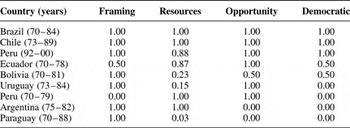
Based on the accounts of church-state conflict provided by various comparative sources (Klaiber Reference Klaiber1998; Gill Reference Gill1998), and discussed at more length earlier I conclude that Chile represents a case that is substantially over the line for full membership in the set of cases with sufficient mobilizing resources, while Paraguay had barely any membership in the set. The full membership bound is thus estimated at 150 (substantially below Chile), and the none-membership one at 40 (just below Paraguay). The range can then be calibrated using these as anchors, as discussed in Appendix I, with the results displayed in Table 4, along with the previously discussed membership scores.
Fuzzy-set model data

It now becomes possible to systematically assess the claims made above. First, cultural framing, mobilizing resources, and political opportunity were argued to be individually necessary for pro-democratic activism. Applying the subset principle, scores on the outcome variable should never be higher than scores on the causal variables. Table 4 demonstrates that there are no exceptions to this claim for either framing or opportunity, and only minor exceptions with regard to resources. Peru (1992–2000) scores 0.88 on resources but reaches 1 in democratic, while Bolivia scores only 0.23 but reaches 0.50. These exceptions almost certainly reflect the juxtaposition of continuous and three-tier measures, as well as the limitations of the mobilizing resources measure, which provides only a rough estimate of the relevant links among priests and ignores the crucial role of links between priests and civil society organizations. Nonetheless, the specific exceptions are revealing: in Peru, Fujimori received non-trivial support from Protestant groups during his election campaign (Burnett 1992), which may have heightened concern among the Catholic hierarchy and predisposed them to opposition. In Bolivia, the influence of particularly charismatic leaders may have been crucial in directing a skeptical leadership to pursue even a limited degree of pro-democratic activism (Albrecht Reference Albrecht2006). Fortunately, even accounting for these limitations, the overall consistency score remains above 90%.
The second claim, that all three causes are jointly sufficient, can be translated in Boolean terms as:

For the claim to hold, the value of the left (cause) half of the equation should never be higher than those on the right (outcome). Once again, the claim holds almost perfectly, with the only exception occurring when Uruguay reaches 0.15 on mobilizing resources, but scores a 0 on Democratic, and Paraguay scores a 0.03 on the former, and 0 on the latter. As with the Peruvian and Bolivian exceptions discussed above, they are almost certainly a consequence of the way in which mobilizing resources is measured. However, while the Paraguayan exception is trivial, the Uruguayan one is substantial enough to merit attention. In this case, the degree of secularization in the country, which is substantially higher than that of any other in South America (Inglehart Reference Inglehart and Hagopian2009, 78), may have made the Uruguayan Church weaker than the measure suggests it should be. Furthermore, Uruguay is effectively dominated by the overwhelming cultural, political, and economic influence of Argentina, where bishops were more outspokenly pro-authoritarian then anywhere else on the continent (Gill Reference Gill1998). However, as with the exceptions to the necessary cause argument, the overall consistency of the claim remains high at 95.6%.
4. CONCLUSION
The evidence examined herein strongly supports the claim that the three key variables used in social movement theory, political opportunities, mobilizing structures, and cultural frames, can be usefully deployed to understand the decision of national episcopacies to engage in pro-democratic activism. As such, it confirms what other scholars have noted, that social movement theory provides a strong foundation for the study of religious phenomena (Wald, Silverman and Fridy Reference Wald, Silverman and Fridy2005; Wilcox, Wald and Jelen Reference Wilcox, Wald and Jelen2008), and seeks to provide further reinforcement for conceptual bridges between areas of scholarship that have too often remained isolated from each other.
Empirically, the analysis concludes that conditions favorable to democratic activism were, if not rare, at least narrow: regimes whose modus operandi clashed with concerns about human rights and social justice, churches with substantial capacity for mobilization, and the presence of friendly parties likely to perform well in democratic environments. The qualitative comparative analysis carried out in connection with this article strongly suggests that all three conditions must be met before democratic advocacy by religious authorities becomes likely but that once they are achieved they are sufficient to cause such activism. Pro-democratic advocacy by the Catholic hierarchy was therefore much more contingent than is usually recognized.
By articulating and evaluating its thesis in terms of necessary and sufficient conditions, this analysis also allows one to observe that pitfalls for pro-democratic activism abound. First, some authoritarian regimes were able to co-opt aspects of newly emerging religious frames in ways that curbed their anti-authoritarian impact. The pro-human rights, pro-social justice discourse of the Second Vatican Council has been almost universally understood to be inherently opposed to dictatorship, but military governments in Peru, and to a lesser extent Ecuador, were able to use it to limit church advocacy for democratic reform. This raises the concern that even those cultural frames that appear to be most clearly pro-democratic are flexible enough to support the right type of authoritarianism.
Second, and less surprisingly, small churches proved vulnerable to authoritarian pressure, despite initial efforts to challenge their policies. While the inability of authoritarian regimes in South America to engage in direct repression of the church, due to their limited legitimacy, provided national episcopacies with an important advantage, sufficiently small churches were unable to sustain pro-democratic activism. Although the Peruvian and Bolivian cases suggest that under certain conditions churches may be able to overcome these limitations to some degree, very small organizations can almost certainly be effectively depoliticized by force.
Third, the absence of strong, friendly parties diminished the opportunities represented by political openings. Church authorities did not advocate transitions when these would have clearly resulted in victory for threatening anticlerical forces, as was most clearly the case in Argentina. In those cases in which democratic advocacy was most pronounced, as in Brazil, Chile, and Peru, parties friendly, or at least unthreatening to the church, dominated a substantial range of the political spectrum. In particular, viable links to leftist parties (or the severe weakening of parties of the left), coupled with a strong position in the center of the political spectrum created conditions in which the church could advocate transitions without excessive concern for their consequences.
These findings are important for several reasons. First, they suggest that, in contrast to traditional secular arguments that perceive any interaction between the religious and political spheres as damaging to democracy, an effective means for representing religious interests is fundamental to gaining the committed support of religious bodies. Second, it challenges the notion that strong religious organizations are a threat to democracy, suggesting instead that organizational weakness allows the manipulation of the church by authoritarian interests. Finally, through its discussion of the importance of ideological conflicts, it highlights the intuitive but often neglected point that even religious communities explicitly committed to democracy embrace it as only one of their many values, and that even principles often linked to democracy can, in fact, dampens a commitment to political reform.
APPENDIX 1: ESTABLISHING SET MEMBERSHIP
Outcome: Democratic Advocacy
The nine cases explored here represent the existing universe of authoritarian regimes in South America operating since 1970. Assessments of their degree of democratic advocacy are based on a range of sources, mostly country-specific, listed in the article’s References. The number of explicit comparative analyses on this topic is limited, but the texts are in substantial agreement about the relative degree of pro-democratic activism exhibited by various churches: Argentina, Uruguay, and Paraguay are consistently listed as the least pro-democratic, and Chile and Brazil as the most (Smith Reference Smith1975, Reference Smith1979; Philpott Reference Philpott2007). Complete rankings are available from Gill (Reference Gill1998), who uses a binary coding but explicitly recognizes Ecuador and Bolivia as borderline cases. Klaiber (Reference Klaiber1998), who provides a descriptive account of church-state conflict for every country in the region, provides further comparative evidence in favor of this ranking.
Necessary Condition 1: Cultural Frames and authoritarian ideologies
The ideological leanings of specific military governments are discernible from a variety of case-specific accounts listed in the References, as well as from their various pronouncements, and from the policies they adopted. In his study of military radicalism in Latin America, Wolpin (Reference Wolpin1981) classifies the various military leaders according to whether they had leftist or rightist preferences. Although he finds examples of both in most of the countries he analyzes, only in Peru did leftists represent the dominant tendency during the period covered by my study; leaders of regimes in Argentina, Bolivia, Brazil, Chile, Paraguay are considered rightist; the leaders of Uruguayan and Ecuadorian regimes are not analyzed. The unique features of the Peruvian military regime led by Velasco, in comparison to those elsewhere in the continent, are extensively discussed by Stepan (Reference Stepan1978), Lowenthal (Reference Lowenthal1975), and Malloy (Reference Malloy1974), among many others. On its complex links with the Catholic Church and Catholic activists, see Schmidt (Reference Schmidt, Mainwaring and Scully2003), Pasara (Reference Pasara, Mainwaring and Wilde1989), and Klaiber (Reference Klaiber1996). Information on the Ecuadorian regime is less easily available, but the accounts provided by Gill (Reference Gill1998), Klaiber (Reference Klaiber1998), Isaacs (Reference Isaacs1993), and Davila (Reference Dávila1981) support its classification as an intermediate case in which the regime pursued some reformist policies without reaching the level of its Peruvian counterpart.
Necessary Condition 2: Mobilizing Resources and the number of links among priests
The normalized measure of mobilizing resources is obtained by calculating the total number of potential linkages among priests and dividing this by the population:

where n refers to the average number of priests and p is the average population during the period of military government. Both n and p are obtained from the Annuario Statistico della Chiesa 1970–2000, published on a yearly basis by the Vatican. The resulting measure for mobilizing resources is converted to a continuous set membership measure through the following formula:

where the lower bound is set at 40 and the upper bound at 150. To complete the transition to fuzzy membership in the set of cases with high mobilizing resources, when the resulting value is higher than 1, it is set to 1 and when it is negative, it is set to 0. The calculation from n and p to fuzzy-set membership is presented here.
Calculating Mobilizing Resources Fuzzy-Set Membership

Necessary Condition 3: Political Opportunity and Political Parties
Evidence of the presence and strength of political parties acceptable to the Catholic Church, that is moderate centrist parties, Christian Democrats or leftist parties with strong ties to Catholic ecclesiastical or lay organizations, can be found in a variety of secondary sources provided in the References and in electoral archives. The most useful of the latter, because it covers all the relevant cases during virtually all the relevant time period, is the PARLINE Database of the International Parliamentary Union (2009) available at: http://www.ipu.org/parline-e/parlinesearch.asp.
A brief summary of the parties fitting these descriptions and obtaining significant electoral support present in each of the countries, as well as those parties that were considered inimical to Catholic Church interests is provided below. Sources are those used in the main body of the text.
Argentina (0)
The political spectrum was dominated by the Partido Justicialista and the Unión Cívica Radical, neither of which had a positive relationship with the clergy
Bolivia (0.5)
Although the Movimiento Nacional Revolucionario had shifted to the center of the political spectrum, the legacy of the 1952 revolution made it suspect. In addition, the Unidad Democrática y Popular, a leftist coalition without strong links to the Church remained the most popular party throughout the late 1970s.
Brazil (1)
The dominant democratic alterative was the moderate centrist Movimento Democrático Brasileiro. In the left, the Partido dos Trabajadores had strong ties to the powerful progressive branch of the Catholic Church.
Chile (1)
Every part of the political party spectrum had positive links to the Church. In the center, the Partido Demócrata Cristiano was the most significant pro-democratic force. On the left, the Partido Socialista had developed strong links to the Church during the period of anti-authoritarian campaigning. The substantial pro-Pinochet contingent on the right also supported the Church, in spite of the latter’s pro-democratic stance.
Ecuador (1)
The political center was dominated by the Concentración de Fuerzas Populares, which was led by Christian Democrats. On the right were the Partido Conservador and the Partido Social Cristiano.
Paraguay (0)
The authoritarian Partido Colorado remained the sole dominant party, and challenges to the regime came from within the organization.
Peru, 1970–1779 (1)
The most important challengers on the center Acción Popular and the center-right Partido Popular Cristiano, both had positive links to the church. While the APRA party did not have substantial links to the church, its policies were also perceived as centrist at this time.
Peru, 1992–2000 (1)
The Partido Popular Cristiano remained an important player in the political arena. While Fujimori dismantled most existing parties, the anti-regime alternatives that formed to challenge him in 1995, Unión por el Perú, and 2000, Perú Posible, were both centrist and moderate. The radical left had been radically diminished by the devastating conflict between the state and Shining Path.
Uruguay (1)
The Partido Nacional, on the center-right, was moderate and unthreatening. On the left, the Frente Amplio had Christian Democrats as a core part of their organization.
APPENDIX 2: CALCULATING CONSISTENCY SCORES
The method used here to calculate consistency scores varies slightly for necessary and sufficient causes.
Necessary Causes: Is membership in the set of cases exhibiting the cause consistently higher than membership in the set of cases exhibiting the outcome? (1) When the value for the cause (C) is higher than for the outcome (O), its value is set equal to O; when it is equal or lower, it retains the original value. (2) Modified values of C for each of the cases are added, and divided by the sum of their values for O. (3) Ideally, C is now equal to O, and the result it 1, or 100% consistency. However, if any C was lower than O, violating the subset principle, the consistency score is reduced to reflect the discrepancy. Below are the calculations for the resources consistency scores. Consistency scores for the other two necessary causes can easily calculated, as they yield 100%.

Sufficient Causes: Is membership in the set of cases exhibiting the cause consistently lower than membership in the set of cases exhibiting the outcome? (1) When C is lower than O, its value is set equal to O; when it is equal or higher, it maintains the original value. (2) The sum of O values is divided by the sum of modified C values. (3) If C was never higher than O, the result is 1 or 100% consistency. However, if C was ever higher than O, violating the subset principle, the consistency score is reduced to reflect the discrepancy.