The contest for the 2016 Republican presidential nomination was unprecedented. Donald Trump, who few saw as a serious candidate when he announced he was running for president, became the nominee at the Republican Convention in Cleveland in July. This is the case despite the fact that he has never held political office before and has very low favorability ratings among the general population.
Trump emerged as the likely nominee by presenting himself stylistically as a completely different candidate from previous Republican presidential candidates. Trump’s bluntness and lack of “political correctness” clearly appealed to many more Republican voters than was imagined by the media and Republican establishment at the beginning of the nomination process. Trump, simply put, appealed to a segment of the Republican electorate that had long been ignored at the presidential nomination stage. Demographically, Trump’s support varied from that of other Republican candidates, but not by as much as was widely portrayed. Although a number of demographic divides existed in the Republican primaries, this study finds that these demographic divisions are secondary to state political culture as an explanatory factor differentiating Trump’s level of support in different states. In the end, state political culture played an outsized role in determining Trump’s vote share throughout the nomination process.
THE DYNAMICS OF DONALD TRUMP’S SUPPORT
Much of the discussion of Trump’s surprising appeal to the Republican electorate has focused on the demographic groups that have given disproportionate support. Trump tended to do best in counties where white identity mixes with long-simmering economic dysfunctions. A significant share of his supporters were from areas of the country that largely missed the transition of the United States away from manufacturing and into a diverse, information-driven globalized economy. In particular, Trump did better in areas of the country with high concentrations of whites without a high school diploma, in areas of those that self-describe themselves as ancestrally “American,” and areas with high percentages living in a mobile home (Irwin and Katz Reference Irwin and Katz2016).
Trump’s campaign slogan “Make American Great Again” suggests that his campaign is stoking fears about generational societal change. Many Trump supporters are deeply concerned that the country they live in is not the country of their youth and that they themselves are no longer represented by the US government. Support for Trump is motivated by something beyond the more conventional view of conservatism in which economic freedom and small government as well as social and fiscal responsibility are prized. In a similar vein, Trump may also represent an identity politics of the Right that is the legacy of cultural populism that originated with segreationist George Wallace, former governor of Alabama who ran for president in 1968 and 1972. Wallace’s technique of “positive polarization”—pitting his supporters against the dominant cultural establishment—branded him as the “authentic” candidate (Fraser and Freeman Reference Fraser and Freeman2010). Supporting this theory is the fact that Trump has done considerably better in areas that supported George Wallace in the presidential election of 1968 (Irwin and Katz Reference Irwin and Katz2016). This idea of Trump being the authentic, anti-elitist truth teller was a critical component to his success. In all states with primary exit polls, Donald Trump overwhelmingly won the support of voters who said the top candidate quality was to “tell it like it is.”
Focusing solely on demographic groups, however, misses important geographic nuances of the 2016 Republican nomination. Where people live is politically more important than ever (Brown et al. Reference Brown, Knopp and Morrill2005). States—and regions—have real and significant cultural and political differences (Gelman Reference Gelman2008). Even after accounting for group traits, regional effects can often be detected because people that are proximate to one another influence each other’s attitudes and behavior (Mutz Reference Mutz2002). This can be considered a “neighborhood effect”—the tendency for people to be socialized by those they live around (Gimpel and Schuknecht Reference Gimpel and Schuknecht2003).
Focusing solely on demographic groups, however, misses important geographic nuances of the 2016 Republican nomination.
It would thus be a vast oversimplification to say that Trump’s support in winning the nomination was due mostly to his success with blue-collar workers. Even though Trump’s support has been portrayed as appealing to poorer working-class whites who are assumed to have lost the most from globalization, his appeal is in reality much wider than that. Despite some consistent demographic relationships in Trump’s support from state to state through the nomination process (in particular, his support among voters without a college education), it is clear that demographics alone does not explain all the variance in Trump’s support. Even though there were obviously demographic differences between the coalitions that supported and opposed Trump, the explanatory power of these demographic gaps is limited. State political culture, as it turns out, tends to be a much stronger predictor of how well Trump did in a particular state than state demographics.
POLITICAL CULTURE AND SUBCULTURES
Given the importance of the relationship between what government does (or does not do) and political culture, the political cultures of American states rightfully should be a major focus of study. Political cultural factors are influential in shaping government in three ways: 1) by molding the political community’s perceptions of the nature and purposes of politics and expectations from government and the political process, 2) by influencing the recruitment of specific kinds of people to become active in government and politics, and 3) by directing the actual way in which government is practiced by citizens and politicians (Elazar Reference Elazar, Elazar, Gray and Spano1999).
A commonly used typology for political subcultures within the United States is that proposed by Daniel Elazar (Reference Elazar1984). Elazar’s theory is based on the immigration and migration patterns of ethnic groups and religions. Elazar’s scheme has widely been seen as the most promising effort to map American political cultures and the best way to characterize state political culture (Mead Reference Mead2004). According to Elazar, the national political culture is the synthesis of three major political subcultures that are dominant in varying parts of the country: moralistic, individualistic, and traditionalistic. All three are of nationwide proportions, having spread over time throughout the country. At the same time, each subculture is strongly tied to specific areas of the country, reflecting the streams and currents of migration that have carried people of different origins and backgrounds across the country.
The moralistic political culture stresses the conception of the commonwealth as the basis for democratic government. Politics is viewed as being a positive activity in which citizens have an obligation to participate. Good government is measured by the degree to which it promotes the public good . The individualistic political culture, on the other hand, is based on the utilitarian conception that politics should work like a marketplace. Government should handle only those functions demanded by the people it is created to serve. This businesslike conception of politics places a premium on limiting community intervention on private activities and restricts government action to only those areas that encourage private initiative. Finally, the traditionalistic political culture views the proper role of government in a much different light: politics is viewed as a privilege, not an obligation. It has an ambivalent attitude toward the marketplace and an elitist conception of the commonwealth. The traditionalistic political culture reflects a precommercial attitude that accepts the inevitability of a hierarchical society.
Elazar’s impact on state politics scholarship has been widespread. The Elazar cultures are distinct from other political differences among the states such as political ideology or partisanship. Yet, at the same time, the cultural types are linked to many features of state politics and government. Moralistic states have higher levels of political participation, more competitive parties, stronger merit personnel systems, and more liberal and innovative programming. Traditionalistic states, on the other hand, tend to display less of these characteristics while individualistic states tend to fall in between the two other cultures (Mead Reference Mead2004).
STATE POLITICAL CULTURE AND SUPPORT FOR DONALD TRUMP
Political culture is distinct from political ideology. States of any of the three political subcultures can be either liberal or conservative or some mixture of both. Utah, for example, is a moralistic state, as is Minnesota (Elazar Reference Elazar, Elazar, Gray and Spano1999). The political ideology and partisan leanings of these states, however, are on opposite sides of the ideological spectrum: Utah is generally considered to be one of the most conservative and Republican states, while Minnesota has a reputation for being progressive and currently has the longest streak of supporting the Democratic nominee for president (every year since 1972). As it turns out, both Minnesota and Utah—polar opposites ideologically—were two of Trump’s worst states in the 2016 nomination process. Minnesota has long been seen as the archetypical example of a state informed and permeated by the moralistic political subculture. The tone set by the state’s political culture, Elazar argues, permeates Minnesota’s entire civil society, its politics and government, giving Minnesota a clean government image (Elazar Reference Elazar, Elazar, Gray and Spano1999). Minnesota’s political culture represents everything that Trump is not politically. The reformist, inclusive, good government nature of moralistic subcultures is simply put the antithesis of Trump’s message of populist, dogmatic authoritarianism that appeals to those who believe he “tells it like it is” despite obvious, and continuous, fabrications.
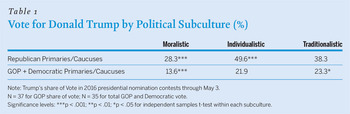
Beyond just Minnesota and Utah, Elazar’s typology of political subcultures proves to be a good predictor of Trump’s support in the 2016 Republican nomination process through the Indiana primary on May 3 (at which point Trump’s remaining opponents—Ted Cruz and John Kasich—dropped out of the race). Specifically, whether or not the moralistic subculture was dominant in the state was an excellent predictor of Trump’s vote share (see table 1). Trump does very poorly in moralistic states, regardless of whether or not the state is relatively liberal or conservative. Trump’s Republican vote share in the 2016 primaries and caucuses was 28.3% in moralistic states, much lower than the 38.3% he received in traditionalistic states and 49.6% in individualistic states. The difference between Trump’s share of the vote in moralistic and individualistic states is especially noteworthy. As much as Republicans in moralistic states were repelled by Trump, Republicans in individualistic states gravitated toward the billionaire businessman from New York City. This is consistent with the individualistic subculture’s business-like view of government: government in individualistic subcultures simply represents a means of defending one’s own interests.
Beyond just Minnesota and Utah, Elazar’s typology of political subcultures proves to be a good predictor of Trump’s support in the 2016 Republican nomination process . . .
Vote for Donald Trump by Political Subculture (%)

Note: Trump’s share of Vote in 2016 presidential nomination contests through May 3.
N = 37 for GOP share of vote; N = 35 for total GOP and Democratic vote.
Significance levels: ***p < .001; **p < .01; *p < .05 for independent samples t-test within each subculture.
Table 1 also displays Trump’s vote share by subculture of all voters, including those who participated in both the Democratic and Republican primaries and caucuses. Calculating Trump’s support as a proportion of the total Republican and Democratic vote leads to a different impression of Trump’s popularity in a state relative to looking at just the Republican vote total. As a measure of all voters, Trump’s poor standing in moralistic states is especially reinforced: he received less than 14% of the total vote in moralistic states. Trump’s support in individualistic states, however, looks considerably less impressive by this measure as Democratic turnout in individualistic states tended to be noticeably stronger. Trump did extremely well among Republican voters in many individualistic states of the Northeast, but the number of Republican voters was considerably lower than those voting in the Democratic primary. New York, for example, was one of Trump’s best states among Republican voters, but there were more than twice as many voters in the Democratic primary than the Republican primary. Consequently, as a share of all voters Trump’s strongest subculture was the traditionalistic, where 23.3% of all voters supported him.
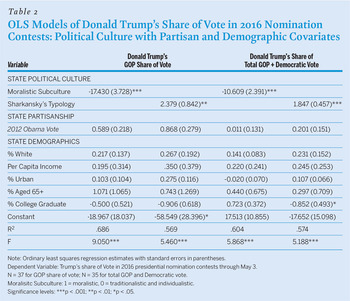
To further test the predictive value of Elazar’s subcultures in the contest for the 2016 Republican presidential nomination, ordinary least squares regression models were employed utilizing state political culture, state partisanship, and state demographics as independent variables. Two measurements of Elazar’s typology are used to test the influence of political culture. For the first model, whether or not the dominant subculture in a state is moralistic is used as a dummy variable (with moralistic subculture coded as 1 and traditionalistic and individualistic subcultures coded as 0). The second model used Ira Sharkansky’s (1969) operationalization of Elazar’s typology, which rates states on a scale from 1 to 9, with low scores given to moralistic states and high scores given to traditionalistic states, with individualistic states in between. This measurement was used in a prior study to test the “institutional lag model” that predicts that a state’s political institutions are structured according to a political culture dominant in the state (Norrander Reference Norrander2000).
Table 2 contains the results of the model predicting Trump’s vote share in the 2016 Republican presidential primaries and caucuses before his remaining opponents dropped out on May 3. Upon controlling for state partisanship Footnote 1 and the demographics of the state, Footnote 2 table 2 indicates that having or not having a moralistic subculture is a strong and significant predictor of Trump’s share of the Republican as well as the overall vote. The same can also be said of the model that includes Sharkansky’s typology of political culture, which is also a statistically significant predictor of Trump’s performance in a state. Taken together, these models indicate that, net of statistical controls, political culture is an important determinant of Trump’s vote share in the race for the Republican nomination. State partisanship and state demographics, on the other hand, proved to be relatively poor predictors of Trump’s vote share relative to political culture. It must be noted, however, that because the analysis is done at the state-level it is uncertain if the culture/vote correlations reflect the true effects of culture or if they simply are proxies for individual differences that vary across the states.
OLS Models of Donald Trump’s Share of Vote in 2016 Nomination Contests: Political Culture with Partisan and Demographic Covariates

Note: Ordinary least squares regression estimates with standard errors in parentheses.
Dependent Variable: Trump’s share of Vote in 2016 presidential nomination contests through May 3.
N = 37 for GOP share of vote; N = 35 for total GOP and Democratic vote.
Moralisitc Subculture: 1 = moralistic, 0 = traditionalistic and individualistic.
Significance levels: ***p < .001; **p < .01; *p < .05.
Why did Trump do so much worse in moralistic states? In short, Trump’s ideology and persona were a terrible fit for moralistic states. Moralistic states are more likely to be ideologically extreme, in both directions (Erikson et al. Reference Erikson, Wright and McIver1993). As a result, Trump’s ideological “flexibility,” as he has termed it, appealed less to the citizens of moralistic states.
Furthermore, given Trump’s outsider campaign message of “make America great again,” it is perhaps not surprising that Trump performed the worst in moralistic states that put a premium on a communitarian vision of the public good. Trump’s blunt authoritarian message, which at times potentially encouraged violence, resonated poorly among those who instinctively sympathize with communitarian notions of the commonwealth. In a similar vein, the historic nature of Donald Trump’s candidacy in his attempt to become the first businessman to be elected president directly from the private sector may have cost him support in communitarian moralistic states, which unlike individualistic states, resist a businesslike approach to politics and government.
Trump’s outlandish comments regarding race and immigration (e.g., building a wall at the Mexican border, preventing Muslims from entering the country, and his “birther” statements) were also less attractive to those in moralistic states who pride themselves on good citizenship. Attitudes toward race and immigration, therefore, appear to have been a much more important factor in explaining Trump’s relative weakness in moralistic states. Since moralistic states have traditionally been the most supportive of civil rights and the most racially tolerant, Trump’s race-baiting may have been more of a deterrent to vote for him among white voters in moralistic states than it was in individualistic and traditionalistic states.
Since subculture support for Trump varied so greatly, the timing of the states in the primary calendar could have proven to be critical. Was Trump’s surprising nomination a result of the primary calendar? In short, no. Subculture variation may have actually hindered Trump’s momentum in the beginning because moralistic states tend to schedule their primaries earlier. Christopher Carman and David Barker (Reference Carman and Barker2005) found that primary scheduling is substantially conditioned by state political culture. Moralistic states tend to schedule primary dates earlier in the primary season than do individualistic or traditionalistic states. As a result, moralistic states have tended to enjoy disproportionate influence over presidential nominations since 1972. Thus, the tendency toward frontloading among moralistic states may have considerably hindered Trump. By receiving low vote shares the early primary moralistic states, Trump was prevented from winning a large cushion of delegates and potentially lost momentum in the early stages of the primary calendar.
Now that Donald Trump is the Republican nominee for president, the question is whether or not this relationship of his relative support in different subcultures will also exist in the general election.
Now that Donald Trump is the Republican nominee for president, the question is whether or not this relationship of his relative support in different subcultures will also exist in the general election. The strong political subculture relationship during the nomination stage suggests that Trump may be potentially destined to do worse in moralistic states than previous Republican presidential nominees. Early indications are that this could indeed be the case. An April 2016 poll conducted for Deseret News by KSL, for example, found Hillary Clinton tied with Donald Trump in general election match in the state of Utah, a state that Obama lost by 48 percentage points in the 2012 general election. Although one poll with Trump and Clinton tied by no means suggests that Clinton will win Utah, simply the fact that she was deemed to even be potentially competitive in the state is a startling turnaround for a state that has not voted Democratic for a president since 1964. Any discussion of Trump winning the 270 Electoral College votes necessary to win the presidency thus becomes more problematic because some states that are key to his electoral strategy—states like Michigan and Wisconsin—have moralistic subcultures. Given his lack of support in moralistic states, in fact, Trump may have a hard time holding onto traditionally Republican moralistic states. By nominating Trump, the Republicans are potentially risking turning some red moralistic states blue.