




No CrossRef data available.
Article contents
Response bias and aging on a recognition memory task
Published online by Cambridge University Press: 23 January 2006
Abstract
Response bias reflects the decision rule an individual uses when faced with uncertainty on recognition memory tasks. Recent studies indicate frontal regions may mediate response bias performance. One theory of aging also implicates frontal lobe contributions in age-related cognitive changes. This suggests that frontal lobe changes may mediate response bias in older adults. Consistent with this frontal aging hypothesis, we predicted that response bias would become more liberal with age. Methods: Participants were 181 younger (30–49) and 112 older normal adults (75+) that were part of the California Verbal Learning Test-second edition (CVLT-2) normative sample (total n = 1078). We used parametric measures of discriminability and response bias provided by the CVLT-2 scoring program. Groups were similar in IQ and education. Multi-level regression models were created to examine the effects of moderating variables. The interaction between age and age group significantly predicted response bias. Post hoc analysis indicated that increasing age was associated with more liberal bias in the older but not in the younger group. In the light of reported relationships between frontal regions and both aging and response bias, we hypothesize that frontal changes may be the underlying mechanism explaining the increase in liberal response bias with age. (JINS, 2006, 12, 1–7.)
Information
- Type
- Research Article
- Information
- Journal of the International Neuropsychological Society , Volume 12 , Issue 1 , January 2006 , pp. 1 - 7
- Copyright
- © 2006 The International Neuropsychological Society
INTRODUCTION
Normal aging has been associated with performance deficits on hippocampal-dependent memory tasks requiring delayed recall or recognition (Buckner, 2004; Lamar et al., 2004; Rapp & Heindel, 1994). However, multiple factors contribute to these age related changes in memory (Gunning-Dixon & Raz, 2000). For example, although age-related hippocampal atrophy probably plays a major role in memory decline (DeCarli et al., 2005), normal aging has also been linked with reduced frontal lobe volume (Raz et al., 1997) and proportionately greater deficits on measures of frontal lobe function (Chao & Knight, 1997).
Recognition memory paradigms are well suited to studying both hippocampal and frontal contributions to age-related memory decline. Response bias and discriminability are two measures derived from recognition memory tasks that are useful in understanding the cognitive systems and therefore the neuroanatomical substrates that underlie memory. Discriminability refers to performance accuracy and reflects the strength of a memory trace, suggesting medial temporal lobe (MTL) recruitment (Deweer et al., 1995). Memory as measured by recall or recognition has been associated with the MTL (Johnson et al., 2001) and therefore discriminability has been the primary focus in most studies of recognition memory. Response bias, on the other hand, reflects the outcome of a decision making process that occurs as an individual is faced with choosing between two or more options. Response bias quantifies the tendency to either respond in a predominantly liberal (i.e., “yes”) or conservative (i.e., “no”) direction. Response bias has been linked to the frontal lobes, such that lesions to the frontal lobe will lead to a more liberal response set (Swick & Knight, 1999; Walton et al., 2004; Windmann et al., 2002). Importantly, response bias is theoretically independent of discriminability (Miller et al., 2001; Snodgrass & Corwin, 1988). Although response bias might change with normal aging as a consequence of frontal lobe atrophy, response bias in aging has not been fully explored.
Studies that have investigated recognition memory in aging indicate that older adults have reduced discriminability (i.e., accuracy) (Fulton & Bartlett, 1991; Harkins et al., 1979) compared to younger subjects. The response bias studies have been more mixed. Some studies have suggested a more conservative bias in older subjects (Ferris et al., 1980; Vakil et al., 2003). Other studies found age-related increases in false recognitions (Fulton & Bartlett, 1991), although formal measurement of response bias is rarely reported. There have also been studies that reported more liberal responding (Bastin & Van der Linden, 2003; Flicker et al., 1990). However, other potential mediating factors, such as education, IQ, sex, and memory accuracy, typically have not been considered.
We conducted this study to further investigate response bias in aging based on a multiple factor model of aging, known as the frontal aging hypothesis (Buckner, 2004; West, 1996). Investigators of normal aging have more recently suggested that a multiple factor model of aging might better explain the process of age related neurocognitive changes (Buckner, 2004). The multiple factor framework proposes “distinct age-associated cascades that target different brain systems and may independently vary in their level of progression across individuals” (in Buckner, 2004, p. 196). Investigators have given particular attention to frontal-striatal white matter changes (Salat et al., 2005), frontal gray (Raz et al., 1997; Salat et al., 1999) and striatal volume loss (Raz et al., 2003), and neuro-chemical changes such as reduction of dopamine (Haycock et al., 2003). Typically, researchers refer to age ranges starting at 65 and older as a particularly vulnerable period for expression of specifically age associated pathophysiological changes (Buckner, 2004). Such structural changes have also been associated with both executive function and memory changes (Gunning-Dixon & Raz, 2000). Buckner (2004) describes a study (Park et al., 1996), which demonstrated a striking drop in long-term and working memory performance after the age of 70, with relatively stable performance from the 20's to 60's.
With the consistent evidence for alterations in frontal-striatal networks, investigators have turned to the frontal aging hypothesis. This theory suggests that the vulnerability of the frontal lobes to normal aging will be associated with age-related declines on more frontally mediated aspects of memory performance like response bias and that these declines will be present earlier than for other cognitive abilities. Accordingly, this study had two hypotheses: (1) Age would significantly predict response bias even after controlling for multiple moderator variables including discriminability; and (2) the relationship between age and response bias would be greater in an older cohort than in a younger cohort.
MATERIAL AND METHODS
Subjects
All data for this study were drawn from the final normative reference sample of the California Verbal Learning Test, Second Edition (CVLT-2, Delis et al., 2000). The final normative sample consisted of 1078 subjects who were screened for self-reported neurological or psychiatric disorders or debilitating medical illnesses. To screen out participants with unreported cognitive impairments or poor cooperation, the publishers excluded individuals with extremely low levels of immediate recall or extremely high levels of intrusions or false positive errors (>15) from the final normative sample.
We selected 293 subjects from the normative sample based on age alone: a younger cohort consisting of all 181 participants from ages 35 to 49, and an older cohort consisting of all 112 participants from ages 75 to 89. Data from the publishers reflected that 22 potential participants (5 were in the 35–49 age range and 13 from the 75–89 age range) had been excluded from the final normative sample because of excessive false positive errors. Group characteristics are summarized in Table 1. The two groups were significantly different in age only; there were no other differences in demographic characteristics such as IQ or years of education.
Demographic and CVLT-II data for the younger and older age groups

Procedures
We administered the CVLT-2 during the CVLT-2 standardization study under standardized conditions along with the Wechsler Abbreviated Scale of Intelligence (WASI; The Psychological Corporation, 1999) and the Delis-Kaplan Executive Function System (D-KEFS; Delis et al., 2001). Participants were read a list of 16 words (list A) that was presented over five learning trials, and instructed to recall as many words as they could at each trial. They were then presented with an interference list (list B) composed of 16 entirely new words. Immediately following list B, free and cued recalls for list A were assessed. After an additional 20-minute delay, we assessed free recall, cued recall, and recognition memory.
The recognition memory trial consists of the 16 target items randomly mixed with 32 distractors; subjects were to respond “yes” if the item was from the target list, and “no” if it was not. Level of performance was reflected in the number of correct hits and false-positive errors. These data yield two measures of recognition memory that we adapted from signal detection theory: recognition discriminability and response bias. Discriminability refers to the ability to distinguish target words from distractor words, and is widely considered to be the best measure of recognition memory accuracy. The discriminability index, or d′, is analogous to a contrast z score reflecting the absolute difference in standard deviation units between the subjects hit rate and false-positive rate.
Performance on a recognition memory test is also influenced by response bias, which is the tendency to favor “yes” or “no” responses, particularly when there is uncertainty about the correct response. Response bias is theoretically independent of recognition discriminability (Donaldson, 1992), that is, subjects can exhibit a positive (i.e., “yes”) or negative (i.e., “no”) response bias when discriminability is high or low. The response bias measure employed in this study is a parametric measure of “C” (for criterion level) that is defined as −0.5 (z score of hit rate + z score of false-positive rate). More negative scores reflect a positive or “yes” response set, and more positive scores reflect a negative or “no” response set.
Results
Descriptive data from the CVLT-2 are summarized in Table 1. Univariate analyses (Bonferroni corrected) indicated that older subjects had significantly fewer recognition hits (p < .001), more false alarm errors (p < .001), lower discriminability scores (p < .001), more liberal response bias (p < .001), and poorer short and long delayed recall (p < .001), and compared with younger subjects.
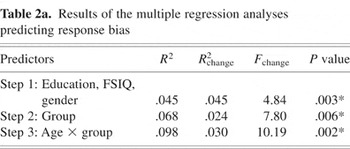
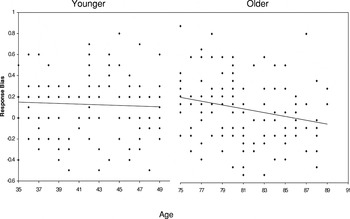
We performed a hierarchical regression analysis to test the hypotheses of interest, which were to determine the relationships between age and response bias after controlling for the relative contributions of individual characteristics such as gender, education, and WASI Full Scale IQ (see Table 2a). Gender, education, and IQ were entered into the model in the first step, and collectively explained 4.5% of the variance in response bias. In the second step, we entered age group to determine the effects of belonging to either the older or younger group. This explained an additional 2.4% of the variance, with the older group being associated with a more liberal response bias. In the third step, adding the age group by age interaction term explained an additional 3.0% of the variance. Post-hoc analyses on each group indicated that age was not significantly correlated with response bias in the younger age group (r = .048; p = .26), but age was inversely correlated with response bias in the older age group (r = −.234; p < .01), that is, response bias became more liberal with increasing age (see Figure 1).
Results of the multiple regression analyses predicting response bias


Relationship between response bias and age in the two age groups
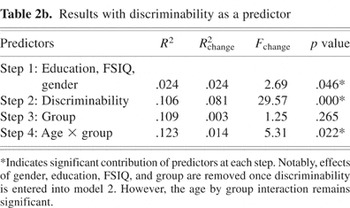
According to signal response theory, response bias is unrelated to discriminability. However, because there were age differences in recognition discriminability, we repeated the multiple regression analyses to determine what impact these differences might have on response bias. In this model, the first step included the individual characteristics (gender, education, IQ), discriminability was entered in the second step, followed by age group in the third step, and age group by age interaction in the fourth (see Table 2b). Entering discriminability into the model explained an additional 8.1% of the variance, with lower discriminability associated with a more liberal response bias. With discriminability in the model, the age group effect was no longer significant, but the interaction effect remained (β = −1.4, p = .022).
Results with discriminability as a predictor

Several previous studies have linked response bias to the frontal lobes. To examine this hypothesized link further, we carried out several exploratory analyses to determine if response bias was also related to other measures thought to rely on frontal lobe function. To test this, several representative executive tasks were selected from the D-KEFS to yield measures of concept formation, inhibition, set-shifting, and verbal fluency. The most commonly used measures of executive function that have been well validated in patients with particularly executive deficits (i.e., focal frontal lesions, Parkinson's disease, and schizophrenia) were selected (Delis et al., 2001, 2004). Our measure of concept formation was card sorting. Inhibition was the Stroop interference task after controlling for color naming. Set-shifting was the switching condition of the trail making test after controlling for the non-shifting sequencing conditions. Verbal fluency was word generation to letters F, A, and S. In each of these secondary analyses, we used hierarchical multiple regression to determine the relationship between response bias and executive functioning after controlling for education, gender and full scale IQ.
Stroop inhibition (β = .18, p = .04) was the only executive measure we used to predict response bias scores (Table 3a). Trails switching, total free sort, and word generation to letters F-A-S did not significantly contribute to response bias (Tables 3b–d). In Stroop inhibition, we also included color naming, to control for the influence of color-naming ability to the inhibition task. This condition did not predict response bias. Finally, in the analysis with trails switching, we included both number and letter tracing conditions in the model, to control for additional factors such as processing speed and motor involvement. These tasks did not contribute to response bias performance.
Table 3a–3d: Tasks of executive function as predictors of response bias

DISCUSSION
The primary goal of this study was to assess response bias in older and younger age cohorts on a recognition memory task. The first major finding of this study demonstrated age differences in response bias performance, with older subjects demonstrating a more liberal response bias than younger subjects. The second major finding was an interaction between age and age group reflecting the fact that age affected response bias in the older cohort but not in the younger group. In older adults, increasing age was related to more liberal responding, whereas in younger adults, there was no relationship between age and response bias.
Our finding of age-related change in response bias is consistent with the frontal aging hypothesis (West, 1996). Several recent studies (Alexander et al., 2003; Bechara, 2001; Kramer et al., 2005; Manes et al., 2002; Miller et al., 2001; Windmann et al., 2002) suggest that frontal lobe mediated functions influence response bias. Investigators using functional magnetic resonance imaging (Miller et al., 2001) demonstrated increased activation of the dorsolateral prefrontal regions as well as more posterior regions during a recognition memory task in which subjects were instructed to be liberal or conservative in their responses. Windmann et al. (2002) demonstrated sensitive ERP responses in frontal sites in healthy young subjects who were divided into High and Low bias groups and differed only in their response bias scores. Windmann et al. (2002) further suggested that changes in these early prefrontal ERP reflected the criterion setting function of this cortical region. Swick & Knight (1999) demonstrated significantly more liberal response bias in patients with frontal lobe lesions compared to patients with temporal lobe lesions. Frontal lesion patients also demonstrate higher intrusion errors (Daum & Mayes, 2000), false memories (Curran et al., 1997; Schacter et al., 1996), and confabulation (Baddeley & Wilson, 1988; Johnson et al., 1997). Kramer et al. (2005) used volumetric MRI to show that while hippocampal volumes best predicted recognition discriminability, frontal lobe volumes best predicted response bias.
The specific vulnerability of the frontal lobes to aging is supported by several converging programs of study including structural (DeCarli et al., 2005; Raz et al., 2000) and functional (Chao & Knight, 1997; Grady et al., 2003; Lamar et al., 2004) imaging, as well as traditional behavior studies (MacPherson et al., 2002; Ratcliff et al., 2003). MacPherson et al. (2002) demonstrated age related changes on executive function tasks considered to reflect set shifting, planning and temporal ordering. Older adults have also been shown to have higher false alarm rates (Fulton & Bartlett, 1991; Jacoby, 1999), more liberal response bias (Trahan et al., 1986), and difficulty with inhibiting task irrelevant stimuli (Chao & Knight, 1997).
The mechanisms by which the frontal lobes mediate response bias have only begun to be elucidated. Investigators have discussed the associations between frontal lobe function and response bias as part of the top-down processes (Swick & Knight, 1999) that are necessary to setting different criteria, such as monitoring (Shimamura, 2000; Walton et al., 2004) and controlling item retrieval (Buckner et al., 1996; Fletcher et al., 1998). There are several steps relying specifically on frontal lobe structures that must occur when individuals must decide whether presented stimuli have been presented before. One has to compare a stimulus to items in storage that might entail retrieval processes (Buckner et al., 1999). Once an item or several items have been retrieved, a comparison of the different items and the relevant descriptions associated with the information must be conducted, for example, context or source (Baldo et al., 2002). Then based on a certain threshold the strength of the item that was brought up must be assessed. Finally, inhibition of stimuli that are not relevant must be performed (Chao & Knight, 1997).
Secondary analyses with four widely used measures of executive functioning were also conducted because executive ability is often used as a marker of frontal lobe functioning. Only one of these measures, the D-KEFS Stroop, showed a significant relationship with response bias. Trails switching, word generation to letters F-A-S, and card sorting did not. Executive function processes cover a broad spectrum of cognitive function and abilities, which in turn, likely reflects the diverse circuits that comprise the frontal-subcortical networks (Elliott et al., 2000; Ongur et al., 2003; Tekin & Cummings, 2002). It is possible that response bias performance in older adults may rely on a relatively circumscribed system that may be captured by one particular executive task but not by others. Miyake et al. (2000) demonstrated that several measures of executive function had discriminant loadings. For example, a measure of inhibition (Stroop) did not significantly correlate (r = .09) with a measure of switching (letter-number). It may be that response inhibition is more involved with response bias than are concept formation, fluency, and set shifting. Nevertheless, no conclusions regarding the relationship between response bias and executive function can be drawn from this study.
Nonfrontal factors such as reduced hippocampal recruitment may have also contributed to the observed age-related increase in liberal bias. According to Hirshman (1995), weaker memory traces might influence the decision criterion that is used to respond, thus, leading to different response biases. For example, in our study encoding and short and long delayed recall of information were also reduced in older subjects compared to their younger cohort, suggesting that older adults may have weaker ability for creating and storing memory traces than younger subjects. This may have been one factor influencing older subjects in their decision making process.
Older adults may become more liberal in their responses because of reduced top-down processes that result in lowering the criterion level from which to make a decision, for example, reduced control in inhibiting task irrelevant information. Chao and Knight (1997) demonstrated different prefrontal and medial temporal regional activation patterns in older subjects compared to younger subjects during the Sternberg task. Older adults demonstrated decreased frontal activation and higher false alarm rates during performance on this task. Chao and Knight (1997) provide evidence for the role of the frontal regions in top-down processing and inhibiting task irrelevant stimuli, which are reduced in older subjects.
There were several limitations in this study. First, the CVLT-II has delayed recall trials that can potentially confound the results of the delayed recognition condition. The recognition task is also subject to criticism because the CVLT-II recognition task uses twice as many distractors as target words instead of the more traditional 1:1 ratio of studied and nonstudied items (Donaldson, 1992; Snodgrass & Corwin, 1988). Although this was done to make the task more difficult and enables a comparison between semantically related and semantically unrelated distractors, the response bias measure calculated by the CVLT-II may not reflect the true response bias of the subject. Future studies should use a recognition memory task that has more items and fewer learning trials (and therefore less risk of a ceiling effect), no delayed recall trials, and a recognition condition with equal numbers of targets and distractors.
ACKNOWLEDGMENTS
This work was supported by the National Institute on Aging (NIA) grants AG10129, P50-AG05142, and AG16570, and the State of California Alzheimer's Disease Research Center of California (ARCC) grant 01-154-20.
References
REFERENCES
Alexander, M.P.,
Stuss, D.T., &
Fansabedian, N.
(2003).
California Verbal Learning Test: Performance by patients with focal
frontal and non-frontal lesions.
Brain,
126(Pt 6),
1493–1503.Google Scholar
Baddeley, A. &
Wilson, B.
(1988).
Frontal amnesia and the dysexecutive syndrome.
Brain Cognition,
7,
212–230.Google Scholar
Baldo, J.V.,
Delis, D.,
Kramer, J., &
Shimamura, A.P.
(2002).
Memory performance on the California Verbal Learning Test-II:
Findings from patients with focal frontal lesions.
Journal of the International Neuropsychological Society,
8,
539–546.Google Scholar
Bastin, C. &
Van der Linden, M.
(2003).
The contribution of recollection and familiarity to recognition
memory: A study of the effects of test format and aging.
Neuropsychology,
17,
14–24.Google Scholar
Bechara, A.
(2001).
Neurobiology of decision-making: Risk and reward.
Seminars in Clinical Neuropsychiatry,
6,
205–216.Google Scholar
Buckner, R.L.
(2004).
Memory and executive function in aging and AD: Multiple factors that
cause decline and reserve factors that compensate.
Neuron,
44,
195–208.Google Scholar
Buckner, R.L.,
Kelley, W.M., &
Petersen, S.E.
(1999).
Frontal cortex contributes to human memory formation.
Nature Neuroscience,
2,
311–314.Google Scholar
Buckner, R.L.,
Raichle, M.E.,
Miezin, F.M., &
Petersen, S.E.
(1996).
Functional anatomic studies of memory retrieval for auditory words
and visual pictures.
Journal of Neuroscience,
16,
6219–6235.Google Scholar
Chao, L.L. &
Knight, R.T.
(1997).
Prefrontal deficits in attention and inhibitory control with
aging.
Cerebral Cortex,
7,
63–69.Google Scholar
Curran, T.,
Schacter, D.L.,
Norman, K.A., &
Galluccio, L.
(1997).
False recognition after a right frontal lobe infarction: Memory for
general and specific information.
Neuropsychologia,
35,
1035–1049.Google Scholar
Daum, I. &
Mayes, A.R.
(2000).
Memory and executive function impairments after frontal or posterior
cortex lesions.
Behavioural Neurology,
12,
161–173.Google Scholar
DeCarli, C.,
Massaro, J.,
Harvey, D.,
Hald, J.,
Tullberg, M.,
Au, R.,
et al.
(2005).
Measures of brain morphology and infarction in the Framingham Heart
Study: Establishing what is normal.
Neurobiology of Aging,
26,
491–510.Google Scholar
Delis, D.,
Kramer, J.,
Kaplan, E., &
Ober, B.
(2000).
CVLT-II California Verbal Learning Test, Second Edition, Adult
Version.
Psychological Corporation, a Harcourt Assessment Company.
Delis, D.C.,
Kramer, J.H., &
Kaplan, E.
(2001).
Delis-Kaplan Executive Function System Examiner's
Manual.
The Psychological Corporation, a Harcourt Assessment Co.:
San Antonio, TX.
Delis, D.C.,
Kramer, J.H.,
Kaplan, E., &
Holdnack, J.
(2004).
Reliability and validity of the Delis-Kaplan Executive Function
System: An update.
Journal of the International Neuropsychological Society,
10,
301–303.Google Scholar
Deweer, B.,
Lehericy, S.,
Pillon, B.,
Baulac, M.,
Chiras, J.,
Marsault, C.,
et al.
(1995).
Memory disorders in probable Alzheimer's disease: The role of
hippocampal atrophy as shown with MRI.
Journal of Neurology, Neurosurgery, and Psychiatry,
58,
590–597.Google Scholar
Donaldson, W.
(1992).
Measuring recognition memory. Journal of Experimental
Psychology.
General,
121,
275–277.Google Scholar
Elliott, R.,
Dolan, R.J., &
Frith, C.D.
(2000).
Dissociable functions in the medial and lateral orbitofrontal
cortex: Evidence from human neuroimaging studies.
Cerebral Cortex,
10,
308–317.Google Scholar
Ferris, S.H.,
Crook, T.,
Clark, E.,
McCarthy, M., &
Rae, D.
(1980).
Facial recognition memory deficits in normal aging and senile
dementia.
Journal of Gerontology,
35,
707–714.Google Scholar
Fletcher, P.C.,
Shallice, T.,
Frith, C.D.,
Frackowiak, R.S., &
Dolan, R.J.
(1998).
The functional roles of prefrontal cortex in episodic memory. II.
Retrieval.
Brain,
121 (Pt 7),
1249–1256.Google Scholar
Flicker, C.,
Ferris, S.H.,
Crook, T., &
Bartus, R.T.
(1990).
Impaired facial recognition memory in aging and dementia.
Alzheimer Disease and Associated Disorders,
4,
43–54.Google Scholar
Fulton, A. &
Bartlett, J.C.
(1991).
Young and old faces in young and old heads: The factor of age in
face recognition.
Psychology and Aging,
6,
623–630.Google Scholar
Grady, C.L.,
McIntosh, A.R., &
Craik, F.I.
(2003).
Age-related differences in the functional connectivity of the
hippocampus during memory encoding.
Hippocampus,
13,
572–586.Google Scholar
Gunning-Dixon, F.M. &
Raz, N.
(2000).
The cognitive correlates of white matter abnormalities in normal
aging: A quantitative review.
Neuropsychology,
14,
224–232.Google Scholar
Harkins, S.W.,
Chapman, C.R., &
Eisdorfer, C.
(1979).
Memory loss and response bias in senescence.
Journal of Gerontology,
34,
66–72.Google Scholar
Haycock, J.W.,
Becker, L.,
Ang, L.,
Furukawa, Y.,
Hornykiewicz, O., &
Kish, S.J.
(2003).
Marked disparity between age-related changes in dopamine and other
presynaptic dopaminergic markers in human striatum.
Journal of Neurochemistry,
87,
574–585.Google Scholar
Hirshman, E.
(1995).
Decision processes in recognition memory: Criterion shifts and the
list-strength paradigm.
Journal of Experimental Psychology, Learning, Memory, and
Cognition,
21,
302–313.Google Scholar
Jacoby, L.L.
(1999).
Ironic effects of repetition: Measuring age-related differences in
memory.
Journal of Experimental Psychology, Learning, Memory, and
Cognition,
25,
3–22.Google Scholar
Johnson, M.K.,
O'Connor, M., &
Cantor, J.
(1997).
Confabulation, memory deficits, and frontal dysfunction.
Brain and Cognition,
34,
189–206.Google Scholar
Johnson, S.C.,
Saykin, A.J.,
Flashman, L.A.,
McAllister, T.W., &
Sparling, M.B.
(2001).
Brain activation on fMRI and verbal memory ability: Functional
neuroanatomic correlates of CVLT performance.
Journal of the International Neuropsychological Society,
7,
55–62.Google Scholar
Kramer, J.H.,
Rosen, H.J.,
Du, A.T.,
Schuff, N.,
Hollnagel, C.,
Weiner, M.W.,
Miller, B.L., &
Delis, D.C.
(2005).
Dissociations in hippocampal and frontal contributions to episodic
memory performance.
Neuropsychology,
19,
799–805.Google Scholar
Lamar, M.,
Yousem, D.M., &
Resnick, S.M.
(2004).
Age differences in orbitofrontal activation: An fMRI investigation
of delayed match and nonmatch to sample.
NeuroImage,
21,
1368–1376.Google Scholar
MacPherson, S.E.,
Phillips, L.H., &
Della Sala, S.
(2002).
Age, executive function, and social decision making: A dorsolateral
prefrontal theory of cognitive aging.
Psychology and Aging,
17,
598–609.Google Scholar
Manes, F.,
Sahakian, B.,
Clark, L.,
Rogers, R.,
Antoun, N.,
Aitken, M., &
Robbins, T.
(2002).
Decision-making processes following damage to the prefrontal
cortex.
Brain,
125(Pt 3),
624–639.Google Scholar
Miller, M.B.,
Handy, T.C.,
Cutler, J.,
Inati, S., &
Wolford, G.L.
(2001).
Brain activations associated with shifts in response criterion on a
recognition test.
Canadian Journal of Experimental Psychology,
55,
162–173.Google Scholar
Miyake, A.,
Friedman, N.P.,
Emerson, M.J.,
Witzki, A.H.,
Howerter, A., &
Wager, T.D.
(2000).
The unity and diversity of executive functions and their
contributions to complex “Frontal Lobe” tasks: A latent
variable analysis.
Cognitive Psychology,
41,
49–100.Google Scholar
Ongur, D.,
Ferry, A.T., &
Price, J.L.
(2003).
Architectonic subdivision of the human orbital and medial prefrontal
cortex.
Journal of Comparative Neurology,
460,
425–449.Google Scholar
Psychological Corporation, The
(1999).
The Wechsler Abbreviated Scale of Intelligence.
San Antonio, TX:
The Psychological Corporation, A Harcourt Brace and Company.
Park, D.C.,
Smith, A.D.,
Lautenschlager, G.,
Earles, J.L.,
Frieske, D.,
Zwahr, M., &
Gaines, C.L.
(1996).
Mediators of long-term memory performance across the life
span.
Psychology and Aging,
11,
621–637.Google Scholar
Rapp, P.R. &
Heindel, W.C.
(1994).
Memory systems in normal and pathological aging.
Current Opinion in Neurology,
7,
294–298.Google Scholar
Ratcliff, G.,
Dodge, H.,
Birzescu, M., &
Ganguli, M.
(2003).
Tracking cognitive functioning over time: Ten-year longitudinal data
from a community-based study.
Applied Neuropsychology,
10,
76–88.Google Scholar
Raz, N.,
Gunning, F.M.,
Head, D.,
Dupuis, J.H.,
McQuain, J.,
Briggs, S.D.,
Loken, W.J.,
Thornton, A.E., &
Acker, J.D.
(1997).
Selective aging of the human cerebral cortex observed in vivo:
Differential vulnerability of the prefrontal gray matter.
Cerebral Cortex,
7,
268–282.Google Scholar
Raz, N.,
Rodrigue, K.M.,
Kennedy, K.M.,
Head, D.,
Gunning-Dixon, F., &
Acker, J.D.
(2003).
Differential aging of the human striatum: Longitudinal
evidence.
American Journal of Neuroradiology,
24,
1849–1856.Google Scholar
Raz, N.,
Williamson, A.,
Gunning-Dixon, F.,
Head, D., &
Acker, J.D.
(2000).
Neuroanatomical and cognitive correlates of adult age differences in
acquisition of a perceptual-motor skill.
Microscopy Research and Technique,
51,
85–93.Google Scholar
Salat, D.H.,
Kaye, J.A., &
Janowsky, J.S.
(1999).
Prefrontal gray and white matter volumes in healthy aging and
Alzheimer disease.
Archives of Neurology,
56,
338–344.Google Scholar
Salat, D.H.,
Tuch, D.S.,
Greve, D.N.,
van der Kouwe, A.J.,
Hevelone, N.D.,
Zaleta, A.K.,
Rosen, B.R.,
Fischl, B.,
Corkin, S.,
Rosas, H.D., &
Dale, A.M.
(2005).
Age-related alterations in white matter microstructure measured by
diffusion tensor imaging.
Neurobiology of Aging,
26,
1215–1227.Google Scholar
Schacter, D.L.,
Curran, T.,
Galluccio, L.,
Milberg, W.P., &
Bates, J.F.
(1996).
False recognition and the right frontal lobe: A case study.
Neuropsychologia,
34,
793–808.Google Scholar
Shimamura, A.P.
(2000).
Toward a cognitive neuroscience of metacognition.
Consciousness and Cognition,
9(Pt. 1),
313–323;
discussion 324–326.Google Scholar
Snodgrass, J.G. &
Corwin, J.
(1988).
Pragmatics of measuring recognition memory: Applications to dementia
and amnesia. Journal of Experimental Psychology.
General,
117,
34–50.Google Scholar
Swick, D. &
Knight, R.T.
(1999).
Contributions of prefrontal cortex to recognition memory:
Electrophysiological and behavioral evidence.
Neuropsychology,
13,
155–170.Google Scholar
Tekin, S. &
Cummings, J.L.
(2002).
Frontal-subcortical neuronal circuits and clinical neuropsychiatry:
An update.
Journal of Psychosomatic Research,
53,
647–654.Google Scholar
Trahan, D.E.,
Larrabee, G.J., &
Levin, H.S.
(1986).
Age-related differences in recognition memory for pictures.
Experimental Aging Research,
12,
147–150.Google Scholar
Vakil, E.,
Mosak, C., &
Ashkenazi, M.
(2003).
The effect of aging on script memory for typical and atypical
actions.
Applied Neuropsychology,
10,
239–245.Google Scholar
Walton, M.E.,
Devlin, J.T., &
Rushworth, M.F.
(2004).
Interactions between decision making and performance monitoring
within prefrontal cortex.
Nature Neuroscience,
7,
1259–1265.Google Scholar
West, R.L.
(1996).
An application of prefrontal cortex function theory to cognitive
aging.
Psychological Bulletin,
120,
272–292.Google Scholar
Windmann, S.,
Urbach, T.P., &
Kutas, M.
(2002).
Cognitive and neural mechanisms of decision biases in recognition
memory.
Cerebral Cortex,
12,
808–817.Google Scholar

Demographic and CVLT-II data for the younger and older age groups
Results of the multiple regression analyses predicting response bias
Relationship between response bias and age in the two age groups
Results with discriminability as a predictor
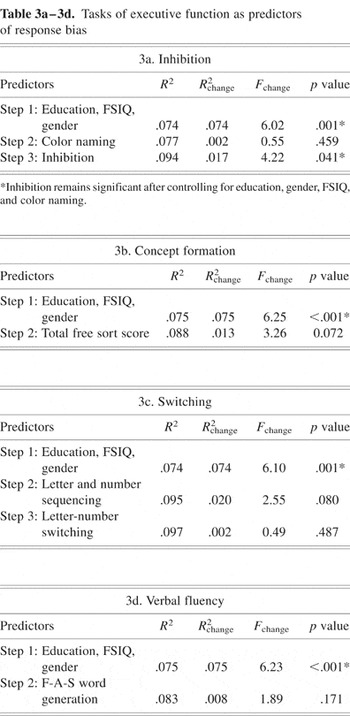
Table 3a–3d: Tasks of executive function as predictors of response bias
 You have
Access
- 35
- Cited by