Introduction
From about 1963 to 2003 (J. Doebrich, pers. comm.), the U.S. Geological Survey participated in a program of reconnaissance geological mapping, petrological studies and mineral assessments of Mesoproterozoic and Neoproterozoic rocks throughout the Arabian Shield, Kingdom of Saudi Arabia (Jackson, Reference Jackson1986; Stoeser, Reference Stoeser1986; and references therein; Fig. 1, inset). A significant aspect of that research pertained to the study of post-orogenic peralkaline, metaluminous, and peraluminous rocks to determine the compositions and ages of individual plutons (Aleinikoff and Stoeser, Reference Aleinikoff and Stoeser1989). These intrusions define the youngest episodes of plutonism in Saudi Arabia, and, as such, are a critical component of the magmatic processes responsible for final cratonisation of the Proterozoic Arabian Shield.
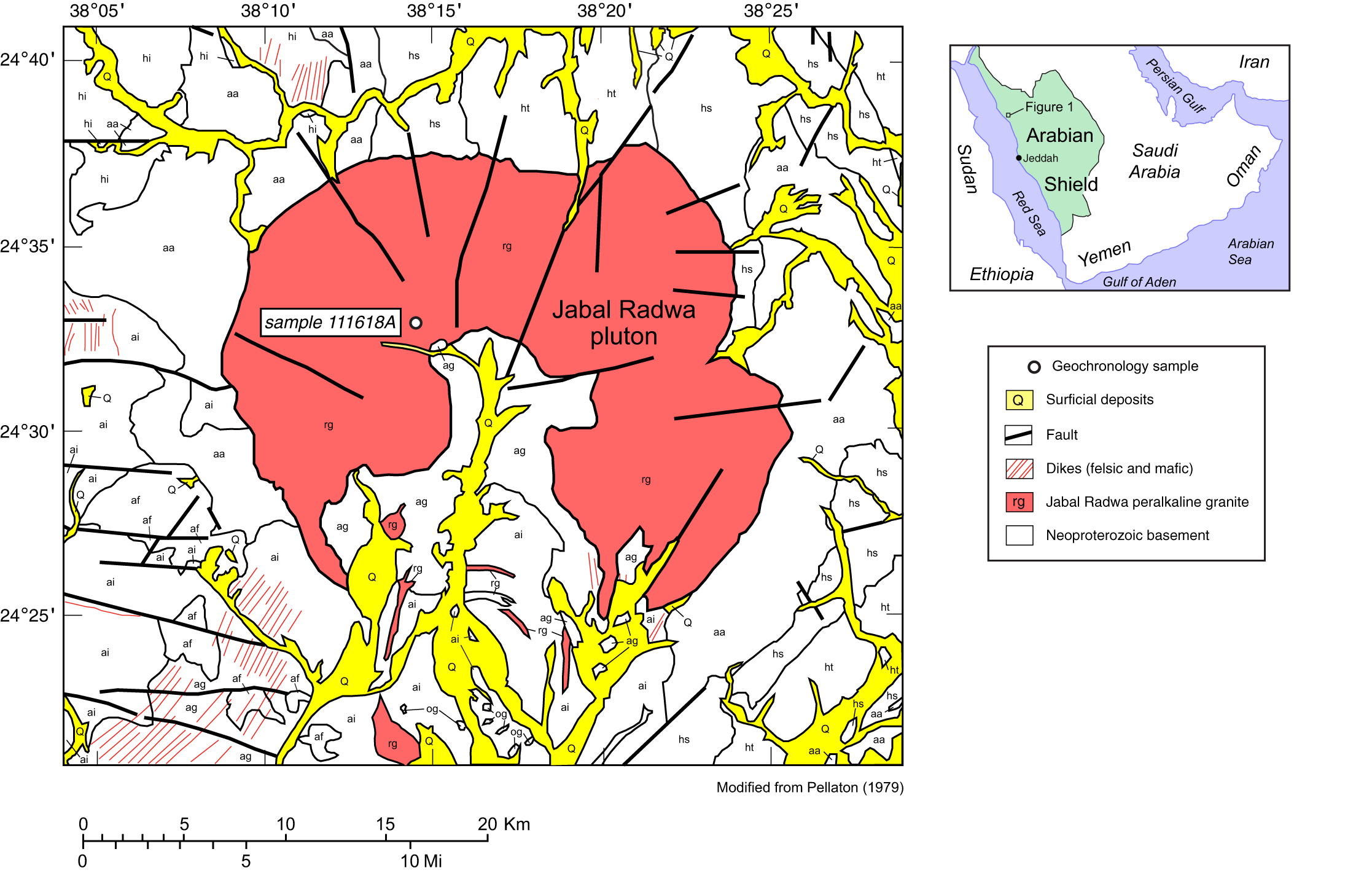
Simplified geological map of the Radwa alkali granite pluton and surrounding metasedimentary rocks (modified from Pellaton, Reference Pellaton1979). The inset shows location of the pluton in the Arabian Shield, Kingdom of Saudi Arabia. The labelled basement units are described in the text.

Using thermal ionisation mass spectrometry (TIMS), Aleinikoff and Stoeser (Reference Aleinikoff and Stoeser1989) determined the age of multigrain fractions of zircon from three metaluminous granite plutons and four peralkaline granite plutons from the Arabian Shield. Ages for six of these post-orogenic bodies range from ∼640 to 550 Ma (Aleinikoff and Stoeser, Reference Aleinikoff and Stoeser1989); one additional pluton (Jabal Radwa) appears to be significantly younger and hence is the subject of the present contribution. Zircon from these compositionally distinct plutons indicates two markedly different crystallisation histories. Because metaluminous rocks, with low agpaitic ratios (molar Na2O+K2O/Al2O3; Shand, Reference Shand1951) of <1, are saturated in Zr at ∼100 ppm (Watson, Reference Watson1979), zircon forms early during magma solidification. Thus, most zircon from Saudi Arabian metaluminous granites forms euhedral, prismatic, tan crystals with little common lead (Pb) and modest uranium (U) contents of a few hundred ppm. Consequently these are ideal candidates for U–Pb geochronology (Aleinikoff and Stoeser, Reference Aleinikoff and Stoeser1989). In contrast, peralkaline granites in Saudi Arabia have high agpaitic ratios (>1) which result in Zr saturation at several percent (Watson, Reference Watson1979). Thus, zircon forms late in these magmas, resulting in anhedral to subhedral morphologies, sometimes even with a pseudo-octahedral appearance of well-developed bipyramidal grains that lack prism faces. Many of these grains are medium to dark brown. These zircon frequently contain high common Pb and U contents (Supplementary Tables S1–5) which present significant challenges for U–Pb geochronology.
The Radwa alkali granite contains several populations of zircon; previously, TIMS analysis of zircon from this pluton yielded a tentative age of ∼481 ± 14 Ma (Aleinikoff and Stoeser, Reference Aleinikoff and Stoeser1989). Because zircon from the Radwa alkali granite occurs as a variety of colours (i.e. tan, green, blue, yellow and dark brown) and habit (i.e. euhedral prismatic, bipyramidal, subhedral and anhedral populations) and because of its anomalously young age relative to all other Proterozoic igneous rocks in the Arabian Shield (Stoeser, Reference Stoeser1986), we initiated a detailed geochronological study using a sensitive, high-resolution ion microprobe (SHRIMP) and laser ablation-inductively coupled plasma mass spectrometry (LA-ICP-MS) to constrain better the age of the host granite. In addition, the major-element and trace-element concentrations of zircon from the various colour populations were used to establish the distinctiveness of the diverse zircon populations.
Regional geology and local setting
The Radwa alkali granite forms a hypabyssal, near-circular pluton that is 27 km in diameter (Fig. 1) and covers an area of ∼370 km2 (Pellaton, Reference Pellaton1979). The pluton is located ∼350 km north-northwest of Jiddah, Saudi Arabia and ∼90 km east of the Red Sea on the western side of the Arabian Peninsula (Fig. 1 inset), within the Neoproterozoic Hijaz terrane of Stoeser and Camp (Reference Stoeser and Camp1985). In addition to the previously determined zircon TIMS U–Pb age of 481 ± 14 Ma (Aleinikoff and Stoeser, Reference Aleinikoff and Stoeser1989), Kemp and others (Reference Kemp, Pellaton and Calvez1980) determined a slightly older, yet still anomalously young, Rb–Sr isochron age of 521 ± 14 Ma.
The Radwa alkali granite is hosted by rocks of the Hijaz terrane to the east and west, rocks of the As Sard sedimentary basin to the north and the Jar-Salajah batholith to the south (Pellaton, Reference Pellaton1979; Johnson et al., Reference Johnson, Andresen, Collins, Fowler, Fritz, Ghebreab, Kusky and Stern2011, Reference Johnson, Halverson, Kusky, Stern and Pease2013; Stern, Reference Stern2024). The Neoproterozoic Hijaz terrane constitutes one of five microplates accreted between 715 and 630 Ma to form the Arabian Shield (Stoeser and Camp, Reference Stoeser and Camp1985; Pallister et al., Reference Pallister, Stacey, Fischer and Premo1988). The Hijaz terrane, which is bounded by ophiolite-bearing suture zones, includes mafic to felsic igneous rocks principally associated with island arc magmatism, including calc-alkaline subaqueous volcanic rocks and related intrusive rocks, which might represent the roots of former arc volcanic centres (Pellaton, Reference Pellaton1979; Stoeser and Camp, Reference Stoeser and Camp1985; Johnson et al., Reference Johnson, Andresen, Collins, Fowler, Fritz, Ghebreab, Kusky and Stern2011, Reference Johnson, Halverson, Kusky, Stern and Pease2013). Hijaz terrane rocks to the east and west of Jabal Radwa are part of the Al Ays group (Pellaton, Reference Pellaton1979). In the area around Jabal Radwa, only rocks of the Abathir formation (unit aa, Fig. 1) are present, and are the middle of three formations within the Al Ays group. The schistose metasedimentary Abathir formation is several thousand metres in thickness and consists of interlayered volcanic rocks, principally rhyolite tuff, which also include minor andesite and basalt lava with associated but volumetrically less abundant epiclastic volcanic sedimentary deposits. Igneous rocks intrusive into the Al Ays group rocks include gabbro (unit ag, Fig. 1) and intermediate to felsic intrusions (units ai and af, respectively, Fig. 1). Between 700 and 680 Ma, the Hijaz terrane was accreted to the Asir terrane along the Bir Umq suture (Stoeser and Camp, Reference Stoeser and Camp1985; Pallister et al., Reference Pallister, Stacey, Fischer and Premo1988). North of Jabal Radwa, sedimentary rocks of the Hadiya group were deposited in the As Sard basin between ∼680 and 615 Ma (Pellaton, Reference Pellaton1979, Stoeser and Camp, Reference Stoeser and Camp1985, Johnson et al., Reference Johnson, Andresen, Collins, Fowler, Fritz, Ghebreab, Kusky and Stern2011, Reference Johnson, Halverson, Kusky, Stern and Pease2013). Near Jabal Radwa, only the two oldest of three formations of the Hadiya group are present. The oldest of these, the Siqam formation (unit hs, Fig. 1), is up to 2000 m in thickness and is dominated by andesitic to basaltic magmatism. Rocks of the overlying Tura’ah formation (unit ht, Fig. 1), which is up to 3000 m in thickness, are sedimentary and consist of interlayered sandstone, siltstone and conglomerate (Pellaton, Reference Pellaton1979). Igneous rocks essentially coeval with, and intrusive into, Hadiya group rocks include granite and granodiorite intrusions (unit hi, Fig. 1). The Jar-Salajah batholith (∼695 Ma; Pallister et al., Reference Pallister, Stacey, Fischer and Premo1988) is an intrusive complex that includes medium-grained gabbro, diorite, granodiorite and tonalite (Pellaton, Reference Pellaton1979). Numerous dykes of diverse composition were emplaced locally into intrusive rocks coeval with the Hadiya group and intermediate igneous rocks and gabbro that intrude Al Ays group rocks (Pellaton, Reference Pellaton1979). Distal to the Hijaz terrane, additional accretionary events culminated in cratonisation of the Arabian Shield by ∼620–600 Ma (Stoeser and Camp,Reference Stoeser and Camp1985; Hargrove et al., Reference Hargrove, Stern, Kimura, Manton and Johnson2006; Doebrich et al. Reference Doebrich, Al-Jehani, Siddiqui, Hayes and Wooden2007; Johnson et al., Reference Johnson, Andresen, Collins, Fowler, Fritz, Ghebreab, Kusky and Stern2011, Reference Johnson, Halverson, Kusky, Stern and Pease2013; Stern, Reference Stern2024 and references therein). The Radwa alkali granite (unit rg, Fig. 1) and small bodies of layered olivine gabbro (unit og, Fig. 1) represent subduction-related magmatism that followed cratonisation of the Proterozoic Arabian Shield.
Petrography
The granitoid intrusion exposed at Jabal Radwa is composed of pink hypersolvus alkali granite associated with numerous pegmatite dykes (Pellaton, Reference Pellaton1979). By definition, alkali granite intrusions are composed of phaneritic igneous rocks having modal compositions akin to granite (Streckeisen, Reference Streckeisen1976) which contain sodic pyroxenes and/or amphiboles. In most places, the Radwa alkali granite is fine-grained granophyre principally composed of quartz and perthitic alkali feldspar that includes ∼3 vol.% arfvedsonite and 1 vol.% aegirine. The accessory and trace mineral assemblage includes zircon, titanite, synchysite, apatite, ilmenite, rutile, monazite, xenotime, albite, aenigmatite, magnetite and corundum (Pellaton, Reference Pellaton1979; Stoeser and Elliott, Reference Stoeser, Elliott and Al-Shanti1980; Aleinikoff and Stoeser, Reference Aleinikoff and Stoeser1989; this study). None of the alkali-zirconosilicates, which occur in peralkaline rocks (cf. Linthout, Reference Linthout1984; Marr et al., Reference Marr, Baker and Williams-Jones1994; Salvi and Williams-Jones, Reference Salvi and Williams-Jones1995; Cegielka et al., Reference Cegielka, Baginski, Macdonald, Belkin, Kotowski and Upton2022; Chao et al., Reference Chao, Lin, Sheng-Rong, Santosh and Jun-Feng2022), were observed.
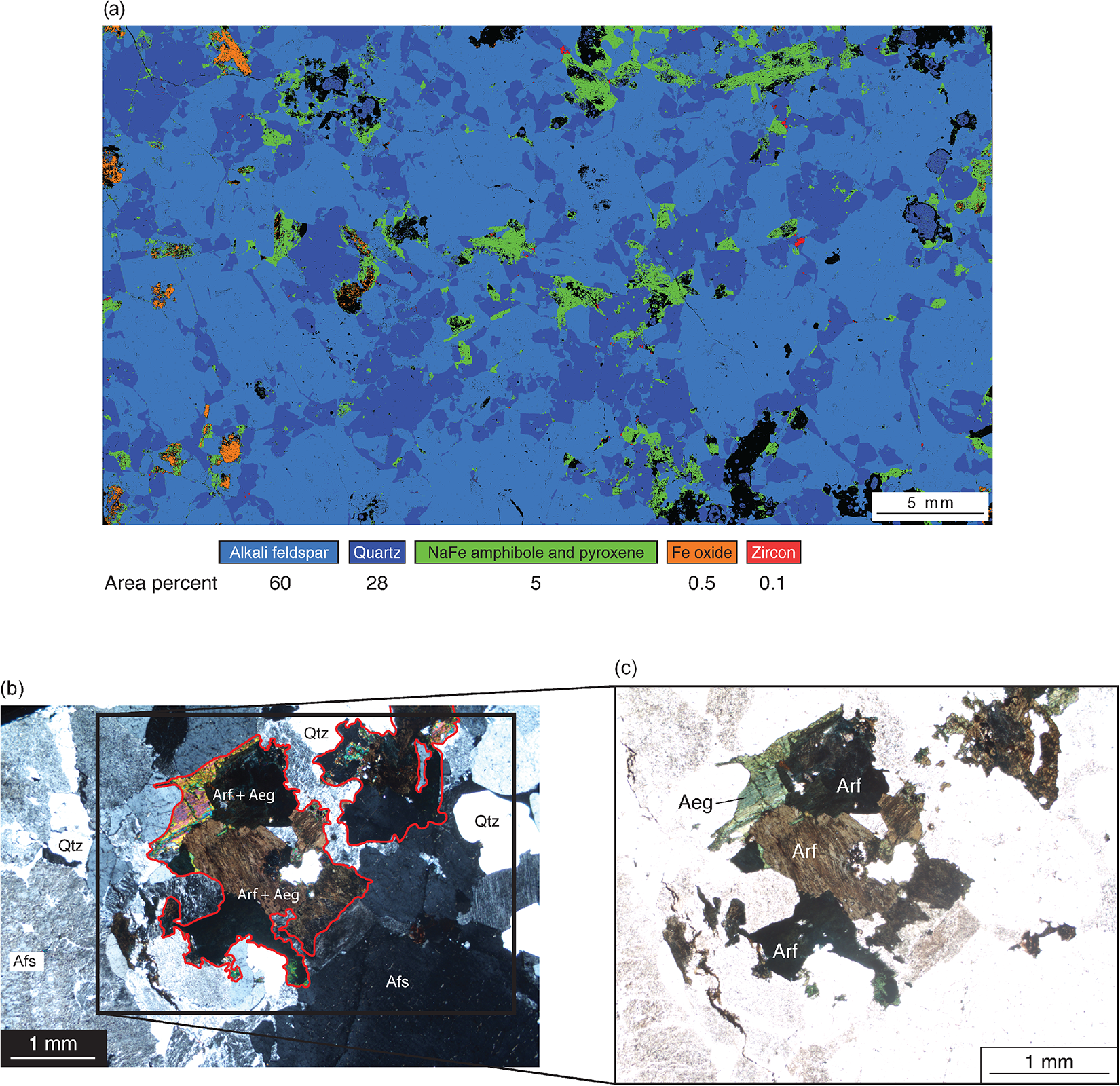
The Radwa alkali granite contains medium- to coarse-grained domains from which our geochronology sample was collected. This is characterised by an inequigranular, hypidiomorphic granular texture (Fig. 2a). Abundant alkali feldspar is coarsely perthitic, anhedral to euhedral (although most are subhedral), and somecrystals are Carlsbad twinned. Individual crystals are 0.5 to almost 10 mm in length (average, ∼5 mm). Quartz is principally anhedral and interstitial with most grains exhibiting undulose extinction with individual grains ranging from ∼0.2 to ∼4 mm in diameter (average: ∼2 mm) (Fig. 2b). Plagioclase is scarce and forms anhedral, albite-twinned crystals which are 0.3 to 1 mm in length. Aleinikoff and Stoeser (Reference Aleinikoff and Stoeser1989) reported that the amphibole in the Radwa alkali granite is arfvedsonite. Weakly altered arfvedsonite is interstitial and forms crystals which are 0.1–2 mm in length (average, ∼1 mm). These are mainly subhedral to anhedral crystals which exhibit a diagnostic blue grey to deep blue pleochroism. Most arfvedsonite is intergrown with aegirine (Aleinikoff and Stoeser, Reference Aleinikoff and Stoeser1989) which forms anhedral to subhedral interstitial grains that are 0.2–2 mm (av. ~0.8 mm) in diameter. The aegirine has a distinctive pale yellow-green to emerald-green pleochroism (Fig. 2). Opaque iron–titanium oxides are a minor component of the Radwa alkali granite and form anhedral grains that are 0.05–0.5 mm in diameter (average, ∼0.2 mm). Weakly altered perthitic alkali feldspar and arfvedsonite probably reflect the effects of exsolved, late-stage magmatic fluids.
Petrography of sample 111618 (Radwa alkali granite). (a) SEM full thin-section scan, showing predominant perthitic alkali feldspar (Afs) and quartz (Qtz). (b) High magnification optical view (crossed polars) optimised by adjustment of contrast and brightness to show the texture of perthitic alkali feldspar crystals; note the pervasive, weak sericitic alteration. Contact between mafic silicate minerals and perthitic alkali feldspar plus quartz, shown by red lines. (c) Slightly higher magnification view (in plane-polarised light) of part (b) showing the textural relationship of arfvedsonite (Arf) and aegirine (Aeg). Note the irregular, somewhat altered grain boundaries of arfvedsonite.

Whole-rock composition
The peralkaline Radwa alkali granite belongs to one of the world’s largest assemblage of intrusions of this type (Stoeser and Elliot, Reference Stoeser, Elliott and Al-Shanti1980). Importantly, composite plutons of the Arabian Shield that include peralkaline components exhibit magma reservoir compositional evolution from early peralkaline phases to progressively younger metaluminous and even peraluminous compositions (Stoeser and Eliott, Reference Stoeser, Elliott and Al-Shanti1980; du Bray, Reference du Bray1988). A single analysis of this granite (table II, p. 247; Aleinikoff and Stoeser, Reference Aleinikoff and Stoeser1989) gave an agpaitic ratio of 1.09. Equally distinctive, the intrusion is composed of high-silica granite, abundances of MgO and CaO that are low relative to the average low-Ca granite (Turekian and Wedepohl, Reference Turekian and Wedepohl1961), K2O and Na2O contents that are approximately equal, and relative FeO* and MgO abundances that correspond to a distinctly ferroan (Frost and Frost, Reference Frost and Frost2008) composition. The granite has a somewhat elevated fluorine abundance (1100 ppm). Perhaps the most distinctive geochemical characteristic of the Radwa alkali granite is that its zirconium (Zr) content (650 ppm) is far in excess of Zr abundances (∼100–200 ppm) typical of most silicate melts (Watson, Reference Watson1979). Rare earth element abundances in a single sample (Jackson et al., Reference Jackson, Walsh and Pegram1984) of the Radwa alkali granite are similar to those of other peralkaline Neoproterozoic granites of the Arabian Shield (Stuckless et al., Reference Stuckless, Knight, VanTrump and Budahn1982). Specifically, its chondrite-normalised REE distribution pattern is gently negatively sloping (LaN/YbN = 4.89) and total REE contents (448 ppm) are somewhat elevated. Uncharacteristically, the magnitude of the negative europium anomaly (Eu/Eu* = 0.72) is relatively small (Jackson et al., Reference Jackson, Walsh and Pegram1984), suggesting that petrogenesis of the Radwa magma involved somewhat less plagioclase fractionation than is characteristic of many Arabian Shield peralkaline granites.
Zircon and titanite mineralogy
The compositions, morphology and age of zircons were investigated using scanning electron microscopy-energy dispersive spectroscopy (SEM-EDS), a sensitive, high-resolution ion microprobe (SHRIMP) and laser ablation-inductively coupled plasma mass spectrometry (LA-ICP-MS). Full details on the methods and samples used are given in Supplementary material 1.
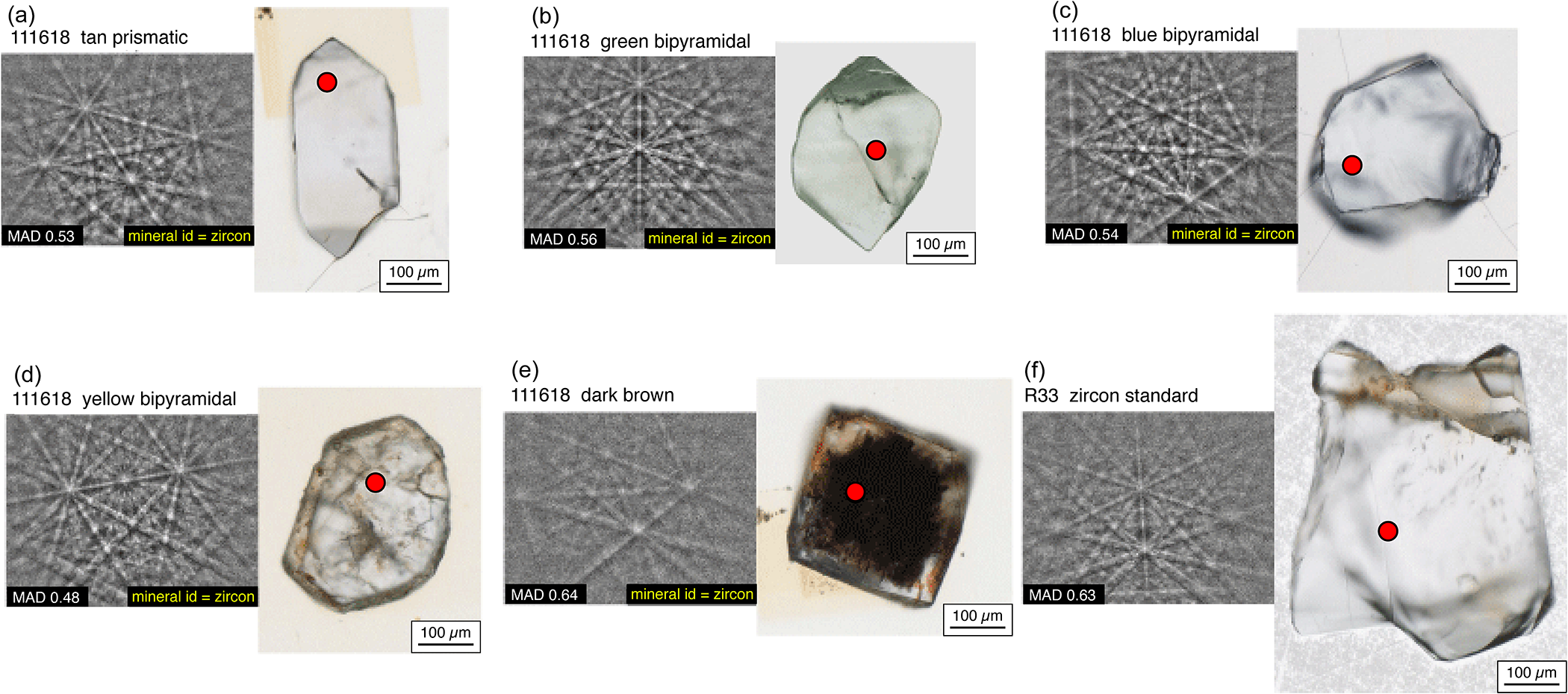
Zircon was extracted from a coarse-grained fresh spall block collected from the centre of the Radwa alkali granite pluton (Fig. 1) and concentrated using standard mineral separation techniques, including crushing, pulverising, magnetic separation using a Franz Isodynamic separator (non-magnetic at maximum current of ∼1.7 A, with a track side tilt of 15° and forward tilt of 10°) and sinking in methylene iodide (density = 3.3 g/cm3). A wide variety of crystals with diverse morphologies and colours, as determined in natural light), were extracted from the non-magnetic heavy mineral population. Using SEM-EDS, these grains were identified as: (1) zircon (prismatic, tan colour typical of felsic igneous rock origin); (2) pinkish, radiating, bladed synchysite; and (3) subhedral to anhedral grains (colour groups of dark brown, olive green, pale blue and yellow, in natural light) most of which are also zircon. The population of yellow anhedral grains was found to contain zircon and titanite which appeared similar (eventually distinguished by SEM-EDS analysis). Because of the unusual occurrence of diversely coloured grains considered to be zircon, based primarily on SEM-EDS analysis plus some morphological characteristics, all colour populations were analysed by electron back-scatter diffraction (EBSD) to determine the orientation of diffracting crystal planes and therefore mineralogy. All analysed grains yielded Kikuchi bands (electron back-scatter patterns) entirely consistent with zircon (Fig. 3a–e).
Electron back-scattered diffraction (EBSD) images showing the crystal structure of the five zircon colour populations in sample 111618. Red dots show the locations of the EBSD analytical spots (grains imaged in incandescent transmitted light). Kikuchi bands patterns confirm that all grains are zircon: (a) tan zircon core; (b) green zircon; (c) blue zircon; (d) yellow zircon; (e) dark brown zircon core; (f) R33 standard zircon; R33 also used for SHRIMP U–Pb geochronology. Abbreviation: MAD (mean angular deviation) is the goodness of fit of the solution to the reference pattern.

The sizes, morphologies and other characteristics of each zircon colour population in the Radwa alkali granite are distinct. Results are presented for each of the zircon colour populations (i.e. dark brown, green, blue, tan and yellow), from oldest to youngest (see ‘Zircon SHRIMP U–Pb geochronology’ below).
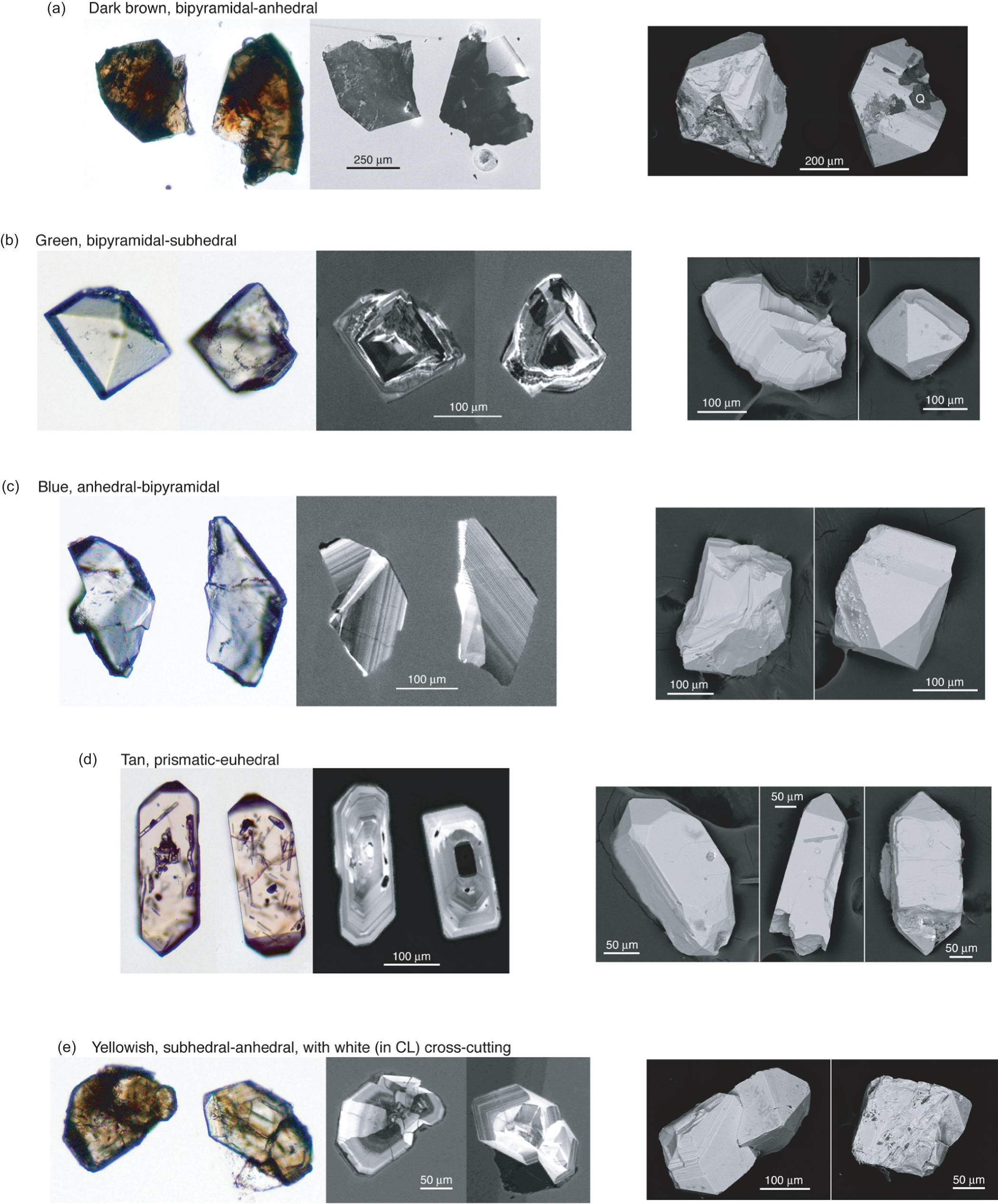
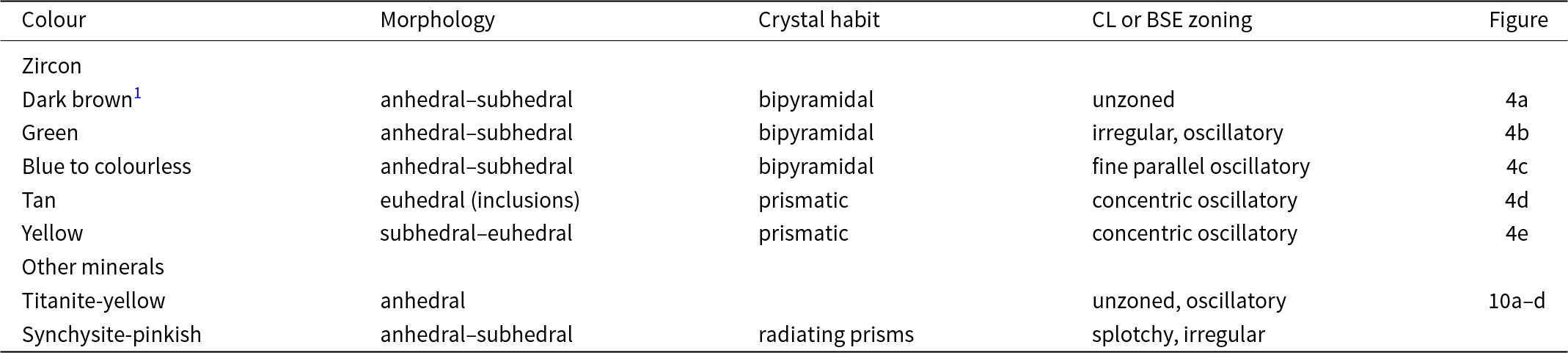
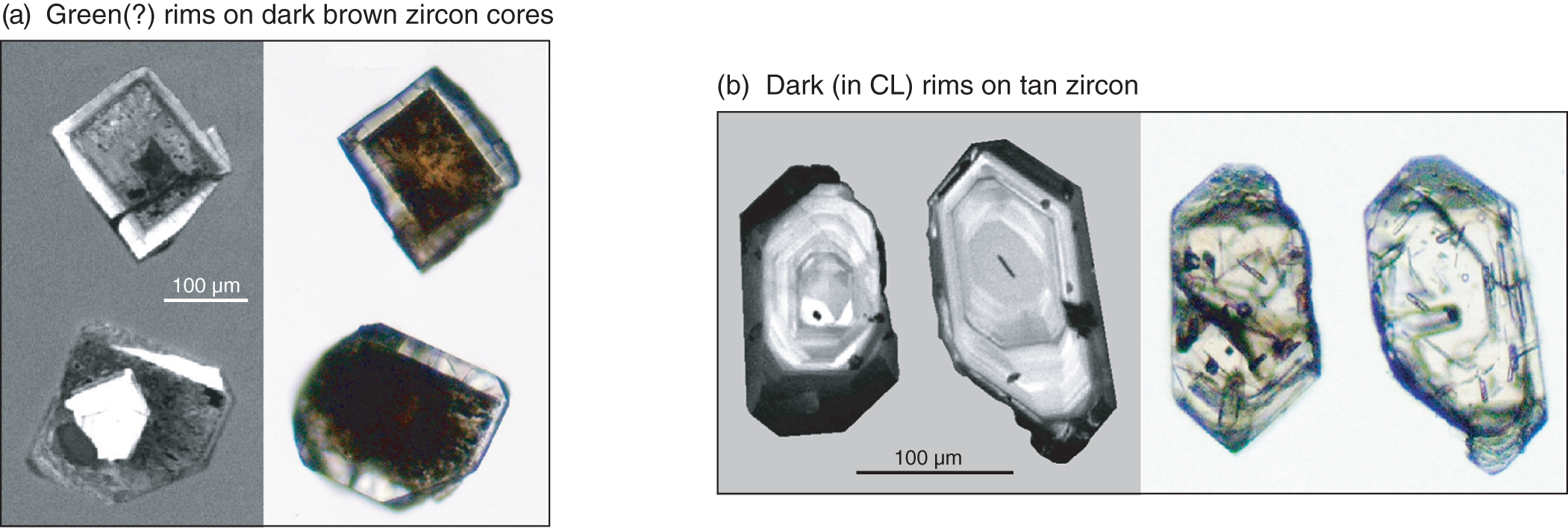
Dark brown zircon (Fig. 4a, Table 1) is anhedral and bipyramidal (length-to-width ratios (l/w) = 1–4). Many appear to be coarse fragments from even larger grains. Some of the dark brown grains are overgrown by rims (either tan or greenish; Fig. 5a), indicating that the dark brown cores are older than the tan or green zircon rims. In addition, some grains have irregular white (in cathodoluminescence (CL)) overgrowths (Fig. 5a). Most of the internal zones of the dark brown grains are amorphous, although some grains show oscillatory zoning in CL. Green zircon grains (Fig. 4b, Table 1) are anhedral, subhedral, or euhedral. Most grains are somewhat equant (l/w = 1–2). Some grains are dominated by bipyramidal terminations (pseudo-octahedral morphology) and have poorly developed prism faces. Most grains have irregularly zoned (or unzoned) cores and thin oscillatory zoned rims. Blue zircon grains (Fig. 4c, Table 1) are anhedral to subhedral (some grains show bipyramidal terminations; l/w = 2–4) and most grains show fine oscillatory zoning. Tan zircon (Fig. 4d, Table 1) is euhedral and prismatic (l/w = 4–6) and contains numerous inclusions. All grains display concentric oscillatory zoning in CL. Many grains contain dark, unzoned rims (Fig. 5b). Yellow zircon (Fig. 4e, Table 1) is anhedral to subhedral (l/w = 1–3) and most show broad oscillatory and/or sector zoning in CL. Only one grain (in the dark brown population) yielded evidence of a xenocrystic component.
Images of five zircon colour populations. The images in the left-hand column are by transmitted light photomicroscopy, those in middle column are by SEM cathodoluminescence and those in right-hand column are secondary electron images by SEM.

Characteristics of zircon, titanite and synchysite from Radwa alkali granite

1 Cores overgrown by green (or tan) rims.
Previous geochronology
Thermal ionisation mass spectrometry U–Pb data for four multigrain fractions of zircon from sample 111618 (Radwa alkali granite) do not form a co-linear array but rather are scattered (figure 8 of Aleinikoff and Stoeser, Reference Aleinikoff and Stoeser1989). Three fractions were composed of hand-picked coarse, tan prismatic grains, whereas a fourth fraction was composed of fine grains (<45 µm long) that were not magnetically sub-divided (presumably a mixture of colour populations). A fraction containing non-magnetic coarse grains (∼100–150 µm in length) yielded a nearly concordant age of 468 Ma (206Pb/238U age) and 481 Ma (207Pb/206Pb age); other fractions were discordant and produced older 207Pb/206Pb ages between 512 to 555 Ma, suggesting incorporation of inherited xenocrystic material. A reference chord calculated from a lower intercept age of 15 ± 15 Ma (characteristic lower intercept age for rocks of the Arabian Shield, representing opening of the Red Sea; Girdler and Styles, Reference Girdler and Styles1974; Davison et al., Reference Davison, Al-Kadasi, Al-Khirbash and Al-Subbary1994) projected through data from the youngest fraction, resulted in an upper intercept age of 481 ± 14 Ma. This age was considered to be the emplacement age of the Radwa alkali granite; it may actually be a mixture of low-U cores (bright in CL) and high-U rims (dark in CL) components, however (Fig. 5b).
Transmitted light (left) and cathodoluminescence (right) image pairs showing distinct rims on zircon grains: (a) dark brown zircon cores overgrown by green (or tan) zircon rims; (b) tan zircon cores with oscillatory zoning, overgrown by unzoned dark (in CL) rims.

The regionally young upper intercept age motivated further study of these zircons by SHRIMP. This micro-analytical technique is capable of avoiding altered or damaged zones and/or inheritance of xenocrystic material, in individual zircon grains to obtain age data from pristine, undisturbed crystal domains. Hence, careful location of analytical spots results commonly in concordant age data. In addition, the zircon grains were analysed by LA-ICP-MS to confirm the SHRIMP data.
Results
Electron probe microanalysis
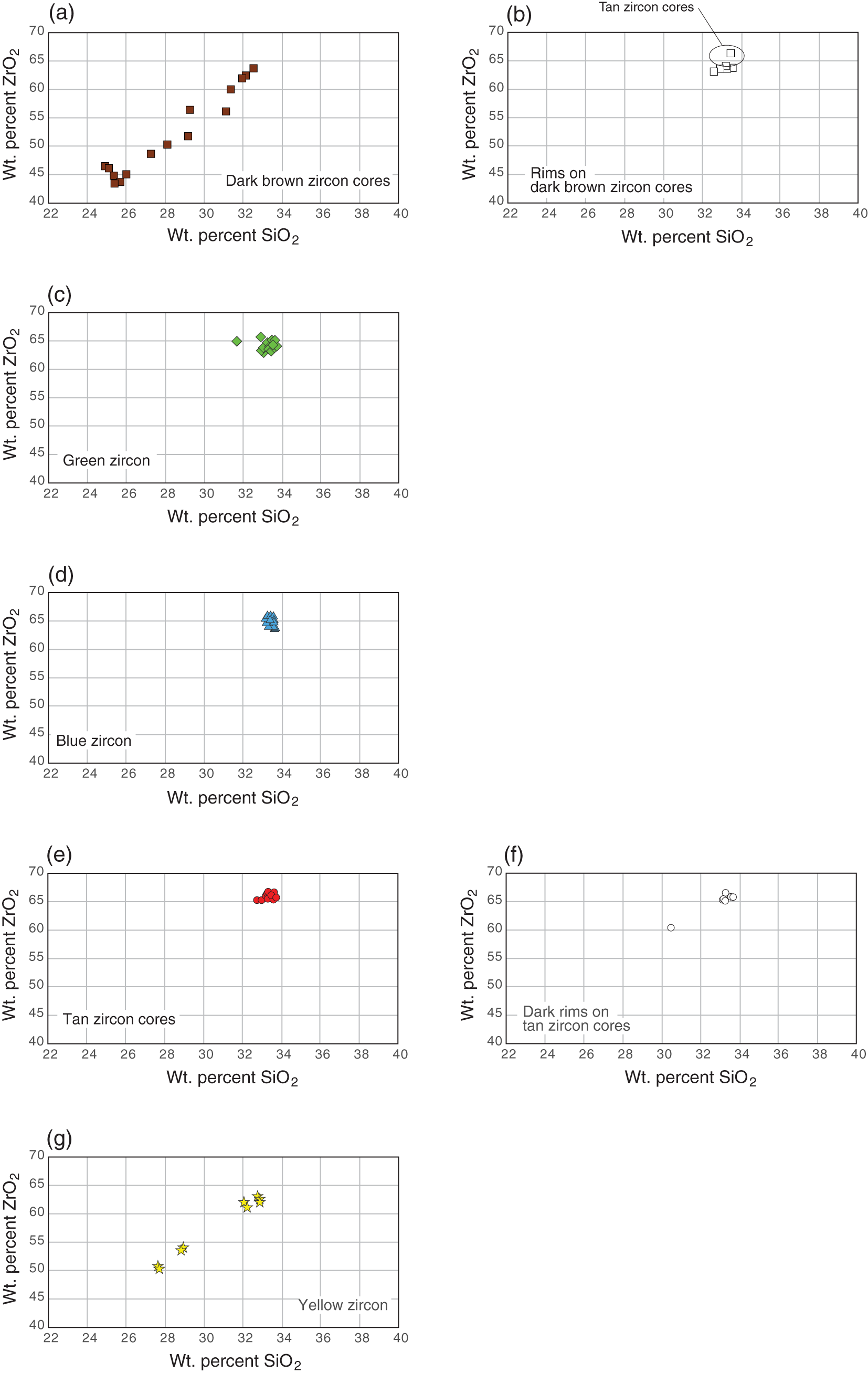
Electron probe microanalysis (EPMA) demonstrates that the five colour populations of zircon have variable major and trace element compositions (Supplementary Table S1). Dark brown zircon cores have wide ranges of both ZrO2 and SiO2 (43–64 and 25–33 wt.%, respectively; Fig. 6a). Abundances of ZrO2 and SiO2 in rims on dark brown zircon (∼63–65 and 33–34 wt.%, respectively) define narrow compositional ranges (Fig. 6b). Although these rims appear to be green or blue zircon (Fig. 5a), their REE distribution patterns are distinct from those characteristic of green and blue zircon. Major-element and REE distribution patterns of rims on dark brown zircon are similar to those of tan zircon cores (Figs 6b, 11a).
SiO2 vs. ZrO2 EPMA of five colour populations of zircon. Compositions of dark brown and yellow zircon display considerable variation (parts a, g), whereas green, blue and tan zircon yield coherent data clusters with minimal variation (parts c–e). Distinct rims on brown and tan zircon grains were analysed separately (parts b,f).

Compositionally, green and blue zircon are reasonably homogeneous and tend to have SiO2 contents similar to those of tan zircon (Fig. 4e) but slightly smaller ZrO2 contents of ∼63–66 wt.% (Fig. 4c,d). Cores of tan prismatic zircon are compositionally fairly homogeneous, mostly containing ∼65–67 wt.% ZrO2 and 33–34 wt.% SiO2 (Fig. 4e), which are close to the stoichiometric compositions of zircon (67.2% and 32.8%, respectively). With the exception of one result, thin, dark (in CL) rims on tan prismatic zircon have the same major-element composition as the cores (Fig. 4f). In contrast, yellow zircon is significantly compositionally heterogeneous (similar to dark brown zircon). Yellow zircon has an intermediate range of ZrO2 and SiO2 contents (50–63 and 27–33 wt.%, respectively; Fig. 4g).
Zircon SHRIMP U–Pb geochronology
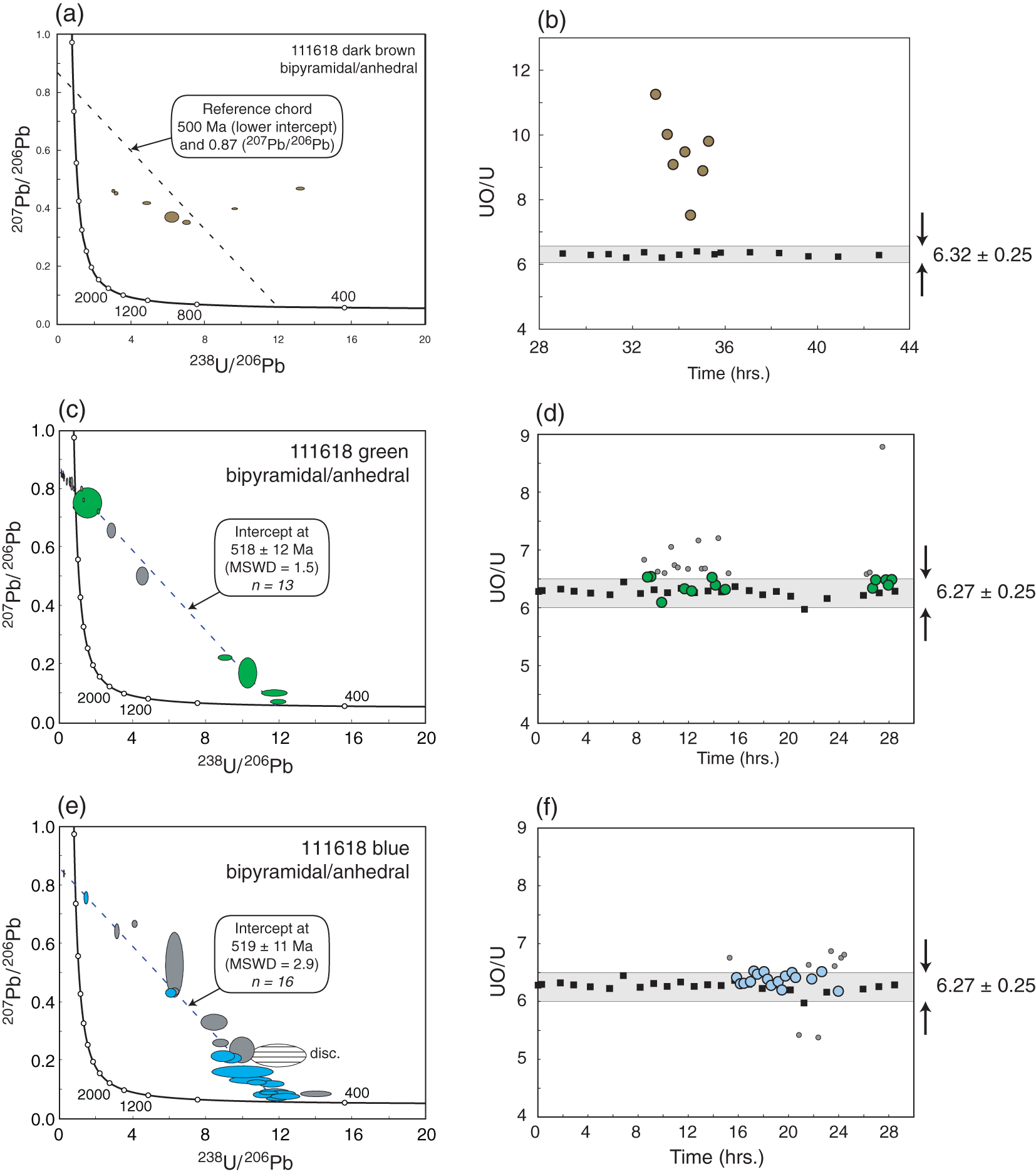
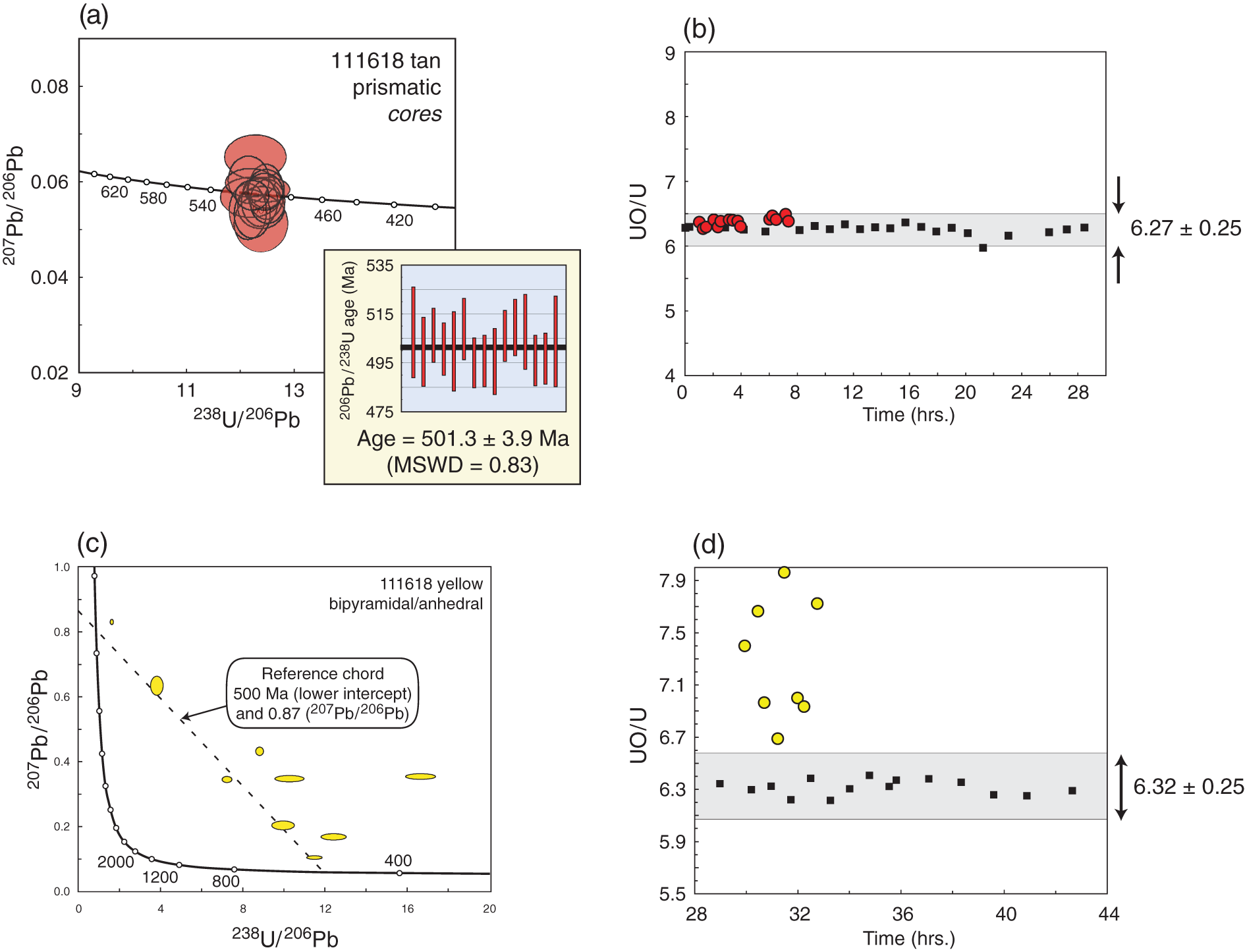
A critical aspect for SHRIMP geochronology is that the standard zircon (or titanite) must have a composition similar to that of the unknowns. Matrix differences between standard and unknowns can result in inaccurate ages. A specific measure of compatibility is UO/U values. As demonstrated by data for the zircon standard R33, acceptable values of UO/U are in the range of 6.27 ± 0.25 for session 1 (tan, green and blue zircon) and 6.32 ± 0.25 for session 2 (yellow and brown zircon); data outside these ranges are unusable for the present geochronology study. Because of the wide variety of colours and morphologies in the five zircon populations, isotopic data for each group are shown both as Concordia plots and UO/U versus relative time of the analysis (Figs 7, 8) to aid data interpretation. The SHRIMP-II at the Research School of Earth Sciences, Australian National University was used to obtain U–Pb zircon geochronology data.
SHRIMP isotopic data for zircon from sample 111618, Radwa alkali granite. The figures in the left column are Tera-Wasserburg concordia plots; those in the right column are plots of UO/U versus relative analysis time for both standard zircon (filled squares) and zircon from sample 111618 (coloured circles). Grey error ellipses on figures in the left column correspond to analyses with UO/U values which are outside of the acceptable range and were excluded from age calculations: (a,b) dark brown zircon – all analyses yielded unacceptable UO/U, which precluded an age calculation from these data for dark brown zircon; (c,d) green zircon – thirteen (of 26) analyses were excluded (based on UO/U systematics) from the age calculation; (e,f) blue zircon – eight (of 24) analyses were excluded (based on UO/U systematics) from the age calculation.

SHRIMP isotopic data for zircon from sample 111618, Radwa alkali granite. Figures in the left-column are Tera-Wasserburg concordia plots, figures in the right column are plots of UO/U versus relative analysis time for both standard zircon (filled squares) and zircon from sample 111618 (coloured circles): (a,b) tan zircon – UO/U for all sample analyses are commensurate with the standard; the inset in (a) shows weighted average plot of 206Pb/238U ages (± 2 sigma); (c,d) yellow zircon – all analyses yielded unacceptable UO/U, which precludes an age calculation from these data.

All of the dark brown grains analysed have large common Pb contents (mostly in the range of ∼17–77% common 206Pb), low to intermediate U contents (26–588 ppm) and large Th contents (∼1000–20,000 ppm) (Supplementary Table S2). Isotopic data from dark brown grains are scattered (Fig. 7a) and all results yielded UO/U values which were far outside the acceptable range (Fig. 7b). Thus, although tan zircon overgrew dark brown zircon (providing relative age constraints), no meaningful absolute age data were obtained from the dark brown cores.
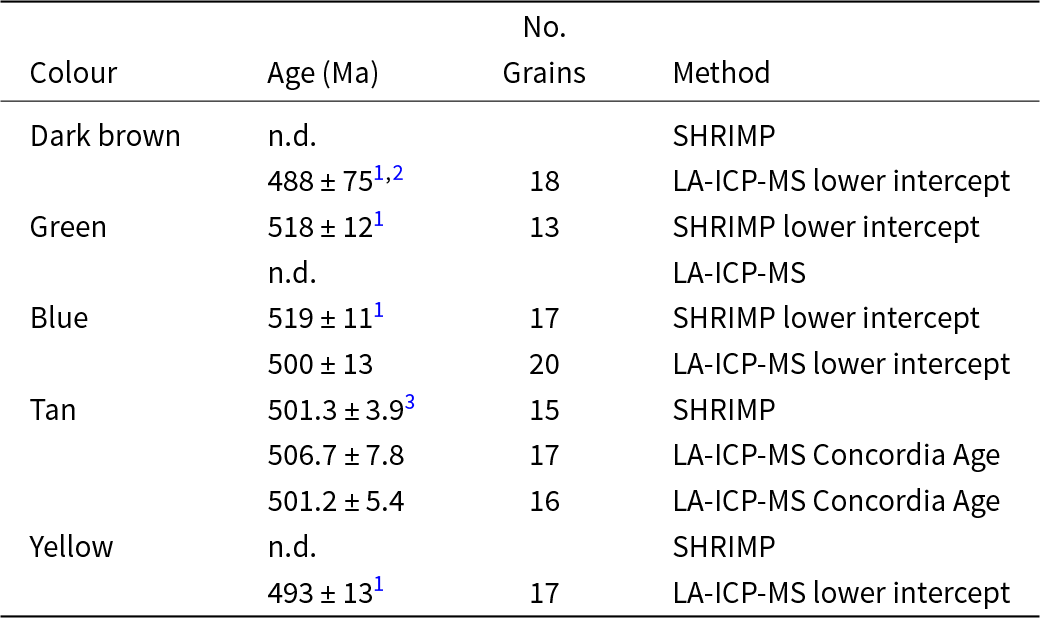
Green zircon contains an extreme range of common Pb contents, ranging from ∼1.2 to 99% common 206Pb and low U contents (4–37 ppm) (Supplementary Table S2). Because of the large common Pb content and discordant data, a best-fit line on a Tera-Wasserburg concordia plot was calculated using only data with acceptable UO/U. This regression yields a lower intercept age of 518 ± 12 Ma (MSWD = 1.5) (Fig. 7c). About half of the results have acceptable UO/U (Fig. 7d).
Blue zircon has moderate common Pb contents, ranging from ∼0 to 78% common 206Pb and small U contents (2–27 ppm) (Table S2). Because of the elevated common Pb contents, a best-fit line on a Tera-Wasserburg concordia plot was calculated using only data with acceptable UO/U. This regression yields a lower intercept age of 519 ± 11 Ma (MSWD=2.9) (Fig. 7e). About two-thirds of the results have acceptable UO/U values (Fig. 7f).
The tan coloured zircon grains analysed contain little common 206Pb (mostly <0.6%) and intermediate amounts of U (typically 75–135 ppm) (Table S2). Age data for tan zircon are mostly concordant (Fig. 8a) and values of UO/U for these zircon grains are entirely within the acceptable range (Fig. 8b). The weighted average of the 206Pb/238U ages is 501.3 ± 3.9 Ma (MSWD = 0.83) (Fig. 8a). This age is considered to define the time of emplacement of the Radwa alkali granite.
All yellow grains contain large amounts of common Pb (∼16–58% common 206Pb) and small to intermediate amounts of U (11–243 ppm) (Table S2). The grains yielded scattered U–Pb isotopic data (Fig. 8a) and entirely unacceptable UO/U values (Fig. 8b). Thus, no meaningful SHRIMP data were obtained from the yellow zircon.
LA-ICP-MS U–Pb geochronology analysis
To assess the accuracy of the SHRIMP-derived ages of zircon from the Radwa alkali granite, representative zircon from the five colour populations were also analysed by LA-ICP-MS using the USGS AttoM mass spectrometer. In addition, yellow titanite was analysed by the USGS Resolution SE 155 laser ablation system, using a spot size of ∼20 µm (see Supplementary Material 1).
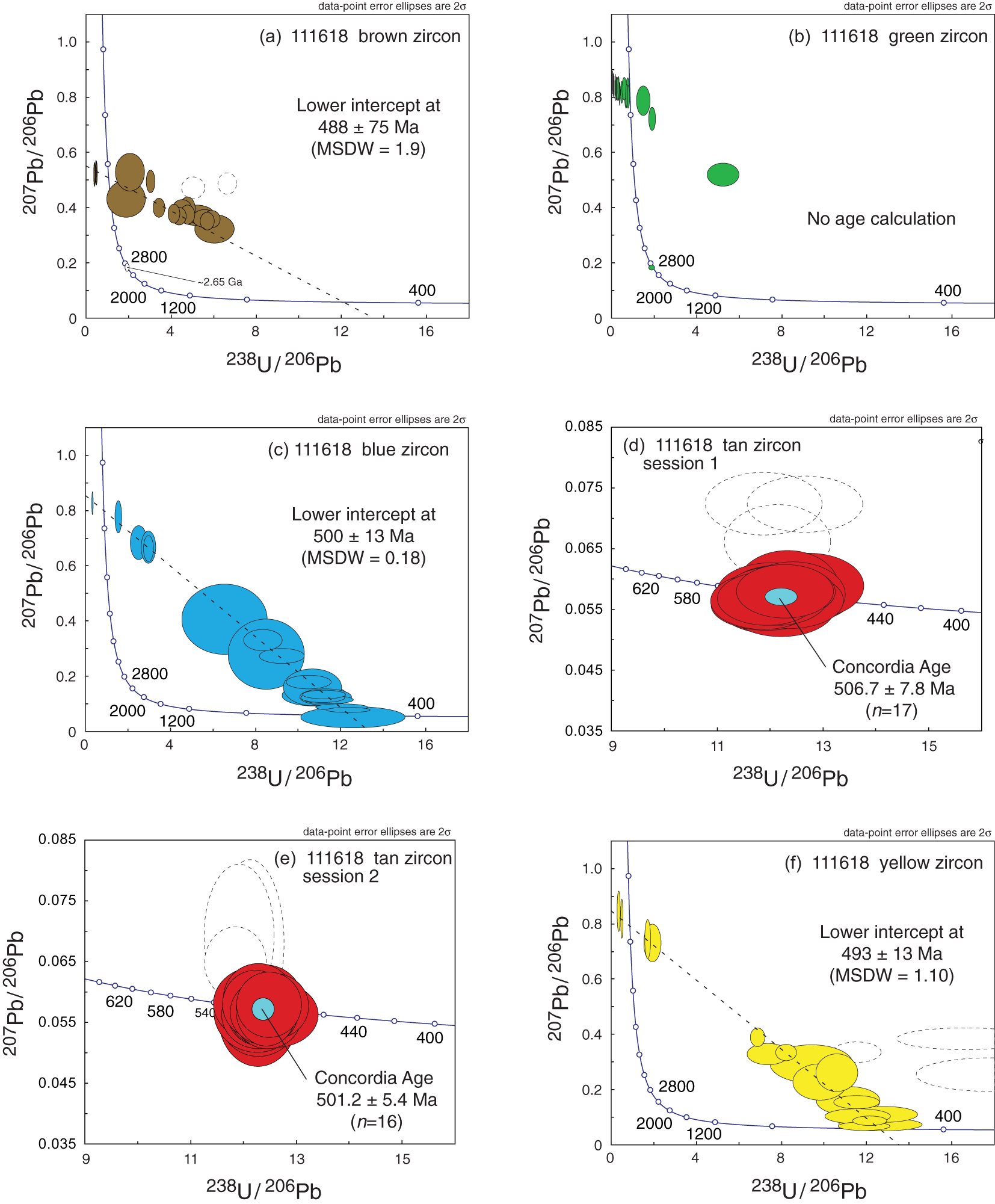
Dark brown grains (with high common Pb) yielded an imprecise age of 488 ± 75 Ma (Fig. 9a). Green zircon (with high common Pb) yielded a discordant data array; Isoplot was unable to calculate a lower intercept age (Fig. 9b). Blue zircon (with medium to high common Pb) yielded a discordant array with a lower intercept age of 500 ± 13 Ma (Fig. 9c). Tan zircon, run in two analytical sessions, yielded Concordia Ages of 506.7 ± 7.8 Ma (session 1) and 501.2 ± 5.4 Ma (session 2) (Fig. 9d,e), identical within error to the SHRIMP age of 501.3 ± 3.9 Ma. Yellow zircon (with high common Pb) resulted in a lower intercept age of 493 ± 13 Ma (Fig. 9f). A single dark brown zircon grain has an age of 2.65 Ga and, although this age clearly represents xenocrystic zircon, it is in accord with the identification of ∼3.0 Ga zircon from the Khida terrane in the east central part of the Arabian Shield (Whitehouse et al., Reference Whitehouse, Flowerdew, Stoeser and Stacey2023).
LA-ICP-MS isotopic data, on Tera-Wasserburg concordia plots, for five zircon colour populations from sample 111618, Radwa alkali granite. Data shown by dashed error ellipses were excluded from age calculations: (a) data for dark brown zircon; discordant data result in calculation of an imprecise lower intercept age; (b) data for green zircon; discordant results preclude calculation of a lower intercept age; (c) data for blue zircon, resulting in calculation of a lower intercept age; (d) data for tan zircon analysed during session 1. Blue ellipse corresponds to the calculated Concordia Age; (e) data for tan zircon analysed during session 2; the blue ellipse corresponds to the calculated Concordia Age; (f) data for yellow zircon, resulting in calculation of a lower intercept age.

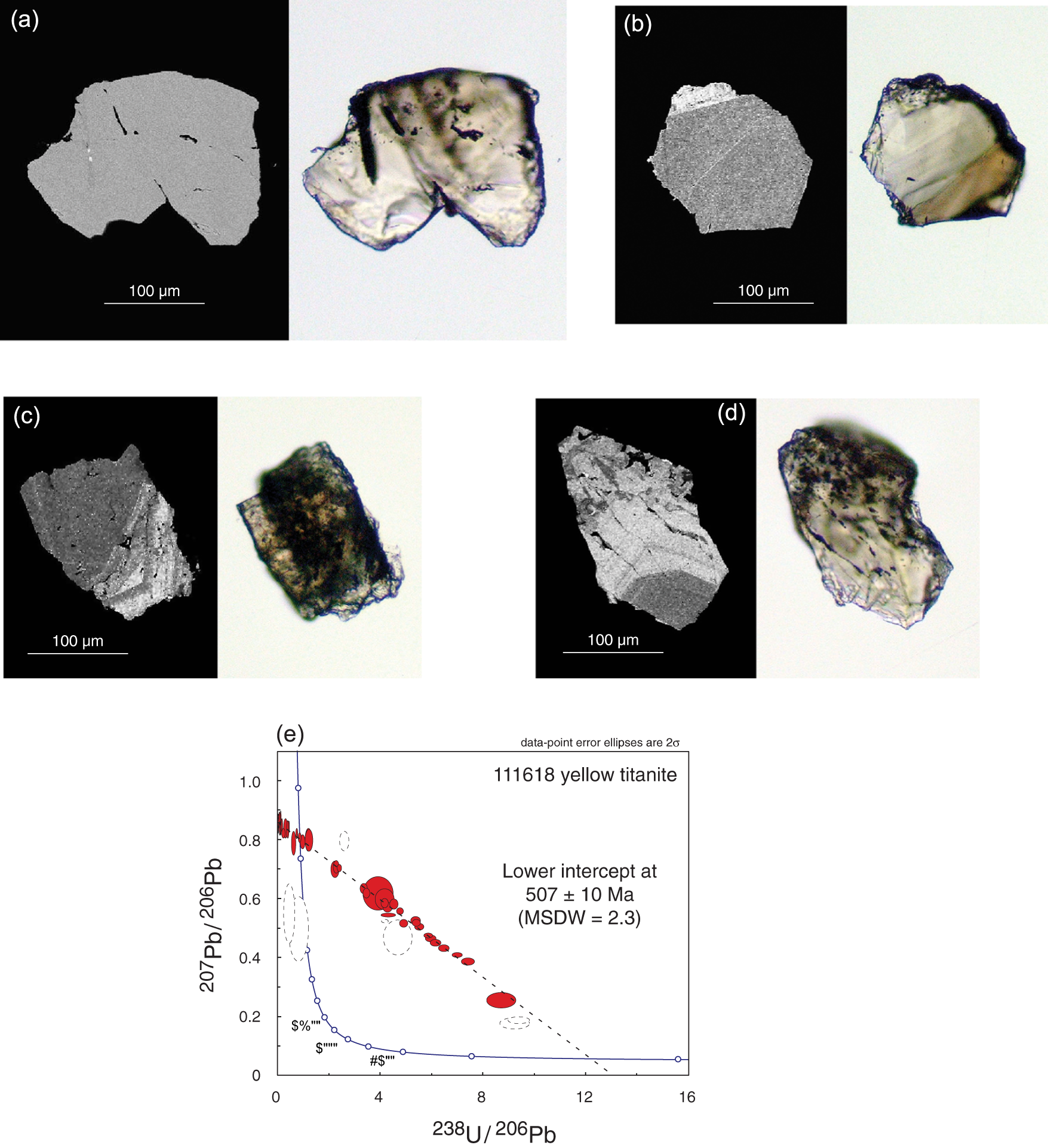
The age of titante, similar to yellow zircon in its external anhedral morphology and yellow colour, was also determined by the U–Pb technique using LA-ICP-MS (Table S3). These mostly anhedral grains lack the characteristic wedge shape of igneous titanite, contain small amounts of U (mostly <50 ppm) and moderate to high common Pb. Titanite is mostly unzoned in back-scattered electron (BSE) images (Fig. 10a,b), although a few grains display oscillatory zoning (Fig. 10c,d), which suggests an igneous origin for the titanite despite its anhedral crystal morphology. BSE zoning also suggests multiple episodes of titanite growth (Fig. 10b–d).
BSE (left) and transmitted light (right) images of titanite from sample 111618, Radwa alkali granite: (a) unzoned, anhedral grain; (b) faintly zoned grain with small white overgrowth; (c) unzoned core with oscillatory zoned mantle; (d) oscillatory zoned core and mantle, overgrown by splotchy zoned outer domain; (e) Concordia plot of LA-ICP-MS data for titanite. Data corresponding to dashed ellipses were excluded from the age calculation.

A best-fit line calculated through isotopic data from 47 analyses (seven data points excluded) yields a lower intercept age of 507 ± 10 Ma. This age, in agreement with precise age data from the tan zircon population, corroborates the anomalously young emplacement age of the Radwa alkali granite. Despite BSE evidence for multiple growth episodes, low U and high common Pb contents preclude precise determination of ages for these apparently separate crystallisation events.
SHRIMP trace-element analysis of zircon
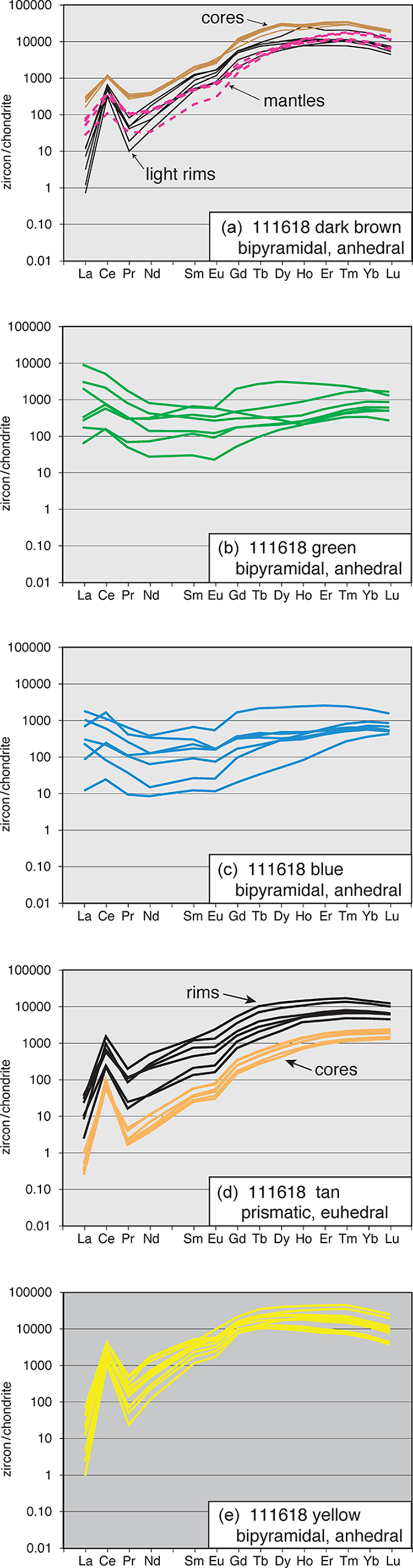
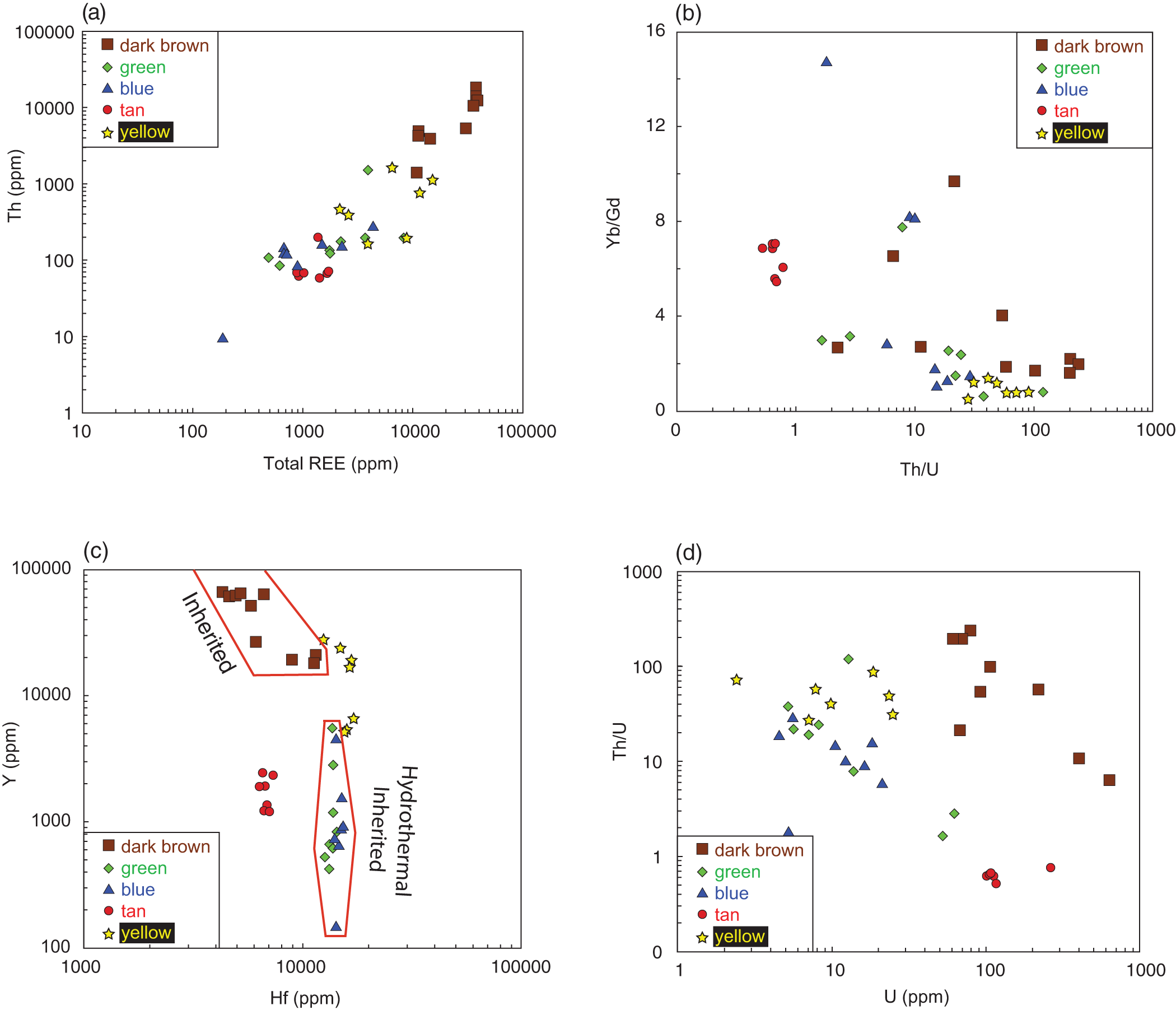
The five colour populations of zircon were analysed for selected trace elements (sampling most of the grains used for age determination, see Table 2 and Supplementary Table S4, S5) using the USGS/Stanford SHRIMP-RG. Selected plots (Figs 11, 12) show that compositions of each population are somewhat distinct and fairly homogeneous. REE distribution patterns for the dark brown zircon grains are parallel to, but higher than, patterns for tan and yellow grains (Fig. 11a). REE distribution patterns for green and blue zircon grains are essentially flat and unfractionated (Fig. 11b,c). REE patterns for cores in the tan zircon grains have large positive Ce anomalies, small negative Eu anomalies and are relatively LREE-depleted/HREE-enriched. Rims have parallel REE patterns, but greater total REE contents (Fig. 11d). REE patterns for yellow grains are similar to those of rims on tan grains (Fig. 11e). Dark brown zircon grains have high concentrations of certain trace elements (including Th and U) relative to those in the tan prismatic grains. In general, most igneous zircon contains ∼100 ppm Th and has a Th/U ratio of ∼0.5–0.7. In contrast, dark brown zircon contains ∼3000–20,000 ppm Th and Th/U is 2–200 (Fig. 12a,b,d). Dark brown zircons also have large total REE contents (10,000–40,000 ppm), in accord with their unusual major oxide compositions (Fig. 6f).
REE distribution patterns for five zircon colour populations from sample 111618, Radwa alkali granite: (a) REE patterns for dark brown zircon; (b) unusual horizontal REE patterns (i.e. relatively unfractionated) for green zircon; (c) unusual horizontal REE patterns (i.e. relatively unfractionated). See text for further discussion of REE abundances in green and blue zircon; (d) tan zircon. Cores and rims have parallel REE patterns, rims have greater total REE abundances. Cores and rims are HREE-enriched and have small negative Eu anomalies that are somewhat atypical of igneous zircon; (e) REE patterns for yellow zircon are characterised by moderate negative Eu anomalies and HREE-enrichment.

Trace-element geochemistry of five zircon colour populations from sample 111618, Radwa alkali granite: (a) Total REE (ppm) versus Th (ppm), showing that the REE and Th contents of dark brown, green, blue and yellow zircon populations are distinctly greater than in tan zircon; (b) Th/U versus Yb/Gd, showing that dark brown, green blue and yellow zircon populations have elevated Th/U (due to high Th contents) and generally lower Yb/Gd relative to tan zircon; (c) Hf (ppm) versus Y (ppm); (d) U (ppm) versus Th/U. Tan and dark brown zircon have similar U contents that are distinctly elevated relative to those of green, blue and yellow zircon populations.

Age summary for Radwa alkali granite

1 High common Pb.
2 High Th.
3 Weighted average of 206Pb/238U ages; n.d.: not determined.
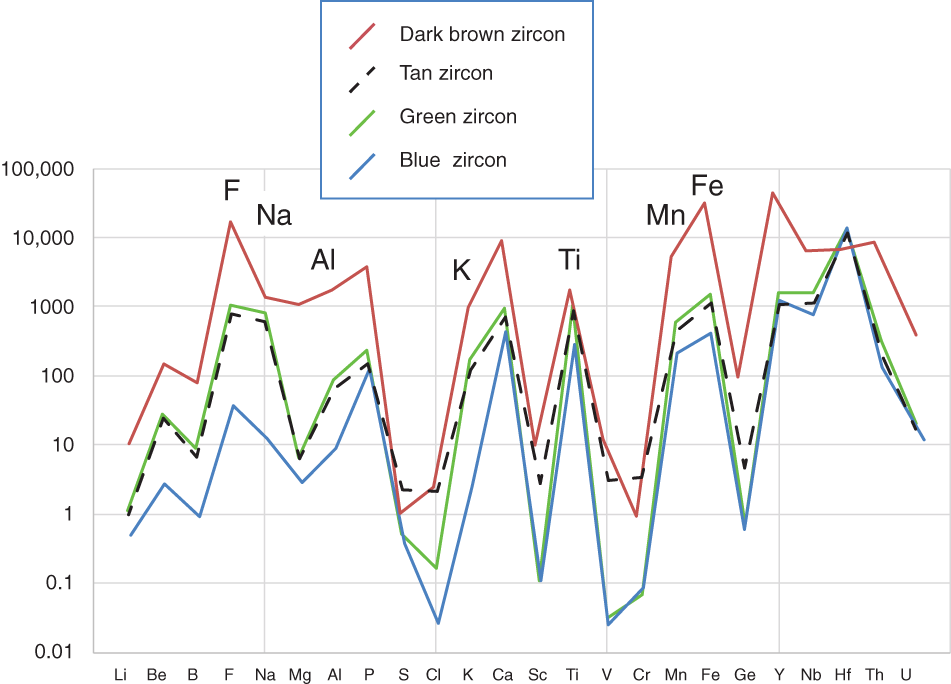
Although green and blue zircons have similar ages and REE patterns, each population contains somewhat distinct trace-element abundances; these variations probably account for the colour variations in zircon from the Radwa alkali granite. In general, relative to the other zircon colour populations, green zircon grains contain equal or greater concentrations of 25 measured trace elements (as determined by SHRIMP analysis; Table S5); in particular, it has elevated F, Na, Al, K, Ti, Mn, Fe and Nb abundances. In contrast, blue zircon contains lower abundances of all of the trace elements analysed. By comparison, trace-element concentrations in tan zircon are similar to those of the green zircon (Fig. 13). Dark brown (and possibly yellow) grains contain less ZrO2 and SiO2 that may represent substitutions by F, Al, P, K, Ca, Ti, Mn, Fe, Ge, Y, Nb and Th (Figs 6, 12, 13).
LA-ICP-MS trace-element contents of green, blue, tan and dark brown zircons from sample 111618, Radwa alkali granite. The labelled peaks are elements for which there are significant differences between values for green and blue zircon (green and blue lines, respectively). The data for dark brown zircon (brown lines) show enrichment in nearly all elements compared to other colours. The data for the tan euhedral zircon (dashed black lines) are shown for comparison.

Discussion
Ages of zircon in the Radwa alkali granite
SHRIMP and LA-ICP-MS U–Pb isotopic data suggest the following order of crystallisation, from oldest to youngest, of zircon recovered from the Radwa alkali granite: dark brown; blue and green; tan; and yellow. Ages determined for four of the zircon populations (excluding tan zircon) are all subject to correction for large common Pb contents and thus are problematic relative to accurate radiometric age determinations (i.e. the associated age uncertainties are correspondingly large).
Although the precise age of dark brown zircon is unknown, it must be older than tan zircon because dark brown grains are commonly overgrown by tan zircon. According to select SHRIMP data (only results with acceptable UO/O included in the age calculation), green zircon probably formed at ∼518 ± 12 Ma. Having similar geochemistry, crystal morphology and REE distribution patterns, blue zircon probably formed at ∼519 ± 11 Ma (based on age calculation using select SHRIMP data). The SHRIMP age of green zircon was not substantiated by LA-ICP-MS, whereas the SHRIMP age for blue zircon (519 ± 11 Ma) is within error of the LA-ICP-MS age of 500 ± 13 Ma.
Because the tan zircon has low common Pb and contains sufficient U to produce ample radiogenic Pb, its determined U–Pb age is quite robust. SHRIMP data yield an age of 501.3 ± 3.9 Ma, in agreement with LA-ICP-MS ages of 506.7 ± 7.8 and 501.2 ± 5.4 Ma. However, this now well-determined age depicts magmatism that is significantly younger than otherwise associated with the formation of the Proterozoic Arabian Shield. This unusual zircon age is supported by U–Pb age data of 507 ± 10 Ma from co-existing titanite.
Yellow zircon has trace-element concentrations that are only slightly lower than those in dark brown zircon. LA-ICP-MS data suggest a younger age of 493 ± 13 Ma (SHRIMP analysis did not yield reasonable age data because of large matrix-effect discrepancies). Unfortunately, independent textural evidence bearing on the relative age of yellow zircon as compared to the remaining zircon populations is absent.
Origin of zircon in Radwa alkali granite
The extreme variations in morphology and colour of zircon in the Radwa alkali granite suggest that diverse processes might have been responsible for these zircon populations.. Crystal morphology, major- and trace-element mineral geochemistry and geochronology can be employed to understand the genesis of the zircon colour populations characteristic of the Radwa alkali granite.
Although REE distribution patterns for the dark brown zircon population are typical of an igneous origin (i.e. fractionated, relatively LREE-depleted/HREE-enriched patterns), many of these grains are anhedral to subhedral and contain unusually high Th and common Pb contents (but relatively typical U). As such, the dark brown zircon population (no precise age obtained) is probably xenocrystic in origin and represents inheritance from pre-existing Arabian Shield crust. Overgrowth rims on dark brown cores indicate that these zircon cores formed before emplacement of the Radwa alkali granite.
REE distribution patterns for the four other colour populations (green, blue, tan and yellow) define two groups: (1) unfractionated, essentially horizontal REE patterns; and (2) fractionated, relatively LREE-depleted/HREE-enriched patterns similar to those that are characteristic of most igneous zircon. Group 1 zircon grains, composed of the green and blue varieties, formed relatively early (∼520–515 Ma) prior to emplacement of the Radwa alkali granite, whereas Group 2 zircon grains, composed of euhedral tan and anhedral to subhedral yellow varieties, formed later, between ∼510 and 480 Ma. Semi-horizontal REE patterns suggest that Group 1 grains are hydrothermal in origin (cf. Hoskin, Reference Hoskin2005; Cegielka et al., Reference Cegielka, Baginski, Macdonald, Belkin, Kotowski and Upton2022; Chao et al., Reference Chao, Lin, Sheng-Rong, Santosh and Jun-Feng2022; Ersay et al., Reference Ersay, Greenough, Larson and Dostal2022). After crystallisation and fractionation of alkali-rich minerals (especially relatively Na-enriched minerals such as arfvedsonite and aegirine), the remaining melt evolved to a metaluminous composition (agpaitic ratio >1), which fostered early crystallisation of the tan zircon, followed by formation of anhedral to subhedral yellow zircon, both with HREE-enriched patterns typical of zircon in most igneous rocks. Thus, we suggest that dark brown, green and blue zircon are xenocrystic (unrelated to crystallisation of the Radwa alkali granite), whereas tan and yellow zircon formed during Radwa magmatism.
Regional implications of the 500 Ma age of the Radwa alkali granite
Arabian Shield magmatism is thought to have ended by ∼570 Ma (Jackson, Reference Jackson1986; Stoeser, Reference Stoeser1986; Johnson et al., Reference Johnson, Andresen, Collins, Fowler, Fritz, Ghebreab, Kusky and Stern2011, Reference Johnson, Halverson, Kusky, Stern and Pease2013; Stern, Reference Stern2024). In the Eastern Desert region of Egypt (to the west across the Red Sea from the Arabian Shield), granitic rocks as young as 540 Ma (Stern and Hedge, Reference Stern and Hedge1985; Lundmark et al., Reference Lundmark, Andresen, Hassan, Augland and Boghdady2012) have been reported; however, no granites as young as 500 Ma have been recognised. Accordingly, the Radwa pluton is probably not genetically associated with geological processes responsible for the formation of the Arabian or Nubian shields. Stern (Reference Stern2024) suggested that southward-directed subduction and associated magmatism beneath the northern edge of Gondwana extended into the northern Arabian Shield area, as part of the Cadomian orogeny. Subduction-related magmatism associated with the Cadomian orogeny ensued from ∼600–500 Ma (Fig. 3, Stern, Reference Stern2024). Therefore, we conclude that the anomalously young age of the Radwa alkali granite is consistent with magmatism related to processes intrinsic to the Cadomian orogeny in the Arabian Shield.
Supplementary material
The supplementary material for this article can be found at https://doi.org/10.1180/mgm.2025.10146.
Acknowledgements
The authors thank Ryan Taylor, Carol Frost, an anonymous reviewer and Guest Editor Barbara Dutrow for careful reviews. We appreciate support provided by the U.S. Geological Survey in Saudi Arabia.
Competing interests
The authors declare none.