


1. INTRODUCTION
The nonlinear coupling of intense laser beams with plasmas has got much attention in the study of various waves excited in plasmas. The propagation of intense laser pulse through plasma may be affected by number of parametric instabilities such as self-focusing, filamentation, stimulated Raman scattering from electron plasma wave, stimulated Brillouin scattering from ion acoustic wave (IAW), harmonic generation, two-Plasmon instability etc. (Kaw et al., Reference Kaw, Schmidt and Wilcox1973; Young et al., Reference Young, Baldis, Drake, Campbell and Estrabrook1988; Deutsch et al., Reference Deutsch, Bret, Firpo, Gremillet, Lefebrave and Lifschitz2008; Kline et al., Reference Kline, Montgomery, Rousseaux, Baton, Tassin, Hardin, Flippo, Johnson, Shimada, Yin, Albright, Rose and Amiranoff2009; Huller et al., Reference Huller, Masson-Laborde, Pesme, Labaune and Bandulet2008; Wang et al., Reference Wang, Lu, He, Zheng and Zhao2009). The study of parametric instabilities driven in laser-produced plasmas critically depends upon the complex interaction between plasma waves in high temperature high density plasmas. Waves driven by parametric instabilities interact among themselves, modifying in turn the behavior of the instabilities (Labaune et al., Reference Labaune, Baldis, Renard, Schifano and Michard1997). Filamentation instability (Abbi et al., Reference Abbi and Mahr1971; Jones et al., 1988; Wilks et al., Reference Wilks, Young, Hammer, Tabak and Kruer1994; Wei et al., 2004) in laser plasma interaction significantly influences all other instabilities and nonlinear coupling between the waves, which is caused by small scale density fluctuation or small scale intensity spikes associated with the main beam. The filamentary structures also destroy the symmetry of the energy deposition and may trigger the scattering instabilities (stimulated Brillouin scattering and stimulated Raman scattering) of target.
Excitation of IAW in plasma by high power laser beam is the subject of current research interest due to its application in plasma heating in inertial confinement fusion experiments. The IAWs are low frequency longitudinal plasma density oscillations, which exhibit strongly nonlinear properties. They are highly Landau damped unless T i << T e, and have been studied in many types of high-temperature laboratory plasmas (Stix, Reference Stix1992; Nakamura et al., Reference Nakamura, Bailung and Shukla1999). The theoretical and experimental results show that the ion-acoustic waves play an important role in the particle heating, turbulence heating, particle acceleration, and other nonlinear phenomenon in laser plasma interaction as well as in space plasma. Tonks and Langmuir (Reference Tonks and Langmuir1929) first theoretically predicted IAWs in plasmas on the bases of the fluid theory and observed experimentally by Revans (Reference Revans1933). It has been observed that collisions between ions and electrons played no role in the propagation of IAWs (Suryanarayana et al., Reference Suryanarayana, Kaur and Dubey2010). Chakrabarti and Janaki (Reference Chakrabarti and Janaki2002) have reported nonlinear evaluation of a large amplitude electrostatic ion-acoustic wave in unmagnetized plasma using a one-dimensional Vlasov code simulation in the open system. Saini and Gill (Reference Saini and Gill2000) have studied the effect of low powered laser beam on the excitation of IAW taking into account the relativistic nonlinearity. Excitation of IAWs by the Langmuir decay instability is observed in laboratory plasma experiments with an intense laser (Depierreux et al., Reference Depierreux, Fuchs, Labaune, Michard, Baldis, Pesme, Huller and Laval2000; Reference Depierreux, Labaune, Fuchs, Pesme, Tikhonchuk and Baldis2002; Umedaa et al., Reference Umedaa and Ito2008). The excited IAW after Landau damping transfers its energy to the plasma particles and leads to the enhanced heating of the plasma. The saturation of IAWs in laser plasma interaction experiments is one of the current research interests (Divol et al., Reference Divol, Cohen, Williams, Langdon and Lasinski2003; Williams et al., Reference Williams, Cohen, Divol, Dorr, Hittinger, Hinkel, Langdon, Kirkwood, Froula and Glenzer2004; Huller et al., Reference Huller, Masson-Laborde, Pesme, Labaune and Bandulet2008). Specifically, the nonlinear evolution of IAW (IAW) may play an important role in nonlinear saturation of stimulated Brillouin scattering process. The stimulated Brillouin scattering is one of the most important resonant three-wave interaction processes in laser fusion plasmas involving IAWs (Kruer, Reference Kruer1988; Lindl et al., Reference Lindl, Amendt, Berger, Glendinning, Glenzer, Haan, Auffman, Landen and Suter2004; Mahmoud et al., Reference Mahmoud, Sharma, Kumar and Yadav1999), which is responsible of depleting and redirecting the incident laser flux. It has been observed that the electron kinetic effects play an important role in the nonlinear evolution of a driven ion-acoustic wave (Riconda et al., Reference Riconda, Heron, Pesme, Huller, Tikhonchuk and Detering2005). Excitation of IAW in plasma by intense laser beam toward the study of stimulated Brillouin scattering has been reported in the literature (Sharma et al., Reference Sharma, Sharma, Rajput and Bhardwaj2009; Reference Sharma and Singh2013; Singh et al., Reference Singh and Walia2012; Sodha et al., Reference Sodha, Umesh and Sharma1979). Since the reflectivity of stimulated Brillouin scattering is directly proportional to the amplitude of the IAW, it is therefore important to understand the dynamics of stimulated Brillouin scattering driven ion-acoustic wave at high laser power flux.
Filamentation of the laser beam significantly affected the propagation of the IAW and stimulated Brillouin scattering process in plasma (Sharma et al., Reference Sharma, Sharma, Rajput and Bhardwaj2009; Giulietti et al., Reference Giulietti, Macchi, Schifano, Biancalana, Danson, Giulietti, Gizzi and Willi1999; Afshar-rad et al., Reference Afshar-Rad, Gizzi, Desselberger and Willi1996). For most of the study of parametric instabilities in plasmas, smooth Gaussian intensity profile of laser beam and ponderomotive/relativistic nonlinearity have to be considered and taken separately. However, in actual case when high power laser beam propagates in plasma, both relativistic and ponderomotive nonlinearities are simultaneously arises at different time scales, i.e., τpe < τ< τpi, (where τ is the pulse duration, τpi is the ion plasma period, and τpe is the electron plasma period) and the beam is not perfectly smooth. In such a case, the nonlinearity in the dielectric function occurs is caused by the electron mass variation due to large laser intensity and the change in electron density as a consequence of the ponderomotive force. In addition, it is experimentally observed that smooth appearing laser beam is essentially nonsmooth but comprises superimposed intensity spikes, which may lead to distortion of self-focusing in nonlinear media (Abbi et al., Reference Abbi and Mahr1971). Limited studies have been carried out toward the propagation of a rippled laser beam in plasma and its effect on the excitation of the IAW by considering the combined effects of relativistic electron mass variation and ponderomotive force nonlinearity. In this context, we have made an analytical study of the propagation of intense rippled laser beam in a collisionless unmagnetized plasma and its effect on the excitation of IAW in the presence of relativistic and ponderomotive nonlinearities. The growth of laser ripple in the plasma has been studied in some detail. The IAW excited due to nonlinear coupling between IAW and rippled laser beam. The ripple superimposed on the main laser beam and the contribution of both nonlinearities significantly modified the dynamics of IAW. The nonlinear evolution has been studied by using the paraxial theory developed by Akhmanov et al. (Reference Akhmanov, Sukhorukov and Khokhlov1968) and Sodha et al. (Reference Sodha, Ghatak and Tripathi1976).
In Section 2, we have derived the expression for the effective dielectric constant of plasma, growth of laser ripple (superimposed on the main beam) and self-focusing equation of the main and rippled laser beam in the presence of relativistic and ponderomotive nonlinearities. In Section 3, first, the equation for IAW (in the presence of the rippled laser beam) is derived and then its solution is obtained in order to study the evaluation of the IAW. A brief discussion of the numerical results is presented in Section 4. The main conclusions are summarized in the last section.
2. ANALYTICAL FORMULATION
2.1. Nonlinear Dielectric Constant of the Plasma
Consider the propagation of a Gaussian laser beam of frequency ω0 and wave number k 0 in collisionless homogeneous plasma along the z direction. The initial intensity distribution of the main beam can be represented by
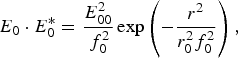 $$E_0 \cdot E_0^{\ast} = \displaystyle{{E_{00}^2 } \over {\,f_0^2 }}\exp \left({ - \displaystyle{{r^2 } \over {r_0^2 f_0^2 }}} \right)\comma \;$$
and the initial intensity distribution of the ripple superimposed on the main beam may be expressed as
 $$E_1 \cdot E_1^{\ast} = \displaystyle{{E_{100}^2 } \over {\,f_1^2 }}\left({\displaystyle{r \over {r_{10}f_1 }}} \right)^{2n} \exp \left({ - r^2/r_{10}^2 f_1^2 } \right)\comma \;$$
where r 0 is the initial beam width, r is the radial coordinate of cylindrical coordinate system, and E 00 is the axial amplitude of the main beam, E 100 refers to the initial amplitude of the ripple, n is a positive number characterize the position of the ripple, r 10 is the width of the ripple; as n increases, the maximum (r max = r 10f 1n 1/2) of the ripple shifts away from the axis, and f 0 and f 1 are the beam width parameters of the main beam and the rippled beam. The ripple is usually a small perturbation over the main beam and its parameters may be assumed to satisfy
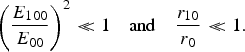 $$\left({\displaystyle{{E_{100} } \over {E_{00} }}} \right)^2 \lt\!\!\! \lt 1 \quad {\rm and} \quad \displaystyle{{r_{10} } \over {r_0 }} \lt\!\!\! \lt 1.$$
The total electric vector E of a Gaussian beam with ripple can be expressed as
 $$E = E_0 + E_1.$$
The intensity distribution of the beam is given by
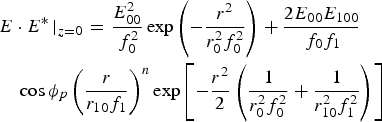 $$\eqalign {& E \cdot E^{\ast} \left\vert _{z = 0} \right. = \displaystyle{{E_{00}^2 } \over {\,f_0^2 }}\exp \left({ - \displaystyle{{r^2 } \over {r_0^2 f_0^2 }}} \right)+ \displaystyle{{2E_{00} E_{100} } \over {\,f_0 f_1 }} \cr & \quad \cos {\rm \phi} _p \left({\displaystyle{r \over {r_{10} f_1 }}} \right)^n \exp \left[{ - \displaystyle{{r^2 } \over 2}\left({\displaystyle{1 \over {r_0^2 f_0^2 }} + \displaystyle{1 \over {r_{10}^2 f_1^2 }}} \right)} \right]}$$
where ϕp is the angle between the electric vectors of the main beam and the ripple.
The effective dielectric constant of the plasma at frequency ω0 can be expressed as
 $${\rm \varepsilon} = {\rm \varepsilon} _0 + {\rm \varphi} \lpar E \cdot E^{\ast} \rpar$$
Here ε0 and ϕ(E.E*) are the linear and nonlinear parts of the dielectric constant and are given by
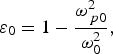 $${\rm \varepsilon} _0 = 1 - \displaystyle{{{\rm \omega} _{\,p0}^2 } \over {{\rm \omega} _0^2 }}\comma \;$$
and
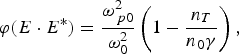 $${\rm \varphi} \lpar E \cdot E^{\ast} \rpar = \displaystyle{{{\rm \omega} _{\,p0}^2 } \over {{\rm \omega} _0^2 }}\left({1 - \displaystyle{n_T \over {n_0 {\rm \gamma} }}} \right)\comma \;$$
where ωp0 is the relativistic plasma frequency given by ωp0 = 4πn 0e 2/m 0γ (with e being the charge of an electron, m 0 its rest mass, and n 0 is the density of plasma electrons in the absence of laser beam) and γ is the relativistic factor. The relativistic-ponderomotive force on an electron in the presence of an intense laser beam may be represented as (Borishov et al., Reference Borisov, Borovisiky, Shiryaev, Korobkin, Prokhorov, Solem, Luk, Boyer and Rhodes1992; Brandi et al., Reference Brandi, Manus, Mainfray, Lehner and Bonnaud1993; Gupta et al., Reference Gupta, Sharma and Gupta2005)
 $$F_P = - m_0 c^2 \nabla \lpar {\rm \gamma} - 1\rpar .$$
The relativistic factor γ is given by
 $${\rm \gamma} = \left[{1 + \alpha E_0 \cdot E_0^{\ast} } \right]^{1/2}\comma \;$$
and
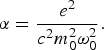 $${\rm \alpha} = \displaystyle{{e^2 } \over {c^2 m_0^2 {\rm \omega} _0^2 }}.$$
Eq. (6) is valid, when there is no change in the plasma density. Using the electron continuity equation and the current density equation for second-order correction in the electron density equation (with the help of ponderomotive force), the total density nT is given by (Brandi et al., Reference Brandi, Manus, Mainfray, Lehner and Bonnaud1993)
 $${n_{T}} = n_0 + n_2 = n_0 + \displaystyle{{c^2 n_0 } \over {{\rm \omega} _{\,p0}^2 }}\left({\nabla ^2 {\rm \gamma} - \displaystyle{{\lpar \nabla {\rm \gamma} \rpar ^2 } \over {\rm \gamma} }} \right)\comma \;$$
where, n 2 is the nonlinear variation of the density together with the relativistic correction i.e. second order correction in the electron density equation and
 $$\displaystyle{{n_T} \over {n_0}} = 1 + \displaystyle{{c^2 } \over {{\rm \omega} _{\,p0}^2 {\rm \gamma} }}\left[{ - \displaystyle{{2a} \over {r_0^2 f_0^4 }} - \displaystyle{{2r^2 a^2 } \over {r_0^4 {\rm \gamma} ^2 f_0^8 }}e^{ - \displaystyle{{r^2 } \over {r_0^2 f_0^2 }}} + \displaystyle{{2r^2 a} \over {r_0^4 f_0^6 }}} \right]e^{ - \displaystyle{{r^2 } \over {r_0^2 f_0^2 }}}.$$
To write the dielectric constant of the plasma (in the presence of the main laser beam) in the paraxial region where (E 1·E 1* ≤ E 0·E 0*), it is a good approximation to assume ε(r, z) to be function of E 0 alone, i.e., ϕ(E·E*) ~ ϕ(E 0·E 0*). Thus in Eq. (5), ε(r, z) may be replaced by ε0(r, z) where
 $${\rm \varepsilon} _0 \lpar r\comma \; z\rpar = {\rm \varepsilon} _0 + {\rm \phi} \lpar E_0\cdot E_0^{\ast}\rpar \comma \;$$
and expanding the dielectric constant in Eq. (5) around r = 0 by Taylor expansion, one can write
 $${\rm \varepsilon}_0 \lpar r\comma \; z\rpar = {\rm \varepsilon} _0 \lpar z\rpar + {\rm \gamma} _0 r^2\comma \;$$
where
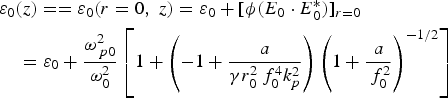 $$\eqalign {& {\rm \varepsilon} _0 \lpar z\rpar = = {\rm \varepsilon} _0 \lpar r = 0\comma \; z\rpar = {\rm \varepsilon} _0 + [{\rm \phi} \lpar E_0 \cdot E_0^{\ast} \rpar] _{r = 0} \, \cr & \quad = {\rm \varepsilon} _0 + \displaystyle{{{\rm \omega} _{\,p0}^2 } \over {{\rm \omega} _0^2 }} \left[{1 + \left({ - 1 + \displaystyle{a \over {{\rm \gamma} r_0^2 \,f_0^4 k_p^2 }}} \right)\left({1 + \displaystyle{a \over {\,f_0^2 }}} \right)^{ - 1/2} } \right]}$$
and
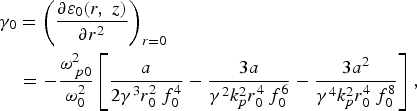 $$\eqalign{& {\rm \gamma} _0 = \left({\displaystyle{{\partial {\rm \varepsilon} _0 \lpar r\comma \; z\rpar } \over {\partial r^2 }}} \right)_{r = 0} \cr & \quad = - \displaystyle{{{\rm \omega} _{\,p0}^2 } \over {{\rm \omega} _0^2 }}\left[{\displaystyle{a \over {2{\rm \gamma} ^3 r_0^2 \,f_0^4 }} - \displaystyle{{3a} \over {{\rm \gamma} ^2 k_p^2 r_0^4 \,f_0^6 }} - \displaystyle{{3a^2 } \over {{\rm \gamma} ^4 k_p^2 r_0^4 \,f_0^8 }}} \right]\comma \; }$$
where a = αA 02 (A 02 = E 002) is square of dimensionless vector potential, f 0 is the dimensionless beam width parameter of laser beam at z as given by Eq. (15), k p2 = ωp02/c 2, and the rest of symbols have their usual meaning.
In order to obtain the dielectric constant of a rippled laser beam in plasma, we have taken the contribution of E·E*, i.e., E·E* = (E 0 + E 1)·(E*0 + E*1), and the maximum intensity of ripple at (r max2 = r 102f 12n). One can write
 $${\rm \varepsilon} \lpar r\comma \; z\rpar = {\rm \varepsilon} _1 \lpar z\rpar + {\rm \gamma} _1 \lpar r^2 = r_{10}^2 f_1^2 n\rpar \comma \;$$
where
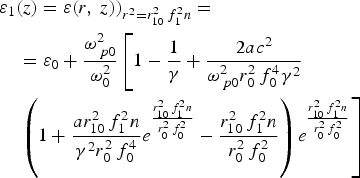 $$\eqalign{& {\rm \varepsilon}_1 \lpar z\rpar = {\rm \varepsilon} \lpar r\comma \; z\rpar \rpar _{r^2 = r_{10}^2 \,f_1^2 n} = \cr & \quad = {\rm \varepsilon} _0 + \displaystyle{{\rm \omega}_{\,p0}^2 \over {\rm \omega}_0^2} \left[1 - \displaystyle{1 \over {\rm \gamma} } + \displaystyle{2ac^2 \over {\rm \omega}_{\,p0}^2 r_0^2 \,f_0^4 {\rm \gamma}^2} \right. \cr & \quad \left. \left(1 + \displaystyle{ar_{10}^2 \,f_1^2 n \over {\rm \gamma}^2 r_0^2 \,f_0^4}e^{{r_{10}^2 \,f_1^2 n \over r_0^2 \,f_0^2}} - \displaystyle{r_{10}^2 \,f_1^2 n \over r_0^2 \,f_0^2} \right)e^{{r_{10}^2 \,f_1^2 n \over r_0^2 \,f_0^2}} \right]}$$
and
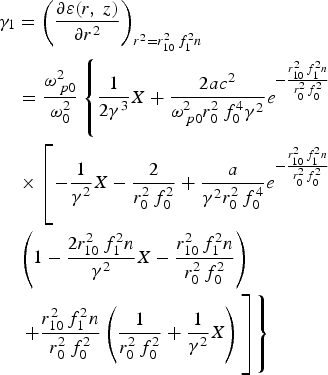 $$\eqalign{& {\rm \gamma} _1 = \left({\displaystyle{{\partial {\rm \varepsilon} \lpar r\comma \; z\rpar } \over {\partial r^2 }}} \right)_{r^2 = r_{10}^2 \,f_1^2 n} \cr & \quad = \displaystyle{{{\rm \omega} _{\,p0}^2 } \over {{\rm \omega} _0^2 }}\left\{{1 \over 2{\rm \gamma} ^3 } X + {2ac^2 \over {\rm \omega} _{\,p0}^2 r_0^2 \,f_0^4 {\rm \gamma} ^2 }e ^{ - {r_{10}^2 \,f_1^2 n \over r_0^2 \,f_0^2 }} \right. \cr &\quad \times \left[- {1 \over {\rm \gamma} ^2} X - {2 \over r_0^2 \,f_0^2} + {a \over {\rm \gamma}^2 r_0^2 \,f_0^4} e^{- {r_{10}^2 \,f_1^2 n \over r_0^2 \,f_0^2}} \right. \cr &\quad \left(1 - \displaystyle{2r_{10}^2 \,f_1^2 n \over {\rm \gamma}^2} X - \displaystyle{r_{10}^2 \,f_1^2 n \over r_0^2 \,f_0^2} \right)\cr &\quad \left. \left. + \displaystyle{r_{10}^2 \,f_1^2 n \over r_0^2 \,f_0^2} \left(\displaystyle{1 \over r_0^2 \,f_0^2} + \displaystyle{1 \over {\rm \gamma}^2} X \right)\vphantom{e ^{ - {r_{10}^2 \,f_1^2 n \over r_0^2 \,f_0^2 }}}\right]\right\}}$$
Here
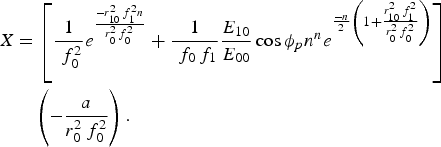 $$\eqalign{X & = \left[{\displaystyle{1 \over {\,\,f_0^2 }}e^{{{ - r_{10}^2 \,f_1^2 n} \over {r_0^2 \,f_0^2 }}} + \displaystyle{1 \over {\,\,f_0 \,f_1 }}\displaystyle{{E_{10} } \over {E_{00} }}\cos {\rm \phi} _p n^n e^{{{ - n} \over 2}\left({1 + {{r_{10}^2 \,f_1^2 } \over {r_0^2 \,f_0^2 }}} \right)} } \right]\cr & \quad \left({ - \displaystyle{a \over {r_0^2 \,f_0^2 }}} \right).}$$
2.2. Solution of Wave Equations and Growth of Laser Ripple in Plasma
The effective electric vector E satisfies the wave equation
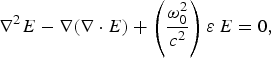 $$\nabla^2E - \nabla \lpar \nabla \cdot E\rpar + \left({\displaystyle{{{\rm \omega} _0^2 } \over {c^2 }}} \right){\rm \varepsilon} \, E = 0\comma \;$$
where ε is the effective dielectric constant of the plasma and c is the speed of light in free space. Under the Wentzel-Kramers-Brillouin approximation the second term of Eq. (12) can be neglected. Assuming the ripple to be a small perturbations one can write the wave equation for main beam (E 0) and the ripple (E 1), respectively,
 $$\nabla^2E_0 + \displaystyle{{{\rm \omega} _0^2 } \over {c^2}}{\rm \varepsilon} \lpar E_0 \cdot E_0^{\ast} \rpar E_0 = 0.$$
and
 $$\eqalign{\nabla^2E_1 + \displaystyle{{{\rm \omega} _0^2 } \over {c^2}}{\rm \varepsilon} \lpar E \cdot E^{\ast} \rpar E_1 + \displaystyle{{{\rm \omega} _0^2 } \over {c^2}}[ {\rm \phi} \lpar E \cdot E^{\ast} \rpar E_1 - {\rm \phi} \lpar E_0 \cdot E_0\rpar ] E_0 = 0.}$$
The solution of Eq. (13) can be written as (Akhmanov et al., Reference Akhmanov, Sukhorukov and Khokhlov1968; Sodha et al., Reference Sodha, Ghatak and Tripathi1976)
 $$E_0 = A_0\exp [ \!- ik_0\lpar z + S_0\rpar ] \comma \; \quad \quad S_0 = \lpar r^2/2\rpar {\rm \beta} _0\lpar Z\rpar + {\rm \phi} _0\lpar z\rpar \comma \;$$
 $${\rm \beta} _0\lpar z\rpar = \displaystyle{1 \over {\,\,f_0}}\displaystyle{{d\,f_0} \over {dZ}}\comma \; \quad\quad k_0 = \displaystyle{{{\rm \omega} _0} \over c}{\rm \varepsilon} _0^{1/2} \comma \;$$
and the intensity of the main laser beam as
 $$A_0^2 = \lpar E_{00}^2 /\,f_0^2 \rpar \exp \lpar - r^2/r_0^2 \,f_0^2 \rpar$$
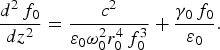
The dimensionless beam width parameter f 0 of the main beam can be obtained by using the initial boundary conditions  $\,f_0 \left\vert {_{z = 0} } \right. = 1\,\, {\rm and}\,\, d\,f_0 /dz\left\vert {_{z = 0} \, = 0} \right.$ (Akhmanov et al., Reference Akhmanov, Sukhorukov and Khokhlov1968)
 $$\displaystyle{{d^2 \,f_0 } \over {dz^2 }} = \displaystyle{{c^2 } \over {{\rm \varepsilon} _0 {\rm \omega} _0^2 r_0^4 \,f_0^3 }} + \displaystyle{{{\rm \gamma} _0 \,f_0 } \over {{\rm \varepsilon} _0 }}.$$
To obtain the solution of Eq. (14) we express
 $$E_1 = A_1 \lpar r\comma \; z\rpar \exp \lpar \!- ik_0 z\rpar \comma \;$$
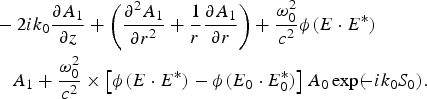
where A 1(r, z) is a complex function of its argument. Substituting for E 1 from Eq. (17) into Eq. (14) we get the following equation within the Wentzel-Kramers-Brillouin approximation:
 $$\eqalign{&- 2ik_0 \displaystyle{{\partial A_1} \over {\partial z}} + \left({\displaystyle{{\partial ^2A_1 } \over {\partial r^2}} + \displaystyle{1 \over r}\displaystyle{{\partial A_1 } \over {\partial r}}} \right)+ \displaystyle{{{\rm \omega} _0^2 } \over {c^2}}{\rm \phi} \lpar E \cdot E^{\ast} \rpar \cr & \quad A_1 + \displaystyle{{{\rm \omega} _0^2 } \over {c^2}} \times \left[{{\rm \phi} \lpar E \cdot E^{\ast} \rpar - {\rm \phi} \lpar E_0 \cdot E_0^{\ast} \rpar } \right]A_0\exp \lpar\!\! - ik_0S_0\rpar .}$$
Further, substituting for A 1 in Eq. (18)
 $$A_1 = A_{10}\lpar r\comma \; z\rpar \exp [\!- ik_0S_1\lpar r\comma \; z\rpar] \comma \;$$
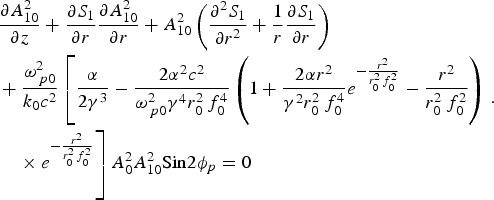
where A 10 is a real function and S 1 is the Eikonal. Using Eq. (19) into Eq. (18) and separating the real and imaginary parts we get
 $$2\displaystyle{{\partial S_1} \over {\partial z}} + \left({\displaystyle{{\partial S_1} \over {\partial r}}} \right)^2 = \displaystyle{1 \over {k_0^2 A_{10}}}\left({\displaystyle{{\partial ^2A_{10} } \over {\partial r^2 }} + \displaystyle{1 \over r}\displaystyle{{\partial A_{10} } \over {\partial r}}} \right)+ \displaystyle{{{\rm \phi} _{eff} } \over {{\rm \varepsilon} _0 }}\comma \;$$
and
 $$\eqalign{& \displaystyle{{\partial A_{10}^2 } \over {\partial z}} + \displaystyle{{\partial {S_1}} \over {\partial r}}\displaystyle{{\partial A_{10}^2 } \over {\partial r}} + A_{10}^2 \left({\displaystyle{{{\partial ^2}{S_1}} \over {\partial {r^2}}} + \displaystyle{1 \over r}\displaystyle{{\partial {S_1}} \over {\partial r}}} \right)\cr & + \displaystyle{{{\rm \omega} _{\,p0}^2 } \over {{k_0}{c^2}}}\left[{\displaystyle{{\rm \alpha} \over {2{{\rm \gamma} ^3}}} - \displaystyle{{2{{\rm \alpha} ^2}{c^2}} \over {{\rm \omega} _{\,p0}^2 {{\rm \gamma} ^4}r_0^2 \,f_0^4 }}\left({1 + \displaystyle{{2{\rm \alpha} {r^2}} \over {{{\rm \gamma} ^2}r_0^2 \,f_0^4 }}{e^{ -{{{r^2}} \over {r_0^2 \,f_0^2 }}}} - \displaystyle{{{r^2}} \over {r_0^2 \,f_0^2 }}} \right)} \right. \cr & \quad \left. \times \ {{e^{ - {{{r^2}} \over {r_0^2 \,f_0^2 }}}}} \right]A_0^2 A_{10}^2 {\rm Sin}2{\phi _p} = 0}.$$
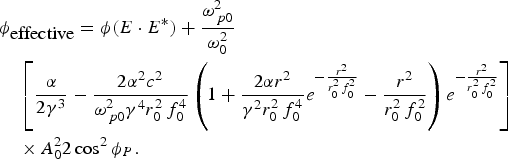
where
 $$\eqalign{& {\rm \phi} _{\hbox{effective}} = {\rm \phi} \lpar E \cdot E^{\ast} \rpar + \displaystyle{{{\rm \omega} _{\,p0}^2 } \over {{\rm \omega} _0^2 }} \cr & \quad \left[{\displaystyle{{\rm \alpha} \over {2{\rm \gamma} ^3 }} - \displaystyle{{2{\rm \alpha} ^2 c^2 } \over {{\rm \omega} _{\,p0}^2 {\rm \gamma} ^4 r_0^2 \,f_0^4 }}\left({1 + \displaystyle{{2{\rm \alpha} r^2 } \over {{\rm \gamma} ^2 r_0^2 \,f_0^4 }}e^{ -{{r^2 } \over {r_0^2 \,f_0^2 }}} - \displaystyle{{r^2 } \over {r_0^2 \,f_0^2 }}} \right)e^{ - {{r^2 } \over {r_0^2 \,f_0^2 }}} } \right]\cr & \quad \times A_0^2 2\cos ^2 {\rm \phi} _P.}$$
Eq. (20) can be expanded as
 $$\Phi \lpar E \cdot E^{\ast} \rpar = \Phi \lpar E_0 \cdot E_0^{\ast} \rpar + \displaystyle{{d\Phi } \over {dE \cdot E^{\ast} }}\left\vert \matrix{\cr _{E \cdot E^{\ast} = E_0 \cdot E_0^{\ast} }} \right.\lpar E \cdot E^{\ast} - E_0 \cdot E_0^{\ast} \rpar .$$
The solution of Eqs. (20a) and (20b) can be written as (Sodha et al., Reference Sodha, Singh, Singh and Sharma1981)
 $$A_{10}^2 = \displaystyle{{E_{100}^2 } \over {\,\,f_1^2 }}\left({\displaystyle{r \over {r_{10} \,f_1 }}} \right)^{2n} \exp \left({ - \displaystyle{{r^2 } \over {r_{10}^2 \,f_1^2 }}} \right)\exp \left({ - 2\int_0^z {k_i z} } \right)$$
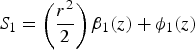 $$S_1 = \left({\displaystyle{{r^2 } \over 2}} \right){\rm \beta} _1\lpar z\rpar + {\rm \phi} _1 \lpar z\rpar$$
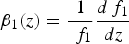 $${\rm \beta} _1 \lpar z\rpar = \displaystyle{1 \over {\,\,f_1 }}\displaystyle{{d\,f_1 } \over {dz}}$$
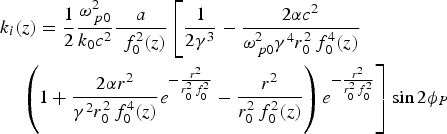 $$\eqalign{& {k_{i }}\lpar z\rpar = \displaystyle{1 \over 2}\displaystyle{{{\rm \omega} _{\,p0}^2 } \over {{k_0}{c^2}}}\displaystyle{a \over {\,\,f_0^2 \lpar z\rpar }}\left[{\displaystyle{1 \over {2{{\rm \gamma} ^3}}} - \displaystyle{{2{\rm \alpha} {c^2}} \over {{\rm \omega} _{\,p0}^2 {{\rm \gamma} ^4}r_0^2 \,f_0^4 \lpar z\rpar }}} \right. \cr & \quad \left. { \left({1 + \displaystyle{{2{\rm \alpha} {r^2}} \over {{{\rm \gamma} ^2}r_0^2 \,f_0^4 \lpar z\rpar }}{e^{ -{{{r^2}} \over {r_0^2 \,f_0^2 }}}} - \displaystyle{{{r^2}} \over {r_0^2 \,f_0^2 \lpar z\rpar }}} \right){e^{ - {{{r^2}} \over {r_0^2 \,f_0^2 }}}}} \right]\sin 2{{\rm \phi} _P}}$$
where k i an f 1 are the growth rate and the dimensionless beam width parameter of the ripple respectively, and ϕ1(z) is a constant. Eq. (21a) describes the axial intensity of rippled laser beam, which depends upon the growth rate of laser ripple in plasma. It is obvious from Eq. (21) for A 102 is the ripple grows/decays inside the plasma and the growth rate is k i. The growth rate depends on the intensity of the main beams, the phase angle ϕp, parameter of the pump wave and plasma. For a plane wave front d f 1/dz = 0 and f 1 = 1 at z = 0. Substituting for A 10 and S 1 from Eq. (21) into Eq. (20a) and expanding around r = r 10f 1n 1/2 by Taylor expansion as
 $${\rm \phi} _{efff} = {\rm \phi} _{eff} \lpar r^2 = r_{10}^2 \,f_1 n\rpar + {\rm \phi} ^{\prime} r^2 \comma \;$$
where
 $$\eqalign{& {{\rm \phi} ^{\prime}} = \displaystyle{{d{{\rm \phi} _{eff}}} \over {d{r^2}}}\left\vert {_{{r^2} = r_{10}^2 \,f_1^2 n} } \right. = \left({\displaystyle{{{\rm \omega} _{\,p0}^2 } \over {{\rm \omega} _0^2 }}} \right)\cr & \quad \left\{{\left({ - \displaystyle{a \over {2{{\rm \gamma} ^3}r_0^2 \,f_0^4 }}{e^{ -{{r_{10}^2 \,f_1^2 n} \over {r_0^2 \,f_0^2 }}}} + \displaystyle{{2{\rm \alpha} {c^2}} \over {{\rm \omega} _{\,p0}^2 r_0^2 \,f_0^4 }}{e^{ - {{r_{10}^2 \,f_1^2 n} \over {r_0^2 \,f_0^2 }}}} \times [A] } \right)} \right. \cr & + 2a\displaystyle{{{E_{100}}} \over {{E_{00}}}} {n^{n/2}}\exp \lpar\! - {k_i}z\rpar {e^{ - {n \over 2}\left({1 + {{r_{10}^2 \,f_1^2 } \over {r_0^2 \,f_0^2 }}} \right)}}\cr & \quad \left. {\left({\displaystyle{{3a} \over {4{{\rm \gamma} ^5}r_0^2 \,f_0^4 }}{e^{ - {{r_{10}^2 \,f_1^2 n} \over {r_0^2 \,f_0^2 }}}} - \displaystyle{1 \over {4{{\rm \gamma} ^3}r_0^2 \,f_0^2 }} - \displaystyle{{2{\rm \alpha} {c^2}} \over {{\rm \omega} _{\,p0}^2 }}{e^{ - {{r_{10}^2 \,f_1^2 n} \over {r_0^2 \,f_0^2 }}}} \times [B] \rpar } \right.} \right)\cos {{\rm \phi} _p}\cr & + \displaystyle{1 \over {r_0^2 \,f_0^2 }}{e^{ - {{r_{10}^2 \,f_1^2 n} \over {r_0^2 \,f_0^2 }}}}\left({\displaystyle{{3{a^2}} \over {4{{\rm \gamma} ^5}\,f_0^4 }}{e^{ - {{r_{10}^2 \,f_1^2 n} \over {r_0^2 \,f_0^2 }}}} - \displaystyle{a \over {2{{\rm \gamma} ^3}\,f_0^2 }} - \displaystyle{{2{\rm \alpha} {c^2}} \over {{\rm \omega} _{\,p0}^2 \,f_0^2 }}{e^{ - {{r_{10}^2 \,f_1^2 n} \over {r_0^2 \,f_0^2 }}}} \times [C] } \right)\cr &\left. \quad \vphantom{\left({\displaystyle{{{\rm \omega} _{\,p0}^2 } \over {{\rm \omega} _0^2 }}} \right)} 2 \,{\cos ^2}{{\rm \phi} _p}\right\}}$$
and
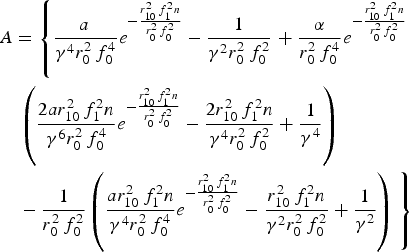 $$\eqalign{& A = \left\{{\displaystyle{{a\, } \over {{\rm \gamma} ^4 r_0^2 \,f_0^4 }}e^{ - {{r_{10}^2 \,f_1^2 n} \over {r_0^2 \,f_0^2 }}} - \displaystyle{1 \over {{\rm \gamma} ^2 r_0^2 \,f_0^2 }}} \right. + \displaystyle{{\rm \alpha} \over {r_0^2 \,f_0^4 }}e^{ - {{r_{10}^2 \,f_1^2 n} \over {r_0^2 \,f_0^2 }}} \cr & \quad \left(\displaystyle{{2ar_{10}^2 \,f_1^2 n} \over {{\rm \gamma} ^6 r_0^2 \,f_0^4 }}e^{ -{{r_{10}^2 \,f_1^2 n} \over {r_0^2 \,f_0^2 }}} - \displaystyle{{2r_{10}^2 \,f_1^2 n} \over {{\rm \gamma} ^4 r_0^2 \,f_0^2 }} + \displaystyle{1 \over {{\rm \gamma} ^4 }}\right)\cr & \quad - \displaystyle{1 \over {r_0^2 \,f_0^2 }}\left(\displaystyle{{ar_{10}^2 \,f_1^2 n} \over {{\rm \gamma} ^4 r_0^2 \,f_0^4 }}e^{ -{{r_{10}^2 \,f_1^2 n} \over {r_0^2 \,f_0^2 }}} - {{r_{10}^2 \,f_1^2 n} \over {{\rm \gamma} ^2 r_0^2 \,f_0^2 }} + \displaystyle{1 \over {{\rm \gamma} ^2 }}\right)\left. \vphantom{\displaystyle{{a\, } \over {{\rm \gamma} ^4 r_0^2 \,f_0^4 }}e^{ - {{r_{10}^2 \,f_1^2 n} \over {r_0^2 \,f_0^2 }}}} \right\}}$$
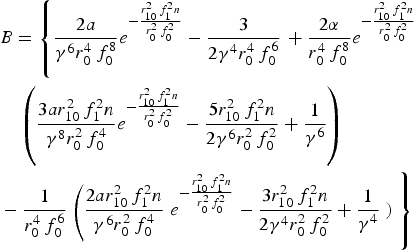 $$\eqalign{& B = \left\{\displaystyle{{2a} \over {{\rm \gamma} ^6 r_0^4 \,f_0^8 }}e^{ - {{r_{10}^2 \,f_1^2 n} \over {r_0^2 \,f_0^2 }}} - \displaystyle{3 \over {2{\rm \gamma} ^4 r_0^4 \,f_0^6 }} \right. + \displaystyle{{2{\rm \alpha} } \over {r_0^4 \,f_0^8 }}e^{ -{{r_{10}^2 \,f_1^2 n} \over {r_0^2 \,f_0^2 }}} \cr & \quad \left({\displaystyle{{3ar_{10}^2 \,f_1^2 n} \over {{\rm \gamma} ^8 r_0^2 \,f_0^4 }}} e^{ - {{r_{10}^2 \,f_1^2 n} \over {r_0^2 \,f_0^2 }}} - \displaystyle{{5r_{10}^2 \,f_1^2 n} \over {2{\rm \gamma} ^6 r_0^2 \,f_0^2 }} + \displaystyle{1 \over {{\rm \gamma} ^6 }} \right)\cr & - \displaystyle{1 \over {r_0^4 \,f_0^6 }}\left({\displaystyle{{2ar_{10}^2 \,f_1^2 n} \over {{\rm \gamma} ^6 r_0^2 \,f_0^4 }}} \right.e^{ - {{r_{10}^2 \,f_1^2 n} \over {r_0^2 \,f_0^2 }}} - \displaystyle{{3r_{10}^2 \,f_1^2 n} \over {2{\rm \gamma} ^4 r_0^2 \,f_0^2 }} + \displaystyle{1 \over {{\rm \gamma} ^4 }}\left. \right)\left.\vphantom{\displaystyle{{2a} \over {{\rm \gamma} ^6 r_0^4 \,f_0^8 }}e^{ - {{r_{10}^2 \,f_1^2 n} \over {r_0^2 \,f_0^2 }}}} \right\}}$$
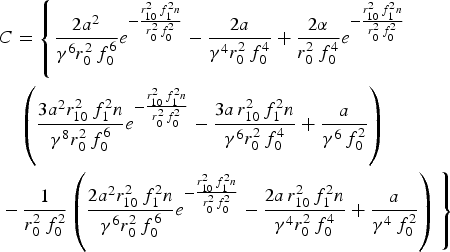 $$\eqalign{& C = \left\{\displaystyle{{2a^2 } \over {{\rm \gamma} ^6 r_0^2 \,f_0^6 }}e^{ - {{r_{10}^2 \,f_1^2 n} \over {r_0^2 \,f_0^2 }}} - \displaystyle{{2a} \over {{\rm \gamma} ^4 r_0^2 \,f_0^4 }} + \displaystyle{{2{\rm \alpha} } \over {r_0^2 \,f_0^4 }}e^{ -{{r_{10}^2 \,f_1^2 n} \over {r_0^2 \,f_0^2 }}} \right. \cr & \quad \left({\displaystyle{{3a^2 r_{10}^2 \,f_1^2 n} \over {{\rm \gamma} ^8 r_0^2 \,f_0^6 }}e^{ -{{r_{10}^2 \,f_1^2 n} \over {r_0^2 \,f_0^2 }}} - \displaystyle{{3a\, r_{10}^2 \,f_1^2 n} \over {{\rm \gamma} ^6 r_0^2 \,f_0^4 }} + \displaystyle{a \over {{\rm \gamma} ^6 \,f_0^2 }}} \right)\cr & - \displaystyle{1 \over {r_0^2 \,f_0^2 }}\left({\displaystyle{{2a^2 r_{10}^2 \,f_1^2 n} \over {{\rm \gamma} ^6 r_0^2 \,f_0^6 }}e^{ -{{r_{10}^2 \,f_1^2 n} \over {r_0^2 \,f_0^2 }}} - \displaystyle{{2a\, r_{10}^2 \,f_1^2 n} \over {{\rm \gamma} ^4 r_0^2 \,f_0^4 }} + \displaystyle{a \over {{\rm \gamma} ^4 \,f_0^2 }}} \right)\left. \vphantom{\displaystyle{{2a^2 } \over {{\rm \gamma} ^6 r_0^2 \,f_0^6 }}e^{ - {{r_{10}^2 \,f_1^2 n} \over {r_0^2 \,f_0^2 }}}}\right\}}$$
We get the following equation for f 1 after equating the coefficient of r 2
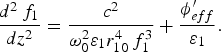 $$\displaystyle{{d^2 \,f_1 } \over {dz^2 }} = \displaystyle{{c^2 } \over {{\rm \omega} _0^2 {\rm \varepsilon} _1 r_{10}^4 \,f_1^3 }} + \displaystyle{{{\rm \phi} _{eff}^{\prime} } \over {{\rm \varepsilon} _1 }}.$$
Eq. (22) determines the focusing/defocusing of the ripple and has the same form as the equation of self-focusing for the main beam Eq. (16).
3. EFFECT OF THE GROWTH OF RIPPLE ON THE EXCITATION OF IAW
Nonlinear interaction of an IAW with the laser beam filaments leads to its excitation. To analyze the excitation process of IAW in the presence of relativistic and ponderomotive nonlinearity and rippled laser beam, we use the following fluid equations: (1) the continuity equation
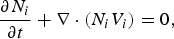 $$\displaystyle{{\partial N_i } \over {\partial t}} + \nabla \cdot \lpar N_i V_i \rpar = 0\comma \;$$
(2) momentum balance equation
 $$m_i \left[{\displaystyle{{\partial V_i } \over {\partial t}} + \lpar V_i \cdot \nabla \rpar V_i } \right]= - eE_i - \displaystyle{e \over c}\lpar V_i \times B\rpar - 2\Gamma _i m_i V_i - \displaystyle{{{\rm \gamma} _i } \over N}\nabla P_i\comma \;$$
and (3) Poisson's equation
 $$\nabla \cdot E_{ia} = - 4{\rm \pi} e\lpar n_e - n_i \rpar \comma \;$$
where N i is the total ion density, V i is the velocity of ion-fluid, B is the total magnetic field of the IAW wave, E i is the total electric field in the plasma, γi is the ratio of specific heat of ion-gas, P i (=N i k BTi) is the electronic pressure, E ia is the electric field associated with the generated ion acoustic, n e and n i corresponds to perturbations in the electron and ion densities, and are related to each other by following equation:
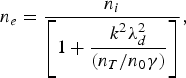 $${n_e} = \displaystyle{{{n_i}} \over {\left[{1 + \displaystyle{{k^2{\rm \lambda} _d^2 } \over {\lpar n_T/{n_0}{\rm \gamma} \rpar }}} \right]}}\comma \;$$
where k is the propagation constant for IAW and λd (=k BT 0/4πN ie 2)1/2 is the Debye length. The Landau damping coefficient Γi for IAW is given by Krall and Trivelpiece (Reference Krall and Trivelpiece1973)
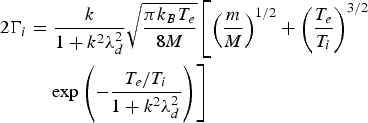 $$\eqalign{ 2{\Gamma _i} & = \displaystyle{k \over {1 + {k^2}{\rm \lambda} _d^2 }} \sqrt {\displaystyle{{{\rm \pi} {k_B}{T_e}} \over {8M}}} \left[ {\left(\displaystyle{m \over M} \right)}^{1/2} + {\left(\displaystyle{{T_e} \over {T_i}} \right)}^{3/2} \right. \cr & \quad \left. \exp \left({ - \displaystyle{{{T_e}/{T_i}} \over {1 + {k^2}{\rm \lambda} _d^2}}} \right) \right]}$$
where T e and T i are the electron and ion temperatures. Applying the perturbation approximation in Eqs. (23)–(25), we have
 $${N_i} = {N_i}_0 + n_i\comma \; \quad V_i = V_{i_0} + n_i\comma \; \quad E_{ia} = E + E_{i_0}$$
where
 $${n_i} \ll \; {N_i}_0\comma \; \quad {v_{i\; }} \ll \; {V_i}_0 \comma \; \quad {\rm and} \quad {E_i}_0 \ll \; E$$
N i0 is the background ion density modified by the dc component of the relativistic-ponderomotive force, V i0 is the ion drift velocity in the pump field, E (= E 0 + E 1) is the total electric field of the laser beam having ripple and ν i is the drift velocity of ion in the electrostatic field E i0 of the IAW. With the help of Eqs. (23)–(28), one obtain the following equation for the excitation of the IAW
 $$\displaystyle{{\partial ^2 n_i } \over {\partial t^2 }} + 2\Gamma _i \displaystyle{{\partial n_i } \over {\partial t}} - {\rm \gamma} _i {\rm \nu} _{th}^2 \nabla ^2 n_i + \displaystyle{{{\rm \omega} _{\,pi}^2 } \over {\rm \gamma} }\displaystyle{n_T \over {n_0 }}\left({\displaystyle{{k^2 {\rm \lambda} _d^2 } \over {1 + k^2 {\rm \lambda} _d^2 }}} \right)n_i = 0\comma \;$$
where νth = (KBTi/Mi)1/2 is the ion thermal velocity. To solve Eq. (29) for n i we used the approach developed by Akhmanov et al. (Reference Akhmanov, Sukhorukov and Khokhlov1968) and Sodha et al. (Reference Sodha, Ghatak and Tripathi1976) and writing
 $$n_i = n_{i0} \lpar r\comma \; z\rpar \exp \lpar i\lpar {\rm \omega} t - k_i [z + S\lpar r\comma \; z\rpar] \rpar \comma \;$$
where n i0 is the slowly varying real function of r and z and S is the Eikonal for IAW.
Substituting for n i from Eq. (30) in Eq. (29), and separating real and imaginary parts of the resulting equation, we obtain
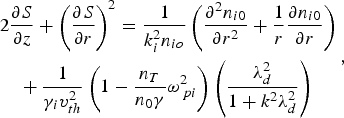 $$\eqalign{& 2\displaystyle{{\partial S} \over {\partial z}} + {\left({\displaystyle{{\partial S} \over {\partial r}}} \right)^2} = \displaystyle{1 \over {k_i^2 {n_{io}}}}\left({\displaystyle{{{\partial ^2}{n_{i0}}} \over {\partial {r^2}}} + \displaystyle{1 \over r}\displaystyle{{\partial {n_{i0}}} \over {\partial r}}} \right)\cr & \quad + \displaystyle{1 \over {{{\rm \gamma} _i}v_{th}^2 }}\left({1 - \displaystyle{n_T \over {{n_0}{\rm \gamma} }}{\rm \omega} _{\,pi}^2 } \right)\left({\displaystyle{{{\rm \lambda} _d^2 } \over {1 + k^2{\rm \lambda} _d^2 }}} \right)}\comma \;$$
and
 $$\displaystyle{{\partial n_{i0}^2 } \over {\partial z}} + \displaystyle{{\partial S} \over {\partial r}}\displaystyle{{\partial n_{i0}^2 } \over {\partial r}} + n_{i0}^2 \left({\displaystyle{{\partial ^2 S} \over {\partial r^2 }} + \displaystyle{1 \over r}\displaystyle{{\partial S} \over {\partial r}}} \right)+ \displaystyle{{2{\rm \omega} \Gamma _i } \over {k{\rm \gamma} _i v_{th}^2 }}n_{i0}^2 = 0\comma \;$$
To solve the coupled Eqs. (31) and (32) we assume the initial radial variation of the density perturbation in the IAW at z = 0 to be
 $$n_{i0}^2 \left\vert {_{Z = 0} } \right. = \lpar n_{i00} \rpar ^2 \exp \lpar r^2 /a_0^2 \rpar \comma \;$$
where n i00 is the axial amplitude of density perturbation of IAW and a 0 is the initial beam width of the acoustic wave. The solution of Eqs. (31) and (32) can be written as (Akhmanov et al., Reference Akhmanov, Sukhorukov and Khokhlov1968),
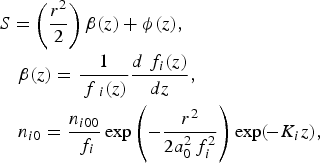 $$\eqalign{& S = \left({\displaystyle{{r{}^2} \over 2}} \right){\rm \beta} \lpar z\rpar + {\rm \phi} \lpar z\rpar \comma \cr & \quad {\rm \beta} \lpar z\rpar = \displaystyle{1 \over {\,f\,{}_i\lpar z\rpar }}\displaystyle{{d{\,\,f_i}\lpar z\rpar } \over {dz}}\comma \cr & \quad {n_{i0}} = \displaystyle{{{n_{i00}}} \over {{\,\,f_i}}}\exp \left({ - \displaystyle{{{r^2}} \over {2a_0^2 \,f_i^2 }}} \right)\exp \lpar \!- {K_i}z\rpar \comma}$$
where  $K_i = \displaystyle{{\Gamma _i {\rm \omega} } \over {k{\rm \nu} _{th}^2 }}$ is the damping factor. Using Eq. (33) in Eq. (31) and equating the coefficients of r 2 on both sides, we obtain the following dimensionless beam width parameter (f i) equation of the acoustic wave under the boundary conditions: df i/dz = 0, f i= 1 at z = 0
 $$\displaystyle{1 \over {{\,\,f_i}\lpar Z\rpar }}\displaystyle{{d{}^2{\,\,f_i}\lpar z\rpar } \over {d{z^2}}} = \displaystyle{1 \over {{k^2}a_0^4 \,f_i^4 \lpar z\rpar }} - \displaystyle{1 \over {{{\rm \gamma} _i}{\rm \nu} _{th}^2 }}\left({\displaystyle{{{\rm \omega} _{\,pi}^2 {\rm \lambda} _d^2 } \over {1 + {k^2}{\rm \lambda} _d^2 }}} \right)\times \displaystyle{{d{\rm \phi} } \over {dr{}^2}}$$
where
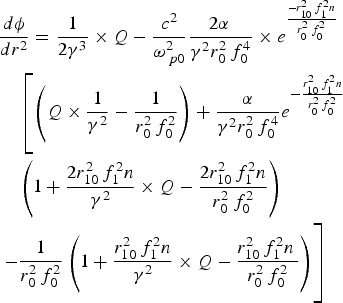 $$\eqalign{& \displaystyle{{d{\rm \phi} } \over {d{r^2}}} = \displaystyle{1 \over {2{{\rm \gamma} ^3}}} \times Q - \displaystyle{{{c^2}} \over {{\rm \omega} _{\,p0}^2 }}\displaystyle{{2{\rm \alpha} \, } \over {{{\rm \gamma} ^2}r_0^2 \,f_0^4 }} \times {e^{{{ - r_{10}^2 \,f_1^2 n} \over {r_0^2 \,f_0^2 }}}} \cr & \quad \left[{\left({Q \times \displaystyle{1 \over {{{\rm \gamma} ^2}}} - \displaystyle{1 \over {r_0^2 \,f_0^2 }}} \right)+ \displaystyle{{\rm \alpha} \over {{{\rm \gamma} ^2}r_0^2 \,f_0^4 }}{e^{ - {{r_{10}^2 \,f_1^2 n} \over {r_0^2 \,f_0^2 }}}}} \right. \cr & \quad \left({1 + \displaystyle{{2r_{10}^2 \,f_1^2 n} \over {{{\rm \gamma} ^2}}} \times Q - \displaystyle{{2r_{10}^2 \,f_1^2 n} \over {r_0^2 \,f_0^2 }}} \right)\cr & \left. { - \displaystyle{1 \over {r_0^2 \,f_0^2 }}\left({1 + \displaystyle{{r_{10}^2 \,f_1^2 n} \over {{{\rm \gamma} ^2}}} \times Q - \displaystyle{{r_{10}^2 \,f_1^2 n\, } \over {r_0^2 \,f_0^2 }}} \right)}\vphantom{e^{{{ - r_{10}^2 \,f_1^2 n} \over {r_0^2 \,f_0^2 }}}} \right]}$$
here
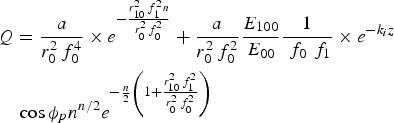 $$\eqalign{& Q = \displaystyle{a \over {r_0^2 \,f_0^4 }} \times {e^{ - {{r_{10}^2 \,f_1^2 n} \over {r_0^2 \,f_0^2 }}}} + \displaystyle{a \over {r_0^2 \,f_0^2 }}\displaystyle{{{E_{100}}} \over {{E_{00}}}}\displaystyle{1 \over {{\,\,f_0}{\,\,f_1}}} \times {e^{ - {k_i}z}} \cr & \quad \cos {{\rm \phi} _p}{n^{n/2}}{e^{ - {n \over 2}\left({1 +{{r_{10}^2 \,f_1^2 } \over {r_0^2 \,f_0^2 }}} \right)}}}$$
and the modified value of γ (due to the contribution of E·E*)
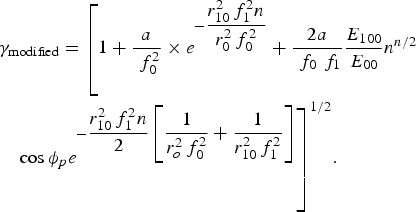 $$\eqalign{& {{\rm \gamma} _{{\rm modified}}} = \left[{{\rm 1} + \displaystyle{a \over {\,\,f_0^2 }} \times {e^{ - \displaystyle{{r_{10}^2 \,f_1^2 n} \over {r_0^2 \,f_0^2 }}}} + \displaystyle{{2a} \over {{\,\,f_0}{\,\,f_1}}}\displaystyle{{{E_{100}}} \over {{E_{00}}}}{n^{n/2}}} \right. \cr & \quad {\left. {\cos {{\rm \phi} _p}{e^{ - \displaystyle{{r_{10}^2 \,f_1^2 n} \over 2}\left[{\displaystyle{1 \over {r_o^2 \,f_0^2 }} + \displaystyle{1 \over {r_{10}^2 \,f_1^2 }}} \right]}}} \right]^{1/2}}.}$$
Eq. (34) describe the beam width parameter (f i) of the excited IAW in collisionless plasma with df i/dz = 0 and f i = 1 at z = 0. To see the effect of the ripple on the excitation of IAW, we have solved Eq. (33) with the help of Eq. (34) numerically to obtain the amplitude of the density perturbation associated with the IAW at finite z.
4. NUMERICAL RESULTS AND DISCUSSION
In order to understand the dynamics of the propagation of rippled laser beam in plasma in the presence of both relativistic and ponderomotive nonlinearities at high laser power flux and its effect on the excitation of IAW, we have performed a numerical computation of Eqs. (16a), (16b), (21a), (21b), (22), (33), and (34) at high laser power flux. We have also solved the coupled equations and obtained the numerical results with typical plasma and laser beam parameters. The following set of the parameters has been used in numerical calculation: ω0 = 1.77 × 10¹⁵ rad/s, r 0 = 20 µm, r 10 = 0.75r 0, ωp0 = 0.3ω0, 2ϕp = π/2, n = 1.5, ν th = 0.5c, E 100 = 0.01E 00, a 0 = 0.5r 0. Normalized intensity of laser beam (a = 0.5, 1.0, 1.5, 2.0) are equivalent to 3.5 × 10¹⁷, 1.4 × 10¹⁸, 3.1 × 10¹⁸, and 5.5 × 10¹⁸ W/cm2, respectively. For initial wave front of the beams, the initial conditions for both f 0 and f 1 are:
 $$\displaystyle{{d{f_0}} \over {dz}} = \displaystyle{{d{f_1}} \over {dz}} = 0\comma \; \, \, {\rm and}\, {\,\,f_0} = {\,\,f_1} = 0\, \, \, {\rm at}\, \, \, z = 0.$$
Eqs. (16b) and (22) determine the focusing/defocusing of the main laser beam and the rippled beam, along with the distance of propagation in the plasma. In both equations, the first term on right-hand side represents the diffraction phenomenon and the second term describes the nonlinear refraction of the beam, which arises due to the relativistic and ponderomotive nonlinearities. The relative magnitudes of these two terms determine the focusing and defocusing behavior of the beams. Eq. (16a) gives the intensity profile of the main laser beam in the plasma in the presence of relativistic and ponderomotive nonlinearities. The intensity profile of main laser beam depends on the beam width parameter (f 0) in the paraxial regime. Figure 1 shows intensity profile of the laser beam in plasma with the normalized distance of propagation for different values of intensities. It is obvious that as the laser beam propagates through the plasma it gets filamented due to the laser plasma coupling. The generated filaments of the laser beam are shown in Figures 1a–1d for a fixed value of ωp0 = 0.3ω0 and varying laser beam intensity, a = 0.5, 1.0, 1.5, 2.0, respectively. It clearly shows, as the intensity increases, the normalized intensity of the laser beam also increases.
Variation in laser beam intensity with normalized distance (Z = zc/ω0r 02) and radial distance (R = r/r 0), when relativistic and ponderomotive nonlinearities are operative, keeping ωp0 = 0.030ω0 constant, at different laser beam intensities, (a) αE 002 = 0.5, (b) αE 002 = 1.0, (c) αE 002 = 1.5, (d) αE 002 = 2.0, respectively.
The growth rate of the ripple (k i) is given by Eq. (21b) which depends on the effective intensity and frequency of the main laser beam in the plasma, electron density in the plasma and the phase angle ϕp. Due to the coupling between the main beam and the ripple, ripple grow/decay in the plasma. From numerical analysis, it has been observed that the ripple will grow only when sin 2ϕp is negative. In Figures 2a and 2b, we have plotted the growth rate of ripple in the plasma with the distance of propagation for different values of laser intensities and plasma frequencies. It is clearly shown in the figures that the growth rate of ripple increases with increase in laser intensity and plasma frequency in the presence of both relativistic and ponderomotive nonlinearities. It is also important to mention here that both ϕp and n significantly affected the intensity profile of the of the ripple, growth rate of the ripple, intensity profile of IAW, beam width parameters of the rippled beam (f 1) and IAW (f i), respectively. The effect of ϕp and the parameters n on the above has been reported earlier (Sodha et al., Reference Sodha, Singh, Singh and Sharma1981; Saini et al., Reference Saini and Gill2000; Purohit et al., Reference Purohit, Pandey, Mahmoud and Sharma2004; Reference Purohit, Chauhan, Sharma and Pandey2005) and hence not repeated in present study.
(a) Variation of the growth rate of laser ripple with normalized distance of propagation (Z = zc/ω0r 02) for n = 1.5, 2ϕp = π/2, ωp0 = 0.030ω0 and for different laser beam intensities (b) Variation of the growth rate of laser ripple with normalized distance of propagation (Z = zc/ω0r 02) for n = 1.5, 2ϕp = π/2, αE 002 = 1, and for different plasma frequencies (green, red and blue lines corresponds to ωp0 = 0.015, 0.025, and 0.035, respectively.
The intensity profile of the rippled laser beam is expressed by Eq. (21) when relativistic and ponderomotive nonlinearities are operative. It depends on the beam width of the rippled laser beam (f 1) and the growth rate (k i) of ripple in plasma. Figures 3a–3d shows the filamentary structures of the rippled beam at different laser intensities. It shows that a small ripple on the axis of the main beam grows very rapidly with distance of propagation as compared with the intensity profile of the main beam. It is also observed that in the presence of both nonlinearities, the ripple intensity starts decreasing with the increase in the laser intensity at constant ωp0. This is due to the complex dependency of beam width parameter (f 1) and the growth rate (k i) on laser intensity.
Variation in axial intensity of laser ripple with normalized distance (Z = zc/ω0r 02) and radial distance (R = r/r 10), when relativistic and ponderomotive nonlinearities are operative, keeping ωp0 = 0.030ω0 constant, at different laser beam intensities, (a) αE 002 = 0.5, (b) αE 002 = 1.0, (c) αE 002 = 1.5, (d) αE 002 = 2.0, respectively.
The IAW excited due to nonlinear coupling between rippled laser beam and plasma in the presence of relativistic and ponderomotive nonlinearities. This coupling arises on account of the relativistic change in the electron mass and the modification of the background electron density due to ponderomotive nonlinearity, consequently the laser beam gets filamented. In these filaments, the laser beam intensity is very intense and the plasma density is also changed due to ponderomotive force. Thus, the amplitude of IAW, which depends upon the background electron density, gets strongly coupled to the laser beam. The magnitude of relativistic ponderomotive force is modified in the presence of the ripple because it depends on the intensity of the main beam and of the ripple. The presence of the ripple also leads to a change in modified ion density; consequently, the excitation of IAW is modified. Eq. (28) represents an expression for the excitation of IAW, used in laser heating experiments, where the last term represents the nonlinear coupling of IAW to the modified background density.
In order to study the effect of rippled laser beam in the presence of both relativistic and ponderomotive nonlinearities on the excitation of IAW, we have solved numerically Eq. (33) with the help of Eq. (34) to obtain the amplitude of the density perturbation associated with excited IAW at finite z. The intensity profile of the IAW depends on the beam width parameter (f i) in the paraxial regime. The results are displayed in Figures 4a–4d and Figures 5a–5c at different laser intensities and plasma frequencies respectively, which show that the IAW excited due to nonlinear coupling with intense rippled laser beam in the presence of relativistic and ponderomotive nonlinearities. It is obvious from the figures that in paraxial regime the intensity of the IAW decreases with increase in laser intensity and plasma frequency. This is due to the fact that the Landau damping term in Eq. (33) and growth rate are sensitive to the intensity of the IAW, which reduces the growth and intensity of the IAW.
Variation in IAW intensity with normalized distance (Z = zc/ω0r 02) and radial distance (R = r/r 0), when relativistic and ponderomotive nonlinearities are operative, keeping ωp0 = 0.030ω0 constant, n = 1.5, 2ϕp = π/2, at different laser beam intensities, (a) αE 002 = 0.5, (b) αE 002 = 1.0, (c) αE 002 = 1.5, (d) αE 002 = 2.0, respectively.
Variation in IAW intensity with normalized distance (Z = zc/ω0r 02) and radial distance (R = r/r 0), when relativistic and ponderomotive nonlinearities are operative, keeping αE 002 = 1 constant, n = 1.5, 2ϕp = π/2, at different plasma frequencies, (a) ωp0 = 0.015ω0, (b) ωp0 = 0.025ω0, (c) ω p0 = 0.035ω0, respectively.
5. CONCLUSION
IAW excitation by intense rippled laser beam has been investigated in the presence of relativistic and ponderomotive nonlinearities. The growth rate of ripple in plasma increased at higher laser intensity and plasma frequency, which affect the dynamics of the rippled laser beam as well as the IAW. The intensity variation of the main laser beam, rippled laser beam as well as IAW with normalized distance and radial distance has been observed when both relativistic and ponderomotive nonlinearities are operative. The decrease in intensity of the ripple depends on the growth rate and the beam width parameter (f 1) of the ripple. It is evident from the results that the IAW gets excited due to nonlinear coupling with the rippled laser beam, and due to Landau damping, it gets damped as it propagates. The results of the present analysis are useful in understanding the physics of laser beam propagation in plasma at high power flux and find application in plasma heating in inertial confinement fusion (ICF) experiments.
ACKNOWLEDGEMENT
The authors are grateful to Uttarakhand council for Science & Technology (UCOST), Uttarakhand, India for financial support.



