INTRODUCTORY REMARKS
The site of Kouphovouno (37°3′18.62N 22°25′26.05E) lies just to the south of Sparta, Laconia, Greece. The current project has seen seasons of surface survey and excavation over the period 1999–2006 (for fuller background information see Cavanagh, Mee and Renard Reference Cavanagh, Mee and Renard2004 and 2007). The site had multi-period occupation from the Middle Neolithic (MN) period, through the Late Neolithic (LN) and in the Early (EBA), Middle (MBA) and Late Bronze Ages (LBA) as well as in the historic periods,Footnote 1 notably when part of the site was given over to a rural settlement in the Late Roman period. One of the aims of the project has been to clarify the chronology of these periods of occupation and a number of samples have been taken for 14C estimates. Samples were taken from the bones of a series of inhumations which dated to the Middle Bronze Age (Lagia and Cavanagh Reference Lagia, Cavanagh, Philippa-Touchais, Touchais, Voutsaki and Wright2010), while the main Neolithic sequence has been dated on the basis of seed samples (Mee, Cavanagh and Renard Reference Mee, Cavanagh and Renard2014). Seed samples were taken at the same time from an EBA context and dated together with those of the Neolithic sequence; unfortunately this sample produced an estimate far too early for the EBA archaeological materials (OxA-20984: 6836 ± 37 bp from context G1660). In devising a new sampling programme for the EBA it was already evident that residuality, the presence of earlier material in the later deposits, was going to be a problem; this problem was also illustrated by the MBA series of dates, where the 14C from the human bones showed the burials were of MBA date, although often the pottery finds from the contexts above and around the skeletons contained finds no later than the EBA.
It may be helpful to introduce some of the terminology used in the paper; these comments are very abbreviated and those who wish to find out more are strongly recommended to turn to discussions (with leads to further references) such as Buck, Cavanagh and Litton Reference Buck, Cavanagh and Litton1996, Bronk Ramsey Reference Bronk Ramsey2009, Buck and Meson Reference Buck and Meson2015 or the website of the International Society for Bayesian Analysis (<http://bayesian.org/>). The Bayesian paradigm looks to the relationship between our current understanding of a question and new information which can update that understanding. In this respect it reflects common human practice: we adapt our views of the world in the light of experience. For a statistical approach one's current beliefs about any given scientific problem need to be couched in terms of a model or hypothesis expressed as probabilities governing the parameters which encapsulate the model; the probability distributions of this current belief are termed the prior, in notation p(θ). In our case the model includes the relationship between the radiocarbon estimates and the calibration curve together with our beliefs, for example, about archaeological phases (e.g. that EH1 precedes EH2) and that we aim to set dates to the boundaries between these phases. New data are then introduced to the analysis, in our case the uncalibrated radiocarbon estimates assigned to various EH and MH phases; we can label these new data y. The likelihood, expressed as p(y | θ), is the probability distribution of y conditional on θ. Crucially, following the Bayesian approach, the likelihood is combined with the prior to give the posterior probability density function: p(θ | y). The prior, the likelihood and the posterior are brought together through Bayes’ theorem, which can be expressed as follows:
 $$p\left( {\theta \,\vert\, y} \right) \propto \left( {y \,\vert\, \theta} \right)p\left( \theta \right)$$
In our case the posterior probabilities include the dates arrived at in the light of the calibration and phasing and are illustrated below in the graphs showing the probabilities of the individual 14C determinations given the model. (These are called the marginal posterior densities, where ‘marginal’ is a technical term referring to the fact that these graphs show the probability of one variable without regard to any other random variable in the model.) In this way one's beliefs are updated in the light of the new evidence. The calculation of the posterior probability density function is frequently intractable mathematically, but methods can be used drawing samples from the posterior distribution, such as the Markov Chain Monte Carlo (MCMC) methods mentioned in the text.
Another, if more trivial, point needs to be made to avoid confusion on dating terminology. Traditionally, ‘lower’ in archaeological chronologies refers to an earlier period (Lower Palaeolithic precedes Upper Palaeolithic), perhaps on a stratigraphic model. Here we follow this convention and use terms like ‘lower dating’ or ‘down dating’ to mean ‘dating earlier (than previously thought)’. Other authors use terms such as a ‘high chronology’ to mean an earlier chronology, perhaps on the basis that the higher the date bc/bp the earlier the context.
EARLY BRONZE AGE RADIOCARBON DATES FROM KOUPHOVOUNO
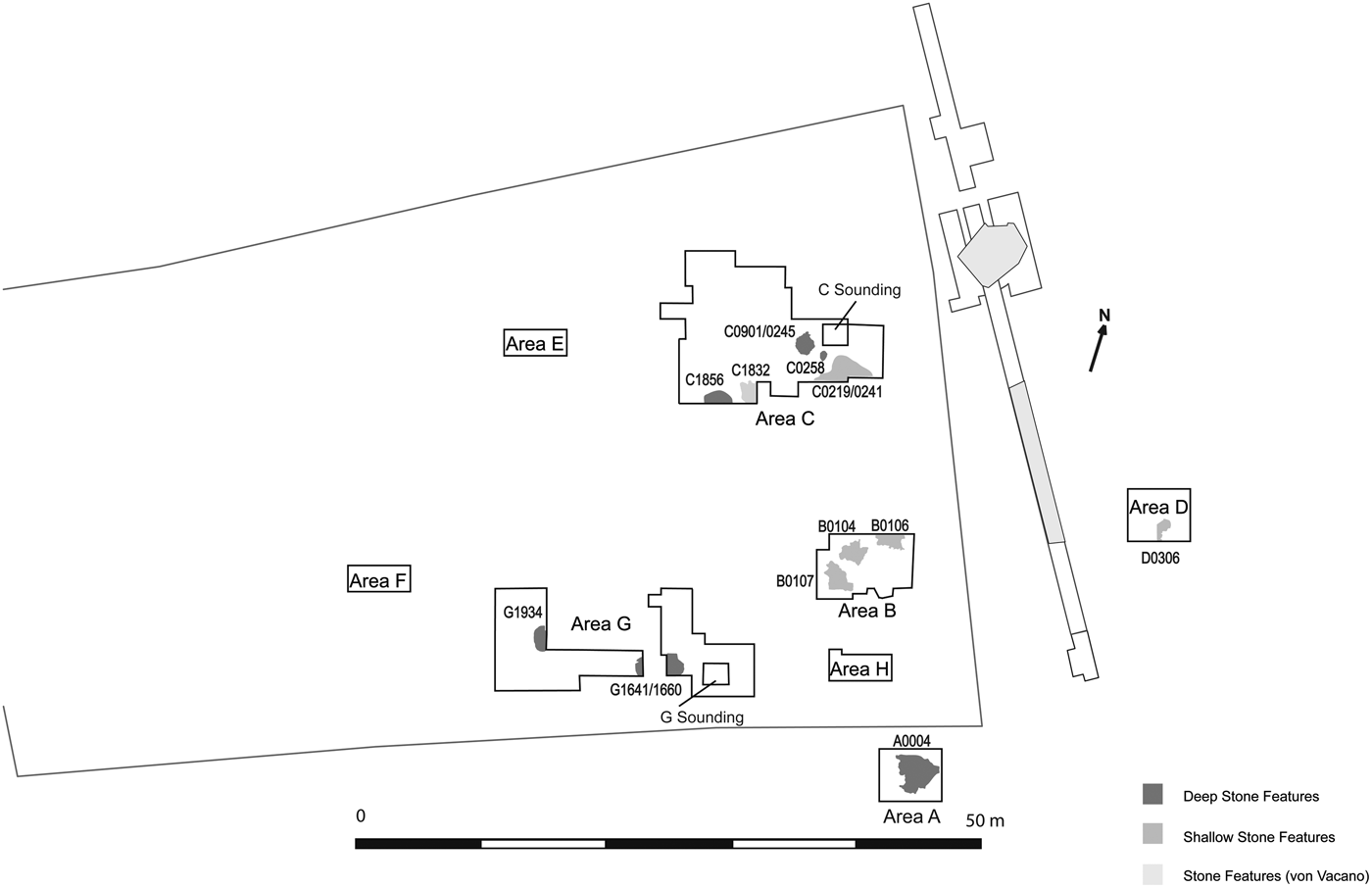
The major EBA contexts at Kouphovouno consisted of two main types of stone rubble features (Fig. 1): firstly those where a relatively deep pit (roughly one metre in depth) was cut and then filled with stone rubble, and secondly a shallower type, the depth of one or two stones (roughly 0.2–0.3 m), where the stones seem to rest in a hollow or just on the ground surface. Their interpretation is still uncertain, but it is plain that as well as EH sherds the fills all contained admixtures of MN and LN pottery. It was decided, therefore, to select for dating not seeds, which ran the risk of being incorporated with the Neolithic pottery, but animal bones, and in particular the larger, better-preserved bones which, we hoped, would stand a better chance of being contemporary with the date of the fills’ deposition. Of course, bone does not yield the dating precision of seeds, which grow in a single season and therefore reflect the 13C/14C ratio of a given year, but on the other hand they are not liable to the time lags (as opposed to residuality) sometimes suffered by wood charcoal.
Map showing Early Helladic Features at Kouphovouno.

It must be stressed that the contexts here distinguished (A0004, C0219, C0241, C0245, C0901, G1641, G1660, C1832, C1856 and G1934; see Fig. 1) were not found in a stratigraphic relationship one with another, but were ascribed to different phases on the basis of the pottery typology.
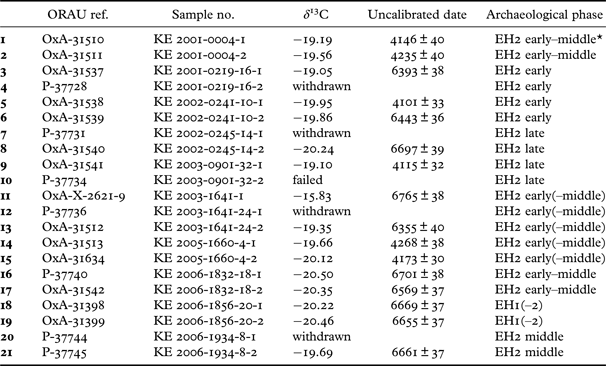
In all, 21 samples were selected for dating and submitted to the Oxford Accelerator Laboratory in August 2014. The samples are listed in Table 1. The sample number recorded in column 3 of the table consists of the prefix KE (Kouphovouno Excavation) followed by the year of excavation, the context number, and the lot/specimen from that context which contained the bone. The fifth column records the bp uncalibrated estimate and the sixth the pottery phase ascribed to each context by Chris Mee, based on his analysis of the typology of the ceramics. Note in the first place that four samples (4, 7, 12, 20) were withdrawn before dating, because they failed the %Nitrogen test, indicating that they were unlikely to have sufficient collagen to yield good dates (Brock et al. Reference Brock, Wood, Higham, Ditchfield, Bayliss and Bronk Ramsey2012). A fifth sample (10) failed to date.
List of samples from EBA contexts at Kouphovouno submitted for 14C dating, and phases ascribed to the contexts by Mee.

*Note in the later discussion we use the term ‘EH2 Early’ to cover Mee's ‘EH2 early–middle’, in keeping with the terminology applied more generally in the literature.
Of the remaining 16 samples it is striking that 10 gave dates earlier than 6000 bp, that is to say when calibrated they dated to the sixth millennium bc and consequently to the MN–LN phases in Greece (3, 6, 8, 11, 13, 16, 17, 18, 19, 21). These dates, from residual materials, tell us nothing about the chronology of the EBA period. It was particularly disappointing that the samples from context C1856 (18 and 19, the earliest of the EH pottery phases recognised by Mee), failed to provide usable dates.
Calibration of the Kouphovouno 14C Determinations
In spite of the disappointing results it has still been possible to make progress on the dating of the early phases of EH2 at Kouphovouno. Because relatively few of the samples returned relevant dates, however, combined with the general problem of residuality, we decided to take a more cautious approach, rather than follow the very refined phasing provided by Mee in advance of the submission of the 14C samples. Thus we combined the six remaining dates into just two phases: firstly EH2 Early – 5 from context C0241, characterised by Mee as slightly earlier than A0004 (in Lerna terms IIIA[–B]), 14 and 15 from context G1660 (contemporary with A0004) and 1 and 2 from context A0004 (Lerna late A–early/mid B); and secondly EH2 Middle – 9 from context C0901, the pottery of which has been characterised by Mee as ‘probably Lerna IIIC’ (unpublished notes made in 2013). At a later stage (see below) the Kouphovouno results are confirmed by incorporating information from other sites.
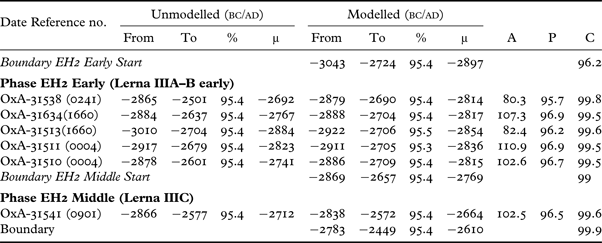
On running the OxCal calibration program (OxCal 4.2) using the IntCal13 calibration curve, the dates converged to a satisfactory result using the MCMC (Markov Chain Monte Carlo) algorithm; interested readers can find out more about the application of MCMC simulation methods for 14C calibration in Buck, Cavanagh and Litton Reference Buck, Cavanagh and Litton1996, 188–99 or Bronk Ramsey Reference Bronk Ramsey2009. The results (Table 2 and Fig. 2) indicate that the earlier stages of the EH2 period at Kouphovouno fall roughly between 3000 and 2600 bc. The finds from context A0004 have been extensively published (Cavanagh, Mee and Renard Reference Cavanagh, Mee and Renard2007) and the pottery forms a fairly tight chronological grouping which has been defined in terms of the Lerna EH2 (=Lerna III) sequence as ‘late phase A–mid B but it may be predominantly early or mid B’ (Cavanagh, Mee and Renard Reference Cavanagh, Mee and Renard2007, 30). We used 9 context C0901 to set a constraint on this ‘EH2 early’ phase.Footnote 2 In very general terms, therefore, we can suggest on this initial analysis that the earlier phases of the EH2 sequence (equivalent to Lerna III phases A–B middle) fall roughly between 3000 and 2650 bc. The Bayesian analysis proceeded by establishing a prior model which stated that our ‘EH2 Early’ dates belong to a single phase, and the boundary for the start of this phase is estimated in the light of the calibration of the 14C estimates (the data) to produce the posterior probability (the modelled dates); the boundary for the start of ‘EH2 middle’ is informed by the further prior information that the phase ‘EH2 early’ precedes it (for more on this see Buck, Cavanagh and Litton Reference Buck, Cavanagh and Litton1996, 226–32). The ‘Agreement indices’ A are designed to investigate any inconsistences between the model and the data and are further explained in Bronk Ramsey Reference Bronk Ramsey2009, 356–7 and Reference Bronk Ramsey1995, where the A model value is considered more sensitive; for our purposes the values indicate no contradiction between the model and the data.
Marginal posterior densities (for this term see Buck, Cavanagh and Litton Reference Buck, Cavanagh and Litton1996, 164–9; Bronk Ramsey Reference Bronk Ramsey2009, 353) for the sequence of dates from the Early Bronze Age contexts at Kouphovouno.

Results of the OxCal modelling of the EH2 dates from Kouphovouno. Index A model = 98.3. In the column marked A is listed a measure of the agreement of the individual estimate with the model; values above 60 are considered to indicate good agreement. C is an indication of how effective the model is by measuring the convergence of the MCMC algorithm; values above 95% indicate consistent convergence.

THE KOUPHOVOUNO DATES IN THE CONTEXT OF GREEK EARLY BRONZE AGE CHRONOLOGY
The chronology frequently quoted is that proposed by Manning (Reference Manning1995, summarised in Rutter Reference Rutter and Cullen2001, 106 table 2) and updated in Manning Reference Manning and Cline2010; a slightly different model has been put forward by Wiencke (Reference Wiencke2000, 656; see also Pullen Reference Pullen2011, 15). (Note that the so-called ‘chest-of-drawers’ models illustrated in Table 3 are an example of the modelling process but without adopting a formal statistical framework; see Buck, Cavanagh and Litton Reference Buck, Cavanagh and Litton1996, 27–46.) These chronologies are given in Table 3 together with that published by Warren and Hankey in 1989.
Chronological Table of absolute dates (after Manning Reference Manning and Cline2010, 23, Rutter Reference Rutter and Cullen2001, 106 table 2, Wiencke Reference Wiencke2000, 656, Warren and Hankey Reference Warren and Hankey1989, 169).

Manning's Reference Manning1995 publication appeared before the extensive application of Bayesian analysis to radiocarbon dating, though the methodology was first developed in the early 1990s (Buck, Litton and Smith Reference Buck, Litton and Smith1992; Buck, Cavanagh and Litton Reference Buck, Cavanagh and Litton1996). It is now possible to propose a revised chronology incorporating 14C estimates from other sites, not only those from Kouphovouno, though estimates made some 50 years ago have been included. This procedure is subject to an important proviso: the use of 14C estimates made so long ago is not entirely recommended, as there have been many improvements in laboratory protocols, advances in instrumentation, increased understanding of the carbon cycle, and more precise measurement. To this extent, the chronology proposed here is provisional and we must hope that more and better dates will be determined in the future from new EBA samples. Having said that, as we conclude below, there is independent evidence to suggest the estimates made in the 1960s and quoted here are reliable.
In what follows we have distinguished the following six phases: EH1, EH2 Early, EH2 Middle, EH2 Late, EH3 and MH1 in the belief that these best correspond to the data points for which we currently have 14C estimates. Certainly, different sites have yielded different partitions of the period such as Wiencke's fourfold division of EH2 at Lerna (III A–D) (Wiencke Reference Wiencke2000) or Pullen's ‘EH2 Initial’ and ‘EH2 Developed’ at Tsoungiza (Pullen Reference Pullen2011), or the tripartite division of the EH2 period presented by Maran (Reference Maran1998, pls 80–1). A further note of caution is needed here: phasing is an exercise in drawing lines across a chronological continuum; the bounds of a given context or phase at site A are very unlikely to coincide with the bounds of different contexts/phases at site B, so that different authors will have a tendency to lump them together in slightly different configurations – there is an element of the arbitrary (a point effectively emphasised by Forsén for destruction horizons of the EH period: Forsén Reference Forsén1992, 157–70). The more determinations we have, the more refined a chronology we can hope for.
Radiocarbon dates for the EH1 period have recently seen the addition of a new date from the EH1 cistern/well at Tsoungiza (Pullen Reference Pullen2011, 15–16 – the other date from this context is plainly an outlier), to add to the two Eutresis dates published in the 1960s (Manning Reference Manning1995, 175). For the EH2 Early phase we have used the five dates from Kouphovouno from contexts equated with Lerna III A–early/mid B. For EH2 Middle three more dates from Tsoungiza derive from the Burnt Room structure dated to Tsoungiza ‘EHII Developed Phase 2’, the equivalent of late Lerna IIIB–early Lerna IIIC (Pullen Reference Pullen2011, 15–16); to these three dates we have added that from Kouphovouno context C0901, whose pottery has been characterised as Lerna IIIC. For EH2 Late, the EH2 dates from Lerna have been ascribed to phases Lerna IIIC–D; more precisely, they came from Room CA and the House of Tiles Room III/IV (Wiencke Reference Wiencke2000, 656–7). Of these, P321 and P321A seem to be from seeds found in the destruction layer of Room CA. P312, P318 and P319 are on wood charcoal fragments from the House of Tiles, probably Aleppo pine, and possibly from timbers used in the construction of the House. Wiencke has commented that ‘most of the Lerna III phase C precedes the burning of Room CA’ (Wiencke Reference Wiencke2000, 657), so these samples belong to the end of Lerna IIIC and the beginning of IIID. The charcoal coming from long-lived timbers might date from a number of decades earlier, or it might not; we cannot be sure. We can now add to this a new date from the site of Geraki, in Laconia. The sample is of a grass pea (Lathyrus sativus) seed found with others in a pithos and dating an EH2 late destruction context.Footnote 3 The 14C date is entirely consistent with those from Lerna IIIC–D included in the same group, confirming the archaeological evidence for their contemporaneity.
Thanks to a series of new (and a few old) dates from the site of Kolonna on the island of Aigina (Wild et al. Reference Wild, Gauß, Forstenpointner, Lindblom, Smetana, Steier, Thanheiser and Weninger2010), further precision has been brought to the chronology of EH3 and the Middle Bronze Age. Their analysis placed Phase E of that site, which follows the earliest EH3 Phase D, perhaps just after 2200, and the transition to the Middle Bronze Age at somewhere in the range 2190–2060 bc. On the model presented here, dates from Kolonna phases E and F have been placed in EH3 (VERA-2678, VERA-2680, VERA-2679, VERA-2683, VERA-2692).Footnote 4 The dates from Lerna IV (P299, P300) have also been included. Finally, and to place a constraint on the date for the end of EH3 and beginning of MH1, we have included in MH1 four dates from Kolonna phase G (VERA4638, VERA4281, VERA4282, VERA4283 – two of the dates, VERA 4640 and VERA 4639, showed unsatisfactory agreement in the model and were omitted). We have also included one of the dates from the MH1 burials at Lerna (GrA-28051); GrA-28046 and GrA-28213 again showed unsatisfactory agreement with the model and were omitted (Voutsaki, Nijboer and Zerner Reference Voutsaki, Nijboer, Zerner, Philippa-Touchais, Touchais, Voutsaki and Wright2010). Finally, we have not included the MH1 14C dates from Ayios Stephanos; a run using four of them (P-2968, P-2967, P-2571, P-2969) produced results consistent with the model presented here, though the other dates did not fit the model so well (see Taylour and Janko Reference Taylour and Janko2008 Appendix 9 CD 186–91). Some further work is required in defining the start of MH1; furthermore, new 14C estimates from closely stratified contexts are needed to confirm the date of the EH3–MH1 transition. All the same, on current evidence we would concur with the finding of Wild et al. (Reference Wild, Gauß, Forstenpointner, Lindblom, Smetana, Steier, Thanheiser and Weninger2010) that the transition lies within the range 2190–2060 bc; as our main concern is with the preceding EH phases we shall not pursue this issue in detail.
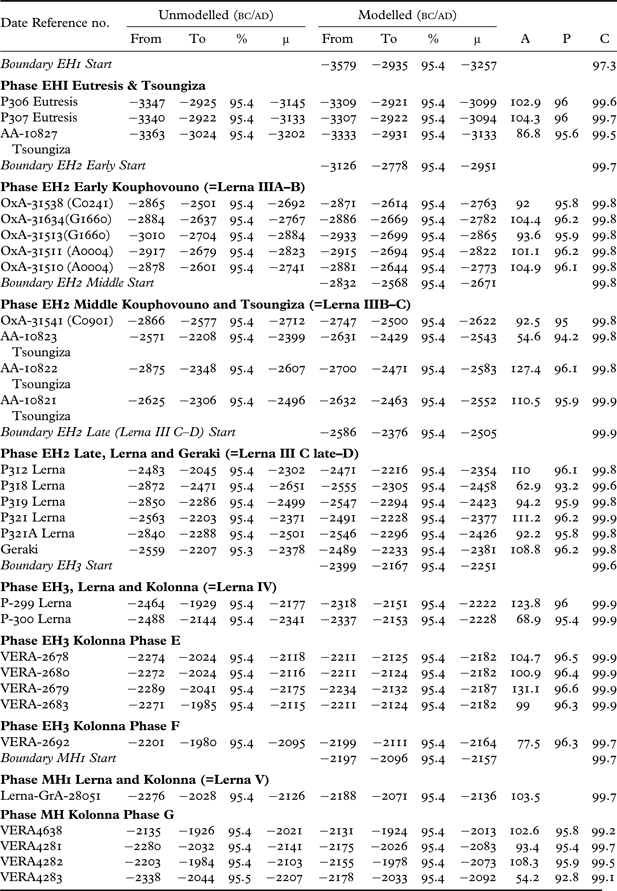
The results of the Bayesian analysis are summarised in Table 4; the model is presented in graph form in Fig. 3.
Marginal posterior densities (for this term see Buck, Cavanagh and Litton. Reference Buck, Cavanagh and Litton1996, 164–9; Brock Ramsey Reference Bronk Ramsey2009, 353) for the sequence of dates from Early Helladic contexts from Eutresis, Kouphovouno, Lerna, Tsoungiza and Kolonna.

Results of the OxCal modelling of EH dates from Eutresis, Kouphovouno, Lerna, Geraki and Kolonna. Index of Agreement model = 76.8. In the column marked A is listed a measure of the agreement of the individual estimate with the model; values above 60 are considered to indicate good agreement. C is an indication of how effective the model is by measuring the convergence of the MCMC algorithm; values above 95% indicate consistent convergence.

Comparison with the dates in Table 3 indicates that a downward (earlier) extension of Early Helladic chronology is required. The EH1 period would have extended back into the fourth millennium bc, may have lasted for some three centuries, and probably barely persisted into the third millennium. The start of EH2 would roughly be placed shortly after the start of the third millennium. The phases equivalent to Lerna IIIA, IIIB and IIIC would appear to span something like five to six centuries, each phase corresponding to some 200 years. On the other hand, the model suggests a long duration for Lerna IIIC late–IIID, perhaps of the order of 250 years, which seems too long, and a relatively short duration for EH3 of a century or so, which seems too short; of course, the error ranges can accommodate a shorter span for the former and a longer span for the latter. Note, moreover, that the Kolonna sequence did not include dates from the earliest EH3 phase, so the EH2–EH3 boundary might, in the future, be pushed earlier, should more samples from early EH3 contexts be found.
Early Helladic and Early Cycladic Chronologies
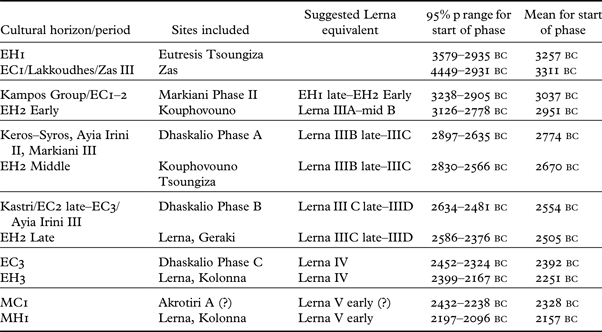
Support for this Early Helladic chronology in mainland Greece comes from the Cycladic chronology based on recent estimates from Dhaskalio Kavos and Markiani (Manning Reference Manning, Brodie, Doole, Gavalas and Renfrew2008; Renfrew, Boyd and Bronk Ramsey Reference Renfrew, Boyd and Bronk Ramsey2011). The comparison is summarised in Table 5. The main posterior density plots for Markiani Phase II lie in the range 3000–2800 bc (Renfrew, Boyd and Bronk Ramsey Reference Renfrew, Boyd and Bronk Ramsey2011 fig. 9); we reran the model to include the Markiani Phase II dates (Marangou et al. Reference Marangou, Renfrew, Doumas and Gavalas2006, 72) and the EC1/Lakkoudes phase date from the Zas Cave (Manning Reference Manning, Brodie, Doole, Gavalas and Renfrew2008, 56).Footnote 5 The Zas EC1 date is coherent with those from Eutresis and Tsoungiza. The range for the start of Markiani II (range for start 3238–2905 bc; mean 3037 bc) indicates an overlap with our EH2 Early (range for start 3126–2778 bc; mean 2951 bc), and suggests that the Kampos group is contemporary with late EH1–early EH2 (Lerna IIIA). This confirms the typological arguments that the Kampos phase spans late EB1–early EB2 (Manning Reference Manning1995, 45–8; Karantzali Reference Karantzali, Brodie, Doole, Gavalas and Renfrew2008). In mainland terms, the next Cycladic phase Dhaskalio A/Ayia Irini II is equated with Lerna III B–C (Wilson Reference Wilson1999, 228), and although the phasing of Ayia Irini has recently been refined and Periods II and III have each been subdivided into an early and a late phase, nevertheless distinctive ceramics features to mark the sub-phases are still unclear (Wilson Reference Wilson2013); thus more precise equations between the Ayia Irini and Dhaskalio pottery sequences are not yet available. By including, as a constraint, the Markiani II dates in the model, it was possible to give a closer range for the start of the Dhaskalio A/Markiani III phase (range for start 2897–2635 bc; mean 2774 bc). This range is close to our EH2 Middle (range for start 2830–2566 bc; mean 2670 bc), and thus once again supports the archaeological arguments that both phases correspond to Lerna IIIB late–IIIC. Our EH2 Late group (range for the start: 2597–2387 bc; mean 2505 bc) would, as expected, match up with Dhaskalio Phase B/Ayia Irini III/Kastri (range for the start: 2634–2481 bc; mean 2554 bc). If anything the Lerna dates, now supported by the date from Geraki, lie a little later, which should help allay fears that the charcoal samples from the House of Tiles were from old timbers. In sum, these two sequences, arrived at independently, support each other and are compatible with what has been proposed independently on the basis of pottery typology. Wilson has recently confirmed that ‘the earliest stratified Period II deposits at Ayia Irini postdate Lerna IIIA and possibly some or most of Lerna IIIB; late Period II at Ayia Irini is largely or wholly contemporary with Lerna phase IIIC; the final EH II phase at Lerna, IIID (House of Tiles), overlaps with at least a portion of Ayia Irini Period III’ (Wilson Reference Wilson2013, 413–14; cf. Manning Reference Manning1995, 53; Maran Reference Maran1998 pls 80–1; Wiencke Reference Wiencke2000, 655–6). The agreement of the Cycladic and Helladic 14C chronologies also helps confirm that the dates from Lerna and Eutresis calculated at the University of Pennsylvania in the 1960s give consistent results.
Comparison of the EH chronology presented here and the recent EC chronology (Renfrew, Boyd and Bronk Ramsey Reference Renfrew, Boyd and Bronk Ramsey2011).

On the other hand, the transition to EC3 suggested by the Cycladic dates (Transition Dhaskalio B–C: 2452–2324 bc, mean 2392 bc) lies at the early end of the range suggested by the transition to EH3 (Lerna IV/Kolonna E: 2391–2158 bc, mean 2251 bc). We have already noted that we have no 14C estimates from the earliest EH3 phases (Kolonna D), and this may explain the difference. At the same time, the archaeology of the EH2–EH3 transition continues to be controversial (recently the theme of a special issue of the American Journal of Archaeology: see Brogan Reference Brogan2013, Broodbank Reference Broodbank2013,Footnote 6 Davis Reference Davis2013, Kouka Reference Kouka2013, Pullen Reference Pullen2013, Rutter Reference Rutter2013, Wiener Reference Wiener2013; see also Weiberg and Lindblom Reference Weiberg and Lindblom2014). Note also that this period in the Aegean has been linked with the so-called 2200 bc climatic breakdown (Wiener Reference Wiener2013).Footnote 7 Bayesian modelling of a new series of estimates from contexts dating to the EB3 phase ought to help pin down the chronology.
Likewise, the transition to MC I (2432–2238 bc, mean 2328 bc) appears distinctly earlier than the transition to MH I (2197–2097 bc, mean 2157 bc; cf. Wild et al. Reference Wild, Gauß, Forstenpointner, Lindblom, Smetana, Steier, Thanheiser and Weninger2010, 1019). It may be that the Dhaskalio C phase lies at the early end of EC3, and we lack radiocarbon dates for the later part of EC3 (Broodbank Reference Broodbank2013, 537), but a decisive influence on the ‘early’ EC3–MC1 transition date is exerted by the Akrotiri samples: their exact context is Akrotiri Phase A – Irene Nikolakopoulou writes (pers. comm.): ‘the 3 samples (charred seeds) from Akrotiri are from the same context, Pillar Pit 67N (group 67N069), which in my ceramic study is a Phase A context’.Footnote 8 Phase A is to be equated with the later part of Phylakopi I-ii/iii and the earlier part of Phylakopi II-i (Knappett and Nikolakopoulou Reference Knappett and Nikolakopoulou2008, 3), which in turn serves to confirm a priority of MC1 over MH1. At Kolonna Cycladic imports can be identified for the first time in Phase F along with local Aiginetan imitations of Phylakopi I-ii types (Gauss and Smetana Reference Gauss, Smetana, Brodie, Doole, Gavalas and Renfrew2008, 329; the 14C date from this phase has a calibrated range 2199–2111 bc). This could in turn suggest that Phylakopi I-ii/iii was a long-lived phase, the archaeological definition of which is still to be identified and worked through; Robin Barber has suggested to us (pers. comm.) that there could be at that site
a substantial transitional phase (of which Phylakopi II, Phase I is part – or most) between Classic EC III and Classic MC (the latter represented ceramically by Cycladic White (CW) and Dark Burnished (DB) pottery). DB pottery (of MC type) was almost certainly a part of the transitional phase, though the extent to which decorated CW was already current then is not clear. Akrotiri Phase A might (on the basis of the limited published evidence) belong partly to such a transitional phase, though it contains some purely ECIII elements which suggest an earlier starting point.Footnote 9
More radiocarbon dates with clear stratigraphic associations can only help clarify what still seems a problem.
CONCLUDING REMARKS
Although the starting point of this analysis has been the chronology of the site of Kouphovouno, we believe that sufficient new dates have appeared in recent years to justify a broader review of the EH sequence. In general terms, the new dates suggest two main developments: firstly some down dating of the EH1, EH2 and EH3 phases, making them earlier, and secondly a lengthening of the spans of all three EH phases. The lowering of the absolute dates, placing them earlier, has some impact on neighbouring periods. Thus the great length of the Final Neolithic/Late Neolithic II period has created a ‘fourth millennium gap’.Footnote 10 We are far from resolving the details of this chronological problem, but if, thanks to the new dates, the earlier phases of EH2 are pushed back to the beginning of the third millennium and EH1 is moved into the later fourth millennium, then the gap begins to be bridged. Progress has also been made in northern Greece in bridging the fourth millennium gap (Maniatis and Chiota Reference Maniatis and Chiota2011, Maniatis and Papadopoulos Reference Maniatis and Papadopoulos2011, Maniatis et al. Reference Maniatis, Tsirtsoni, Oberlin, Darcque, Koukouli-Chryssanthaki, Malamidou, Siros, Miteletsis, Papadopoulos and Kromer2014), but unfortunately it is difficult to link the ceramic sequence from these sites in northern Greece with that of the FN in southern Greece. Important progress has also been made on the EBA chronology of Troy (Weninger and Easton Reference Weninger, Easton, Horejs and Mehofer2014), and this needs to be worked into the broader Aegean chronology, though again the long chain of cross-cultural links could lead to a certain chronological imprecision in any such attempt. At the other end of the sequence, the lowering of the transition EH3–MH1 to an earlier date has the effect of lengthening the absolute duration of the MBA phase, which under previous models had seemed unduly short. The results of this analysis have also served to underline some continuing uncertainties, in particular over the EB2–EB3 and EB3–MB transitions, and new dates would certainly contribute to their solution. The possibility that there may be time lags in the spread of styles needs exploring (see Broodbank Reference Broodbank2013, 536–8), but this raises deep questions concerning the transmission of styles, techniques and knowledge not only from community to community but also across generations – it is easy to lose sight of the human timescale (say a generation of 25 years) when dealing with an era over a millennium in length and phases spanning centuries. All the same, the strength of the Bayesian paradigm in combining information from different domains (in our case stratigraphy, typology and radiocarbon dating) opens the hope of greater precision and a more human scale in our reconstruction of the past.
ACKNOWLEDGEMENTS
The excavations at Kouphovouno are a joint project of the British School at Athens and l’École française d'Athènes. They were carried out under the aegis of the 5th Ephoreia of Prehistoric and Classical Antiquities. We would particularly like to thank the members of the Archaeological Service of the Greek Ministry of Culture who helped the progress of our project over many years: Dr E. Kourinou, Dr A. Mantis, Mrs A. Panagiotopoulou, Mrs S. Raftopoulou, Mrs E. Rozaki, Dr Th. Spyropoulos, Mr N. Themos, Mrs M. Tsouli, Dr A. Vasiligamvrou and Mrs E. Zavvou. We are also most grateful to the staff of the British School at Athens for their assistance. Thanks are also due to Professor T. Higham and the staff of the Oxford Radiocarbon Accelerator Unit for the radiocarbon dates. The work was funded by the Institute of Aegean Prehistory, the British School at Athens, the Society of Antiquaries of London, the British Academy, the École française d'Athènes, The French Ministry of Foreign Affairs, the Centre National de la Recherche Scientifique and the Universities of Liverpool, Nottingham, Bretagne-Sud and Clermont-Ferrand. The authors also wish to express their thanks to the referees who contributed useful suggestions for improving the article and to Robin Barber, Joost Crouwel, Carl Knappet and Irene Nikolakopoulou for their invaluable help and contributions.