When children believe that aggression is a justified and valuable tool in social interactions, such beliefs are likely to predispose them to developing an actual habit of aggression. Indeed, children with such cognitive beliefs and biases are consistently found to be more aggressive than their counterparts without hostile cognitions (for a general review, see Crick & Dodge, Reference Crick and Dodge1994). For example, aggressive children tend to have elevated beliefs in the legitimacy and usefulness of aggression (Slaby & Guerra, Reference Slaby and Guerra1988; Zelli, Dodge, Lochman, Laird, & Conduct Problems Prevention Research Group, 1999). This is especially true of children who are reactively aggressive (Dodge, Lochman, Harnish, Bates, & Pettit, Reference Dodge, Lochman, Harnish, Bates and Pettit1997) and of children who are recognized as aggressive by teachers (Dodge, Laird, Lochman, Zelli, & Conduct Problems Prevention Research Group, Reference Dodge, Laird, Lochman and Zelli2002; Marcus, Lindahl, & Malik, Reference Marcus, Lindahl and Malik2001). These aggressive cognitions have been identified as precursors of aggressive behaviors, as longitudinal data show that they are often predictive of future manifest aggression in children (Crick & Dodge, Reference Crick and Dodge1994; Zelli et al., Reference Zelli, Dodge, Lochman and Laird1999). Finally, these aggressive cognitive styles and beliefs tend to be relatively stable and become even more “rigid” over time (Crick & Dodge, Reference Crick and Dodge1994). In short, aggressive cognitions represent one of the most salient risk factors for aggression problems in children. Whether the negative effects of such an individual risk factor can be moderated, or offset, by other influences from children's environments is therefore an important question and was the primary focus of this investigation.
It is increasingly clear that risk factors for many developmental problems almost never occur in isolation, and that understanding both normative and pathological development relies on understanding complex interactions of multiple influences, both positive and negative, from all ecological levels (Compas, Hinden, & Gerhardt, Reference Compas, Hinden and Gerhardt1995; Gutman, Sameroff, & Cole, Reference Gutman, Sameroff and Cole2003; Stouthamer-Loeber, Loeber, Wei, Farrington, & Wikstrom, 2002). This longitudinal report investigated such an interaction between a risk factor and a putative moderating influence associated with aggression during middle childhood. However, in contrast to most prior child psychopathology studies, which usually focus on environmental-level risk factors and seek to identify individual factors that can moderate this risk (Gutman et al., Reference Gutman, Sameroff and Cole2003), this study utilized the opposite approach. It focused on an individual-level risk factor and sought to identify a possible environmental-level factor moderating this risk. Specifically, this study emphasized (a) the negative contribution of children's own characteristics (i.e., high aggressive beliefs), and (b) the positive contribution of optimal family context (i.e., cohesive and nonconflicted families). In other words, we were ultimately interested in the positive moderating role of optimal family environment in children who had initial high aggressive beliefs. Understanding whether, and if so how, family environment interacts with the negative child characteristic of belief in the value of aggression to effect changes in aggressive behavior over time may help explain diverse outcomes in children with seemingly identical early risk factors.
Family Environment as a Moderating Influence
There is strong emerging evidence for the capacity of functional and well-adjusted families to successfully moderate various developmental threats and reduce the chances of maladjustment in children at risk (Masten & Shaffer, Reference Masten, Shaffer, Clarke-Stewart and Dunn2006). For example, Masten et al. (Reference Masten, Hubbard, Gest, Tellegan, Garmezy and Ramirez1999) reported that parenting quality successfully differentiated children with adjustment problems from children without such problems, even though both groups shared similar life challenges. Other researchers similarly reported that well-adjusted and competent families had well-adjusted and competent children, even under conditions of risk and in times of high stress (Cowen et al., Reference Cowen, Wyman, Work, Kim, Fagen and Magnus1997). More specifically, the role of supportive and functional families was also found to make a difference in children with various risks predisposing them toward externalizing behaviors such as aggression and delinquency. For example, at-risk adolescents who had good relationships with their parents were found to be four times less likely to engage in delinquent behavior, compared with their peers who did not have good parent relationships (Stouthamer-Loeber et al., Reference Stouthamer-Loeber, Loeber, Wei, Farrington and Wikstrom2002). Families marked by skilled parenting and high cohesion successfully moderated the risk of poverty in minority children, placing them well below children from all other (impoverished) families in externalizing problem behavior (Gorman-Smith, Tolan, Henry, & Florsheim, Reference Gorman-Smith, Tolan, Henry and Florsheim2000). Similarly, Kerig (Reference Kerig1995) reported the lowest rates of externalizing problems in children from cohesive families, whereas Johnson (Reference Johnson2003) reported that changes in children's externalizing problems (as reported by school teachers) were reflective of the changes in their family functioning, such that externalizing problems were reduced in children whose families were cohesive or became more cohesive over time. These results support the idea that at-risk children or children with early behavioral problems may benefit from optimal family environments, because such (marked by cohesion, closeness, and emotional support and a low level of contention and conflict) can add a much needed positive element or buffer to other negative influences in their children's development. Even in extreme situations, such as within high-crime and violent neighborhoods, cohesive, well-functioning families and supportive parents tended to have relatively well-adjusted, nonviolent children (Brookmeyer, Henrich, & Schwab-Stone, Reference Brookmeyer, Henrich and Schwab-Stone2005; Gorman-Smith, Henry, & Tolan, Reference Gorman-Smith, Henry and Tolan2004; Richters & Martinez, Reference Richters and Martinez1993). In other words, although both troubled and nontroubled children faced identical risks, it appears that individual child adjustment was to a large extent a function of the general family and parenting quality, at least when the focus was externalizing problems, such as aggression.
However, it is important to note that the positive family environments in these studies were found to be successful at moderating primarily exogenous developmental risks: poverty, general life stressors, violent neighborhoods, and other challenges not necessarily originating within the individual child's attributes or cognitions. The question still remains whether such general positive family environments, marked by cohesion and support, would prove successful in moderating the negative effects of more proximal risks, such as children's own impaired social cognitions and pro-aggressive beliefs. This is the main question of interest for this study.
Rationale for and Hypotheses of the Current Study
We therefore argue that prior research has neglected to adequately explore the role of moderating influences on aggressive behaviors in situations when developmental risk is both specific and endogenous, that is, when children themselves (because of their negative, antisocial cognitions and traits) are, in fact, the greatest source of risk for their maladjustment. This study aims to address these gaps by exploring this question: is there a moderating, buffering effect of cohesive, nonconflictual families for children with pro-aggressive beliefs, because such children may be at greater risk for later externalizing problems such as aggression? We focused on two specific domains, children's aggressive beliefs and family environment, as sources of negative and positive developmental influences, respectively, because they have specific and well-documented theoretical and empirical relations to the development of child aggression (Dodge, Pettit, Bates, & Valente, Reference Dodge, Pettit, Bates and Valente1996; Gorman-Smith & Tolan, 1998; Huesmann & Guerra, Reference Huesmann and Guerra1997; Lochman & Dodge, Reference Lochman and Dodge1994; Lochman & Wells, Reference Lochman and Wells2002; Masten & Shaffer, Reference Masten, Shaffer, Clarke-Stewart and Dunn2006; Schwartz et al., Reference Schwartz, Dodge, Coie, Hubbard, Cillessen and Lemerise1998; Slaby & Guerra, Reference Slaby and Guerra1988). In other words, they do not represent general, nonspecific life stressors that are, to some degree, experienced by almost all children and families. In addition, these factors tend to be more stable influences stemming from the proximal levels of child development (individual and family), and therefore, are likely to be more potent factors in shaping child development (Bronfenbrenner, Reference Bronfenbrenner1979).
In short, we first wanted to examine the initial negative (i.e., risk) effects of children's aggressive beliefs on their early aggression. Next, we wanted to examine the possible moderating effects of an optimal family environment on the association between the risk of aggressive beliefs and actual aggression over time. Accordingly, we postulated two main hypotheses: (a) aggressive beliefs act as a general risk factor, such that greater early aggressive beliefs are associated with greater overall aggression problems in children, and (b) family environment moderates the impact of aggressive beliefs on children's aggression, such that aggression is reduced over time in at-risk children who have more cohesive and less conflicted family environments.
Method
Springfield Child Development Project (SCDP)
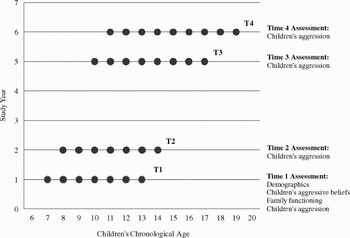
This study was based on data from the SCDP, a prospective, longitudinal study, in which a community-representative sample of 440 mother–child dyads (M Child Age = 10.00 ± 2.0 at baseline) was interviewed four times over a 6-year study period (see Figure 1). The research presented here utilized data from all four completed assessments.
A graphic illustration of the SCDP data collection.

Sampling
From available street records required in the state of Massachusetts, names and addresses of all Springfield, MA, female residents between ages 25 and 44 years were obtained (N = 4,518). The final sample was drawn from this initial population. To obtain representation of minority participants, the Springfield ZIP codes that included a higher proportion of certain minorities were oversampled, resulting in a balanced representation of African American, Latino, and European American families in the final sample (approximately one-third in each group). Eligible women (i.e., mothers or female legal guardians of children between the ages of 7 and 13 years) were identified from recruitment letter responses and telephone calls (N = 510).
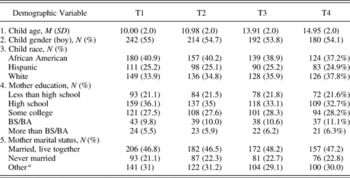
Among eligible women who could be contacted, the response rate for study participation was 86.3%, resulting in a final sample of 440 mother–child dyads at baseline. A target child was randomly selected if more than one child between ages 7 and 13 years resided in a given household. Participation in the study was entirely voluntary, and mothers and children were reimbursed for their time with a modest honorarium. The participants were interviewed in their homes by professional research staff starting in November 1995 (Time 1 [T1]; baseline). Both mothers and children individually responded to a number of questionnaires (some oral, some written) assessing psychological and behavioral characteristics of the child, as well as family and neighborhood characteristics. The second wave of data collection (Time 2 [T2]) started 1 year after the baseline (in November 1996), with 88% (N T2 = 391) of the original dyads remaining in the study. The third wave of data collection (Time 3 [T3]) started 3 years after T2 (in November 1999; N T3 = 357), whereas the final wave of data collection (Time 4 [T4]) was conducted about 1 year after T3 (N T4 = 333). The attrition between each successive wave was primarily because of relocation from the state, and the overall retention rate for the study was 75% over 6 years of study (see Table 1 for demographic characteristics of the sample at each wave).
Sample demographic characteristics for each assessment time

Note: T1–T4, Time 1, Time 2, Time 3, Time 4, respectively. The T2–T4 gender, race, and mother education distributions are provided for attrition comparison purposes. There were 440 valid cases at T1 assessment, 391 at T2, 357 at T3, and 333 at T4.
aSuch as women who may have been divorced, separated, widowed, etc.
In terms of attrition analyses, we compared families who completed at least three assessments (N = 359) with those who completed fewer than three assessments, because at least three time points are required for fitting the linear growth model. Families who completed fewer than three assessments were not significantly different from families who completed at least three assessments in terms of overall family quality ratings or mothers' education at T1. Children who completed fewer than three assessments were not significantly different from children who completed at least three assessments in terms of age or gender at T1, but they were marginally more likely to be African American, χ2 (2) = 5.48, p = .065, and were marginally more likely to score higher on the measure of aggressive beliefs at T1, t (438) = 1.7, p = .085. Of most importance, children who completed fewer than three assessments did not significantly differ from the remaining sample on the Child Behavior Checklist (CBCL; Achenbach, Reference Achenbach1991) aggression measure at T1, indicating that the final sample was not a self-selected sample of children with lower aggression problems.
Sample characteristics
The SCDP was an accelerated longitudinal study by design: it followed several distinct cohorts of children over a relatively short period of time. Children were between 7 and 13 years of age at T1 assessment and between 12 and 19 years of age at T4 assessment, as shown in Figure 1. There were approximately equal numbers of boys and girls in the SCDP, as well as an approximately equal distribution of African American, European American, and Hispanic families. The participants came from all socioeconomic backgrounds. Such a balanced and representative sample helps in obtaining results that are relatively unbiased by socioeconomic or ethnic categories, enables substantive examination of gender, ethnic, and socioeconomic status (SES) differences, and increases generalizability of the findings. The basic sample characteristics are shown in Table 1.
Measures
Child aggression
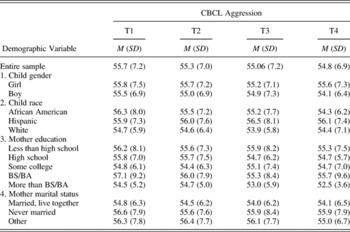
Children's physical aggression was assessed at all four assessments through maternal reports on the 20-item aggression subscale of the CBCL (Achenbach, Reference Achenbach1991). The CBCL aggression subscale assessed the frequency of children's physical aggression (e.g., attacking, threatening) as well as other associated behaviors (e.g., yelling, destroying property). The CBCL response options range from 0 (never) to 2 (very often), and individual responses were summed to compute the overall scale score. These raw scores were then adjusted by age and gender and converted to T scores, which were used in all reported analyses. The aggression problems of the SCDP children appeared congruent with the norms for this scale as reported by Achenbach (Reference Achenbach1991). Children from this sample had clinical rates of aggression similar to the normative samples: the percentages of the SCDP sample scoring at or above the CBCL borderline clinical T score of 67 were 10.2%, 10.7%, 10.4%, and 8.7% for T1, T2, T3, and T4, respectively. Means and standard deviations for aggression scores by demographic variables are shown in Table 2.
Means and standard deviations for CBCL aggression T scores for the entire sample and for different demographic categories at each assessment time

Note: CBCL, Child Behavior Checklist (Achenbach, Reference Achenbach1991); T1–T4, Time 1, Time 2, Time 3, Time 4, respectively. There were 440 valid cases at T1 assessment, 391 at T2, 357 at T3, and 333 at T4. CBCL aggression scores are age- and gender-adjusted T scores.
Child aggressive beliefs
Aggressive beliefs of SCDP children were assessed at T1 through children's responses to a 12-item Beliefs about Aggression Scale (cf. Slaby & Guerra, Reference Slaby and Guerra1988). This instrument evaluated children's endorsement of appropriateness of aggression and captured its perceived legitimacy as a problem-solving tool (e.g., “It's OK to fight”); its relation to increased self-esteem (e.g., “I feel like a champion when I fight”); and its contribution to achieving of social status (e.g., “If you don't fight, others will think you are a loser”). Responses were coded on a 4-point scale (1 = completely disagree, 4 = completely agree), where greater scores indicated greater overall aggressive beliefs and, therefore, greater risk. This scale had a Cronbach α of .72.
Family environment
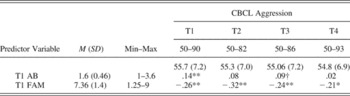
Family environment was assessed at T1 through mothers' responses to the cohesion and conflict subscales (nine items each) of the Family Environment Scale (FES; Moos & Moos, Reference Moos and Moos1986). These measures tap into a broad range of both positive and negative family relationships (e.g., “Family members help support each other.” “There is feeling of togetherness in our family” vs. “Family members often criticize each other.” “Family members sometimes hit each other”). The cohesion and conflict subscale scores were computed as a sum of mothers' affirmative (coded as 1) and negative (coded as 0) responses. Both scales had Cronbach α values of >.80. A more general family environment indicator was an arithmetic mean of these two scales and was coded such that greater scores indicated better family environment. Both scales combined gave a more complete picture of a family's cohesiveness, closeness, and lack of conflicting behaviors and arguments than either scale alone. Similar conceptualizations of family environment and functioning, especially the importance of the “cohesion” dimension were utilized in previous research on families' impact on child adjustment (e.g., Gorman-Smith & Tolan, Reference Gorman-Smith and Tolan1998; Lindahl, Reference Lindahl1998). Means and standard deviations for the predictor variables, as well as their correlations with the CBCL aggression measure at all four assessments are provided in Table 2.
Results
Descriptive analyses
Descriptive analyses and zero-order correlations were obtained before the more complex growth models were tested. They describe general patterns of associations between the outcome and predictor variables studied in this report and are shown in Table 3. In a normative sample such as this one, most children reported relatively low aggressive beliefs and relatively high-quality family environments. As expected, greater aggressive beliefs in children at T1 were positively associated with child aggression at T1, and better family environments (i.e., more family cohesion and less family conflict) at T1 were negatively associated with child aggression at all assessment times. Children's aggressive beliefs and family environment at T1 were not significantly correlated with each other.
Means, standard deviations, range, and zero-order correlations among the predictor and outcome variables

Note: CBCL, Child Behavior Checklist (Achenbach, Reference Achenbach1991); T1–T4, Time 1, Time 2, Time 3, Time 4, respectively; AB, aggressive beliefs; FAM, family environment. Children's aggressive beliefs were measured with the Aggressive Beliefs Scale (child report). Family environment is a composite variable based on the Family Environment Scale (Moos & Moos, Reference Moos and Moos1986) cohesion and conflict scales (mother report); CBCL aggression is a gender- and age-adjusted T score for the CBCL aggression subscale (mother report). Children's aggressive beliefs and family environment were independent of one another at T1, r (440) = −.06, p = .23.
†p < .10. *p < .05. **p < .01.
Longitudinal models of aggression over time
The main question of this study was concerned with whether, and if so, how, aggression in children can be predicted over time by the extent of their early aggressive beliefs and by the quality of their early family environments. This question was tested by modeling changes in child aggression from age 7 to age 19, as a function of their aggressive beliefs and family environment as measured at T1 assessment. Even though there were only four assessments in the SCDP study, its accelerated longitudinal design makes it possible to disentangle the effects of children's chronological age, time, and cohort, but even more importantly, it makes it possible to piece together a longer developmental trajectory from the available shorter individual trajectories (Raudenbush & Chan, Reference Raudenbush and Chan1993; Willet, Singer, & Martin, Reference Willet, Singer and Martin1998).
In the SCDP sample, and as shown in Figure 1, several age cohorts were followed over time: children were between 7 and 13 years of age at baseline assessment and between 12 and 19 years of age at final assessment. Because there was an “overlap” in children's ages at each assessment time (e.g., there were children who were 12 and 13 years of age at each assessment), it was possible to examine a more general and longer developmental trajectory of aggression, starting at age 7 (i.e., the age of the youngest child at baseline assessment) and finishing at age 19 (i.e., the age of the oldest child at final assessment, cf. Raudenbush & Chan, Reference Raudenbush and Chan1993; Willet et al., Reference Willet, Singer and Martin1998). Thus, time models were estimated in regard to children's age, and not in regard to the developmentally meaningless assessment times.
In all analyses we also controlled for the possible effects of children's gender, ethnic group, mothers' education level and marital status, including their interactions with time. We used growth modeling (Bryk & Raudenbush, Reference Bryk and Raudenbush2002; Willet, Singer, & Martin, Reference Willet, Singer and Martin1998) with SAS PROC MIXED procedure (cf. Singer, Reference Singer1998; Singer & Willet, Reference Singer and Willet2003) to examine changes in aggression in children from our sample. This is an ideal statistical approach for examining longitudinal data in developmental psychopathology studies, as it addresses the developmental issues of change over time, allows for examination of causal relations, and makes possible examination of incomplete data and of data collected in unequal intervals (as was the case in SCDP study). For example, despite attrition, all available data could be used in the analyses.
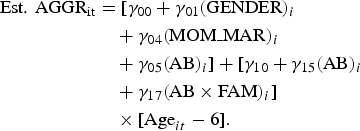
Each child's individual trajectory of aggression is defined by its initial estimated status (intercept) and its change over time (slope), which can be modeled independently. Because children were observed on multiple occasions, a two-level model was used as the most appropriate, where children's aggression (AGGR) can be expressed as a linear function of children's age:

Equation 1 represents what is known as the “within-person differences” model (or Level 1), and it describes the individual growth trajectory of aggression for each child i for each time occasion t. Note that the children's chronological age variable was centered to age 6, so that the estimated intercept value for aggression when π coefficients are zero would be at age 6 rather than at a meaningless age 0. Although children were not actually assessed at age 6, this was an appropriate intercept, as this centering of the age variable makes interpretation of results both easier and more meaningful (Singer & Willet, 2003; Willet et al., Reference Willet, Singer and Martin1998). Value 0i is the true level of a child's initial aggression (i.e., at age 6), whereas the parameter 1i shows the true rate of change in aggression over time.
The next step was an attempt to explain (by adding substantive predictors to the model) the possible variations in children's aggression over time. That explanation is the role of a second model (also known as the “Level 2” or the “between-person differences” model), in which substantive predictors are hypothesized to predict both differences in children's initial aggression levels (0i) and changes in aggression over time (1i). In our case, we first included the child and family demographic characteristics: child gender (GENDER), ethnic group or race (RACE), maternal education (MOM_ED), and marital status (MOM_MAR). We then added the predictors of theoretical interest to the model: child aggressive beliefs (AB); family environment (FAM), and their interaction (AB × FAM)Footnote 1:
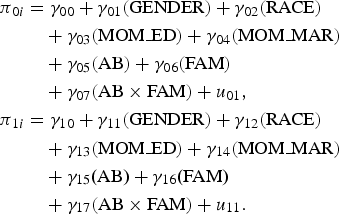
In sum, Equation 2 hypothesizes that the individual initial differences in aggression and changes in aggression over time represent a function of children's gender, race, mother's education, mothers' marital status, and, finally, of children's aggressive beliefs and family environment, and their interaction. If statistically significant, this interaction would describe the development of aggression in children with all combinations of high and low aggressive beliefs and high and low family environment.
In the above equation, γ00 and γ10 parameters refer to the average level of initial aggression and average rate of change, respectively. The γ0 intercept parameters describe individual differences around the initial status, and γ1 slope parameters describe individual differences around the average rate of change.Footnote 2 Residuals uki denote the portion of variance unexplained by the substantive predictors in each of the corresponding πki coefficients. Note that we did not standardize the predictor variables, and that we tested for interactions of all predictors with time, following the recommendations of Willet et al. (Reference Willet, Singer and Martin1998) for analyses of longitudinal data in developmental studies.
Aggression trajectories from age 6 to age 19
The results for the general model without any predictors (also known as the “unconditional growth model,” which includes only the effects of time on outcome), showed a significant fixed effect for the initial status (estimate = 55.9, p < .0001) and a nonsignificant fixed effect for slope (estimate = −0.08, p = .17). However, examination of variance components showed that there were significant variations in both initial aggression status (estimate = 48.4, p < .0001) as well as in its rates of change over time (estimate = 0.42, p < .0001). In other words, addition of substantive predictors (i.e., Level 2) would be meaningful, and would help explain significant individual differences in child aggression, both in the initial status (i.e., intercept) and in rates of change over time (i.e., slope). Most importantly, the examination of AB × FAM effect (i.e., aggression beliefs by family environment interaction) on changes in aggression over time would help elucidate the putative moderating role of family environment.
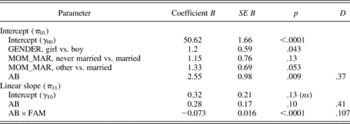
The full model (as described in Equation 2) was initially tested, and nonsignificant predictors were trimmed to yield the most parsimonious combined model (see Table 4 for estimated parameters):
Growth curve model results for CBCL aggression from age 7 to age 19 as predicted by child and family demographics, early children's AB, and early FAM

Note: CBCL, Child Behavior Checklist (Achenbach, 1981); AB, early aggressive beliefs; FAM, early family environment; d (effect size), fixed-effect parameter divided by the square root of the corresponding random effect (cf., Raudenbush & Xiao-Feng, 2001). Effect sizes were computed only for the substantive predictors of interest.
Note that the demographic predictors MOM_ED and RACE were entirely eliminated from the model, as they had no significant effects on either intercept or slope. The FAM and AB × FAM terms were eliminated from the intercept estimates, as they did not predict children's initial aggression levels, while the GENDER, MOM_MAR, and FAM terms were eliminated from the slope estimates, as they did not predict changes in children's aggression over time.
At the intercept (i.e., at age 6), the average CBCL aggression T score was γ00 = 50.62 (p < .0001), whereas the average slope coefficient was γ10 = 0.32 (ns). Note that family environment did not predict intercept or slope (i.e., did not predict initial levels of aggression at age 6, or the changes in aggression over time), but the interaction of aggressive beliefs and family environment was a significant predictor of slope (i.e., of longitudinal changes in aggression). Examination of variance components for both these estimates revealed that there still remained a significant variation in both the intercept and slope, even after the addition of our substantive predictors. However, our conditional growth model displayed better fit than the unconditional growth model, as demonstrated by lower Akaike information criterion (AIC) statistics (AICcond. = 9482.0 vs. AICuncond. = 9513.4).
The results revealed a significant intercept effect of child gender, such that at age 6, girls were slightly more aggressive than boys (GENDER, γ01 = 1.19, p = .043) and a marginally significant effect of maternal marital status such that, at age 6, children whose mothers were in some “other” marital arrangement were more aggressive than children whose mothers were married and living with their husbands (MOM_MAR, γ04 = 1.33, p = .053). Of most importance, the results of the conditional growth model revealed a significant main effect for aggressive beliefs (AB, γ05 = 2.55, p = .009) on initial aggression problems, such that children with greater aggressive beliefs were more aggressive at age 6. More specifically, with each point increase in aggressive beliefs scores, children's aggression T scores at age 6 increased by 2.5 points (γ05 = 2.55). These results support our predictions and our first hypothesis that early aggressive beliefs represent a general risk factor for early aggression.
Changes in children's aggression from middle childhood into adolescence were predicted by both their early aggressive beliefs and by an interaction of aggressive beliefs with family environment quality. There was a marginally significant effect of children's AB on the aggression slope, such that aggression changed at a faster rate in children who had greater aggressive beliefs (AB, γ15 = 0.28, p = .10). Most importantly, however, there was a significant AB × FAM interaction on the aggression slope. In other words, changes in children's aggression over time were contingent upon the interaction of their early aggressive beliefs and their early family environment (AB × FAM, γ17 = −0.073, p < .0001).
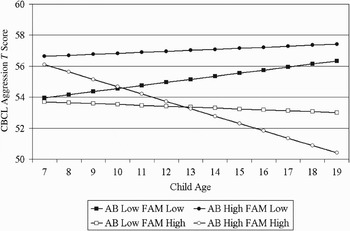
The main interaction of substantive interest (Level 2 AB × FAM) was further probed by (a) tests of simple slopes and (b) graphs of growth trajectories. Specifically, following the guidelines and procedures for three-way HLM interactions outlined in Curran, Bauer, and Willoughby (Reference Curran, Bauer, Willoughby, Bergeman and Boker2006), and Preacher, Curran, and Bauer (Reference Preacher, Curran and Bauer2006), we first examined aggression trajectories over time as predicted by all four possible combinations of conditional high and low values of aggressive beliefs and family environment (which were chosen as scores at the top 10% and bottom 10% of these two scales) and tested whether their simple slopes significantly differed from zero.Footnote 3 In other words, we tested whether these trajectories were, statistically speaking, “flat” or not, but note that a statistically significant interaction term implies that all individual trajectories will significantly differ from one another (cf. Curran et al., Reference Curran, Bauer, Willoughby, Bergeman and Boker2006). We then plotted prototypical growth trajectories of aggression from age 6 to age 19, as a function of children's aggressive beliefs and family environment (cf. Singer & Willet, Reference Singer and Willet2003). The plotted growth curves are shown in Figure 2 and show aggression over time for children with all four combinations of high and low aggressive beliefs and family environment scores that were used to estimate simple slopes (note that for simplicity reasons, growth curves were plotted for the entire sample, showing no separate intercept effects).
Growth trajectories for child aggression from age 6 to age 19, showing prototypical aggression trajectories for the entire sample as a function of four possible combinations of early high/low aggressive beliefs (AB) and high/low family environment quality (FAM).

As is evident from the simple slopes test and graphic representation, family environment did act as the expected moderator of the risk association between children's aggressive beliefs and their aggression over time. Overall, children with elevated aggressive beliefs had greater aggression problems at age 6 and were therefore at risk for later aggression (shown in Figure 1 by trajectories marked with circles). How aggression changed over time in these children depended not only on their aggressive beliefs but also on the interaction of aggressive beliefs with their family environments. As shown in Figure 2, at-risk children who had less than average family environments manifested the greatest aggression problems of all children and remained on a stable, high aggression trajectory throughout middle childhood and adolescence (simple slope = .066, p = .50, ns; shown in Figure 2 by a trajectory marked with dark circles). However, most importantly, at-risk children who had better than average family environments had equally high initial aggression problems but experienced a sharp decline in aggression over time (simple slope = −.47, p < .0001; shown in Figure 2 by a trajectory marked with open circles). Thus, there was an observable and significant decline in aggression problems in children with early aggressive cognitions only if they had high quality family environments, and such children were less aggressive in adolescence than their counterparts who lacked positive family influences.
Children who had initially low aggressive beliefs had lower aggression problems at age 6, and are shown in Figure 2 with trajectories marked by squares. If they had high-quality family environments, these children did not experience significant changes in aggression over time (simple slope = −.05, p = .57; shown in Figure 2 by a trajectory marked with open squares). However, if these children had low quality family environments, they actually experienced a significant increase in aggression problems over time (simple slope = .203, p = .04; shown in Figure 2 by a trajectory marked by dark squares).
Even though we made no specific hypotheses on how family environment would affect aggression trajectories of children without the early risk of aggressive beliefs, these results (see Figure 2) suggest that a less than optimal family environment poses a developmental risk for children, predisposing them toward later aggression. Specifically, children without the risk of early aggressive beliefs and with only positive family influences were doing the best (i.e., had stable and the least aggressive behaviors throughout the course of development), and children with the risk of early aggressive beliefs and with less than optimal family environments were doing the worst (i.e., had stable and high aggressive behaviors throughout the course of development). At the same time, children without the risk of aggressive beliefs who suffered low quality family environment were initially relatively nonaggressive, but then experienced an increase in aggression, whereas the children with the risk of early aggressive beliefs who benefited from better than optimal family environments were initially relatively aggressive, but then experienced a decrease in aggression from middle childhood into adolescence.
In other words, there appears to be an ordering in aggression and in its changes over time such that children without any negative influences were doing best (i.e., they were relatively nonaggressive), followed by at-risk children who had positive families (i.e., they were declining in aggression), followed by children who were not at risk but had no positive family influences (i.e., they were increasing in aggression), and finally followed by children who had both the risk of aggressive beliefs and no positive family environments (i.e., their aggression was high and additionally increasing over time).
Discussion
In this study we examined the relation between children's aggressive beliefs and their aggression trajectories from childhood to adolescence. Furthermore, we examined whether the putative risk of individual aggressive beliefs could be offset by positive influences from children's environment, or specifically, whether highly cohesive and nonconflictual families would moderate this risk association to reduce children's aggression problems over time. We tested these hypotheses using individual growth curve modeling, which enabled examination of changes in childhood aggression over time as predicted by demographic variables, children's aggressive beliefs, and quality of their family environment.
Supporting our first hypothesis, aggressive beliefs acted as a general risk for children's aggression, such that children who had higher aggressive beliefs were indeed more aggressive in middle childhood. However, how children's aggression changed from childhood into adolescence did not depend on the level of their aggressive beliefs alone, but also on its interaction with family environment, supporting the second hypothesis of family environment being a moderating influence on the association between the aggressive beliefs and aggression in children. Specifically, better than average family environments were associated with a decline in aggression in at-risk children, such that by adolescence, these children were functioning within a normal range and were less aggressive than their at-risk peers who did not have the benefit of highly cohesive and nonconflicted homes. In other words, highly optimal family environments moderated the negative influences of early aggressive beliefs and helped such at-risk children attain a less aggressive developmental trajectory over time.
These results are in harmony with the positive effects found in previous studies of optimal families offsetting different types of risks predisposing children to aggression and externalizing problems in general (Cowen et al., Reference Cowen, Wyman, Work, Kim, Fagen and Magnus1997; Gorman-Smith et al., Reference Gorman-Smith, Tolan, Henry and Florsheim2000, Reference Gorman-Smith, Henry and Tolan2004; Masten et al., Reference Masten, Hubbard, Gest, Tellegan, Garmezy and Ramirez1999; Richters & Martinez, Reference Richters and Martinez1993). We also observed a highly ordered hierarchy of aggression and its changes over time, such that children without the risk of aggressive beliefs and with highly positive familial influences were the least aggressive of all, and children with aggressive beliefs and less than optimal familial influences were the most aggressive of all. These results echo the extant research on risk and protective factors for externalizing problems, in which they were found to operate in a cumulative or additive manner (Jessor, Van Den Bos, Vanderryn, Costa, & Turbin, Reference Jessor, Van Den Bos, Vanderryn, Costa and Turbin1995; Lansford et al., Reference Lansford, Malone, Stevens, Dodge, Bates and Pettit2006; Stouthamer-Loeber et al., Reference Stouthamer-Loeber, Loeber, Wei, Farrington and Wikstrom2002) such that less than optimal family environments seem to represent an additional risk for child maladjustment (Campbell, Shaw, & Gilliom, Reference Campbell, Shaw and Gilliom2000; Prevatt, Reference Prevatt2003).
Even though we controlled for sociodemographic characteristics of children and their families in all our analyses, we found that few of those variables were strongly related to either initial aggressiveness in children or its changes over time. The only demographic variable predictive of initial aggression in children was maternal marital status, such that at age 6 children of married mothers were less aggressive than children of mothers who were in some “other” marital arrangement, which included divorced, widowed, and separated women, but not unmarried single mothers. These results are not surprising, as such marital arrangements often can imply a degree of family instability and disruption that would likely negatively affect child adjustment (Milan & Pinderhughes, Reference Milan and Pinderhughes2006). We assume that the lack of significant differences between children from one- and two-parent families can be attributed to the inclusion of more specific family characteristics into our model, as prior research shows that the predictive value of family configuration often tends to pale when more specific indicators of family environment are accounted for (Florsheim, Tolan, & Gorman-Smith, Reference Florsheim, Tolan and Gorman-Smith1998).
Furthermore, neither minority status nor maternal educational attainment was associated with either initial aggression in children or with its rates of change over time. These results echo the results reported by Brookmeyer et al. (Reference Brookmeyer, Henrich and Schwab-Stone2005), in which ethnicity did not significantly predict outcomes in at-risk children who witnessed violence, and by Gorman-Smith et al. (Reference Gorman-Smith, Tolan, Henry and Florsheim2000) in which minority adolescents did not differ among themselves on externalizing outcomes once SES was accounted for. We believe that our findings of racial background and maternal education having little predictive power are important, and attempts should be made to replicate and investigate them further. For example, it is possible that our assessment of maternal education was too fine tuned, and that simpler categorization (i.e., finished high school vs. not) would have produced different results. Our analyses cannot determine why these sociodemographic variables were not associated with children's aggression, but we speculate that our avoidance of high-risk sampling may have ensured a more representative minority inclusion. Similarly, given that there were both high- and low-functioning families of all SES ranges, it is possible that these sociodemographic predictors paled after the inclusion of more specific measures of family environment.
Overall, our results provide additional support for the importance of optimal family environments in the lives of at-risk children, as they both replicate and extend the research on the moderating and protective role of supportive families and good parent–child relationships in children facing various risks (Cowen et al., Reference Cowen, Wyman, Work, Kim, Fagen and Magnus1997; Gorman-Smith et al., Reference Gorman-Smith, Tolan, Henry and Florsheim2000, 2004; Masten & Shaffer, Reference Masten, Shaffer, Clarke-Stewart and Dunn2006; Masten et al., Reference Masten, Hubbard, Gest, Tellegan, Garmezy and Ramirez1999; Prevatt, Reference Prevatt2003). However, considering that in our study developmental risk was specifically defined as a negative and often-stable individual trait of children's aggression-justifying beliefs at an early age (as opposed to the more general, unstable, and nonchild specific risks often studied before), we believe that these results are of particular importance. Prior intervention and prevention research suggested that involving parents more directly in the lives of their at-risk children often resulted in improved behavior in children (Tremblay, Kurtz, Moose, Vitaro, & Phil, 1995), and that supporting families as a way of targeting at-risk children had positive effects (Tolan, Gorman-Smith, & Henry, Reference Tolan, Gorman-Smith and Henry2004). Even though a more comprehensive overview of family-targeted intervention indicated that such strategies seem to work well in ameliorating family-level risks (Yoshikawa, Reference Yoshikawa1994), our results suggest that better than average family environments also can help ameliorate the negative influences of individual child-level risks, such as the explicit liking and open endorsement of aggression at younger ages.
Even though we made no specific hypotheses regarding the psychological mechanisms through which the moderating effect of family environment takes place, our findings seem to lend credence to some more recent theories of aggressive problems in children. Our findings of reduced aggression in at-risk children only under conditions of highly positive family environment are congruent with the intriguing proposition that childhood aggression is not so much a problem of learned misbehavior, as it is a problem of failed socialization and unlearning of instinctive aggressive impulses present to a large extent in all children (Tremblay, Reference Tremblay, Lahey, Moffit and Caspi2003; Tremblay et al., Reference Tremblay, Kurtz, Masse, Vitaro and Phil1995). Indeed, it is possible that the families who created more cohesive and supportive home environments were simply more successful in properly socializing their troubled children, regardless of how those initial aggressive beliefs originated in children in the first place. In contrast, less functional and more conflicted families not only failed in that important socialization task, but over time likely created additional risks in the lives of their children. It is also possible that such functional families influenced children's behavior through a number of direct and indirect mechanisms, from directly reducing aggressive beliefs for instance, to providing examples of and rewards for nonaggressive interactions. These questions are to be explored in future research.
Limitations
It is important to note that we examined a relatively young (i.e., beginning in middle childhood) and normative sample of children, rather than a high-risk sample, as has been more common in past studies. We believe that it is because of this sampling difference that we obtained a nonexpected result of girls being more aggressive than boys at age 6 (see Table 2 for CBCL means from each assessment and Table 4 for the individual growth modeling results), but note that the average CBCL aggression T scores for both the boys and girls remained well within the normative range. Similarly, the role of demographic characteristics, such as ethnicity or maternal education, may have been more prominent in high-risk samples unlike ours. Furthermore, high-quality family environments may be more likely to moderate the negative effects of various risks in younger children, during middle childhood and in situations when additional risks (from schools, peers, and neighborhoods) have not yet accumulated over time to define such children as high risk in multiple domains. In summary, we examined children's aggressive beliefs and family environment as they occurred in middle childhood; how our results would have changed if we had examined an older sample and if these particular predictors were assessed at a later developmental stage is not known.
Further, the overlap between informants as well as inherent scale limitations need to be acknowledged, as mothers provided data on children's aggression problems, as well as on the quality of family environment. It is not clear whether different measures and different informants (i.e., children themselves reporting on quality of their relationships with parents) would have altered our results. Nevertheless, both of these scales (CBCL and FES) are well-established and widely used instruments, thus providing a degree of reliability and validity to these reports.
In addition, one may ask why family environment would not be the very source of aggressive beliefs, rather than a moderator of the association between children's cognitive characteristics and aggressive behaviors. It is certainly possible that a child's family environment has a great influence in shaping his or her cognitions, but it is also possible that aggressive cognitions may come from other influences, including a child's past success in getting what he or she wants by engaging in aggressive behavior outside of family interactions, or that some of these tendencies may simply be inherent to all children to a certain degree (Tremblay, Reference Tremblay, Lahey, Moffit and Caspi2003). Our study could not address the question of where these aggressive beliefs come from, nor could we appropriately test mediation models in which family environment shapes children's aggressive beliefs with the data available in this study because aggressive beliefs and family environment were measured at the same time, at baseline assessment. However, it is worth noting that at T1 assessment children's aggressive beliefs and family environment were not correlated at T1 and that therefore such hypothetical mediation models did not seem to have even the preliminary empirical support. In other words, children with early elevated aggressive beliefs were equally likely to come from highly functional or highly dysfunctional homes, and it was only over time that the effect of family environment became evident in reducing actual aggressive behavior in these children.
Finally, it is important to note a statistical caveat in our longitudinal model. Even though we estimated time-invariant effects of “early” aggressive beliefs and “early” family environments in relation to childhood aggression, these predictors were not measured at quite the same time for all children; that is, children were between the ages of 7 and 13 at the time of this initial assessment. However, it is important to note that (a) this was the first assessment for all children, thus establishing temporal order, and (b) conceptualization of these “early” experiences encompassed this wider age range, as we loosely defined these preadolescent years as “early.” In other words, we believe that this general age range can be considered as an “early” developmental stage in comparison to the three follow-ups in which the majority of children entered adolescence and in which aggression problems are likely to be both more severe and to have more severe consequences.
Nevertheless, the question remains as to the effect of different ages at T1 baseline assessment. To properly investigate such specific effects of children's age with our data, a different longitudinal model would need to be estimated: one in which the metric for time would not be child chronological age but assessment time, one in which intercept would be set at baseline assessment, and one in which changes in child aggression over four assessments would be investigated as a function of child age. Such a model could answer the questions of whether aggression trajectories differ in children who have high aggressive beliefs at age 7 versus age 13. But such a model would not be able to offer any insight into longer developmental trajectories from early childhood into late adolescence, and that was the purpose of this specific investigation. Thus, we chose to model aggressive beliefs and family environment as time-invariant predictors because we did not have multiple assessments of these variables, and because we focused on “early” preadolescent experiences as generally defined. Our selection of longitudinal model was bound by the parameters of the available data, and we could not consider how these aggression trajectories might have changed if aggressive beliefs and family environment had changed over time, or if they significantly waxed and waned over the course of child development. These, however, are important questions for future research.
Conclusion
In conclusion, we found evidence for a moderating effect of family functioning in counteracting a negative personal characteristic (a child's liking and positive beliefs about the value of physical aggression) to reduce levels of aggressive behavior at a later developmental period. It is important to note that the full benefits of early positive family environments for at-risk children became evident not immediately, but over the longer course of development. Such findings testify both to the long-term effects of early experiences, as well as the importance of examining longer trajectories in studies of child development.