Introduction
Adverse prenatal environmental conditions are known to induce permanent adaptive changes in a developing foetus, which may promote short-term survival; however, these conditions may increase vulnerability to metabolic and cardiovascular injuries. These processes, according to the developmental origins of health and disease,Reference Barker, Osmond, Golding, Kuh and Wadsworth 1 , Reference Barker, Eriksson, Forsén and Osmond 2 constitute the intrauterine programming of adult disease. Studies supporting this intrauterine programming hypothesis have demonstrated that adverse foetal conditions result in adaptive responses that lead to structural and molecular alterations in various organs and tissues, such as the kidney.Reference Langley-Evans and McMullen 3 , Reference Nuñez, Arguelles and Perillan 4
The kidney is an extremely common target organ for therapeutic and diagnostic agents.Reference You, Zhu and Shrubsole 5 – Reference Trasande, Attina and Trachtman 8 Nephrons are the functional units in the kidney. The number, size and distribution of the nephron components determine the renal function.Reference Nyengaard and Bendtsen 9 The design-based stereological method is a validated tool for quantifying changes in the kidney structure and predicting the renal function.Reference Beeman, Zhang and Gubhaju 10 Stereology is a branch of morphometry that applies mathematical principles to obtain three-dimensional information from serial, parallel and equidistant two-dimensional microscopic sections.Reference Bertram 11 The expression and pattern of renal damage are dependent on the nature of the inciting agent and its action.Reference Hard and Khan 12 , Reference Bonventre, Vaidya, Schmouder, Feig and Dieterle 13 Exposure to environmental pollutants can result in structural and pathophysiological changes in the human kidney.Reference Hughson, Douglas-Denton and Bertram 14 , Reference Kataria, Trasande and Trachtman 15 The widespread endocrine-disruptor bisphenol A (BPA) is an endocrine-disrupting chemical (EDC) that is used in the production of polycarbonate plastics and the epoxy resin lining in metal cans. BPA is commonly found in a variety of plastic items, including plastic dinnerware, water bottles, children toys and electronic equipment.Reference vom Saal and Welshons 16 , Reference Schecter, Malik and Haffner 17 Several recent studies have shown that BPA exposure may be associated with kidney disease, including low-grade albuminuria or decreased renal function in animals and humans.Reference You, Zhu and Shrubsole 5 – Reference Trasande, Attina and Trachtman 8
Type 2 diabetes (T2DM) has become a major public health problem, reaching epidemic proportions. With the increasing incidence of T2DM, diabetic nephropathy has emerged as a worldwide public health problem.Reference Martínez-Castelao, Navarro-González, Górriz and de Alvaro 18 Human exposure to EDCs, such as BPA, has contributed to the increased incidence of T2DMReference Alonso-Magdalena, Quesada and Nadal 19 – Reference Firmin, Bahi-Jaber and Abdennebi-Najar 22 and diabetic nephropathy.Reference Hu, Yang and Wang 23 , Reference Hu, Wang and Xiang 24 Studies on animals have revealed the deleterious effects of BPA exposure on the regulation of glucose homeostasis, specifically during pregnancy or during prenatal and perinatal periods. These are sensitive periods in life that are particularly susceptible to BPA exposure.Reference Alonso-Magdalena, Vieira and Soriano 25 – Reference Liu, Chen, Wang, Shen and Zhao 27 The developing kidney appears to be sensitive to a high glucose environment that may result in congenital renal malformations.Reference Tran, Chen, Chenier, Chan and Quaggin 28 High glucose levels impair renal development by nascent nephron cell apoptosis via enhanced intrarenal renin-angiotensin system activationReference Chen, Chenier, Chang, Tran and Ingelfinger 29 and the altered expression of extracellular matrix glycoproteins.Reference Kanwar, Nayak, Lin, Akagi and Xie 30 In rodents, gestational diabetes may lead to altered kidney morphology as well as nephron deficit in the offspring. Therefore, the risk of developing renal and cardiovascular diseases as an adult is increased. Reference Amri, Freund, Vilar, Merlet-Benichou and Lelievre-Pegorier 31 – Reference Hokke, Arias and Armitage 33
The aim of this study was to investigate the prenatal BPA exposure effects on nephrogenesis in a mice model. This study quantitatively evaluated the renal structural changes using stereology and histomorphometry methods. We hypothesized that the prenatal BPA treatments, which disrupt glucose homeostasis during pregnancy, could affect nephron endowment in the developing kidneys of the offspring.
Methods
The ethical committee of Miguel Hernandez University ‘Comisión de Ética en la Investigación Experimental’ reviewed and approved this study (approval ID: IB-AN-001-11). The animals were treated humanely to alleviate suffering.
Animals and treatment
Pregnant OF1 mice were purchased from Charles River (Barcelona, Spain) and individually housed under standard conditions. This strain of mice had vigour and were productive. The mice were maintained on a 2014 Teklad Global 14% protein rodent maintenance diet (Harlan Laboratories, Barcelona, Spain), which did not contain alfalfa or soya bean meal (chow diet). The diet composition of the was as follows: calories from protein, 18%; calories from fat, 11%; and calories from carbohydrate, 71% with an energy of 2.9 kcal/g.
The BPA (MP Biomedicals, cat. No.155118) was dissolved in corn oil stripped tocopherol (MP Biomedicals, cat. No. 901415) and administered subcutaneously on days 9–16 of gestation. During this time (early stage of nephrogenesis), the embryos increased in size and underwent developmental progression determined by the morphological and molecular criteria.Reference García-Arévalo, Alonso-Magdalena and Servitja 34 The mice in the control group received tocopherol-stripped corn oil. The daily dose used was 10 µg/kg (BPA10) or 100 µg/kg (BPA100). The dose of 10 μg/kg/day was considered low because it was below the current lowest observed effect level (LOAEL) (50 μg/kg/day) established by the US EPA, and the dose was similar to the temporary tolerable daily intake given by the European Food and Safety Authority (4 μg/kg/day). The chosen animal experimental dose during pregnancy was based on data from a previous study.Reference García-Arévalo, Alonso-Magdalena and Servitja 34 The pups of the same treatment group were pooled together and then placed in equal numbers with foster mothers of the same treatment group. The litter size was maintained constant in all groups. After delivery, the groups were adjusted to eight pups per litter (four females and four males). The animals were weaned on postnatal day 21 and housed from weaning through adulthood. Pups of the same gender were housed together. The 30-day-old offspring were sacrificed, and the tissue samples were collected (n=5–6 animals per group).
Tissue processing
The kidneys were removed and fixed for 24 h in 4% phosphate-buffered formaldehyde at room temperature. Then, the samples were dehydrated using a series of ethanol solutions and were embedded in paraffin. After the blocks were formed, they were stored at room temperature. The specimens were sectioned in a series of transverse and parallel sections with a thickness of 5 µm at a fixed distance T (500 µm) with a random start and were stained with periodic acid-Schiff and Masson’s trichrome to assess the degree of glomerular injury and renal fibrosis, respectively. The evaluation of the slides was performed using blind testing.
Stereology
The stereology parameters were estimated as described previously.Reference Fernández García, Núñez Martínez and García de la Fuente 35 The kidney volume was estimated using the Cavalieri principle. Briefly, a test point system (a grid) was randomly superimposed on the reference sections of each kidney, and the grid points that hit the kidney were used. The volume of the two kidney components was determined using the formula below.
 $$V_{{cortical\,/\,medullar{\rm }}} \left( {{\rm mm}^{3} } \right){\,\equals\,}\Sigma P \cdot {a \over p} \cdot T$$
The parameter ΣP was the number of points used that hit the kidney (cortical or medullar). The parameter (a/p) represented the area associated with each grid point (0.04 mm), and T was a fixed distance between the reference sections (0.5 mm). The points that hit the cortex or medulla were counted separately for all of the reference sections from the kidney. Finally, the kidney volume was estimated using the formula below.
 $$V_{{kidney}} \left( {{\rm mm}^{3} } \right){\,\equals\,}V_{{cortical}} {\plus}V_{{medullar}} $$
The numerical density of glomeruli per cortex (Nv) was measured using ~10 random microscopic fields from each reference section to count 100–150 glomeruli per kidney. For estimating the number of glomeruli using the physical dissector method, the same images of the reference and look-up sections were viewed simultaneously. The glomeruli that were inside the counting frame (in the reference section) or those that cut the ‘acceptance’ line without also cutting the ‘forbidden’ line, and not the next section (look-up section), were used. Using the following formula, the numerical density of the glomeruli was calculated.
 $$N_{v} \left( {{\rm glomeruli}\,/\,{\rm cortex}} \right){\,\equals\,}{{{\rm \Sigma }Q} \over {\sum P{\rm } \cdot Area{\times}Height}}$$
The parameter ΣQ was the sum of the glomeruli seen in all of the reference sections, except for the look-up sections. The parameter ΣP was the sum of the counting frames hitting the reference space (500–1000). The Height was the dissector height (0.025 mm), and the Area was the frame area divided by the square of the magnification (0.020 mm2). Finally, the following formula was used to estimate the total number of glomeruli.
 $$N_{{{\rm total}\,{\rm glomeruli}}} {\,\equals\,}N_{v} _{{\left( {{\rm glomeruli\,/\,cortex}} \right)}} \cdot V_{{{\rm cortex}}} $$
The glomerular volume was calculated using the following formula.
 $$Glomerular\,volume\,\left( {{\rm \mu m}^{3} } \right){\,\equals\,}4\pi \cdot {{\left( {{{d\left( G \right)} \over 2}} \right)^{3} } \over 3}$$
The parameter d(G) represented the arithmetic average of the longest and shortest diameters.Reference Sugimoto, Shikata and Matsuda 36 , Reference Yamashita, Kawashima and Miwa 37 Observations were performed with a light microscope, and photomicrographs were taken using an Olympus BX-53 microscope and a DP73 digital camera. Measurements were performed with CellSens software (Olympus American Inc., 2016).
Statistical analysis
The normality (Kolmogorov–Smirnov test) and homogeneity of variance (Levene’s test) of the data were evaluated. The data obtained from the kidneys were analysed using the ANOVA (with the main factors of the treatment group and the offspring gender) and Tukey post-hoc tests. Analyses were performed using the statistical package program SPSS 15.0 (IBM Corp., NY, USA), and the statistical significance was determined for P⩽0.05.
Results
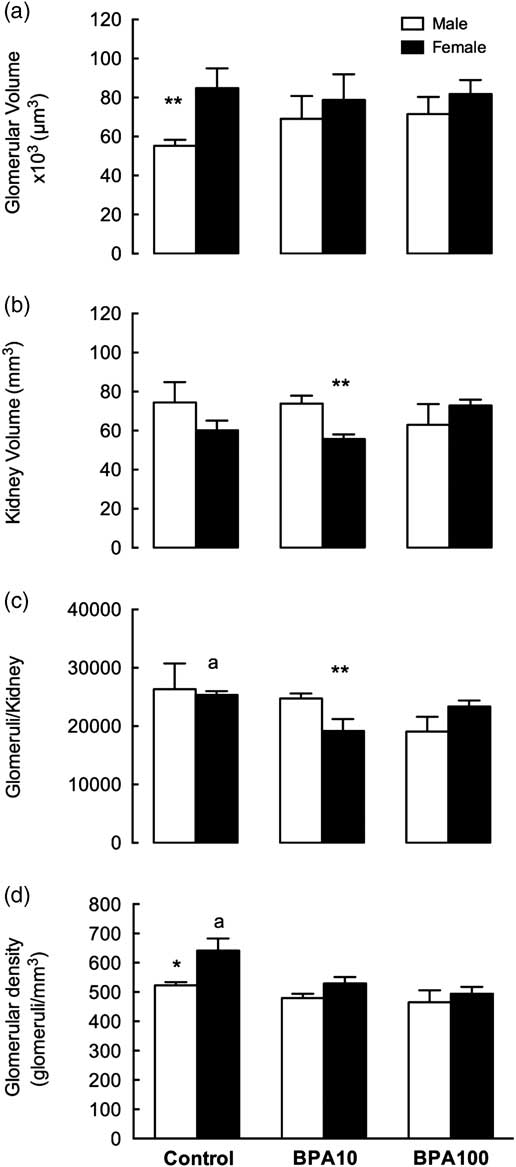
Using stereology, the glomerular abnormalities and reduced glomerular formation in BPA-treated offspring were evaluated. To investigate the potential role of gender, the offspring were analysed separately according to their gender. The glomerular histomorphometry study revealed a significant difference (P<0.01) between the females and males in the CONTROL offspring for the analysed glomerular volume (Fig. 1a). This difference disappeared in the BPA10 and BPA100 groups. When the kidney volume (mm3) was measured, it was significantly higher in the female BPA100 group than that of the female CONTROL and BPA10 offspring (P<0.05, Fig. 1b). Significant differences in the amount of glomerular were only detected in the female offspring. The female CONTROL offspring had higher total glomeruli per kidney compared to the female BPA10 and BPA100 offspring (P<0.05, Fig. 1c). The kidneys of the female BPA10 and BPA100 offspring had a significantly lower density (glomeruli/mm3) (P<0.05) than that of the female CONTROL offspring (Fig. 1d). The female BPA10 offspring contained fewer glomeruli per kidney (P<0.01, Fig. 1c) and a significantly lower kidney volume (P<0.01, Fig. 1b) compared to the male BPA10 offspring. However, the female CONTROL offspring showed a significantly higher density (P < 0.05, Fig. 1d) than that of the male CONTROL offspring.
Stereology and histomorphometry results. (a) The glomerular volume in the 30-day-old offspring of the control, BPA10, and BPA100 dams (BPA daily dose was 10 and 100 µg/kg, respectively), **P<0.01, male v. female. (b) The kidney volume (mm3) in the 30-day-old offspring of the control, BPA10, and BPA100 dams, **P<0.01, male v. female. (c) The total nephron quantity in the 30-day-old offspring of the control, BPA10, and BPA100 dams, **P<0.01, male v. female, a P<0.05, control female v. BPA10 and BPA100 female. (d) The glomerular density (glomeruli/mm3) in the 30-day-old offspring of the control, BPA10, and BPA100 dams, *P<0.05, male v. female, a P<0.05, control female v. BPA10 and BPA100 female. The kidney stained sections from the female (black) and male (white) with n=5 to 6 animals/group are shown. The results are expressed as the mean±s.e.m. BPA, bisphenol A.

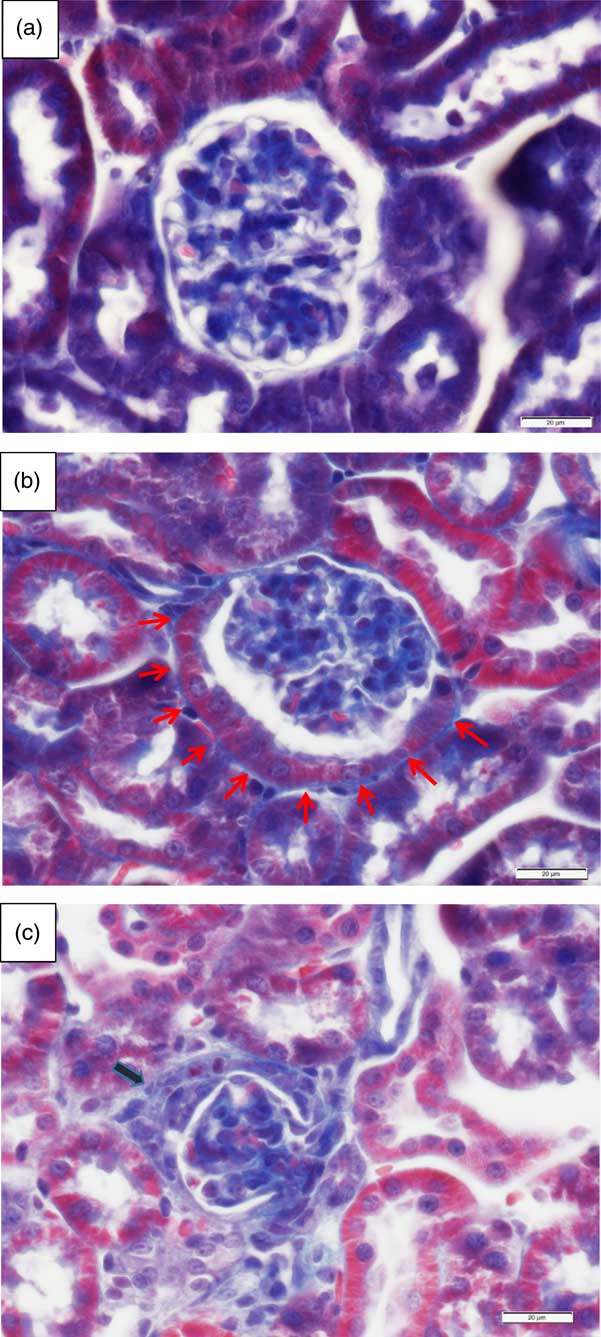
A histopathological examination of the kidney showed male histological features in the female BPA offspring kidneys. This was reflected in the presence of a cuboidal epithelium lining of the parietal layer of the Bowman capsule, which is typical in male mice (Fig. 2b). The diagnostic feature of the male-type Bowman capsule was the presence of columnar cells that extended as an epithelial crescent from the urinary pole along the capsular circumference one-half to two-thirds of the distance to the vascular pole, in approximately three-quarters of the renal corpuscles in the sections examined.Reference Hard, Alden and Bruner 38
Kidney tissues of the 30-day-old female offspring. (a) The glomerular histology on the female control group, and the Bowman capsule in the control female kidney. (b) The renal histological features of sexual dimorphism of the bisphenol A (BPA)-treated group. The figure presents the metaplasia or replacement of the flat squamous parietal cells of the Bowman capsule as tall cuboidal epithelium in the female kidney. This has been referred to as a male-type of Bowman capsule (red arrows). (c) The glomerular histopathology of the BPA100 group. The figure shows the proliferation of parietal epithelial cells that form peripheral crescents with the Bowman space reduced (black arrow), stained with Masson’s trichrome, and a scale of 20×.

In addition, metaplasia and hyperplasia of the Bowman capsule were found in scarce glomeruli of the female BPA100 offspring (Fig. 2c). Hyperplasia of the Bowman capsule has been described as proliferation of parietal and/or visceral glomerular epithelial cells to form peripheral crescents with Bowman’s space reduced without intraglomerular matrix accumulation, inflammation or fibrosis.Reference Frazier, Seely and Hard 39 There was no evidence of glomerular sclerosis or interstitial fibrosis.
Discussion
Previous animal studies have reported a nephron deficit in the offspring exposed to maternal diabetes, hypertension or nutritional disorders.Reference Barker, Osmond, Golding, Kuh and Wadsworth 1 , Reference Thornburg 40 In this study, exposure to environmentally relevant doses of BPA during embryonic development altered nephrogenesis in the offspring. The nephron is the structural and functional unit of the kidney; therefore, a reduced nephron quantity is associated with renal pathology and increases the risk for adult development of renal and cardiovascular complications.Reference Kanzaki, Tsuboi and Haruhara 41 Nephrogenesis is characterized by harmonized proliferation and differentiation of urinary epidermal primordial and mesenchymal cells. In humans, metanephros begins to develop at 5 weeks. Nephrogenesis begins at 9 weeks and ends at 34–36 weeks. In rodents with a term gestation of 22.5 days, metanephros begins to develop at 11 days of gestation and ends at 7–10 days after birth. The nephrons lost during the nephrogenesis process are not replaced.Reference Moritz, Dodic and Wintour 42
Animal studies have reported nephron deficiency in the offspring of gestational diabetic dams.Reference Hokke, Arias and Armitage 33 , Reference Chen, Chenier and Tran 43 , Reference Hoy, Ingelfinger and Hallan 44 This reduced nephron quantity may produce glomerular hyperfiltration that is associated with augmented glomerular hydrostatic pressure and renal hypertrophy. Thus, the risk for adult development of renal and cardiovascular diseases is increased.Reference Kanzaki, Tsuboi and Haruhara 41 In this study, the kidney tissues of 30-day-old female offspring of BPA-treated groups showed a significant decrease in glomeruli density. As this number does not change with age, the reduced glomerular filtration area from an acquired nephron deficit, could be a risk factor for adult cardiovascular and chronic disease.Reference Zandi-Nejad, Luyckx and Brenner 45 , Reference Fong, Denton, Moritz, Evans and Singh 46 The interruption of nephron formation during nephrogenesis, surgically or pharmacologically in animal models or by unilateral renal agenesis in humans, results in the onset of hypertension in later life.Reference Thornburg 40 , Reference McMullen and Langley-Evans 47 Exposure to lower levels of BPA is associated with a higher risk of heart and kidney disease among children and adolescents.Reference Gowder 6 Animal studies indicated that prenatal exposure to BPA increased the susceptibility of the offspring to develop cardiovascular and metabolic dysfunction later in life. Reference Hoy, Ingelfinger and Hallan 44 , Reference Cagampang, Torrens, Anthony and Hanson 48 , Reference Johnson, Painter and Javurek 49
Glomerular enlargement is a common feature in several prevalent pathologies, including hypertension,Reference Hughson, Douglas-Denton and Bertram 14 diabetes mellitusReference Lemley 50 and obesity.Reference Chen, Li and Chen 51 In diabetic adults, alterations of the glomerular volume have been demonstrated in several disease states.Reference Schmitz, Nyengaard and Bendtsen 52 , Reference Keller, Zimmer and Mall 53 The kidney tissues showed an inverse relationship between the total nephron quantity (glomeruli per kidney) and the glomerular volume. Recent studies have shown that maternal glucose intolerance induced in the offspring a decrease in the nephron quantity and an increment of glomerular volume.Reference Hokke, Arias and Armitage 33 This was observed in the 30-day-old male BPA offspring. Therefore, BPA exposure during pregnancy resulted in the development of glucose intolerance in the mother,Reference Alonso-Magdalena, Vieira and Soriano 25 – Reference García-Arévalo, Alonso-Magdalena and Servitja 34 which could be related to the renal abnormalities observed in the BPA offspring.
The endocrine-disrupting effects of BPA in reproductive systems have been thoroughly investigated, and it has been recognized that congenital anomalies of the reproductive tract or reproductive dysfunctions arising later in life may be associated with the exposure to EDCs during the developmental stages.Reference Rochester and Bisphenol 54 Metaplasia or replacement of flat squamous parietal cells of the Bowman capsule in BPA female mice was observed as tall cuboidal epithelium. This has been referred to as a male-type of Bowman capsule, which may indicate an altered sexual dimorphism and suggest the masculinization of the female corpuscle following induced endocrine alterations. The cells of the parietal epithelium of the capsule had a hormonal influence in male/female mice, and alterations in the circulating levels of testosterone may have affected their morphology.Reference Frazier and Seely 55 , Reference Hard, Alden, Stula and Trump 56
There was no significant renal pathology in the kidneys studied from all of the groups. Hyperplasia of the Bowman capsule was found in scarce glomeruli of the female BPA100 offspring, which could be experimentally induced by the administration of xenobiotics.Reference Frazier, Seely and Hard 39 The OF1 mice did not have pathologic changes on the nephron loops and collecting ducts, probably still existed good compensatory mechanisms in their organisms. Chronic renal failure typically develops gradually. A physical examination and urine test may be normal because the kidney damage in chronic renal failure occurs gradually over a period of time. The symptoms develop slowly and usually begin when more than 80% of kidney function is lost.Reference You, Zhu and Shrubsole 5 – Reference Trasande, Attina and Trachtman 8 This hyperplasia is not associated with pathologic alterations and is not considered a preoneoplastic lesion.Reference Sahota, Popp, Hardisty and Gopinath 57 There were no histopathological lesions that demonstrated the loss of nephrons and/or functional changes in the young adult mice; however, the lower nephron density and the minor lesions found in the BPA-treated animals suggested that they could develop more extensive lesions and/or a greater degree of lesions with ageing than those of the control animals.Reference Langley-Evans and McMullen 3 , Reference Nuñez, Arguelles and Perillan 4
This study improved the understanding of the renal BPA developmental effects. However, further studies are needed to clarify the potential role of BPA exposure in the pathogenesis and progression of renal diseases. The assessment of renal function parameters, such as serum creatinine, albumin, and other urinary biomarkers and their relation to the structural data may be useful. In summary, exposure to environmentally relevant doses of BPA during embryonic development altered nephrogenesis in a gender-dependent manner. This knowledge is important to toxicological studies and clinical obstetrics. These fields are concerned with BPA exposure during pregnancy and the increased risk of developing cardiometabolic diseases later in life.
Acknowledgements
None.
Financial Support
This research was supported by Ministerio de Economía y Competitividad (grant number BFU2011-28358).
Conflicts of Interest
None.
Ethical Standards
The authors assert that all procedures contributing to this work comply with the ethical standards of relevant national guides on the care and use of laboratory animal and the ethical committee of Miguel Hernandez University ‘Comisión de Ética en la Investigación Experimental’ specifically reviewed and approved this study (approval ID: IB-AN-001-11). Animals were treated humanely and with regard to alleviate suffering. The authors have read the Animals in Research: Reporting In Vivo Experiments (ARRIVE) guidelines.Reference Kilkenny, Browne and Cuthill 58