Background
The decision to care for a person with dementia at home is influenced by a range of factors including a historical shift towards the non-institutionalization of older people (Egdell et al., Reference Egdell, Bond, Brittain and Jarvis2010); the increasing cost of residential care (Low et al., Reference Low, Yap and Brodaty2011); aging in place policies (Robinson et al., Reference Robinson2012); and the desire of most people with dementia to remain in their own homes (van Der Roest et al., Reference van Der Roest2009). The provision of services to people with dementia and their carers in the community delays entry into residential aged care (Gaugler et al., Reference Gaugler, Kane, Kane and Newcomer2005).
Dementia is a neurocognitive disorder that interferes with the person's ability to independently complete everyday tasks such as shopping, cooking, or dressing (American Psychiatric Association, 2013). Over time, people with dementia require assistance with complex and eventually basic activities of daily living (Seeher et al., Reference Seeher, Withall and Brodaty2011). As the individual's capacity for independent function declines, the uptake of support from either formal or informal sources increases (van Exel et al., Reference van Exel, de Graaf and Brouwer2007). Informal carers (who are not service providers or volunteers) are those who provide assistance on an ongoing basis to those whom have disabilities that limit their ability for independent self-care (Australian Institute of Health and Welfare, 2012).
A broad range of supports and services for people with dementia and their informal carers are described in the international research literature including nursing care, personal care (or home care), domestic assistance (or home help), allied health, and various respite care models (Cantegreil-Kallen et al., Reference Cantegreil-Kallen, Turbelin, Angel, Flahault and Rigaud2006; Kelly and Williams, Reference Kelly and Williams2007; Raivio et al., Reference Raivio2007; Forbes et al., Reference Forbes2008; Roelands et al., Reference Roelands, Van Oost and Depoorter2008; Wolfs et al., Reference Wolfs, De Vugt, Verkaaik, Verkade and Verhey2010; Casado and Lee, Reference Casado and Lee2012; Lim et al., Reference Lim, Goh, Chionh and Yap2012; Department of Social Services, 2015). Support services are not uniformly defined in the literature; for example, in Australia there are six service types that could be classified as respite for carers (Department of Social Services, 2015). Respite incorporates short-term care in residential care settings (as provided in Australia (Department of Social Services, 2015), Finland (Raivio et al., Reference Raivio2007), and the Netherlands (Wolfs et al., Reference Wolfs, De Vugt, Verkaaik, Verkade and Verhey2010)), through to individual social support providing carers with a respite break (as provided in the United Kingdom (National Health Service, 2015) and Australia (Department of Social Services, 2015)). Education for carers was described in literature for four countries: Singapore (Lim et al., Reference Lim, Goh, Chionh and Yap2012), France (Cantegreil-Kallen et al., Reference Cantegreil-Kallen, Turbelin, Angel, Flahault and Rigaud2006), the Netherlands (Wolfs et al., Reference Wolfs, De Vugt, Verkaaik, Verkade and Verhey2010), and Australia (Department of Social Services, 2015). Education may have been available in other countries; however, it was not described as a government-funded service. This highlighted the broad range of services available to people with dementia and their carers, but there are gaps between the met and unmet care needs of people with dementia and their carers (Forbes et al., Reference Forbes2008; Freyne et al., Reference Freyne, Dolan and Cooney2010; Landmark et al., Reference Landmark, Aasgaard and Fagerström2013).
A number of studies have identified the experience of people with dementia and carers when accessing services in various countries. van der Roest et al. (Reference van der Roest, Meiland, Maroccini, Comijs, Jonker and Dröes2007) identified that while people with dementia have needs, it has been difficult to gather accurate information because they do not always clearly express their wants and needs. The association between carers’ felt need (as identified by carers) and the number of services they accept is significant; while normative need (as defined by professionals and researchers) is not as strong a predictor of service acceptance (Bradshaw, Reference Bradshaw, Popay and Williams1994; Stirling et al., Reference Stirling, Andrews, Croft, Vickers, Turner and Robinson2010). Furthermore, Cheston et al. (Reference Cheston, Bender and Byatt2000) highlighted the importance of understanding the views of people with dementia and their carers as key stakeholders to services with the potential to respond to those needs. Understanding what is needed by people with dementia and their carers to support continuing to live in the community has been recognized as an area of research that needs further development (Seeher et al., Reference Seeher, Withall and Brodaty2011). The purpose of this scoping review was to summarize and disseminate what is known internationally about the identified care needs of people with dementia and their informal carers living in the community, and if there are common gaps in the services available to meet their needs.
Method
The methodology used in this scoping review has been described by Arksey and O'Malley (Reference Arksey and O'Malley2005) as a five-stage iterative and ad hoc process in which inclusion and exclusion criteria are developed to ensure that the scope of included literature is broad and the aims of the review are met. This review aims to summarize and disseminate the current international research evidence on the met and unmet needs of people with dementia and their carers, to inform researchers and policy-makers. A scoping review is particularly appropriate due to the breadth of the research question and limited availability of randomized controlled trials on this issue (Levac et al., Reference Levac, Colquhoun and O'Brien2010).
Stage 1: identifying the research question
The research question guiding this review was “What is currently known from existing peer-reviewed literature about the needs of people with dementia living in the community; the needs of their carers; and whether the available services meet the needs of the person with dementia and their carer?” A broad approach was used to gather all relevant studies, including those using qualitative, quantitative, and mixed methodologies.
Stage 2: identifying relevant studies
A search of five databases (Medline, CINAHL, Science Direct, SCOPUS, and PsycInfo) and Google Scholar was performed. Saturation was apparent as no additional studies were identified. Reference lists of included studies were hand searched to locate any other relevant studies. Original research studies published in English between 2004 and 2015 to reflect contemporary care contexts, which focused on the needs of people with dementia and/or their carers living in the community were considered. Multiple papers based on the same dataset were included only once and studies that focused solely on non-continuing pilot care services were excluded. Services included any type of respite, education, support groups, assistance with daily care tasks, counseling, or other support.
The term “need” is complex and has many connotations. Bradshaw (Reference Bradshaw, Popay and Williams1994) identified four types of need (normative, expressed, felt, and comparative) that are still widely referred to.
The following search terms were used (all fields):
dementia OR Alzheimer's AND
home OR community dwelling NOT residential care OR long term care OR nursing home AND
spouse OR caregiver OR family AND
service OR utilization OR non-utilization AND
need OR demand OR preference OR expectation AND
evaluat* OR satisf* OR response OR reaction
Stage 3: study selection
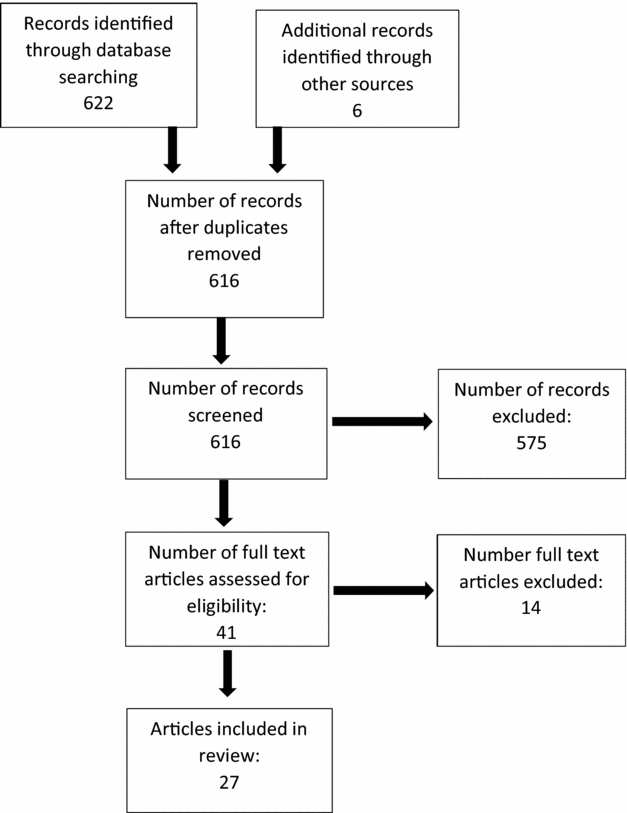
The search process initially identified a large number of studies, given the broad search terms used; for example, the term “caregiver” is inclusive of many types of care roles and dementia has many etiologies. Study titles and where necessary abstracts were reviewed for fit to the inclusion criteria. Studies were included if participants had any form or stage of dementia and the focus was on informal caregiving. Studies referring to caring for people with dementia in residential or nursing home care were excluded. The first author initially located 622 studies; titles were checked for relevance and duplicates removed, resulting in 41 potentially relevant articles. Abstracts of studies were checked to ensure they met the inclusion criteria; ineligible studies were excluded reducing the total to 21 studies. Hand searching reference lists identified six more studies resulting in a final total of 27 studies included in this review (see Figure 1).
Flow diagram of study selection.

Stage 4: charting the data
The 27 studies were read and data on authors, year, location, study population, aims, outcomes, and conclusions were collated. Critical appraisal of the quality of the articles was not completed as that is not required in a scoping review (Arksey and O'Malley, Reference Arksey and O'Malley2005); although, limitations of included studies were considered in the discussion of the status of current literature.
Stage 5: collating, summarizing and reporting the results
Data related to authors, location, and methodology of studies were collated to understand the scope of the available literature.
Publication year and location of research
The majority of studies were from the United Kingdom (UK; n = 6) and Australia (n = 5); the USA, Canada, and the Netherlands each produced three studies; Finland two studies; and Norway, Hong Kong, Sweden, Germany, and South Korea each produced one study. There was an upwards trend in the number of relevant publications from 2009 until 2013, before falling to only two publications in 2014.
Type of research
Of the 27 studies included, an equal number of studies (n = 11) utilized either a mixed methods or a qualitative approach, including participatory action research and critical ethnography. Five studies were purely cross-sectional in design.
Participants
There were 5,069 carers (4,618 in quantitative studies), 2,089 people with dementia (1,796 in quantitative studies), and 54 other respondents (such as care workers and other health professionals) in the included studies. Six studies specified the type of dementia (younger onset (n = 2), Alzheimer's disease (AD) and Vascular Dementia (VD) (n = 1), and AD only (n = 3)). Participants were generally recruited via agencies from which they had received services or been assessed (n = 18); were consecutively referred from services or care agencies (n = 3); or were randomly selected from databases of those known to have a diagnosis of dementia (n = 3).
Measures used
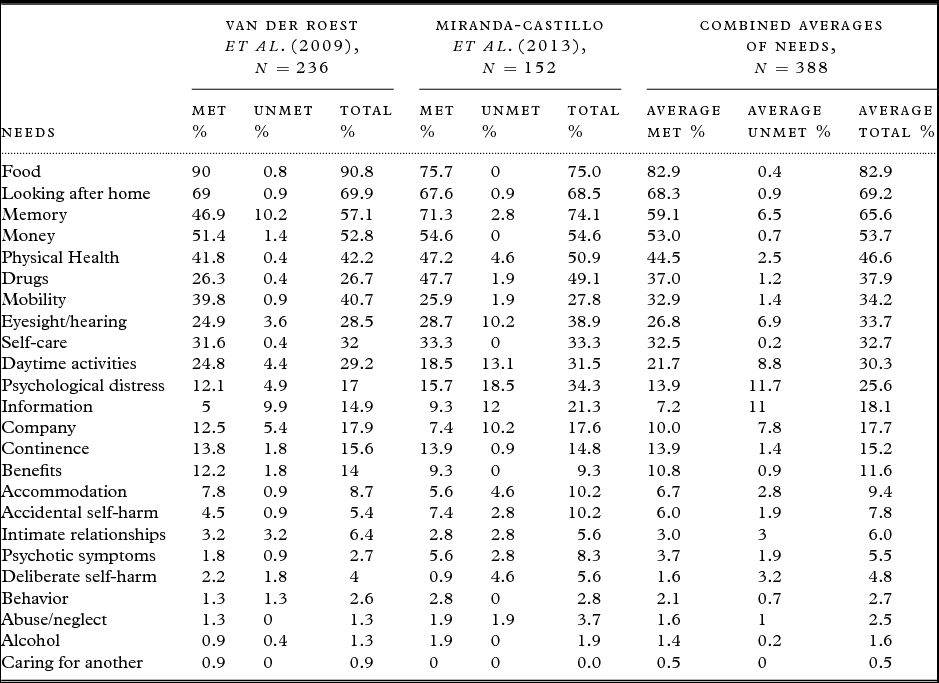
The outcome measure of need most commonly used in the mixed methods research was the Camberwell Assessment of Needs in the Elderly (CANE) (n = 4). Other measures used included the Care Needs Assessment Pack for Dementia (CareNapD), the COPE index, and the Johns Hopkins Dementia Care Needs Assessment (JHDCNA) (n = 1) with which a skilled clinician rates needs as met or unmet based on observation and interview. Of the four studies that used CANE, only two reported full data from people with dementia (see Table 1).
Results for studies using CANE: PWD

Results
Identified needs and unmet needs
Based on the CANE, people with dementia reported on average a high number of needs in the areas of food (82.9%), looking after the home (69.2%), memory (65.6%), money (53.3%), and physical health (46.6%) (see Table 1). People with dementia reported fewer unmet needs, with the most common being psychological distress (11.7%), information (11%), daytime activities (8.8%), company (7.8%), eyesight/hearing (6.9%), and memory (6.5%).
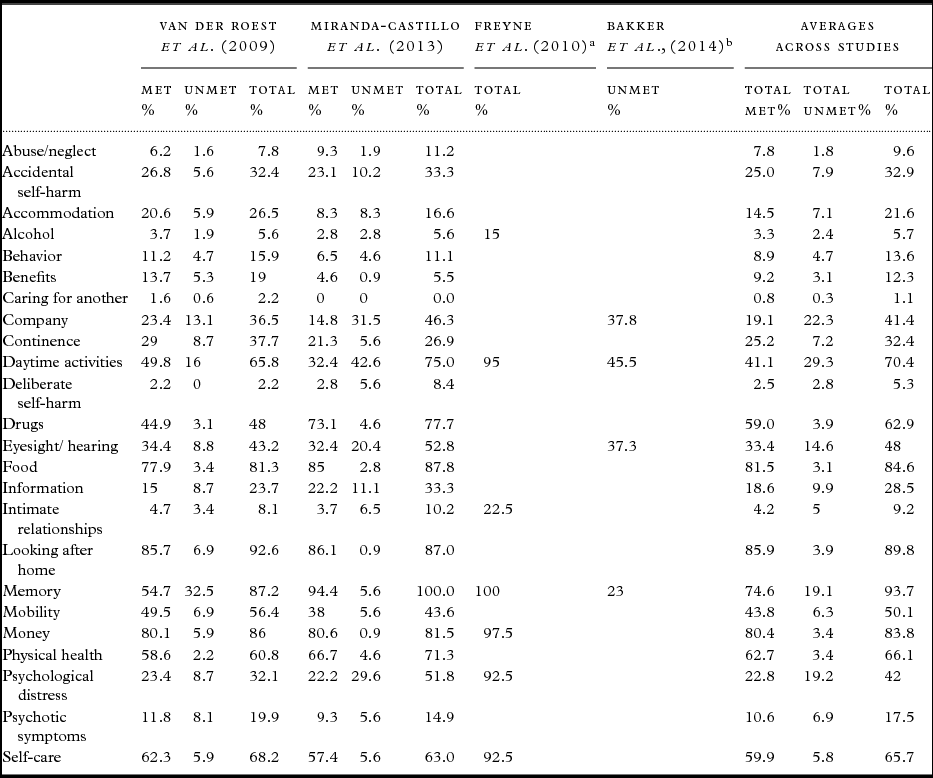
In the four studies using carer proxy reports of the needs of people with dementia (Table 2), the most commonly reported needs related to memory (89.3%), looking after the home (89.2%), money (87.7%), food (78.3%), self-care activities (74.6%), and daytime activities (73.9%). Carer proxy reports indicated that people with dementia had unmet needs in the following key areas: daytime activities (29.3%), company (22.3%), psychological distress (19.2%), memory (19.1%), and eyesight/hearing (14.6%).
Carer proxy reports

aIncomplete data provided; missing data excluded in calculation of averages.
bReported unmet needs only, excluded from calculation of averages.
Chung (Reference Chung2006) reported that self-care activities (such as daily routines, dressing, and bathing) were also high-priority needs. Unmet needs were reported in areas such as social interaction, issues with memory, and emotional control. High levels of unmet care needs were reported in the areas of home and personal safety (91.7%), allied health and general medical care (67.7%), meaningful activities and activities of daily living (61.4%), and legal assistance (48%) (Hughes et al. (Reference Hughes2014).
Only one qualitative study (Mountain and Craig, Reference Mountain and Craig2012) reported identified needs of people with dementia that included information tailored to them, and support services (including meaningful activities) that are accessible and promote independence. In summary, the most commonly reported unmet needs were related to meaningful activity, social company and social opportunities, and information.
Thematic analysis of qualitative themes and quantitative results
An inductive thematic analysis of the results included in the qualitative and mixed methods studies (Corbin and Strauss, Reference Corbin, Strauss, Corbin and Strauss2008) using constant comparison approach revealed five key areas of need: information, availability, barriers to services, personalization of services, and peer support. Two of the researchers independently analyzed the qualitative results and then discussed, resolved discrepancies, and agreed on the themes.
Availability of services for people with dementia
Six of the 11 qualitative studies identified that services were not adequately available (Grenade and Walker, Reference Grenade and Walker2005; Forbes et al., Reference Forbes2008; Raivio et al., Reference Raivio, Laakkonen and Pitkala2011; Mountain and Craig, Reference Mountain and Craig2012; Ward-Griffin et al., Reference Ward-Griffin2012; Ducharme et al., Reference Ducharme, Kergoat, Coulombe, Lévesque, Antoine and Pasquier2014). Carers in Ireland reported dissatisfaction with services available to support daytime activities and the need for services to support completion of self-care activities and home maintenance (Freyne et al., Reference Freyne, Dolan and Cooney2010). Raivio et al. (Reference Raivio2007) noted that further support (i.e. additional need for the same services) was an issue for between 16.1% and 30.8% of Finnish carers. Problems with availability of formal services (both initial and to supplement previously established services) in Canada were reportedly due to financial prioritization of available services according to perceived needs (Ward-Griffin et al., Reference Ward-Griffin2012; Ducharme et al., Reference Ducharme, Kergoat, Coulombe, Lévesque, Antoine and Pasquier2014). The time available to provide care was associated with the ability to provide outcome-focused or relationship-focused care, the key components of personalized services (Grenade and Walker, Reference Grenade and Walker2005; Gethin-Jones, Reference Gethin-Jones2014).
The timing of services was a factor in receiving the right support along the continuum of dementia. Four qualitative and one quantitative study identified this as an issue (Chung, Reference Chung2006; Raivio et al., Reference Raivio, Laakkonen and Pitkala2011; Mountain and Craig, Reference Mountain and Craig2012; Ward-Griffin et al., Reference Ward-Griffin2012; Ducharme et al., Reference Ducharme, Kergoat, Coulombe, Lévesque, Antoine and Pasquier2014), and included a lack of ongoing assessment of care needs to adapt to changes in function (Ward-Griffin et al., Reference Ward-Griffin2012), and a lack of referral to support services appropriate for early stage dementia (Mountain and Craig, Reference Mountain and Craig2012).
Personalized services
Services that provided trusting relationships, choice and control, and focused on the goals of the person with dementia (or carer) were highly regarded by people with dementia and carers. Ward-Griffin et al. (Reference Ward-Griffin2012) in Canada stated: “When formal care services were provided in a standardized and regimented way, they were often described as inadequate and substandard” (p. 6). In their qualitative studies, Raivio et al. (Reference Raivio2007) and Grenade and Walker (Reference Grenade and Walker2005) found that carers required adequately tailored or personalized care to meet the needs of families of people with dementia, and this led to improvements in sense of independence and confidence among people with dementia. People with dementia and carers reported that control and autonomy were valued and important features of services that met their needs (Grenade and Walker, Reference Grenade and Walker2005; Rothera et al., Reference Rothera2008; Raivio et al., Reference Raivio, Laakkonen and Pitkala2011; Landmark et al., Reference Landmark, Aasgaard and Fagerström2013; Gethin-Jones, Reference Gethin-Jones2014). When services were not flexible and personalized this contributed to non-use of services (Brodaty et al., Reference Brodaty, Thomson, Thompson and Fine2005). Landmark et al. (Reference Landmark, Aasgaard and Fagerström2013), Gethin-Jones (Reference Gethin-Jones2014), and Ducharme et al. (Reference Ducharme, Kergoat, Coulombe, Lévesque, Antoine and Pasquier2014) identified the need for services in to be person-centered or outcome-focused rather than task-oriented because families were concerned by the lack of social contact provided during home care visits. This is a particularly crucial recommendation given the high number of unmet needs regarding social interaction as reported by people with dementia and their carer proxies.
Barriers to effective services
Key barriers to effective service provision were identified as cost, geographic location, lack of flexibility, fragmentation of services, and a lack of expertise or knowledge among health professionals (Forbes et al., Reference Forbes2008; Rothera et al., Reference Rothera2008; Raivio et al., Reference Raivio, Laakkonen and Pitkala2011; Mountain and Craig, Reference Mountain and Craig2012; O'Connell et al., Reference O'Connell, Hawkins, Ostaszkiewicz and Millar2012; Ward-Griffin et al., Reference Ward-Griffin2012; Landmark et al., Reference Landmark, Aasgaard and Fagerström2013; Ducharme et al., Reference Ducharme, Kergoat, Coulombe, Lévesque, Antoine and Pasquier2014; Gethin-Jones, Reference Gethin-Jones2014). Fragmentation of services because of changes in frontline staff and systemic communication breakdowns negatively affected the quality of services received by people with dementia and their carers (Ward-Griffin et al., Reference Ward-Griffin2012). Wolfs et al. (Reference Wolfs, De Vugt, Verkaaik, Verkade and Verhey2010) found that more than 70% (177) of carers in the Netherlands were satisfied with services provided through a case management system because it supported quality communication and consistency of providers. A lack of knowledge or expertise among health professionals affects access to relevant services and may also impact on the ability of carers to continue supporting people with dementia in the community. This was identified as an issue in three qualitative studies (Forbes et al., Reference Forbes2008; Hain et al., Reference Hain, Touhy and Engström2010; Raivio et al., Reference Raivio, Laakkonen and Pitkala2011).
Education and information
Commonly reported needs for carers and people with dementia included information regarding future expectations as a carer for a people with dementia, services available, or education for practical skills in caring such as communication (Raivio et al., Reference Raivio2007; Forbes et al., Reference Forbes2008; van Der Roest et al., Reference van Der Roest2009; Alwin et al., Reference Alwin, Oberg and Krevers2010; Freyne et al., Reference Freyne, Dolan and Cooney2010; Wolfs et al., Reference Wolfs, De Vugt, Verkaaik, Verkade and Verhey2010; Raivio et al., Reference Raivio, Laakkonen and Pitkala2011; Mountain and Craig, Reference Mountain and Craig2012; Robinson et al., Reference Robinson2012; Ducharme et al., Reference Ducharme, Kergoat, Coulombe, Lévesque, Antoine and Pasquier2014; Hughes et al., Reference Hughes2014). Carers in Sweden identified receiving information about dementia as a priority with 70% (77) reporting this as met (Alwin et al., Reference Alwin, Oberg and Krevers2010). In contrast, Freyne et al. (Reference Freyne, Dolan and Cooney2010) found that 52.5% (21) of carers had a need for information with more than half not having this need met. Similarly, 64.3% (158) of carers in an American study reported a need for dementia education, and 24.8% (61) reported an unmet need for education on practical caring skills (Hughes et al., Reference Hughes2014). People with dementia indicated that there was a lack of information or education designed for them, and that resources were predominantly aimed towards carers (Mountain and Craig, Reference Mountain and Craig2012).
Knowledge of available services was a key need for carers in Germany (Graessel et al., Reference Graessel, Luttenberger, Bleich, Adabbo and Donath2011) and Finland (Raivio et al., Reference Raivio2007; Raivio et al., Reference Raivio, Laakkonen and Pitkala2011); some services (i.e. home nursing) were well known but carers experienced difficulty locating additional services. Carers in the USA (Hain et al., Reference Hain, Touhy and Engström2010) and the United Kingdom (Rothera et al., Reference Rothera2008) experienced difficulties in identifying sources of guidance or advice about what to expect in the future. This was also identified by Robinson et al. (Reference Robinson2012) who found that Australian carers were often overwhelmed by the “maze of information out there” (p. 205).
Peer support for carers and people with dementia
Carers and people with dementia across countries reported a need for peer or emotional support; a finding that was similar in qualitative and quantitative studies. Over one-third (34.9%) of American caregivers stated that their need for emotional support was unmet (Hughes et al., Reference Hughes2014). Opportunities to discuss challenges faced in caregiving were very important to 70% (77) of Swedish carers (Alwin et al., Reference Alwin, Oberg and Krevers2010). Positive social interactions and affectionate support were considered by South Korean carers to be more helpful than information or emotional support to reduce psychological burden associated with caregiving (Han et al., Reference Han2014). Carers in the United Kingdom had a need for support groups that focused on proactive strategies and coping mechanisms and not just talking (Mountain and Craig, Reference Mountain and Craig2012). Sharing past and present experiences with other carers provided emotional support, encouraged carers to share coping strategies, and helped carers to develop problem-solving skills (Rothera et al., Reference Rothera2008; Greenwood et al., Reference Greenwood, Habibi, Mackenzie, Drennan and Easton2013). People with dementia reported their need for support groups that provide peer support and emotional release (Greenwood et al., Reference Greenwood, Habibi, Mackenzie, Drennan and Easton2013), as well as having a support group separate to those for their carers (Mountain and Craig, Reference Mountain and Craig2012). The continuation of social contact was a key need for 63% (20) Canadian people with dementia in a study by Ducharme et al. (Reference Ducharme, Kergoat, Coulombe, Lévesque, Antoine and Pasquier2014).
A fear of the future due to lack of predictability or normalcy, the need for hope, and the need to learn to cope with changes in family relationships was reported by carers in Sweden (Alwin et al., Reference Alwin, Oberg and Krevers2010), the USA (Hain et al., Reference Hain, Touhy and Engström2010), Norway (Landmark et al., Reference Landmark, Aasgaard and Fagerström2013), and the United Kingdom (Mountain and Craig, Reference Mountain and Craig2012). Freyne et al. (Reference Freyne, Dolan and Cooney2010) reported the needs identified by carers included adequate sleep and ways to encourage service use by people with dementia. No information was available to confirm if available services addressed the needs reported by Freyne et al. (Reference Freyne, Dolan and Cooney2010).
Discussion
This scoping review investigated the research literature reporting the needs of people with dementia and their carers, and the responsiveness of community services to those needs. As the quality of the included studies was not established, the data are considered a representative view of the current state of the research. Common met and unmet needs for people with dementia and their carers reflected a shared experience across countries, regardless of different models of service. Although the findings of the 27 studies focused on community-based carers and people with dementia across 12 countries, differences in study methodologies, quality of services, and social policy between countries limited the conclusions that can be drawn.
Measurement and identification of need is a difficult task with data collection and methodology influencing the conclusions of each study. Studies using quantitative outcome measures (e.g. CANE, CareNapD, and JHDCNA) focused more on survival and basic daily needs. The spectrum of met and unmet needs also incorporates needs that are not effectively met; however, this subset of needs was not well expressed in the findings of the quantitative studies in this review. Qualitative studies for people with dementia and their carers focused on the lived experience of dementia, even when exploring the same needs as the quantitative studies; for example, memory, activity, and social company. Diverse findings between qualitative and quantitative studies provided support for using both research approaches to measure outcomes (McCabe et al., Reference McCabe, You and Tatangelo2016). Using measures that quantify need in conjunction with rich descriptions from people with dementia, carers, health professionals, and service providers, better revealed the extent of needs and how well they were responded to, the importance of individualized care, and contextual factors.
Self-reports from people with dementia, as opposed to proxy reports by carers, affected how needs were measured (Moyle et al., Reference Moyle, Murfield, Griffiths and Venturato2012). Voices of people with dementia were included in only two of 11 quantitative studies (van Der Roest et al., Reference van Der Roest2009; Miranda-Castillo et al., Reference Miranda-Castillo, Woods and Orrell2013). The exclusion of the perspectives of people with dementia in research was acknowledged (McKeown et al., Reference McKeown, Clarke, Ingleton and Repper2010); however, given the insights obtained from people with dementia, the value of including their perspectives to understand their needs is unquestionable. Disparities between perceptions of needs among people with dementia and their carers, and the perceptions of health professionals, create a challenge for researchers and service providers. Understanding the generic needs of people with dementia and their carers is important for generic service development and planning (Beeber et al., Reference Beeber, Thorpe and Clipp2008). However, by understanding specific needs of people with dementia and their carers as individuals or families, providers can take a client-centered approach to service delivery (Rothera et al., Reference Rothera2008; Raivio et al., Reference Raivio, Laakkonen and Pitkala2011). Understanding the felt or perceived needs of carers was a better measure of service need than standardized measures of caregiver burden or functional status of the people with dementia (Roelands et al., Reference Roelands, Van Oost and Depoorter2008; Stirling et al., Reference Stirling, Andrews, Croft, Vickers, Turner and Robinson2010).
Difficulties among carers in recognizing their own needs or those of the people with dementia were frequently identified as a reason for not accessing available services. The impact of this on service utilization has been documented in the literature (Brodaty et al., Reference Brodaty, Thomson, Thompson and Fine2005; Wolfs et al., Reference Wolfs, De Vugt, Verkaaik, Verkade and Verhey2010; Robinson et al., Reference Robinson2012); however, this scoping review also highlighted this gap and the importance for service providers to understand the perspectives of people with dementia. Although the literature indicated that basic needs such as food, security, and housing for people with dementia were met, it was not clear who met these needs. Forbes et al. (Reference Forbes2008) raised the concern that meeting needs was generally the responsibility of family and other informal carers, and the exhaustible nature of these informal supports needs to be addressed. From this perspective, it is also crucial to understand the needs of carers, separate to those of people with dementia (Steiner et al., Reference Steiner, Pierce and Salvador2016).
The methodological quality of included studies limited the validity of the findings of this scoping review. Data reported in two quantitative studies were incomplete (Freyne et al., Reference Freyne, Dolan and Cooney2010; Bakker et al., Reference Bakker2014) and the inconsistency in outcome measures used and the diverse dimensions of need that were identified limited the comparison of findings across studies. For example, only one study addressed needs related to sleep strategies, relationship support, and support in service utilization (Hughes et al., Reference Hughes2014). The methodological limitations of the included studies resulted in a gap in the evidence reported across studies. While all included studies investigated the needs of people with dementia and carers living in the community, some only focused on the experience of carers utilizing specific services, thereby creating a potential bias wherein some needs were perceived as more important than others.
When qualitative data were collected solely on the needs of people with dementia it was from dyads (the person with dementia and their carer) rather than only from the people with dementia. This may explain why only one study, which included the views of people with dementia, described maintenance of meaningful roles as an identified need (Mountain and Craig, Reference Mountain and Craig2012). Study samples ranged in size from 10 carers (Mountain and Craig, Reference Mountain and Craig2012) to 731 dyadic pairs (Han et al., Reference Han2014). Typically, studies using a qualitative methodology had small, purposive samples selected from active service users who provided rich, detailed information based on their personal experiences as per the aims of qualitative research.
In conclusion, the needs identified by carers and people with dementia encompassed social, emotional, personal, and physical needs. Most commonly identified needs were meaningful activity, social company and social opportunities, and information or education; and many study participants reported the inadequacy of formal services in meeting these needs. Carers in all studies in this review had concerns about the quality of available services, particularly with regard to responsiveness and flexibility. High levels of satisfaction with services were influenced by those that had a strong focus on empowering people with dementia and their carers. Service delivery methods and models perceived by carers as insufficient were related to those that were not sufficiently responsive and flexible to the holistic needs of carers and people with dementia. Providing people with dementia and their carers with greater control, choice, support to make decisions, and guidance to navigate through the complex health and welfare systems is needed.
Implications for practice and future directions
It is important for various stakeholders to acknowledge the holistic nature of needs and include the voices of people with dementia and their carers. Health professionals working with this population must recognize that timeliness and flexibility are key elements of effective services and that trust and rapport among formal services, people with dementia, and families are crucial to building strong relationships.
Policy-makers, funding bodies, and service providers have a clear remit to develop services that focus on choice, continuity, and certainty. Allocation of funds and services should be individualized to respond to the perceived needs of people with dementia and their carers, empower their ongoing education and access to information, and provide consistent access to health professionals. Current service delivery models are considered to be fragmented, disempowering, and confusing – leading to negative health and quality of life outcomes for people with dementia and carers.
Researchers have a responsibility to meet the challenge of actively including the views of people with dementia; their contribution is invaluable to help others to understand their needs. Although the studies included in this scoping review used both quantitative and qualitative methodologies to collect data about the needs of people with dementia and their carers, the flexibility in design of the qualitative studies allowed the capture of rich data that supports the holistic investigation and analysis of needs.
Conflict of interest declaration
None.
Description of authors’ roles
C. Morrisby designed the scoping review, collected and analyzed the data, and wrote the paper. A. Joosten assisted with study design, data analysis, and wrote the paper. M. Ciccarelli confirmed data analysis and wrote the paper.