


For several decades U.S. public discourse has been saturated with signals about where political parties and religious leaders stand on the frontline issues of the culture war. In the political arena the national parties have polarized on abortion and gay rights (Adams Reference Adams1997; Lindaman and Haider-Markel Reference Lindaman and Haider-Markel2002). In the religious domain divisions between orthodox and progressive worldviews have supplanted denominational differences as the dominant cleavage (Hunter Reference Hunter1992; Wuthnow Reference Wuthnow1988). Moreover, political and religious cleavages reinforce one another. On the religious and political right, leaders and activists oppose abortion and gay rights while their counterparts on the religious, secular, and political left defend abortion and gay rights (Layman Reference Layman2001).
How have ordinary citizens responded to these developments? The canonical models of opinion change are party-driven and religion-driven, holding that individuals recalibrate their positions on cultural issues to ensure consonance with stable political and religious predispositions (Campbell et al. Reference Campbell, Converse, Miller and Stokes1960; Djupe and Gilbert Reference Djupe and Gilbert2009; Leege et al Reference Leege, Wald, Krueger and Mueller2002). By contrast, we develop and test a novel theory, contending that culture war attitudes lead people to update their partisan and religious predispositions.Footnote 1 We test these perspectives with individual-level data from four panel studies covering the period 1992–2012. Our results imply that culture war attitudes function as foundational elements in the political and religious belief systems of ordinary citizens that match and sometimes exceed partisan and religious predispositions in terms of motivating power.
Four key findings emerge from our statistical examinations. First, culture war opinions match the stability of Party Identification (Party ID), orthodox religious belief, and religious commitment. Second, culture war opinions and party constrain one another over periods of four to six years. Moreover, the influence of culture war opinion on Party ID greatly eclipses that of party on cultural issue attitudes. Third, we show that culture war issues impact—and are impacted by—religious beliefs and commitments. Fourth, we show that culture war opinions shape—while only being marginally shaped by—short-term candidate evaluations. In all, we show that canonical models of the relationship between Party ID, religiosity, and public opinion must be revised to incorporate cultural attitudes as bedrock predispositions that drive partisan and religious change.
THEORETICAL FRAMEWORK
Concepts
Culture war attitudes can be defined as evaluative tendencies of the issues that are most closely associated with the culture war. A number of discrete issues fall under the culture war rubric, such as school prayer, gun control, climate change, and so on. Without denying the potency of these controversies, scholars identify abortion and gay rights as the central issues in the culture war because these touch upon universal concerns about human sexuality and family organization (Jelen Reference Jelen, Smidt, Kellstedt and Guth2009; Putnam and Campbell Reference Putnam and Campbell2010). For this reason, we emphasize abortion and gay rights in our article.Footnote 2 We characterize pro-choice, pro–gay rights Americans as culturally progressive and pro-life, anti-gay rights Americans as culturally orthodox.
Next, we define party identification as a psychological attachment to a political party that shapes political perception and judgment. Classic and contemporary works establish that party loyalties develop early in the life cycle, hold steady over time, and grow stronger as the years roll by (Campbell et al. Reference Campbell, Converse, Miller and Stokes1960). Party ID functions as a bedrock predisposition that guides political information processing and judgment across multiple contexts.
Religiosity is as a multidimensional construct comprised of religious belonging, belief, and behavior (Layman Reference Layman2001). Belonging refers to affiliation with a given tradition (e.g., Catholic). Religious belief denotes whether someone accepts or rejects an orthodox religious worldview. Individuals at the orthodox end of this spectrum see religious texts as literally true or infallible, whereas religious progressives and seculars see religious texts and tenets as moral guidelines or fables rather than literal truths. Lastly, religious behavior refers to specific religious practices, such as worship attendance, saying grace, praying, and other religiously inspired acts. People that habitually engage in such behaviors can be described as religiously committed, while people that rarely or never act in these ways can be labelled as uncommitted. We focus on the belief and behavior dimensions of religiosity in what follows.
Having defined the key concepts, we turn now to the theoretical question of how they are related in the minds of voters. To answer this question, we need a working definition of what makes a given attitude or orientation strong. Strong attitudes persist over time, resist change, impact information processing, and guide behavior (Krosnick and Petty Reference Krosnick, Petty, Petty and Krosnick1995). So far as a given attitude has these properties, it is powerful. We use this definition in conjunction with accumulated research to argue that orthodox religious beliefs, religious commitment, Party ID, and culture war attitudes should be conceptualized as strong predispositions (cf. Sears Reference Sears and Kuklinski2001; Telser Reference Tesler2015).
Religious Beliefs and Commitments are Strong Predispositions
To begin with religious orientations, scholars proffer several rationales to explain how religious beliefs and commitments become strong in the first place. Researchers posit that religious beliefs and behavioral orientations emerge early in the life cycle and are reinforced throughout middle childhood and adolescence (Sears Reference Sears and Kuklinski2001). The initial development and subsequent persistence of religious orientations reflects the influence of socialization agents in the family and church (Djupe and Gilbert Reference Djupe and Gilbert2009; Welch et al. Reference Welch, Leege, Wald, Kellstedt, Leege and Kellstedt1993). Conversely, individuals that have been raised in less orthodox or nonreligious environments adopt progressive or secular religious orientations. Beyond these social agents, psychological factors render religious beliefs and commitments strong. These factors reflect a mix of moral intuitions, existential and epistemic needs, in-group loyalties, and out-group antipathies, all of which make religious beliefs and commitments durable and impactful (Graham et al. Reference Graham, Haidt, Koleva, Motyl, Iyer, Wojick and Ditto2013).
Because religious beliefs and commitments—whether orthodox, progressive, or secular— develop early in life and are rooted in core aspects of human identity, one would expect them to possess the attributes of strong predispositions. Empirical research backs this claim. First, religious orientations are more stable than nearly all other political attitudes and beliefs (Achen Reference Achen1975; Putnam and Campbell Reference Putnam and Campbell2010). Second, religiosity is deeply rooted in a sense of the sacred, and is thus unlikely to be moved by day-to-day events in the private lives of individuals or in the public life of the nation (Leege Reference Leege, Leege and Kellstedt1993). Third, religious orientations impact information processing. Source cues from religious opinion leaders activate religious predispositions that impact how people process new information (Adkins et al. Reference Adkins, Layman, Campbell and Green2013; Djupe and Gilbert Reference Djupe and Gilbert2009; Guth et al. Reference Guth, Green, Smidt, Kellstedt and Poloma1997). Fourth, religious orientations predict turnout and voting behavior across a range of electoral contests (Abramowitz Reference Abramowitz1995; Cook et al. Reference Cook, Jelen and Wilcox1994; Kohut et al. Reference Kohut, Green, Keeter and Toth2000; Leege et al. Reference Leege, Wald, Krueger and Mueller2002). Given evidence of denomination switching and religious change over the life course (Putnam and Campbell Reference Putnam and Campbell2010) it would be foolhardy for us to characterize the scholarly consensus as saying that religious orientations never change. That said, we think it is fair to conclude that the prevailing wisdom characterizes religiosity as more stable and impactful than issue positions.
Party Identification is a Strong Predisposition
The conventional vantage point holds that Party ID is a powerful predisposition in mass belief systems. As with religious orientations, preadult socialization facilitates the development of partisan attachments. Thereafter, partisan ties grow stronger as people age (Campbell at al. Reference Campbell, Converse, Miller and Stokes1960). Once in place, Party ID operates like a perceptual screen that colors how partisans interpret, store, weigh and utilize political information (Bartels Reference Bartels2002). Green, Palmquist, and Schickler (Reference Green, Palmquist and Schickler2002, 4) argue that partisan identifiers, like religious adherents, “absorb the doctrinal positions that the group advocates.” As such, Party ID can be expected to drive issue judgments.
Accumulated research shows that Party ID is durable, resists change, and systematically affects information processing and behavior. To begin, party ties are remarkably stable over time relative to issue positions and candidate evaluations (Converse and Markus Reference Converse and Markus1979). Second, panel data research suggests that under most circumstances Party ID resists the influence of other belief system elements (Carsey and Layman Reference Carsey and Layman2006; Levendusky Reference Levendusky2009). Third, a rich body of work reveals that Party ID affects all stages of information processing. For instance, Bartels (Reference Bartels2002) shows that partisanship colors what people believe is true. Finally, Party ID has long been recognized as the best predictor of the presidential vote. To conclude, party ties, like religious beliefs and commitments, are strong.
Are Culture War Attitudes Strong Predispositions?
In this section we propose that culture war attitudes are strong attitudes. This view cuts against the standard account about the nature of issue attitudes. Many analysts view public opinion on issues as the paradigmatic example of nonattitudes (Bartels Reference Bartels, MacKuen and Rabinowitz2003; Converse Reference Converse and Tufte1970). For instance, the model of the survey response developed by Zaller (Reference Zaller1992) and Zaller and Feldman (Reference Zaller and Feldman1992) maintains that people do not have “true attitudes” on most issues. Instead, policy attitudes are short-term constructions based on whatever considerations happen to be at the top of the head when an opinion response is required. This model derives support from evidence that issue opinions fluctuate erratically over time and are subject to an array of response effects (e.g., question wording, question order, etc.). No exception is made for culture war issues. For example, Zaller (Reference Zaller1992, 32, 92–3) and Bartels (Reference Bartels, MacKuen and Rabinowitz2003, 64) cite research on question wording effects to argue that people do not hold crystallized abortion attitudes.
Perhaps the strongest evidence against the claim that people hold strong views on public policies can be found in the work of Lenz (Reference Lenz2012) who demonstrates that once an issue has been primed by the media or political campaigns, voters’ positions on issues do not engender changes in candidate support. Instead, pre-existing attitudes toward a candidate induce shifts in issue positions. More succinctly: “voters first decide they like a politician for other reasons, then adopt his or her policy views” (ibid., 3). To sum up, a rich vein of classic and contemporary work undercuts the proposition that citizens possess real attitudes—let alone strong attitudes—on the issues of the day.
Could moral issues be an exception to this rule? Some have speculated that moral issues have “deeper resonance” and are more “crystallized” than opinions on fiscal and foreign policy issues (Converse and Markus Reference Converse and Markus1979). But why should this be so? What mental forces and processes might facilitate the emergence of durable and impactful culture war attitudes? Converging streams of work on disgust sensitivity and moral foundations provide some answers.
To begin, an emerging line of research shows that feelings of disgust—“the most primitive and central of emotions”—predict positions on abortion and gay marriage, but fail to manifest comparable effects on issues such as government spending or tax policy (Smith et al. Reference Smith, Oxley, Hibbing, Alford and Hibbing2011, 1; Terrizzi et al. Reference Terrizzi, Shook and Ventis2010). This holds for both self-reported measures of sensitivity to repulsive stimuli and physiological measures of disgust (Oxley et al. Reference Oxley, Smith, Alford, Hibbing, Miller, Scalora, Hatemi and Hibbing2008; Smith et al. Reference Smith, Oxley, Hibbing, Alford and Hibbing2011). Next, a well-developed body of work on moral foundations theory suggests that attitudes toward abortion and gay rights are grounded in innate moral modules that generate automatic, gut-level judgments about right and wrong (Graham et al. Reference Graham, Haidt, Koleva, Motyl, Iyer, Wojick and Ditto2013). For instance, Koleva et al. (Reference Koleva, Graham, Iyer, Ditto and Haidt2012) demonstrate that the innate moral foundation of purity drives attitudes toward abortion and same-sex marriage to a much greater extent than alternative moral foundations (e.g., harm, fairness, etc.). Furthermore, they find that concerns about purity manifest much weaker effects on cultural issues such as euthanasia, global warming, and teaching creationism than on abortion and gay rights.
Overall, complementary streams of research on disgust sensitivity and moral foundations suggest that abortion and gay rights habitually activate deeply ingrained, biologically informed emotional and cognitive systems (Hibbing et al. Reference Hibbing, Smith and Alford2014). Because biological forces constrain mental systems to generate consistent responses to issues that evoke disgust reflexes and gut-level moral judgments, culture war attitudes seem likely to possess the attributes of strong attitudinal predispositions. In short, culture war attitudes should be durable, resist attack from weaker attitudes and beliefs, impact information processing, and guide behavior.
Empirical research supports each of these propositions. To begin with durability, studies affirm that positions on abortion and gay rights hold steady in the minds of voters (Converse and Markus Reference Converse and Markus1979; Dancey and Goren Reference Dancey and Goren2010). Second, studies show that culture war attitudes are hard to move. In work on party sorting, Levendusky (Reference Levendusky2009) establishes that Party ID induces meaningful change in every policy issue he examines save abortion. Dancey and Goren (Reference Dancey and Goren2010) show that public opinion on gay rights is surprisingly resistant to partisan updating. Tesler (Reference Tesler2015) finds that attitudes toward gays and lesbians, once primed, do not move in response to pre-existing evaluations of the incumbent president. And while Carsey and Layman (Reference Carsey and Layman2006) find that abortion attitudes prove susceptible to partisan updating, this effect is confined to small subsets of the mass public.
One objection to the durability argument points to the fact that collective public opinion toward LGBT rights have changed substantially over the past decade. There are two reasons why the strong attitudes framework for culture war issues remains appropriate in light of macro-level change. Our first response involves a conceptual clarification of what “durability” means. Put simply, there is no such thing as an attitude or predisposition that cannot change. Indeed, as we noted above, evidence of denomination switching (Putnam and Campbell Reference Putnam and Campbell2010) and party updating (Carsey and Layman Reference Carsey and Layman2006) reveals that fundamental religious and partisan orientations move under certain conditions. Despite such movement, most scholars rightly conceptualize these as durable predispositions. We propose that the same holds true for culture war attitudes. Second, it is important to remember that opinion change at the aggregate level should not be confused with opinion change at the individual level. While some of the observed macro change must result from change at the individual level, another significant source of change must be generational replacement as younger, highly tolerant “millennials” replace their older, less tolerant grandparents.
Beyond the durability attribute, extant work demonstrates that culture war attitudes have impact. With respect to information processing, indirect evidence implies that culture war attitudes wield influence. Lodge and Taber's (Reference Lodge and Taber2013) experiments reveal that strong issue attitudes, once activated, bias subsequent information processing in ways that ensure concordance with subjects’ initial views on the issues. Since culture war attitudes possess the other attributes of strong attitudes, they probably exert significant pull on how people interpret and evaluate information encountered in the environment. Lastly, accumulated research shows that culture war attitudes guide political judgment and behavior. Culture war attitudes exert substantial impacts on presidential evaluations and voter choice in national and statewide elections (Cook et al. Reference Cook, Jelen and Wilcox1994; Layman and Green Reference Layman and Green2006; Tessler Reference Tesler2015).
To reiterate, we have argued that culture war attitudes are shaped by elemental neurophysiological systems and moral modules, therefore they should possess the attributes of strong attitudes. The findings reviewed above support this view. We have seen that culture war attitudes are stable, resist change, color information processing, and affect behavior. Of course, culture war attitudes are not immutable. Some—perhaps many—people update their views about abortion and gay rights on occasion. Nonetheless, the evidence suggests that culture war attitudes, like religious belief, religious commitment, and Party ID, can be conceptualized as strong predispositions. As such, culture war attitudes may move partisan and religious orientations.
What does prior theoretical and empirical work have to say about this possibility? The dominant perspective in the social sciences holds that religious beliefs and commitments impact—without being impacted by—culture war attitudes (e.g., Leege et al. Reference Leege, Wald, Krueger and Mueller2002; Wald and Glover Reference Wald, Glover, Rimmerman and Wilcox2007). Against this perspective, a handful of innovative studies suggest that Party ID and symbolic ideology have the power to shape religious orientations for certain slices of the population. For example, Hout and Fisher (Reference Hout and Fischer2014) link ideological orientations to patterns of religious nonaffiliation, while Patrikios (Reference Patrikios2008) finds that partisanship and ideology influence church attendance, particularly among Evangelicals from the 1990s forward.
Our article builds on these pioneering efforts by arguing that moral issue attitudes—presumed by most scholars to be weaker than partisan and liberal-conservative identifications—also guide religious predispositions (we follow the lead of Putnam and Campbell (Reference Putnam and Campbell2010) on this point). Because issue attitudes are viewed as too weak and fickle to effect change in “unmoved movers” like religious orientations, our research presents a demanding test of the politics-to-religion link.
Turning to the Party ID-issue relationship, political scientists maintain that Party ID shapes issue preferences for most people under most circumstances (Bartels Reference Bartels2002; Green et al. Reference Green, Palmquist and Schickler2002; Levendusky Reference Levendusky2009). Beginning with the classic work of Fiorina (Reference Fiorina1981), revisionist scholars have argued that citizens revise their party ties under some conditions (e.g. Franklin and Jackson Reference Franklin and Jackson1983; Highton and Kam Reference Highton and Kam2011). Yet even when evidence of partisan endogeneity emerges, party dominates policy. Carsey and Layman (Reference Carsey and Layman2006, 474) concede the point without equivocation: “we view our findings as further confirmation that party identification is a ‘moving force in politics,’ that tends to be moved itself only in special circumstances” (emphasis added).
We believe standard frameworks, which hold that party and religion shape culture war attitudes, are too simplistic. As our discussion makes plain, all three orientations are durable and impactful. So far as they possess the attributes of strong attitudes, we cannot settle by assumption the question of how they relate to one another. Instead, the matter must be examined empirically.
HYPOTHESES
We now take up the question of how these orientations shape one another over time. Models of party-driven and religion-driven issue change presume that citizens’ partisan and religious attachments are stronger than their issues attitudes. According to this perspective, given a high intensity political environment, whereby religious and political leaders take clear positions on culture war issues, citizens should revise their issue positions in response to the cues they receive (Dancey and Goren Reference Dancey and Goren2010; Levendusky Reference Levendusky2009). Consider someone who identifies politically with the Republican Party (GOP) or who is very religious. Each time she hears a Republican presidential candidate or religious leader (e.g., a pastor or a priest) take a stand against abortion or gay marriage, she moves a bit to the right on both issues. Now imagine that a religiously progressive or secular Democrat discovers that the Democratic candidate supports abortion rights without exception, or hears a spokesman for the Religious Right denounce gay marriage. Upon receiving these messages, she moves slightly left on culture war issues. The conventional framework leads to the following hypotheses.
-
• H1: Party ID should induce change in culture war opinions over time, holding initial culture war positions constant.
-
• H2: Religious belief should induce change in culture war opinions over time, holding initial culture war positions constant.
-
• H3: Religious commitment should induce change in culture war opinions over time, holding initial culture war positions constant.
In models of issue-based change citizens possess deep-seated views on salient issues that possess the force necessary to move individuals off their partisan anchors under theoretically specified conditions (Carsey and Layman Reference Carsey and Layman2006; Dancey and Goren Reference Dancey and Goren2010) and, more speculatively, to adjust their religious orientations (Putnam and Campbell Reference Putnam and Campbell2010). Imagine a person who takes fairly orthodox positions on culture war issues, is religiously devout, and identifies with the GOP. Upon hearing his party's presidential nominee and his pastor affirm the pro-life position on abortion and the traditional marriage position on gay unions, his GOP affinities and religious commitments grow stronger. Likewise, someone that holds progressive positions on culture war issues may follow the path of issue-driven change. When she learns about the Democratic nominee's pro-abortion rights position, her Democratic allegiance waxes stronger. When she hears a leader of the Religious Right lambasting gay marriage, her religious commitment wanes a bit. This reasoning leads to our rival issue-based change hypotheses.
-
• H4: Culture war opinions should induce change in Party ID over time, holding initial party positions constant.
-
• H5: Culture war opinions should induce change in religious beliefs over time, holding initial religious beliefs constant.
-
• H6: Culture war opinions should induce change in religious commitments over time, holding initial commitments constant.
DATA AND MEASURES
Most research on the relationship between religion, partisanship and culture war attitudes relies on cross-sectional data in which purported causes and effects are measured at the same point in time. The obvious flaw in this approach is that we cannot tell from cross-sectional regressions whether religion and party shape culture war issues, whether culture war opinions shape religion and party, or whether both processes occur simultaneously. This is the problem of “observational equivalence” (Lenz Reference Lenz2012). To overcome this limitation we rely on panel data from the 1992–96 National Election Study (NES), the 2006–10 General Social Survey (GSS), the 2008–12 GSS, and the 2006–12 Portrait of American Life Study (PALS). These panels contain the measures needed to model the dynamic relationship between religiosity, party, and issues over two decades of cultural conflagrations.
We measure the variables as follows (the Measurement Appendix reports question wording for all key variables while Online Appendix Table A describes the samples and reports the descriptive statistics). For Culture War Issues, we sum all available items that tap abortion and gay rights opinions into simple additive scales. Each scale contains four or more items and is moderately to highly reliable (the Cronbach α coefficients range from 0.70 to 0.96). Second, we rely on the standard seven-point scale to tap Party ID. Third, for religious belief we employ an item in the NES and GSS surveys that asks respondents whether the Bible is the literal word of God. This dichotomous variable, which we label Biblical Literalism, is coded 1 for respondents who endorse a literalist view and 0 otherwise. In the PALS survey we create a simple additive scale based on three items that probe respondents’ views about the inerrancy of their preferred religious text (the Bible, typically: Cronbach's α = 0.86). Fourth, we create a multi-item scale that captures Religious Commitment. In each survey we combine self-reported religious behaviors such as frequency of worship service attendance, frequency of prayer, the importance ascribed to religion, and similar items into a religious commitment variable. Each scale contains at least three items (Cronbach's α ranges from 0.83 to 0.90). These variables are coded to range from 0.00 to 1.00 with higher scores denoting increasing traditionalism/orthodoxy on culture war issues, stronger GOP affinities, biblical literalism, and firmer religious commitments on the respective scales. Lastly, we include a series of control variables. Age is measured in years. Dummy variables are used to capture Female, African American (1 = black, 0 otherwise), and College Graduate (1 = BA/BS degree, 0 otherwise).
We use ordinary least squares (OLS) regression and logistic regression to estimate a series of cross-lagged models whereby each dependent variable is modeled as a function of its lagged value, lagged values for the other key variables, and the controls.Footnote 3
STATISTICAL ANALYSIS AND RESULTS
Culture War Issues, Party ID, and Religiosity
Before proceeding to the regression results, we report stability estimates for our key variables across the four panels. Scholarly investigations have shown that partisan and religious predispositions persist over time (Achen Reference Achen1975; Putnam and Campbell Reference Putnam and Campbell2010). That is, the relative distance between Democrats and Republicans in the partisan distribution changes little from year to year. The same holds true for more religious and less religious individuals. This is precisely what we expect of strong predispositions. We have argued that attitudes toward abortion and gay rights are equally strong. As such, culture war opinions should prove as durable in citizens’ minds. Operationally, this implies that continuity correlations for culture war opinions should match those of party identification, biblical literalism, and religious commitment.
Table 1 reports the Pearson r correlations for each variable in each panel. We focus on mean continuity correlations across the panels, which appear in the bottom row. To begin with culture war opinion, the mean continuity correlation equals 0.77. By the conventions of survey research, this is an impressive figure for panels lasting four to six years. Next, partisan identities, unsurprisingly, prove very stable with a mean correlation of 0.78. Turning to the religion variables, we see the mean Pearson r for biblical literalism and religious commitment equals 0.60 and 0.83, respectively. On average, then, culture war opinions seem to be more stable than religious belief (0.77 > 0.60) and a tad less stable than religious commitment (0.77 < 0.83). More broadly, the estimates in Table 1 demonstrate that culture war opinions are, roughly speaking, as durable as partisan and religious predispositions. This is consistent with our claim that culture war attitudes are strong.Footnote 4
Continuity Correlations for Culture War Issues, Party ID, Biblical Literalism, and Religious Commitment across Four Panel Studies

Notes: Cell entries represent Pearson r correlations.
We turn now to the cross-lagged regression models that estimate how these variables shape one another over time. To remind readers, we model each dependent variable at time t as a function of the lagged dependent variable at time t−1, the lagged independent variables at t−1, and the demographic controls. This yields 24 relationships of interest across 16 equations. The Online Appendix (Tables B–E) contains all parameter estimates and model fit statistics.
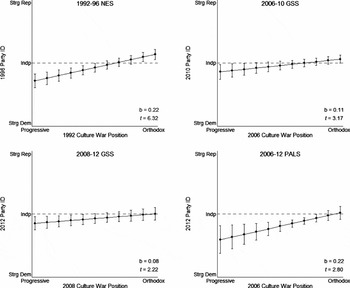
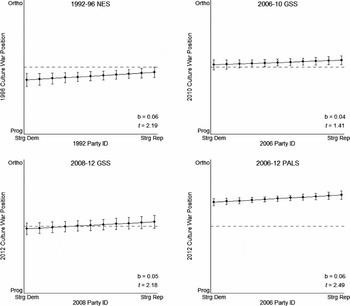
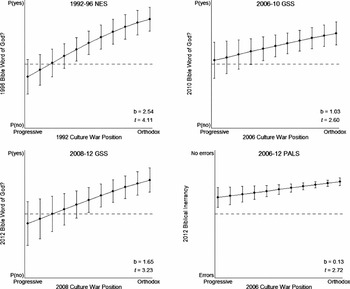
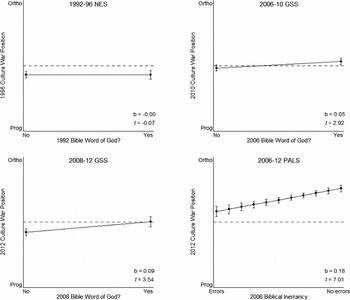
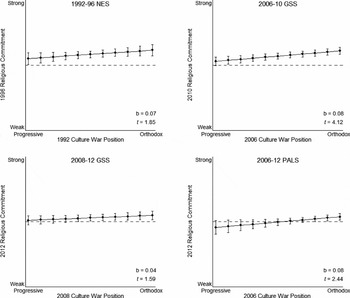
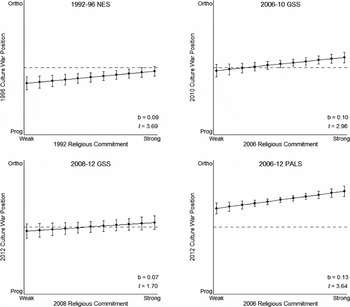
We present the key results in graphical form. Figure 1 illustrates the effect of culture war issues at time t−1 on Party ID at time t (the issue-based change hypothesis), and Figure 2 tests the party-based change hypothesis by plotting the effects of pid t −1 on issue opiniont. Figure 3 illustrates the impact of culture war issues t −1 on biblical literalismt, and Figure 4 shows the reciprocal effect of religious belief-based change in issues. Figures 5 and 6 are similar to 3 and 4, substituting “commitment” for “belief” as the religious variable under scrutiny. Each figure reports predicted values for the dependent variable across the full range of the lagged independent variable of interest, holding all else constant. Given the coding of the variables, all slopes should be positive.
Effect of Culture War Positionst−1 on PlDt across 4 Panels

Effect of PIDt−1 on Culture War Positionst across 4 Panels

Effect of Culture War Positionst−1 on Religious Belieft across 4 Panels

Effect of Religious Belieft−1 on Culture War Positionst across 4 Panels

Effect of Culture War Positionst−1 on Religious Commitmentt across 4 Panels

Effect of Religious Commitmentt−1 on Culture War Positionst across 4 Panels

Figures 1 and 2 shed light on the dynamic relationship between Party ID and culture war opinions. Beginning with the 1992–96 NES (the upper left corner), Figure 1 shows that the effect of culture war issues92 on Party ID96 is correctly signed, highly significant (t = 6.32), and substantively large (
 $\hat{b} = 0.22$
). Because the variables are normed onto a 0–1 scale, the regression coefficients can be interpreted as the percentage change in the dependent variable given movement across the full range of a given independent variable. Hence, movement from the most progressive to the most orthodox position on culture war issues in 1992 produces a 22% shift in the GOP direction on Party ID in 1996, holding Party ID92 and all else constant. Figure 2 reveals that lagged partisanship significantly predicts culture wars issues (t = 2.19). However, the party-to-issue coefficient is about one-fourth the size of the issue-to-party coefficient (
 $\hat{b} = 0.06$
vs.
 $\hat{b} = 0.22$
). Substantively, strong Republicans in 1992 score 6% more orthodox on abortion and gay rights in 1996 relative to strong Democrats in 1992.Footnote
5
Was there something unique about the first Clinton term? The 2006–10, 2008–12, and 2006–12 graphs in Figures 1 and 2 allow us to investigate the possibility. As indicated in the upper right quadrant in Figure 1, culture war issues06 significantly affects partisanship10 (t = 3.17). Turning to the upper right graph in Figure 2, we find that Party ID06 may not have affected culture wars issues10 (t = 1.41). Note further that the cultural issues-to-party effect is almost three times larger than the party-to-issues effect (0.11 > 0.04). The lower left corners of Figures 1 and 2 illustrate significant effects of modest magnitude for issues08 on Party ID12 (t = 2.22,
 $\hat{b} = 0.08$
) and Party ID08 on issues12 (t = 2.18,
 $\hat{b} = 0.05$
). Finally, the 2006–12 PALS graphs in the lower right quadrants reveal significant effects in each direction (p < 0.01). The impact of party on issues (
 $\hat{b} = 0.06$
) is dwarfed by the effect of culture war issues on Party ID (
 $\hat{b} = 0.22$
).
Taken together, the statistical and substantive evidence in Figures 1 and 2 demonstrates that culture war opinions and Party ID predict change in one another over time, holding initial positions on both variables constant. Averaging across all of the Figure 1 slopes, we see that the most culturally orthodox at time 1 move nearly 16% in the GOP direction on Party ID at time 2 compared to the most culturally progressive at time 1. Averaging across the Figure 2 slopes, we find that strong Republicans at time 1 score 5% more conservative on culture war issues at time 2 compared to strong Democrats at time 1. In other words, the influence of issues on party exceeds that of party on issues by a substantial margin.
Turning to Figures 3 and 4, we test whether religious beliefs reinforce culture war opinions or whether issues lead people to modify their beliefs about the Bible. The biblical literalism measure is dichotomous in the NES and GSS data sets, therefore the first three curves in Figure 3 array predicted probabilities derived from logistic regression models. The top quadrant of Figure 3 reveals that culture war opinions92 predict biblical literalism96 (t = 4.11,
 $\hat{b} = 2.54$
), while the corresponding plot in Figure 4 reveals that the effect of biblical literalism92 on culture war opinions96 is effectively zero. Evidently, the impact of moral issues on beliefs about the Bible was much greater than the effect of religious beliefs on issue opinions during Clinton's first term. Moving beyond the Clinton years, the data redeem the religious-based change hypothesis. Lagged religious beliefs predict culture war issues in each of the remaining datasets (all p < 0.01: see quadrants 2–4 in Figure 4). But as called for by our theory, lagged culture war opinions are highly significant predictors of biblical literalism in every panel (all p < 0.01: see quadrants 2–4 in Figure 3).
The substantive magnitude of the issues-to-religion effect is generally larger than the reverse religion-to-issue effects. In the NES and GSS, a move from the most progressive to the most orthodox position on lagged culture war opinion induces a 0.35 rise in the probability a respondent takes a literal view of the Bible, ceteris paribus (recall that these are logit estimates). By contrast, respondents who take a literal view of the Bible at time 1 are predicted to score 5% more conservative on culture war issues at time 2 compared to people who do not take a literal view of the Bible at time 1 (these are OLS results). In the PALS data, the OLS estimates indicate that the religion-to-issues effect exceeds the issues-to-religion effect (18% > 13%). Recall that we have a multi-item measure of religious belief in the PALS data and a single item measure in the other panels. The fact that the PALS belief variable has a bigger effect on culture war attitudes relative to the effects in the other data sets suggests that we must be very cautious in drawing firm conclusions about the relative strengths of the issues-to-belief and belief-to-issues pathways across the models. Summing up, we have found strong support for the issue-based change hypothesis and slightly weaker support for the religious-based change hypothesis.
Next, we turn to the cultural issues-religious commitment relationship. In a sense, this is the most demanding test of the issue-based change hypothesis, because it posits that culture war attitudes alter the things people do in their daily lives, such as praying, saying grace at meals, attending church, and the like. Figure 5 summarizes the culture war opinion-to-religious commitment relationships, while Figure 6 illustrates the reverse connections.
The evidence supports both hypotheses. Beginning with the 1992–96 panel, lagged culture war opinion induces change in future religious commitments (Figure 5: t = 1.85,
 $\hat{b} = 0.07$
) while lagged commitment predicts future opinion (Figure 6: t = 3.69,
 $\hat{b} = 0.09$
). In the 2006–10 GSS (quadrant 2) the relationship is nearly identical, with culture wars predicting a significant shift in future religious commitments (Figure 5: t = 4.12,
 $\hat{b} = 0.08$
) and religious commitment having a similar effect on issue attitudes (Figure 6: t = 2.98,
 $\hat{b} = 0.10$
). Over the period 2008–12, culture wars issues falls just short of significance (Figure 5: t = 1.59, p =0.055), while the effect of religious commitment08 on culture war opinion12 barely exceeds it (Figure 6: t = 1.70, p =0.045). Lastly, in the 2006–12 era culture war opinions and religious commitment are again significant predictors of one another (t = 2.44 and 3.64, respectively). The issues-to-religious commitment effect equals 8% vs. a 13% commitment-to-issues effect.
To sum up so far, we have discovered that (1) culture war opinions are as durable as partisan and religious predispositions (Table 1); (2) culture war opinions leads people to revise their partisan identities over time to a much greater extent than party induces modifications in issue preferences (Figures 1 and 2); and (3) culture war opinions and religious predispositions operate on one another over time (Figures 3–6). The evidence yields support for the standard models of party- and religion-based change in issue positions and, more provocatively, our rival model of issue-based change in partisan and religious predispositions.Footnote 6
Culture War Issues and Candidate Evaluations
Next, we present several additional tests of our claim that culture war attitudes are strong. One objection that warrants close scrutiny is the possibility that, consistent with Lenz (Reference Lenz2012), candidate appraisals predict changes in cultural issue positions over time. So far as people adjust their views of abortion and gay rights based on fluctuating feelings about prominent public officials, one could question our conclusion that culture war attitudes resist attack. The data at our disposal permit several tests of this hypothesis. Because both waves of the 1992–96 NES pose a series of questions about Bill Clinton, we can pit the issue-based change model against the leader-based change model.
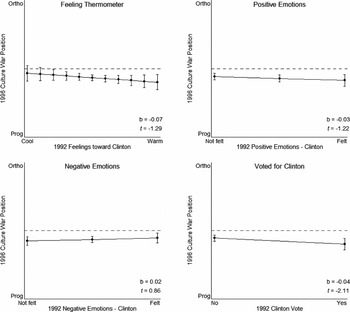
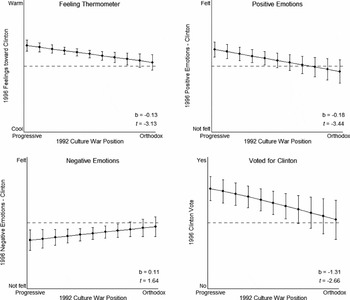
We examine the dynamic relationship between culture war opinion and four different measures of Clinton evaluations: feeling thermometer ratings, positive emotions toward Clinton (i.e., has Bill Clinton ever made you feel “proud” and “hopeful”; both items combined into a single scale), negative emotions toward Clinton (“afraid” and “angry” combined into a single scale), and Clinton vote choice (1 = voted for Clinton, 0 = voted for any other presidential candidate or did not vote). First, we regress culture war opinion96 on culture war opinion92, Clinton evaluation92, Party ID92, and several demographic controls. Second, we regress Clinton evaluations96 on Clinton evaluations92, culture war positions92, Party ID92, retrospective economic and foreign policy evalutions96, and demographic controls (the OLS estimates appear in the Online Appendix Tables F and G). If culture war attitudes are malleable, we should find that increasingly pro-Clinton92 evaluations lead to more progressive positions on culture war issues96, and that increasingly orthodox culture war positions92 do not systematically affect Clinton96 evaluations. Conversely, if culture war attitudes are robust along the lines we have argued, we should find that increasingly pro-Clinton evaluations92 do not operate on culture war opinion96 and more orthodox positions on cultural issues92 generate anti-Clinton96 evaluations.
The results, displayed in Figures 7 and 8, reinforce our claim that culture war attitudes are strong. The lagged Clinton vote choice model (bottom right quadrant of Figure 7) shows that Clinton92 supporters are 4% less orthodox on the culture war scale96 relative to people who did not support Clinton in 1992 (t = −2.11). However, the remaining three lagged Clinton evaluation variables, though correctly signed, fail to attain statistical significance in predicting culture war opinion. By contrast, Figure 8 shows that lagged culture war attitudes predict feeling thermometer96 (t = −3.13), positive emotions96 (t = −3.44), negative emotions96 (t = 1.64), and vote choice96 (t = −2.66), controlling for lagged Clinton evaluations and other factors. Put simply, citizens’ evaluations of the president were lodged in prior culture war issues. For the most part, individuals did not update or rationalize their culture war attitudes to accommodate their feelings toward the president. Once again, the evidence suggests that culture war attitudes are strong.Footnote 7
Effect of Clinton Evaluations92 on Culture War Positions96, NES Panel

Effect of Culture War Positions92 on Clinton Evaluations96, NES Panel

Do Other Issues Move Religious and Partisan Predispositions?
We provide a final set of tests of our theoretical framework. If our claim that culture war attitudes are unusually strong is on the mark, we would not expect views about other kinds of issues to systematically affect biblical literalism and religious commitment, controlling for culture war attitudes. Furthermore, we would expect culture war attitudes to manifest stronger effects on Party ID relative to other issues. To test these expectations, we returned to the 1992–96 NES data because this panel has a rich array of policy measures. We created a three-item measure of opposition to government aid to blacks (tapped via the federal spending item for aid to blacks and two affirmative action items), and a three-item measure of social welfare conservatism (measured using seven-point scales for government services, government job, and government health care). As indicated in supplemental Table K the racial variable does not systematically affect biblical literalism or religious commitment. This is true when we include lagged culture war attitudes in the models and when we drop culture war attitudes from the models. In the Party ID models, culture war attitudes manifest much stronger effects on partisan updating compared to the racial variable. Lastly, as indicated in Online Appendix Table L these patterns replicate when we add social welfare conservatism to the baseline models. In short, culture war attitudes move Party ID, biblical literalism, and religious behavior a great deal. Racial issues and social welfare issues do not.Footnote 8
Summary
With the analyses now complete, we tally up the central findings. First, considerable evidence buttresses the conventional party-based and religion-based accounts of change. Party identification predicted future culture war attitudes in three of the four tests, and religiosity significantly predicted culture war attitudes in seven of the eight tests. And yet, our evidence reveals that these paradigmatic models of opinion change provide at best partial—and therefore misleading—explanations about what shapes what. Culture war issues significantly predicted future partisanship in all four of our tests, and the average substantive magnitude of the issue-to-party effect far surpassed the party-to-issue effect (see Figures 1 and 2). Culture war issues also induced significant changes in beliefs about the Bible that sometimes eclipsed the size of the religion-to-issue coefficient (see Figures 3 and 4). Next, positions on abortion and gay rights lead people to revise their levels of religious commitment in all four tests (one at p < 0.06) as well as vice versa (see Figures 5 and 6). The substantive effects of issues on religion were comparable to the religion-to-issue effects in the commitment models.Footnote 9 Lastly, we showed that culture war positions systematically affect—without being equivalently affected by—candidate evaluations (see Figures 7 and 8).
Importantly, the culture war effects hold in when salient domestic policy issues are added to our baseline model (Online Appendix Tables K and L); controlling for ideological and deep psychological predispositions (see Tables M–Q); and do not, at this juncture, appear to vary across subgroups in any systematic fashion (see Tables R–T). As a final set of checks, we re-estimated our models utilizing different estimators and statistical models, including errors-in-variables regression (see Online Appendix Tables U–X); 2SLS estimators (Tables Y–BB); structural equation modeling (Table CC); and a Heckit treatment effect model (Tables DD–FF). As indicated in the write up accompanying these tables, the culture war effect generally holds.
CONCLUSIONS AND IMPLICATIONS
The conventional wisdom in the social sciences maintains that people ground their views of abortion/gay rights in long-standing, deep-seated partisan loyalties, religious beliefs, and religious commitments (see Johnston (Reference Johnston2006) and Jelen (Reference Jelen, Smidt, Kellstedt and Guth2009) for comprehensive reviews of the respective literatures). The claim that public opinion on culture war issues shapes partisan and religious orientations has received far less attention (see Killian and Wilcox (Reference Killian and Wilcox2008) and Putnam and Campbell (Reference Putnam and Campbell2010) for notable exceptions). Drawing on theories of attitude strength and prior research indicating that culture war attitudes are durable and impactful, we hypothesized that culture war attitudes lead people to revise their partisan and religious predispositions.
We tested these claims by exploiting data from multiple panel studies over the period 1992–2012. Consistent with the dominant perspective, we discovered that people bring their evaluations of culture war issues into closer alignment with their partisan and religious predispositions. Contrary to the dominant perspective, but consistent with our novel theory, citizens habitually update their party loyalties, their beliefs about their preferred religious texts, and their religious commitments to better reflect their preferences on divisive culture war issues. Perhaps most surprisingly, the culture war issues-to-party link appears much stronger than the party-to-issues link, and the culture war issues-to-religious belief pathway seems somewhat stronger than the religious belief-to-opinion pathway. Put succinctly, culture war issues have power sufficient to alter the so-called fountainheads in political and religious belief systems.Footnote 10
Our work makes several contributions to the study of public opinion and American politics. First, this article demonstrates the power of culture war issues in the minds of American voters. Prior work has hinted that moral issues are stronger than other issues (Converse and Markus Reference Converse and Markus1979; Layman and Green Reference Layman and Green2006). By demonstrating that public opinion on these issues rival partisan and religious predispositions in terms of durability and impact, our research suggests that these attitudes function like core predispositions in political and religious belief systems. Second, we have presented some of the clearest evidence to date that Party ID is grounded deeply in issues, albeit a narrow subset of issues. Whereas some studies show that the influence of issues on party is confined to those who care about a given issue and know where the parties stand (Carsey and Layman Reference Carsey and Layman2006; Sniderman and Stiglitz Reference Sniderman and Stiglitz2012), our work suggests that most people ground their partisan identities in judgments about the frontline issues in the culture war. Third, our findings complement an emerging line of innovative research which shows that partisan and ideological predispositions systematically affect religious orientations (Hout and Fischer Reference Hout and Fischer2014; Patrikios Reference Patrikios2008). Our work advances this perspective by demonstrating that culture war opinions do the same (cf. Putnam and Campbell Reference Putnam and Campbell2010).
We would be remiss if we failed to underscore the limits of what we have done. The first caution is that while our findings attest to the power of cultural war issues, it must be remembered that abortion and gay rights may be unique in their ability to detach people from partisan and religious roots. Second, we have shown that the ability to link culture war opinions to party and religiosity holds for the general public, but acknowledge that there may be moderators, such as religious affiliation or issue importance, that condition these relationships. Given the limited instrumentation and sample sizes at our disposal, we could not explore these possibilities at length. Third, our data cover a period of intense elite and cultural polarization. As such, we cannot say whether the propensity of individuals to ground their partisan and religious predispositions in issue opinions held in the pre-polarization era, arose in response to it, or reinforced elite polarization. Since polarization appears here to stay for the foreseeable future, we see little reason to expect things to change moving forward. To the degree that political parties and religious communities continue to divide along these lines––a path they have followed since the early 1990s––citizens will rethink their partisan and religious commitments from time to time to ensure consonance with their views on touchstone cultural issues.
In closing, we reiterate that in order to truly understand America's culture war, it is essential to determine whether voters update their culture war positions to conform to their partisan and religious predispositions, or whether they adjust their partisan and religious predispositions to reflect their issue positions. So far as partisan and religious cues drive microlevel opinion change, the possibility that citizens function as autonomous agents in the broader drama of American politics and religion diminishes. But if individuals’ views of abortion and gay rights lead people to alter partisan and religious predispositions, it suggests a degree of domain-specific agency in the process of partisan and religious choice. The lines of the culture war have been drawn, and Americans are recalibrating their partisan and religious sympathies to reflect deeply held moral sensibilities.
APPENDIX: MEASUREMENT
1992–1996 NES
Culture War Issues
-
1. 4-point abortion scale: “There has been some discussion about abortion during recent years. Which one of the opinions on this page best agrees with your view? You can just tell me the number of the opinion you choose. (1) By law, abortion should never be permitted. (2) The law should permit abortion only in case of rape, incest or when the woman's life is in danger. (3) The law should permit abortion for reasons other than rape, incest, or danger to the woman's life, but only after the need for the abortion has been clearly established. (4) By law, a woman should always be able to obtain an abortion as a matter of personal choice.”
-
2. 101-point feeling thermometer: “Gay men and lesbians; that is, homosexuals.”
-
3. 4-point scale job discrimination against gays: “Do you favor or oppose laws to protect homosexuals against job discrimination?” “Strongly or not strongly?”
-
4. 4-point scale gays in the military: “Do you think homosexuals should be allowed to serve in the United States Armed Forces or don't you think so?” “Strongly or not strongly?”
Party Identification
-
1. 7-point scale: “Generally speaking, do you usually think of yourself as a Republican, a Democrat, an Independent, or what?” “Would you call yourself a strong Republican/Democrat or a not very strong Republican/Democrat?” “Do you think of yourself as closer to the Republican Party or the Democratic Party?”
Religious Belief
-
1. 3-point Biblical literalism scale recoded as dummy variable: “Which of these statements comes closest to describing your feelings about the Bible? (1) The Bible is the actual word of God and is to be taken literally, word for word, or (2) the Bible is the word of God but not everything in it should be taken literally, word for word, or (3) the Bible is a book written by men and is not the word of God.”
Religious Commitment
-
1. 5-point religious worship scale: “Thinking about your life these days, do you ever attend religious services, apart from occasional weddings, baptisms or funerals?” “Do you go to religious services every week, almost every week, once or twice a month, a few times a year, or never?”
-
2. 5-point prayer scale: “People practice their religion in different ways. Outside of attending religious services, do you pray several times a day, once a day, a few times a week, once a week or less or never?”
-
3. 4-point religious importance scale: “Do you consider religion to be an important part of your life, or not?” “Would you say your religion provides some guidance in your day-to-day living, quite a bit of guidance, or a great deal of guidance in your day-to-day life?”
Clinton Evaluations
-
1. Yes, have felt/no, never felt angry: “Think about Bill Clinton. Has Bill Clinton (because of the kind of person he is, or because of something he has done) ever made you feel angry?”
-
2. Yes, have felt/no, never felt hopeful: “Think about Bill Clinton. Has Bill Clinton (because of the kind of person he is, or because of something he has done) ever made you feel hopeful?”
-
3. Yes, have felt/no, never felt afraid: “Think about Bill Clinton. Has Bill Clinton (because of the kind of person he is, or because of something he has done) ever made you feel afraid?”
-
4. Yes, have felt/no, never felt proud: “Think about Bill Clinton. Has Bill Clinton (because of the kind of person he is, or because of something he has done) ever made you feel proud?”
-
5. 101-point feeling thermometer: “Bill Clinton”
-
6. Vote choice, Clinton or any other candidate or did not vote: “Who did you vote for?”
2006–10 and 2008–12 GSS
Culture War Issues
-
1. Yes-no abortion any reason: “Please tell me whether or not you think it should be possible for a pregnant woman to obtain a legal abortion if the woman wants it for any reason?”
-
2. Yes-no abortion chance of defect: “Please tell me whether or not you think it should be possible for a pregnant woman to obtain a legal abortion if there is a strong chance of serious defect in the baby?”
-
3. Yes-no abortion health: “Please tell me whether or not you think it should be possible for a pregnant woman to obtain a legal abortion if the woman's own health is seriously endangered by the pregnancy?”
-
4. Yes-no abortion married: “Please tell me whether or not you think it should be possible for a pregnant woman to obtain a legal abortion if she is married and does not want any more children?”
-
5. Yes-no abortion poor: “Please tell me whether or not you think it should be possible for a pregnant woman to obtain a legal abortion if the family has a very low income and cannot afford any more children?”
-
6. Yes-no abortion rape: “Please tell me whether or not you think it should be possible for a pregnant woman to obtain a legal abortion if she became pregnant as a result of rape?”
-
7. Yes-no abortion unmarried: “Please tell me whether or not you think it should be possible for a pregnant woman to obtain a legal abortion if she is not married and does not want to marry the man?”
-
8. 4-point homosexual relations scale: “What about sexual relations between two adults of the same sex—do you think it is always wrong, almost always wrong, wrong only sometimes, or not wrong at all?”
-
9. 5-point same sex marriage scale: “Do you agree or disagree with the following statement: Homosexual couples have the right to marry one another.” Agree/disagree responses format.
Party Identification
-
1. 7-point scale: “Generally speaking, do you usually think of yourself as a Republican, Democrat, Independent, or what?” “Would you call yourself a strong Republican/Democrat or a not very strong Republican/Democrat?” “Do you think of yourself as closer to the Republican Party or the Democratic Party?”
Religious Belief
-
1. 3-point Biblical literalism scale recoded as dummy variable: “Which one of these statements comes closest to describing your feelings about the Bible? (1) The Bible is the actual word of God and is to be taken literally, word for word. (2) The Bible is the inspired word of God but not everything should be taken literally, word for word (3) The Bible is an ancient book of fables, legends, history and moral precepts recorded by man.”
Religious Commitment
-
1. 5-point prayer question: “About how often do you pray?” Responses range from “several times a week” to “never”
-
2. 9-point religious worship scale: “How often do you attend religious services?” Responses range from “several times a week” to “never”.
-
3. 10-point religious activities: “How often do you take part in the activities and organizations of a church or place of worship other than attending service?” Responses range from “several times a day” to “never”.
-
4. 6-point commitment scale: “Please look at this card and tell me which of the statements comes closest to expressing what you believe about God. (1) I don't believe in God (2) I don't know whether there is a God and I don't believe there is any way to find out (3) I don't believe in a personal God, but do believe in a Higher Power of some kind (4) I find myself believing in God some of the time, but not at others (5) While I have doubts, I feel that I do believe in God (6) I know God really exists and I have no doubts about it.”
2006–12 PALS
Cultural War Issues
-
1. 5-point same-sex marriage scale: “The only legal marriage should be a marriage between one man and one woman.” Agree/disagree responses format.
-
2. 5-point legal abortion scale: “Do you personally believe that abortion should be legal under (1) almost all circumstances, (2) most circumstances, (3) some circumstances, (4) only extreme circumstances, (5) under no circumstances.”
-
3. 5-point term late term abortion: “Do you believe that each of the following is morally wrong or not a moral issue? Having an abortion when the fetus is old enough to survive on its own outside the mother's womb. Would you say that is always morally wrong, usually morally wrong, sometimes morally wrong, never morally wrong, or not a moral issue?”
-
4. 5-point genetic engineered baby scale: “Using genetic engineering, that is changing a person's DNA or genes, to create a baby that is smarter, stronger, or better looking.” Responses range from “always morally wrong” to “not a moral issue.”
Party Identification
-
1. 7-point scale: “In politics, do you usually think of yourself as a Democrat, a Republican, or an Independent?” “Are you a strong Republican/Democrat or a not very strong Republican/Democrat?” “Do you lean toward the Democrats, or toward the Republicans?”
Religious Belief
-
1. 3-point text literalism scale: “Was the [R's preferred religious text] fully inspired by God, partly inspired by God, or not inspired by God?”
-
2. 5-point moral fallibility scale: “For each of the following statements, please indicate whether you strongly disagree, somewhat disagree, neither agree nor disagree, somewhat agree, or strongly agree. There are errors in the [R's preferred religious text] on moral, spiritual, or religious matters.”
-
3. 5-point scientific fallibility scale: “For each of the following statements, please indicate whether you strongly disagree, somewhat disagree, neither agree nor disagree, somewhat agree, or strongly agree. There are errors in the [R's preferred religious text] regarding science or history.”
Religious Commitment
-
1. 5-point religious importance scale: “How important is religion or religious faith to you personally? Is it not at all important, somewhat important, very important, extremely important, or by far the most important part of your life?”
-
2. 5-point importance of God scale: “How important is God or spirituality in your life? Is it not at all important, somewhat important, very important, extremely important, or by far the most important part of your life?”
-
3. 7-point religious worship scale: “This question is about how often you attend worship services, not including weddings or funerals. Would that be never, once or twice a year, several times a year, once a month, two or three times a month, once a week, twice a week or three times a week or more?”
-
4. 7-point prayer scale: “In the past 12 months, how often have you typically prayed, not including before meals and at religious services? Would that be never, a few times a year, one to three times a month, once to several times a week, once a day, two to three times a day, or more than three times a day?”
-
5. 7-point grace at meals scale: “At home, how often does someone say grace or give thanks aloud?” Responses range from “never” to “More than once a day.”
SUPPLEMENTARY MATERIAL
To view supplementary material for this article, please visit https://dx.doi.org/10.1017/S0003055416000435.





Comments
No Comments have been published for this article.