

Introduction
Parliamentary debates such as those staged during Question Time can be seen in two complementary ways: scholars of the policy agenda consider them as an intermediate step in the policy-making stream connecting the systemic agenda to laws adoption (Soroka, Reference Soroka2002), while those studying party competition treat them as valuable tools for communicating party preferences to the electorate in-between elections (Otjes and Louwerse, Reference Otjes and Louwerse2018). Indeed, parliamentary questions are generally used by parties to stress their favorite issues, often with the aim of criticizing the government or, when it comes to majority parties, to highlight its achievements. In this article we study whether and to what extent parties maintain coherence between the issues prioritized during electoral campaigns and in-between elections in a period characterized by a dramatic economic crisis. Do policy priorities declared in electoral manifestos and those pursued in parliament correspond? Has the economic crisis weakened the relationship between what parties promise at election time and what they prioritize once in parliament due to a more constrained agenda in this period? Considering the double nature of parliamentary questions (both an instrument of party competition and an intermediate step of the policy-making process), these problems are relevant not only to assess how party strategies have been affected by the crisis, but also to evaluate whether the crisis has undermined the strength of the electoral mandate.
Testing the party mandate model by comparing just the first (i.e. electoral pledges) and the last links (i.e. bills) of the representative chain does not only set a very high hurdle, it also ignores the activities of opposition parties (Louwerse, Reference Louwerse2012). Our approach here is a different one. Our aim is to explore the correspondence between attention allocation in electoral manifestos and during question time in the national parliament. This research strategy allows us to benchmark two initial stages of the agenda framing process against which later stages – such as actual government actions – could be compared. Electoral manifestos include sets of policy proposals formulated with various degrees of specificity whose main aim is to attract voters. When a voter considers a party as owning an issue she deems important, the chances that she will vote for that party are expected to increase. Manifestos can be understood as inputs for the political system, while government activities are the outputs. By occupying an intermediate position between the two, parliamentary questions offer an opportunity to check how the transmission of policy priorities works. In this respect, we can think of several factors hindering the translation of policy pledges into institutional actions, from the intrusion of new issues in the agenda to the necessity to respond to challengers’ strategies.Footnote 1 While it is not realistic to expect a perfect match between the above two stages, due to the impact of new events, the role of the media, and the necessity to respond to the strategies of others, according to the party mandate model, a certain degree of congruence between the issues prioritized during elections and in parliament should exist.Footnote 2 Voters choose parties for various reasons, including their declared commitment to solving some specific problems. The transmission of policy priorities from the electoral to the parliamentary arena is a pre-requisite for the existence of collective political representation. If policy congruence is problematic at this stage, we can expect it will be even more so at later stages of the process.
In this article, we assess congruence between attention allocation to policy issues in manifestos and during question time in parliament in four countries: Greece, Italy, Portugal, and Spain. The focus on southern Europe protects us against the risk of comparing a set of heterogeneous political contexts. It is true that the political systems in these countries differ substantially. For example, the party system, or the composition and degree of stability of government, vary a great deal across the four democracies. However, the Euro-crisis has revealed cleavages across the European Union (EU) that are heavily dependent on the asymmetric power and varieties of capitalism among its member states and which, according to many observers, have made these countries more similar. The crisis has produced the same kind of pressures on southern European democracies, constraining the agenda of the national governments in similar ways through austerity. This has also triggered very similar dynamics in the structure of political competition (Charalambous et al., Reference Charalambous, Conti and Pedrazzani2018; Hutter et al., Reference Hutter, Kriesi and Vidal2018). Our selection of cases allows us to observe whether the Great Recession produced similar effects in those countries that in this most critical context found themselves in the eye of the storm.
Our analysis is original and innovative in several ways. First, so far only few studies (Borghetto and Russo, Reference Borghetto and Russo2018; Otjes and Louwerse, Reference Otjes and Louwerse2018) have focused on the correspondence between electoral priorities and parliamentary questions. Second, our analysis takes a comparative perspective that is still rather uncommon in this field of research, but it is also necessary in order to advance in theory building. Third, from the methodological point of view, our study elaborates a detailed conversion scheme to compare data coming from the Manifesto Project (MRG/CMP/MARPOR) and the Comparative Agendas Project (CAP), two widely used sources for scholars of party competition. Finally, and in contrast with the above-mentioned studies, we develop a synthetic measure to assess the overall congruence between manifestos and questions.
The article is structured as follows. In the next section, we outline our core expectations based on a discussion of the most recognized arguments available in the literature. Subsequently, we describe the method that we have developed to compare manifesto data and parliamentary question data. Finally, we present the main results of our analysis and discuss the theoretical relevance of our findings for the broader literature on policy agendas, political representation, and democracy. We conclude by pointing to avenues for further research.
Theoretical framework
Electoral manifestos are party documents containing a list of policy priorities to which a party publicly commits itself (Budge et al., Reference Budge, Klingemann, Volkens, Bara and Tanenbaum2001). Their most obvious aim is to communicate to voters the broad ideological position of a party and the issues that are most important to it. However, it is often argued that their importance should not be overestimated because only few citizens actually read manifestos. Moreover, the media tend to select and prioritize only some (often the most contentious) issues that appear in the manifestos, and only these get visibility in the public debate. The media filter may change the original plans of parties and force them to shift attention to different issues from those they would normally focus on. Regardless of the size of the actual readership of manifestos and the filter played by the media, manifestos still represent one of the most authoritative sources of information for understanding where a party stands from the ideological point of view and with respect to some specific issues. If the party mandate theory of democracy requires that citizens vote for the parties which are closest to their positions, and that the electoral outcome is a means to translate voters’ preferences into public policy decisions, agenda-setting studies show empirically that the path leading from citizens’ priorities to actual decisions is a troubled one. The number of issues that can be discussed within public institutions is limited (Jones and Baumgartner, Reference Jones and Baumgartner2005) and only a few of them make it to the decision-making stage. In this perspective, in order to test theory, it becomes particularly relevant to assess whether and to what extent parties keep their policy priorities once in parliament.
Parliamentary questions have no direct policy consequences, as they mainly provide an arena for interaction between parties and government. There are many reasons for questioning the government, including pressing for action, gaining publicity, attacking ministers, showing interest in certain topics, and demonstrating the government's faults (Wiberg, Reference Wiberg1994a: 30). As they may serve multiple goals, parliamentary questions have received increasingly scholarly attention since the 1990s (Franklin and Norton, Reference Franklin and Norton1993). Agenda scholars have also started looking at the content of questions in order to analyze the policy priorities that different parties express in parliament (Vliegenthart and Walgrave, Reference Vliegenthart and Walgrave2011). In this perspective, those questions that are orally discussed on the floor are of special interest, because they provide a simple way for parties to expand the conflict on selected issues (Russo and Wiberg, Reference Russo and Wiberg2010). In general, despite some obvious differences, manifestos and parliamentary questions are comparable documents because they are both connected to, while at the same time standing apart from, the actual policy-making process. They are both useful tools to communicate issue priorities to voters before and after the elections, respectively.
Given their similar nature and function, in the absence of constraints, the issue priorities of a party in the parliamentary arena should simply mirror those expressed in the manifestos. However, reality is inevitably more complex. The changing mood of the public opinion (Jennings and John, Reference Jennings and John2009), the emergence of new issues in the media (Walgrave et al., Reference Walgrave, Soroka and Nuytemans2008; Vliegenthart et al., Reference Vliegenthart, Walgrave, Baumgartner, Bevan, Breunig, Brouard, Chaqués-Bonafont, Grossman, Jennings, Mortensen, Palau, Sciarini and Tresch2016), or the evolution of the objective importance of a policy problem (Jones and Baumgartner, Reference Jones and Baumgartner2005: 208) may significantly alter the content of the policy agenda, eventually reducing the congruence between manifestos and questions. Still, for the party mandate model, manifestos should at least give a good approximation of the issues that a party considers most important. We share the view that there are several reasons to hypothesize a connection between the electoral and post-electoral phases of issue competition. If we assume that issue emphasis is a function of party ideology, we should expect a strong similarity between manifestos and parliamentary questions. For instance, this is the basic idea which underpins the studies investigating the link between manifestos and government spending (Budge and Hofferbert, Reference Budge and Hofferbert1990; Hofferbert and Budge, Reference Hofferbert and Budge1992). Partisan ideology is deep-rooted in history and is a rather persistent feature that constrains the strategic behavior of parties, before and after the elections. The importance of ideology does not only regards long-established parties but also the new party families. It would not be surprising to see green parties championing environmental battles and radical right parties pursuing their anti-immigrants agenda both at election time and in parliament. Indeed, it has been shown that parties filter the incoming information through the lens of their preferences (Vliegenthart et al., Reference Vliegenthart, Walgrave and Zicha2013). For instance, we can expect that a human-made disaster causing a massive oil spill will be particularly emphasized by the green parties. In the same way, a brutal crime committed by an immigrant will be over-emphasized by extreme-right parties.
A related (albeit analytically different) argument focuses on issue ownership. According to this theory, parties stress those issues on which they are regarded as being more competent than their competitors (Budge and Farlie, Reference Budge and Farlie1983; Petrocik, Reference Petrocik1996). By increasing the salience of those issues, parties try to modify the content of political competition and push it to their favorite ground. Just like ideology, also the concept of issue ownership implies some stability in the choice of the issues that parties decide to emphasize. In order to ‘own’ an issue, a party should enjoy a good reputation for its issue competence and building such a reputation requires time and effort in both pre- and post-electoral phases. Ultimately, theories on ideology and issue ownership posit a high degree of congruence between the issues prioritized by parties in the manifestos and at question time in parliament. This is also our baseline expectation in this work.
The first obstacle to a perfect congruence between manifestos and questions has to do with the intrusion of new issues. Wars, natural disasters, economic crises, and other pressures such as immigration or terrorism, just to name a few, are examples of events affecting reality in ways that are not possible for parties to ignore. As policy problems change, public priorities shift and so do partisan priorities. Applying different methods and approaches, several studies found evidence that both parties and governments adapt their list of priorities to contingent situations (see e.g. Stimson et al., Reference Stimson, Mackuen and Erikson1995; Soroka and Wlezien, Reference Soroka and Wlezien2010; Bevan and Jennings, Reference Bevan and Jennings2014; Borghetto and Russo, Reference Borghetto and Russo2018). If these events become priorities for public opinion, no party could really afford to ignore them. Building on the above arguments, we formulate the following hypothesis:
H1:
Disruptive external events – such as an economic crisis – increase the issue dissimilarity between manifestos and parliamentary questions.
It is rather intuitive that major events such as crises, wars, earthquakes, etc., can ‘invade’ the political agenda, forcing parties to divert attention from their preferred issues. However, there is also a subtler factor that could erode the congruence between the policy priorities advertised in the electoral arena and those gaining attention in parliament: time. As time elapses, the cumulative number of unexpected events is likely to grow larger, because the real world continuously evolves. Problems calling for a policy solution gradually develop, new issues emerge, etc. We can think of this mechanism as an error accumulation process. Moreover, the political debate and the concerns of public opinion evolve at an even faster pace than the real world, often due to the role exerted by the media: issues that are perceived as topical today might be completely forgotten in a few months. As a consequence:
H2:
The dissimilarity between party manifestos and parliamentary questions progressively grows during the electoral cycle.
So far, we have hypothesized that the degree of congruence between the priorities revealed by manifestos and by parliamentary questions is a function of two factors with opposite effects. While party preferences (either conceptualized as ideology or issue ownership) would play in favor of congruence, external events that change reality and public preferences would create divergence. The above arguments apply to all parties, irrespective of their characteristics. However, it is well-known that parliamentary questions have a different function for governing and opposition parties. While in several parliaments most questions are asked by opposition parties, empirical data show that incumbent parties also engage in questioning (Wiberg, Reference Wiberg1994b) perhaps to give the government an opportunity to emphasize its own achievements. It is safe to assume that each party tries to push the contents of competition to its favorite ground. However, opposition and government parties might be differently equipped to do so. When a party attempts to expand the political conflict on a previously neglected issue, other parties have at least two choices: they may ignore this attempt, or they may take up the new issue (Meguid, Reference Meguid2005). This dynamic aspect of issue competition has been explored under different perspectives and one of the most interesting findings is that the opposition is in a privileged position for setting the political agenda. Evidence of the role played by the opposition has been found to hold at the level of both individual legislators (Sulkin, Reference Sulkin2005) and the party system (Green-Pedersen and Mortensen, Reference Green-Pedersen and Mortensen2010). According to Green-Pedersen and Mortensen (Reference Green-Pedersen and Mortensen2010: 262), opposition parties are free to focus on the issues they prefer, whereas government parties are often forced to respond to others’ priorities. The basic reason for this behavior is that governing parties must avoid blame for unsolved policy issues because failure to do so would result in accusations of being unable to deliver solutions to problems. This challenge is very effective between elections, when there is a clear distinction between the roles of government and opposition and the incumbent is called upon to respond about its capacity to solve problems more directly. However, to the best of our knowledge, this difference between government and opposition parties has never been tested with regard to the congruence between the issues emphasized in manifestos and during the question time. This argument leads to an additional hypothesis on the congruence between manifestos and parliamentary questioning:
H3:
The issue dissimilarity between manifestos and parliamentary questions is greater among government parties and lower among opposition parties.
These are the main hypotheses that we will analyze in the article. In the following section, we describe how this will be done empirically.
Data and operationalization
To test the hypotheses formulated in the previous section, we analyze the level of dissimilarity between parties’ manifestos and the parliamentary questions delivered by their members in four countries: Greece, Italy, Portugal, and Spain. More precisely, for all parties included in our study, we assess how each distributes its attention across policy topics in the electoral manifestos and in the ensuing question time in parliament.
We do this by combining two sources of data whose use is widespread in the comparative literature on party competition and policy dynamics: the Manifesto Project (MRG/CMP/MARPOR) and the CAP. The MARPOR project has been coding the electoral platforms of over 1000 parties in more than 50 countries since 1945 (Budge et al., Reference Budge, Klingemann, Volkens, Bara and Tanenbaum2001; Klingemann et al., Reference Klingemann, Volkens, Bara, Budge and McDonald2006; Volkens et al., Reference Volkens, Bara, Budge, McDonald and Klingemann2013). The project splits the text of each party manifesto into quasi-sentences that are manually coded according to their policy content following a pre-set classification scheme. The scheme developed by the Manifesto Project comprises 56 categories grouped into seven major policy domains. While we took data on party manifestos from the MARPOR project, data on parliamentary questions were taken from the CAP, a transnational network that has developed a method for comparing policy agendas across time and political arenas. The CAP codebook includes more than 200 minor topics that are grouped into 21 major topics.Footnote 3 In the four countries included in this study, a national team manually coded each question posed in parliament into one minor topic (and hence into the corresponding major topic) depending on its policy content.
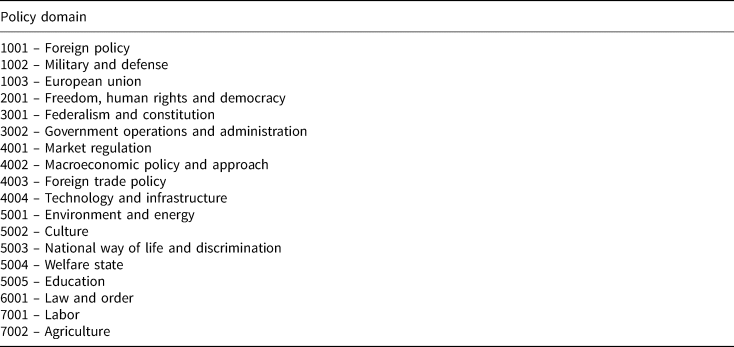
In order to compare MARPOR-coded party manifestos and CAP-coded parliamentary questions, we built a new scheme that allowed us to classify the policy content of both types of documents. In particular, we looked at the most basic items in the two original classification schemes and matched MARPOR (56) categories with CAP (213) minor topics.Footnote 4 We then aggregated these MARPOR-CAP pairs into broader policy domains and created in the end 18 domains, each dealing with a substantive policy area. The policy domains in our classification scheme are reported in Table 1, while full details about the correspondence between MARPOR categories and CAP minor topics are given in Appendix 1.
Classification scheme for comparing MARPOR and CAP data (18 categories)

Based on our classification scheme, we then built an integrated dataset comprising both party manifestos and parliamentary questions in Greece, Italy, Portugal, and Spain. As for the time span, we concentrated on the period after 2000. Due to asymmetries in the availability of data, the period covered is not exactly the same in all four countries. This is because although the MARPOR data provide a long time series of coded manifestos, the same is not true for the CAP data. The time period covered in our analyses is longer for Italy (2001–2013), Portugal (2003–2013), and Spain (2000–2015), but shorter for Greece (2010–2014).Footnote 5
In our joint dataset, a party can appear more than once. A first reason is that in the considered time period, a party participated in more than one election and entered parliament more than once. For instance, the Spanish Socialist Workers Party (PSOE) participated and gained seats in the 2000, 2004, 2008, and 2011 elections. Moreover, to test our hypotheses – in particular whether the degree of congruence between party manifestos and parliamentary questions depends on the electoral cycle (H2) – we had to calculate values on our variables at different points in time during a parliamentary term. For this reason, in the dataset we have built the unit of analysis as the party occurrence by the number of years of the legislative term. Coming back to the example above, since the Spanish Legislature VII covers 4 years (2000, 2001, 2002, and 2003), for that term we find PSOE 2000/year 1, PSOE 2000/year 2, PSOE 2000/year 3, and PSOE 2000/year 4. In the article, we use the term ‘party occurrence’ to refer to the different instances of one party – e.g. from PSOE 2000/year1 to PSOE 2012/year4 – under the same ‘label’ (PSOE).
Starting from an initial set of 129 manifestos and 14,783 parliamentary questions, we dropped those party occurrences for which either the manifesto or the parliamentary questions were not available.Footnote 6 Our final dataset consists of 263 observations (party occurrences), which in turn correspond to 35 party labels. Each party occurrence is associated with the questions posed in parliament by the party in a given year and with the manifesto issued before the election. As displayed in Table 2, overall the 263 party occurrences included in our study put forward 12,020 parliamentary questions.
Distribution of electoral manifestos and parliamentary questions in the dataset

Before moving to the analysis of data, we now describe how we operationalized our dependent and independent variables. As to our dependent variable, on a yearly basis, we calculated a measure of dissimilarity between two distributions: the distribution of policy topics covered in a party manifesto and the distribution of policy topics in the same party's parliamentary questions (during each year of the legislative term after the manifesto election). For every year of a legislative term, we applied the Duncan index of dissimilarity (Duncan and Duncan, Reference Duncan and Duncan1955) to each party occurrence as follows:  $1/2\sum\nolimits_{i = 1}^{18} {\vert {m_i-q_i} \vert } $. In this formula, i = 1…18 represents the policy domains in our classification scheme, m i is the proportion of quasi-sentences related to domain i in a party manifesto, and q i is the proportion of parliamentary questions dealing with domain i asked by the same party during a given year of the related legislative term. This index has a minimum of 0 (no difference) when the two distributions are identical, that is, when a party distributes its attention in the same way in both its manifesto and its parliamentary questions. The maximum value of the index is 1 (maximum difference) when there is absolutely no correspondence between the two distributions, that is, when the entire content of a party manifesto addresses one topic while all the questions posed by the same party deal with another topic.
Turning now to the explanatory variables, H1 posits that the worsening of economic conditions stemming from major external events, such as economic crises, may increase dissimilarity between manifestos and parliamentary questions. To capture the impact of the economic crisis, we calculated the Economic Performance Index (EPI), which combines data on a country's annual inflation rate, unemployment rate, budget deficit/GDP ratio, and growth rate (Khramov and Lee, Reference Khramov and Lee2013).Footnote 7 Higher values indicate a country's better economic performance. The EPI included in our analyses is calculated on a yearly base and is lagged (previous year).Footnote 8
According to H2, manifesto-question dissimilarity should increase as the parliamentary term unfolds. To empirically evaluate this hypothesis, we created a Term Year variable indicating the different years of a parliamentary term. This variable is equal to 1 for the first year, 2 for the second year, and so on. To further explore the relationship between issue dissimilarity and a time effect of the electoral cycle, in the analyses we also introduced the squared variable Term Year × Term Year.Footnote 9
Since H3 posits higher issue dissimilarity for governing parties compared with opposition parties, we introduced the dummy Government Party. This variable takes a score of 1 if a party was in the cabinet during a certain year, and 0 if in that year a party was in the opposition. Moreover, we created a categorical variable – Alternation – aimed at capturing the impact of party shifts from opposition to government (and vice versa). This variable is calculated year by year and includes four categories: a party in government in the previous year and still in government, a party in the opposition in the previous year and still in the opposition, a party in opposition in the previous year and now in government, and finally a party in government in the previous year and now in opposition.
In addition to these key explanatory variables, a set of control variables were incorporated in our analyses. First, we controlled for the ideological positions of parties. To do this, we looked at the distribution of all parties included in our dataset along the left-right scale according to the RILE index provided by MARPOR. We then created two dummies: Extreme Left, identifying those parties that are located in the lowest quartile of the left-right distribution, and Extreme Right, indicating those parties placed in the highest quartile of the same distribution. The omitted baseline category corresponds to centrally located parties.
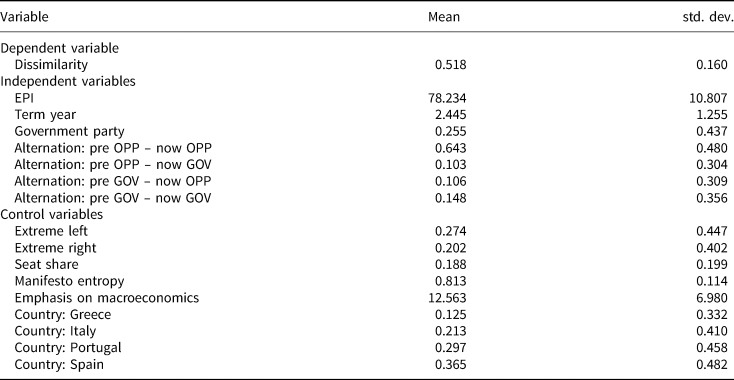
Second, we included Seat Share, measuring the share of parliamentary seats obtained by every party.Footnote 10 Third, we controlled for the degree of dispersion of attention in parties’ manifestos. More precisely, for every manifesto, we calculated the normalized Shannon's entropy index. The resulting variable, Manifesto Entropy, ranges from 0 (when attention is concentrated on just one policy domain) to 1 (when attention is equally spread across all the 18 domains). This variable captures, at least in part, the content nature of the manifestos of parties, as well as their electoral strategies (from catch-all to single-issue parties). Fourth, we included a variable – labeled Emphasis on Macroeconomics – that was calculated by counting the percentage of references to the Macroeconomic Policy and Approach category in every party manifesto. Especially after the start of the crisis, party members may be more inclined to address issues regarding the state of the economy when delivering questions in parliament. At the same time, in their electoral program, parties are likely to present measures for tackling the negative consequences of the crisis. Certainly, after the outbreak of the crisis, parties cannot reiterate exactly the same programmatic pledges they put forward in the pre-crisis period and ignore this dramatic change to context. Hence, following the start of the crisis, the level of dissimilarity that we observe between manifestos and parliamentary questions might be lower simply because parties put more emphasis on crisis-related topics in their electoral platforms. Finally, we created country dummies. Descriptive statistics for the variables employed in our analyses are reported in Table 3.
Descriptive statistics for the dependent and independent variables

Analysis and discussion
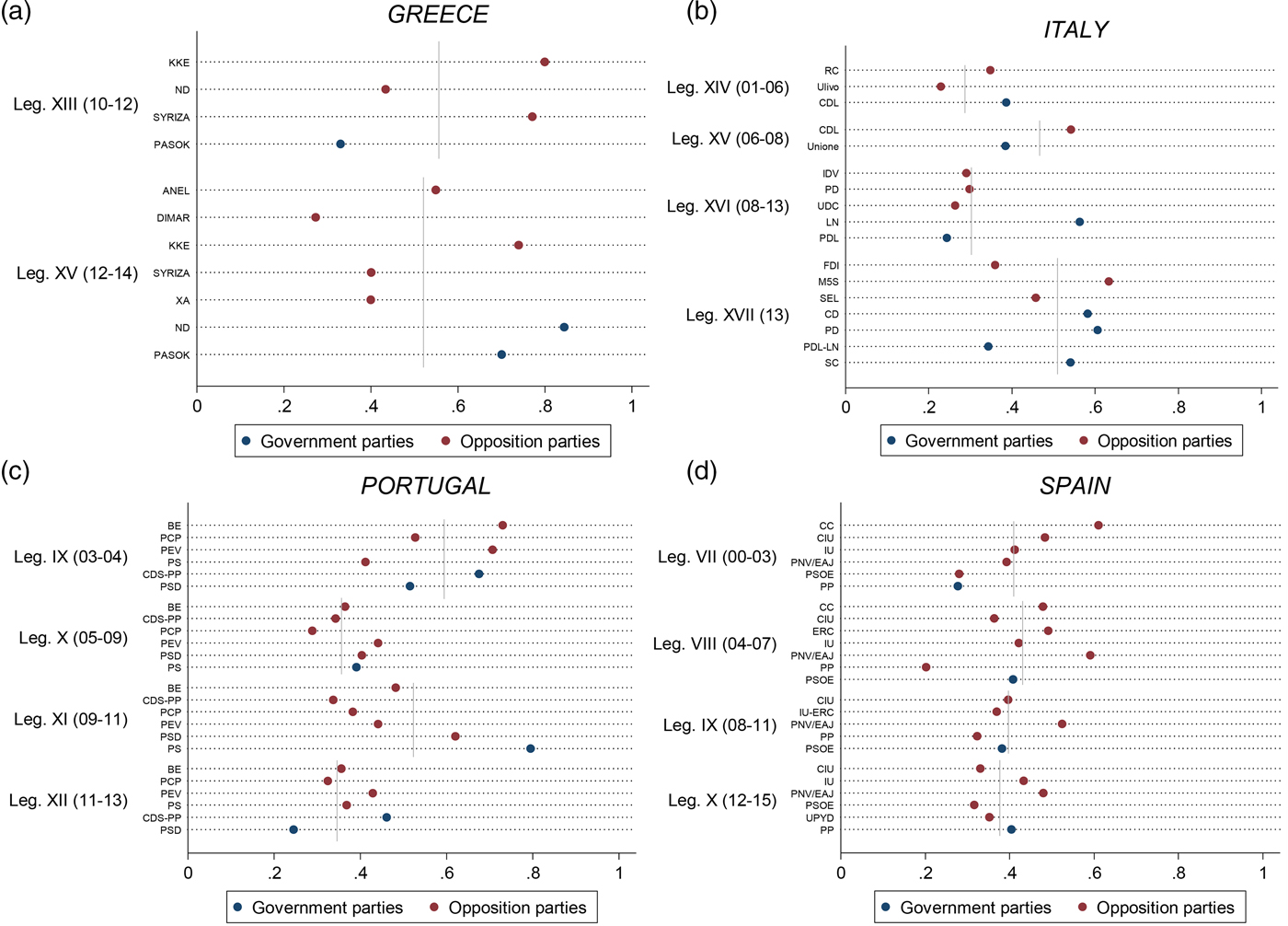
In this section, we start our examination of issue congruence with some descriptive analyses about the level of dissimilarity in issue emphasis between party manifestos and parliamentary questions. As discussed above, we measured dissimilarity through the Duncan index, which was calculated on a yearly basis for all the parties included in our analyses. Figure 1 shows the degree of issue dissimilarity between manifestos and parliamentary questions for Greek, Italian, Portuguese, and Spanish parties in the 2000–2015 period. For ease of illustration, in this picture, we report a single aggregated dissimilarity score for each party in a given legislative term. Each dot in Figure 1 represents the Duncan index calculated by comparing a party's distribution of attention among topics in the electoral platform and the same party's distribution of attention among topics in the parliamentary questions delivered during the entire legislative term after the manifesto election. The gray vertical lines represent the average level of dissimilarity in each legislative term.
Duncan index of dissimilarity between party manifestos and parliamentary questions (0 = minimum dissimilarity and 1 = maximum dissimilarity). (a) Greece, (b) Italy, (c) Portugal, (d) Spain.
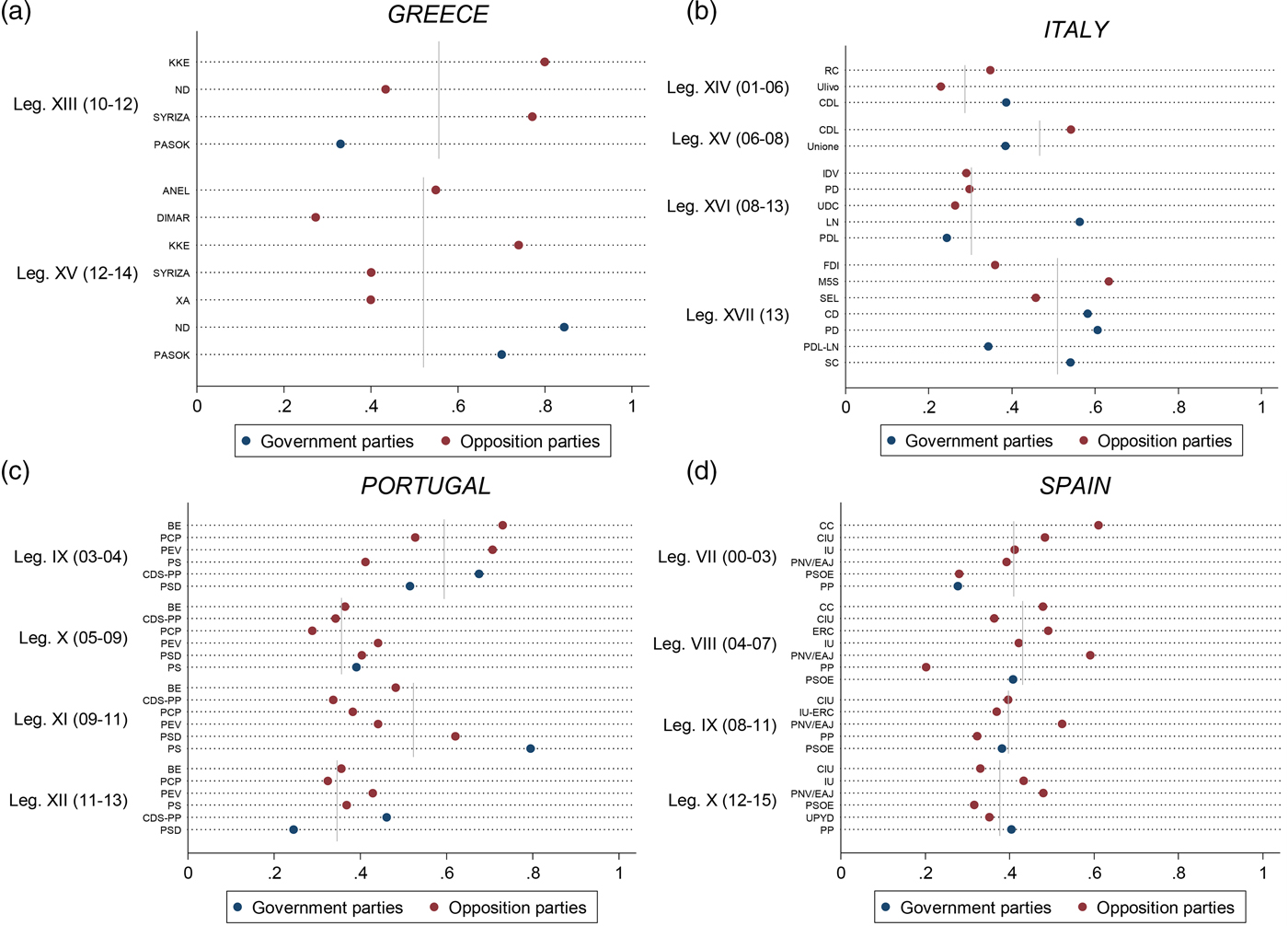
Generally speaking, we can see from the graphs that the level of dissimilarity between party manifestos and parliamentary questions varies substantially across countries. Moreover, dissimilarity did not necessarily become more relevant during the most turbulent years of the economic crisis, when parties had to face many emergencies that may have obscured most of their former electoral commitments.
In the case of Italy, for example, we found considerable variation of manifesto-question dissimilarity across legislative terms. The degree of dissimilarity is on average higher in Legislature XV than in Legislatures XIV and XVI.Footnote 11 Such a variation cannot be explained by the presence of common electoral platforms issued by the parties participating to pre-electoral coalitions, as joint coalition manifestos were issued before the 2001 election (by the center-left Ulivo and by the center-right Casa delle libertà, CDL) and before the 2006 election (by the center-left Unione and by the center-right Casa delle libertà), but not before the 2008 election.
The impact of the crisis in Italy is not immediately visible from the data in Figure 1. It should be noted that the economic crisis became particularly tangible in Italy in the middle of Legislature XVI – that is, from the end of 2011 (later than in the other analyzed countries) when exceptional austerity measures were taken by a newly formed technocratic government led by Mario Monti. Coherently, we found a particularly high value of the Duncan index in that year. As mentioned above, however, the degree of issue dissimilarity during the entire 2008–2013 term was rather low and very similar to that recorded in the 2001–2006 term, well before the outbreak of the crisis.
Figure 1 also reveals that Italian governing parties display relatively low levels of dissimilarity between manifestos and parliamentary questions. The only exception to this trend was the Northern League (Lega Nord, LN) in Legislature XVI, while the data available for the first year of Legislature XVII only hint at a possible growth of dissimilarity in the following years.Footnote 12 This general finding seems to resonate with some recent studies on agenda setting in Italy showing a certain correspondence of the priorities announced in electoral manifestos with Prime Ministers’ investiture speeches (Borghetto and Carammia, Reference Borghetto, Carammia, Conti and Marangoni2015) and with the policy agenda endorsed by the relevant parties through legislation (Carammia et al., Reference Carammia, Borghetto and Bevan2018). However, our data do not suggest that, during question time, Italian governing parties were systematically more consistent with their electoral manifestos than their opposition counterparts. Sometimes, opposition parties appeared better able to fuel the day-by-day political debate with their preferred issues. Several analyses of the government-sponsored decision-making have indeed highlighted some chronicle difficulties that Italian governments experience when trying to implement the electoral pledges of the majority coalition (Conti and Marangoni, Reference Conti and Marangoni2015; Pedrazzani, Reference Pedrazzani2017).
Comparatively, the degree of issue dissimilarity appears less variable in Spain, where peaks are mainly visible among smaller parties. This finding may add relevant information about varying predispositions of different types of parties with respect to issue congruence. Smaller Spanish parties are characterized by relatively high issue dissimilarity, which suggests that their agendas normally undergo greater transformations after the electoral phase. At election time, smaller parties tend to demarcate from the larger parties to preserve their distinctiveness and attract voters. However, once in parliament they are not able to push forward the agenda in their own direction, being instead compelled to take their cue from the agenda of the larger parties.Footnote 13 In addition, if we focus on the two major parties, we can note that both PPE and PSOE tend to be more congruent when they are in opposition than in government.
In Portugal, the socialist PS and the Christian Democrat CDS-PP present their greatest issue dissimilarity values when in government, and their lowest values when in the opposition. The same, however, does not occur to the center-right PSD. The overall level of dissimilarity between party manifestos and parliamentary questions did not increase in the wake of the outbreak of the crisis in Portugal (i.e. following the bailout program of 2011). Apparently, over time, in the case of opposition parties, there has been a certain decline in the levels of dissimilarity.Footnote 14
Finally, Greece is the country showing the highest scores of dissimilarity. For this country, we only have data for the 2010–2015 period, so we cannot contrast our findings with the period before the crisis. However, our results are quite revealing and indicate that, even compared with the other southern European countries, a massive disconnection between electoral promises in the manifestos and issue prioritization in parliament has been in place in this country. As the crisis proceeded after the 2010 bailout, issue dissimilarity increased for the social-democratic PASOK, which was in government during the entire 2010–2014 period. Issue dissimilarity became larger also for the conservative ND, which shifted from opposition to government during the period under investigation. At the same time, issue dissimilarity shrank for opposition parties and in particular for the leftist SYRIZA. In 2010, SYRIZA was an anti-establishment party with a manifesto that put primary emphasis on issues of government corruption and political incompetence. By 2012, however, SYRIZA became a more purposeful party forwarding a variety of proposals in many issue areas (especially welfare, labor, and quality of life) and achieving a higher level of congruence between pre- and post-electoral issue engagement.
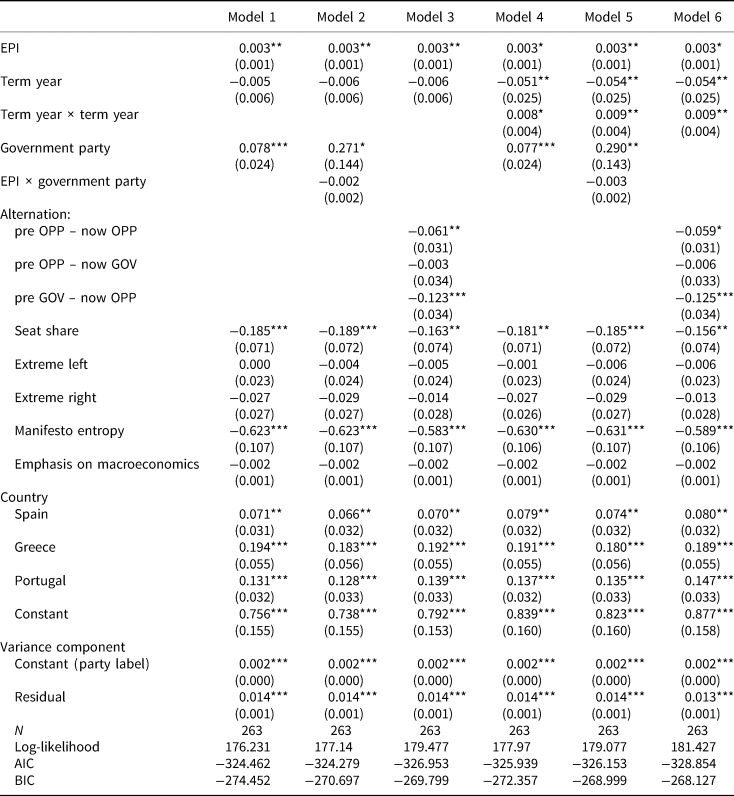
In order to analyze in a more systematic way the variability of issue congruence between parties’ manifestos and parliamentary questions, we now test the hypotheses put forward in the above theoretical section. As discussed earlier, our data have a hierarchical structure: party occurrences per year are the units of analysis and are nested in party labels within the same legislative term. In turn, party labels are nested in parliamentary terms and these are nested in countries. Therefore, we ran multilevel linear regressions with random intercepts on party labels (Steenbergen and Jones, Reference Steenbergen and Jones2002; Rabe-Hesketh and Skrondal, Reference Rabe-Hesketh and Skrondal2012).Footnote 15 The results are reported in Table 4. In the first three models, we assess the relationship between issue dissimilarity and time effects of the electoral cycle by using the variable Term Year that refers to the different years within a parliamentary term. In particular, Model 1 is the baseline model, while in Model 2 the indicator measuring countries’ economic performance (EPI) is interacted with the dummy Government Party. Model 3 incorporates Alternation, which is the categorical variable that we have created for capturing the impact of shifts in party status from opposition to government (and vice versa). Models 4–6 replicate the same analyses, but the impact of time is now modeled by adding the squared variable Term Year × Term Year.
Analyses of issue dissimilarity between parties’ manifestos and parliamentary questions (Greece, Italy, Portugal, and Spain, 2000–2015)

Notes: Multilevel regression models with random intercepts on party label. Omitted reference category for alternation: pre GOV – now GOV. Omitted reference category for country: Italy.
Statistical significance: *P < 0.1, **P < 0.05, ***P < 0.01.
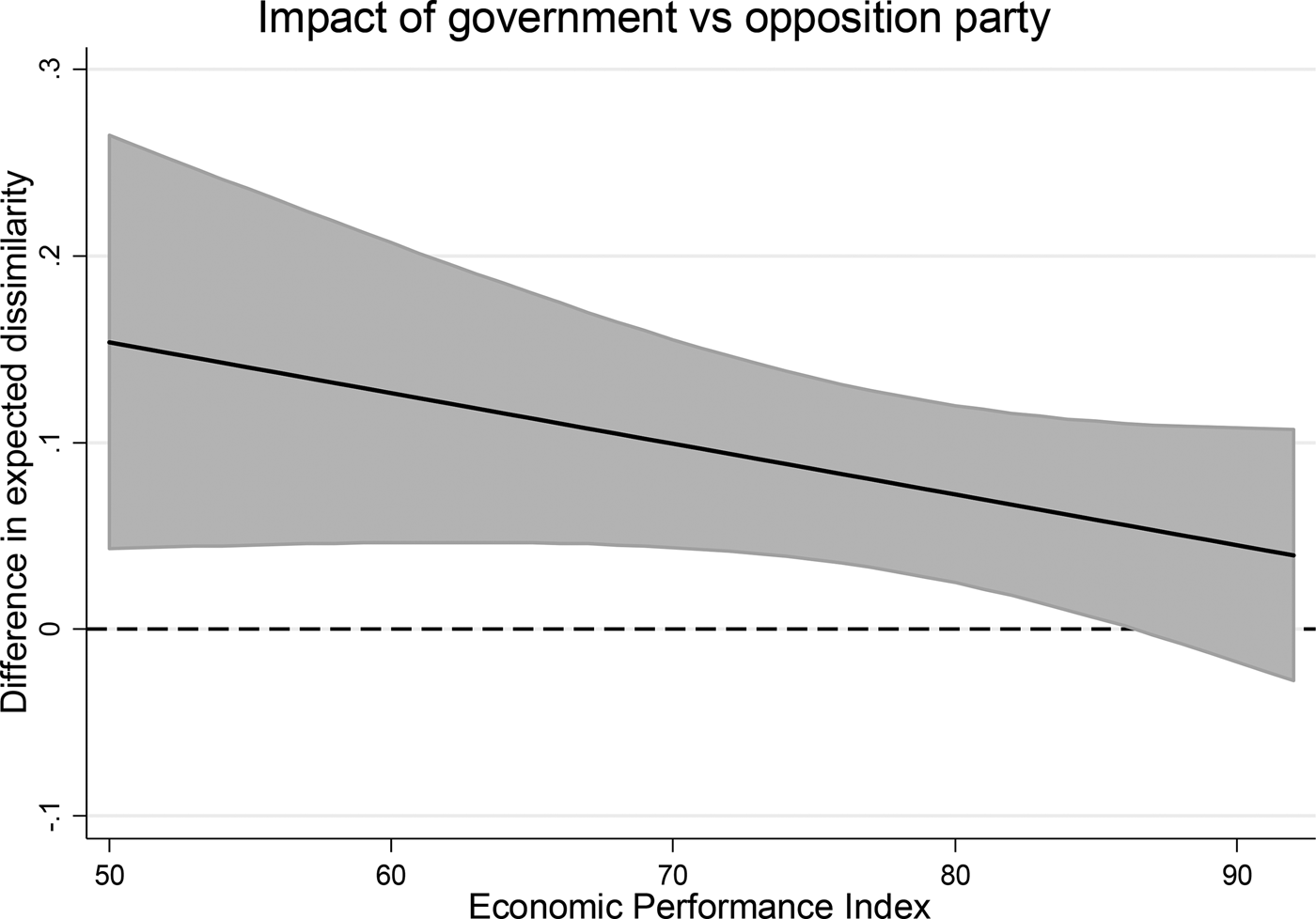
Let us recall that in our analyses the dependent variable is a measure of issue dissimilarity. Hence, a positive sign on the estimated coefficients indicates greater dissimilarity (lower congruence), while a negative sign indicates lower dissimilarity (higher congruence). The results in Table 4 lend mixed support for the three hypotheses outlined in the theoretical section. As to H1, the worsening of economic conditions related to the crisis (external shock) is not found to increase issue dissimilarity between parties’ manifestos and parliamentary questions. On the contrary, and quite surprisingly, the EPI variable in the baseline model (Model 1) has a positive sign, suggesting that better economic conditions are associated with higher dissimilarity between a party's manifesto and ensuing parliamentary questions. However, Model 2 shows that the positive relation between better economic performance and issue dissimilarity only holds for opposition parties. Although the interaction between EPI and Government Party is not statistically significant, the positive and significant coefficient on EPI indicates that, when the dummy Government Party is equal to zero (i.e. when a party is in opposition), issue dissimilarity becomes larger the better is the state of the national economy. In other words, opposition parties present higher levels of congruence when their country's economy gets worse.
Figure 2 displays the estimated difference in the manifesto-question dissimilarity between government and opposition parties, as a function of the EPI. This picture shows that the expected difference is not statistically different from zero when a country's economy is in good shape, while it becomes positive – that is, dissimilarity is greater for government parties than for opposition parties – when the economy goes bad. These findings appear to suggest that, in times of economic hardship, opposition parties, which are less bound by the constraints of incumbency, tend to challenge the government in parliament by insisting on the agenda of priorities outlined in their own manifesto.
Difference in expected manifesto-question dissimilarity between government and opposition parties, as a function of the Economic Performance Index.

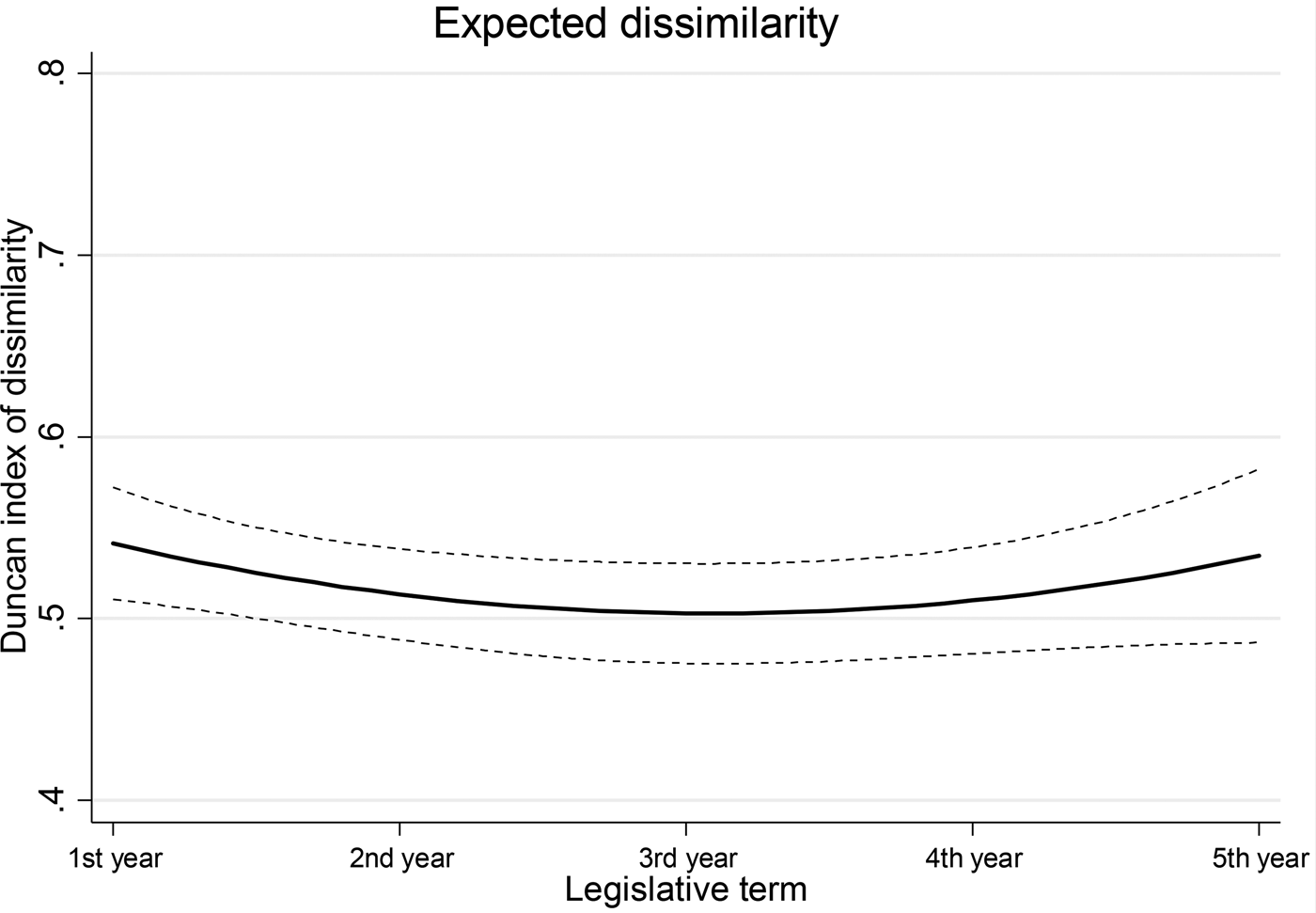
With regard to H2, our findings show that the relationship between manifesto-question dissimilarity and the time that has passed in the course of a legislative term is rather complex. Models 1–3 indicate that such a relationship is not linear. As highlighted in Models 4–6, dissimilarity is affected by a curvilinear function of time. Time has a U-shaped impact on manifesto-question dissimilarity: while at the beginning of the parliamentary term it progressively decreases, after a certain point (more precisely, after the third year since the last election), it increases (see Figure 3). It appears that parties need a time window of several months/years to be able to pursue their electoral agenda within parliament. After the mid-point of the legislative term, we found a decline in the correspondence between issue emphases in manifestos and parliamentary questions. This may be attributed to the accumulation of external events, or to parties’ attempts to build a fresh programmatic agenda in view of new elections.
Effect of the electoral cycle on the issue dissimilarity between parties’ manifestos and their parliamentary questions.

As far as H3 is concerned, issue dissimilarity is greater for governing parties than for their opposition counterparts. This is consistent with our expectations and holds across models. Moreover, our analyses (Models 3 and 6) provide evidence that shifting from the government to the opposition systematically reduces a party's manifesto-question dissimilarity. The negative and statistically significant coefficient on the pre GOV – now OPP category indicates that, compared with the parties that have remained in the cabinet, those opposition parties that in the previous year were in the cabinet now present lower dissimilarity rates. After leaving the cabinet, parties are free to pursue their own electoral agenda through parliamentary questions. Unsurprisingly, the analysis also shows that manifesto-question dissimilarity tends to be lower for the parties that remain in the opposition than for the parties that remain in the government.
Turning now to the control variables included in our analyses, the ideological position of parties is not found to affect manifesto-question dissimilarity. The same happens to the emphasis put on crisis-related issues in the manifestos: we do not observe an increase in issue congruence simply because parties include crisis-related topics in their manifestos. In contrast, dissimilarity is lower for larger parties and for those parties whose manifesto gives emphasis to a wider set of policy topics. Large mainstream parties show a stronger capacity to forward their own electoral priorities within parliament, while smaller and single-issue parties are less able to do so. Finally, the analysis highlights some differences across countries that in part we have anticipated above in our descriptive account. Compared with Italian parties, dissimilarity between manifesto and parliamentary questions tends to be higher for Portuguese, Spanish, and, especially, Greek parties.
Conclusion
We started our work with the assumption that the crisis context has produced a negative impact on parties as purposeful actors able to formulate policy priorities and to set the institutional agenda following those priorities. Through our analysis, we found that the crisis context has not produced a linear trend on party issue congruence. As far as governing parties are concerned, the level of congruence between manifestos and parliamentary questions remained largely unaffected by the economic cycle. However, when it comes to opposition parties, the crisis magnified their capacity to maintain programmatic coherence. Our analysis shows that, in southern Europe, the Great Recession worked as a helping hand for opposition parties that managed to present themselves as coherent actors with structured policy platforms. This may well explain the fall of popularity among the incumbents and the high alternation rate in government experienced by these crisis countries in the past years. Furthermore, it could help to account for the electoral emergence and rise to power of radical opposition parties (SYRIZA, Five Star Movement, Northern League, Podemos).
We also found that opposition parties tend to maintain greater issue congruence than governing parties. This result consolidates an emerging finding of the policy agenda literature pointing to governing parties facing serious obstacles when setting the agenda coherently with their electoral pledges, especially when it comes to question time. Parliamentary questions provide a good opportunity for opposition parties to publicly criticize the government and to attract attention to their preferred topics. In the light of our findings, we suggest that these two goals are not mutually exclusive. Although our data cannot prove it directly, it appears credible to assume that the questions coming from opposition parties contain an implicit or explicit critique of the government. At the same time, however, they also focus on reiteration of the same signature issues they have stressed during the electoral campaign.
The impact of time on issue congruence is not linear, but time progressively adds information to which parties should adapt. Rather, our data reveal an electoral cycle effect according to which congruence is lower in the aftermath of the previous elections and before the next ones. While the low point touched at the end of the term is consistent with our argument, it is more difficult to make sense of the relatively long time-span needed after elections to reach the highest congruence. This is an interesting phenomenon that is worth additional scrutiny if one wants to understand whether this is a peculiarity of the countries examined in the article or, instead, it reveals an empirical regularity in need of theoretical explanations.
Data
The replication dataset is available at http://thedata.harvard.edu/dvn/dv/ipsr-risp.
Supplementary material
The supplementary material for this article can be found at https://doi.org/10.1017/ipo.2019.9.
Author ORCIDs
Andrea Pedrazzani, 0000-0003-1262-2686.
Acknowledgements
An earlier version of this article was presented at the Tenth General Conference of the European Consortium for Political Research, held in Prague, 7–10 September 2016. We thank Catherine Moury and all participants of the panel ‘Rewriting Policy Agenda: Party Pledges, Issue Prioritisation and Policy-Making’ for discussing the article. We also thank two anonymous referees for their helpful comments and suggestions.
Financial support
The authors would like to acknowledge the support by the Unitelma Sapienza University research grant 2014 for data collection and the final support of the 2015 PRIN Project of the Italian Ministry of Education: ‘Politics and policy in Europe in times of crisis: Causes and consequences’ (Prot. 2015P7RCL5).