

Introduction
Nationally, 53 million tonnes of carbon dioxide equivalent (MtCO2e) emissions are produced in Norway every year, of which around 8% is attributed to agriculture. Agriculture contributes almost 50% of the total human-sourced methane (CH4) emissions produced in Norway. About 90% of agricultural emissions in Norway are attributed to feed and livestock production (Grønlund and Harstad, Reference Grønlund and Harstad2014). Thus, greenhouse gas (GHG) emissions associated with production of grains and vegetables for human consumption are rather low. In Norway, dairy sector exclusive recruitment contributes around 30% of the GHG emissions from animal production (Grønlund and Harstad, Reference Grønlund and Harstad2014). The major GHGs associated with Norwegian dairy farming are methane and nitrous oxide. It is likely that the projected increase in population and the increased demand for food production by at least 20% by 2030 in Norway will be accompanied environmental side effects. Therefore, the Norwegian Ministry of Agriculture and Food suggests a 20% reduction in agricultural emissions from 1990 levels by 2020 (Climate and Pollution Agency, 2013). Even though many studies to date have investigated the impact of animal- (e.g. breeding cows with high feed conversion efficiency) and diet-related factors (e.g. adding fat) on production and mitigation of GHG emissions, there is little information available about the impact of impaired health (e.g. subclinical mastitis) on GHG emissions. Production losses related to udder health are commonly measured by somatic cell count (SCC). Impaired animal health such as through subclinical mastitis is associated with shorter lifetime, and hence increased replacement rate. This study aims to demonstrate the impact of high SCC and replacement rate on GHG emissions produced from Norwegian dairy systems, using a modelling approach.
Material and methods
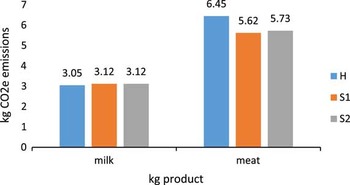
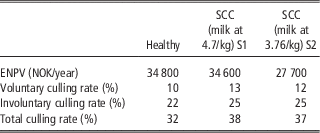
A dynamic programming (DP) model of dairy cow replacement decision problem was used to estimate the optimised total culling rate that consists of involuntary and voluntary culling rates as well as structure of the herd in terms of proportion of animals in each parity. The objective of the DP was to maximise the expected gross margins over feed (i.e. expected net present value (ENPV) of margin over feed expressed as an annuity) from a current lactating cow and future cows over an infinite time horizon by making appropriate replacement decisions. Once the replacement rates were obtained from the DP model, HolosNor (Bonesmo et al., Reference Bonesmo, Beauchemin, Harstad and Skjelvåg2013) was used to calculate the change in GHG emissions. HolosNor is a farm-scale model that estimates net farm GHG emissions from combined dairy and beef farming systems in Norway, accounting for all significant GHG emissions including soil C changes. The three scenarios compared were: (i) a healthy herd with an SCC of 50 000 cells/ml and below, and milk price of 4.7 NOK/kg; (ii) a diseased herd with an SCC of 200 000 cells/ml and above, and milk price of 4.7 NOK/kg; and (iii) a diseased herd in (ii) but with a milk price of 3.76 NOK/kg due to penalty (Table 1, Figure 1).
The greenhouse gas emissions produced for kg milk and meat under three scenarios examined.

The output of the dynamic programming model for expected net present value (ENPV) and culling rates

SCC=somatic cell count.
Conclusion
Results showed that the healthy cows, for any level of milk price, achieved higher ENPVs than the diseased cows (34 800 v. 34 600 and 27 700 NOK/year for healthy and diseased cows, respectively). The GHG emissions produced per kg of milk increased by 2% in the diseased scenarios relative to the healthy scenario. This increase in emissions can be, in part, attributed to the increased culling rate in the diseased scenario, resulting in a younger herd partitioning less of their energy into milk production. The reduction in the GHG emissions produced per kg of meat may have been resulted from the higher number of older than second lactating cows in healthy herds than those in diseased herds (71 v. 66 and 67 cows, respectively). The increase in the GHG emissions produced per kg milk in diseased scenarios warrants a potential for mitigation in herds with subclinical mastitis.
Acknowledgement
This study was funded by the Research Council of Norway and FACCE-JPI through the MACSUR knowledge hub.
Further information
The LiveM International Livestock Modelling and Research Colloquium was hosted by the Basque Centre for Climate Change (BC3) at the Maritime Museum in Bilbao, Spain between 14 and 16 October 2014. LiveM is the livestock and grassland modelling theme of the EU knowledge hub Modelling European Agriculture with Climate Change for Food Security (MACSUR). The MACSUR project is a pilot knowledge hub started by FACCE-JPI in 2012. It provides an opportunity to explore the role and potential of multi-disciplinary networking structures to address complex regional and global issues. More information on MACSUR and the LiveM theme can be found at www.macsur.eu, with PDFs of slides from conference presentations available through the conference website (http://www.livem2014bilbao.com/).