Introduction
The lifetime prevalence of post-traumatic stress disorder (PTSD) in women is approximately 10–13%, nearly twice that in men (Resnick et al. Reference Resnick, Kilpatrick, Dansky, Saunders and Best1993; Kessler et al. Reference Kessler, Sonnega, Bromet, Hughes and Nelson1995; Breslau et al. Reference Breslau, Kessler, Chilcoat, Schultz, Davis and Andreski1998) and alcohol abuse and dependence occur at much higher rates in women with PTSD than in women from the general population (Breslau et al. Reference Breslau, Davis, Peterson and Schultz1997; Kessler et al. Reference Kessler, Crum, Warner, Nelson, Schulenberg and Anthony1997; Perkonigg et al. Reference Perkonigg, Kessler, Storz and Wittchen2000; Danielson et al. Reference Danielson, Amstandter, Dangelmaier, Resnick, Saunders and Kilpatrick2009). According to National Comorbidity Survey (NCS) data, 27.9% of women with PTSD meet diagnostic criteria for alcohol use disorders (AUDs), compared to only 13.5% without PTSD (Kessler et al. Reference Kessler, Sonnega, Bromet, Hughes and Nelson1995). Although their co-occurrence is well documented, the mechanisms underlying the association between PTSD and AUDs have not been clearly established. One plausible link is a common source of genetic risk.
The heritability of alcohol dependence (AD) is 50–60% (Reed et al. Reference Reed, Page, Viken and Christian1996; True et al. Reference True, Heath, Bucholz, Slutske, Romeis, Scherrer, Lin, Eisen, Goldberg, Lyons and Tsuang1996; van den Bree et al. Reference van den Bree, Johnson, Neale, Svikis, McGue and Pickens1998), with the remainder of variance accounted for by individual-specific (i.e. non-shared) environmental influences. Twin studies of PTSD indicate that PTSD is attributable to a greater extent to individual-specific environmental sources of influence (with no substantial shared environmental influences), but genetic contributions are consistently found, typically accounting for about 30% of variance in risk for the disorder (True et al. Reference True, Rice, Eisen, Heath, Goldberg, Lyons and Nowak1993; Stein et al. Reference Stein, Jang, Taylor, Vernon and Livesley2002; Koenen et al. Reference Koenen, Fu, Ertel, Lyons, Eisen, True, Goldberg and Tsuang2008). Unlike AD, which has been studied extensively in females, producing nearly identical heritability estimates to those found for males (Kendler et al. Reference Kendler, Neale, Heath, Kessler and Eaves1994; Heath et al. Reference Heath, Bucholz, Madden, Dinwiddie, Slutske, Bierut, Statham, Dunne, Whitfield and Martin1997; Prescott et al. Reference Prescott, Aggen and Kendler1999), genetic influences on PTSD in women have been examined in only one known twin study (Stein et al. Reference Stein, Jang, Taylor, Vernon and Livesley2002). The vast majority of genetically informative research on PTSD is based on twins from the all-male Vietnam Era Twin Registry (VETR).
Potential common genetic contributions to PTSD and AD have been tested in studies using the VETR sample. Xian et al. (Reference Xian, Chantarujikapong, Scherrer, Eisen, Lyons, Goldberg, Tsuang and True2000) examined PTSD in combination with AD and illicit drug dependence (DD) and reported that 15.3% of variance in PTSD was accounted for by heritable influences common to AD and DD and 55.7% of variance in AD was attributable to genetic sources of influence shared by PTSD and DD. In Scherrer et al.'s (Reference Scherrer, Xian, Lyons, Goldberg, Eisen, True, Tsuang, Bucholz and Koenen2008) study of combat exposure, PTSD and AD in VETR twins, a link found between combat exposure and AD was accounted for by genetic influences shared with PTSD. By contrast, in Koenen et al.'s (Reference Koenen, Lyons, Goldberg, Simpson, Williams, Toomey, Eisen, True, Cloitre, Wolfe and Tsuang2003) co-twin control design study, rates of AD in monozygotic (MZ) co-twins of PTSD-positive twins did not differ from MZ co-twins of combat-exposed twins who did not develop PTSD, indicating that genetic liability to PTSD did not confer additional risk for AD.
All of these VETR studies accounted for possible heritable contributions to trauma exposure, which may otherwise be misattributed to PTSD (Seedat et al. Reference Seedat, Niehaus and Stein2001; Afifi et al. Reference Afifi, Asmundson, Taylor and Jang2010). Lyons et al. (Reference Lyons, Goldberg, Eisen, True, Tsuang, Meyer and Henderson1993) estimated heritability of combat exposure to be 47% in the VETR sample and Stein et al. (Reference Stein, Jang, Taylor, Vernon and Livesley2002) found evidence for genetic contributions to assaultive (but not non-assaultive) trauma in their general population-based twin sample. An individual's genetic composition clearly does not directly influence the likelihood of experiencing trauma, but may do so indirectly through heritable personality traits. Jang et al. (Reference Jang, Stein, Taylor, Asmundson and Livesley2003), for example, found a substantial genetic correlation between exposure to assaultive trauma and both juvenile antisociality and openness to new experiences. Thus, to accurately characterize the relative genetic and environmental influences on PTSD and the overlap of these influences on those that contribute to AD, trauma exposure must also be modeled.
The current study was guided by two primary aims. The first was to estimate heritability of PTSD in young women, using a large (n=3768) community-based sample. This is itself a unique contribution to the literature, as the one known twin study addressing PTSD that included women was based on only 812 twins (25% of whom were male) and examined symptoms rather than the full PTSD diagnosis (Stein et al. Reference Stein, Jang, Taylor, Vernon and Livesley2002). Our second aim was to test for common genetic influences on PTSD and AD in women after accounting for possible heritable influences on trauma exposure. Given the gender differences in rates of exposure to various types of trauma, conditional probability of developing PTSD following trauma exposure (Resnick et al. Reference Resnick, Kilpatrick, Dansky, Saunders and Best1993; Breslau et al. Reference Breslau, Kessler, Chilcoat, Schultz, Davis and Andreski1998; Hapke et al. Reference Hapke, Schumann, Rumpf, John and Meyer2006), and prevalence of AD (Holdcraft & Iacono, Reference Holdcraft and Iacono2002; Hasin et al. Reference Hasin, Stinson, Ogburn and Grant2007; Keyes et al. Reference Keyes, Grant and Hasin2008), patterns of heritable influences may differ considerably from what has been observed in combat-exposed males.
Method
Participants
The sample was composed of 3768 female twins: 964 MZ pairs, 808 dizygotic (DZ) pairs, and 243 singletons from the Missouri Adolescent Female Twin Study (MOAFTS). The MOAFTS is a longitudinal study of alcohol-related problems and associated psychopathology in female adolescents and young adults using twins born in Missouri between 1975 and 1985. Twins were identified through birth records and recruited from 1995 to 1999 using a cohort-sequential design. Cohorts of 13-, 15-, 17- and 19-year-old female twin pairs and their families were ascertained in the first 2 years. New cohorts of 13-year-old twins and their families were added in the subsequent 2 years. Parental diagnostic interviews were completed by at least one parent in 78% of eligible families. [See Heath et al. (Reference Heath, Howells, Bucholz, Glowinski, Nelson and Madden2002) for additional information on ascertainment.] Wave 3 retest interviews were conducted with a subset of Wave 1 participants 2 years after Wave 1 was completed. (Data were not drawn from Wave 2 assessments as they did not cover all domains of interest for this study and referenced experiences from only the previous 24 months.) All twins from the target cohort (excluding those who had asked not be recontacted) were contacted for Wave 4 interviews, which were conducted from 2002 to 2005. (Approximately 83% of Wave 1 participants took part in Wave 4. Attrition was not related to history of childhood trauma.) PTSD diagnoses were collected only at Wave 4, but trauma exposure and AD diagnoses were also assessed in Waves 1 and 3. Lifetime trauma and AD status were established using data from all available waves of data collection (78% of the sample had participated in Wave 1 and/or Wave 3). Mean age at the time of Wave 4 interviews was 21.7 years (s.d.=2.7, range=18–29). Eighty-five per cent of the sample self-identified as Caucasian, 15% as African-American.
Procedure
Data were collected by telephone by trained interviewers. At baseline, a screening to determine zygosity of the twin pair was conducted with one of the twins' parents. Parental diagnostic interviews were then scheduled and conducted after verbal consent was obtained. Interviews with the twins were conducted after obtaining verbal consent (and parental consent for those under the age of 18). The same protocol was followed in Waves 3 and 4. An interview modified for telephone administration from the Semi-Structured Assessment for the Genetics of Alcoholism (SSAGA/SSAGA-II; Bucholz et al. Reference Bucholz, Cadoret, Cloninger, Dinwiddie, Hesselbrock, Nurnberger, Reich, Schmidt and Schuckit1994; Hesselbrock et al. Reference Hesselbrock, Easton, Bucholz, Schuckit and Hesselbrock1999) was used to assess trauma history, early childhood home environment, and DSM-IV diagnoses, including PTSD and AD.
A standard trauma checklist (adapted from the checklist used in the NCS) was used to query history of traumatic experiences. In an effort to capture as many cases of trauma exposure as possible, child maltreatment and sexual assault questions were also included in other sections of the interview under different wording.
Trauma checklist
Respondents were asked if they had experienced any of the following events: (1) fire, flood, or natural disaster; (2) life-threatening accident; (3) witnessing someone being badly injured or killed; (4) rape; (5) sexual molestation; (6) physical abuse as a child; (7) serious physical attack or assault; (8) serious neglect as a child; and (9) being threatened with a weapon, held captive, or kidnapped.
Additional child maltreatment and sexual assault questions
Childhood physical abuse and neglect (CPAN) were queried in the early home environment section, which covered experiences that occurred from 6 to 13 years of age. Participants were coded positive for CPAN if they reported either of the following experiences as occurring often: (1) ‘hit with a belt or stick or something like that’ or (2) ‘physically punished so hard that you hurt the next day’ (with mother figure and father figure queried separately); or if they endorsed (3) ‘being physically injured or hurt on purpose by any adult.’ CPAN criteria could also be met by endorsing (4) ‘non-physical, harsh (lock in closet, deprive of food)’ or ‘physical harsh (use weapon, punch, whip)’ as the usual means of punishment by either the mother figure or father figure (queried separately). Sexual molestation was assessed in the home environment section by asking whether before age 16 there was any forced sexual contact with (1) a family member or (2) anyone 5 or more years older. History of rape was assessed in the sexual maturation with the question, ‘Has anyone ever forced you to have sexual intercourse?’
Trauma status
Individuals who endorsed criteria at any wave of data collection were coded as positive for that traumatic event. A three-level variable was used to represent trauma status, with no trauma (i.e. none of the items on the traumatic event checklist endorsed and neither child maltreatment nor sexual assault criteria met) as ‘0’, non-assaultive trauma (fire, flood, or natural disaster, life-threatening accident, or witnessing someone being badly injured or killed endorsed on the traumatic event checklist) only as ‘1’, and assaultive trauma (child maltreatment or sexual assault criteria met or rape, sexual molestation, physical abuse, neglect, serious physical attack or assault, or being threatened with a weapon, held captive, or kidnapped endorsed on the traumatic event checklist) as ‘2’. A total of 43.9% of the sample did not report any trauma, 22.1% reported non-assaultive trauma only, and 34.0% reported assaultive trauma. The ranking of assaultive trauma above non-assaultive trauma with respect to risk for PTSD was based on prior literature (Resnick et al. Reference Resnick, Kilpatrick, Dansky, Saunders and Best1993; Breslau et al. Reference Breslau, Kessler, Chilcoat, Schultz, Davis and Andreski1998; Hapke et al. Reference Hapke, Schumann, Rumpf, John and Meyer2006) and on empirical findings in our data. Participants who experienced assaultive trauma had more than 19 times the odds of developing PTSD than those exposed only to non-assaultive trauma [odds ratio (OR) 19.18, confidence interval (CI) 7.83–47.01] (10.4% developed PTSD compared to 0.6% of women exposed only to non-assaultive trauma). [Prevalence and conditional probability of developing PTSD are reported for each qualifying event in McCutcheon et al. (in press).]
The conditional nature of the PTSD diagnosis (i.e. its contingency on exposure to trauma) necessitated the use of a three-level trauma variable when modeling trauma and PTSD in combination. Correct model specification required that more than one category of trauma exposure had the potential to be associated with positive PTSD status. We allowed for this possibility by classifying trauma as assaultive, non-assaultive, and absent rather than simply present or absent. [See Heath et al. (Reference Heath, Howells, Bucholz, Glowinski, Nelson and Madden2004) for this approach to structural equation modeling with contingent phenotypes.]
PTSD
All respondents endorsing one or more traumatic events in the trauma checklist administered at Wave 4 (n=1684; 44.5% of the sample) were asked which of the events they experienced was the most disturbing. They were then asked if they had experienced ‘intense fear, helplessness, or horror’ following that event (DSM-IV Criterion A). For those who responded ‘yes’, this became the index event for which PTSD symptoms were assessed. For Criteria B, C and D, diagnostic questions were administered only if the preceding criterion was met. Criterion B was met if 1 or more of the five possible re-experiencing symptoms were endorsed. Meeting Criterion C required endorsement of three or more of the seven possible avoidance symptoms. Criterion D was met if two or more of the five arousal symptoms were endorsed. A diagnosis of PTSD was given if Criteria A–D were met and respondents reported clinically significant distress or impairment and persistence of symptoms for ⩾1 month. The prevalence of PTSD in the sample was 3.7% (n=138). As a PTSD diagnosis is contingent on trauma exposure, participants who did not endorse any traumatic experiences were coded as missing for PTSD.
AD
AD was also defined according to DSM-IV, as three or more of the seven possible AD symptoms occurring during the same 12-month period. Individuals who endorsed full AD criteria at any wave of data collection were coded positive for lifetime AD.
Data analysis
Twin modeling
Genetic analyses conducted with twins reared together are used to decompose the variance of a phenotype into additive genetic sources (A), shared environmental sources (C; influences that make members of a twin pair more alike, such as family and school) and environmental influences that contribute to within-pair differences (E). Genetic influence is suggested by higher correlations in MZ than DZ twin pairs for the phenotype; shared environmental influence is indicated by DZ twin correlations exceeding half of MZ twin correlations. Non-additive sources of genetic influence (D) can be estimated in place of C when the correlation between members of DZ twin pairs is less than half of that between their MZ counterparts. However, as C and D cannot be estimated jointly when data from twins alone are used, the choice of an ACE versus an ADE model is made based on results of twin correlations. In our sample, the DZ correlations were greater than half the MZ correlations for trauma exposure (r DZ=0.51, r MZ=0.60) and AD (r DZ=0.45, r MZ=0.71). In the case of PTSD, the twin correlation for DZs was less than half that for MZs (r DZ=0.19, r MZ=0.69). We therefore tested an ADE model in the univariate analysis. D could be dropped without a significant change in model fit, so we fitted an ACE model to represent genetic and environmental influence on the three phenotypes in the trivariate analysis.
Trivariate Cholesky
A trivariate genetic Cholesky decomposition was fitted to assess the degree of overlap in genetic and environmental influences between trauma exposure, PTSD and AD. Models were fitted in Mx (Neale et al. Reference Neale, Boker, Xie and Maes2003) using raw categorical data. Thresholds were adjusted for age at time of report (divided into three approximately equal groups based on age distributions) using two dummy variables for each phenotype: 13–18 and 22–29, with 19–21 as the comparison group for trauma exposure; 18–19 and 25–29, with 20–24 as the comparison group for PTSD (because all participants were 18 or older when PTSD was assessed); and 13–19 and 23–29, with 20–22 as the comparison group for AD. For those individuals who did not endorse a given condition/diagnosis, age at time of report was coded as age at Wave 4 interview, that is, age at the time the absence of that condition/diagnosis was reported. A series of submodels examining the statistical significance of A, C and E were compared to the full model to derive the best-fitting trivariate model. Submodels were tested by calculating the difference between the −2 log likelihood fit of the full model and the nested submodel, which is distributed as χ2 for the given degrees of freedom.
Results
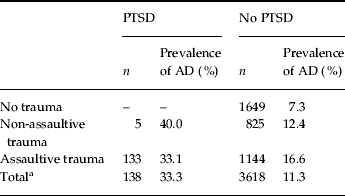
Table 1 displays the rates of AD by non-assaultive and assaultive trauma status separately for those who met criteria for PTSD and those who did not (and also for women who did not report any traumatic experiences). As expected, a greater proportion of women with versus without lifetime PTSD diagnoses were alcohol dependent: one in three compared to only one in nine. Rates of AD did not differ significantly by non-assaultive versus assaultive trauma status among women with PTSD (although this finding should be interpreted with caution, given the low prevalence of PTSD in women who experienced only non-assaultive trauma). However, increasing rates of AD from no trauma (7.3%) to non-assaultive trauma (12.4%) to assaultive trauma (16.4%) were observed in women without PTSD [χ2(2)=59.3, p<0.001].
Rates of lifetime DSM-IV AD by trauma and lifetime DSM-IV PTSD status

PTSD, Post-traumatic stress disorder; AD, alcohol dependence.
a Thirty-one cases missing trauma status.
Within-twin cross-trait polychoric correlations revealed modest associations between the phenotypes. For trauma exposure and AD, r=0.27, and for PTSD and AD, r=0.30.
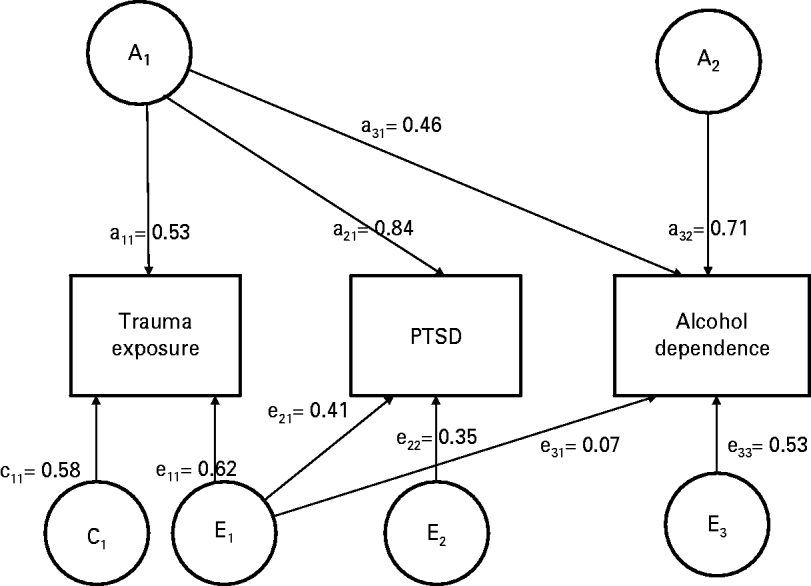
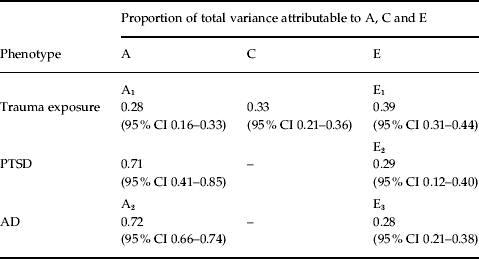
The best-fitting trivariate Cholesky is shown with unstandardized path coefficients in Fig. 1 and summarized with standardized coefficients and 95% confidence limits in Table 2. The final model was derived by conducting a series of tests. First, for each phenotype we dropped the A and C variance components with values below 0.40 (A for trauma exposure and C for PTSD and AD) one at a time and compared the resulting submodels to the full model. Dropping the A pathway from trauma exposure resulted in a significant deterioration in model fit [Δχ2 (3)=8.50, p=0.04], but removal of neither C pathway significantly impacted model fit. [For PTSD, Δχ2 (3)=2.78, p=0.43 and for AD, Δχ2 (3)=5.11, p=0.16.] In the second step, the C pathways were dropped simultaneously from PTSD and AD and the reduced model was compared to the full model. No deterioration in fit was observed [Δχ2 (5)=4.44, p=0.49], so the reduced model was accepted. Next, we tested this reduced model against a model in which a single factor accounted for genetic influences on trauma exposure and PTSD and found no significant change in model fit [Δχ2 (3)=0.16, p=0.92]. Variance in these three phenotypes was best represented with an ACE model for trauma exposure and AE models for PTSD and AD, with one genetic factor accounting for heritable influences on trauma exposure and PTSD and a second accounting for heritable influences on AD.
Trivariate Cholesky decomposition: genetic and environmental influences on trauma exposure, post-traumatic stress disorder (PTSD) and alcohol dependence (AD). Unstandardized pathways are shown. A, additive genetic; C, shared environmental; and E, non-shared environmental influences.

Magnitude of additive genetic (A), shared environmental (C), and non-shared environmental (E) influences on trauma exposure, PTSD and AD: best-fitting trivariate model

PTSD, Post-traumatic stress disorder; AD, alcohol dependence; CI, confidence interval.
In the final model, over two-thirds of the variance in PTSD (71%) and AD (72%) were attributable to additive genetic effects, with the remainder accounted for by individual-specific environmental influences. By contrast, only 28% of variance in trauma exposure was accounted for by genetic factors. Unlike either PTSD or AD, to which there was no evidence of significant shared environmental contributions, 33% of variance in trauma exposure was attributable to C. A considerable degree of overlap was observed between the two genetic factors, with r A1–A2=0.54, CI 0.31–0.66. Individual-specific environmental influences on trauma exposure were highly correlated with those contributing to PTSD (r E1–E2=0.75, CI 0.29–0.82) and modestly correlated with those contributing to AD (r E1–E3=0.13, CI 0.04–0.38), but CIs for covariance in E between AD and PTSD included 0, so this pathway was not included in the final model.
Discussion
The current investigation extends our understanding of the co-morbidity of PTSD and AD in women by characterizing common genetic and environmental contributions to the two disorders using a large, all-female community-based sample. Ours is the first known study to quantify the degree of overlap in the heritable and environmental influences on PTSD and AD in women and one of only a few to estimate heritability of PTSD in a sample that includes females. The existing literature is based primarily on an all-male twin sample in which combat was the traumatic event that led to PTSD. Our examination of PTSD and AD in an all-female population-based sample allows us both to uncover potential differences by gender in the relative role of genetics versus environment and to study the inter-relatedness of these heritable and environmental influences in the context of a broader range of trauma exposures.
Consistent with the existing literature, phenotypic analyses revealed elevated rates of lifetime AD diagnoses in women who had experienced traumatic events (Fergusson et al. Reference Fergusson, Horwood and Lynskey1996; Kilpatrick et al. Reference Kilpatrick, Acierno, Resnick, Saunders and Best1997; Wilsnack et al. Reference Wilsnack, Vogeltanz, Klassen and Harris1997), with an even more pronounced elevation in women meeting lifetime criteria for PTSD (Kessler et al. Reference Kessler, Sonnega, Bromet, Hughes and Nelson1995; Breslau et al. Reference Breslau, Davis, Peterson and Schultz1997; Danielson et al. Reference Danielson, Amstandter, Dangelmaier, Resnick, Saunders and Kilpatrick2009). We also found that, among women who reported traumatic events but had no history of PTSD, the likelihood of meeting AD criteria was higher in those who experienced assaultive versus only non-assaultive traumas (paralleling the elevated rates of PTSD in victims of assaultive events). Genetic analyses produced heritability estimates of 28%, 72% and 71% for trauma exposure, PTSD and AD respectively, and indicated that trauma exposure and PTSD were attributable to the same source of genetic variance. Whereas only additive genetic and individual-specific environmental influences were evident for PTSD and AD, shared environmental factors were also found to play a role in trauma exposure, accounting for 33% of variance. Of greatest relevance to our primary research question, we found that the genetic factors that contribute to trauma exposure and PTSD were correlated at 0.54 with those that contribute to AD, thus accounting for just under 30% of the genetic variance in AD. Although we did not test a causal model of the PTSD–AD association (Chilcoat & Breslau, Reference Chilcoat and Breslau1998), our findings have implications for such models, specifically that they need to take into account the contribution of common genetic influences to the two disorders.
The relative contributions of genetic and environmental factors to AD observed in our sample are very similar to those reported in earlier studies, with additive genetic factors accounting for just over half of the variance in the disorder and individual-specific, but not shared, environmental influences accounting for just under half (Kendler et al. Reference Kendler, Neale, Heath, Kessler and Eaves1994; van den Bree, Reference van den Bree, Johnson, Neale, Svikis, McGue and Pickens1998; Prescott et al. Reference Prescott, Aggen and Kendler1999). By contrast, the heritability estimate for PTSD in our sample is approximately twice that reported in earlier investigations. Xian et al.'s (Reference Xian, Chantarujikapong, Scherrer, Eisen, Lyons, Goldberg, Tsuang and True2000) study using the VETR sample, which is among the few to examine the full lifetime PTSD diagnosis, reported the heritability of PTSD to be 35%. Although not as directly comparable to our findings, similar values have been reported for PTSD symptoms. Stein et al. (Reference Stein, Jang, Taylor, Vernon and Livesley2002), for example, found that 38% of variance in PTSD symptoms was accounted for by genetic sources. Discrepancies between our findings and earlier reports cannot be attributed to the possible confounding effects of genetic contributions to trauma exposure itself, as we modeled trauma as a separate phenotype in our analyses. They are also not likely to be due purely to our exclusive focus on females or to the wider range of traumas represented in our sample, as the sample used by Stein et al. (Reference Stein, Jang, Taylor, Vernon and Livesley2002) was non-military and 75% female. However, given that Stein and colleagues did not test for gender differences in heritability estimates, it is possible that modest distinctions by gender in the relative contribution of genetic factors were present but not identified. Another factor to consider is that the prevalence of PTSD in our sample is lower than that reported for women in previous studies (Resnick et al. Reference Resnick, Kilpatrick, Dansky, Saunders and Best1993; Kessler et al. Reference Kessler, Sonnega, Bromet, Hughes and Nelson1995; Breslau et al. Reference Breslau, Kessler, Chilcoat, Schultz, Davis and Andreski1998). If this reflects under-reporting, we may have identified only the most severe cases of PTSD. To the extent that severity is associated with heritability, categorizing only cases at the high end of the severity continuum as positive for PTSD could inflate the heritability estimate. Importantly, although we found a greater relative contribution of additive genetic influences to PTSD than has been reported previously, the support in our sample for an AE model is consistent with all prior genetically informative studies of PTSD.
Although intended to be a statistical control rather than a focus of the current study, the results of genetic modeling of the trauma exposure phenotype merit comment. We found that 28% of variance in trauma exposure could be accounted for by genetic sources. In the VETR sample, Lyons et al. (Reference Lyons, Goldberg, Eisen, True, Tsuang, Meyer and Henderson1993) reported 47% heritability for combat exposure. Stein et al. (Reference Stein, Jang, Taylor, Vernon and Livesley2002) found no evidence for genetic influences on non-assaultive trauma, but estimated heritability for assaultive trauma at 20%. Our finding that 33% of variance in trauma exposure was accounted for by shared environmental factors is closely aligned with Stein et al.'s estimates of 21% and 39% for assaultive and non-assaultive trauma respectively, but contrasts sharply with the absence of shared environmental influences reported in the VETR sample. With so few studies against which to compare our results, it is difficult to draw any definitive conclusions, but the greater similarity of our results to those of Stein et al. (Reference Stein, Jang, Taylor, Vernon and Livesley2002)versusLyons et al. (Reference Lyons, Goldberg, Eisen, True, Tsuang, Meyer and Henderson1993) suggests that the relative contribution of genetic and shared environmental influences may vary by gender and/or nature of the trauma. Again, although rarely reported in other studies, the high genetic correlation we found between trauma exposure and PTSD has also been documented previously (Stein et al. Reference Stein, Jang, Taylor, Vernon and Livesley2002).
Despite our substantially higher heritability estimate for PTSD, the associations observed in our sample between genetic and environmental factors that influence PTSD and those that influence AD are highly comparable to results from the VETR sample (the only other sample in which genetic overlap between the disorders has been studied). In Xian et al.'s (Reference Xian, Chantarujikapong, Scherrer, Eisen, Lyons, Goldberg, Tsuang and True2000) study examining PTSD and AD in combination with drug dependence and also in Scherrer et al.'s (Reference Scherrer, Xian, Lyons, Goldberg, Eisen, True, Tsuang, Bucholz and Koenen2008) study examining PTSD and AD with combat exposure, common genetic contributions to PTSD and AD were evident. Also consistent with our findings, Scherrer et al. (Reference Scherrer, Xian, Lyons, Goldberg, Eisen, True, Tsuang, Bucholz and Koenen2008) found genetic overlap between combat exposure and PTSD.
Limitations
Certain limitations should be kept in mind when interpreting the results from the current investigation. First, although the higher rate of PTSD in women who experienced assaultive versus only non-assaultive traumas supports the validity of this distinction as a crude severity indicator, we expect that a more direct measure of severity (e.g. subjective ratings of distress) would be more accurate. Second, our use of retrospective reports introduced potential retrospective reporting biases, although the adjustments made for age at time of report for all three phenotypes likely reduced their impact. Third, although integrating data from earlier waves of data collection and other sections of the interview with the Wave 4 trauma checklist enhanced the accuracy in establishing trauma status, only individuals who endorsed events on the trauma checklist (which, unlike the questions from early home environment and sexual maturation questions, were not worded behaviorally) were assessed for PTSD. As a result, PTSD diagnoses were missing for this subset of the sample. Fourth, although highly comparable to the lifetime prevalence of trauma exposure reported in studies using similar definitions, the rate of trauma exposure in our sample is lower than that reported in studies using broader definitions (e.g. learning about a loved one experiencing a traumatic event). Fifth, most, but not all, participants had passed the age of risk for AD. Similarly, some women in our study who had not yet been exposed to trauma or developed PTSD are likely to do so in the future, so we cannot assume that our findings are equally valid in older women.
Future directions
Given the scarcity of the literature in this area, the first priority in this line of research is to attempt to replicate our findings in another genetically informative female sample. The next logical step is to test for gender differences in heritability of PTSD and its genetic overlap with AD in a civilian sample of men and women. Studies in this area are of particular interest in light of the absence of evidence of gender differences for other anxiety disorders (Hettema et al. Reference Hettema, Prescott, Myers, Neale and Kendler2005; Kendler et al. Reference Kendler, Prescott, Myers and Neale2003) and mixed evidence for depression (Bierut et al. Reference Bierut, Heath, Bucholz, Dinwiddie, Madden, Statham, Dunne and Martin1999; Franic et al. Reference Franic, Middledorp, Dolan, Ligthart and Boomsma2010). It is also important to address potential distinctions in both the link with AD and the relative contribution of genetic factors to childhood versus adulthood trauma exposure and PTSD onset. With respect to identifying populations at high risk for substance-related problems, it is also important to determine the extent to which our findings generalize to other substances of abuse.
Acknowledgments
This study was funded by grants AA009022, AA007728, AA017010, AA017688, AA018146 and AA011998 from the National Institute on Alcohol Abuse and Alcoholism, grant HD049024 from the National Institute of Child Health and Human Development, and grants DA014363, DA018267, DA027995, DA012854 and DA017305 from the National Institute on Drug Abuse.
Declaration of Interest
None.