As signaled by a recent series of national and global reports interest in agricultural sustainability has exploded. Agricultural systems are argued to be at a ‘crossroads’ (Foresight, 2011), ‘facing daunting challenges’ (IAASTD, 2009) and experiencing an ‘unprecedented confluence of pressures’ (National Research Council, 2010). The most commonly identified challenges are population growth, global climate change, environmental degradation and resource scarcity. Given these conditions, agricultural sustainability is championed as an urgent task that requires significant and immediate action.
While sustainability is garnering more attention, it remains a highly contested concept (Constance, Reference Constance2010; National Research Council, 2010; Thompson, Reference Thompson2010). There is little agreement on the meaning of sustainability beyond the idea of ensuring the viability of future generations. Key points of disagreement include the relationship between social sustainability and social justice, and the value of nature itself (Dobson, Reference Dobson1996). Thompson (Reference Thompson2010) argues that thinking about sustainability tends to fall into one of three approaches: resource sufficiency, functional integrity and social movement. From a resource sufficiency perspective, sustainability entails ensuring sufficient resources for the continuation of society. From a functional integrity perspective, sustainability means ensuring resilient social and ecological systems. From a social movement perspective, sustainability is a collective identity that ties together a diverse set of social and environmental organizations into a common movement to transform society and its relationship to the environment. Thompson (Reference Thompson2010) maintains that each of these three approaches encompasses different values and thus, will lead to different outcomes if implemented. Consequently, contemporary efforts to conceptualize sustainability are highly politicized and contested.
Much of the effort to define and operationalize agricultural sustainability is now taking place in private settings (Hatanaka, Reference Hatanaka2014; Loconto and Fouilleux, Reference Loconto and Fouilleux2014). Multi-stakeholder initiatives (MSIs) that develop metrics and standards have become the leading forum for conceptualizing sustainability (Tamm Hallstrom and Bostrom, Reference Tamm Hallstrom and Bostrom2010; Cheyns, Reference Cheyns, Ponte, Gibbon and Vestergaard2011; Hatanaka and Konefal, Reference Hatanaka and Konefal2013). MSIs are a form of network governance intended to bring together representatives of all potentially affected actors, and use consensus-based and transparent practices to develop standards, metrics and codes of conduct (Bäckstrand, Reference Bäckstrand2006; Tamm Hallstrom and Bostrom, Reference Tamm Hallstrom and Bostrom2010). As they are constructed on normative democratic principles, MSIs are generally viewed as more legitimate than other forms of governance (Cheyns, Reference Cheyns, Ponte, Gibbon and Vestergaard2011).
In this paper, we examine three MSIs that have developed sustainability metrics and a sustainability standard for US agriculture: Field to Market, the Stewardship Index for Specialty Crops (SISC) and the National Sustainable Agriculture Initiative (LEO-4000).Footnote 1 Field to Market has developed sustainability metrics for row crops and SISC has done the same for specialty crops. LEO-4000 has developed a sustainable agriculture standard for the USA that applies to all of agriculture, except livestock. In examining these three MSIs, our objectives in this paper are twofold. First, we use Thompson's three-part sustainability framework to analyze the ways that each of three MSIs has developed specific conceptualizations of sustainability. We find that two contrasting versions of sustainable agriculture for the USA have emerged from the three MSIs. On the one hand, Field to Market and SISC have developed eco-efficiency metrics that are largely congruent with a resource sufficiency conceptualization of sustainability. On the other hand, LEO-4000 has developed a standard that is largely aligned with a functional integrity approach, as it emphasizes the maintenance of diverse and resilient agricultural and ecological systems.
Secondly, we examine the governance practices of the MSIs to explain why such divergent conceptualizations of sustainability have been mapped out. As MSIs incorporate diverse stakeholders, MSIs are a site where different visions of sustainability are negotiated. Our analysis focuses on the ways that that these different visions of sustainability clash in MSIs, and the process by which collective agreement is reached. We find that far from being a neutral forum, the internal dynamics of MSIs often reflect and reproduce existing power relationships among stakeholders. The result is sustainability metrics and standards that tend advance incremental improvements in sustainability and not generate transformative change.
The findings in this paper are based on two data sources. The first set of data is reports and other documents produced by the three MSIs; these outline their metrics and standard, as well as other information about their metric- and standard-development processes. Secondly, we conducted 36 in-depth interviews between 2011 and 2013 with (ex-)participants and facilitators in Field to Market, SISC, and LEO-4000, as well as professionals and activists working on issues related to agricultural sustainability who were not formally part of these projects. Interviews focused on two primary topics: the ways that the metric- and standard-development process works and understandings of sustainable agriculture.
The remaining sections of the paper are organized accordingly. First, we provide an overview of theories of sustainability, with the focus primarily on Thompson's (Reference Thompson2010) three-part sustainability framework. Secondly, we briefly review the literature on metrics, standards and their development through MSIs. Thirdly, we introduce the three sustainable agriculture MSIs and outline their metrics and standard. Fourthly, we analyze the ways that the metrics and standard of Field to Market, SISC and LEO-4000 embody particular conceptualizations of sustainability. Fifthly, we examine how the governance processes of the MSIs have affected the metrics and standard that they have developed. In concluding, we discuss the implications of our findings for the future of agricultural sustainability in the USA. In particular, we highlight the way that the market embeddedness of MSIs moderates the ways that sustainability is operationalized in metrics and standards.
Theorizing sustainability
Despite its widespread usage, the meaning of sustainability remains highly contested (Constance, Reference Constance2010; National Research Council, 2010; Thompson, Reference Thompson2010). In assessing potential conceptualizations of sustainability, Dobson's ethical framework is a useful starting point. Dobson (Reference Dobson1996) develops a typology for mapping different meanings of sustainability based on four ethical questions: (1) what to sustain, (2) why, (3) what are the objects of primary concern and (4) what is the relationship between human-made and natural capital? For each of these questions, there is a continuum of potential answers, which taken collectively produce a range of conceptualizations of sustainability from weak to strong. In weak forms, natural resources are to be managed for human welfare and a high degree of technological substitutability is possible for natural resources (Solow, Reference Solow1974). In strong conceptualizations, ecological systems are to be maintained because of commitments to both human welfare and nature (Dobson, Reference Dobson1996; Neumayer, Reference Neumayer2003). Given the commitment to nature by proponents of strong conceptualizations of sustainability, technological substitutability is viewed as limited.
In his comprehensive review of the literature, Thompson (Reference Thompson2010) finds that understandings of sustainability generally fall into one of three approaches: resource sufficiency, functional integrity and social movements. He argues that each conceptualization of sustainability has different values embedded within it. Hence, the outcomes will vary according to the conceptualization of sustainability that is put into practice. In a resource sufficiency approach, sustainability is viewed as a question of ensuring sufficient resources for the continuation of society. Society must manage resources to ensure their continued availability for future generations, and invest in technologies that allow for greater access to natural resources (e.g., hydraulic fracking) and/or the development of alternative resources (e.g., solar). Thus, in resource sufficiency approaches, Thompson (Reference Thompson2010) notes that sustainability becomes largely an accounting question in that ‘one can tell if a practice is sustainable by measuring the rate at which resources are being consumed, then multiplying the rate of use by the time frame over which the practice is to be sustained. If current or foreseeable supplies meet or exceed the calculated amount, the practice is sustainable’ (p. 4). From this perspective sustainability is largely an economic question of optimizing resource use to meet social needs.
Applying the weak versus strong framework, resource sufficiency represents a weak form of sustainability, as the aim is preserving the future viability of society, with little consideration for the maintenance of healthy ecologies. The key constraint society faces is the decline and loss of natural capital (e.g., natural resources). Within weak sustainability approaches, the loss of natural capital is not a problem if technical innovation is able to offset declines in natural resources (Solow, Reference Solow1974; Neumayer, Reference Neumayer2003). That is, ecological scarcity or changing environmental conditions (e.g., climate change) do not constitute absolute limits to future economic development and social welfare, as natural resources are substitutable. Therefore, from a resource sufficiency perspective, a key task to achieving sustainability is ensuring sufficient investment and innovation.
A second way of thinking about sustainability is what Thompson (Reference Thompson2010) terms functional integrity. Functional integrity conceptualizes sustainability as an issue of regenerative systems. On the one hand, this means that an ecological system is sustainable if ‘the elements of the system—soil, water, flora and fauna—are reproducing within ranges that allow them to neither increase without limit nor decline into extinction’ (Thompson, Reference Thompson2010: p. 227). In this conceptualization of sustainability ecological systems are deemed to have intrinsic value. On the other hand, a functional integrity approach views ecological and social systems as interconnected and interdependent. As Thompson (Reference Thompson2010) notes, ‘the relevant system includes not only geology, climate, flora and fauna, but it also includes human institutions: habits, traditions, standing practices and organized forms of collective behavior such as governments, corporations, trade associations and political pressure groups’ (p. 229). Hence, sustainability entails both resilient social and ecological systems, as well as symbiotic relationships between the two.
Functional integrity represents a strong approach to sustainability in that the substitutability of natural capital is highly constrained (Neumayer, Reference Neumayer2003). Ecological degradation cannot necessarily be offset by technological innovations and hence, the depletion of natural capital will constrain future economic development and the welfare of society in ways that are often irreversible (Daly, Reference Daly1996). Thus, in contrast to resource sufficiency, a functional integrity approach defines robust and resilient ecosystems as necessary for the sustainability of society. A functional integrity also approach broadens understandings of social and economic sustainability. For example, social sustainability is not only a question of ensuring the reproduction of society, but is broadened to include the character of social reproduction (e.g., quality of life and cultural identity).
A third way of understanding sustainability is as a social movement. Building on the work of Allen and Sachs (Reference Allen and Sachs1992, Reference Allen, Sachs and Allen1993), Thompson (Reference Thompson2010) argues that for some activists and advocacy organizations, sustainability has become a banner used to critique contemporary society and its institutions. It is a frame used to tie together disparate causes (e.g., labor, environmental and sovereignty) in a critique of political, economic and cultural practices. In other words, sustainability is a collective identity that provides social and environmental advocacy organizations a shared understanding of the contemporary environmental crisis, the actions necessary to address it and its solution. From this perspective, sustainability is aspirational in that it signifies a world that is made up of radically different structures, practices and values. This banner approach differs from resource sufficiency and functional integrity in that it conceptualizes sustainability in a more amorphous and fluid manner. In resource sufficiency and functional integrity approaches, the sustainability of a given practice or technology is often debated, but the meaning of sustainability is relatively constant; whereas in the social movement approach the meaning of sustainability itself may change as movements and their priorities shift. For example, Thompson (Reference Thompson2010) notes that whether social justice or human rights are part of sustainability are dependent on the constellation of movements that are participating in the collective framing of sustainability.
Social movements focused on sustainability tend to fit with the notion of strong sustainability.Footnote 2 On the one hand, many social movements tend to be critical of existing structures and practices and thus, view achieving sustainability as requiring transformational change. On the other hand, the environmental advocacy organizations that make up the sustainability movement tend to view nature as having an intrinsic value, while social advocacy organizations tend to focus on social justice.
In the analysis presented below, we employ Thompson's framework to analyze the sustainability metrics and standard developed by Field to Market, SISC and LEO-4000. Thompson's framework helps to elucidate differences in the ways that each of the three initiatives conceptualizes agricultural sustainability, and the future trajectories that each initiative is mapping out for US agriculture.
Private governance and agrifood sustainability
Busch (Reference Busch2011) argues that metrics and standards are the ‘recipes by which we create realities’ (p. 2). By this, he means that they are tools for arranging humans and non-humans into particular configurations. In terms of sustainable agriculture, metrics and standards translate sustainability from a general concept to a set of concrete measurements and/or practices. The metrics and standards that get adopted, in turn, strongly influence, if not technically determine, the actual implementation of sustainability on farms (Loconto, Reference Loconto2010). Furthermore, once enacted, metrics and standards often become naturalized in that they become ‘part of the taken-for-granted technical infrastructure of modern life’ (Timmermans and Epstein, Reference Timmermans and Epstein2010: p. 71). This means that the politics, disagreements and negotiations that were part of the development process largely disappear from sight. Once specific metrics and standards for sustainable agriculture are implemented, modifying or replacing them becomes difficult.
Metric- and standard-development is increasingly taking place in the private sphere. In agriculture, private governance initiatives have become key sites where different interests and visions intersect and are negotiated (Busch, Reference Busch2011; Bain et al., Reference Bain, Ransom and Higgins2013; Konefal et al., Reference Konefal, Hatanaka, Constance, Constance, Renard and Rivera-Ferre2014). This includes sustainable agriculture, as much of the effort to define and enact sustainability is now located in the private sphere. While private governance can take different forms, MSIs are the preferred approach in sustainability governance (Ponte, Reference Ponte2014). In part, this trend is because MSIs are generally viewed as more legitimate than other forms of governance. Constructed on normative democratic principles, MSIs seek to use participatory and democratic practices in dialog and decision-making, reach decisions by consensus, and be transparent (Beisheim and Dingwerth, Reference Beisheim and Dingwerth2008; Tamm Hallstrom and Bostrom, Reference Tamm Hallstrom and Bostrom2010; Cheyns and Riisgaard, Reference Cheyns and Riisgaard2014). Their democratic character is claimed to result in metrics and standards that are inclusive of all stakeholders, and thus, are not biased toward specific actors.
While MSIs are commonly understood as among the most credible forms of private governance, recent research has begun to raise questions as to their democratic character. Research by Hatanaka et al. (Reference Hatanaka, Konefal and Constance2012) finds that there may be a distinction between the front stage appearance of MSIs and the actual backstage practices. They argue that while the formal structures and procedures of an MSI may comply with normative democratic principles, in actual practice there are often opportunities for actors to exert considerable influence in advancing their interests. Surveying recent sustainability MSIs, Cheyns and Riisgaard (Reference Cheyns and Riisgaard2014) similarly suggest that MSIs ‘do not neutralize differences and give voice to all through balanced representation,’ but rather generate metrics and standards that are ‘exclusionary and inclusionary’ (p. 410).
Initial evidence indicates that private governance generally, and MSIs specifically, is becoming increasingly political. While advocacy organizations were among the earliest users of private governance (Bartley, Reference Bartley2007; King and Pearce, Reference King and Pearce2010), particularly in the area of environmental issues, the business world has become more active in private governance for social and environmental issues in recent years (Fridell et al., Reference Fridell, Hudson and Hudson2008; Jaffee and Howard, Reference Jaffee and Howard2010; Hatanaka et al., Reference Hatanaka, Konefal and Constance2012). In a 2010 Harvard Business Review article, Unruh and Ettenson (Reference Unruh and Ettenson2010) argue that the world is in the midst of a ‘green frenzy’ in which there is ‘a tooth-and-claw-competition among a growing pack of stakeholders, including environmental activists, think tanks, bloggers, industry associations, consultants, and your rivals, all clamoring to establish and impose their will on green standards’ (p. 212). For example, analyzing organic and Fair Trade standards, Jaffee and Howard (Reference Jaffee and Howard2010) argue that commercial interests have successfully weakened some aspects of these standards through participation in the governance of each of these programs (see also Jaffee, Reference Jaffee2014). Thus, given the way that private forms of governance have become a key site where different actors, often with conflicting interests, come together to develop sustainability metrics and standards, examining the politics and practices of such initiatives are of critical importance to understanding the ways that sustainability will be enacted.
Agricultural sustainability initiatives
Until recently, the idea of sustainability in US agriculture has largely been limited to a general guiding principle. While the USDA Sustainable Agriculture Research Education Program has a formal definition of sustainable agriculture, which includes ecological, economic and social dimensions, there are few policies explicitly linked to it. The USDA National Organics Program governs agricultural sustainability through third party certification, but focuses solely on the ecological aspects of agriculture (Guthman, Reference Guthman2004). In the private sphere, while sustainability was often acknowledged as important, there were few metrics or standards for sustainable agriculture.Footnote 3 In 2006, the situation began to change as a number of MSIs emerged to enact sustainable agriculture in the USA through the development of sustainability metrics and standards. Today, multiple MSIs have developed sustainability metrics and standards for U.S. agriculture. Three prominent initiatives are Field to Market, SISC and LEO-4000.
Field to market
Begun in 2006, Field to Market was the first sustainability MSI to emerge in the USA. Spearheaded by the Keystone Center, which is a conflict resolution environmental organization, the initial meetings consisted of 12 representatives from agribusiness and environmental organizations. Under Keystone leadership, an executive director and committee oversaw Field to Market, supported by a host of subcommittees focused on specific issues such as water use and soil loss. The entire membership met twice a year in person at plenaries, where they established the foundation of the initiative through a set of guiding principles, which included a technology-neutral approach to sustainability, science- and outcome-based metrics, and a multi-stakeholder process. The boundaries of the initiative were also delineated. First, it was decided that the focus would be on commodity crops, namely corn, soy, cotton and wheat. Rice and potatoes have since been added. Secondly, the focus would be on-farm sustainability.
The membership of Field to Market has grown substantially. At the release of its first metrics in 2009, Field to Market had expanded to 28 members, and in 2012 when it released its revised metrics Field to Market had grown to 45 members. By 2015, Field to Market had grown to 66 members. Members consist of agribusiness companies and associations, grower associations, environmental advocacy organizations and research institutes. However, membership is unbalanced, with large agribusiness firms and grower associations making up the largest contingent of the membership.
In 2013, Field to Market transitioned from Keystone Center management to an independent non-profit organization. To date, Field to Market has developed seven metrics: land use, soil conservation, soil carbon, irrigation water use, energy use, greenhouse gas emissions and water quality. The land use metric measures the efficiency of agricultural land by calculating planted area per unit of production. The soil erosion metric from the 2012 report has since been divided into soil conservation and social carbon metrics. Field to Market has not made information on the criteria of these revised metrics publicly available. The irrigation water metric measures the amount of irrigation water applied using multiple units of analysis (e.g., total per acre and per unit of production). The energy use metric measures both direct and indirect (e.g., input production) energy use. The greenhouse gas emissions metric gauges both the direct and indirect production of carbon dioxide. Water quality is a new metric for which Field to Market has yet to publicly release a definition and criteria.
In its most recent report, Field to Market outlined a set of preliminary socioeconomic sustainability indicators. These include: debt/asset ratio, returns above variable costs, crop production contribution to national and state gross domestic product, non-fatality injury, fatality and labor hours (Field to Market, 2012). While the environmental indicators are being field tested in a series of pilot studies and have been incorporated into a Fieldprint® Calculator that farmers can use to assess their performance, the socio-economic indicators have not been developed further or field tested (Field to Market, 2013).
Stewardship index for specialty crops (SISC)
The Natural Resource Defense Council, Western Growers Association, and Sure Harvest started SISC in 2008 with the objective of developing sustainability metrics for specialty crops (i.e., fruits and vegetables) in the USA. Utilizing existing relationships and networks, the founding organizations recruited producers and processors, buyers and environmentalists to be part of the initiative. The result is a three-part structure consisting of: (1) environmental and public interest groups; (2) growers, suppliers and trade associations and (3) buyers and trade associations. Currently, there are 20 members across the three groups. Collectively these three groups, along with three independent experts, make up the coordinating council.
The coordinating council is responsible for the development and approval of metrics. To be approved, a metric must have the support of a majority of each of the three member groups. There is also a steering committee that consists of two members from each of the stakeholder groups, which oversees the initiative's daily activities. Additionally, there is a series of metric review committees made up of external stakeholders and experts that provide advisory input and feedback on proposed metrics.
In 2013, SISC released its first set of metrics (SISC, 2014a), including five metrics: applied water use efficiency, energy use, nitrogen use, phosphorous use and soil organic matter. The applied water metric measures the amounts of applied water to produce a crop. The energy use metric measures fuel and electricity consumption, and energy used in the production of inputs. The nitrogen use and phosphorus use metrics measure the amount of fertilizer applied by farmers. Lastly, the soil organic matter metric gauges soil quality according to the amount of total organic carbon in the soil. Currently, SISC is working on developing three additional metrics: biodiversity and ecosystem, greenhouse gas emissions and simple irrigation efficiency.
National sustainable agriculture initiative (LEO-4000)
The LEO-4000 initiative began as an effort by Scientific Certification Systems to develop a sustainable agriculture standard for the USA. The draft standard proposed a sustainability standard for crop agriculture. It delineated three dimensions of sustainability—environmental, social/economic and product integrity—and outlined ten objectives: (1) build a healthy agro-ecosystem; (2) preferentially employ biological, mechanical and cultural methods of pest and disease control; (3) phase out the use of agrochemicals that pose acute or chronic health risks, moving toward organic practices; (4) yield practices with high nutritional value and meet national organic standards for purity in terms of pesticide residues/contaminants; (5) protect the surrounding ecology; (6) minimize packaging; (7) optimize energy efficiency in growing; transport and handling; (8) maximize carbon storage while maintaining yield; (9) establish a safe, equitable workplace; and (10) establish productive engagement with the surrounding community (Brown and Keyes, Reference Brown and Keyes2007).
After developing a draft standard, Scientific Certification Systems sought an American National Standards Institute (ANSI) accredited standard-development organization to oversee the standard-development process. In September 2007, the Leonardo Academy, a standard-development organization focused on fostering sustainability, became officially responsible for managing the development of the standard. Soon thereafter, the Leonardo Academy issued a public call for applicants to serve on the standard-development committee. From a pool of over 200 applicants, the Leonardo Academy selected 58 stakeholders to serve on the committee based on their expertise, experiences and role in agriculture. The committee consisted of a diverse set of stakeholders, including ‘commodity producers, specialty crop producers, agricultural product processors and distributors, food retailers, environmental, labor, and development organizations, NGOs, industry trade associations, government representatives, academics, regulatory officials and certifiers’ (Leonardo Academy, 2013). Scientific Certification Systems became one of the 58 members who were divided into four roughly balanced categories: producers, users, environmentalists and general interests. Any interested societal member could also apply to be an observer in LEO-4000. While observers do not have voting rights, they could participate in all meetings and provide input on drafts of the standard.
The first full meeting of the standard committee was held in September of 2008. Responding to complaints that parts of the draft standard were too strongly aligned with organics (Leonardo Academy, 2008), the draft standard was set-aside at this first meeting. This meant that committee would be starting from a blank slate. The general structure and process of the initiative were also established at this time. The structure included a chairperson, several subcommittees, and a schedule of both virtual and in-person meetings. Following ANSI guidelines, decision-making sought consensus and used a formal voting process.
Congruent with the Scientific Certification System's initial framing, the standard excludes livestock, is limited to on-farm practices, and outlines environmental, social and economic principles for sustainable agriculture. The standard outlines six environmental principles:
• Minimize, and/or avoid soil, water and air pollution and degradation;
• Maintain and replenish long-term soil health, fertility and productivity;
• Use renewable and nonrenewable inputs efficiently and minimize waste;
• Maintain or enhance biodiversity and supporting habitats within the farming system and its surroundings;
• Diversified land use on farms that integrate crops and livestock operations;
• Reduce, avoid, offset and/or sequester greenhouse gas emissions (Leonardo Academy, 2013: pp. 14–18).
The standard also includes two social principles: labor rights and community rights. The standard contains four economic principles, which include:
• Sustainable agricultural producers plan and manage operations for short-, mid- and long-term;
• Sustainable agricultural producers use a ‘triple bottom line’ method to plan, manage and account for economic, social and environmental results;
• Sustainable agricultural producers plan and manage operations to minimize negative externalities and maximize positive externalities;
• Sustainable agricultural producers plan and manage operations to manage risk and increase resilience to economic, social and environmental stressors (Leonardo Academy, 2013: p. 18).
Each of these three sets of principles has an array of metrics and sub-metrics associated with it. Additionally, the standard lays out a four-tiered certification rubric in which producers can get certified at different levels of sustainability. Following two public comment periods and revisions, the standard was officially approved by ANSI in November 2015.
Sustainability transitions for US agriculture: two paths
This section applies Thompson's framework of resource sufficiency, functional integrity and social movement to the sustainability metrics and standard developed by the three MSIs to illustrate the different ways that the initiatives have conceptualized sustainability. Analysis of the three sustainable agriculture MSIs indicates that they have mapped out divergent sustainability paths for US agriculture. On the one hand, Field to Market and SISC have developed a set of metrics that are largely congruent with a resource sufficiency approach. On the other hand, the LEO-4000 standard advances a functional integrity approach to sustainable agriculture. Neither the metrics nor the standard developed by the three initiatives is advancing a social movement conceptualization of sustainability.
Consistent with a resource sufficiency approach, SISC states that they are working to develop ‘quantitative performance metrics’ (SISC, 2015: p. 1), while Field to Market states it is developing ‘metrics to facilitate quantification and identification of key impact areas and trends’ in agriculture (Field to Market, 2012: p. 5). Interviewees involved in the initiatives often reiterated this emphasis on quantitative metrics. For example, a member of SISC described the initiative as an ‘accounting system’ in that ‘it's a way to calculate and measure.’ Similarly, in talking about how Field to Market would impact agriculture, one of its member commented, ‘The theory of change is a very simple one, we can learn to do better if we have the numbers. … Figure out what you need to measure, measure it, and then manage your measurements.’
The metrics developed by both Field to Market and SISC are heavily focused on resource use and efficiency, which aligns with the resource sufficiency approach. For Field to Market, four of its seven metrics—land use, soil conservation, irrigation water use and energy use—are focused on measuring resource efficiencies. Similarly, four of SISC's five metrics—applied water use efficiency, energy use, nitrogen use and phosphorous use—also focus on resource efficiencies. The remaining metrics of both Field to Market and SISC focus on measuring outputs (i.e., pollution). Such quantitative measurements designed to gauge eco-efficiencies reflect a resource sufficiency approach to sustainability.
The resource sufficiency orientation of Field to Market (2012) is also evident in the historical analysis of US agriculture presented in their 2012 report. Applying their metrics to corn, cotton, potatoes, rice, soybeans and wheat production from 1980 to 2011, Field to Market finds that the efficiency of land use, soil erosion, irrigation water, energy use and greenhouse gas emissions have all improved over time. In other words, largely driven by productivity gains, Field to Market views agriculture as producing more with fewer resources. Based on this data, it concludes that in the area of row crops, US agriculture has made significant progress toward becoming more sustainable. Some committee members of Field to Market also espoused this view in interviews. For example, when asked about the current sustainability of agriculture, one committee member commented, ‘All these metrics that we're looking at on the whole show US agriculture is moving in the right direction obviously.’ While recognizing that increased demand is partially offsetting efficiency gains, Field to Market formally takes the position that ‘continual efficiency improvements’ through technological innovation can prevent resources scarcities from negatively impinging on agricultural productivity (Field to Market, 2012). Thus, based on its metrics, and the way they have justified their metrics, Field to Market has taken a position very congruent with resource efficiency in that technologies can generate sufficient eco-efficiencies to overcome constraints resulting from the scarcity of natural capital.
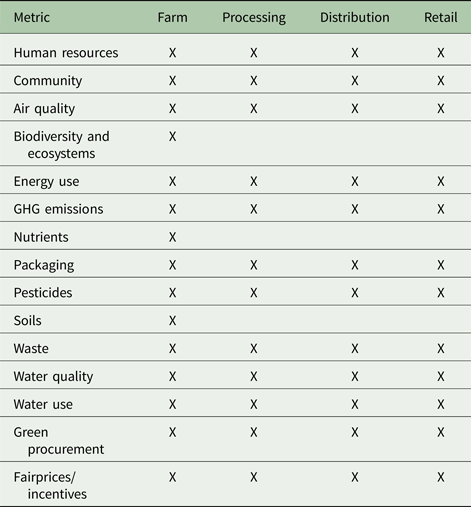
The metrics developed by Field to Market and SISC are also limited to the environmental dimensions of sustainability. While Field to Market has developed a set of preliminary quantitative economic and social metrics, they are weak indicators of social sustainability. For example, principles of social and economic sustainability often include equity, security, justice and governance (Hutchins and Sutherland, Reference Hutchins and Sutherland2008; Bostrom, Reference Bostrom2012), all of which are largely absent from Field to Market's metrics. Interviewees indicated that the initiative has spent most of its effort on the environmental metrics, and that further development of economic and social metrics has been tabled for the time being. Similarly, while there were economic and social indicators, including metrics for ‘green procurement, fair price/incentives, human resources and community’ in SISC's original plans (SISC, 2014b), none of these proposed metrics have been approved. In interviews, SISC committee members stated that they could not reach agreement on such metrics and they have been put on hold for the foreseeable future.
The standard developed by LEO-4000 differs from those of Field to Market and SISC in several significant ways. First, whereas Field to Market and SISC have developed quantitative metrics that measure performance, LEO-4000 has developed a set of practice- and performance-based metrics (as part of their standard) that outline sustainable practices and benchmarks. Thus, whereas Field to Market and SISC make no judgment as to whether specific farming practices or technologies are sustainable or not, LEO-4000 does. This is especially the case with LEO-4000's higher-tiered certifications. For example, large-scale, chemical intensive, mono-crop agriculture would not be able to meet the necessary criteria to be certified as sustainable at its highest platinum level.
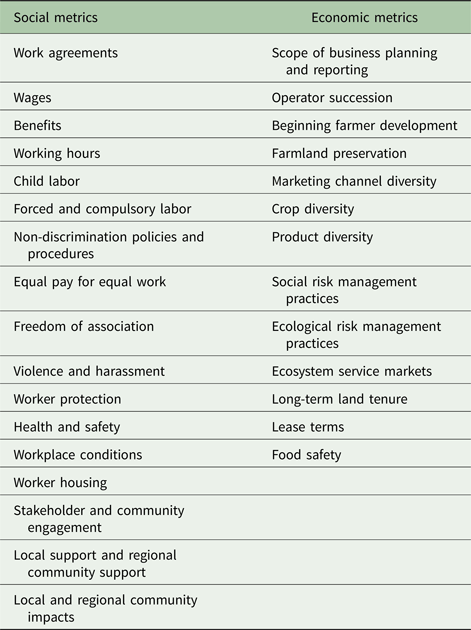
Secondly, in terms of the environmental dimensions of sustainability, the proposed LEO-4000's metrics go beyond eco-efficiency. Specifically, LEO-4000 also includes metrics for the types of inputs and farming practices used (e.g., renewable and closed-system) and biodiversity. This puts the metrics developed by LEO-4000 more in alignment with a functional integrity approach to sustainability in that they focus on not just a sufficient resource base for agriculture, but maintaining the capacity of ecological systems. Thirdly, in contrast to Field to Market and SISC, LEO-4000 has proposed a set of comprehensive and robust social and economic metrics (see Table 1). In including such metrics in its sustainability standard, LEO-4000 acknowledges that the current US agrifood system is characterized by economic and social unsustainabilities, and recognizes the interconnection between sustainable environmental and socio-economic practices in agriculture. This is congruent with a functional integrity approach to sustainability in that it stresses that sustainability is a systemic issue that needs to address environmental, social and economic systems.
LEO-4000 social and economic metrics (Leonardo Academy, 2013).

In summary, the metrics of Field to Market, SISC and LEO-4000 map out two different visions of sustainability for US agriculture. The metrics developed by both Field to Market and SISC are largely congruent with the weak sustainability approach of resource sufficiency. In each of their metrics, more efficient use of inputs, regardless of the means through which it is achieved, equals higher levels of agricultural sustainability. While Field to Market more explicitly emphasizes technological innovation, with their emphasis on eco-efficiencies, both sets of metrics promote sustainable intensification of US agriculture as the path to greater sustainability.Footnote 4 Field to Market and SISC have also not developed robust economic and social sustainability metrics to date. The result is that social and economic sustainability becomes narrowly framed as largely a question of social and economic reproduction (e.g., ensuring sufficient food to feed the population and sufficient income for farmers to stay in business). In not developing robust economic and social metrics, both initiatives exclude the linkages between political economic practices (e.g., government subsidies, trade policies, poverty, etc.), cultural views, and the effects that these have on US agriculture's environmental impacts in operationalizing sustainability.
Compared with Field to Market and SISC, the LEO-4000 standard advances a program of agricultural sustainability that is largely congruent with the strong sustainability approach of functional integrity. First, the environmental metrics in the LEO-4000 standard are focused on the maintenance and resilience of ecological systems, in addition to resource sufficiency. Specifically, in their environmental metrics, LEO-4000 acknowledges the substitutability of natural resources is limited, stresses the importance of maintaining biodiversity, and views ecological systems as having intrinsic value. LEO-4000's environmental metrics also address some of the indirect environmental impacts of agriculture. For example, their metrics specify that for farmers to be sustainable, they not only have to be efficient in their use of resources, but their inputs also need to come from sustainable sources (e.g., renewable energy). Lastly, LEO-4000 has developed metrics that address some of the socio-economic challenges associated with agriculture today.
Governance, power and sustainability
The above analysis of the metrics of Field to Market and SISC and the LEO-4000 standard indicates that there are different, and competing visions of a sustainability transition for US agriculture. One vision for US agriculture is a trajectory that is largely in alignment with a resource sufficiency approach to sustainability, while a second vision is more in alignment with a functional integrity conceptualization of sustainability. To understand why such divergent conceptualizations of sustainability are being advanced for US agriculture, as well as why a vision that is aligned with a social movement approach to sustainability is not reflected in any of the metrics or standard, we now examine the internal workings of each MSI. In particular, we examine the ways that different visions of sustainability compete with one another and how tensions between actors with different conceptualizations of sustainability are negotiated within MSIs.
Field to Market governance practices
For Field to Market there were no formal guidelines governing how committee members were selected. Interviews with committee members and organizers indicate that networks and relationships played a significant role in the selection of its committee members. Interviewees noted that while membership was technically open to anyone, the expectation was that new members are in alignment with the initiative's technology-neutral, science-based, and outcome-oriented principles. Thus, a handful of founding members set the objectives of Field to Market, which have functioned to screen potential new members. Field to Market has been able to strategically recruit and select committee members based on whether they fit with the initiative's principles. The result has been a relatively homogeneous committee in terms of how stakeholders understand sustainability.
In 2012, Field to Market's members were skewed toward lead actors in the conventional US agrifood system with 31 of the 44 members either grower associations or companies or organizations associated with the input, processing or retailing industries. Seven members were from mainstream environmental advocacy organizations, and there were no stakeholders representing labor or community development, or who were associated with alternative forms of agriculture.Footnote 5 Hence, the bulk of Field to Market's membership consisted of lead market actors in the contemporary US agrifood sector, and a handful of mainstream environmental advocacy organizations that have a history of working with industry.Footnote 6
This means that Field to Market members largely support the current structure and practices of the US agrifood system. Not surprisingly, Field to Market has developed metrics focused on eco-efficiencies, which do not challenge the market position of the input companies, grower associations, processors or retailers that are part of the initiative. The environmental organization members also tend to support a productivist approach to agricultural sustainability. For example, one committee member from a mainstream environmental organization remarked:
We're coming at [agricultural sustainability] in terms of how to achieve the levels of productivity to feed the growing population and do that in a way that's environmentally sustainable. So we're looking at what are the shifts that are economically viable for mainstream agriculture.Footnote 7
In sum, Field to Market members’ commitment to maintaining the US agrifood system has steered the initiative to a resource sufficiency approach to sustainability.
SISC governance practices
Similar to Field to Market, SISC had no formal external guidelines governing the process of soliciting members. Interviewees indicated that SISC's committee members also were selected largely based on pre-existing relationships and networks. However, SISC differs from Field to Market in that they have three membership categories and seek to balance members across these categories. The three categories are: (1) Environmental and Public Interest Groups, (2) Growers, Suppliers and Trade Associations and (3) Buyers and Trade Associations. The result is that in addition to having lead market actors, such as Walmart and Unilever, and mainstream environmental organizations, SISC also has a small number of representatives that are more closely associated with alternative agriculture, such as the Community Alliance with Family Farmers and Jacobs Farm. SISC also excludes input companies.
While SISC had membership diversity, the decision-making structure constrained the voices of minority stakeholders. A majority of each of its three membership groups (i.e., environmental and public interest groups; growers, suppliers and trade associations; and buyers and trade associations) has to support a metric in order for the metric to be approved. This means that a single membership group can block a metric, even if the majority of other membership groups agree with a potential metric. As Table 2 indicates, SISC initially proposed a robust set of metrics that included environmental, economic and social dimensions of sustainability. For example, as part of its original vision, SISC proposed metrics for ‘biodiversity and ecosystems,’ ‘fair prices’ for producers and ‘community.’ Thus, SISC's original conceptualization of sustainability clearly went beyond resource sufficiency in that its metrics also focused on the regenerative capacity of environmental and agricultural systems, which is in alignment with a functional integrity approach.
Original metrics proposed by SISC (adapted from SISC, 2014b).

However, stakeholders from conventional agriculture—who tend to support current food and agriculture practices—make up a majority of two of the three membership groups: growers, suppliers and trade associations and buyers and trade associations. Hence, such members vetoed metrics that sought to substantially change current food and agriculture practices. The result has been that SISC has developed five of the 15 metrics it originally proposed. Interviewees indicated that the initiative debated metrics for fair prices and pesticides, but they were not able to garner sufficient support from all three membership groups. As one committee member commented, what SISC has approved are metrics that largely fit with existing farming practices:
If you look at the core set of Stewardship Index metrics, what's actually being asked of growers all are variables, which if properly managed by a grower will result in lower production costs to them. In all of the metrics that would have potentially either had value-laden elements to it, or which would have potentially involved additional cost, didn't get into the final package.
Thus, while SISC began with a set of proposed metrics that had elements of both a resource sufficiency and functional integrity conceptualization of sustainability, the membership and decision-making structures of SISC have narrowed their actual metrics to ones that are congruent with a resource sufficiency conceptualization.
LEO-4000 governance practices
In contrast to Field to Market and SISC, LEO-4000's standard-development process was governed by external guidelines. As an ANSI accredited standard-development organization, the Leonardo Academy had to adhere to International Organization for Standardization (ISO) guidelines in terms of committee membership and decision-making practices. Following ISO guidelines, Leonardo Academy issued a public call for participation and selected committee members based on four stakeholder groups: (1) producers, (2) users, (3) general interests and (4) environmentalists. From over 200 applicants, Leonardo Academy selected 58 committee members distributed across the four categories. Similar to Field to Market and SISC, it included stakeholders from the conventional agrifood system, including large agribusiness companies (e.g., General Mills and Dole), farmer associations (e.g., Farm Bureau, American Soybean Association and United Fresh Produce Association, Western Growers Association), and retailers (e.g., Wegmans, Whole Foods, and Grocery Manufacturers Association). However, LEO-4000 differed from the other two MSIs in that it contained a significant number of members that were critical of the conventional agrifood system. This included stakeholders associated with organics, alternative forms of agriculture and agricultural worker organizations. Thus, LEO-4000 initially had the most diverse set of stakeholders of the three MSIs.
Given the diversity of stakeholders that made up LEO-4000's initial committee, there was also a range of understandings of agriculture and sustainability among committee members. On the one hand, there were lead market actors that were committed to maintaining the current US agrifood system and envisioned sustainability from a resource sufficiency perspective. On the other hand, stakeholders from alternative agriculture tended to think of sustainable agriculture from the perspective of functional integrity. For example, when asked what agricultural sustainability entailed, such committee members typically commented: ‘if you want to be truly sustainable you need to talk about words like diversity and biodiversity and more naturally-based systems,’ and ‘whenever you talk about sustainability it has to be based on the concept of improving the health of the soil, for real sustainability actually not just maintaining soil quality but restoring soil quality.’ There were also a number of stakeholders from alternative agriculture that held social movement positions. In interviews their social movement position was evident through comments like the following: ‘We have a broken food system,’ and ‘ultimately large-scale corporate agribusiness is inherently unsustainable.’ Hence, some committee members had strong views and critiques of the corporate control of agriculture and agricultural technologies (GMOs), and saw sustainability as a potential way to address these concerns.
Because of the heterogeneity of committee members and their different views on agricultural sustainability, the standard-development process was characterized by significant tensions and disagreements. For example, one committee member who was part of the early LEO-4000 committee meetings commented ‘it was just a mess.’ She noted that there was the camp ‘that wanted this to be more like organic plus,’ a second camp that was ‘just really trying to kill it,’ and then people like her who were in the middle. Given such significant differences among committee members, the initiative struggled to find middle ground. At the third annual committee meeting there were a series of votes on the principles of the standard in which stakeholders from conventional agriculture and those from alternative agriculture and agricultural worker organizations largely voted in blocs. Generally, the votes went against the interests of conventional agriculture by narrow margins. Following the meeting, 13 committee members from conventional agriculture resigned. In resigning, in a public letter to the Leonardo Academy they stated:
[M]ainstream agriculture has been given a decided minor voice in Leonardo Academy's process… Despite the Leonardo Academy's claim that the Committee is made up of members from ‘across all areas of agriculture,’ in reality the Committee is dominated by environmental groups, certification consultants, agro-ecology and organic farming proponents. These groups have neither the vision nor desire to speak for mainstream agriculture and the 95 percent of farmers who will be materially affected by any resulting standard (Williams et al., Reference Williams, Allan, Moore, Peterson, Thorne, Johnson, Barach, McCauley, Norman and Guenther2010; p. 1).
While some members contested this interpretation of committee membership, the resignations by conventional agriculture stakeholders clearly illustrate the significant rifts that existed among LEO-4000 members in how sustainability was understood.
Although Leonardo Academy has worked to enroll new committee members that maintain a balance of positions on agricultural sustainability, the resignation from LEO-4000 by many of its members representing conventional agricultural has shifted the committee membership of LEO-4000 from relatively balanced between stakeholders from conventional and alternative agriculture to weighted toward stakeholders from alternative agriculture, who are more critical of current food and agriculture practices. The result is a standard that reflects a critical understanding of contemporary agriculture and conceptualizes sustainability in ways that fit with the notion of strong sustainability.
Summary
This research finds that the governance processes of the MSIs and the stakeholders who get to participate influence the conceptualizations of sustainability being advanced. In the case of Field to Market, the establishment of the core principles and the strategic recruitment of members whose perspective of sustainability fit with their core principles precluded any significant clashes between different conceptualizations of sustainability. The result is a membership that is fairly homogenous, a metrics-setting process that has been relatively conflict free, and resultant metrics that are largely committed to a vision of sustainability for US agriculture that is congruent with a resource sufficiency conceptualization. While SISC began with a much more ambitious vision of sustainability that was aligned with a functional integrity perspective, its membership and voting structure resulted in a set of metrics that also fit a resource sufficiency conceptualization. Lastly, LEO-4000s governance process resulted in the most diverse committee of the three MSIs and thus, contained stakeholders with divergent understandings of sustainability. However, this generated clashes between members and the eventual reorganization of committee members. The result is a standard that not only largely fits with a functional integrity conceptualization of sustainability, but also contains an entry-level tier that does not entail significant changes from current conventional agriculture practices. The standard also does not incorporate the social movement positions of some of its members.
Conclusion
In this paper, we utilize a Thompsonian sustainability framework to assess the sustainability metrics and standard being developed by the three MSIs for US agriculture. The results of this research reveal that two divergent sustainability paths are being mapped out for the US agrifood system. On the one hand, Field to Market and SISC have developed a set of metrics that advance a program of environmental sustainability focused on increasing eco-efficiencies through intensification. As such metrics seek to make the US agrifood system more sustainable through add-on practices, they are unlikely to threaten the market position of leading agrifood corporations or the ‘hegemonic state of free markets’ (Morley et al., Reference Morley, McEntee, Marsden, Marsden and Morley2014: p. 57, see also Freidberg, Reference Freidberg2013). This approach fits with the idea of weak sustainability and is largely congruent with a resource sufficiency conceptualization of sustainability. On the other hand, LEO-4000 has developed a standard that is in alignment with a functional integrity approach to sustainability in that it emphasizes the maintenance of diverse and resilient agricultural and ecological systems. Thus, LEO-4000 has operationalized sustainability in a way that would have more transformative effects on US agriculture if fully implemented.
While this paper is focused on the metric- and standard-development process, the actual impact that metrics and standards have on the future sustainability of US agriculture will be determined by the degree to which they are adopted and implemented. As the metrics and standard are still transitioning from the development to implementation stage, full analysis of their implementation is not yet possible. However, our findings offer some preliminary indications regarding how the implementation process is likely to play out. Regardless of whether they are the proponents of conventional or alternative agriculture, interviewees stressed the importance of the market embeddedness of MSIs to the adoption of metrics and standards. For example, one interviewee commented, ‘standards are part of the marketplace like everything else. … and in the end the standard that provides the most utility in the marketplace to the range of players is going to win.’ Thus, market dynamics need to be examined when assessing the potential adoption of sustainability metrics and standards.
As there are now multiple sustainability metrics and standards for US agriculture, this means that there will be a marketplace in which farmers, processors and retailers can choose the sustainability metrics and standards that best fit with their interests. In this scenario, the metrics of Field to Market and SISC, and the LEO-4000 standard all will be adopted. However, clearly, some metrics and standards have market advantages in terms of getting implemented. The involvement of many lead market actors (e.g., retailers, agribusiness companies and grower associations) in the metrics-setting process of Field to Market and SISC indicates that their metrics are likely to have support from such actors. These lead actors can either demand or suggest that their suppliers, and in the case of grower associations their members, use these particular metrics. In contrast, following the reorganization of its membership committee, there is a dearth of lead market actors in the LEO-4000 initiative. Thus, the LEO-4000 initiative cannot rely on such market networks to facilitate the adoption of their standard. Rather, given who the members of LEO-4000 are, their standard is most likely to be adopted by actors that are part of alternative markets.
The visions of sustainability advanced by the initiatives can also affect the adoption of their metrics or standard. On the one hand, lead market actors benefit from the current structure and practices of the agrifood system, and hence, have little incentive to support significant changes. On the other hand, many farmers are also resistant to metrics and standards that require significant changes in their practices; as such changes often require additional resources and investments. This also suggests that the metrics developed by Field to Market and SISC are likely to be more widely adopted than the LEO-4000 standard.
Given the contested character of sustainability, we argue that in the near future the probable outcome of the current round of metrics and standard development will be a patchwork of agricultural sustainabilities in the USA. This patchwork will range from weak to strong and from incremental to transformative conceptualizations of sustainability. At the same time, given the market dynamics of adoption, there is a significant chance that this patchwork will be quite uneven with weak sustainability metrics and standards becoming the norm, and stronger sustainability metrics and standards relegated to the margins. In fact, this is what representatives of conventional agriculture have indicated will happen, noting that the LEO-4000 standard will be a ‘niche standard at best.’
Our analysis of MSIs raises questions regarding the transformative capacity of MSI governance. Similar to what recent research on fair trade and animal welfare (Jaffee and Howard, Reference Jaffee and Howard2010; Maciel and Bock, Reference Maciel and Bock2013; Buller and Roe, Reference Buller and Roe2014) has found, our findings indicate that MSIs are constrained by political economic dynamics in their capacity to develop transformative metrics and standards. Specifically, we find that the need for agreement in the metric- and standard-development process across a diverse set of stakeholders, and reliance on market actors to facilitate the adoption metrics and standards, function to moderate the ways that sustainability is operationalized. Perhaps this explains why Thompson's social movement vision of sustainability, which is highly critical of the contemporary agrifood system, was not codified in any of the metrics or standards. Thus, our findings suggest that incremental improvements in sustainability can be achieved using MSIs, but more transformative changes may require other forms of governance.
Acknowledgements
This research was supported by an Enhanced Research Grant from Sam Houston State University. The authors would like to thank the anonymous reviewers and the editor of Renewable Agriculture and Food Systems for their comments and feedback.