INTRODUCTION
The increasing exploitation of deep-sea resources has brought into attention the urgent need to conserve and manage the deep-sea environment (Morato et al., Reference Morato, Watson, Pitcher and Pauly2006; Davies et al., Reference Davies, Roberts and Hall-Spencer2007). Not only are most deep-water fisheries believed to be unsustainable for the exploited species itself (Sissenwine & Mace, Reference Sissenwine and Mace2007; Norse et al., Reference Norse, Brooke, Cheung, Clark, Ekeland, Froese, Gjerde, Haedrich, Heppell, Morato, Morgan, Pauly, Sumaila and Watson2012) but their impact on benthic habitats has also shown to be dramatic (Hall-Spencer et al., Reference Hall-Spencer, Allain and Fosså2002; Clark & Koslow, Reference Clark, Koslow, Pitcher, Morato, Hart, Clark, Haggan and Santos2007; Edinger et al., Reference Edinger, Baker, Devillers and Wareham2007a; Waller et al., Reference Waller, Watling, Auster and Shank2007; Clark & Rowden, Reference Clark and Rowden2009). Cold-water corals (CWC) have a worldwide distribution and can be found in a wide variety of deep-water environments such as fjords, continental shelves, island slopes and offshore seamounts (Freiwald et al., Reference Freiwald, Fosså, Grehan, Koslow and Roberts2004). They include colonial anthozoans without symbiont dinoflagellates (e.g. Scleractinia, Antipatharia and Alcyonacea) and calcareous hydrozoans (e.g. Stylasteridae) that often aggregate forming benthic habitats known as coral reefs and coral gardens (Freiwald et al., Reference Freiwald, Fosså, Grehan, Koslow and Roberts2004; Clark et al., Reference Clark, Tittensor, Rogers, Brewin, Schlander, Rowden, Stocks and Consalvey2006; Roberts et al., Reference Roberts, Wheeler and Freiwald2006; Rogers et al., Reference Rogers, Baco, Griffiths, Hart, Hall-Spencer, Pitcher, Morato, Hart, Clark, Haggan and Santos2007). Reefs are 3-dimensional structures densely built up above the bottom by stony scleractinian corals such as Lophelia pertusa or Madrepora oculata, whereas coral gardens are formed by dense aggregations of colonies that can be composed of one or more species belonging to one or more coral groups (i.e. Scleractinia, Antipatharia, Alcyonacea and Stylasteridae) (Roberts et al., Reference Roberts, Wheeler, Freiwald and Cairns2009; OSPAR, 2010).
The ecological importance of such habitats is widely recognized as both types of coral aggregations increase habitat complexity, representing biodiversity rich areas for invertebrates (Jensen & Frederiksen, Reference Jensen and Frederiksen1992; Fosså et al., Reference Fosså, Mortensen and Furevik2002; Buhl-Mortensen & Mortensen, Reference Buhl-Mortensen, Mortensen, Freiwald and Roberts2005; Le Guilloux et al., Reference Le Guilloux, Hall-Spencer, Söffker and Olu2010; Braga-Henriques et al., Reference Braga-Henriques, Carreiro-Silva, Tempera, Porteiro, Jakobsen, Jakobsen, Albuquerque and Santos2011) and support a high abundance of fish (Breeze et al., Reference Breeze, Davis, Butler and Kostylev1997; Husebø et al., Reference Husebø, Nottestand, Fosså, Furevik and Jorgensen2002; Costello et al., Reference Costello, McCrea, Freiwald, Lundälv, Jonsson, Bett, van Weering, de Haas, Roberts, Allen, Freiwald and Roberts2005; Edinger et al., Reference Edinger, Wareham and Haedrich2007b; Söffker et al., Reference Söffker, Sloman and Hall-Spencer2011). The emergence of data on the biology and life history of CWC revealed extremely slow growth rates and long life spans (e.g. Adkins et al., Reference Adkins, Henderson, Wang, O'Shea and Mokadem2004; Marschal et al., Reference Marschal, Garrabou, Harmelin and Pichon2004; Andrews et al., Reference Andrews, Cailliet, Kerr, Coale, Lundstrom, DeVogelaere, Freiwald and Roberts2005; Prouty et al., Reference Prouty, Roark, Buster and Ross2011). While some species' life expectancy is a couple of centuries (Sherwood & Edinger, Reference Sherwood and Edinger2009), others can live more than 4000 years presenting radial growth rates as low as 5 µm year−1 (Leiopathes sp.: Roark et al., Reference Roark, Guilderson, Dunbar, Fallon and Mucciarone2009). Such life history characteristics make them particularly sensitive to anthropogenic perturbations and as a result CWC have been included in the lists of vulnerable marine ecosystems (VME) (FAO, 2009), for which conservation constitutes a global priority (Morgan et al., Reference Morgan, Etnoyer, Scholz, Mertens, Powell, Freiwald and Roberts2005; Hall-Spencer et al., Reference Hall-Spencer, Tasker, Soffker, Christiansen, Rogers, Campbell and Hoydal2009; Clark et al., Reference Clark, Rowden, Schlacher, Williams, Consalvey, Stocks, Rogers, O'Hara, White, Shank and Hall-Spencer2010; Norse et al., Reference Norse, Brooke, Cheung, Clark, Ekeland, Froese, Gjerde, Haedrich, Heppell, Morato, Morgan, Pauly, Sumaila and Watson2012).
Characterizing the impact of human activities is an important step to support conservation policies as addressed by the 2006 United Nations General Assembly Resolution 61/105 on sustainable fisheries. Despite other threats, such as climate change and ocean acidification, deep-sea fisheries are the main cause of species removal and habitat destruction (Caldeira & Wickett, Reference Caldeira and Wickett2003; Freiwald et al., Reference Freiwald, Fosså, Grehan, Koslow and Roberts2004; Guinotte et al., Reference Guinotte, Orr, Cairns, Freiwald, Morgan and George2006; Roberts et al., Reference Roberts, Wheeler and Freiwald2006). The impact of bottom trawling on VMEs has been thoroughly studied (e.g. Clark & O'Driscoll, Reference Clark and O'Driscoll2003; Shester & Ayers, Reference Shester, Ayers, Freiwald and Roberts2005) and has shown to be long lasting. For example, by-catch of CWC and other sessile megafauna in New Zealand's orange roughy trawling fishery can be as high as 50 t in a single tow (Anderson & Clark, Reference Anderson and Clark2003). Seabed video of heavily trawled Lophelia reefs off western Ireland revealed entire areas of dead coral rubble with extensive trawl scars on the sediment with little sign of recovery (Hall-Spencer et al., Reference Hall-Spencer, Allain and Fosså2002; Söffker et al., Reference Söffker, Sloman and Hall-Spencer2011). It has been estimated that between 30 and 50% of the Norwegian Lophelia reefs have been damaged by trawling (Fössa et al., 2002). On the other hand, the effects of deep-sea bottom traps, drift-nets and longlines are believed to be less dramatic (Chuenpagdee et al., Reference Chuenpagdee, Morgan, Maxwell, Norse and Pauly2003) and have as yet received little attention. However, the area swept during a bottom longline fisheries operation (when the gear is being hauled up) can be comparable with that of demersal trawls and interaction with benthic organisms is believed to be quite high (Welsford & Kilpatrick, Reference Welsford and Kilpatrick2008). Furthermore, bottom longlining allows fishing on rocky grounds that are inaccessible for trawling. There is now growing concern surrounding the CWC by-catch of commercial bottom longline fishery from the Hatton Bank in the north-east Atlantic (Dúran-Muñoz et al., Reference Durán-Muñoz, Murillo, Sayago-Gil, Serrano, Laporta, Otero and Gómez2011) and from the Ross Sea (Parker & Bowden, Reference Parker and Bowden2009).
This study is an initial assessment of the level of interaction between bottom longlining and VMEs in the Azores that will provide baseline information for their conservation. The Azorean fishing industry is an interesting case study due to the type and scale of the operations (Carvalho et al., Reference Carvalho, Edwards-Jones and Isidro2011). Taking into consideration that bottom-trawling and other ‘deep water nets’ (gillnet, entangling net or trammel net) have been forbidden in the Azores since 2005 (European Commission, 2005), bottom fisheries are now limited to handlines and longlines. Moreover, there is a good and efficient communication flow and a strong collaborative work between the fishermen of this small community-based fishery with the local scientific community and the Regional Authorities (Morato et al., Reference Morato, Pitcher, Clark, Menezes, Tempera, Porteiro, Giacomello and Santos2010), allowing us to obtain relatively reliable fisheries data.
In this paper we have studied the CWC by-catch in the Azores based on data from the bottom longline fishing as well as from fishermen's local ecological knowledge. Specific aims were to provide a list of impacted coral species and to estimate their catch frequency by surveying commercial landings. We also investigated the interaction between caught species and colony morphology.
MATERIALS AND METHODS
The fishery
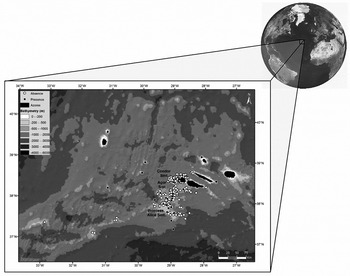
A portion of the longline fishing fleet was surveyed in Horta harbour on the island of Faial, Azores to identify the corals landed, to estimate their catch frequency and to relate the catchability with their own morphology. This multi-species fishery uses mainly small vessels (<14 m) operating on the rocky island's slopes and on seamounts down to ~600 m (Santos et al., Reference Santos, Hawkins, Monteiro, Alves and Isidro1995; Morato et al., Reference Morato, Guénette, Pitcher, Zeller, Watson, Pitcher and Pauly2001). A typical longline fishing trip lasts for 3 to 5 days, during which 2 to 4 fishing sets are completed (see details in Pinho & Menezes, Reference Pinho, Menezes and Shotton2006; Silva & Pinho, Reference Silva, Pinho, Freiwald and Roberts2007). The bottom longlines used normally have a stone/float configuration, with ~4000–7000 J-type hooks number 9 per skate mounted on 40 cm branch-lines at ~1 m intervals and baited with pieces of salted sardine. Line settings usually start before sunrise having a soak time of 2–4 hours. Fishing surveyed is concentrated mainly around the island of Faial and on the complex of seamounts to the south-west of the island (Figure 1). Surveys were conducted between March and June 2007, during commercial landings. Fishermen were asked about the fishing operation and requested to bring all coral colonies caught during their fishing trips. Of 93 fishing vessels operating in this area during that period, 39 (42%) were surveyed and 8 (21%) brought corals to the harbour. A total of 297 fishing trips were surveyed from which 45 (15.2%) landed coral specimens. However, only a small fraction of the fleet (~5 vessels) cooperated regularly. Most vessels landed cold water corals only occasionally, often keeping just the most attractive colonies (i.e. antipatharians or selected gorgonians) discarding the others at sea. Upon collection, landed coral samples were photographed and identified to the lowest taxonomic level possible, following Grasshoff Reference Grasshoff(1977, Reference Grasshoff1979, Reference Grasshoff1981, Reference Grasshoff1986), Zibrowius (Reference Zibrowius1980), Bayer (Reference Bayer1981), Zibrowius & Cairns (Reference Zibrowius and Cairns1992) and Brito & Ocaña (Reference Brito and Ocaña2004).
Location of the fishing sets covered by the present study. ●, fishing position with corals by-catch; ○, fishing position without coral by-catch reported.

Coral sampling and morphological classification
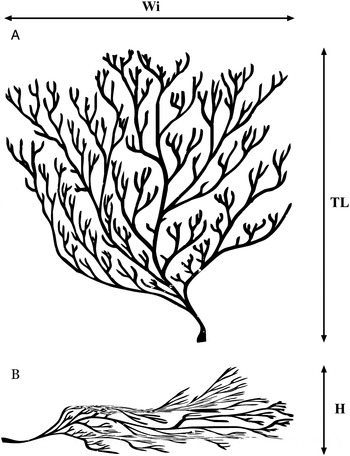
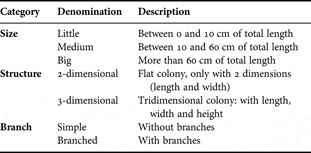
The by-catch was classified into two groups based on how the colonies were brought up to deck: (1) ‘primary by-catch’ is referred to coral colonies that were directly entangled in the fishing gear; and (2) ‘secondary by-catch' for coral colonies that were brought to deck associated with a substrate which got entangled within the fishing gear (e.g. on other corals, rocks or objects). Entire colonies of primary by-catch corals were weighed to 0.1 g and their length, width and height measured (Figure 2). Species were classified into morphological categories based on their maximum size (small, medium or large), structure (3-dimensional versus 2-dimensional) and whether branched or not (see Table 1 for classification criteria). Height determined the 3-dimensional extent of a colony (Figure 2B).
Morphometric measurements (cm) made on deep-water corals colonies sampled. (A) Total length (TL) and colony width (Wi); (B) coral height (H).

Morphological criteria adopted to classify coral colonies by size, structure and branching categories.

Local ecological knowledge
Short interviews were conducted with 16 captains (17% of the total number of captains working in Horta) in order to perceive the distribution of different taxa of corals in the study area. All the captains of the fishing vessels that collaborated frequently with the sampling were interviewed, as well as other captains that know the study area well. They were asked to recognize various coral species (using a photo catalogue for reference) and identify on a map the areas where: (1) they normally fish; and (2) they have captured most CWC. They were also asked to express their views on eventual shifts in coral abundance over their fishing career.
RESULTS
Cold-water corals landed
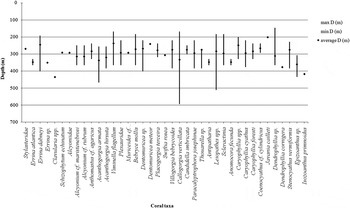
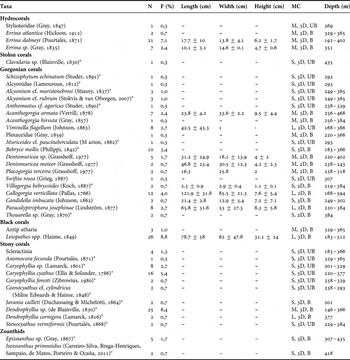
A total of 205 specimens belonging to 39 different taxa (26 to species level) were landed during this survey (Table 2). The species belonged to five different orders (Alcyonacea, Antipatharia, Scleractinia, Zoanthidea and Anthoathecata) and were caught between 146 and 594 m (Table 2; Figure 3). Gorgonians (order Alcyonacea) were the most diverse and abundant group, followed by stony corals (order Scleractinia), hydrocorals (order Anthoathecata), black corals (order Antipatharia) and finally colonial anenomes (order Zoanthidea).
Vertical distribution of corals caught during this survey (average, maximum and minimum depth in metres).

Coral taxa caught by the bottom longline fishery in the Azores (March–July 2007). Total number of colonies (N), frequency in the landings (F (%) of total surveys), mean length (cm), mean width (cm), mean height (cm), morphological classification (MC: see Table 1) and fishing depth are presented. Standard deviations of the means are also shown.

*, indicates secondary by-catch species.
Eighteen taxa were recorded as primary by-catch (directly entangled by the longline) whilst 21 taxa were classified as secondary by-catch (Table 2). Despite a lower species diversity, there were more colonies in the primary by-catch group compared to the secondary by-catch group (N = 113 versus 92). The antipatharian Leiopathes spp., the stylasterid Errina dabneyi and the gorgonian Callogorgia verticillata, were the most abundant primary by-catch species (representing 23%, 18.6% and 10.6% of the total number of colonies within the primary by-catch group, respectively). The remaining fraction of the primary by-catch group was composed of Paracalyptrophora josephinae, Viminella flagellum and Acanthogorgia armata (representing 7.1%, 7.1% and 6.2%, respectively). The most abundant taxa of the secondary by-catch group were the scleractinians Dendrophyll and Caryophyllia cyathus sp. (27.2% and 17.4% of the colonies, respectively). Caryophyllia spp. was also well represented (8.7%) as an epizoan on damaged branches of other corals (mainly Leiopathes spp.) or solitarily fixed to bottom rock crusts. Additionally fishermen often bought to deck entangled bathyal rock crusts or dead fragments of corals colonized by various species such as Alcyonium spp., Anthomasthus agaricus, Thouarella spp. and Bebryce mollis.
Most of the CWC by-catch was originated from 200 to 400 m depth (Figure 3). However, some species like Acanthogorgia armata, Callogorgia verticillata and Leiopathes spp. were caught as deep as 600 m.
Morphological classification
Most of the coral samples were complete colonies, while 28% were damaged or fragments. The morphological classification of the various taxa caught with bottom longline (Table 2) revealed a higher number of ‘small’ corals (22 out of the total 39) that comprised all the zoanthids and scleractinians but also 12 species of gorgonians (Alcyonacea). However, the number of individuals was comparable to the two other size-groups (small = 72; medium = 79; large = 54). Most of these ‘small’ taxa belonged to the secondary by-catch group whilst primary by-catch comprised mostly medium and large coral size-groups. Large corals were represented by only four taxa (3 Alcyonacea and 1 Antipatharia) while the medium size groups included 13 different taxa. Corals with a 3-dimensional morphology represented 78.5% of the specimens caught and comprised 26 taxa, covering four orders except Zoanthidea. Even though the number of taxa of branched and unbranched corals was almost similar, branched corals were much more abundant in the by-catch (72.7%). The most common combination of these three morphological characteristics was colonies being medium, 3-dimensional and branched with 33.2% of the specimens belonging to that group.
Local ecological knowledge
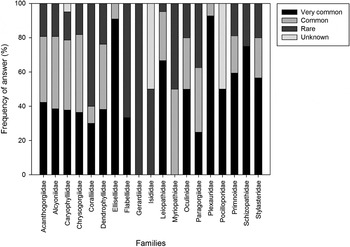
According to the local fishermen corals are commonly caught in the haul of the bottom longline fishing in most of the fished seamounts, namely in Princess Alice, Condor, Açores, Baixo de S. Mateus, Alcatraz do Norte, Ferradura, Voador and Gigante (Figure 1). Fishermen reported low occurrence of CWC by-catch in island slopes. The majority of the fishermen recognized most species in the catalogue and mentioned that colonies of the families Elliselidae, Pleuxaridae and Leiopathidae, which include V. flagellum, Dentomuricea sp., and Leiopathes spp., respectively, are frequently or very frequently caught by fishing lines (Figure 4). Species of other families like Coralliidae, Flabellidae, Parazoanthidae and Isididae were in general not recognized or reported as rarely caught. All fishermen noticed a decrease in the accidental capture of CWC over the years.
Frequency distribution of the local fishermen's answers to the question: how frequently have you caught these cold water corals?

DISCUSSION
The Azores region shows a high diversity of corals of about 150 species from 25 m down to 3250 m deep (DOP/UAz, unpublished database) when compared to other parts of the north-east Atlantic (Brito & Ocaña, Reference Brito and Ocaña2004; Hall-Spencer et al., Reference Hall-Spencer, Rogers, Davies and Foggo2007). Thirty-nine different taxa of anthozoans and hydrozoans were recorded from longline by-catch, representing 26% of currently known CWC. These taxa were by-caught at all depths surveyed in this study. The most abundant species composing the primary by-catch were the antipatharian, Leiopathes spp., the stylasterid, Errina dabneyi and the gorgonians, Callogorgia verticillata, Acanthogorgia armata, Paracalyptrophora josephinae and Viminella flagellum. Most of these species are important habitat builders in the region. However it is important to take into account that due to the selection of by-caught corals by the fishermen this may not reflect the real abundance of species by-caught in longline activities. In addition, those species have been previously reported to be important components of bathyal coral gardens as is the case of Condor seamounts (Tempera et al., 2012). They are large and complex structured colonies that are easily entangled on fishing lines. Inquiries made to the fishermen confirmed these species to be the main recognizable CWC primary by-catch and taxa in this part of the Archipelago.
The list of species also included a large number of individuals which did not get directly hooked, but, were found on rocks, crusts or dead corals brought up by the fishing gear (secondary by-catch). This group included small, solitary or colonial species but also epibionts living on other corals such as the recently described Isozoanthus primnoidus, a zoanthid parasitic to the gorgonian Callogorgia verticillata (Carreiro-Silva et al., Reference Carreiro-Silva, Braga-Henriques, Sampaio, de Matos, Porteiro and Ocaña2011). The most abundant associated species were the stony corals (order Scleractinia) represented by one small to medium size species of the genus Dendrophyllia and various species of the genus Caryophyllia. Even though they are not directly entangled in the fishing line, the settlement preference of these smaller species makes them also vulnerable to bottom longline. In the future, it will be important to carefully assess this secondary by-catch group as it may represent an important fraction of the species affected by the fishing gear.
Our results support the widespread view that CWC communities are important components of the seamount ecosystems in the Azores. So far, dense CWC gardens have only been confirmed in one seamount (Condor Terra: Tempera et al., 2012) but their occurrence on other seamounts of the region is thought to be highly likely. Seamounts are amongst the most suitable habitats for suspension feeding CWC as they are areas of strong current regimes with nutrient-rich upwelling and topographic features retaining particles and zooplankton (Genin et al., Reference Genin, Dayton, Lonsdale and Spiess1986). Scientific surveys are urgently needed and are being conducted to study the spatial distribution of CWC communities in the Azores to understand if they are overlapping with fishing activities as this will be important for conservation measures.
A consensus amongst the fishermen was that there is a decrease in the abundance of CWC in their by-catch over the years, but time-series of CWC abundance are non-existent, making such affirmation very difficult to support with robust data. However, the need for further research is emphasized in order to understand the current health status of Azorean CWC communities and for the conservation of such VMEs.
Observations of by-catch, alone, underestimates the actual level of interaction and the presented data explains only part of the phenomenon as corals getting damaged by passing gear may not be removed and retained, while others may be caught but are lost in the water column before the gear is returned to the deck of the vessel (Edinger et al., Reference Edinger, Wareham and Haedrich2007b; Heifetz et al., Reference Heifetz, Stone and Shotwell2009). Such cases are not insignificant as partial damage due to physical contact with fishing lines may be lethal, as demonstrated for shallower-water anthozoans (Bavestrello et al., Reference Bavestrello, Cerrano, Zanzi and Cattaneo-Vietti1997; Asoh et al., Reference Asoh, Yoshikawa, Kosaki and Marschall2004; Yoshikawa & Asoh Reference Yoshikawa and Asoh2004). Partially damaged colonies may also be more vulnerable to parasitism by other corals like zoanthids (Carreiro-Silva et al., Reference Carreiro-Silva, Braga-Henriques, Sampaio, de Matos, Porteiro and Ocaña2011). Such information on the unseen effects of longlines can only be obtained by complementing by-catch studies with in situ observations from remotely operated vehicle surveys (e.g. Heifetz et al., Reference Heifetz, Stone and Shotwell2009) or with cameras directly fitted onto longlines as recently developed by Kilpatrick et al. (Reference Kilpatrick, Ewing, Lamb, Welsford and Constable2011).
In conclusion, this study showed that VME organisms, particularly CWC are common by-catch components of bottom longline activities in the Azores and that the impact of this fishing gear cannot be negligible. It should be noted that some species such as the black coral Leiopathes spp., one of the most common species in this study has extremely slow growth rates and can span for thousands of years (Roark et al. 2009) and therefore has very low recovery capacity. Not only large, branched species get brought up to deck but also small, solitary corals are caught in abundance. These species are strong indicators of the presence of VMEs, thought to be important habitats for many species of invertebrates and fish alike, including some with commercial interest. More research is needed to determine the level of interaction between longline activities and those ecosystems, by coupling by-catch reports with in situ observations and spatial analysis of fishing effort and CWC distribution.
ACKNOWLEDGEMENTS
We thank all the fishermen who brought to harbour deep-water corals accidentally caught during fishing operations. Thanks are also due to Rui Rosa (landings monitoring group), Emanuel Arand (photographs), Fátima Mendes (laboratory support), Ricardo Medeiros (maps), Les Gallagher from FishPics (coral illustration), John Roddy (English verification) and to Ricardo Serrão Santos. We also thank the referees of this manuscript. The research leading to these results has received funding from the European Community's Seventh Framework Programme (FP7/2007-2013) under the CoralFISH project, grant agreement No. 213144, HERMIONE project, grant agreement No. 226354 and CORAZON (PTDC/MAR/72169/2006). The Bancomac and Censeam projects supported the reference collection of DOP/UAz (COLETA) and a deep-water coral identification workshop, respectively. Í. Sampaio was funded by an Azorean government Estagiar L grant. A. Braga-Henriques is funded by an FRCT Doctoral grant (ref. M3.1.2/F/016/2008) whilst C.K. Pham is funded by an FCT Doctoral grant (Reg. SFRH/BD/66404/2009).